
“I’m very concerned about a phenomenon called ‘concept creep’ – which has been happening to a lot of psychological terms since the 1990s”, he says. “When a word like ‘violence’ is allowed to creep so that it includes a lot of things that are not violence, then this causes a cascade of bad effects. It’s bad for the students themselves because they now perceive an idea that they dislike, or a speaker that they dislike, as having committed a much graver offence against themselves – which means that they will perceive more victimisation of themselves. And it’s also really bad for society because, as we are seeing in a spectacular way in the United States this year, when each side can point to rampant occurrences of what they see as violence by the other side, this then justifies acts of actual physical violence on their side. And there’s no obvious end to this mutual escalation process.”
He adds: “Everybody involved in education needs to be dampening down violence and the acceptance of violence. Telling students that words are violence is counterproductive to that effort.”
Jonathan Haidt, quoted by Naomi Firsht, “The Fragile Generation”, Spiked, 2017-08-31.
September 10, 2019
QotD: Mere words are not “violence”
August 29, 2019
QotD: Imagining a world made up only of women
So what would a world made up totally of women really be like? It would be tyrannical beyond belief. No one would be willing to speak against the accepted narrative unless they were willing to be unpersoned or killed. Think of a mix between 1984, the very worst social aspects of socialist regimes, and the Borg. There would be constant pushing for position, usually by starting whisper campaigns or setting someone above oneself up to be badly embarrassed. Look at the SJWs of today’s world and see how they operate. That’s what it would look like, writ large across the entire planet. They attack anyone outside the group who doesn’t comply with their demands, and if someone inside the group says a single word out of line according to the ever-shifting standards the entire group turns on them without mercy. The only way to get back in their good graces is to loudly proclaim your “sin” and accept their abuse until they get bored of you. Even afterward, you’ll forever be “tainted” with the sin of noncompliance.
When you write your books and send them out into the world, please stop writing women as soft, cuddly pacifists. We aren’t. Kipling was completely right about the female of the species being the more dangerous sex. He was also right about the price of letting women control society. If any thinking individualist finds themselves in a society run by women, may God have mercy on their souls because those women will have none at all.
“outofthedarkness”, guest posting at According to Hoyt, 2017-08-09.
August 26, 2019
QotD: Princesses
How do you spot a Princess? She’ll be keen on pampering to an extent which indicates to the casual onlooker that her natural self must be extraordinarily rank if it takes such effort and expense to keep in check. (Princesses shouldn’t be confused with Professional Beauties, most of whom retain a healthy contempt for the business of exchanging physical gifts for fiscal rewards, from Hedy Lamarr saying “Any girl can be glamorous — all you have to do is stand still and look stupid” to the catwalk models who invariably live in jeans and sneakers after shrugging off the stupid clothes which Princesses pine for.)
The Princess believes that retail therapy is the answer to everything, even though the rest of us avert our eyes from this most obvious manifestation of the essential hollowness of a life that an over-enthusiasm for clothes-shopping invariably indicates in anyone out of their teens. They’ll have long nails, ostensibly to show that they’re ladies of leisure, but signalling to the rest of us that they’re very likely parasites with low sex-drives. They like big weddings — and as a liking for big weddings often goes hand in hand with humourlessness, they often have very short marriages. They are in short practitioners of the Violet Elizabeth Bott school of feminism – less about equal rights and fulfilling one’s potential than about stamping your foot till you get what you want.
They dislike men, seeing them not as flesh-and-blood people so much as platinum-and-titanium meal-tickets, and they mistrust women, seeing them as competition. An ageing Princess is more than likely to end up lonely — and with no life of the mind to comfort her, this loneliness may make her mentally addled at a comparatively young age. Once the sheen is off her skin, the Princess has nothing that would make one seek her out; like a lot of people over-keen on spangles and glitter, they are at heart rather drab people — drains not radiators, personality-wise — who never make things happen or drive things forward but rather wait to be rescued. They tend to find themselves eternally in the passenger seat of their life’s journey, stranded on the hard shoulder with their souvenirs, waiting in vain for hunky help to arrive.
Julie Burchill, “The Princess generation needs to grow up”, The Spectator, 2017-07-18.
August 23, 2019
QotD: The ego of Salvador Dali
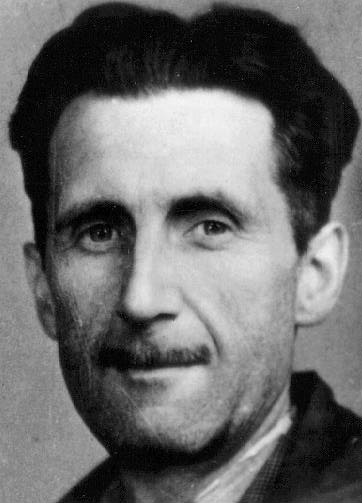
Orwell’s press card portrait, 1943
[Dali’s] aberrations are partly explicable. Perhaps they are a way of assuring himself that he is not commonplace. The two qualities that Dali unquestionably possesses are a gift for drawing and an atrocious egoism. “At seven”, he says in the first paragraph of his book, “I wanted to be Napoleon. And my ambition has been growing steadily ever since.” This is worded in a deliberately startling way, but no doubt it is substantially true. Such feelings are common enough. “I knew I was a genius”, somebody once said to me, “long before I knew what I was going to be a genius about.” And suppose that you have nothing in you except your egoism and a dexterity that goes no higher than the elbow; suppose that your real gift is for a detailed, academic, representational style of drawing, your real métier to be an illustrator of scientific textbooks. How then do you become Napoleon?
There is always one escape: into wickedness. Always do the thing that will shock and wound people. At five, throw a little boy off a bridge, strike an old doctor across the face with a whip and break his spectacles — or, at any rate, dream about doing such things. Twenty years later, gouge the eyes out of dead donkeys with a pair of scissors. Along those lines you can always feel yourself original. And after all, it pays! It is much less dangerous than crime. Making all allowance for the probable suppressions in Dali’s autobiography, it is clear that he had not had to suffer for his eccentricities as he would have done in an earlier age. He grew up into the corrupt world of the nineteen-twenties, when sophistication was immensely widespread and every European capital swarmed with aristocrats and rentiers who had given up sport and politics and taken to patronising the arts. If you threw dead donkeys at people, they threw money back. A phobia for grasshoppers — which a few decades back would merely have provoked a snigger — was now an interesting “complex” which could be profitably exploited. And when that particular world collapsed before the German Army, America was waiting. You could even top it all up with religious conversion, moving at one hop and without a shadow of repentance from the fashionable salons of Paris to Abraham’s bosom.
That, perhaps is the essential outline of Dali’s history. But why his aberrations should be the particular ones they were, and why it should be so easy to “sell” such horrors as rotting corpses to a sophisticated public — those are questions for the psychologist and the sociological critic. Marxist criticism has a short way with such phenomena as Surrealism. They are “bourgeois decadence” (much play is made with the phrases “corpse poisons” and “decaying rentiers class”), and that is that. But though this probably states a fact, it does not establish a connection. One would still like to know why Dali’s leaning was towards necrophilia (and not, say, homosexuality), and why the rentiers and the aristocrats would buy his pictures instead of hunting and making love like their grandfathers. Mere moral disapproval does not get one any further. But neither ought one to pretend, in the name of “detachment”, that such pictures as Mannequin rotting in a taxicab are morally neutral. They are diseased and disgusting, and any investigation ought to start out from that fact.
George Orwell, “Benefit of Clergy: Some Notes on Salvador Dali”, Saturday Book for 1944, 1944.
August 19, 2019
QotD: Hitler’s “wonder weapons”
Marcus Jones, “Innovation For Its Own Sake: The Type XXI U-boat”, Naval War College Review, 2014-04.
July 30, 2019
Mark Steyn: Boris Johnson is “Bertie Wooster with Jeeves’ brain”
The new British PM is quite different from anyone else inhabiting Number 10 in my lifetime, certainly:

Prime Minister Boris Johnson at his first Cabinet meeting in Downing Street, 25 July 2019.
Official photograph via Wikimedia Commons.
… unlike most media or entertainment figures who progress into politics, Boris has not abandoned his old self — for the very good reason that it’s a hit persona: The great-grandchild of Jews, Muslims and a distant cousin of the Queen, he invented himself in his teens as what his Oxford chum (and another old editor of mine) Toby Young calls a Wodehousian buffer — one might say a Drones Club character, were it not for the fact that he is not, as it happens, terribly clubbable.
It was a canny choice of shtick: It duped the left and half of the right into dismissing him as a buffoon. And, even more cleverly, chuntering his way around the country as a toff with a massive thesaurus gave him, somewhat counter-intuitively, the common touch. The famous image of him stuck on the zipline in a beanie-like helmet waving plastic Union Jacks is so ingeniously endearing one assumes he paid them to stall the thing — because a failed photo-op is way less tedious than one that goes off like clockwork.
This is the genius of the act: He’s Bertie Wooster with Jeeves’ brain. Out on the street, he’s everybody’s friend; among his actual alleged friends, he’s utterly ruthless: Within twenty-four hours of entering 10 Downing Street, he’d pulled off the bloodiest cabinet reshuffle of “modern times”, as the papers say — although actually I can’t think of a bloodier one even from non-modern times. (Only four members of the May regime were retained: Michael Gove, Amber Rudd, Baroness Evans and Matt Hancock.)
Is he a nice person? Well, he’s left an awful lot of human wreckage in his wake. Some of the women he’s used and discarded seem to me, without naming names, to be sad and profoundly damaged from their brief intersection with his wandering zipper. His latest squeeze seems likely to be moving into Number Ten without benefit of clergy – a first for the Tories and a sign of how desperate they are after years of letting all the sober, serious, earnest types turn their party into a laughingstock.
What does he believe in? Other than himself, not terribly much. About a decade ago, I was in London for a couple of days and had lunch with him and Stuart Reid at a favorite Italian restaurant. Stuart was the deputy editor who did all the hard grind at the Speccie, while Boris was the great fizzing impresario fronting the operation — a business model he transferred successfully into his mayoral regime, and will no doubt be trying again in Downing Street. He was going on the BBC’s “Question Time” that night and was worried that he didn’t have anything sufficiently arresting to say, so asked if I had any tips. I gave him a few thoughts on the passing scene, and he considered them not in terms of his own public-policy positions (if any) but in terms of attitudinal cachet. Finally, I said, “Why don’t you really stir them up and put in a word for social conservatism?”
“You mean abortion and all that? Oh, God..,” he sighed, and ordered dessert.
If that seems to be (for self-interested reasons) his most firmly drawn red line, don’t nevertheless overstate his ideological flexibility. Like Boris, Theresa May schemed and maneuvered for decades to reach the top spot … and, by the time she pulled it off, she’d spent so much time and effort on the scheming and maneuvering that she had no idea of what to do once she got there. Boris is likewise invested in himself, but, having reached the finial of Disraeli’s greasy pole, he doesn’t intend to be just the latest seat-filler. Mrs May wanted to be prime minister; Johnson wants to be a great and consequential prime minister.
On another brief pop-in from the thirteenth century, David Warren also takes note of the new British PM:
It has come to my attention that Britain has a new prime minister, BoJo the Clown (known to his friends as “Alexander Boris de Pfeffel Johnson”). I gather Mrs Maybe, previously raised to that office under some gender equality programme I suspect, didn’t work out. Mr BoJo has already been criticized for having unkempt blond hair (and small eyes, I have noticed). Too, he was educated at Oxford University, which is still somewhat élite. He was able to use the word anaphora in a sentence (here), and shares with Churchill (and Trump) an ebullience, a buoyant exuberance, that his enemies invariably discount to their cost. He is a reminder that one man (and I have named three) can change the course of history, and the fate of nations.
Not necessarily for the better, of course.
Jacob Rees-Mogg, Member of Parliament for North East Somerset, is suddenly elevated from the backbenches to the front bench; from persistent articulate rearguard rebel, to House Leader in the Mother of Parliaments; and, Lord President of the Council.
Born to rule (the son of an editor of The Times), the now right honourable gentleman stands as a throwback to 1529, when the last indigenous Catholic was appointed to that office. (Though I am not entirely clear what were the Privy Council arrangements under Good Queen Mary, before the return to Erastian apostasy under Bad Queen Bess.)
Not merely a Conservative but a member of the party’s (“Faith, Flag, and Family”) Cornerstone Group, and a diligently practising Roman Catholic with forty children or so, Rees-Mogg has already made a mark in his new rôle, by imposing rules of civility upon the Tory caucus. He was able to do so while characteristically exhibiting them, in a talk that kept everyone in stitches.
Mr BoJo, too, was christened a Catholic, though it has not so far had much effect. He has rabbinical Jewish and infidel Turk antecedents, too, and learnt Anglican hymns at Eton. He is thus a kind of one-stop shop for nominal Abrahamic associations, but to the point, the Orangemen of Ulster are already calling him “England’s first Catholic prime minister” — and what’s good enough for Belfast is good enough for me.
July 27, 2019
“[T]he more educated a Democrat is … the less he or she understands the Republican worldview”
Last week in the Guardian, Arlie Hochschild explained some of the mutual incomprehension of US Democrats and Republicans based on a recent study:
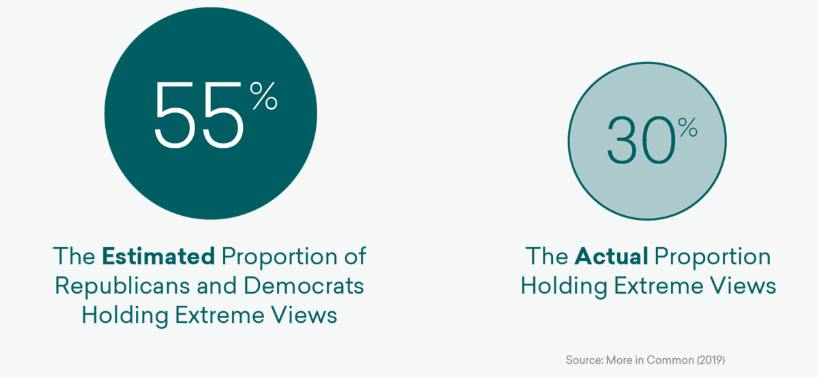
In a surprising new national survey, members of each major American political party were asked what they imagined to be the beliefs held by members of the other. The survey asked Democrats: “How many Republicans believe that racism is still a problem in America today?” Democrats guessed 50%. It’s actually 79%. The survey asked Republicans how many Democrats believe “most police are bad people”. Republicans estimated half; it’s really 15%.
The survey, published by the thinktank More in Common as part of its Hidden Tribes of America project, was based on a sample of more than 2,000 people. One of the study’s findings: the wilder a person’s guess as to what the other party is thinking, the more likely they are to also personally disparage members of the opposite party as mean, selfish or bad. Not only do the two parties diverge on a great many issues, they also disagree on what they disagree on.
This much we might guess. But what’s startling is the further finding that higher education does not improve a person’s perceptions – and sometimes even hurts it. In their survey answers, highly educated Republicans were no more accurate in their ideas about Democratic opinion than poorly educated Republicans. For Democrats, the education effect was even worse: the more educated a Democrat is, according to the study, the less he or she understands the Republican worldview.
“This effect,” the report says, “is so strong that Democrats without a high school diploma are three times more accurate than those with a postgraduate degree.” And the more politically engaged a person is, the greater the distortion.
What could be going on? Bubble-ism, the report suggests. Even more than their Republican counterparts, highly educated Democrats tend to live in exclusively Democratic enclaves. The more they report “almost all my friends hold the same political views”, the worse their guesses on what Republicans think.
So do they believe in sticking with their own? No. When asked in a Pew survey whether it’s important to live in a place “where most people share my political views”, half of conservatives and only a third of liberals agreed. Although in principle more tolerant of political diversity, highly educated – and mostly urban – Democrats live, ironically, with less of it.
Take the quiz or see more of the results here.
July 22, 2019
QotD: Vivid vacation memories
Ten days in a far-off land produces a richer treasury of detailed memories than 10 weeks back home. But what is behind this phenomenon? And does it teach us something about living a full life?
One answer comes from Claude Shannon, a titan of computer science still under-appreciated outside his field. In 1948, Shannon published one of his two profound contributions, A Mathematical Theory of Communication.
One of the implications of Shannon’s theory is that a message can be compressed to the extent that it is predictable. Anyone who has played the guessing game of Hangman knows that once a few letters are in place, the remainder are usually easy to guess. Similarly: sntnces wth vwls rmvd sty cmprhsbl. Ritualised conversations (“How are you?” “Very well, thank you. How are you?”) can be heavily compressed; poetry, perhaps, less so.
A movie can be compressed because, between cuts, each frame tends to resemble the previous one. A compression algorithm can start with the first frame after the cut and store a series of “diffs” — changes from the previous frame. The faster and more dramatic the movement or transitions, the harder a video is to compress, because the diffs are almost as big as the original frames.
Although the parallel is not exact, much the same thing seems to be going on with our memories of life. The brain is not a video recorder; we recall the gist. Sometimes the gist is very brief. If I get up in the morning at the usual time, eat my customary breakfast and catch my usual train to the office, why should my brain trouble itself to remember this day two weeks after the fact? The diffs are barely worth bothering with. In contrast, fresh experiences defy compression: the diffs are too big.
Tim Harford, “Why going on holiday gives us more memories”, Financial Times, 2019-04-26.
July 17, 2019
Andrew Scheer falls into carefully prepared media trap on “conversion therapy”
Chris Selley explains why federal Conservative leader Andrew Scheer is now being pilloried over his stance on banning so-called “conversion therapy”:

Andrew Scheer meets British Prime Minister Theresa May
Photo via Wikimedia Commons
The day before Global ran its story, CBC reported it had “obtained” a letter the feds sent to the provinces in June asking them to ramp up efforts to outlaw preposterous and potentially dangerous so-called treatments designed to turn homosexual people into heterosexual people. “The provincial, territorial, municipal and federal governments all have roles to play to protect Canadians from the harms associated with this practice,” read the letter, signed by federal Justice Minister David Lametti among others. “The federal government is committed to doing everything within its jurisdiction to combat conversion therapy” — including, supposedly, amendments to the Criminal Code.
Global took that to Scheer, who had nothing nice to say about conversion therapy: “We will always … stand up for the rights of LGBTQ individuals and protect their rights and … we’re opposed to any type of practice that would forcibly attempt to change someone’s sexual orientation.”
Asked whether he would support a “ban,” Scheer responded precisely as opposition leaders always do in the absence of legislation: “We will wait and see exactly what is being contemplated.” After all, Scheer trenchantly noted, “this is something that this Liberal government is only now recently proposing.”
This entirely reasonable position begat the above-noted headline, and the above-noted headline begat mass outrage — including among commentators who know very well how the game is played. “Why would you allow any ambiguity about where you stand?” Global radio host Charles Adler fumed on Twitter, addressing Scheer. “Why can’t you just say this so-called therapy is peddled by charlatans. It exploits vulnerable people including children. Voluntary or coercive, it’s bogus.”
Now, if you think it’s self-evident that conversion therapy ought to be illegal in Canada, and you hold anyone who doesn’t share and proselytize that opinion in contempt, then Scheer has given you your answer. But if that’s what you think, you should be just as furious with the Liberals — probably more.
Not only is the “plan for (a) conversion therapy ban” referred to in the Global headline nothing of the sort, but rather a hitherto private and suddenly, conveniently, public letter that explicitly leaves open the question of federal jurisdiction. But the letter was sent just a few weeks after the Liberals ruled out exactly what the headline would have us believe they are now proposing!
July 13, 2019
QotD: The severe spotlight deprivation (SSD) sufferer
I confronted a SSD sufferer recently. I was delivering a keynote. The questioner was not – and his ostentatiously displayed knowledge was as dated as his shiny silver suit. After, he approached me in the lunch room and stated: “It will be great to see how your career develops from here.”
I had published 17 books when he offered that comment. He had not. If I was any more developed, my breasts would occupy two time zones. But the mediocrity of SSD sufferers rarely allows facts to inform the movements of their restless tongues.
Tara Brabazon, “Fifty shades of conference feedback”, Times Higher Education, 2017-07-06.
June 30, 2019
QotD: The humble dishwasher
Dishwasher technology is already pretty good. Yes, we haggle over which things should be loaded where. And then we close the door, and some time later, open it again to find our dishes clean. It’s a miracle. Miracles are not ordinarily subject to major technical advances.
But there’s another sense in which dishwashers are too good to be made sexy, a more important one: Dishwashers do the whole job of, you know, washing dishes. There is no scope for the chef’s skill. Your refrigerator holds your culinary creations as they await unveiling; your range midwifes the moment of transformation under your careful control and with your vigilance. Even those who don’t spent a lot of time putting fabulous meals together often entertain extensive fantasies about being the sort of person who does. And express those fantasies through a $10,000 steel box.
No one fantasizes about being the sort of person who puts plates away. And because even basic dishwashers are so efficient, they kill any fantasies we might develop about buying a lavish model so that we can be known for our sparkling-clean tableware. The dishwasher offers us many hours of extra leisure, but no scope for imagination. And so after the argument is over, and the dishes are put away, it retreats to the back of our mind. It can stay there.
Megan McArdle, “A $2,000 Dishwasher Will Never Impress Me”, Bloomberg View, 2017-05-25.
June 28, 2019
QotD: “Intelligence” is just a noun
We have said that we will be drawing most heavily on data from the classical tradition. That implies that we also accept certain conclusions undergirding that tradition. To draw the strands of our perspective together and to set the stage for the rest of the book, let us set them down explicitly. Here are six conclusions regarding tests of cognitive ability, drawn from the classical tradition, that are by now beyond significant technical dispute:
- There is such a thing as a general factor of cognitive ability on which human beings differ.
- All standardized tests of academic aptitude or achievement measure this general factor to some degree, but IQ tests expressly designed for that purpose measure it most accurately.
- IQ scores match, to a first degree, whatever it is that people mean when they use the word intelligent or smart in ordinary language.
- IQ scores are stable, although not perfectly so, over much of a person’s life.
- Properly administered IQ tests are not demonstrably biased against social, economic, ethnic, or racial groups.
- Cognitive ability is substantially heritable, apparently no less than 40 percent and no more than 80 percent.
Charles Murray, “The Bell Curve Explained”, American Enterprise Institute, 2017-05-20.
June 12, 2019
Men’s mental health and the conflicting demands they face
In Psychology Today, Rob Whitley explains the paradoxical demands that men make active efforts to talk about mental health issues and to “check their privilege” and shut up:
Men, Please Talk More
Men experience elevated rates of numerous mental health issues including suicide and substance use disorder while showing low rates of mental health service utilization and a tendency to bottle-up. This has led many scholars to posit a silent crisis of men’s mental health.
Consequently, many mental health organizations and high-profile individuals are sending out an insistent message that men must talk more about their mental health.
Even royalty has endorsed this message, with HRH Prince William stating in a recent documentary that we need to “pass the message onto men everywhere that it’s okay to talk about mental health… and be able to talk about our emotions.”
Fine words indeed.
Men, Please Shut Up
However, other individuals and organizations are sending out a completely different message, namely that men as a group need to remain silent and “check their privilege.” As wryly noted by Bloomberg journalist Ramesh Ponnuru “check your privilege means shut your mouth.”
Such messages can be seen all over the Internet, with pleas for men to shut-up or stop whining. Of note, these pleas come from both men and women. These echo comments men often hear in face-to-face interactions, even from their intimates and their employers.
Indeed, such perspectives can emanate from high places, including the U.S. Senate, with Hawaii Senator Mazie Hirono recently stating, “I just want to say to the men in this country: just shut up and step up. Do the right thing for a change.” For some, male silence is a sign of moral rectitude.
This situation creates a men’s mental health double-bind. On the one hand, men are being told to talk more and open-up; on the other hand, men are being told to check their privilege and be silent. This can only create cognitive and emotional distress.
Interestingly, the men’s mental health double-bind manifests itself beyond the borders of the U.S. As such, examples from the U.K and Canada are given below to illustrate its global nature.
June 2, 2019
QotD: Explaining modern female sexuality
I have a theory that for many women, sex, or rather agreeing to have sex is difficult, and especially so for the first time with a new partner. How else to explain the fact that so many women admitted that their first time with a new man was generally experienced in an alcoholic haze? (For those who haven’t been keeping up, the source data is here.) So if confronting herself about her “slutty” behavior (even if the sluttiness is only in her own mind), a woman would like to have an excuse like “Oh, but I was drunk…” and thus can excuse away or justify the indiscretion. Or else, as the original study showed, women can even explain away the drunkenness as just a regular part of the dating process, so therefore it’s okay.
I also believe that this is why so many women have rape fantasies, because “Oh, he forced me to do it…” is likewise an expression that denies the woman’s [shameful] complicity in the act. (Of course, now that it’s become okay to accuse a previous partner with actual rape as part of the excuse, the whole thing has become considerably more sinister, especially as such accusations can take place months or years afterwards and still be considered valid by law enforcement. But for the sake of argument, let’s treat this scenario as but a blip on societal consciousness which will disappear at some point when women regain their sanity. We can only hope.) Certainly, this explains female submissiveness (outside a natural submissive personality anyway), which can be regarded (by women) as a kind of watered-down rape fantasy.
The only time, I think, when self-delusion disappears is when a woman encounters a universal object of female desire, such as a hunky actor or popular musician. Even then, there is a “safety in numbers” excuse — “OMG everybody is crazy about him!” — which makes it okay, or at least, provides a figleaf of an excuse for irresponsibility and sexual licentiousness. You only need a sliver of an excuse, and it will be acceptable, in other words.
Kim du Toit, “Seeking Excuses”, Splendid Isolation, 2017-04-24.
May 30, 2019
Fahrenheit 451 – Dystopias and Apocalypses – Extra Sci Fi
Extra Credits
Published on 28 May 2019Ray Bradbury not only cautions against censorship (the primary theme of Fahrenheit 451), but offers interesting commentary on who censors works at all, and why humans do it anyway.
Fahrenheit 451 is about many things. In Bradbury’s younger days, just coming out of the McCarthy era, he said the book was about censorship and book burning. Later in life, he said it was about the dangers of easy entertainment. Let’s analyze these viewpoints a little further.


