Quotulatiousness

January 22, 2025

“Do not give institutional power to activists” or “moral projects to bureaucrats”, but “Progressivism systematically does both”

Lorenzo Warby on the dangers of enabling totalitarians and suffering the useful idiots in any political system:

The overthrow of Robespierre in the National Convention on 27 July 1794, Max Adamo (1870),
Wikimedia Commons.

Do not give institutional power to activists, as activism — being power without responsibility that readily lauds bad behaviour — attracts manipulative “Cluster B” personalities. Moreover, activism degrades realms of human action by imposing pre-conceived outcomes and constraints on them. We can see this is in all the entertainment franchises whose internal logics of story and canon have been debauched in the service of political messaging.1

Do not give moral projects to bureaucrats, as such projects elevate the authority of the bureaucrats who become moral masters, devaluing the authority of the citizens turned into moral subjects, and so undermines any ethic of service to said citizenry. Such projects also frustrate accountability, as the grand intentions can, and will, be used to shield the bureaucrats from scrutiny. Indeed, moral projects rapidly become moralised projects, whose grand intentions protects, even aggrandise, the self-interest of the bureaucrats.2

Progressivism systematically does both — give institutional power to activists and moral projects to bureaucrats. Hence progressivism has so often proved disastrous for human flourishing. Indeed, it has a powerful tendency to use the grandeur of its moral intentions to free itself from moral constraints: to be moralised, rather than moral.

As various folk “walk away” from what left-progressivism has become, a common sentiment is some version of “this is not the Left I remember” or “this is not what the Left used to stand for”. Yet, one of the striking things about Post-Enlightenment Progressivism (aka “wokery”) within contemporary societies is how thoroughly it is replicating mechanisms of social control familiar to any student of Communism, of Marxist Party-states.

This “not the Left I joined” is typically a notion of “the Left” that does not include Lenin, Stalin, Mao, Pol Pot, Mengistu, Ceausescu … So it is an historically illiterate, “wouldn’t-it-be-nice”, Leftism. Yet it is precisely the Left that does include Lenin, Stalin, Mao, Pol Pot, Mengistu, Ceausescu and so on whose echoes are being played out in our societies.

When we look around our contemporary societies, we have commissars/political officers (aka DEI officers, intimacy consultants, sensitivity readers, bias response teams, etc); Zhdanovism, in the remarkable ideological conformism in the arts, entertainment and gaming (usefully discussed here); Lysenkoism in science journals, especially the genderwoo sex-is-non-binary nonsense, though genetics research and male-female differences also have aspects of it; and censorship that was originally paraded as stopping “hate speech”, now being purveyed as anti-dis/mis/mal-information. Critical Pedagogy — which has become influential in Education Faculties and teacher training — is explicitly about replicating Mao’s Cultural Revolution model of permanent revolution. We have the same, disastrous, patterns of institutional power to activists and moral projects to bureaucrats.


    1. There is a large difference from the “we want to be included, we want a say” activism that abolished first the slave trade and then slavery, that abolished laws against Jews and Catholics, that gave us universal male and then female suffrage — what I have called the Emancipation Sequence. Such political movements included previously excluded folk in freedoms and political processes that already existed. They did not give institutional power to activists nor moral projects to bureaucrats.

    2. The institutional shrinkage of the Church has not abolished the meaning-and-morality role it used to play, it has just shifted it into academe and the welfare state apparat, making both simultaneously more arrogant and less functional.

January 19, 2025

California’s wildfire plight

Theophilus Chilton on the end of California dreamin’:

Southern California has had a REALLY rough week. Wildfires, started by arsonists and driven by the Santa Ana winds, have burned thousands of acres in the city and county of Los Angeles and destroyed over $150 billion worth of property (and counting). As I write this, the fires still burn and largely remain uncontained, even as new blazes break out. It is a disaster of epic proportions, striking one of the richest and most economically and culturally relevant portions of the country.

Never ones to let a crisis go to waste, the Left responded to this disaster by … focusing on climate change. Not empty fire hydrants, not drained reservoirs, not incompetent leadership, but climate change. These fires, we have been breathlessly assured, are the result of ever-worsening climatic conditions in the region, drying it out and making it susceptible to this kind of affliction. Never mind that observers since Spanish times consistently noted the same kind of weather conditions and hazards that we see today, which suggests that maybe things aren’t actually changing all that much. Of course, those who are blaming climate change fail to recognise the fundamentally chaotic, nonlinear nature of the Earth’s biosphere and the interactions of its constituent parts, something governed by complexity (in the chaos/complexity theory sense of the term). As a result, it’s somewhat foolish to try to draw a direct, causal link between two variables (such as atmospheric CO2 content and temperature) which depend upon nonlinear interactions with hundreds of other factors. Thankfully, they don’t seem to be getting much traction with this.

So what did create the conditions that burned down Los Angeles?

First of all, there was the implementation of a number of policies driven by the state’s radical environmentalist lobby. Thanks to the fanatics, common sense policies that would help to mitigate the region’s inherent fire hazard went undone. Regular controlled burns of underbrush are a standard conservation technique in dry areas that help to thin out brush and prevent wildfires from getting out of control. Building a sufficient number of desalination plants is a good way for coastal desert areas to provide themselves with abundant fresh water for things like drinking, watering crops, filling reservoirs, and fighting fires. In fact, filling reservoirs for future needs would make a lot of sense. But all of these things are “unnatural” and might have “negative impacts” on local wildlife and whatnot.

Another contributory issue is the state’s policies towards the chronically homeless and its de facto sanctuary status for illegal aliens. The Reagan-era deinstitutionalisation of the homeless has been a nationwide disaster for years and California’s particular policies have made the situation in their state even worse. For decades, California has regularly seen wildfires caused by untended campfires started by homeless junkies getting out of control, which the state’s liberal approach to its indigent population has only made more prevalent. Likewise, California’s harbouring of illegal aliens has created a situation in which the state is flooded with masses of hostile foreign elements, some of whom have been caught starting fires all around the LA basin and creating the current catastrophe.

Then there is the fact that California has systematically implemented a set of DEI policies for its governmental workers, including its firefighters. As a result, the state’s leadership in the relevant departments is very good at “promoting inclusion,” but not so good at dealing competently with emergencies when they take place. Indeed, Los Angeles’ mayor Karen Bass and LAFD Chief Kristen Crowley presided over budget cuts for the city’s firefighting capabilities while adding layers of “diversity and inclusion” bureaucracy aimed at systematically de-white-maleing the department and depriving it of the demographic most prone to self-sacrifice and overall technical competence. That reflects trends across the board in which the state and the city have regularly spent more on gay choirs and social justice artwork than they have on necessary functions of government.

(more…)

January 16, 2025

The allegations against author Neil Gaiman

Filed under: Britain, Law, Media, USA — Tags: , , , , , , — Nicholas @ 04:00

I haven’t read the article in question, but it certainly looks ugly if even a few of the allegations turn out to be true:

New York magazine has just published a very long investigative piece on alleged sexual misconduct by the author Neil Gaiman, both contextualizing previously-known allegations and introducing new ones. Writer Lila Shapiro, who clearly did an awful lot of legwork, found several new women who allege various forms of bad sexual behavior against Gaiman. It’s all very serious and disturbing, obviously. I have nothing to contribute and no one cares what I think about such things, so we can leave that story there.

But I’m afraid that Shapiro’s piece does again force me to think about New York‘s story last year about Andrew Huberman. You could be forgiven for thinking “New York‘s SIMILAR story last year about Andrew Huberman,” but this would not be a correct characterization; where Gaiman is accused of many acts that, if true, rise to the level of sexual misconduct, including rape, the Huberman piece contains no such allegations. Huberman is accused of dating multiple women at the same time without the knowledge of all involved, of infidelity generally, and there’s a bizarre fixation on his regular tardiness. It is not a MeTooing piece. And the trouble, I’m afraid, is that the piece was written, edited, packaged, and promoted in a way that inevitably gave audiences the impression that such allegations were included — that Andrew Huberman had been MeToo’d.

The fact that the piece contains no allegations of that type, but seems to have been very deliberately associated by New York, its author Kerry Howley, the magazine’s social media channels, and their many media kaffeeklatsch allies with MeToo stories, was a terrible error in editorial judgment. The Gaiman story helps underline why: this shit is so serious that we can’t afford to play around with these types of narratives. The Rolling Stone University of Virginia gang rape fraternity initiation story, a narrative that fell apart under the barest scrutiny and should never have survived even an amateur journalistic investigation, did a lot of damage in our ongoing efforts to take sexual assault on campus seriously. There’s a higher bar to clear with this stuff for that reason, and the Huberman story utterly failed to clear it.

The story’s presentation in the magazine was draped with innuendo, with as many leading terms and dark implications as can be stuffed in. The image on the cover is styled and colored to make him look sinister. People associated with New York tweeted about the piece as if it was a nuclear bomb, using the kind of language that we’ve grown accustomed to when a MeToo story is published and kills a career. I would argue that the story is deliberately written in the slow-burn reveal style that is typically deployed in MeToo stories — that’s deployed, in fact, in the Gaiman story. (There it makes sense, because the slow burn leads to actual accusations.) At every opportunity, the story exaggerates the implication of a man who, yes, was a shithead to some women he dated. The article is forever presenting quotidian-if-unfortunate behaviors and acting as though we should interpret those behaviors as worthy of the kind of censure that has been brought to bear by men guilty of sexual misconduct in the MeToo era. “I experienced his rage,” says one of Huberman’s exes, suggesting some sort of domestic violence situation, when in fact that’s a reference to a verbal argument — again, maybe unfortunate, but simply not in the world of misconduct.

The magazine’s internal references to the piece, and their social media, played up the usual teasing manner of such publicity, broadly hinting at bad behavior in the realm of sex and romance. The repeated phrase used was “manipulative behavior, deceit, and numerous affairs”. I don’t need to tell you that many people, trained by six-plus years of reading about sexual misconduct, are going to assume that a vast cover story in one of the country’s biggest magazines about a man’s bad behavior and deceit towards his partners is going to be a MeToo story. As many would go on to say, the fanfare and length and publicity about the piece themselves implied that it was a MeTooing. After all, what else would justify that level of attention?

January 13, 2025

Muttering something about “manifest destiny” while glancing north

Filed under: Cancon, Media, Politics, USA — Tags: , , , , , — Nicholas @ 05:00

The Line‘s weekly dispatch is, as usual, mostly behind the paywall but the portion visible to cheapskates contains much of interest:

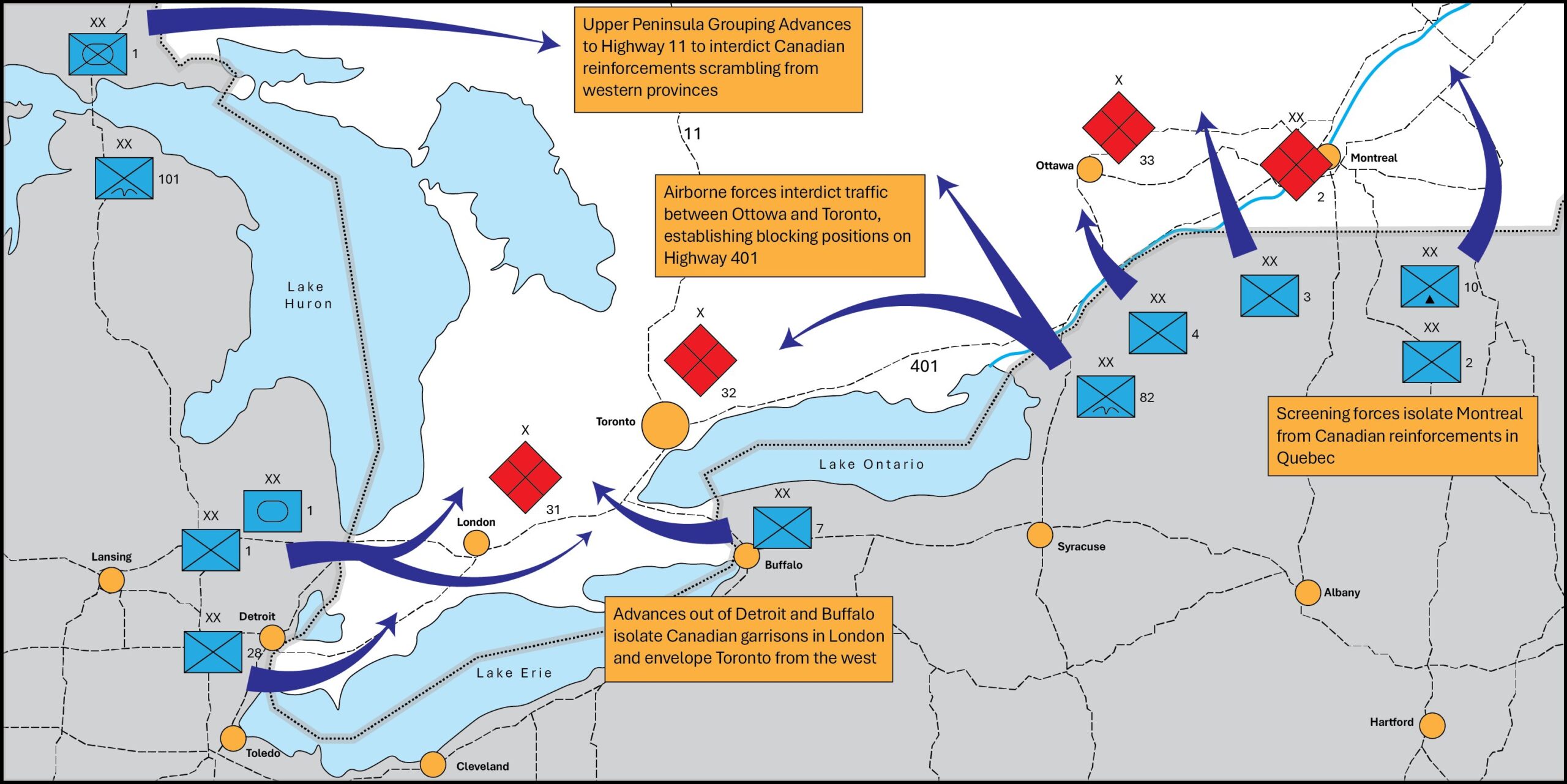
Manifest Destiny, 2025? Big Serge’s updated map for the old US War Plan Red for a military invasion of Canada.

It’s no coincidence that as Canada’s leadership devolved into its own navel, the very-soon-to-be-inaugurated Donald Trump escalated his provocations. This week, Trump threatened to use “economic force” to push Canada to bend the knee. Meanwhile, we cannot help but notice that the idea of a Canadian state is starting to gain significant traction in even moderate and mainstream American conservative circles. Meanwhile, we’ve got Alberta Premier Danielle Smith supping with Kevin O’Leary and Jordan Peterson down in Mar-a-Lago.

Tap tap. May we suggest that you peruse the safety cards tucked into the back of your seat, buckle up, and take note of your nearest emergency exits?

Whether we are talking about some kind of economic union, or a full-blown annexation, the fact that at least some in America are reviving the term “Manifest Destiny” is a possibility that we can no longer afford to dismiss as mere trolling. While we hope that the Trump administration is going to be so bogged down with other policy priorities that “Canada 51” is soon overshadowed, your Line editors have been game theorying out a host of possible scenarios and … none of them look great. If Trump et al get serious about this idea — and, again, we have no way to know if they will get serious about this idea — then we at The Line fear that Canada is in for some serious turmoil in the coming few months.

As I said in an email to Severian the other week, “… Canada will have very little ability to react to whatever Hitler, er, I mean “Trump” will do as soon as he’s inaugurated. It was clear before this that Trudeau cared very little about ordinary Canadians’ lives, but this really is dereliction of duty on a cosmic scale. If Trump does follow through with that huge tariff, the Canadian economy is likely to collapse, as we’re so deeply intertwined with the US on so many levels. Sadly, this might make it even more attractive to Trump, as it would absolutely encourager les autres on a global scale. If the BOM is willing to destroy the economy of his closest trading partner, what might he do to France? Or Germany? Or South Korea?” Back to the dispatch:

To explain our alarm, let’s first look at another news item to cross the desk. This week, Justin Trudeau travelled south to attend the funeral of Jimmy Carter, and stopped at the CNN studios for a quick interview with Jake Tapper on the way through.

On the whole, we think his interview was fine. Look, Trudeau’s been through a lot in the last few days, and considering the circumstances, it’s not reasonable to expect a breakthrough performance. So we’re being a bit unkind to nitpick, but something he said during that interview deserves scrutiny.
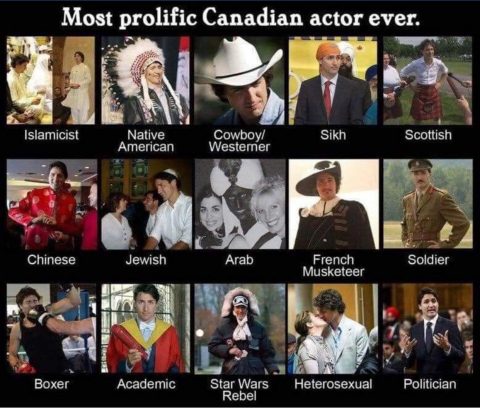
Justin Trudeau got far too comfortable with being treated as a progressive superstar, not only among the sycophants with CBC nametags but even on the international stage … perhaps especially on the international stage. Trudeau was always inclined to the performative in everything he did, and he might well only feel fully alive when cameras are rolling. The evidence certainly seems to point in that direction.

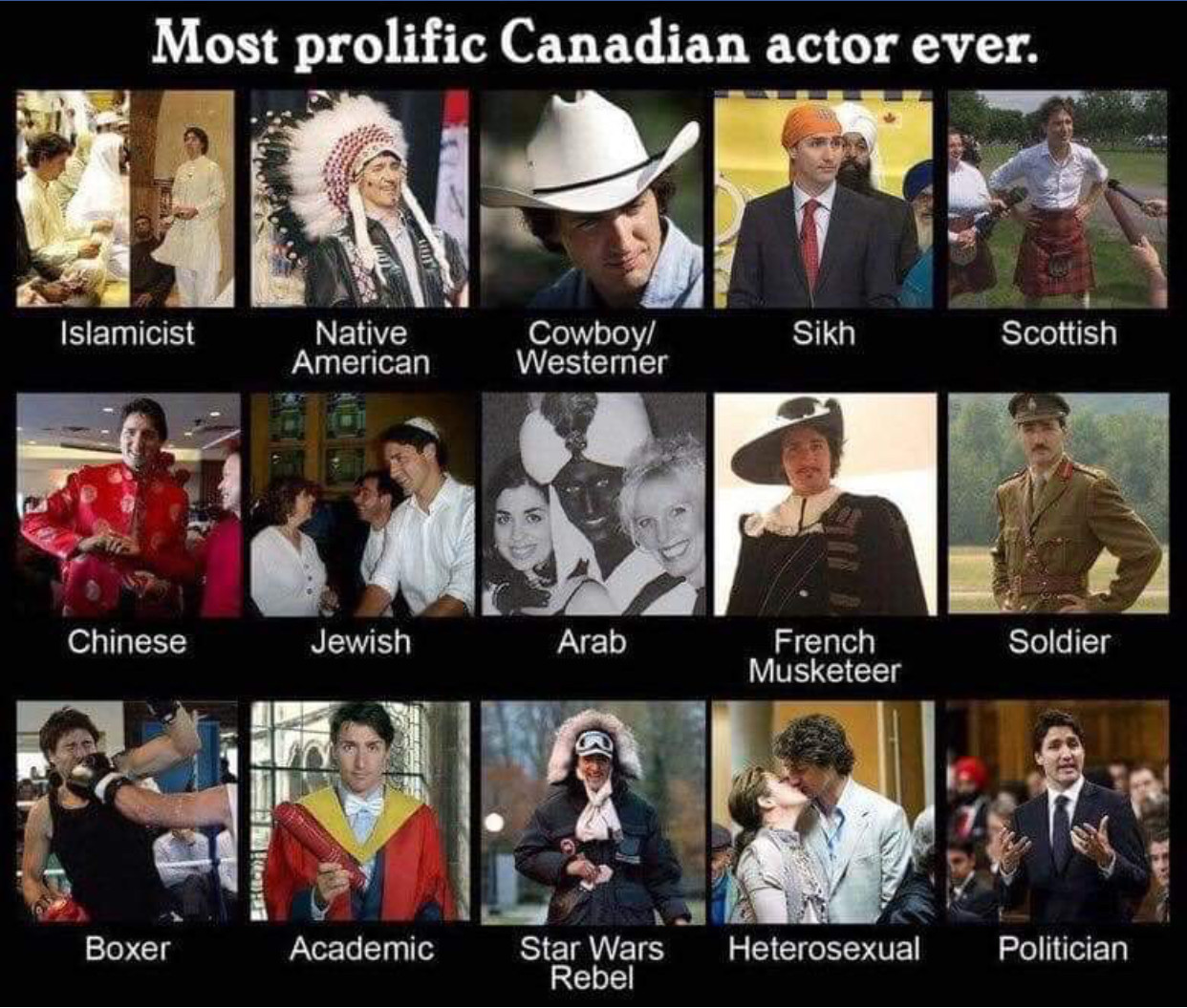
The “most prolific Canadian actor” meme was mildly amusing during Trudeau’s first term in office, as he went out of his way to put on elaborate costumes and to perform for the audience. This sort of thing was understandable if not particularly welcome to those who wanted Canada to be taken seriously by our allies and trading partners. It was clichéd to joke about what novelty socks Trudeau was wearing at any given international event … because it was his trademark. As was the clearly diminished respect he got as his time in office went on.

When asked about Trump’s provocations, Trudeau affirmed Canadians’ pride in their own sovereignty by noting — half jokingly, we presume — that we fundamentally define ourselves as “not American”.

Firstly, this is not a particularly diplomatic jibe to be launched at actual ordinary Americans; it made us wince to consider how it must have landed to CNN’s ordinary watching audience.

Secondly, if the only way in which Canadians can define themselves nowadays is “not-American”, Jeez, that’s an extraordinarily thin peg upon which to hang a hat.

This stuff matters.

It is to wince. However, even that pathetic response was better than launching into yet another diatribe about Trudeau’s firm conviction that Canadians are all genocidal white supremacist morons, I guess.

The ability of a population to withstand neighbourly aggression — “economic force”, if you will — depends on two things. The first is internal social cohesion and identity. The second is what the aggressor is willing to do or offer in order to secure capitulation.

In this case, the second part of that equation is outside our control. So we look to the first: does Canada have a strong sense of self right now? Do its leaders command the moral authority necessary to create the social cohesion required to withstand a period of sustained material sacrifice?

If we are “not Americans”, it rather asks the question why aren’t we Americans? And, more crucially, what are we actually willing to give up in order to preserve that independence?

A people can be rallied to make extraordinary sacrifices for a greater ideal, including the ideal of independent nationhood. Look at the sacrifices of blood and treasure made every day in Ukraine, for example.

If necessary, Canadians can band together and survive on lentils and supply managed dairy and eggs for many months or years. We can pull together through a period of inconceivable material hardship — but only if we’re doing it for something. Canadians, as per usual, can talk a big game, but how many of us are willing to suffer a real collapse of our quality of life to preserve a quasi-ironic, tautological, or negative self-identity?

Before Trudeau’s time in office, I wouldn’t have thought to question Canadians’ pride in their country and willingness to defend it. Nearly ten years later, Trudeau and his minions have done a fantastic job of undermining any kind of patriotic enthusiasms in our “post-national state”, haven’t they?

We at The Line don’t believe there is even a vanishingly small chance of the Americans using martial force to secure Canada — and if they choose to amass a brigade at the border on Monday morning, we’re all taking the Pledge of Allegiance by noon, so let’s not grace this fantasy with a lot of real consideration.

I’d love to refute that, but it’s probably true, at least in the more densely populated areas of southern Canada … the US could send a brigade north to Vancouver, another to Calgary, another to Winnipeg, and one to Montreal. Thanks to the lower lakes, it’d take a bit more to secure Toronto and Ottawa but not a lot more. We literally couldn’t stop them, both because our very limited troops are not positioned to stop an invasion from the south and because they’re not even close to being in a ready-to-move condition. Even our local reserves would have to be notified, travel to their local armouries, be issued weapons and the very limited amount of ammunition kept in local storage and by the time they were ready, there’s a foreign flag waving over Queen’s Park and Parliament hill.

Big Serge’s map at the top of this post vastly overstates the number of US troops necessary to secure the major population areas.

However, it is worthwhile to imagine it as a pure thought experiment: what would you really be willing to give up in order to continue to be “not-American”.

Your investment savings? Your property? Your house? Would you sacrifice the life of your child, or your grandchild, to preserve the legal independence of Canada?

We ask this question not because we think it’s going to come to that, but rather because these questions test the integrity of our national concept. They allow us to examine our resilience, and our willingness to withstand an assault of an economic or moral nature. And, folks, we’re just not convinced that our national resilience is very high at the moment.

Well, I’m sure a lot of new Canadians would want the rest of us to defend the place while they take advantage of all the government and corporate positions that need to be “diversified” … surely us evil white supremacists are willing to lay it all on the line for a more diverse society, right?

It was interesting to us to note, this week, that the most powerful moral appeal for the concept of nationhood was proposed in a Globe and Mail oped by Jean Chrétien. While we salute the old patriot, we can’t help but point out that he’s, well, very old — 91, to be precise.

We at The Line have a sneaking suspicion that Canadian patriotism and, more importantly, a willingness to make serious sacrifices to preserve that patriotism, is going to decline precipitously by age cohort in any well-constructed survey of the topic.

Would the young fight to preserve Canada against the Russians or the Chinese? Yes, we think our fellow Canadians could absolutely be called upon to make serious sacrifices to circumvent the rule of autocrats and dictators. But to prevent being subsumed by the — checks notes — wealthiest and most powerful democratic nation on earth (presuming America stays that way)? A nation that shares almost all of our essential values; one that looks and sounds just like us, and would probably provide a better set of opportunities to our kids? The place an increasing number of us are going to do start business and receive timely medical care?

Why?

Why would we do that? Can someone — anyone — please articulate a vision, here? Is anyone in our leadership class even trying?

It’s been noted many times that people are willing to charge even bare-handed into machine guns and cannons for things like “Liberté, égalité, fraternité“, but nobody is going to man the ramparts for “peace and good government”.

We put a lot of the blame for this on Justin Trudeau, and on the identitarian politics that consciously sought to undermine national legitimacy in the pursuit of progressive ends. But, if we’re being honest, we think this complacency of identity predates these social movements by many decades.

The Liberal Party as an institution owns a lot of it for the ways in which the “Natural Governing Party” has tied national identity to its preferred partisan policy options, at the direct expense of more transcendental and bi-partisan national self concepts. The Liberals have usurped “Canada” into a party brand

The national flag is effectively the Liberal Party flag … thanks Mr. Pearson!

and marshalled the very concept of “patriotism” to build consensus for picayune material entitlements. Trudeau couldn’t even help but do this in his CNN interview with Jake Tapper this week: “We delivered $10-a-day childcare. We’re delivering a dental care program that provides free dental care for people who don’t have coverage. We’re moving forward on a price on pollution that puts more money in the pockets of eight out 10 Canadians.”

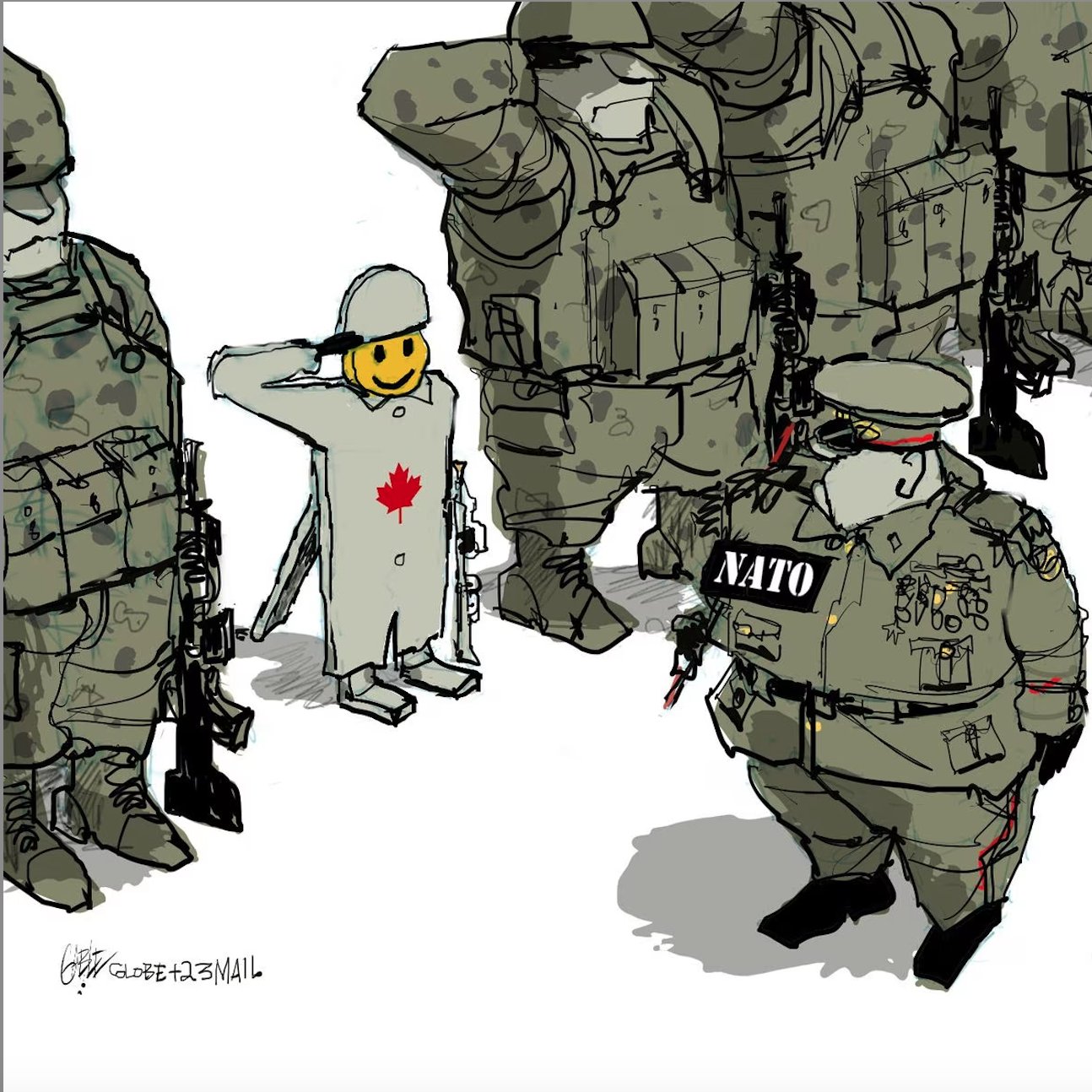
We suppose Trudeau found that argument very compelling argument to Americans marvelling at Canada’s inability to meet its basic NATO commitments.
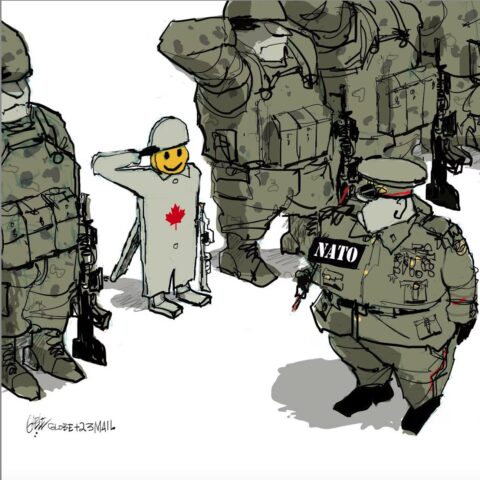
The weird thing is that Trudeau could have deflected a lot of these criticisms by our NATO allies almost painlessly without spending any more money directly on the Canadian Armed Forces“It’s well known that Justin Trudeau has no time for military issues, but it’s surprising that he hasn’t done a few things that wouldn’t increase the actual spending on the CAF, but would be “bookkeeping” changes that would shift some existing government spending into the military category, like militarizing the Canadian Coast Guard. (That is, moving the CCG from the Fisheries and Oceans portfolio into the National Defence portfolio, not actually putting armaments on CCG vessels. Something similar could be done with the RCMP, switching it from Public Safety to National Defence with no other funding or operational changes.) That Trudeau hasn’t chosen to make even these symbolic changes shows that he actively opposes fulfilling the commitment his government has made twice in the last ten years for reasons of his own.”

This tactic has been very electorally effective for the Liberals, no doubt, but it’s also reduced the idea of “Canada” to a smug transactional exchange. “Canada” as nothing more than what provinces and citizens can wheedle out of the commonweal in transfer payments, equalization cheques, and grandiose but poorly executed national program spending. At least we’re better than America, though, right? We’re “not American!” — we’re so much more thoughtful and compassionate, as evidenced by the entitlements we’ve voted for ourselves, secure in the knowledge that the troglodytes to the south will spend and bleed and die for our coddled asses if Russia lobs a missile from the North.

Canada has become a question of what we, citizens, are able to get, rather than one of what we’re willing to give. And we’re smarmy, preachy assholes about it, to boot. (There’s a very famous political quote we could drop in here about what citizens can do for their countries and vice versa, but you’ll know why we aren’t, if you can guess the quote! It would be a little on the nose.)

A nation that is unwilling to make serious sacrifices of blood and treasure to protect its own sovereignty is a nation that is going to cease to be a nation sooner or later — and if we judge Canada by its commitment to its military, ours is a nation that has regarded itself as a quasi-ironic post-modern punchline for many generations now.

January 9, 2025

Hollywood’s favourite creation … the “hero forgives” scene

Filed under: History, Media, Politics, USA — Tags: , , , , , — Nicholas @ 04:00

I’ve never been much of a moviegoer or TV-watcher, so I hadn’t consciously noticed what kulak is discussing here:

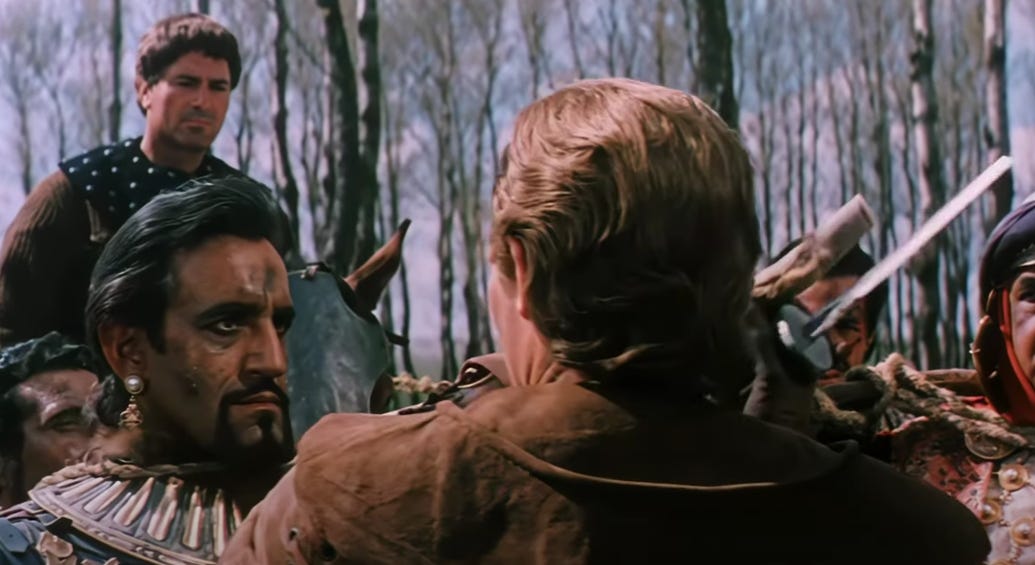
“El Cid” (Charlton Heston) releases enemy raiders who’ve just burnt down a village … for no reason.

All that it takes for evil to triumph is for good men to do nothing.”
-Edmund Burke

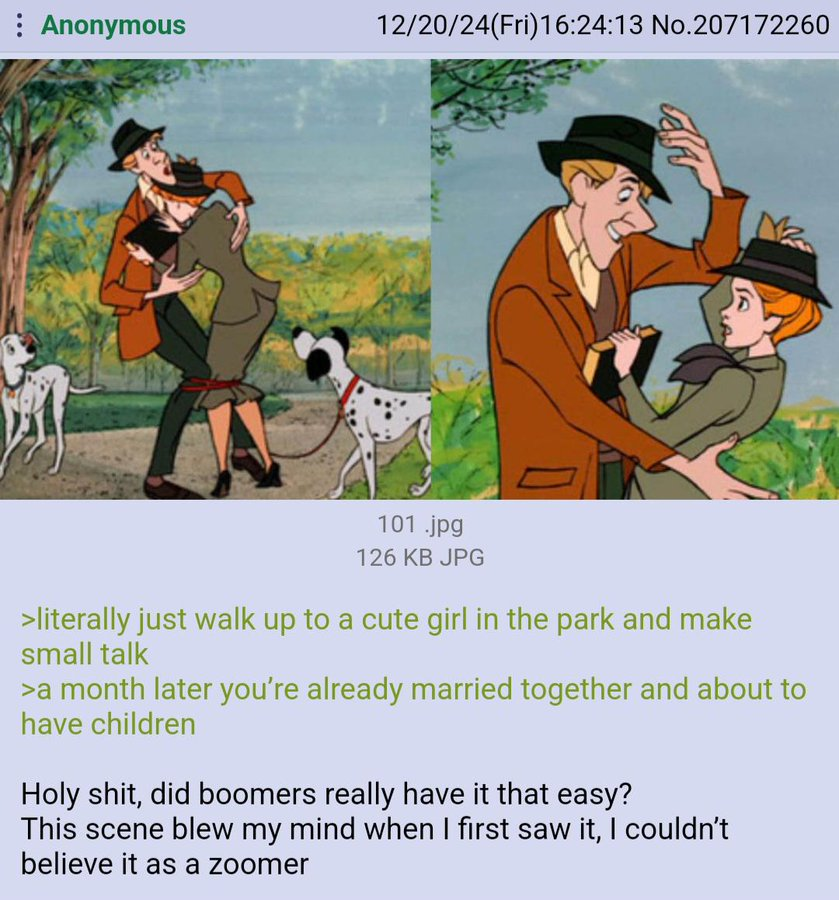
The reason the boomers are the way they are, and the reason no one in the west fights back against their dispossession and replacement is an 80 year long program to indoctrinate an Ideology I call “Hollywood Anti-justice”.

In almost every piece of media to do with violence, crime, justice, and individual heroism of the past 80 years there is a scene: The “Hero Forgives” scene.

Upon violently defeating, disarming, and capturing the villain, the hero, in spite of his every instinct, in spite of friends screaming at him and reasoning with him with arguments he can’t counter, in spite of the villains mocking unrepentance, dead to rights evidence, gleeful confessions, and even vows to reoffend.

Even if the villain is guilty of hundreds of murders, rapes, and treason, even if the hero himself has killed hundreds of henchmen to capture the villain …

The hero will refuse to kill or punish him.

Sometimes the hero will insist that he must go through the courts … Sometimes the villain will openly mock him that the courts are corrupt and will never convict him, and the hero still will refuse to take matters into his own hands …

Sometimes the hero himself IS the lawful authority. Sometimes the hero is a Military officer, post apocalyptic militia captain, Medieval Knight, Greek Hero, Roman Centurion … etc. And in fact his private judgement IS the official lawful means of passing judgement and executing obviously guilty villains … And he STILL refuses to punish or kill them.

I recently saw El Cid, where the hero, a Knight, refused to hang brigands who had pillaged, raped, burnt a town, confessed and were themselves quite resigned to dying, and even as his fellow knights berated him that the law itself demands he hang them, that it is his sacred duty to hang them, and that it would be treason for him not to…

And the Hero simply cuts their bindings and lets them go … Choosing to be forsworn as a traitor rather than hang the confessed and red-handed guilty. Now this may be a historical, but as far as I’ve been able to find such an event never occurred, it’s been made up for the film, doubly egregious because the historical El Cid almost certainly executed many criminals and brigands, committing and ordering justice … Which is NOT depicted in the film.

Even if the hero has been in this exact position before and spared the villain only for more to die, sometimes even his own family and friends, demonstrating the failure of this unspoken philosophy, the hero will STILL let them go … AGAIN.

Ussually there is some Deus Ex Machina that makes this all workout some ironic or divine punishment will find the Villain through their own folly … but not always. Indeed entire franchises have been perpetuated on THE SAME serial killer villain being forgiven, released, allowed to escape, etc. over and over again.

And audiences consistently hate this, this is always the most cliched, poorly written, out of character, film breaking scene in the entire work … Supposedly great kings, ruthless bounty-hunters, outlaws, veteran knights, military officers, grey and black market criminal anti-heroes, smugglers … All of them transformed into the most inconsistent pacifists for exactly this scene. I’ve seen audiences groan and scream at the TV “Just kill him” and yet the hero, often entirely contrary to their character, will not.

This is not an old literary trope, this is a Hollywood trope.

You can read the original Greek legends, the tales of King Arthur and his Knights, early modern nationalist heroes’ stories, the adventure stories of the Napoleonic officer, the Boys’ Own adventures of empire, and well into contemporary fiction westerns, crime stories, military science fiction, historical fiction, etc.

And in all of them you will see heroes kill their enemies in cold blood, order executions of the guilty, demand deserters, spies, and traitors be shot, seek revenge, order mass hangings … Etc.

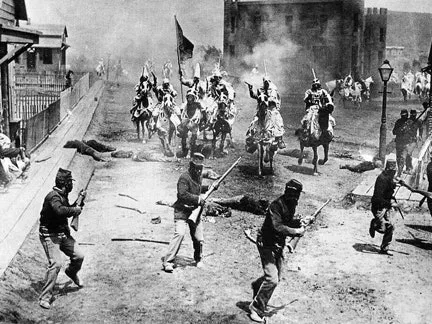
Nor is this some uniquely American madness … As late as the 1950s the vigilantes/terrorists of the original reconstruction era (1864-1877) Ku Klux Klan were treated as folk heroes… Birth of a Nation was played at the White House when it was released. The idea of vengeance, wild justice, and vigilante killings being some unconscionable moral horror was simply not the case in the first half of the 20th century … It was celebrated, much as it had been for the previous 3000 years of the west.

In 1915 the legitimacy of Vigilantism, Vengeance, and Private Justice was so accepted that even arch-progressive, Princeton University Professor, and US President Woodrow Wilson screened Birth of a Nation, a celebration of the Ku Klux Klan’s vigilante-terror campaign, at the White House.

Why did Hollywood invent this trope?

Where Hollywood producers just so attached to an idea of Christian forgiveness and pacifism that they just HAD to include it over the groans and often shouting of their audiences?

Were any of these writers, directors and producers even Christian to begin with!?

Why would the communists, atheists, Jews, and pedophiles that comprise the core of Hollywood writing include such an unusual Christian theme so insistently and often story breakingly?

Well. why do they insist on bullshit girl-bossery, race mixing, and woke theming today over the protests and disinterest of their audience?

Because it benefits them to brainwash the masses that way.

The Hollywood writers never identified with the hero refusing to kill an enemy … they identified with the villain and quite liked for him to get away (indeed many Hollywood writers will openly say as much, that they identify with the villains and much prefer writing them).

January 6, 2025

The rape gangs in Britain were enabled and protected by “good people” who didn’t want to be accused of racism

Tom at The Last Ditch confesses his early complicity with the official culture of silence that protected and encouraged the exploitation of girls and young women in Britain for decades:

Everyone who ever participated in the leftist orthodoxy of identity-politics is to blame for the near-total impunity of the Muslim rape gangs in Britain. As I reported here, when I was a young solicitor in Nottingham, a police sergeant told me I was “part of the problem.” I had a choice between believing what he told me about “honour killings” in that city or preserving my good standing as an anti-racist liberal. I chose the latter. I feared my career prospects and social standing would be jeopardised (they would have been) if I accepted his honest account. I called a good man a racist (mentally equating him with the likes of Nick Griffin and recoiling in fear from the association) when he was just horrified (as any decent human should be) by young women being murdered.

In that moment, I very much was “part of the problem” and I am profoundly ashamed of that. It is fortunate that – unlike the politicians, local councillors, social-workers and police officers who should have brought the rape gangs or the “honour” killers to justice (or prevented both phenomena altogether) – I had no occasion ever to make any real life choices on the matter. I believe – faced with actual evidence – I would have made better ones, but the way I failed the good sergeant’s test that long-ago day in the early 1980s proves I would have wanted to look the other way, just as they actually did.

I am not still playing the stupid rainbows and unicorns game of cultural moral equivalence (still less the foul Critical Race Theory game of cultural moral hierarchy) when I make the point that the young white working class girls in our cities have not been the only victims of multiculturalism. Those murdered Muslim girls who (so the sergeant told me) had paraffin poured over them and were burned to death were victims too. It was racist to refuse to consider that their Muslim dads, uncles and brothers might murder them because of their primitive religious and cultural notions. It was racist for our authorities to treat Muslim men who gang-raped white girls differently than they would have treated others. It was racist to cover up these horrors in order to protect the myth – shamefully repeated just days ago in his annual Christmas message by His Majesty the King – that multiculturalism has been an overall benefit to Britain.

Some of us have been making these points as best we can for a long time. Many of us had given up, if we’re honest. It was clear that the official narrative that we were racists and that these stories were disinformation – a “moral panic” as Wikipedia puts it – was going to prevail. Until recently the key social media market of ideas – Twitter – was controlled by the Left and attempts to raise the issue were likely to be memory-holed by their private sector woke equivalent of Orwell’s MiniTru.

Miraculously, Elon Musk – a modern Edison, with plenty to occupy him besides our concerns about free speech – bought Twitter and (in one of history’s greatest acts of philanthropy) set it free at his own personal expense. He told advertisers who sought to maintain its old Newspeak regime to “go fuck themselves.” Miraculously he got involved in the issue not just in America (where the Constitution gives him some basis for hope) but in Britain too.

My British Constitution textbook at law school illustrated the supremacy of our Parliament by jokingly saying that it could – in law – make a man into a woman. Little did its authors know that dimwit politicians would later prove the educational point of their joke by making it real. Our constitution – as a result of centuries of struggle with the monarchy, which Parliament decisively won – can be summarised in just three words – “Parliament is supreme”

January 4, 2025

More on the “Boomers and Year Zero” thing

Filed under: Food, Media, Politics, USA — Tags: , , , , , — Nicholas @ 03:00

I sent the link I posted yesterday to Severian and asked for his reaction, saying that “Eric is three years older than me, so I’m on a cultural time-delay both for that and for not being American, but I still felt he was much more right than wrong here”. Sev’s thoughts as posted at FQ in the weekly mailbag post:

The upshot is that it isn’t the Boomers’ fault — they got tricked into it by Marxists, for whatever value of “it” is foremost in your mind, every time you’re tempted to say “OK, Boomer.”

I largely agree, with the caveat that “tricked” is a bit strong. There were conscious, indeed State-directed, attempts at outright cultural subversion — Raymond cites Yuri Bezmenov, and we’re all familiar with that. But there’s a limit to how much damage that kind of thing can do. What mostly happened, I think, circles back to that “excess calories” bit, above. That’s overly reductive — it’s a springboard for discussion, not a categorical statement — but the fact is, you need a certain baseline of physical security before Chesterton’s Fence becomes a thing. Or, as Confucius (or whoever) said, “The man with an empty belly has one problem, but the man with a full belly has a thousand”.

By 1960, at least in AINO, you had a critical mass of people who had never gone to bed hungry. Ever. And so it never crossed their minds that “going to bed hungry” is a thing people have to worry about. That had profound effects, that we’re still working through. It was never the case, ever, in the entire history of mankind, that the average person didn’t have to put some thought into where his next meal was coming from.

The entire human organism — physically, mentally, culturally — is oriented around the problem of caloric supply. Again, I acknowledge that’s overly reductive, but roll with me here: Our biochemistry has been profoundly fucked up by high fructose corn syrup, for the simple reason that a teaspoon of that shit has more, and more highly bioavailable, energy than an entire feast for our Paleolithic ancestors. At the risk of looking like a fool for using an engineering, especially an automotive, metaphor with this crowd, it’s like trying to run rocket fuel through a Model T.

You cannot blame the Boomers for fumbling a situation that has never before been seen, in the history of mankind.

And it’s even hard to blame them for not getting it, even now. One’s mental habits ossify, like one’s tastes, sometime in one’s twenties. It is very, very hard to break the conditioning of a lifetime, and it gets exponentially harder the older you get. I myself thought Ace of Normies was just crazy edgy — how can that maniac say these things?!? — when I first started reading him …

… back around 2004. That’s because I was in my 30s, which means my worldview was stuck a decade earlier. Even now, all my go-to cultural touchpoints are in the 1990s — Alanis, obviously, but pretty much all of them; the 21st century might as well not exist for me, culturally, if you go just by what I’ve written here. Which means that my own worldview tends to be kinda Boomerish, thanks to that weird telescoping effect TV had on the culture. The Boomers grew up watching TV, and then they made TV, such that you can ask anyone who was there — your typical college campus in 1994 was all but indistinguishable from a “liberal” campus in 1968 (your typical college campus in 1968 would’ve had sex-segregated dorms, a whole bunch of “married student housing”, and so on).

I got over it, obviously — and just as obviously tend to go a little overboard with my getting over it — but it takes tremendous effort. As I like to say, the Red Pill is really a suppository, usually administered by jackhammer. To expect a Donald Trump (born 1946), to say nothing of a million lesser lights, to fundamentally grok that it’s not 1968 anymore, is asking an awful lot. It is what it is.

December 31, 2024

QotD: Pre-revolution Russia satirized by Dostoevsky

Filed under: Books, History, Quotations, Russia — Tags: , , , , , , — Nicholas @ 01:00

The opening of Demons tries to fool you into thinking it’s a comedy of manners about liberal, cosmopolitan Russian aristocrats in the 1840s. The vibe is that of a Jane Austen novel, but hidden within the comforting shell of a society tale, there’s something dark and spiky. Dostoevsky pokes fun at his characters in ways that translate alarming well into 2020s America. Everybody wants to #DefundTheOkhrana and free the serfs, but is terrified that the serfs might move in next door. Characters move to Brookl … I mean to St. Petersburg to start a left-wing magazine and promptly get canceled by other leftists for it. Academics endlessly posture as the #resistance to a tyrannical sovereign (who is unaware of their existence), and try to get exiled so they can cash in on that sweet exile clout. There are polycules.1

As the book unfolds, the satire gets more and more brutal. The real Dostoevsky knew this scene well — remember he spent his early years as a St. Petersburg hipster literary magazine guy himself — and he roasts it with exquisite savagery. As a friend who read the book with me put it: the men are fatuous, deluded about their importance, lazy, their liberal politics a mere extension of their narcissism. The woman are bitchy, incurious about the world except as far as it’s relevant to their status-chasing, viewing everyone and everything instrumentally. Nobody has any actual beliefs, and everybody is motivated solely by pretension and by the desire to sneer at their country.

But this is no conservative apologia for the system these people are rebelling against either, Dostoevsky’s poison pen is omnidirectional. Many right-wing satirists are good at showing us the debased preening and backbiting, like crabs in a bucket, that surplus elites fall into when there’s a vacuum of authority. But Dostoevsky admits what too many conservatives won’t, that the libs can only do this stuff because the society they despise is actually everything that they say it is: rotting from the inside, unjust, corrupt, and worst of all ridiculous. Thus he introduces representatives of the old order, like the conceited and slow-witted general who constantly misses the point and gets offended by imagined slights. Or like the governor of the podunk town where the action takes place, who instead of addressing the various looming disasters, sublimates his anxiety over them into constructing little cardboard models.2 If there’s a vacuum of authority, it’s because men like these are undeserving of it, failing to exercise it, allowing it to slip through their fingers.

All of this is very fun,3 and yet not exactly what I expect from a Dostoevsky novel. It’s a little … frivolous? Where are the agonizingly complex psychological portraits, the weighty metaphysical debates, the surreal stroboscopic fever-dreams culminating in murder, the 3am vodka-fueled conversations about damnation? Don’t worry, it’s coming, he’s just lulling you into a false sense of security. After a few hundred pages a thunderbolt falls, the book takes a screaming swerve into darkness, and you realize that the whole first third of this novel is like the scenes at the beginning of a horror movie where everybody is walking around in the daylight, acting like stuff is normal and ignoring the ever-growing threat around them.

John Psmith, “REVIEW: Demons, by Fyodor Dostoevsky”, Mr. and Mrs. Psmith’s Bookshelf, 2023-07-17.


    1. In an incredible bit of translation-enabled nominative determinism, the main cuckold is a character named Virginsky. I kept waiting for a “Chadsky” to show up, but alas he never did.

    2. Look, the fact that he’s sitting there painting minis while the world burns makes the guy undeniably relatable. If you transported him to the present day he would obviously be an autistic gamer, and some of my best friends, etc., etc. Nevertheless, though, he should not be the governor.

    3. For some reason, there are people who are surprised that Demons is funny. I don’t know why they’re surprised, Dostoevsky is frequently funny. The Brothers Karamazov is hilarious!

December 23, 2024

Mark Steyn – “…the German state’s message to voters is: It’s all your fault and nothing’s gonna change”

Filed under: Germany, Media, Politics — Tags: , , , , — Nicholas @ 05:00

At SteynOnline, Mark discusses the media reactions to the terror attack on the Christmas market in Magdeburg:

Say what you like about Germany but their crack police investigators are second to none:

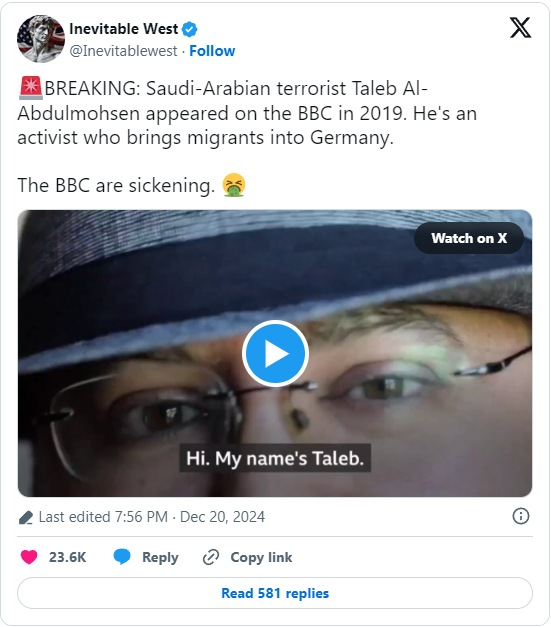
    Prosecutor Horst Walter Nopens said on Saturday that the investigation was ongoing but suggested one potential motive for the attack “could have been disgruntlement with the way Saudi Arabian refugees are treated in Germany“.

Gotcha. So, two months before the federal election, the German state’s message to voters is: It’s all your fault and nothing’s gonna change. Nothing against the nine-year-old boy who’s dead or the four ladies – aged 75, 67, 52 and 45 – but that’s just the way it is. There will be a few empty chairs at the Christmas table, but diversity is our strength and a well-integrated psychiatrist driving a BMW is just the kind of high-skilled newcomer Mutti Merkel promised us. He could have gone to Canada or Ireland. To modify George W Bush, we need immigrants to do the jobs that Germans won’t do … like, er, psychiatry.

Are they putting this kind of bollocks in the Covid boosters? Not so long ago the most famous terrorist killer on the planet was a high-value German immigrant. At least a few readers I’ve had occasional email exchanges with over the decades may recall him flying through the window of their office building on a Tuesday morning in September: Mohammed Atta, the man who pulled off what they used to call “the day the world changed” … and a postgraduate student of the Hamburg Institute of Technology.

If you’ve been enjoying the expert class’s bewilderment at the citizenship and professional status of the perp, well, way back when, the grandparents of the current crop of media experts were all over the airwaves explaining why the real threat came from well-travelled middle-class westernised Muslims and that Mr Atta had become “radicalised” when he moved to Hamburg.

It certainly was “the day the world changed” — if by “changed” you mean accelerated Islamic migration to the west: Twenty years ago there were half-a-million Muslims in Canada; now there are two million. As to the “disgruntlement” of Saudis at the way they’re treated in the west, seventeen of Mohammed Atta’s accomplices were Saudi nationals who’d been admitted to flight school in America, where they told their instructors that they didn’t need to do the bit about learning how to land. Which raised not an eyebrow. To channel P G Wodehouse, few people have so much cause to be gruntled.

By the way, how did Mr Atta wind up at the Hamburg University of Technology? Because a nice tourist couple from Germany were visiting Cairo and, at a restaurant one night, struck up a conversation with Mohammed’s dad and said they ran an exchange programme for foreign students back in der Vaterland and would Mo like to come and live with them. Aw, that’s heart-warming. And, despite the three thousand deaths directly arising from that virtue-signalling, I’m sure they’d do it all over again.

In other words, this is where we came in: all the elements the cable experts profess to find “puzzling” we knew back on Day One of the soi-disant “War on Terror”. Even the allegedly newest wrinkle is not new:

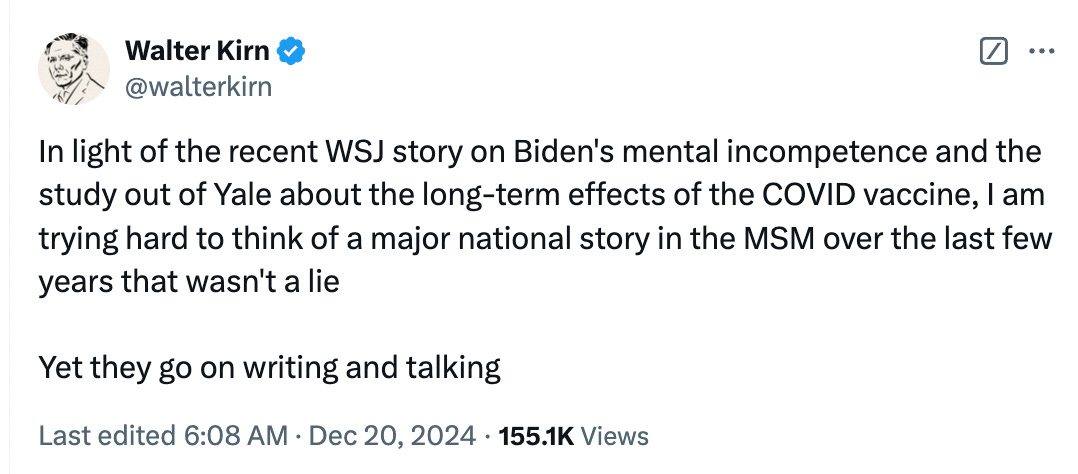
“I am trying hard to think of a major national story in the MSM over the last few years that wasn’t a lie”

Filed under: Media, Politics, USA — Tags: , , , — Nicholas @ 04:00

Chris Bray with a link-filled post about the modern malaise of western society:

We’re getting there. We can all see it, especially as it gets ready to die.

But a more and more widely shared diagnosis is still producing explanations that don’t quite fit together. Take some time over the holidays, or just over this weekend, to read two remarkable new essays that offer different explanations for the same sickness:

At Tablet, David Samuels describes the creation of a messaging system designed to advance untruth and herd people into compliance — and he discusses “Obama’s role in directing the entire system from above”. In this telling, the system of social manipulation is a party instrument. Democrats did it.

At the same time, on his Substack page, Lorenzo Warby has just posted a deeply argued essay concluding that “we in the West do not live in Party-States. We increasingly live in activist-network states.” In this formulation, our descent into a societal atmosphere of enforced untruth is distributed, not centralized — through “networks and (interactive) signalling”.

What you’ll find striking about these two essays is how much they overlap in description while offering different explanations. We live in an atmosphere of dishonesty and manipulation — an age of psychic warfare — but we’re not quite sure who to blame for it.

However it works, whatever force or system or personality is driving, the social illness caused by the cultural compliance exercise has been obvious for years. Samuels: “The effect of the permission structure machine is to instill and maintain obedience to voices coming from outside yourself, regardless of the obvious gaps in logic and functioning that they create. The clinical term for this state is schizophrenia.”

An argument against Obama did it is that the “it” is global, and more obviously horrible in Australia, New Zealand, Canada, and the UK, and nearing its grotesque apogee in Germany. The pandemic-era narrative enforcement efforts of people like Daniel Andrews, Jacinda Ardern, and Canadian Prime Minister Derek Zoolander surely make American commissars swoon with jealousy. Another argument against the claim that Obama created a new compliance system is the behavior of Václav Havel’s greengrocer, which suggests the use of new media tools for an old job.

An argument against socially guided networks that aren’t top-down party-state systems is the astonishing degree to which the US government is now known to have weaponized the corporate-state coordination of narrative control.

Trump’s second term – “The counterrevolution begins now”

A few weeks back in City Journal, Christopher Rufo provided a blueprint for President-elect Donald Trump’s second term with emphasis on “dewokification” of the executive branch:

The second election of Donald Trump, along with Republican victories in both houses of Congress, sets the stage in the United States for a confrontation between democracy, which depends on representative institutions to form a government, and the rule of unelected elites, which relies on claims of expertise to control the state.

Already, internal opposition to Trump is organizing within the federal agencies. CNN reports that Pentagon officials are discussing disobeying official policy. Federal Reserve Chairman Jerome Powell has declared that he would refuse if Trump asked for his resignation. Some would like to see a reprise of the orchestrated counteractions against Trump, from the Russia collusion hoax to the Hunter Biden laptop censorship to the political prosecutions that led to his arrest and felony convictions.

The coming political confrontation is unusual because the specific antagonist is hard to identify. Trump is not contending against Joe Biden or Kamala Harris, or even the Democratic minority in Congress. Instead, the president-elect’s post-electoral opposition comes from inside the executive branch itself, in defiance of Article II of the Constitution, which opens with the unqualified statement: “The executive Power shall be vested in a President of the United States of America”.

In recent years, phrases like “the deep state” have arisen in American political discourse to describe this phenomenon, in which administrators, bureaucrats, and unelected officials seem to wield a kind of power that we still lack appropriate language to describe. Part of the motivation is self-interest — bureaucrats want to protect their positions — but another is ideological: the federal government is steeped in left-wing race and gender ideology, and its adherents see Trump as an existential threat.

By rights, he should be. The incoming president has, under the Constitution, every right to bend the administration to his vision, which is contrary to the tenets of left-wing racialism. But those ideologies, which the Biden administration has entrenched through its “whole-of-government” diversity agenda, have long ruled the agencies that control the details of federal policymaking. Hence, the conflict: the president, who has formal authority, versus the ideological bureaucracy, which has real power.

At the end of his first term, Trump attempted to correct this problem through actions such as an executive order banning critical race theory in the federal government. The second Trump administration must go further and dedicate itself to a process that Vice President–elect J. D. Vance has described as “dewokeification”. This is the most urgent policy problem facing the administration, because without representative institutions and a restoration of constitutional authority, it is not possible to govern America.

The Trump administration has a unique opportunity to take decisive action on Day One, through executive orders that can serve as the opening salvo in a counterrevolution. The basic premise: the U.S. should strip left-wing racialism from the federal government and recommit the country to the principle of color-blind equality. Through an aggressive campaign, Trump and his cabinet can put an end to forms of discrimination disguised under the name of “diversity, equity, and inclusion” (DEI) and make government work again.

The process of ideological capture has taken decades. But the counterrevolution can, and must, quickly retake those institutions in the name of the people and reorient them toward the enduring principles of liberty and equality. Bureaucrats abusing the public trust to advance their own ideologies should be put on notice: they will be shut down, their departments abolished, and their employment terminated. The administration will work to rid America of this ideological corruption before it further rots our institutions, demoralizes our citizens, and renders the government totally incompetent.

The counterrevolution begins now.

December 21, 2024

The Canadian Armed Forces are doing great on diversity … but not much else

Filed under: Cancon, Media, Military, Politics — Tags: , , , — Nicholas @ 03:00

In the National Post, Tristin Hopper reports on the amazing progress in anti-racist activism, diversity, equity, inclusion and — for all I know — drag queen story times in the officers’ messes but too bad about all the other stuff, eh?

A new report finds that while the Department of Defence is making steady progress on all its new “equity and diversity” goals, morale is plummeting and the Canadian military has reached new lows in terms of its ability to actually deploy forces.

For the first time, more than half of Canada’s naval and air fleets were marked as being unfit to “meet training and readiness requirements”, according to the military’s latest Departmental Results Report, published Tuesday.

Only 45.7 per cent of Royal Canadian Navy ships are fit to be used for “training and operations”, and the same is true for just 48.9 per cent of RCAF “aerospace fleets”.

And the figures weren’t much better in the army. The report wrote that the serviceability of Canadian Army equipment remained in a “persistent downward trend”, with army personnel forced to rely on “aging and increasingly obsolete fleets”.

One example was the BV 206, a tracked snow carrier that is ostensibly the main form of transportation at the Nunavut-based Arctic Training Centre. The vehicle now has an incredible 80 per cent failure rate, with the report saying that it can’t be safely used for “essential” tasks.

Morale is also hitting new lows. In a survey, just 30.4 per cent of military personnel said that the armed forces provide a “reasonable quality of life” — that’s far less than the official target of 85 per cent.

And among full-time personnel, just 53.5 per cent said they felt “positive” about their job.

Some of the few figures in the document that weren’t in decline were in the realm of “equity and diversity”.

The Canadian Armed Forces slightly increased the share of personnel who “self-identify as a visible minority” (from 11.1 per cent in 2023 to 12.2 per cent in 2024).

There was also a moderate uptick in the number of civilian employees “who self-identify as a woman” (from 42.4 to 43 per cent).

The report boasted of a new system of military promotions that does not “disadvantage the intersections of diverse groups of women, men and non-binary people”.

It also announced that “Gender Advisors” were now being routinely deployed on overseas operations, including on Operation Unifier, Canada’s mission to provide combat training to Ukrainian soldiers engaged in their ongoing war with Russia. “The Task Force Gender Advisor was involved in all aspects of this training mission”, it read.

December 15, 2024

QotD: Elite luxury beliefs – cultivated non-disgust

Filed under: Cancon, Europe, Media, Politics, Quotations, USA — Tags: , , , , , — Nicholas @ 01:00

Then there is the acceptance of what can only be described as unconventional lifestyles. Gay rainbow gender-bending madness is one thing. It seems progressive. Sodomites used to get ten years of hard labour. Look how advanced we have become.

But now they’ve moved on to the kids. It is easy to believe a listless, drug-addled elite might indulge in sexual degeneracy just for the hell of it. But how do we explain kindergarten teachers teaching their pupils about pronouns? Doctors emotionally blackmailing parents by insisting that the alternative to mutilating their children is their suicides? Or civil servants quietly putting gender-neutral bathrooms in public spaces?

How do we explain any of this? How do we even explain the emergence of transgenderism at all? There have been transexuals and gender dysphorics throughout history. They were typically understood as an offshoot of homosexuality, the extreme end of the effeminacy spectrum, and a vanishingly small fraction of the population.

But the current contagion is unusual and is clearly artificial. Its scale can only be a result of active promotion. Much of that is accomplished via the media and fellow travellers who champion these activities. But it is helped along by a collection of other professionals, and any attempt to question it is met with energetic pushback.

It is apparent that much of this comes from on-high, a literal top-down initiative. In less than twenty years we have witnessed a journey that began with gay rights and now includes active promotion of sexual deviancy to children, none of it natural or wanted by the majority. There is lots of speculation as to why this may be, including the part it may play in a comprehensive depopulation agenda.

What is apparent is that the professional class who endorse and promote this perceive it as an exercise in tolerance.

The notion of tolerance has typically been invoked for the distasteful, a last line of defence when direct measures fail, not a behavioural response indicating sophistication.

We rely on tolerance for things we dislike but cannot avoid. We learn to tolerate a persistent whine from an air conditioning unit, a noisy neighbour, or a noxious smell. But our goal is always to remove the source of the problem. Tolerance is a stopgap only when more permanent solutions are absent.

Their belief that tolerance is a virtue is one of the greatest shortcomings of today’s chattering classes. It is exactly the kind of signal error that exemplifies the disconnect between globalist elites and their obedient cheerleaders. The mechanism here seems to be a kind of learned override to natural disgust or discomfort. When others then object to whatever letter they have just added to the LGBTQWERTY+ community on the basis that it can’t be healthy or normal to endorse this stuff, that learned response includes the flare of superiority at your obvious backwardness.

How satisfying it must feel to have your natural inclination toward superiority endorsed in this way. Like whole food vegans at a Medieval banquet, it must provide an irresistible sense of smugness to know that you are the one-eyed man in the rainbow-decked land of the blind, with the uneducated hopelessly lost in their backward understanding of the benefits of sexual liberation.

While elites and their public relations machine happily endorse this misplaced emphasis on tolerance, all evidence suggests the elites themselves are not tolerating anything, despite what their obedient minions may think. They really are indulging in the cocaine-fuelled all-star human sacrifice orgies for real because they are cosmically bored and rich.

They aren’t rising above intrinsic disgust responses, they have sexualized them. They seem to have fetishized everything we consider unacceptable. Trafficked kids, femboys, chicks with dicks, gangbangs, farmyard orgies, human sacrifice, the lot.

They may even experience a thrill in seeing just how far they can push public morality as many have suggested, and especially how far they can get otherwise normal middle-class people to champion deviancy and hedonism most cultures find distasteful enough to ban.

The excessive promotion of tolerance is a defence against unnatural practices bored elites are rumoured to engage in. The professional class, for all their faults, probably aren’t into human sacrifice or animal orgies. So their response is to elevate the importance of visible acceptance of alternative lifestyles, hence gay kids, castrated boys, invented genders and other absurdities they cannot possibly believe themselves, and all of it instantly conveyed to one’s peers with nothing more than a multicoloured flag.

To top it all when they see how normals react, those unmoved by inept calls to be more understanding about sexual abuse, when they see parents reach for the shotgun at the very idea of sexually mutilating children, they get to invoke the conjoined twin of their cultivated tolerance, namely artificial superiority. The deep belief that they see further than the yokels with their primitive instinct to actually protect the vulnerable and embrace some basic sense of public morality.

These absurd beliefs can be observed in our educated classes because they ostentatiously demonstrate tolerance and its newfound position as the supreme virtue of the post-Christian age, one of the most successful public relations campaigns ever run by elites.

Spaceman Spiff (guest-post) “Praying to Absent Gods”, Postcards from Barsoom, 2024-07-16.

December 9, 2024

“… liberalism has become a political ideology that is utterly incapable of policing itself for its own worst excesses”

Filed under: Media, Politics, USA — Tags: , , , , , — Nicholas @ 03:00

Freddie deBoer patiently explains why outrageous over-the-top emoting isn’t a useful or productive way to argue for your political views:

I’ve written several times about the phenomenon of adolescent women on TikTok pretending to have dissociative identity disorder for social media clout and attention. I’ve focused on it not because I necessarily think the issue itself is particularly important, but rather because it’s so emblematic of what liberalism has become: a political ideology that is utterly incapable of policing itself for its own worst excesses, a collection of well-intentioned people who mistake the responsibility to fight discrimination for a broad, vague duty to shield certain groups of people from any criticism.

For the book I’m currently writing, I’m talking to a ton of people in the broad world of mental health — psychiatrists, therapists, researchers, policymakers, journalists, fellow patients — and I’ve brought up the TikTok DID community over and over again. Remarkably, not one person defends the phenomenon as a true expression of genuine illness, not even a few disability rights activists I’ve talked to, who usually have an ethic of never questioning a disability claim. Countless normie liberals I’ve chatter with, over the past several years, have also accepted my basic position that these young women don’t actually have dissociative identity disorder. But, also, almost no one is willing to affirmatively say anything about this dynamic themselves. Indeed, The Verge reported that many experts have decided that the costs of speaking out about that whole culture just aren’t worth it. And so you have a set of behaviors that no one defends but that no one feels comfortable criticizing, thanks to the pathologies of 21st century liberalism and online rage. That’s what I’m really here to talk to you about today.

I don’t, of course, want to be too harsh on the individual young women who have turned a debilitating and controversial disorder into an opportunity to put on vertical video fashion shows; they’re just kids and kids do stupid shit, sometimes even genuinely offensive shit. What you usually have, or used to have, is the ability to tell someone doing stupid shit to knock it off. Not oppress anyone, not humiliate anyone, not permanently shun anyone. But just to say, “You don’t have dissociative identity disorder, pretending you do is unhealthy and offensive towards people who actually have serious mental illnesses, knock it off“. I find that very easy to say. But clearly a lot of people don’t, and the reasons are fairly obvious. First, despite whatever vibe shift we may be living through, it remains the case that in progressive discursive spaces, saying the wrong thing is still very fraught and can result in accusations of bigotry that are personally and professionally damaging. Second, liberals have trained themselves to avoid any position at all that might be construed as siding with the enemy, as a matter of in-group identification. Take it from me: “A lot of people in Gen Z appear to be lacking in emotional resilience, in a way that’s unhealthy for them” has become, in the internet-soaked mind, “Gen Z is a bunch of snowflakes”, and so a ton of liberals recoil at that idea. Can’t appear to make a concession to the enemy! I’m afraid we do not have a vocabulary for critical solidarity anymore.

All of this is bad, and you only have to look at how incredibly harsh certain slices of “queer fandom” can be to see what I’m talking about.

December 6, 2024

QotD: Herbert Hoover in the Harding and Coolidge years

[Herbert] Hoover wants to be president. It fits his self-image as a benevolent engineer-king destined to save the populace from the vagaries of politics. The people want Hoover to be president; he’s a super-double-war-hero during a time when most other leaders have embarrassed themselves. Even politicians are up for Hoover being president; Woodrow Wilson has just died, leaving both Democrats and Republicans leaderless. The situation seems perfect.

Hoover bungles it. He plays hard-to-get by pretending he doesn’t want the Presidency, but potential supporters interpret this as him just literally not wanting the Presidency. He refuses to identify as either a Democrat or Republican, intending to make a gesture of above-the-fray non-partisanship, but this prevents either party from rallying around him. Also, he might be the worst public speaker in the history of politics.

Warren D. Harding, a nondescript Senator from Ohio, wins the Republican nomination and the Presidency. Hoover follows his usual strategy of playing hard-to-get by proclaiming he doesn’t want any Cabinet positions. This time it works, but not well: Harding offers him Secretary of Commerce, widely considered a powerless “dud” position. Hoover accepts.

Harding is famous for promising “return to normalcy”, in particular a winding down of the massive expansion of government that marked WWI and the Wilson Administration. Hoover had a better idea – use the newly-muscular government to centralize and rationalize American In his first few years in Commerce – hitherto a meaningless portfolio for people who wanted to say vaguely pro-prosperity things and then go off and play golf – Hoover instituted/invented housing standards, traffic safety standards, industrial standards, zoning standards, standardized electrical sockets, standardized screws, standardized bricks, standardized boards, and standardized hundreds of other things. He founded the FAA to standardize air traffic, and the FCC to standardize communications. In order to learn how his standards were affecting the economy, he founded the NBER to standardize government statistics.

But that isn’t enough! He mediates a conflict between states over water rights to the Colorado River, even though that would normally be a Department of the Interior job. He solves railroad strikes, over the protests of the Department of Labor. “Much to the annoyance of the State Department, Hoover fielded his own foreign service.” He proposes to transfer 16 agencies from other Cabinet departments to the Department of Commerce, and when other Secretaries shot him down, he does all their jobs anyway. The press dub him “Secretary of Commerce and Undersecretary Of Everything Else”.

Hoover’s greatest political test comes when the market crashes in the Panic of 1921. The federal government has previously ignored these financial panics. Pre-Wilson, it was small and limited to its constitutional duties – plus nobody knows how to solve a financial panic anyway. Hoover jumps into action, calling a conference of top economists and moving forward large spending projects. More important, he is one of the first government officials to realize that financial panics have a psychological aspect, so he immediately puts out lots of press releases saying that economists agree everything is fine and the panic is definitely over. He takes the opportunity to write letters saying that Herbert Hoover has solved the financial panic and is a great guy, then sign President Harding’s name to them. Whether or not Hoover deserves credit, the panic is short and mild, and his reputation grows.

While everyone else obsesses over his recession-busting, Hoover’s own pet project is saving the Soviet Union. Several years of civil war, communism, and crop failure have produced mass famine. Most of the world refuses to help, angry that the USSR is refusing to pay Czarist Russia’s debts and also pretty peeved over the whole Communism thing. Hoover finds $20 million to spend on food aid for Russia, over everyone else’s objection […]

So passed the early 1920s. Warren Harding died of a stroke, and was succeeded by Vice-President “Silent Cal” Coolidge, a man famous for having no opinions and never talking. Coolidge won re-election easily in 1924. Hoover continued shepherding the economy (average incomes will rise 30% over his eight years in Commerce), but also works on promoting Hooverism, his political philosophy. It has grown from just “benevolent engineers oversee everything” to something kind of like a precursor modern neoliberalism:

    Hoover’s plan amounted to a complete refit of America’s single gigantic plant, and a radical shift in Washington’s economic priorities. Newsmen were fascinated by is talk of a “third alternative” between “the unrestrained capitalism of Adam Smith” and the new strain of socialism rooting in Europe. Laissez-faire was finished, Hoover declared, pointing to antitrust laws and the growth of public utilities as evidence. Socialism, on the other hand, was a dead end, providing no stimulus to individual initiative, the engine of progress. The new Commerce Department was seeking what one reporter summarized as a balance between fairly intelligent business and intelligently fair government. If that were achieved, said Hoover, “we should have given a priceless gift to the twentieth century.”

Scott Alexander, “Book Review: Hoover”, Slate Star Codex, 2020-03-17.

« Newer PostsOlder Posts »

Powered by WordPress