
HistoryMarche
Published 29 Apr 2022🚩 In this video we analyze the three defensive strategies the Roman Empire deployed from c.27BC to 350 AD, as described in Edward Luttwak’s book The Grand Strategy of the Roman Empire.
(more…)
August 30, 2022
How did Rome defend its empire? ⚔️
Comments Off on How did Rome defend its empire? ⚔️
May 5, 2022
Belisarius: The Last Battle
Epic History TV
Published 29 Apr 2022Thank you to our video sponsor Displate. Get exclusive discounts on metal posters, including original EHTV artwork, using this link:
https://displate.com/epichistorytv?ar…Big thanks to Legendarian for Total War: Attila gameplay footage, check out his YouTube channel here: https://www.youtube.com/channel/UCOI2…
Big thanks also to our series consultant Professor David Parnell of Indiana University Northwest, who you can follow on Twitter here: https://twitter.com/byzantineprof
Total War: Attila gameplay footage used with kind permission of Creative Assembly – buy the game here: https://geni.us/qDreR
Support Epic History TV on Patreon from $1 per video, and get perks including ad-free early access & votes on future topics https://www.patreon.com/EpicHistoryTV
🎨 Original artwork by Miłek Jakubiec https://www.artstation.com/milek
📚Recommended reading (as an Amazon Associate I earn from qualifying purchases):
📖 Procopius, History of the Wars https://geni.us/L3Pgc
📖 The Wars of Justinian by Michael Whitby https://geni.us/Xxrd3
📖 Rome Resurgent by Peter Heather https://geni.us/ZFoU1
📖 The Armies of Ancient Persia: the Sassanians by Kaveh Farrokh https://geni.us/jMQo3z
📖 Late Roman Cavalryman AD 236–565 (Osprey) by Simon MacDowall https://geni.us/XMGl👕 Buy EHTV t-shirts, hoodies, mugs and stickers here! teespring.com/en-GB/stores/epic-histo…
🎶Music from Filmstro: https://filmstro.com/?ref=7765
Get 20% off an annual license with this exclusive code:EPICHISTORYTV_ANN“Rites” by Kevin MacLeod https://incompetech.filmmusic.io/song…
License: https://filmmusic.io/standard-license#EpicHistoryTV #RomanEmpire #EasternRomanEmpire #Justinian #Belisarius #ByzantineEmpire
Comments Off on Belisarius: The Last Battle
May 3, 2022
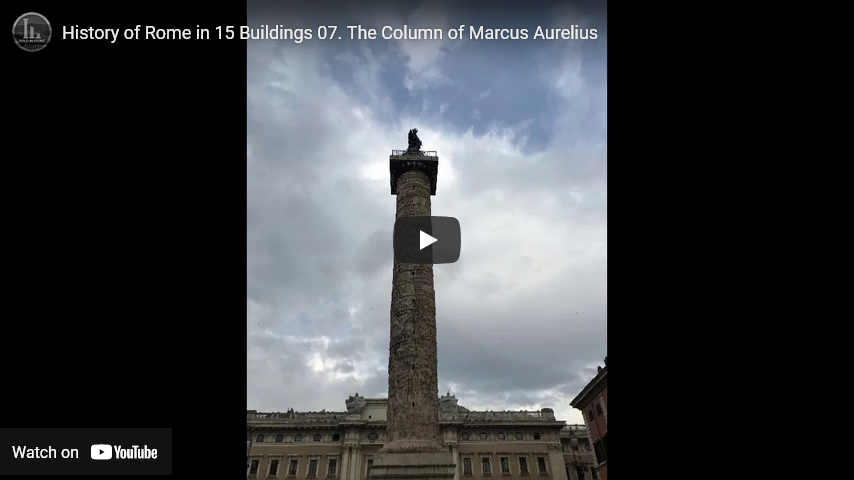
History of Rome in 15 Buildings 07. The Column of Marcus Aurelius
toldinstone
Published 27 Sep 2018Roman troops file in neat lines over raging rivers and trackless mountains. They crush barbarian forces in battle after battle, leaving fields of corpses in their wake. Villages burn, captives weep – and the lonely figure of the philosopher-emperor leads his legions to victory. So the spiraling reliefs of the Column of Marcus Aurelius, subject of the seventh episode in our History of Rome, represent the brutal conflict that turned back the first wave of the barbarian invasions.
If you enjoyed this video, you might be interested in my book Naked Statues, Fat Gladiators, and War Elephants: Frequently Asked Questions about the Ancient Greeks and Romans. You can find a preview of the book here:
https://toldinstone.com/naked-statues…
If you’re so inclined, you can follow me elsewhere on the web:
https://www.reddit.com/r/AskHistorian…
https://www.instagram.com/toldinstone/To see the story and photo essay associated with this video, go to:
https://toldinstone.com/the-column-of…Thanks for watching!
Comments Off on History of Rome in 15 Buildings 07. The Column of Marcus Aurelius
April 19, 2022
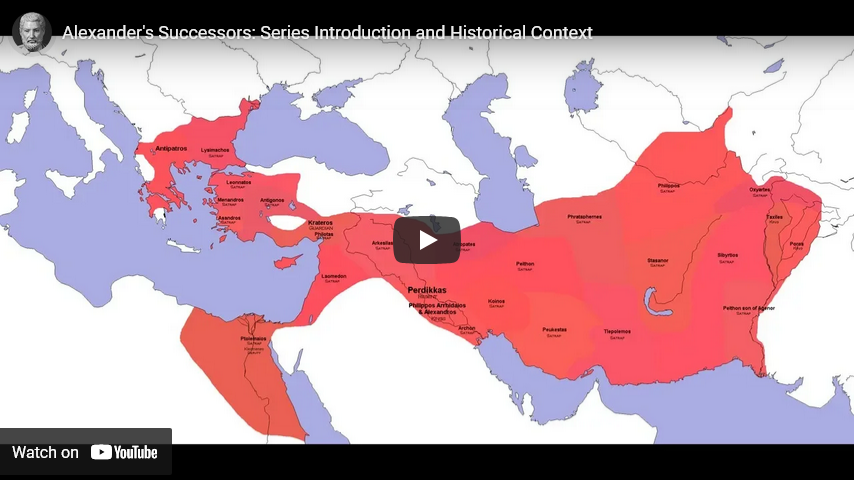
Alexander’s Successors (the Diadochi): Series Introduction and Historical Context
Thersites the Historian
Published 24 Nov 2018This video introduces my series on Alexander’s Successors by talking about what the series will be like and by going through the historical context that the viewer might need to understand the age of the Successors.
Patreon link: https://www.patreon.com/thersites
PayPal link: paypal.me/thersites
Twitter link: https://twitter.com/ThersitesAthens
Minds.com link: https://www.minds.com/ThersitestheHis…
Steemit/dtube link: https://steemit.com/@thersites/feed
Backup Channel: https://www.youtube.com/channel/UCUrD…
Comments Off on Alexander’s Successors (the Diadochi): Series Introduction and Historical Context
March 28, 2022
Republic to Empire: Catiline, Cicero, Crassus, Pompey, Caesar the Death Spiral
Update 6 Feb 2024: Dr. Gabb replaced the original part 7 which discussed the cultural impact of Ancient Greece on the rising Roman Republic.
seangabb
Published 20 Feb 2021
In 120 BC, Rome was a republic with touches of democracy. A century later, it was a divine right military dictatorship. Between January and March 2021, Sean Gabb explored this transformation with his students. Here is one of his lectures. All student contributions have been removed.Here is the seventh lecture, which discusses the Catiline Conspiracy and the rise and disintegration of the First Triumvirate of Caesar, Pompey and Crassus. There is a digression on Eastern politics and the Parthian Empire.
(more…)
Comments Off on Republic to Empire: Catiline, Cicero, Crassus, Pompey, Caesar the Death Spiral
March 25, 2022
QotD: Herodotus as Spartan propagandist
The greatest military asset the Spartans had was not actual military excellence – although, again, Spartan capabilities seem to have been somewhat better than average – but the perception of military excellence.
Herodotus seems to be at the start of it, at least in our sources – he relates a story where, after an embarrassing failure in an effort to reduce tiny Tegea to helotage (the Tegeans kicked the Spartans’ asses) in the mid-sixth century, the Spartans supposedly stole the bones of the hero Orestes. Consequently, Herodotus notes, the Spartans were from that point on able to always beat Tegea and subdued the Peloponnese (Hdt. 1.68), resulting in the creation of the Spartan-led Peloponnesian League. The unbeatable Spartans thus appear. It’s possible the Spartan reputation predated this, but – as we’ll see – Herodotus will be the one who codifies that reputation and cements it.
Except, hold on a minute – how hard was it to subdue the Peloponnese? It seems to have been done with a fairly adept mix of diplomacy and military force (champion one side in a local dispute, beat the other, force both into your alliance, repeat, see Kennell (2010), 51-3 for details). But it is little surprise that Sparta would be dominant in the Peloponnese. Messenia and Laconia together was around 2,600 square miles or so. This is – if you’ll pardon the expression – flippin’ massive by the standards of Greek poleis. More than twice as large as the next largest polis in all of Greece (Athens). Sparta is fully one-third of the Peloponnese (the peninsula Sparta is located on). The remaining two-thirds is home to many other poleis – Corinth, Argos, Elis, Tegea, Mantinea, Troezen, Sicyon, Lepreum, Aigeira and on and on. Needless to say, Sparta was several times larger than all of them – only Corinth and Argos came even remotely close in size. The population differences seem to have roughly followed land area. Sparta was just much, MUCH larger and more powerful than any nearby state by the start of the fifth century.
Sparta thus spends the back half of the 500s as the teenager beating up all of the little kids in the sandbox and making himself leader. When you are upwards of three times larger (and in some cases, upwards of ten times larger) than your rivals, a reputation for victory should not be hard to achieve. And, in the event, it turns out it wasn’t.
Which brings us back to Herodotus […] because he isn’t just observing the Spartan reputation, Herodotus is manufacturing the Spartan reputation. Herodotus is our main source for early Greek history (read: pre-480) and for the two Persian invasions of Greece. Herodotus’ Histories cover a range of places and topics – Persia, Greece, Scythia, Egypt – and contain a mixture of history, ethnography, mythology and straight up falsehoods. But – as François Hartog famously pointed out in his The Mirror of Herodotus (originally in French as Le Miroir d’Hérodote), Herodotus is writing about Greece, even when he is writing about Persia – those other cultures and places exist to provide contrasts to the things that Herodotus thinks bind all of the fractious and fiercely independent Greek poleis. And he is perfectly willing to manufacture the past to make it fit that vision.
Sparta has a role to play in that narrative: the well-governed polis, a bastion of freedom, ever opposed to tyranny, be it Greek or Persian. We’ll come back to Sparta’s … let’s say relationship … with Persian “tyranny” next week. But for Herodotus, Sparta is the expression of an ideal form of “Greekness” and in Herodotus’ logic, being well-governed (eunomia is the Greek term) results primarily in military excellence. For the story Herodotus is telling to work, Sparta – as one of the leading states resisting Persia – must be well governed and it must be militarily excellent. That’s what will make a good story – and Herodotus never lets the facts get in the way of a good story.
(Sidenote: Athens – at least post-Cleisthenic Athens – gets this treatment too. Athens ends up embodying a different set of “Greek” virtues and where Sparta shows its prowess on land, the Athenians do so at sea.)
And so, Herodotus – the myth-maker – talks up the Spartiates at Thermopylae (you know, the brave 300) and quietly leaves out the other Laconians (who, if you scrutinize his numbers, he knows must be there, to the tune of c. 900 men), downplaying the other Greeks. Spartan leadership is lionized, even when it makes stupid mistakes (Thermopylae, to be clear, was a military disaster and Spartan intransigence nearly loses the battle of Plataea, but Herodotus represents this as boldness in the face of the enemy; even more fantastically inept was the initial Spartan plan to hold on the Isthmus of Corinth as if no one had ever seen a boat before).
Bret Devereaux, “Collections: This. Isn’t. Sparta. Part VI: Spartan Battle”, A Collection of Unmitigated Pedantry, 2019-09-20.
Comments Off on QotD: Herodotus as Spartan propagandist
March 19, 2022
Belisarius: War & Plague
Epic History TV
Published 18 Mar 2022Download Endel here, first 100 downloads get 1 week of free audio experiences!
https://app.adjust.com/b8wxub6?campai…Big thanks to Legendarian for Total War: Attila gameplay footage, check out his YouTube channel here: https://www.youtube.com/channel/UCOI2…
Big thanks also to our series consultant Professor David Parnell of Indiana University Northwest, who you can follow on Twitter here: https://twitter.com/byzantineprof
Total War: Attila gameplay footage used with kind permission of Creative Assembly – buy the game here: https://geni.us/qDreR
Support Epic History TV on Patreon from $1 per video, and get perks including ad-free early access & votes on future topics https://www.patreon.com/EpicHistoryTV
🎨 Original artwork by Miłek Jakubiec https://www.artstation.com/milek
📚 Recommended reading (as an Amazon Associate I earn from qualifying purchases):
📖 Procopius, History of the Wars https://geni.us/L3Pgc
📖 The Wars of Justinian by Michael Whitby https://geni.us/Xxrd3
📖 Rome Resurgent by Peter Heather https://geni.us/ZFoU1
📖 The Armies of Ancient Persia: the Sassanians by Kaveh Farrokh https://geni.us/jMQo3z
📖 Late Roman Cavalryman AD 236–565 (Osprey) by Simon MacDowall https://geni.us/XMGl👕 Buy EHTV t-shirts, hoodies, mugs and stickers here! teespring.com/en-GB/stores/epic-histo…
🎶Music from Filmstro: https://filmstro.com/?ref=7765
Get 20% off an annual license with this exclusive code:EPICHISTORYTV_ANN“Rites” by Kevin MacLeod https://incompetech.filmmusic.io/song…
License: https://filmmusic.io/standard-license#EpicHistoryTV #RomanEmpire #EasternRomanEmpire #Justinian #Belisarius #ByzantineEmpire #Romans #Ostrogoths
Comments Off on Belisarius: War & Plague
February 11, 2022
The Peloponnesian War: Athens vs. Sparta (Context and Overview)
Thersites the Historian
Published 28 Oct 2021In this lecture, I cover Greek history from 478-404 BCE with an emphasis on the Peloponnesian War. This is intended as a primer on the topic and I devote more time to establishing the context and causes of the war than I do going through the details of conflict itself.
Patreon link: https://www.patreon.com/thersites
PayPal link: paypal.me/thersites
Discord: https://discord.gg/QCaXXFr
Brave Browser: https://brave.com/noa557
Twitter link: https://twitter.com/ThersitesAthens
Minds.com link: https://www.minds.com/ThersitestheHis…
Steemit/dtube link: https://steemit.com/@thersites/feed
BitChute: https://www.bitchute.com/channel/jbyg…
Comments Off on The Peloponnesian War: Athens vs. Sparta (Context and Overview)
February 7, 2022
Justinian I, 527-565: Wars
Thersites the Historian
Published 21 Sep 2017In this video, I look at the wars of conquest waged by the Emperor Justinian and explore whether or not these conflicts advanced the long-term interests of the Byzantine state.
Comments Off on Justinian I, 527-565: Wars
November 3, 2021
Halikarnassos: The Birthplace of History
Thersites the Historian
Published 24 Feb 2020A Greek polis which became the capital city of a Persian satrapy, Halikarnassos is best known as the birthplace of Herodotos and the site of the Mausoleum. A monarchy in a sea of aristocratic and oligarchic governments, Halikarnassos was one of the more unique places in the wider Greek world.
Patreon link: https://www.patreon.com/thersites
PayPal link: paypal.me/thersites
Twitter link: https://twitter.com/ThersitesAthens
Minds.com link: https://www.minds.com/ThersitestheHis…
Steemit/dtube link: https://steemit.com/@thersites/feed
BitChute: https://www.bitchute.com/channel/jbyg…
Backup Channel: https://www.youtube.com/channel/UCUrD…

Comments Off on Halikarnassos: The Birthplace of History
October 18, 2021
Strategikon – Army Manual of the Eastern Roman Empire
Kings and Generals
Published 30 Mar 2021The Kings and Generals animated historical documentary series on the evolution of the Roman Army continues with the second episode of the series on the Army of the Eastern Roman Empire – the Byzantine Empire. In this episode, we’ll focus on Strategikon of Maurice – the army manual that defined the structure, training and tactics of the Byzantine army.
Support us on Patreon: http://www.patreon.com/KingsandGenerals or Paypal: http://paypal.me/kingsandgeneral
We are grateful to our patrons and sponsors, who made this video possible: https://docs.google.com/document/d/1o…
The video was made by Arb Paninken http://bit.ly/2Ow3oC8, while the script was developed by Matt Hollis. This video was narrated by Officially Devin (https://www.youtube.com/user/OfficiallyDevin)
✔ Merch store ► https://teespring.com/stores/kingsand…
✔ Patreon ► https://www.patreon.com/KingsandGenerals
✔ Podcast ► Google Play: http://bit.ly/2QDF7y0 iTunes: https://apple.co/2QTuMNG
✔ PayPal ► http://paypal.me/kingsandgenerals
✔ Twitter ► https://twitter.com/KingsGenerals
✔ Instagram ► http://www.instagram.com/Kings_GeneralsProduction Music courtesy of Epidemic Sound: http://www.epidemicsound.com
#Documentary #Byzantines #Romans
Comments Off on Strategikon – Army Manual of the Eastern Roman Empire
October 5, 2021
Belisarius Part 1: The Emperor’s Sword
Epic History TV
Published 30 Sep 2021Thank you to our sponsor Brilliant – the first 200 to sign up to their Premium service get 20% off: https://brilliant.org/epichistory
Big thanks to Legendarian for Total War: Attila gameplay footage, check out his YouTube channel here: https://www.youtube.com/channel/UCOI2…
Total War: Attila gameplay footage used with kind permission of Creative Assembly — buy the game here: https://geni.us/qDreR
Thanks also to the 555 mod crew for modding support, find out more about their mods here: https://steamcommunity.com/sharedfile…
🎨 Original artwork by Miłek Jakubiec https://www.artstation.com/milek
🎨 Thanks to Igor Dzis for permission to use his painting, Battle of Dara.📚Recommended reading (as an Amazon Associate I earn from qualifying purchases):
📖Procopius, History of the Wars https://geni.us/L3Pgc
📖The Wars of Justinian by Michael Whitby https://geni.us/Xxrd3
📖Rome Resurgent by Peter Heather https://geni.us/ZFoU1
📖The Armies of Ancient Persia: the Sassanians by Kaveh Farrokh https://geni.us/jMQo3z
📖Late Roman Cavalryman AD 236–565 (Osprey) by Simon MacDowall https://geni.us/XMGlSupport Epic History TV on Patreon from $1 per video, and get perks including ad-free early access & votes on future topics https://www.patreon.com/EpicHistoryTV
👕 Buy EHTV t-shirts, hoodies, mugs and stickers here! teespring.com/en-GB/stores/epic-histo…
🎶Music from Filmstro: https://filmstro.com/?ref=7765
Get 20% off an annual license with this exclusive code:EPICHISTORYTV_ANN#EpicHistoryTV #RomanEmpire #EasternRomanEmpire #Justinian #Belisarius #ByzantineEmpire
I first discovered the Eastern Roman Empire in Robert Graves’ brilliant novel Count Belisarius which I read nearly 50 years ago and still re-read every few years. If the raw history isn’t your bag, try the historical fiction — closely based on the works of Procopius — heartily endorsed by pre-teen me.
Comments Off on Belisarius Part 1: The Emperor’s Sword
August 30, 2021
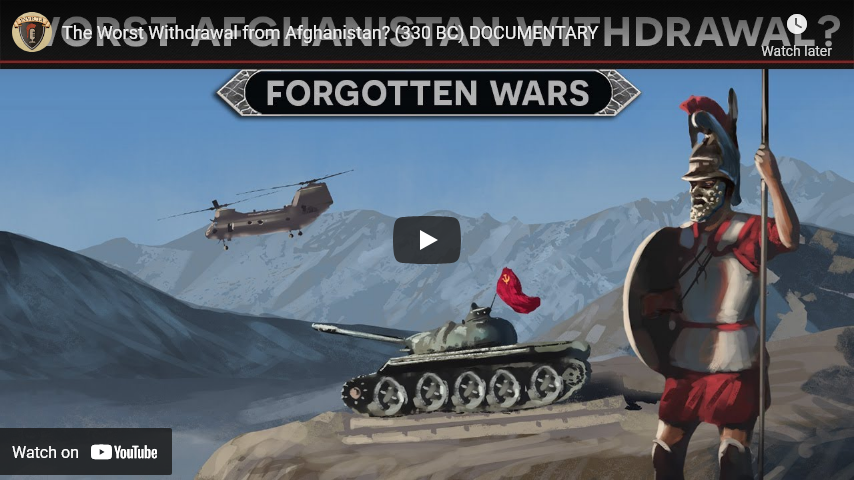
The Worst Withdrawal from Afghanistan? (330 BC)
Invicta
Published 28 Aug 2021Afghanistan has a long history of foreign invasions and withdrawals. Today we explore the first of these chapters with the campaigns of Alexander the Great. Signup for your FREE trial to Wondrium here: http://ow.ly/C3xs30rNLaU
As the last chapter of the US war in Afghanistan appears to draw to a close, the world watches armed and civilian forces alike conduct their final evacuations. However in these moments we hear echoes of the past. The history of the so-called “Graveyard of Empires” is filled with many chapters that tell of yet another major power that has been forced to withdraw after years of spilled blood and treasure. The most well-known instances have occurred in recent memory. However the pages of Afghan history go back thousands of years. Today I wanted to take a look at one of these first major military withdrawals that may just be the most FUBAR one on record; The evacuation of Alexander the Great’s Macedonian army from Afghanistan.
In order to contextualize this conflict we first begin with a quick overview of the history of Afghanistan. No country existed by that name or with those borders in antiquity and it was instead made up of a variety of tribal coalitions and minor kingdoms for much of its early history. However it would first see foreigners begin to claim its lands with the rise of the Median Empire and the succeeding Achaemenid Empire. The lands of modern Afghanistan would now be carved into a series of Satrapies such as Bactria, Gandara, Arakhosia, Drangaian, and Areia.
Following the Ionian Revolt and the Greco Persian Wars, the Kingdom of Macedon would rise to power and take on this ancestral conflict as a way to unify the Hellenic world behind its rule. Phillip II first began to plan and invasion of the Achaemenid Empire but it would be Alexander the Great who carried out this vision. He would campaign for several years through Anatolia, the Levant, Egypt, and Mesopotamia, consuming vast swaths of the enemy’s domains. However King Darius would escape to the east. Alexander initially pursued the Great King but when he was killed by his own Lieutenant, Bessus, Alexander set off against this traitor.
In this chase, Alexander the Great would be sucked into a multi-year war to subdue the eastern satrapies that made up modern Afghanistan. We cover the most significant events of this campaign, the establishment of occupying forces, and the eventual withdrawal of the army following the death of Alexander the Great. The ensuing settler revolt would make it (in my eyes) one of the most FUBAR Afghanistan withdrawals in history that would certainly be worthy of a Vice news documentary had it existed.
The Campaigns of Alexander the Great by Arrian
In the Footsteps of Alexander the Great by Michael Wood
Alexander the Great and Bactria: The Formation of a Greek Frontier in Central Asia by Frank Holt
The Greeks in Bactria and India by W. W. Tarn
On the revolt of the Greek settlers by DiodorusCredits:
Research: Invicta
Script: Invicta
Narration: Invicta
Artwork: Penta Limited#History
#Afghanistan
#Documentary
Comments Off on The Worst Withdrawal from Afghanistan? (330 BC)
July 24, 2021
History Hijinks: Rome’s Crisis of the Third Century
Overly Sarcastic Productions
Published 23 Jul 2021Local Empire Too Stubborn To Die — Field Historian Blue is here at the scene of Ancient Rome with more on the Crisis of the Third Century.
SOURCES & Further Reading
https://www.britannica.com/place/anci… + Aurelian, Postumus, Zenobia
The Great Courses The Roman Empire: From Augustus to The Fall of Rome lectures 13 14 and 15, “From Commodus to Caracalla”, “The Crisis of the Third Century” and “Diocletian and Late Third-Century Reforms”, by Gregory Aldrete
The Enemies of Rome Chapter 20 “Parthia, Persia, Palmyra” by Stephen KershawPartial Tracklist: “Scheming Weasel”, Sneaky Snitch”, “Marty Gots A Plan” Kevin MacLeod (incompetech.com)Licensed under Creative Commons: By Attribution 4.0 License
http://creativecommons.org/licenses/b…Content is intended for teenage audiences and up.
PATREON: https://www.Patreon.com/OSP
PODCAST: https://overlysarcasticpodcast.transi…
DISCORD: https://discord.gg/osp
MERCH LINKS: http://rdbl.co/osp
OUR WEBSITE: https://www.OverlySarcasticProductions.com
Find us on Twitter https://www.Twitter.com/OSPYouTube
Find us on Reddit https://www.Reddit.com/r/OSP/
From the comments:
Facundo Cadaa
2 hours ago
Thumbnail: “Rome’s big crisis”Do you have any idea how little that narrows it down?
Comments Off on History Hijinks: Rome’s Crisis of the Third Century
July 16, 2021
QotD: Thebes
Paul Cartledge makes the case for a central historical role for Oedipus’s home town. As scholarly as he is revisionist, his handsomely garnished Thebes is neither freckled with footnotes nor fancy with Gibbonian phrases. The Thebans’ exceptional capacity for disastrous decisions begins in mythology with the rejection by king Pentheus of the androgynous divinity Dionysus, dramatised in Euripides’s Bacchae.
There followed the king’s death at the hands of his own raving, Bacchanalian mother and the seismic ruin of the city. Homosexuality has no place in Cartledge’s index, but Oedipus’s father Laius, mythical king of Thebes, is the first man said to have swung both ways. The Sacred Band, in classical times, was a select Theban formation of pairs of male lovers, all full citizens.
However gay ancient Hellenes were (not all that, some say, certainly not all), the Sacred Band’s reputation suggests that a zest of scandal accompanied its bravura. Sexual aberration was integral to their city’s fame. Oedipus’s inadvertent marriage with his own mother, Jocasta, led to the mutual slaughter of their sons, as well as to the refusal of his daughter Antigone to marry Haemon, the prince chosen for her by King Creon. Creon then walled her up, the original ochi (NO!) girl. It needed the Athenian Sophocles to make a play out of it. Modern Greeks celebrate ochi day every 28 October, anniversary of the date in 1941 when their dictator, Ioannis Metaxas, refused to surrender to Mussolini and so refurbished himself as a national hero.
Thebes and the confederation of Boeotian states it headed figured on no honours board during the fifth century BC, presumed, until recently, to be the Golden Age of ancient Hellas. When Xerxes marched into Greece in 480 BC, the Theban oligarchs took advice from the Delphic oracle — they may well have leaned on it first — and so had a divine excuse for not offering any obstacle to the barbarian invaders.
Half a century later, the Thebans’ levelling of plucky little Plataea, the Athenians’ sole ally at Marathon, was a lowlight of the Peloponnesian war. It was matched only by their vindictiveness after defeating an Athenian army (including infantryman Socrates and the subaltern Alcibiades) at Delium. They left the enemy dead to rot rather than hand over the bodies.
[…]
Mythical Thebans figure again and again in the work of the great Athenian dramatists, almost always as bad examples. The city and its neighbours may have originated political federation, but it produced no remarkable artist, no Demosthenic orator, no great dramatist. As far as the arts are concerned, Cartledge cites only Pronomus, the pied piper whose mastery of the aulos (not so much flute as “double-oboe”) won wide renown. Nostalgic seniors may recall Danny Kaye’s line, “The oboe, it is clearly understood / Is an ill-wind that nobody blows good.”
Thebes specialised in wrong turnings. During its two decades of ascendancy in the fourth century BC, it sought to keep Macedon in its place by holding the young Philip II hostage. Having learnt the military skills of his captors, the unforgiving outsider returned to chasten them. His son Alexander finished the job by literally flattening the city, save for the house of its greatest poet, Pindar, and the temples of gods whose favours he hoped to enjoy when he set off to purge and pillage the Persians. No second Pindar hymned his conquests; the Greeks never took him for one of their own. His death in his early thirties prompted an immediate rebellion against Macedonian dominion.
Frederic Raphael, “Thick as Thebans”, The Critic, 2021-03-25.
Comments Off on QotD: Thebes


