Quotulatiousness

January 12, 2020

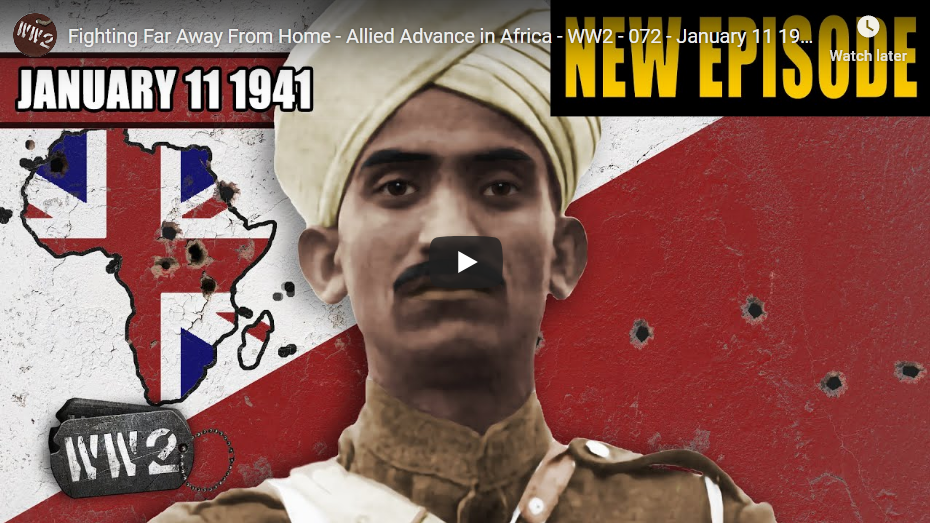
Fighting Far Away From Home – Allied Advance in Africa – WW2 – 072 – January 11 1941

Filed under: Africa, Britain, China, Europe, Greece, History, Italy, Military, WW2 — Tags: , , , , , — Nicholas @ 04:00

World War Two
Published 11 Jan 2020

Action in Albania. Action in North-Africa. Action in East-Africa. Action in China and action on the Mediterranean. It looks like every belligerent party is amping up its efforts to get a foothold wherever they are. And if your enemy is gaining ground? You just throw more material and men at them.

Join us on Patreon: https://www.patreon.com/TimeGhostHistory
Or join The TimeGhost Army directly at: https://timeghost.tv

Follow WW2 day by day on Instagram @World_war_two_realtime https://www.instagram.com/world_war_t…
Join our Discord Server: https://discord.gg/D6D2aYN.
Between 2 Wars: https://www.youtube.com/playlist?list…
Source list: http://bit.ly/WW2sources

Written and Hosted by: Indy Neidell
Produced and Directed by: Spartacus Olsson and Astrid Deinhard
Executive Producers: Bodo Rittenauer, Astrid Deinhard, Indy Neidell, Spartacus Olsson
Creative Producer: Joram Appel
Post-Production Director: Wieke Kapteijns
Research by: Indy Neidell
Edited by: Daniel Weiss
Map animations: Eastory (https://www.youtube.com/c/eastory)

Colorizations by:
– Dememorabilia – https://www.instagram.com/dememorabilia/
– Julius Jääskeläinen – https://www.facebook.com/JJcolorization/

Sources:
IWM (A 4161), (E 872), (A 4162), (A 9793), (A 13509).
Division Coat of Arms by Noclador
oil barrel by BomSymbols from the Noun Project
can by Anniken & Andreas from the Noun Project

Soundtracks from Epidemic Sound:
– “Arriving in Ancient Rome” – Kikoru
– “Easy Target” – Rannar Sillard
– “Split Decision” – Rannar Sillard
– “Road To Tibet 5” – Rannar Sillard
– “Death And Glory 1” – Johannes Bornlöf
– “The Inspector 4” – Johannes Bornlöf
– “Not Safe Yet” – Gunnar Johnsen

Archive by Screenocean/Reuters https://www.screenocean.com.

A TimeGhost chronological documentary produced by OnLion Entertainment GmbH.

From the comments:

World War Two
3 days ago (edited)
It looks like all fronts are heating up this week. And that the German reaction to the British offensive in North-Africa and the Greek progress in Albania is to move more German troops southward. This week already shows how that potentially threatens Britains position in the Mediterranean. Well, just like the British and Germans, we hope to increase our manpower in 1941. Do your part and expand our community of loyal supporters and history buffs by joining the TimeGhost Army on https://www.patreon.com/timeghosthistory and https://timeghost.tv. The war effort needs you!
Cheers, Joram

January 9, 2020

Operation Compass 1940-41 | BATTLESTORM North African Campaign Documentary

Filed under: Africa, Australia, Britain, Germany, History, Italy, Middle East, Military — Tags: , , , , — Nicholas @ 06:00

TIK
Published 21 Dec 2015

The most in-depth look at Operation Compass out there! Using animations and detailed maps, let’s find out what happened in one of the greatest British (and Commonwealth) victories of the war and who was responsible for the destruction of the Italian 10th Army. This video covers the start of the North African Campaign up to the Battle of Beda Fomm.

Sources:
Barnett, C. The Desert Generals. Weidenfeld & Nicolson, 2011.
Bierwirth, J. Beda Fomm: An Operational Analysis. Pickle Partners, 1994.
Christie H. Fallen Eagles: The Italian 10th Army in the Opening Campaign in the Western Desert, June 1940. Pickle Partners 1999.
Dimbleby, J. Destiny in the Desert. Britain 2013.
Moorehead, A. The Desert War: The Classic Trilogy on the North Africa Campaign 1940-43. Aurum Press, 2014.
Playfair, I.S.O. The Mediterranean and Middle East Volume 1: Early Successes against Italy [to May 1941]. 1954.
Wahlert, G. The Western Desert Campaign. Australia, 2011.

Music is my own!

January 5, 2020

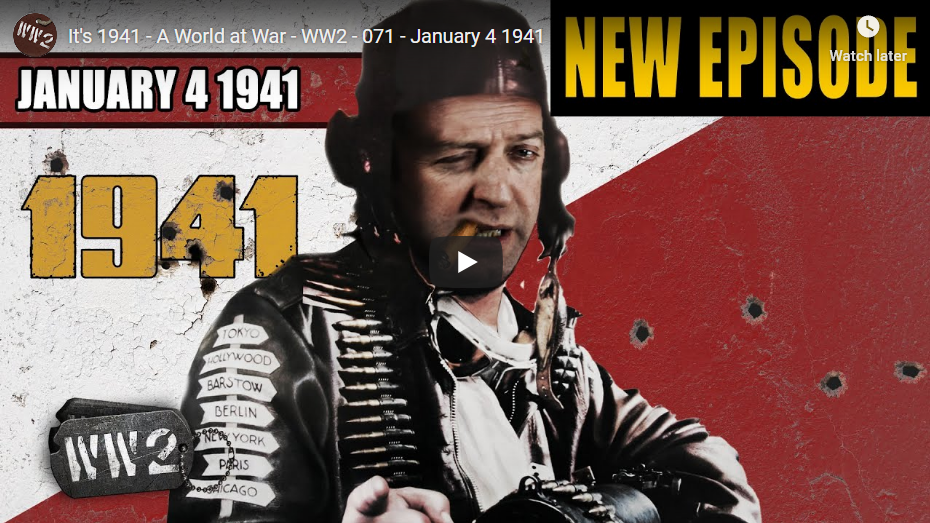
It’s 1941 – A World at War – WW2 – 071 – January 4 1941

World War Two
Published 4 Jan 2020

1941 begins with action in North-Africa and China, but Indy also takes a moment to assess the current stakes and stakeholders in the East-Asian theatre. What is sure, is that 1941 will be an eventful year!

Join us on Patreon: https://www.patreon.com/TimeGhostHistory
Or join The TimeGhost Army directly at: https://timeghost.tv

Follow WW2 day by day on Instagram @World_war_two_realtime https://www.instagram.com/world_war_t…
Join our Discord Server: https://discord.gg/D6D2aYN.
Between 2 Wars: https://www.youtube.com/playlist?list…
Source list: http://bit.ly/WW2sources

Written and Hosted by: Indy Neidell
Produced and Directed by: Spartacus Olsson and Astrid Deinhard
Executive Producers: Bodo Rittenauer, Astrid Deinhard, Indy Neidell, Spartacus Olsson
Creative Producer: Joram Appel
Post-Production Director: Wieke Kapteijns
Research by: Indy Neidell
Edited by: Iryna Dulka
Map animations: Eastory (https://www.youtube.com/c/eastory)

Colorizations by:
– Adrien Fillon – https://www.instagram.com/adrien.colo…
– Julius Jääskeläinen – https://www.facebook.com/JJcolorization/

Sources:
– IWM: MH 2718, C 1850, E2294, E 18542, E 378, E 443, E 3721E, E 1573
– Bundesarchiv, Bild 101I-783-0104-09 / Moosmüller / CC-BY-SA 3.0
– Prison by FORMGUT. from the Noun Project
– Artillery by Creative Mania from the Noun Project

Soundtracks from Epidemic Sound:
– “Easy Target” – Rannar Sillard
– “The Inspector 4” – Johannes Bornlöf
– “Magnificent March 3” – Johannes Bornlöf
– “March Of The Brave 10” – Rannar Sillard
– “March Of The Brave 9” – Rannar Sillard
– “Deviation In Time” – Johannes Bornlof
– “Disciples of Sun Tzu” – Christian Andersen
– “Last Point of Safe Return” – Fabien Tell

Archive by Screenocean/Reuters https://www.screenocean.com.

A TimeGhost chronological documentary produced by OnLion Entertainment GmbH.

From the comments:

World War Two
2 days ago (edited)
Happy New Year to you all!! We hope you all had a great turn of the decade. We certainly have! Here’s a casual, spoiler-free statement: 1941 will be an interesting year. We are all very grateful for those who found us at the very start with the Invasion of Poland, during the Phoney War, the early fighting Northern and Western Europe and the more recent conflicts in Greece and North-Africa. Those of you who joined the TimeGhost Army and support us financially on patreon.com/timeghosthistory or Timeghost.tv deserve extra praise – as we would not have made 1941 without you! And we have BIG plans for the coming year, so please consider supporting us as well! Make history with us and join the TimeGhost Army!!

Here’s to a great 2020 and ‘interesting’ 1941.
Cheers, Joram

December 22, 2019

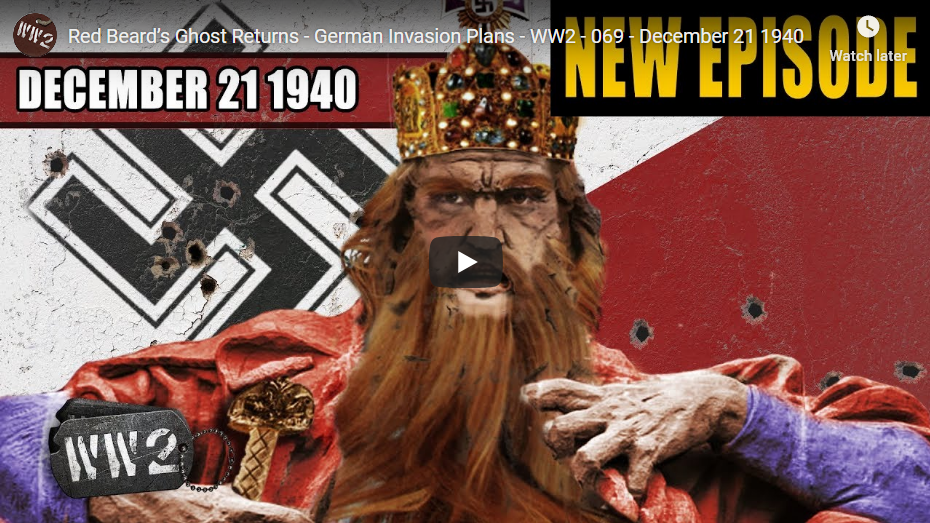
Red Beard’s Ghost Returns – German Invasion Plans – WW2 – 069 – December 21 1940

Filed under: Britain, Germany, History, Italy, Military, Russia, WW2 — Tags: , , , , , — Nicholas @ 06:00

World War Two
Published 21 Dec 2019

What Adolf Hitler expects to be his Magnum Opus offensive is still 6 months in the future, but it’s going to need plans and more plans. The British, though, are seeing success right now on two fronts far to the south.

Join us on Patreon: https://www.patreon.com/TimeGhostHistory
Or join The TimeGhost Army directly at: https://timeghost.tv

Follow WW2 day by day on Instagram @World_war_two_realtime https://www.instagram.com/world_war_t…
Join our Discord Server: https://discord.gg/D6D2aYN.
Between 2 Wars: https://www.youtube.com/playlist?list…
Source list: http://bit.ly/WW2sources

Written and Hosted by: Indy Neidell
Produced and Directed by: Spartacus Olsson and Astrid Deinhard
Executive Producers: Bodo Rittenauer, Astrid Deinhard, Indy Neidell, Spartacus Olsson
Creative Producer: Joram Appel
Post-Production Director: Wieke Kapteijns
Research by: Indy Neidell
Edited by: Iryna Dulka
Map animations: Eastory (https://www.youtube.com/c/eastory)

Colorizations by:
– Cassowary Colorizations – https://www.cassowarycolor.com/

Sources:
– IWM: E 1513, H 4953A, E 3870E
– Termometer icon by Andi Nur Abdillah, bottle icon by W. X. Chee, The Noun Project

Archive by Screenocean/Reuters https://www.screenocean.com.

A TimeGhost chronological documentary produced by OnLion Entertainment GmbH.

December 21, 2019

Christmas In Tobruk (1943)

Filed under: Africa, Britain, History, Military, WW2 — Tags: , , , — Nicholas @ 04:00

British Pathé
Published 13 Apr 2014

Full title reads: “CHRISTMAS IN TOBRUK”.

Tobruk, Libya.

Several shots of Pathe cameraman Terry Ashwood in his pyjamas as he gets up from his bed in the desert. He looks into his Christmas stocking and reads his cards. Bell on Tobruk Church ringing. Various shots of sacks of mail being sorted at desert sorting post. Several shots of ruined buildings in Tobruk where the Tommies are having their own. They write Merry Xmas on the wall and seem to be enjoying themselves. Soldiers ironing their clothes, “dress up” set the table and serve dinner. Men sitting at table with “Merry Christmas” written on the wall behind them. Christmas feast. Christmas pudding with a twig instead of piece of holly. Men drinking. Terry Ashwood leaving building and it is “snowing”. Pan up to show the men ripping paper into small pieces and throwing it from the balcony.

(Mute & Track Negs.)
FILM ID:1071.21

A VIDEO FROM BRITISH PATHÉ. EXPLORE OUR ONLINE CHANNEL, BRITISH PATHÉ TV. IT’S FULL OF GREAT DOCUMENTARIES, FASCINATING INTERVIEWS, AND CLASSIC MOVIES. http://www.britishpathe.tv/

FOR LICENSING ENQUIRIES VISIT http://www.britishpathe.com/

British Pathé also represents the Reuters historical collection, which includes more than 136,000 items from the news agencies Gaumont Graphic (1910-1932), Empire News Bulletin (1926-1930), British Paramount (1931-1957), and Gaumont British (1934-1959), as well as Visnews content from 1957 to the end of 1984. All footage can be viewed on the British Pathé website. https://www.britishpathe.com/

December 15, 2019

The Empire Strikes Back – Britain’s Operation Compass – WW2 – 068 – December 14, 1940

Filed under: Africa, Britain, Germany, History, Italy, Military, WW2 — Tags: , , , , — Nicholas @ 04:00

World War Two
Published 14 Dec 2019

The First British offensive of the War begins in North Africa. Meanwhile, the German Knickebein system is designed for bombers to accurately bomb British targets at night. This is what the Brits do to stop them.

Join us on Patreon: https://www.patreon.com/TimeGhostHistory
Or join The TimeGhost Army directly at: https://timeghost.tv

Follow WW2 day by day on Instagram @World_war_two_realtime https://www.instagram.com/world_war_t…
Join our Discord Server: https://discord.gg/D6D2aYN.
Between 2 Wars: https://www.youtube.com/playlist?list…
Source list: http://bit.ly/WW2sources

Written and Hosted by: Indy Neidell
Produced and Directed by: Spartacus Olsson and Astrid Deinhard
Executive Producers: Bodo Rittenauer, Astrid Deinhard, Indy Neidell, Spartacus Olsson
Creative Producer: Joram Appel
Post-Production Director: Wieke Kapteijns
Research by: Indy Neidell
Edited by: Iryna Dulka
Map animations: Eastory (https://www.youtube.com/c/eastory)

Thumbnail Colorization (Archie Wavell) by:
– Julius Jääskeläinen – https://www.facebook.com/JJcolorization/

Colorizations by:
– Dememorabilia – https://www.instagram.com/dememorabilia/
– Adrien Fillon – https://www.instagram.com/adrien.colo…

Sources:
– IWM: F 4539, B 10600, CM 355, E 6600, E 3720E, E 1416, E 1378, E 4792
– Tropenmuseum, part of the National Museum of World Cultures

– Prison icon by FORMGUT. from the Noun Project; Compass by RULI from the Noun Project.

Archive by Screenocean/Reuters https://www.screenocean.com.

A TimeGhost chronological documentary produced by OnLion Entertainment GmbH.

June 19, 2019

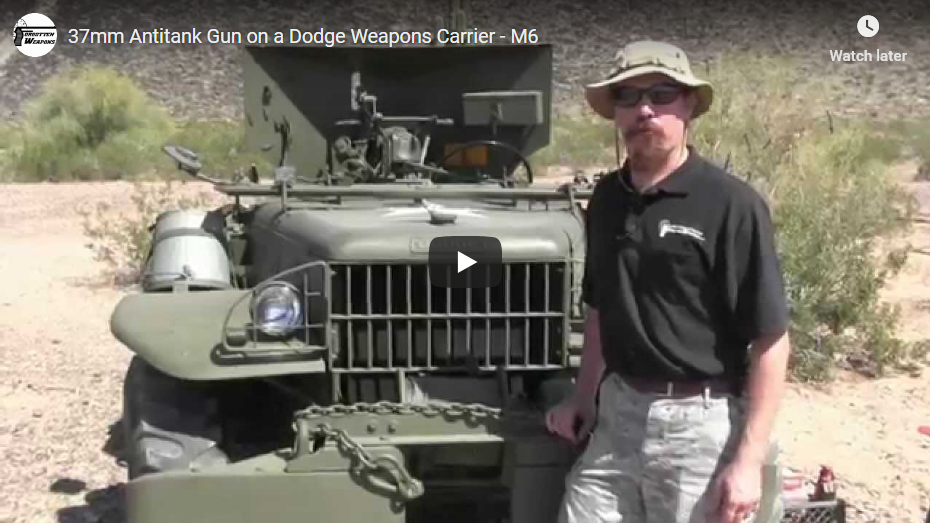
37mm Antitank Gun on a Dodge Weapons Carrier – M6

Filed under: History, Military, USA, Weapons, WW2 — Tags: , , , , — Nicholas @ 02:00

Forgotten Weapons
Published on 1 Jun 2014

http://www.forgottenweapons.com

Theme music by Dylan Benson – http://dbproductioncompany.webs.com

The M6 Gun Motor Carriage was the first American tank destroyer of WWII – a 37mm antitank gun (basically identical to the M3 gun) mounted on the back of a Dodge 3/4 ton weapons carrier. A large armor shield protected the gun crew from small arms fire, but the vehicle was otherwise highly exposed. The truck was powered by a flathead 6-cylinder engine producing 99 horsepower, and had a top speed of 55 mph. The gun was effective and modern in the late 1930s when its design process began, but was underpowered and insufficient by the time the M6 first saw action in 1942/3 in Tunisia.

Not many complete M6 carriages remain in existence today, as they were replaced quickly after their poor showing in North Africa. Most had the guns removed and were converted back into utility trucks, while some were used by the Free French forces and some saw use in the Pacific theater (where the underpowered gun was less of a concern).

June 16, 2019

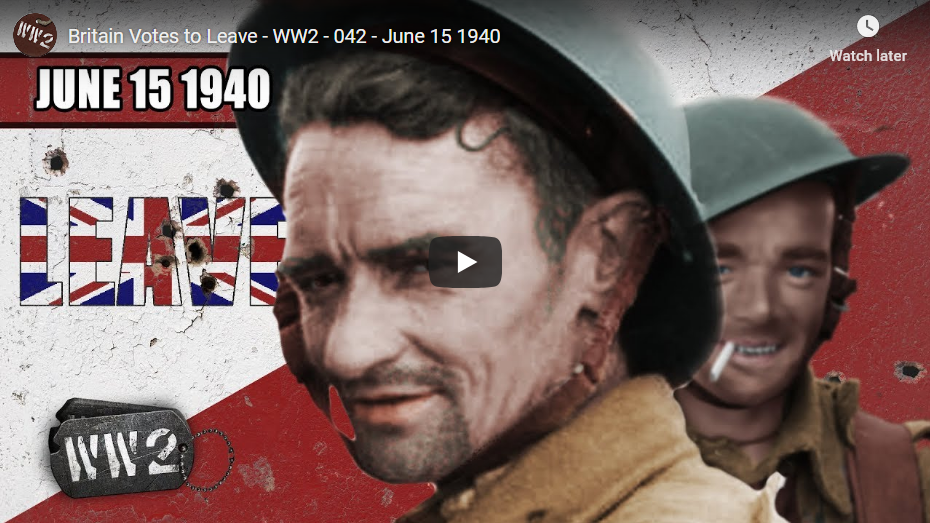
Britain Votes to Leave – WW2 – 042 – June 15 1940

Filed under: Britain, Europe, France, Germany, History, Italy, Military, WW2 — Tags: , , , , — Nicholas @ 04:00

World War Two
Published on 15 Jun 2019

The fighting in France isn’t over, not even when Paris falls, as the Germans advance and Italy joins the fight. But the Brits now have their back to yet another ocean and see no option but out. Further east Stalin uses the chaos in the West as cover to start moving in on his neighbours.

Join us on Patreon: https://www.patreon.com/TimeGhostHistory
Or join The TimeGhost Army directly at: https://timeghost.tv

Follow WW2 day by day on Instagram @World_war_two_realtime https://www.instagram.com/world_war_t…
Join our Discord Server: https://discord.gg/D6D2aYN.
Between 2 Wars: https://www.youtube.com/playlist?list…
Source list: http://bit.ly/WW2sources

Written and Hosted by: Indy Neidell
Produced and Directed by: Spartacus Olsson and Astrid Deinhard
Executive Producers: Bodo Rittenauer, Astrid Deinhard, Indy Neidell, Spartacus Olsson
Creative Producer: Joram Appel
Research by: Indy Neidell
Post Production Director: Wieke Kapteijns
Edited by: Marek Kamiński
Map animations: Eastory

Colorisations by Norman Stewart and Julius Jääskeläinen https://www.facebook.com/JJcolorization/

Eastory’s channel: https://www.youtube.com/channel/UCEly…
Archive by Screenocean/Reuters https://www.screenocean.com.

Sources: Italo-Scottish Research Cluster, Alchemist-hp

A TimeGhost chronological documentary produced by OnLion Entertainment GmbH.

From the comments:

World War Two
2 days ago
Paris… German soldiers in 1914 left their homes for the western front painted “To Paris” on their train carriages, little did they know what horrors were awaiting them. And that after four years of fighting in the trenches, none of them made it to Paris. This week, after another month of fighting in France, they finally do.

Whenever we read that some of you think that it’s just Indy making all of this, we have a good laugh. Actually, there are over 10 people working on this project. We have multiple editors, researchers/historians, producers, fact-checkers, colorisers and volunteers working on this. And of course there’s Eastory making the maps. We’d like to pay each and everyone of them for their hard work so they can feed themselves. Truth is, many of them work on a voluntary or part-time basis right now. The support we get on Patreon and our website is great and helps us sustain this channel, but we’re not nearly at the point that everyone involved gets what they deserve. If you like our work here on YouTube and you want to support the people who make it, please check us out on https://www.patreon.com/TimeGhostHistory or on our website https://timeghost.tv. Help us make history! Every dollar counts!

Cheers,
Joram

May 23, 2019

The early days of the S.A.S.

Filed under: Africa, Britain, History, Middle East, Military, WW2 — Tags: , , — Nicholas @ 04:00

Lindybeige
Published on 31 Oct 2017

One of the world’s most famous regiments was nearly disbanded after one disastrous mission.
Support me on Patreon: https://www.patreon.com/Lindybeige

I forgot to say that David Stirling was twenty-five years old when recovering from his injury and dreaming up the future SAS. Within two years, all the major airfields within 300 miles of the front had been raided by the SAS, some of them up to four times.

The camouflage used on the vehicles of the LRDG, and later the SAS, was rose pink and olive green, and by all accounts it worked very well.

Main sources: SAS Rogue Heroes by Ben Macintyre, Eastern Approaches by Fitzroy Maclean.

Lindybeige: a channel of archaeology, ancient and medieval warfare, rants, swing dance, travelogues, evolution, and whatever else occurs to me to make.

▼ Follow me…

Twitter: https://twitter.com/Lindybeige I may have some drivel to contribute to the Twittersphere, plus you get notice of uploads.

website: http://www.LloydianAspects.co.uk

May 6, 2019

Mers El Kebir: When The British Blew Up the French Fleet

Filed under: Britain, France, History, Military, WW2 — Tags: , , , , — Nicholas @ 04:00

Historigraph
Published on 4 May 2019

Join us in #WarThunder for free using this link and get a premium tank or aircraft and three days of premium time as a bonus: https://gjn.link/Historigraph/190504

If you enjoyed this video and want to see more made, consider supporting my efforts on Patreon: https://www.patreon.com/historigraph

To chat history, join my discord: https://discord.gg/vAFTK2D

#WarThunder #MersElKebir #Historigraph

► Twitter: https://twitter.com/historigraph
►Patreon: https://www.patreon.com/historigraph
►Discord: https://discord.gg/vAFTK2D

Sources:

Colin Smith, England’s Last War Against France: Fighting Vichy 1940-42

Stephen Roskill, Churchill and the Admirals

Correli Barnett, Engage the enemy more closely

http://avalon.law.yale.edu/wwii/frgea…

Music:

Rynos Theme, Incompetech https://incompetech.com

Malicious, Incompetech https://incompetech.com

Crypto, Incompetech https://incompetech.com

April 16, 2019

World War 2 British Armour Doctrine & Tactics with David Willey of the Tank Museum at Bovington

Filed under: Britain, History, Military, WW1, WW2 — Tags: , , , , — Nicholas @ 04:00

Military History Visualized
Published on 8 Dec 2017

David Willey the Curator of the Tank Museum at Bovington explains British Interwar and World War 2 Armour Doctrine and Tactics. Especially, about the Infantry and Cruiser tank “concept”. Additionally, we talk a bit about the 2nd Battle of El Alamein, Montgomery and Rommel.

January 27, 2019

Churchill Tank vs German 88 – Tunisia 1943

Filed under: Africa, Britain, Germany, History, Military, WW2 — Tags: , , — Nicholas @ 02:00

Mark Felton Productions
Published on 19 Dec 2018

The Battle of Steamroller Farm in Tunisia in 1943 is notable for how much damage a pair of British Churchill tanks managed to inflict on the Germans, whom they surprised after climbing a ‘tank-proof’ ridge. Find out the full thrilling story of the tough Churchill in action.

Help support Mark’s channel:

https://www.paypal.me/markfeltonprodu…
https://www.patreon.com/markfeltonpro…

January 26, 2019

The US Army’s tank development and “The Emergency” in Eire

Filed under: Europe, History, Military, USA, WW2 — Tags: , , , , — Nicholas @ 03:00

A discussion on the TimeGhost forums the other day included a link to this fascinating article by World of Tanks writer The Chieftain:

Wouldn’t it have been a terrible thing if, in the middle of WW2, the people responsible for training and equipping the US Army’s armored force were taken prisoner? Well, they were.

Wait, what? I’m sure we’d have heard all about this if it had really happened, and it’s certainly news to me, so he’s just pulling the long bow here, right? Well, no, he’s not. It really did happen, but there were several reasons why it didn’t become even a nine-day wonder in 1942, because it happened in what had been the Irish Free State but known after 1937 as Éire. Ireland was neutral in WW2, and had a policy of interning combatant personnel who found themselves in Ireland during the war. Keep this in mind, as it’s the key point of the story.

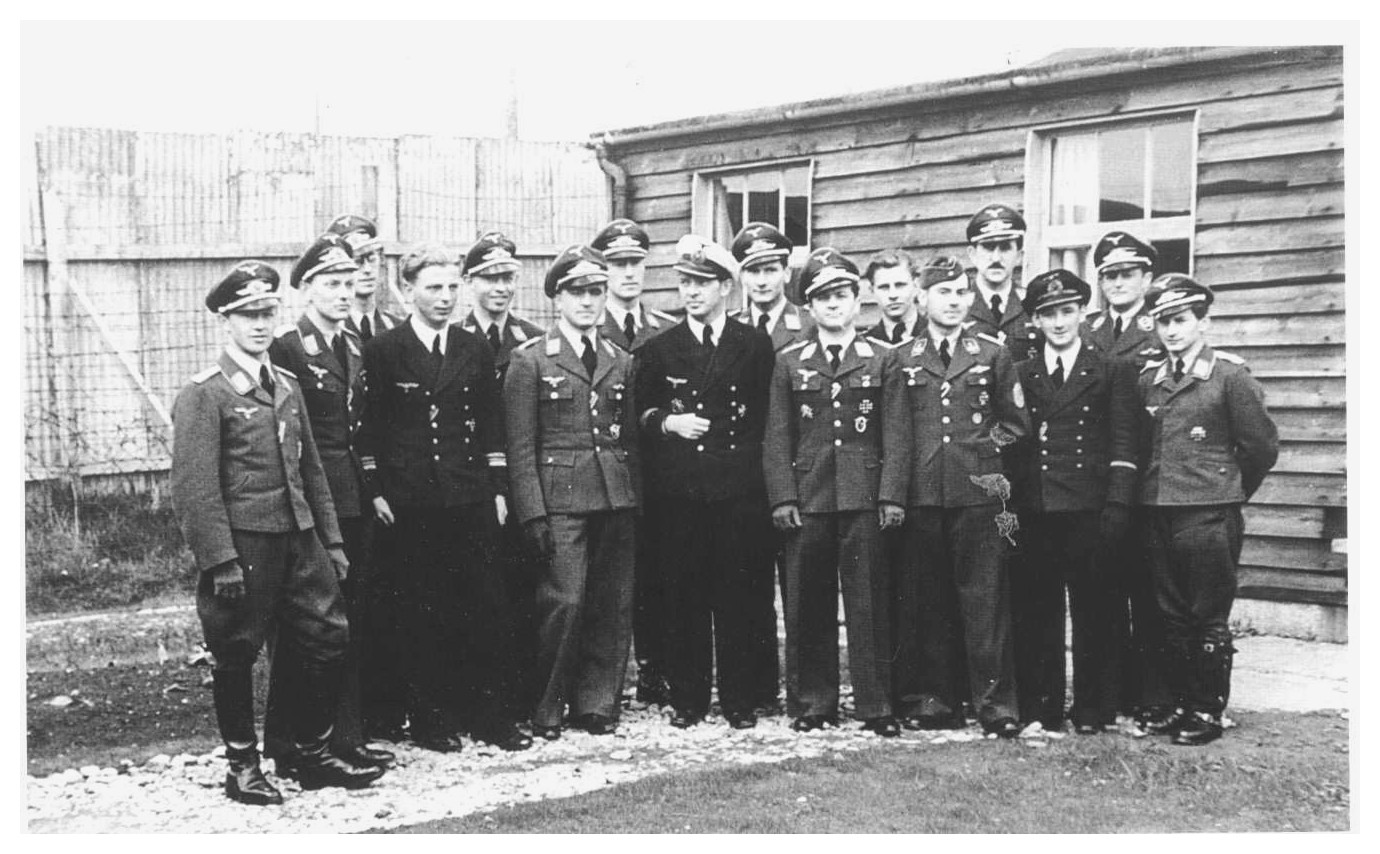
Interned German military personnel at the K-Lines Internment Camp in the Curragh.

Going on another brief tangent, you may be aware of the fact that what we know as “World War II” […] is not known by that name universally. Over on the former Soviet side of the house, it’s “The Great Patriotic War”. (Well, OK, they do distinguish between WWII and TGPW, but not in everyday conversation). The Soviet Union wasn’t the only country to give the conflict a less common name: In Eire, (Ireland), it was known as “The Emergency”

The background to this is that the Irish government wanted to enact emergency powers due to the unusual state of affairs which obtained in Europe in September 1939. The Irish Constitution granted the government such emergency powers in case of war, but it wasn’t entirely sure if the war in Europe counted. So the First Amendment to the Irish Constitution was approved, to add, in effect, that “state of war” could include “wars of which Ireland is not a part if the government thinks it’s important enough.” Once that little clarification was made, the Oireachtas (Parliament) passed its declaration of a state of emergency with the Emergency Powers Act. As a general rule, the Irish ruling bodies were not fans of the concept of acknowledging that there was a war going on which they had chosen not to be a part of. It went so far that when the son of a notable member of the Irish gentry in Malahide was killed when HMS Hood was sunk, his death was noted in the Irish Times as being due to a boating incident. As a result, the entire period 1939-1946 is known as “The Emergency.”

In this, as in so many other things, Ireland is a weird place. But we digress.

In December of 1942, Lieutenant General Jacob Devers, head of the Armored Force, decided to go on a fact-finding mission to the European Theatre of Operations to see how the tank units were holding up. Well, actually, it was mainly the North African Theatre of Operations, as European tank combat hadn’t really gotten off the ground. So he took with him a couple of colleagues, including one Major General Edward Brook, two Brigadier Generals named Gladeon Barnes and William Palmer, a Colonel William Thaddeus Sexton, and to carry the baggage, a Major Earl Hormell. They set off on December 14th, going south to Brazil, Ascension, The Gold Coast, Nigeria and Sudan, arriving Cairo five days later after a distance of 11,140 miles. After spending a little time with the British, they hopped over to Algeria, Tunisia and Morocco. At the end of trip, they went to Gibraltar for a week to consolidate their findings 7-14 January. The result of all this flying around and taking people away from their jobs for a month was one page and a quarter of conclusions, and one half-page of recommendations (the other half is six signature blocks).

[…]

Their duty from their trip being completed, they took advantage of the fact that they were already on the other side of the Atlantic to go to the UK to check in with the goings-on there.

So they boarded their aircraft, a B-17 converted to a VIP transport role, departed Gibraltar, and set off North up the Atlantic’s Eastern edge, looping around to the West of France to avoid German interception. Their B-17 was named “Stinky”.

You can probably guess where this is going.

The daily diary of the Devers mission reads as follows:

“At 2:00pm, January 15th, departed from Gibraltar, weather splendid. At approximately 10:00am, just after daylight, sighted land which navigator described as Lundy Island. From the map, this island appeared to be 100 miles north of the point at which the plane should have turned east towards Port Reath. Retracing south, the contour of the coastline did not correspond to that on available maps. Searched for approximately two hours without finding a familiar landmark. The radio operator was unable to contact any stations. The navigator admitted that he was lost. The ground consisted of small grass fields traversed by stone walls. With the gasoline supply nearly exhausted, a crash landing was made near Athenry at 11:50am. The size of the field was such that after hitting the ground, the plane crashed through a stone wall at approximately 70 miles per hour. Although the plane was wrecked, the members of the party were uninjured. The plane was immediately surrounded by Irish civilians and members of the Home Guard. The local inhabitants were very friendly, offered food and any medical assistance necessary. Shortly thereafter, representatives of the Eire Army arrived and took charge of the situation”

Er, oops? Read the whole thing for the full story.

January 8, 2019

Tank Chats #40 Crusader | The Tank Museum

Filed under: Britain, History, Military, Technology, WW2 — Tags: , , , — Nicholas @ 02:00

The Tank Museum
Published on 30 Jun 2017

In the 40th Tank Chat, David Fletcher looks at the Second World War Crusader tank.

The first Crusader III was delivered in May 1942. Crusader IIIs were landed first in Algeria on 13 November 1942, but removed from service upon conclusion of the campaign in Tunisia in May 1943. This vehicle probably never left England, as it was held by the School of Tank Technology, before transfer to the Tank Museum in 1949. This vehicle is painted to represent a tank serving in Tunisia.

Support the work of The Tank Museum on Patreon: ► https://www.patreon.com/tankmuseum
Or donate http://tankmuseum.org/support-us/donate

Twitter: ► https://twitter.com/TankMuseum
Tiger Tank Blog: ► http://blog.tiger-tank.com/
Tank 100 First World War Centenary Blog: ► http://tank100.com/ #tankmuseum #tanks

October 21, 2018

Tank Chats #36 Tiger 131 | The Tank Museum

Filed under: Germany, History, Military, Technology, WW2 — Tags: , , — Nicholas @ 02:00

The Tank Museum
Published on 21 Apr 2017

Tiger 131 is the most famous tank in The Tank Museum’s collection and arguably the most famous tank in the world.

Here curator David Willey discusses the history of Tiger 131, it’s current place and importance in the collection, and its future.

Support the work of The Tank Museum on Patreon: ► https://www.patreon.com/tankmuseum
Or donate http://tankmuseum.org/support-us/donate

« Newer PostsOlder Posts »

Powered by WordPress