
The Tank Museum
Published on 30 Jun 2017In the 40th Tank Chat, David Fletcher looks at the Second World War Crusader tank.
The first Crusader III was delivered in May 1942. Crusader IIIs were landed first in Algeria on 13 November 1942, but removed from service upon conclusion of the campaign in Tunisia in May 1943. This vehicle probably never left England, as it was held by the School of Tank Technology, before transfer to the Tank Museum in 1949. This vehicle is painted to represent a tank serving in Tunisia.
Support the work of The Tank Museum on Patreon: ► https://www.patreon.com/tankmuseum
Or donate http://tankmuseum.org/support-us/donateTwitter: ► https://twitter.com/TankMuseum
Tiger Tank Blog: ► http://blog.tiger-tank.com/
Tank 100 First World War Centenary Blog: ► http://tank100.com/ #tankmuseum #tanks
January 8, 2019
Tank Chats #40 Crusader | The Tank Museum
October 21, 2018
Tank Chats #36 Tiger 131 | The Tank Museum
The Tank Museum
Published on 21 Apr 2017Tiger 131 is the most famous tank in The Tank Museum’s collection and arguably the most famous tank in the world.
Here curator David Willey discusses the history of Tiger 131, it’s current place and importance in the collection, and its future.
Support the work of The Tank Museum on Patreon: ► https://www.patreon.com/tankmuseum
Or donate http://tankmuseum.org/support-us/donate
August 25, 2018
Mediterranean trade in the Iron Age
Jan Bakker, Stephan Maurer, Jörn-Steffen Pischke, and Ferdinand Rauch look at the relationships between trade and economic growth around the Mediterranean during the Iron Age:
Economists often point out the benefits of trade, yet empirical evidence for these benefits has been hard to come by and tends to be recent. This column goes back to the first millennium BC to analyse the growth effects of one of the first major trade expansions in human history: the systematic crossing of the open sea in the Mediterranean by the Phoenicians. A strong positive relationship between connectedness and archaeological sites suggests a large role for geography and trade in development even at such an early juncture in history.
The effects of free trade inspire a lot of public debate these days, and policies to restrict trade are gaining in prominence. Economists since Adam Smith and David Ricardo have typically pointed out the benefits of trade. Yet empirical evidence for these benefits has been much harder to come by and is much more recent. In particular, empirical economists have tried to demonstrate that more open economies or more integrated markets see faster growth. The relationship between these two variables is not much disputed; the more difficult question is whether this is due to trade causing growth or richer economies being more open.
[…]
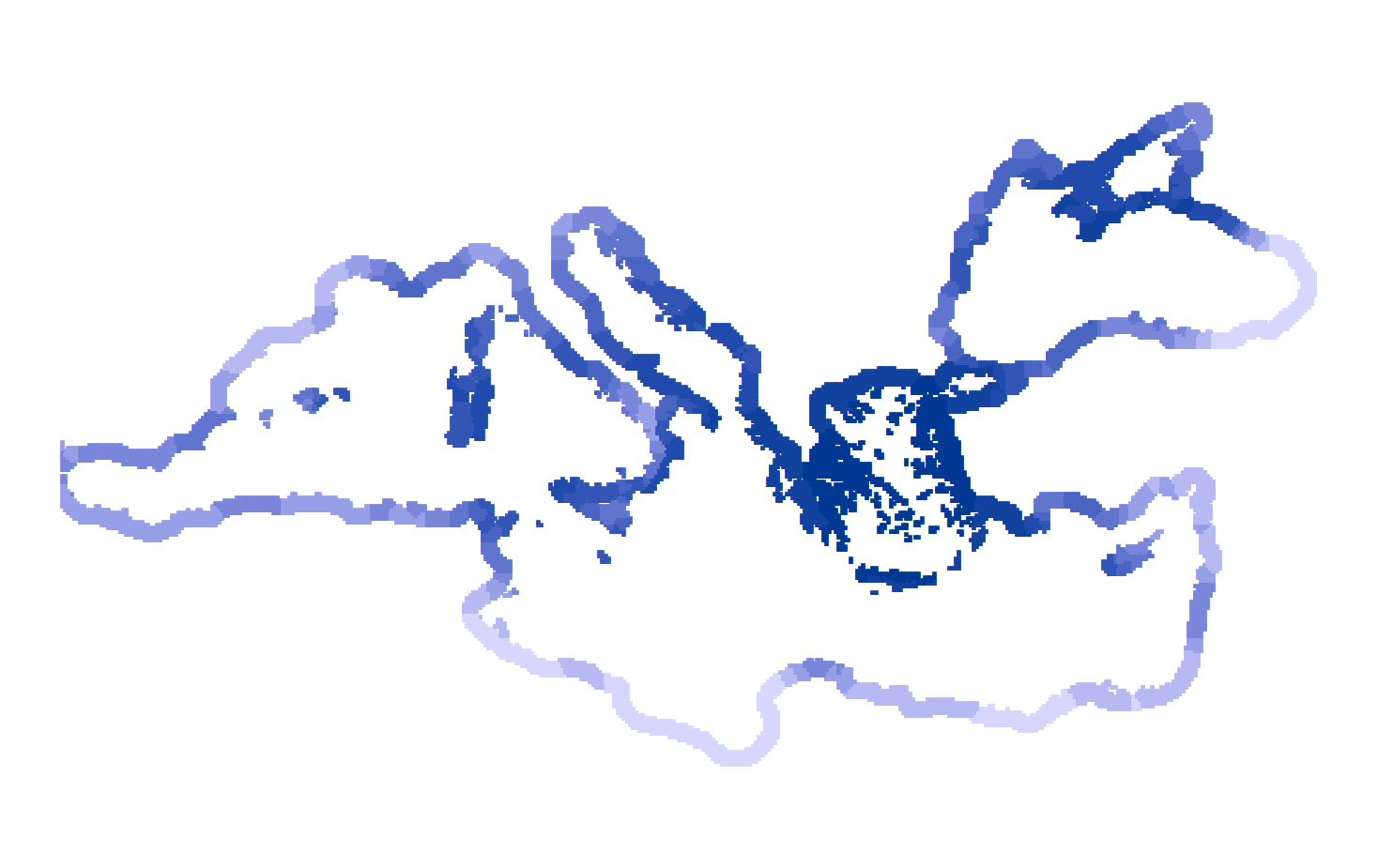
To analyse whether this increased trade also caused growth, we exploit the fact that open sea sailing creates different levels of connectedness for different points on the coast. The shape of the coast and the location of islands determineshow easy it is to reach other points, which might be potential trading partners, within a certain distance. We create such a measure of connectedness for travel via sea. Figure 1 shows the values of this measure on a map and demonstrates how some regions, for example the Aegean but also southern Italy and Sicily, are much better connected than others.
We use this measure of connectedness as a proxy for trading opportunities.
Figure 1 Log connectedness at 500km distance
Note: Darker blue indicates better connected locations.
Measuring growth for an early period of human history is more difficult as we have no standard measure of income, GDP, or even population. We quantify growth by the presence of archaeologic sites for settlements or urbanisations. While this is clearly not a perfect measure, more sites should imply more human presence and activity. We then relate the number of active archaeological sites in a particular period to our measure of connectedness.
We find a large positive relationship between connectedness and archaeological sites. The effect of connections on growth in the Iron Age Mediterranean are up to twice as large as the effects Donaldson and Hornbeck (2016) found for US railroads. Although these results are unlikely to be directly comparable, the magnitudes suggest a large role for geography and trade in development even at such an early juncture in history.
July 3, 2018
French North Africa in World War 1 I THE GREAT WAR Special
The Great War
Published on 2 Jul 2018Algeria, Tunisia and Morocco were all part of French North Africa before and during World War 1. They all contributed in material and men to the war effort and the French colonial soldiers were praised for their bravery.
June 15, 2018
QotD: Churchill on Montgomery
There was a brief firestorm in Britain when a photograph appeared in the press of Montgomery and Gen. Wilhelm Ritter von Thoma, the commander of the Afrika Korps and the highest-ranking German captured at Alamein. After his capture Thoma was brought to the Eighth Army command post, where Montgomery accorded him the respect of one honorable professional soldier to another. The two dined that night, and the photograph of the two generals led Brendan Bracken to send Churchill a memo criticizing Montgomery’s naïveté and noting that it created a bad impression with the public. Churchill merely commented: “I sympathize with Gen. von Thoma. Defeated, humiliated, in captivity, and,” after pausing for effect, “dinner with General Montgomery.”
Carlo d’Este, Warlord: A life of Winston Churchill at war, 1874-1945, 2008.
May 24, 2018
Tank Chats #30 M3 Grant | The Tank Museum
The Tank Museum
Published on 27 Jan 2017The thirtieth in a series of short films about some of the vehicles in our collection presented by The Tank Museum’s historian David Fletcher MBE.
Tanks of this type were first used in Western Desert in 1942. The M3’s were mechanically reliable, but soon superseded by Sherman.
May 16, 2018
Crusader Tank | Animated History
The Armchair Historian
Published on 25 Jun 2016
October 30, 2017
Tank Chats #19 Matilda II
Tank Museum
Published on 28 Apr 2016The name Matilda means Strength in Battle from the Germanic roots Maht, meaning strong and Hild meaning battle.
The Matilda was regarded as a superb tank in its day and carved a remarkable career for itself. A few served in France in 1940 but in the early stages of the North African campaign, under General Wavell, it virtually ruled the desert. Even when the Afrika Korps arrived it remained a formidable opponent, immune to everything but the notorious 88mm gun. Its main failings were its slow speed and small gun, which could not be improved.
June 15, 2017
Why is Rommel so complicated? – Erwin Rommel vs. Desert Fox
Published on 17 May 2017
This video takes a look at why Erwin Rommel often called the “Desert Fox” is so complicated due to the various interest groups and his complex situation in World War 2.


