
Quotulatiousness

September 14, 2010

When the bureaucracy strangles its young

Filed under: Bureaucracy, Military, USA — Tags: , , , — Nicholas @ 07:42

Noah Schactman uncovers the reason it takes a decade for the Pentagon to buy new weapons:

And you thought winning the Afghanistan war was tough. Try building the Army’s new armored vehicle. Or piecing together the Navy’s new network.

All of the complexity of the Afghan conflict — and all of the bureaucracy NATO used to manage the counterinsurgency effort — was summed up by a single spaghetti monster of a PowerPoint slide. “When we understand [it],” war commander Gen. Stanley McChrystal joked when he saw the slide, “we’ll have won the war.”

But that slide was child’s play compared to the three-foot wall chart the military uses to explain its gajillion-step process for developing, buying, and maintaining gear. The “Integrated Acquisitions Technology and Logistics Life Cycle Management” diagram is kind of a precis to the whole interminable progression, from “decompose concept functional definition into component concepts & assessment objective” to “execute support program that meets materiel readiness and operational support performance requirements and sustains system in most cost-effective manner.” Stare long enough, and you’ll start to see why it takes a decade for the Defense Department to buy a tanker plane, or why marines are still reading web pages with Internet Explorer 6.

The chart is put out by the Pentagon’s Defense Acquisitions University, where the Pentagon educates 180,000 people a year on its, um, unique process for purchasing equipment.
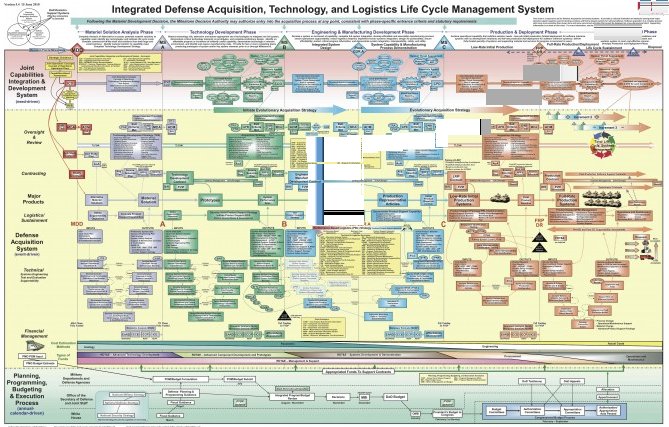
Full-sized horror of the slide at the link. If you think you can survive the insanity of it.

September 10, 2010

The bitter choices facing Britain’s new National Security Council

Filed under: Britain, Military — Tags: , , , , , , — Nicholas @ 09:40

The new National Security Council will have its first meeting next week. It’s expected to report on Britain’s defence priorities next month. For any kind of government body, that’s a breathtaking pace to set — and the decisions to be taken will have a huge impact on Britain’s armed forces for decades to come.

Thanks to poor decision-making on new defence purchases, the current government has to cut spending by an estimated 10 to 20%. Each service has major new equipment already in the pipeline, which means cancellation won’t automatically mean monetary relief for the government. The RAF has their priority purchase of 40 more Typhoon aircraft (costing £2.8 billion). The RN is desperate to keep their two new aircraft carriers on schedule for 2016 and 2018 (costing £5.2 billion for the ships and a mind-bending £10 billion for the F-35B aircraft to load on to them). In addition, the nuclear option needs to be renewed or (saving £20 billion) scrapped.

The Economist anticipates the bulk of the cuts going to the RAF and the army:

The RAF looks certain to be hit hard. Douglas Barrie, of the International Institute for Strategic Studies, reckons that the air force will shrink dramatically, losing perhaps 200 jets through the early retirement of Tornadoes and Harriers and a scaling back of the plan for a 160-strong Typhoon fleet. Attack helicopters and unmanned drones will increasingly be used to support ground operations instead. The order for F-35 jets, which are to be shared between the navy and the air force, looks certain to be more than halved to around 60, saving more than £5 billion in purchase costs and at least as much in maintenance.

Theoretically, one or both of the navy’s aircraft carriers could be cancelled. That would drastically reduce Britain’s expeditionary capability; but the advanced state of construction, the amount of money already spent and the 10,000 or so jobs at stake make it unlikely. Ditching just one of them is impractical, since two are needed if one is to be continuously available for operations. Despite some excitable recent talk of sharing a carrier with France, the difficulty of agreeing what to do with such a shared vessel make that idea unworkable. Dr Fox has ruled it out, though he is exploring other areas of co-operation.

[. . .]

And despite Afghanistan, the army will not escape entirely. A growing emphasis on special forces in ground warfare, combined with rising scepticism about the future utility of heavy armour should allow two or three battalions of infantry to be eliminated, the mothballing of most of the army’s main battle tanks and thus big savings in manpower and logistical support. A smaller army — comprising perhaps 95,000 soldiers rather than the current 107,000 — would also make it possible to repatriate most of the roughly 19,000 British troops still stationed in Germany without building new bases or housing.

Can anyone adequately explain why Britain still has nearly 20,000 troops in Germany at this late date? What possible strategic value are they, sitting in the middle of Europe?

September 5, 2010

No longer “underhand, underwater and damned un-English”

Filed under: Britain, Military, Technology — Tags: , , — Nicholas @ 12:38

BBC News looks at the newest nuclear-powered attack submarine in the Royal Navy, HMS Astute:

It is the stealthiest sub ever built in the UK, able to sit in waters off the coast undetected, listening to mobile phone conversations or delivering the UK’s special forces where needed.

The 39,000 or so acoustic panels which cover its surface mask its sonar signature, meaning it can sneak up on enemy warships and submarines alike, or simply lurk unseen and unheard at depth.

The submarine can carry a mix of up to 38 Spearfish heavyweight torpedoes and Tomahawk Land Attack Cruise missiles, able to target enemy submarines, surface ships and land targets, while its sonar system has a range of 3,000 nautical miles.

[. . .]

HMS Astute itself should never need refuelling over the next 25 years, thanks to the latest nuclear-powered technology which means it can circumnavigate the world submerged.

It even creates the crew’s oxygen from seawater as it sails, meaning that the air on board is no longer heavy with diesel fumes, as submariners used to complain of older vessels. The only limit to how long it can stay underwater is the amount of food on board, enough for 90 days at sea.

Rather a big step up from the diesel-electric clunkers we bought from them, wouldn’t you say? H/T to Adrian MacNair for the link.

September 1, 2010

British and French navies consider going “sharesies” on aircraft carriers

Filed under: Britain, Economics, France, Military — Tags: , — Nicholas @ 13:06

Matt Gurney reports on a bizarre scheme for Britain and France to share their carriers:

The rumoured plan to share the vessels would have certain advantages, to be sure. But it would also have certain ironies. Until the very recent past, the French and the British hated one another for approximately a thousand years, give or take a century. They battled each other endlessly, usually on the high seas. Progress is great and peace is nifty, but could anyone ever again look upon Lord Nelson’s monument in Trafalgar Square without chuckling if they knew the British Isles were protected by a glitchy French carrier named after a colossal thorn in the revered Churchill’s side?

The British have been quick to stamp out these rumours, calling them unwarranted speculation. But it’s interesting to even consider. Set aside the issue of the French and Royal navies co-operating, because stranger things have happened. Not many, but some. Every major Western military power, including Canada, is facing the same crunch. Sure, Prime Minister Harper made a big splash when his government announced plans to spend $16-billion on F-35 fighters, but lots of other things aren’t getting done. New destroyers? New search and rescue aircraft? An armoured vehicle refit? Frigate modernization? Show me the money! Or don’t. There is no money. If they are indeed discussing sharing their carriers, the French and the Brits at least deserve some credit for original thinking.

Original yes, but flawed. The rumoured plan doesn’t involve jointly constructing or manning vessels, but coordinating the patrol schedules of their respective carriers so that at least one would be at sea at all times. This would give both countries the capability to respond swiftly to threats in their shared North Atlantic area, or to react immediately to crises and disasters around the world (Whether for battle or rescue, few military assets can equal the utility of an aircraft carrier). Whichever carrier was deployed at any given time would remain under the command of its own national government, but there would apparently be contingencies to deal with a purely national military situation.

I doubt that the plan, even as scaled-down as indicated, would be workable, but it does show that the Royal Navy is seriously concerned that the new government will deprive them of the funds needed to complete the two new aircraft carriers already underway. Any extra leverage to persuade the government to avoid killing the program (like getting the French involved) may be seen as a good tactical tool.

Update, 3 September: The Guardian reports on the prospect of French/British military co-operation:

Fox stressed the coalition government’s “willingness to engage in stronger bilateral co-operation with France”.

He added: “And why France? Because there are two things that matter most when it comes to defence co-operation: the willingness to deploy and the willingness to spend on the research and development required to maintain modern military capabilities. That makes France the natural European partner for the United Kingdom.”

Fox said it was not simply a response to budgetary pressures. “It has to be driven by wider security interests.”

Morin said the two countries would come up with precise proposals by the end of October, after Britain’s strategic defence and security review.

August 13, 2010

UK to reduce number of senior officers in armed forces

Filed under: Britain, Bureaucracy, Military — Tags: , , , , , — Nicholas @ 09:46

In a desperate search for economies in the army, Royal Navy, and Royal Air Force, Liam Fox announced a good first step:

The number of senior military officers could be cut in an attempt to curb spending in the Ministry of Defence, the defence secretary, Liam Fox, said today.

In a speech setting out his vision for the future of the MoD, Fox said the reforms were intended to make the department leaner, less centralised and more effective.

He said military chiefs would be given greater control over the armed services as he attempted to sweeten what he described as “difficult and painful” cuts he blamed on the “dangerous deficit” left by the Labour government.

Fox said it was a “ghastly truth” that Labour had left the department with a £37bn “unfunded liability” over the next 10 years. However, he made no specific commitments on cuts, which are not expected to be announced until October.

It’s probably a safe bet that you could reduce the number of generals and admirals by half without in any measurable way decreasing the effectiveness of the armed forces — this is true in almost any nation’s armed forces, not just in Britain. Above the rank of Brigadier/Commodore, there are very few combat posts to be filled, but lots of administrative ones. When a senior officer transitions to being an administrator, their focus shifts from supporting the combat mission of the service to building their bureaucratic empire. It’s startling to see that an army of 100,000 troops “needs” 85,000 civil service workers to support it. (I’ve touched on this before.)

Each of the services has been starved of capital improvements so that any reduction in funding at this point will be very detrimental to long-term defence capabilities. The Royal Navy is starting to look more and more like a coastal defence force than a blue water navy . . . and getting rid of one or both of the new aircraft carriers would end Britain’s pretensions to be able to do any force projection at all (but Argentina would be happy to see it). The RAF had hoped to be next in line for shiny new aircraft to replace their current lot. The army has been wearing down their armoured vehicles at a steady pace and were also hoping for new, improved models in the immediate future.

In spite of the statements of the new coalition government, I don’t see why they’re bothering to replace Trident: you’ve already admitted that you can’t support the current force levels — which are clearly inadequate to meet the challenges of today, never mind those of tomorrow. Forcing the Trident replacement into the military budget could almost literally mean scrapping the rest of the RN just to retain those few nuclear submarines and their support structures.

August 4, 2010

The costly San Antonio class

Filed under: Bureaucracy, Military, USA — Tags: , , — Nicholas @ 09:08

Strategypage recounts the sad story of the LPD 17 class:

The U.S. Navy is having major problems with its LPD 17 class amphibious ships. Originally, the plan was for twelve of these ships to replace 41 smaller, older and retiring amphibious ships. Then, disaster struck. Five years ago, the USS San Antonio (the first LPD 17 class ship) entered service. Or at least tried to. The builders had done a very shoddy job, and it took the better part of a year to get the ship in shape. The second of the class, the USS New Orleans, was also riddled with defects that required several hundred million dollars to fix. This pattern of shoddy workmanship, incompetent management and outright lies (from the ship builders) continued with the five LPD 17 class ships now in service. Now the order has been cut to ten ships, partly because of all these problems. To add insult to injury, the last ship in the class is being named after politician John P. Murtha, who is generally hated by soldiers and marines for the way he politically exploited and defamed the troops who served in Iraq and Afghanistan. This is particularly painful because the LPD 17s carry marines into combat.

Many consider the San Antonio class as a poster child for all that’s wrong with American warship construction. The ships are being delivered late, and hundreds of millions of dollars over budget. The list of problems with the ships is long and embarrassing. Although the San Antonio did get into service, it was then brought in for more inspections and sea trials, and failed miserably. It cost $36 million and three months to get everything fixed. The workmanship and quality control was so poor that it’s believed that the San Antonio will always be a flawed ship and will end up being retired early.

July 20, 2010

Cooling the (Navy’s) jets

Filed under: Military, Technology, USA — Tags: , , , , — Nicholas @ 07:57

The carrier variant of the F-35 fighter and the V-22 tilt-rotor helicopter both present an unexpected problem to carrier crews: the risk of melting the deck. The heat of the exhaust on both of these aircraft can cause damage to the carrier’s deck if they are left running for more than a short period of time. Strategy Page reports:

The navy sought a solution that would not require extensive modification of current carrier decks. This includes a lot of decks, both the eleven large carriers, and the ten smaller LHAs and LHDs. This began looking like another multi-billion dollar “oops” moment, as the melting deck problem was never brought up during the long development of either aircraft. Previously, the Harrier was the only aircraft to put serious amounts of heat on the carrier deck, but not enough to do damage. But when you compare the Harrier engine with those on the V-22 and F-35B, you can easily see that there is a lot more heat coming out of the two more recent aircraft. Someone should have done the math before it became a real problem.

The solution to the V-22 heat issue is pretty straightforward: put heat-resistant pads under the exhausts, but the F-35 requires a (hopefully minor) redesign of the exhaust nozzles to diffuse the heat.

Welcome back to the draft era

Filed under: Government, Law, Liberty, Military, USA — Tags: , , , — Nicholas @ 07:11

. . . at least, if Representative Charles Rangel gets this piece of dreck through the legislative process:

HR 5741 IH

111th CONGRESS
2d Session
H. R. 5741

To require all persons in the United States between the ages of 18 and 42 to perform national service, either as a member of the uniformed services or in civilian service in furtherance of the national defense and homeland security, to authorize the induction of persons in the uniformed services during wartime to meet end-strength requirements of the uniformed services, and for other purposes.

If this passes, I’ll be happy to welcome the next generation of draft dodgers into Canada. In spite of their sometimes loopy politics, we managed to absorb the last bunch reasonably well.

June 7, 2010

More progress toward equality in the US Navy

Filed under: Military, USA — Tags: , , , — Nicholas @ 12:09

Strategy Page reports on two recent developments:

For the first time, a female officer will serve as CAG (commander of the air group on an aircraft carrier.) This is no surprise to those in navy. It’s a situation that’s been developing for decades. In the mid 1970s, the U.S. Navy began letting women into Annapolis (the Naval Academy) and flight school. Some 35 years later we have women commanding combat aircraft squadrons, cruisers, an amphibious task force (expeditionary strike group) and a strike group (a carrier task force.)

The newly appointed CAG, recently promoted captain Sara Joyner had, two years earlier, as F-18 pilot, Commander Joyner, completed a tour as the first female commander of a navy combat squadron (VFA 105). This included a seven month cruise to the Persian Gulf aboard the USS Harry S. Truman, where her dozen F-18Cs flew about 412 hours each. The squadron had 245 officers and sailors, including pilots and maintenance personnel. The squadron commander flew combat missions, in addition to running the squadron.

[. . .]

Another female Naval Academy graduate (Class of 1985) recently received an even more senior naval aviation command. This year, Rear Admiral Nora Tyson took command of Task Force 73 (CVN USS George H W Bush and escorts). This was another first.

Probably the most hopeful thing about these two appointments is that they’re pretty clearly not token appointments for political reasons: both women have earned their promotions and are deemed fully qualified for their new roles. That’s a far more positive thing for all women in the armed forces than attempting to meet arbitrary criteria based solely upon gender balance concerns.

June 4, 2010

Detroit has no monopoly on post-apocalyptic urban scenery

Filed under: Asia, China, History, Japan — Tags: , , — Nicholas @ 21:56

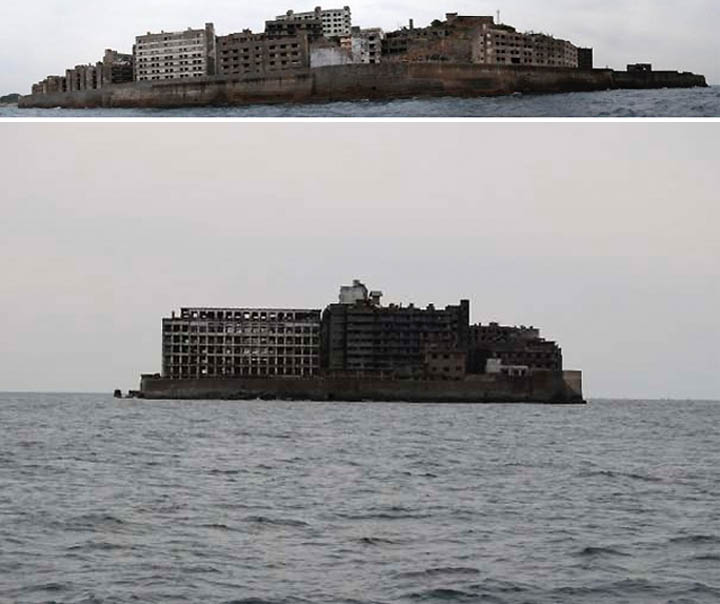
For example, check the images from Battleship Island (Gunkanjima) in Japan:

What’s now decay and rot once was bright and brilliantly full of hope: Who lived here? What were their lives like? What happened? How did it all come apart? How did it all crumble to almost nothing?

In the case of Hashima Island, or Battleship Island (Gunkanjima in Japanese) as it’s often called, hope and optimism became dust and decay because one black resource (coal) was replaced by a cheaper black resource (oil). Populated first in 1887, the island — which is 15 kilometers from Nagasaki — only began to really, and phenomenally, become populated much later, in 1959.

Even the nickname “Battleship Island” has a bit of history behind it.

H/T to Ace of Spades for the original link.

June 1, 2010

The flotilla incident

Filed under: Middle East, Military — Tags: , , , , — Nicholas @ 07:25

I’ve seen lots of posts about yesterday’s boarding of the Mavi Marmara from both pro- and anti-Israeli viewpoints. Adrian McNair has one of the most even-handed summaries:

When I first got wind of the news that Israeli Defense Forces had attacked a Turkish flotilla headed for the Gaza Strip on the Mediterranean Sea, it was accompanied by the words “massacre”, describing the death of 10 pro-Palestinian demonstrators aboard one of the ships. But as Jonathan Kay wrote about the incident in the National Post, if Israel truly had wanted to “massacre” the Hamas sympathizers aboard the flotilla, they could have simply sunk them to the bottom of the Sea with torpedos.

The “massacres” and “genocide” on Gaza continues to go very poorly indeed, given the available firepower of the Israeli military. In fact, like all international incidents involving the IDF, once the fury dies down and the seas calm a little bit, we usually learn the true story of what really happened.

As a humanitarian effort, the flotilla was a waste of resources. As a propaganda tool, however, the flotilla was quite successful: most media reports will concentrate on the casualties and ignore the fact that Israeli forces clearly tried to avoid causing those casualties.

Several different videos seem to corroborate statements by the IDF that troops came under attack by the passengers, who were clearly enraged at having been boarded by the Israelis. To further avoid violence, the soldiers had been armed with paintball guns. If that sounds like something a military command would order with the intent to “massacre” civilians, it could not have been less effective.

After coming under attack, the commandos requested permission for the deployment of lethal force, which they were granted. Up to 10 activists are believed to have been killed in the ensuing melee, with some reports stating that the activists had got a hold of weapons from the soldiers and were firing at them.

Update: Kathy Shaidle advises the “this is terrible PR for Israel” conservatives to back off:

The raw anti-Semitism making the rounds yesterday certainly disturbed me.

However, more sinister (all the more so because it was well intentioned) was the tsking and moaning about how the flotilla incident was “bad PR” for Israel — five minutes after the news broke, no less.

“Who cares about the facts?! Think of how this looks!

You sound like the leftists on the boat.

So-called pro-Israel “conservatives” who’ve read a couple of books and articles — and certainly have never been commandos, or even been on a boat that wasn’t shaped like a swan — really have no business debating the finer points of hand to hand combat at sea.

And they simply polluted the conversation yesterday with their tiresome, showoffy “tsk tsk” tweets and posts about “PR” and “optics.”

May 21, 2010

“Courageous Channel” exercise cancelled in South Korea

Filed under: Asia, Military, USA — Tags: , , , — Nicholas @ 09:07

Strategy Page reports that a regular exercise has been cancelled to avoid further raising tensions between North and South Korea:

In South Korea, the semi-annual American evacuation (for American civilians) exercise has been cancelled. This was because relations between North and South Korea are particularly tense. It was felt that this exercise, which involves setting up the 18 evacuation points and having 10,000 people actually go through some of the procedures involved during an evacuation, might make the unstable North Koreans do something rash. The tension is the result of North Korea torpedoing a South Korean warship two months ago, killing 46 sailors. The North Koreans officially denied they did it, although North Koreans have been congratulating each other about it, and the North Korean general in charge of such things was very publicly promoted for no particular reason. Recently, South Korea announced it was certain the ship was sunk by a North Korean torpedo. North Korea called that accusation an insult and threatened war.

Called Courageous Channel, the evacuation drill has been held twice every year (in the Spring and Fall) since 1996. That was when someone noticed that there a lot more U.S. citizens living in South Korea, particularly in and around the capital Seoul. This city contains a quarter of South Korea’s population, and is a primary target for any North Korean invasion. The city is within range over a thousand North Korean guns and rocket launchers. If there were an actual evacuation, some 140,000 American citizens (and some non-citizen dependents) would be moved south.

The report on the sinking of ROKS Cheonan was issued earlier this week.

May 20, 2010

Torpedo damage and the sinking of the Cheonan

Filed under: Asia, Military — Tags: , , — Nicholas @ 12:18

Geoffrey Forden posted information on likely causes of the sinking of the South Korean frigate Cheonan before the formal report was released:

One of the “mysteries” surrounding the sinking of the ROK’s warship, Cheonan, is that the explosion split the ship in half, a result our popular culture has trained us to forget. After all, World War II movies always show a torpedo strike in the same way: one or two white streaks quickly approaching the ship followed by a localized jet of water where the torpedo struck the hull. Sailors stream out of their bunks to jump over the side as the ship keels over, taking in water. Below the water line, jagged holes, punched by the explosive force of the warhead, let in sea water. Compartments quickly (or if dramatic effect is needed, slowly) fill with water, drowning all the bit players, uh, sailors trapped below.

These movies have influenced our expectations for the damage caused by modern torpedoes even though there are much more efficient ways for a torpedo to destroy a surface ship. [. . .]

The second major effect damaging the hull, and probably the one that caused the vessel to break in half, was a jet of water blasting its way through the ship. This jet was formed as the gas bubble created by the initial explosion collapsed upon reaching the ship’s hull.

This is the way modern torpedoes sink ships. Everything about the Cheonan’s sinking is consistent with either a torpedo or submerged mine blowing up beneath the ship’s keel.

Fascinating though this is, the official report (as filtered through what was made available to international media) discounted this mechanism:

South Korean scientists at the Sound Engineering Research Lab of Soongsil University have performed an analysis of the acoustic signals (the media report mistakenly calls them seismic waves) associated with the sinking of the Cheonan. It would be very nice to see their actual analysis — and the data would be even cooler — but it appears on the face of it to be a very interesting result. Their main conclusion, again based solely on the media report of their findings, seems to be that the Cheonan was actually struck by a heavy torpedo. (The say the most likely candidate is the Chinese Yu-3 heavy torpedo with a 205 kg high explosive warhead.) According the article, the South Korean scientists believe the torpedo struck the hull of the Cheonan but since the explosive is significantly aft of the torpedo’s bow, the center of the explosion was a little over 2 meters away. They rule out the “kill mechanism” being a bubble jet.

Interestingly, a summary in New Scientist (which is where I found the link above), seems to have been written before the updated information was added to the original post, as it attributes the sinking to the “deadly bubble jet”.

May 14, 2010

Defence minister denies that the Navy to be cut by half

Filed under: Cancon, Government, Military — Tags: , , — Nicholas @ 09:57

Canada’s Minister of National Defence Peter MacKay claims that the following operational changes to Canada’s naval forces do not constitute a serious cut:

The directive was sent to maritime forces on the west and east coasts, as well as to senior officers in charge of naval reservists.

The letter says:

– The fleet of Kingston-class maritime coastal defence vessels will be reduced to six ships from 12.

– Three frigates, HMCS Montreal, St John’s and Vancouver, will now be conducting domestic and continental missions to a “limited degree.”

– Combat systems on HMCS Toronto and HMCS Ottawa, as well as on HMCS Athabaskan, will be “minimally supported to enable safe to navigate sensors and communications only.”

– A key weapon system on board the Protecteur-class supply ships designed to destroy incoming missiles “will not be supported.”

Jedi Master MacKay is attempting a mind trick: “these are not the defence cuts you’re looking for”.

May 12, 2010

Technical snag delays further testing for EMALS

Filed under: Britain, Military, Technology, USA — Tags: , , , , — Nicholas @ 12:32

A minor directional error has caused a several month slip in the testing for a new aircraft carrier catapult design:

The so-called Electromagnetic Aircraft Launch System, or EMALS, is now under development in a shore-based test facility at Lakehurst naval air station in New Jersey. However, according to reports, the test mass-driver installation suffered serious damage earlier this year in a mishap blamed on a “software malfunction”. Apparently the “shuttle” — which moves along the catapult track to accelerate a plane to flying speed — went the wrong way in a test shot and smashed into important equipment.

The Newport News Daily Press, reporting on an interview with EMALS programme chief Captain Randy Mahr, says that the accident has delayed the shore-based testing by several months. It had been planned to commence launching aircraft — as opposed to test loads — this summer, but that will not now happen until autumn.

The next US supercarrier, CVN 78, aka USS Gerald R Ford, is now under construction and intended to join the fleet in 2015. Navy officials confirmed last year that it is now too late to amend the ship’s design and revert to steam catapults: EMALS must be made to work or the US Navy will receive the largest and most expensive helicopter carrier ever.

The EMALS development is of great interest to the Royal Navy’s Fleet Air Arm, as the two new carriers under construction (pending the new British government’s defence review) will not be equipped with catapults. Conventional catapults are steam operated, and the British carriers will have gas-turbine propulsion (unlike US and French carriers which use nuclear power plants, providing plenty of steam on demand). If EMALS works as designed, it could be fitted to the new carriers, allowing the Royal Navy to pass on the (ultra-expensive) new F-35B in favour of conventional carrier aircraft.

« Newer PostsOlder Posts »

Powered by WordPress

