
Quotulatiousness

February 10, 2011

No more manned fighters?

Filed under: Military, Technology, USA — Tags: , , , , , , , — Nicholas @ 12:24

As I said the last time this topic came up, “This is not a repost from 1957”. We may actually be looking at the last generation of manned fighters, if this update from Strategy Page is true:

On February 4th, the U.S. Navy X-47B UCAV (unmanned combat air vehicle) made its first flight. It was three years ago that the navy rolled out its first combat UAV; the 15 ton X-47B. This pilotless aircraft has a wingspan of 20 meters/62 feet (whose outer 5 meter/15 foot portions fold up to save space on the carrier). It carries a two ton payload and will be able to stay in the air for twelve hours. The U.S. is far ahead of other nations in UCAV development, and this is energizing activity in Russia, Europe and China to develop similar aircraft.

[. . .]

All of these aircraft are stealthy and can operate completely on their own (including landing and takeoff, under software control). The UCAVs would be used for dangerous missions, like destroying enemy air defenses, and reconnaissance. Even air force commanders are eager to turn over SEAD (Suppression of Enemy Air Defenses) missions to UAVs. SEAD is the most dangerous mission for combat pilots. But until quite recently, all these projects had either been cancelled, or were headed in that direction.

Now, the U.S. Department of Defense wants the new UAV combat aircraft in service by the end of the decade, some twenty years ahead of a schedule that was planned in the 1990s. The F-35 is expected to cease production in 2034, more than a decade after the first combat UAVs, that can match F-35 performance, enters service.

Unable to buy new aircraft designs (because they are too expensive, or simply take too long to get into service), and facing the prospect of unmanned aircraft (UAVs) displacing more and more manned ones, the American military is spending a growing chunk of its budgets on upgrading and refurbishing the combat aircraft they already have. This was not a deliberate, long term plan, but simply a reaction to shortages of new aircraft. A lot of the new electronics and weapons involved in these upgrades can also equip UAV designs still in development, so such efforts are a double win.

More and more, it looks like the new 36 ton F-22 and 27 ton F-35 are the end of the road for manned fighter-bombers. Not just because the F-22 and F-35 cost so much to develop, but because so much new tech has arrived on the scene that it simply makes more military, and economic, sense to go with unmanned aircraft. Meanwhile, the existing F-15s, F-16s, F-18s, A-10s and all American heavy bombers are being equipped with new targeting pods and combat Internet connections, along with new radars and all sorts of electronics. Older aircraft are having worn out structural components rebuilt or replaced. This buys time until the unmanned aircraft are ready. F-35s will also fill the gap, which may be a very small one.

Usual caveats apply of course, and you could do worse than reading the comment thread on that original post for some of the caveats spelled out.
February 8, 2011

Royal Navy to withdraw patrol from Caribbean

Filed under: Americas, Britain, Military — Tags: , , , , — Nicholas @ 00:01

The funding crisis for Britain’s Royal Navy is reported to be the reason for the cancellation of patrols in and around British dependencies in the West Indies:

Britain is to abandon its warship patrols of the Caribbean for the first time since the second world war because of the navy’s funding crisis, the Guardian has learned.

The withdrawal means the navy will no longer provide a warship for anti-narcotic operations in the region, and will have to reduce its role in disaster relief work.

The decision to stop the patrols, which is expected to be confirmed on Tuesday, comes at an embarrassing time for the Ministry of Defence — a documentary series on operations undertaken by the destroyer HMS Manchester in the Caribbean is due to start tonight. The programme on Channel Five follows the ship and crew throughout its seven month deployment last year.

February 7, 2011

X-47B takes flight, Navy pilots feeling threatened

Filed under: Military, Technology, USA — Tags: , , — Nicholas @ 08:46

Lewis Page looks forward to the day US Navy aircraft carriers don’t have pilots cluttering up the works:

The disappearance of swaggering pilots from the flight decks of US naval aircraft carriers came a step closer on Friday with the first flight of the X-47B robot tailhook stealth jet.

The X-47B is intended to demonstrate that unmanned aircraft can take off from aircraft carrier catapults and land back on deck again using tailhook and arrester wires. Such arrested landings have long been regarded as one of the most difficult and dangerous feats for human pilots to master, and US naval aviators tend to measure their manhood (or occasionally these days, womanhood) by the number of “traps” in their logbook.

Not content with automating the Top Guns out of their main trick, the X-47B is also intended to demonstrate autonomous air-to-air refuelling. This is another vital trick which human pilots find quite difficult (the act of flying the probe of the to-be-fuelled aircraft into the basket trailing at the end of the tanker plane’s hose is traditionally described as being of similar difficulty to “taking a running fuck at a rolling doughnut”).

February 6, 2011

US repositioning military forces near Egypt

Filed under: Middle East, Military, USA — Tags: , , — Nicholas @ 09:58

It should come as no surprise that the American government is changing the location and composition of forces around Egypt, as the situation becomes more volatile. Both US Navy and USMC units are involved in the moves. According to the L.A. Times, the USS Kearsarge is a key part of the redeployment:

The Pentagon is moving U.S. warships and other military assets to make sure it is prepared in case evacuation of U.S. citizens from Egypt becomes necessary, officials said Friday.

The Kearsarge, an amphibious assault ship carrying 700 to 800 troops from the 26th Marine Expeditionary Unit, and the Ponce have arrived in the Red Sea, putting them off Egypt’s shores in case the situation worsens.

Pentagon officials emphasized that military intervention in Egypt was not being contemplated and that the warships were being moved only for contingency purposes in case evacuations became necessary.

Business Insider reports that USMC units are being moved now:

A senior member of the US Marine corps is telling people “multiple platoons” are deploying to Egypt, a source tells us.

There is a system within the US Marines that alerts the immediate families of high-ranking marines when their marine will soon be deployed to an emergency situation where they will not be able to talk to their spouses or families.

That alert just went out, says our source.

For those of you not steeped in military jargon, a “platoon” is a small tactical unit of about 40 men, commanded by a lieutenant. This is not an “invasion force” sized move.

January 28, 2011

US Navy’s “pee antenna”

Filed under: Military, Technology, USA — Tags: , — Nicholas @ 08:46

Warships have been sprouting more and more antennae for all the various communication equipment on board — more every year, as new devices are rolled out of development and into active service. This creates problems, especially with smaller vessels, as the multiple antennae need to be spaced far enough apart to avoid mutual interference with signals. The US Navy may have come up with a liquid solution:

With an $80 water pump, a $15 rubber hose and a $20 electrical device called a current probe that was easily plugged into a hand-held radio, [Daniel Tam] produced a spout roughly four metres tall from the waters of San Diego Bay. With this he could send and receive a clear signal. Over the intervening years his invention, dubbed the “pee antenna” by incredulous colleagues, has been tweaked and improved to the point where it can transmit over a distance of more than 50km (30 miles).

To make a seawater antenna, the current probe (an electrical coil roughly the size and shape of a large doughnut) is attached to a radio’s antenna jack. When salt water is squirted through the hole in the middle of the probe, signals are transferred to the water stream by electromagnetic induction. The aerial can be adjusted to the frequency of those signals by lengthening or shortening the spout. To fashion antennae for short-wave radio, for example, spouts between 18 and 24 metres high are about right. To increase bandwidth, and thus transmit more data, such as a video, all you need do is thicken the spout. And the system is economical. The probe consumes less electricity than three incandescent desk lamps.

A warship’s metal antennae, which often weigh more than 3½ tonnes apiece, can be damaged in storms or combat. Seawater antennae, whose components weigh next to nothing and are easily stowable, could provide handy backups — and, eventually, more than backups. Not all of a ship’s antennae are used at once, so the spouts could be adjusted continuously to obtain the types needed at a given moment. According to SPAWAR, ten such antennae could replace 80 copper ones.

January 22, 2011

The increasing cost of fighting pirates

Filed under: Africa, Middle East, Military — Tags: , , , , — Nicholas @ 11:51

Far from solving the problem of piracy in the Indian Ocean, the costs have increased dramatically:

The Somali piracy problem is not going away, despite years of efforts by an every-growing international anti-piracy patrol off the East African coast and the Indian Ocean. Since 2005, the average ship (and crew) ransom has increased over ten times (from $150,000). Thus overall cost of Somali piracy has increased to more than $5 billion a year. Most of the cost is from addition expenses for ships staying at sea longer as they avoid going anywhere near Somalia. This has cost Egypt over 20 percent of the traffic through the Suez canal, which amounts to over a billion dollars a year in lost revenue. The anti-piracy patrol costs nearly a billion dollars a year, but most of the extra costs hit the shipping companies, and their customers, who pay more for ships spending more time at sea, or the expense of additional security measures.

The problem is that piracy is a gamble, but a better gamble than anything else on offer for would-be pirates. A small vessel, a crew willing to fight, and some inexpensive weapons can be translated into a multi-million dollar jackpot. International navies on patrol rarely do more than scare off attempts, so the risk to the pirates is still low even when a patrol is in the area. Given the situation on land, it is logical for pirates to continue attacking ships passing the Somali coastline.

January 14, 2011

Last year’s biggest military developments

Filed under: Military, Technology, USA — Tags: , , , — Nicholas @ 09:37

Strategy Page lists some of the most significant military developments of 2010:

* Infantry. Here we saw more evolution, not revolution, in infantry gear. But at least the trends continued to move in the right direction. The biggest change is the equipment that must be carried. Until the 1980s, you could strip down (for actual fighting) to your helmet, weapon (assault rifle and knife), ammo (hanging from webbing on your chest, along with grenades), canteen and first aid kit (on your belt) and your combat uniform. Total load was 13-14 kg (about 30 pounds). You could move freely, and quickly, like this, and you quickly found that speed and agility was a lifesaver in combat. But now the minimum load carried is twice as much (27 kg), and, worse yet, more restrictive. Over the last seven years, this has translated into some dramatic changes in training. In Iraq, troops found they were not in the best condition to run around with all that weight. This was worse in Afghanistan, with all those hills. Plus, the vest constricted movement, and that took time to adjust to. Commanders complained about troops not being properly trained, and that led to a series of changes in basic and unit training. The big change in basic was to condition troops to handle the heavy weights they would be carrying, for extended periods of time. This was particularly critical for non-combat troops (especially those operating convoys) outside of camps (where you usually didn’t have to wear armor and combat gear.) New exercises were developed. Infantry troops got several months of additional training after basic, and had plenty of opportunity to adjust to moving around wearing 14 kg or more of gear. The heavier weight included better armor and equipment (night vision, personal radio, weapon sights), which reduced combat deaths, and made the troops more lethal. But now the troops accept the fact that a lot of essential training takes place in the gym, particularly the weight room. The army and marines have been developing lighter and more comfortable versions of essential gear, but there’s still a need for muscle. This decade of infantry innovation has been noted by other armies around the world, and they are all hustling to emulate this American revolution. Not just to get the gadgets, but to implement the new training methods as well.

* Support. Few pay attention to support functions, especially no one in the media. But here is where big things happen. One of things has been how video games joined the army. Over the last eight years, billions of dollars has been spent on creating several generations of increasingly accurate combat simulators for training troops to deal with roadside bombs, hostile civilians, flying UAVs and new enemy tactics. These sims are taken for granted inside the army and marines, but still seem out of place to ill informed outsiders.

[. . .]

* Naval Power. The U.S. Navy has accepted the fact that is has gotten smaller, and that this process will continue. The navy shrunk by 20 percent in the last decade, to a force of 280 ships. The main reason is the high cost of new ships, to replace those that are wearing out and being retired. In the next decade, the fleet is expected to shrink another 20 percent, again because Congress refuses to provide enough money to replace older ships (only about $14 billion a year, at most, is provided for new ships, and this is expected to shrink.) New ships cost, on average, $2.5 billion each. This is made possible because of six billion dollar destroyers, seven billion dollar subs and eleven billion dollar carriers. This is offset somewhat by $1.7 billion amphibious ships and half billion dollar LCS (a compact, controversial, ship design). The big news is that the admirals are actively brainstorming how to live with a high cost/low income future, not try to magically make it go away.

January 13, 2011

USN considers decommissioning USS Enterprise

Filed under: Military, USA — Tags: , , , — Nicholas @ 07:57

In the new atmosphere of austerity, the US Navy is having to look at economies, including the possibility of retiring the USS Enterprise:

Meanwhile, the navy is facing budget cuts, and growing costs for new ships. The first of the new Ford-class (CVN-21) aircraft carriers will go for at least $14 billion (this includes R&D for the entire CVN-21 class). The current Nimitz-class carriers cost $4.5 billion each. Both classes also require an air wing (48-50 fighters, plus airborne early-warning planes, electronic warfare aircraft, and anti-submarine helicopters), which costs another $3.5 billion. Thus the thinking is that smaller carriers will be cheaper to build and operate (smaller crews) and carry the same number of warplanes (because most of them will be smaller UAVs).

Meanwhile, the cash crunch is getting serious. So the navy also wants to decommission its oldest aircraft carrier, the USS Enterprise (CVN 65) three years early, in 2012. Originally, the Enterprise was going to stay in service until the USS Ford was ready in 2015. But changes in aircraft weaponry, namely smart bombs and targeting pods, have reduced the need for eleven carriers. The navy believes ten will get the job done. Plus, the Enterprise, as the world’s first nuclear powered carrier, will also be the first to be decommissioned. That will mean removing eight nuclear reactors. Unlike later nuclear carriers, which had only two reactors, the Enterprise was designed so that one reactor replaced one of the steam boilers of a non-nuclear power plant. The navy has decommissioned nuclear powered surface ships before, having retired nine nuclear powered cruisers in the 1990s. This was done because these ships were more expensive to operate and upgrade. So the costs and savings are known.

The Enterprise was an expensive design, and only one was built (instead of a class of six). While a bit longer than the later Nimitz class, it was lighter (92,000 tons displacement, versus 100,000 tons). The Enterprise was commissioned in 1961, almost 40 years after the Langley entered service (1923).

January 10, 2011

Fighting pirates, privately

Filed under: Africa, Economics, Military — Tags: , , , — Nicholas @ 09:42

Strategy Page reports on a new initiative to combat the problem of piracy off the coast of Somalia:

A major British insurer (Jardine Lloyd Thompson) is organizing a private armed escort service for ships operating off Somalia. Called the Convoy Escort Programme (CEP), the 18 small patrol boats will offer armed escort through the Gulf of Aden, and reduce overall security and insurance costs for ships using the service. It’s all about money, as the insurance companies don’t like the spiraling ransom costs, and especially the unpredictability of the pirates. While the insurance companies can pass the costs onto those who buy their insurance, the pirates could rapidly increase the number of ships their steal, and force the insurance companies to incur losses, not to mention the risk of more ships foregoing insurance and using increased shipboard security and armed guards.

The CEP is not a done deal yet. A country has to sign on to allow the patrol boats to fly their flag (and thus provide a national legal system to operate under). The patrol boats will carry heavy machine-guns (12.7mm/.50 cal), armed crews (all former military) and small boats to check suspected pirates. CEP will coordinate with the anti-piracy patrol, and let the larger warships spend more time pursuing the pirates that are now operating much farther from the Somali coast.

This may not be the answer, but it shows that creativity isn’t dead in the insurance industry.

December 21, 2010

EMALs successfully launches aircraft

Filed under: Military, Technology, USA — Tags: , , — Nicholas @ 09:37

In what must be welcome news for naval aviators, the next-generation catapult for launching aircraft from carriers was successful in a land-based test:

The US Navy says it has successfully launched a jet fighter into flight using a radical new electromagnetically powered catapult. The feat is important for the Americans, whose next supercarrier will be a disastrous botch without the new tech: it is even more critical for the future of the Royal Navy.

The US Naval Air Systems Command (NAVAIR) announced the test success of its Electromagnetic Aircraft Launch System (EMALS) last night, saying that the shore-based trials catapult at Lakehurst, New Jersey, successfully launched a Navy F/A-18E Super Hornet on Saturday.

“I thought the launch went great,” said Lieutenant Daniel Radocaj, the test pilot who flew the Hornet off the electric mass-driver. “I got excited once I was on the catapult but I went through the same procedures as on a steam catapult. The catapult stroke felt similar to a steam catapult and EMALS met all of the expectations I had.”

The timing of the test is crucial for the US Navy’s next big warship:

The next US fleet carrier — CVN 78, aka USS Gerald R Ford — is now at an advanced stage of build, and was designed around the EMALS. If EMALS couldn’t be made to work, the US Navy would have found itself in possession of the world’s biggest helicopter carrier. There will be much celebration at NAVAIR following Saturday’s success.

December 15, 2010

Yet another railgun trial

Filed under: Military, Technology — Tags: , — Nicholas @ 12:19

You’ve probably heard about the US Navy’s recent successful railgun test, but it’s not the only game in town:

It’s all go in the world of hypervelocity railguns this week. Following Friday’s 33-megajoule test shot carried out at a US Navy laboratory, it has also been announced that a different railgun known as “Blitzer” has recently carried out firings which suggest that it is almost combat ready.

The Blitzer comes to us courtesy of famous radical-tech company General Atomics, well known to Reg readers for its development of robot warplanes and electromagnetic mass-driver catapults for aircraft carriers among other things.

Now, in a statement which is dated 7 December (but which didn’t appear on the firm’s website until yesterday*) General Atomics would like to inform the world that the Blitzer was carrying out highly interesting and “tactically relevant” shoots back in September, actually, while the johnny-come-lately test job at Naval Surface Warfare Centre Dahlgren hadn’t even got its boots on.

Railguns have been one of the preferred technologies of near-future SF writers for years, but the necessary real-world technology has not been easy to develop. SF versions are often postulated as replacements for rifles and machine guns, but the current technology will only be suitable for fixed installations or shipboard use (and not just any ship: the electrical requirements are huge).

This may be the most attractive facet for the remaining “big gun” advocates in the Navy:

In the nearish future, depending how accurate GA’s “tactically relevant” puffery turns out to be, warships equipped with Blitzer-type railgun turrets might offer far better air defences than Type 45 or Aegis vessels can today. Such defences might only be penetrable by bigger, heavier railguns firing from beyond the horizon — along the lines of the Dahlgren boffins’ desired 64-megajoule weapon. It would, of course, require a massive capital ship to carry such guns and power them for any serious rate of fire — such a future might see the big-gun (railgun) dreadnought battleship return to its lost dominion over the seas, ousting the parvenu aircraft carrier, missile cruiser etc.

December 3, 2010

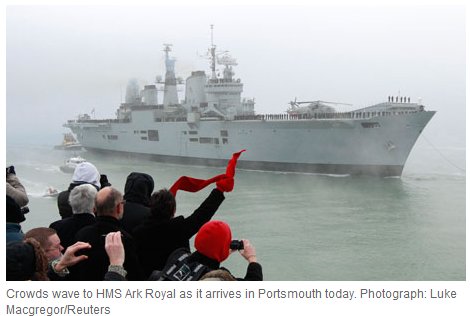
HMS Ark Royal arrives in Portsmouth to be decommissioned

Filed under: Britain, Military — Tags: , — Nicholas @ 11:06

Steven Morris was there as HMS Ark Royal arrived back at her home port for the final time:

The music was corny: a Royal Marines band was belting out a version of the Rod Stewart hit Sailing as HMS Ark Royal emerged from the freezing fog to tie up at her home port for the final time.

But the emotion was genuine enough. From the quarter deck to the frozen quayside, tough sailors gulped back tears at the end of a chapter in Britain’s proud naval history.

After a quarter of a century of service around the globe, the aircraft carrier is being decommissioned as part of the defence review. The former flagship’s future remains unclear. There has been talk that she could be turned into a museum, but that may be too expensive. It is more likely that she will be sold off or simply scrapped for parts.

“It’s very emotional,” said Leading Seaman Paul Stockell, one of those who had tears in his eyes — and not just because of the biting wind — as he helped bring the ship alongside in Portsmouth today.

December 1, 2010

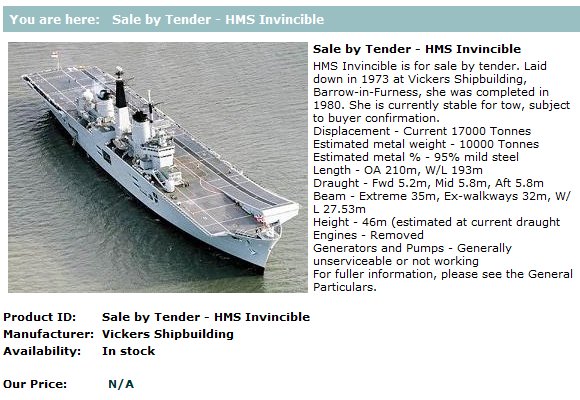
Want to buy (the remains of) an aircraft carrier?

Filed under: Britain, Environment, Military — Tags: , , — Nicholas @ 09:47

HMS Invincible is being disposed of:

Strategy Page has more:

Britain has put its decommissioned (in 2005) 20,000 ton aircraft carrier, HMS Invincible, up for auction at edisposals.com. Five years ago, the Royal Navy said that the ship would be held in reserve until September, 2010, for possible reactivation. That process would take 18 months. However, by last year, Invincible was in a sad state, with its many components removed, and tended to by a detachment of only four sailors. Thus the auction did not come as a big surprise, and the Royal Navy hopes to obtain at least $3 million for the old ship. The Invincible entered service in 1977, and normally carried 18 Sea Harrier vertical takeoff jets, four helicopters and a crew of 1,050. The Invincible underwent a refurbishment in 2004, but cuts in the navy budget forced retirement the next year. Invincible played a vital role in the 1982 Falklands campaign.

It’s not as easy as it used to be for navies to get rid of unwanted ships:

In the past, navies would send retired ships “to the breakers” and receive a portion of the value of the scrap metal obtained when the breakers (the firm the disassembles ships) finished their work. But this is no long profitable in many cases, because taking ships apart in an environmentally correct way costs too much. This has become a problem for navies, that have no easy way to get rid of old ships. The U.S. uses many old ships for target practice and lets them sink at sea. But even this practice is under attack because of potential environmental damage.

Update, 3 December: HMS Ark Royal has just arrived in Portsmouth to be paid off. It’s not clear if the British government will try to sell the ship or if she’s headed to the breaker’s yard.

November 29, 2010

“They’ve taken leave of their senses”

Filed under: Britain, Bureaucracy, Military — Tags: , , , — Nicholas @ 17:24

Con Coughlin was also aboard HMS Ark Royal for the final Harrier launch:

In many respects, it was an appropriate end to the glittering career of one of Britain’s most iconic warplanes. For none of the Royal Navy crewmen and women who braved the sub-zero temperatures were in much of a mood to celebrate the Harrier’s last appearance on the deck of a British aircraft carrier.

Most of them are still too shell-shocked over the Government’s decision to consign the entire Harrier fleet to the scrapheap, together with the Royal Navy flagship which has been the fighters’ proud host for nearly three decades.

“They’ve taken leave of their senses,” was one young rating’s verdict of the Government’s decision to scrap the Harriers and HMS Ark Royal. “You can’t get a better fighting combination than this, and yet they are sending us all to the scrapyard. They can find £7 billion to bail out Ireland, but they can’t find a few measly million to keep us going.”

I wonder what the bookies are offering for the British government to sell off the new carriers as they come off the launchways, rather than putting them into commission?

November 25, 2010

Video of the last Harrier flight from HMS Ark Royal

Filed under: Britain, Military — Tags: , , , — Nicholas @ 13:03

« Newer PostsOlder Posts »

Powered by WordPress


