Quotulatiousness

June 26, 2012

China’s aircraft carrier moves closer to operational status

Filed under: China, Military — Tags: , , — Nicholas @ 09:13

And update from Strategy Page on the Chinese aircraft carrier Shi Lang:

China’s first aircraft carrier, the Shi Lang (formerly the Russian Varyag), recently went to sea for the eighth time since it began sea trials last August. The latest trip is to last 13 days. The previous longest trip was last November 28, when the Shi Lang went out for 12 days. The first trip (last August 11) was for three days, most subsequent ones were for 9-11 days. So far, the Shi Lang has been at sea for ten weeks. All preparations have been made for flight operations, which have not taken place yet.

The Shi Lang has apparently performed well during these extended sea trials. Three months ago some aircraft were spotted on the flight deck. This was probably to make sure aircraft could be moved around the deck, and down to the hanger deck, without any problems. Last year China confirmed that the Shi Lang will primarily be a training carrier. The Chinese Navy is supposed to take possession of the Shi Lang later this year. The Chinese apparently plan to station up to 24 jet fighters and 26 helicopters on the Shi Lang.

[. . .]

China is believed to be building the first of several locally designed aircraft carriers but little is known of this project. The only official announcements have alluded to the need for two or three aircraft carriers, in addition to the Shi Lang. Construction of such large ships has not yet been seen in any shipyard.

Earlier posts on the Chinese carrier program are here.

June 17, 2012

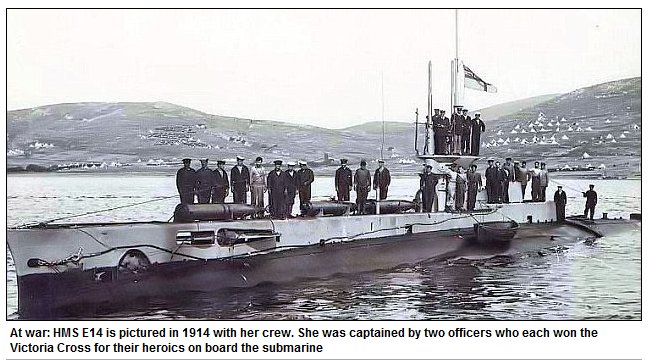
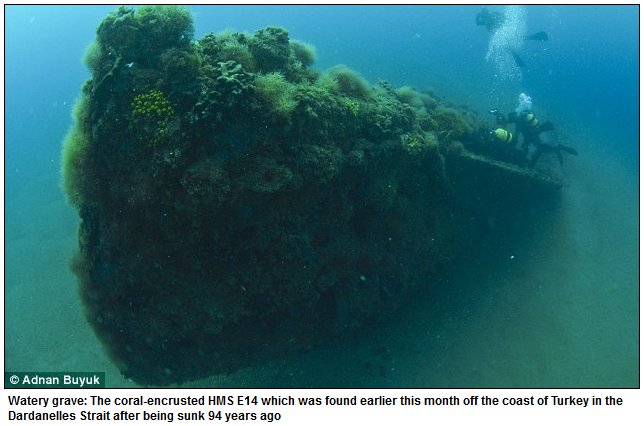
Royal Navy submarine wreck discovered in the Dardanelles

Filed under: Britain, History, Middle East, Military, WW1 — Tags: , , , — Nicholas @ 09:26

What appears to be the wreck of the E14 has been located just 800 feet offshore in the Straits of the Dardanelles:

Its precise location in the eastern Mediterranean remained a mystery until this month when a Turkish marine engineer and a diver detected it on the seabed off the town of Kumkale – just 800ft from the beach.

The wreck was discovered by marine expert Selçuk Kolay and film-making diver Savas Karakas, who had spent three years trying to find it.

After studying documents at the national Archives in Kew, west London, and surveying Turkish defences, they scanned an unusual object from a boat on the surface.

But they could not establish what it was because it was near the mouth of the straits — a sensitive military area where diving was forbidden.

It took two years to get permission from the military before their team were able to dive to the wreck and confirm it was the E14 earlier this month.

June 16, 2012

Sometimes the navy gets far more use out of a ship than they expect

Filed under: Britain, Europe, History, Military, Russia, USA, WW1, WW2 — Tags: , , , — Nicholas @ 10:12

Strategy Page on some extremely old ships still in service in various navies:

Last year, the British Royal Navy retired its oldest warship still in service, the 4,700 ton HMS Caroline. This light cruiser entered service in 1914 and fought in the epic Battle of Jutland in 1916. After World War II, Caroline served as a training ship, mostly tied up at dockside. When decommissioned last year, the ship could no longer move under her own power.

The Caroline was not the only World War I warship still in service. Currently, the oldest ship still in service is the Russian salvage ship VMF Kommuna. This 2,500 ton catamaran was built in the Netherlands and entered service in 1915. Kommuna began service in the Czar’s navy, spent most of its career in the Soviet (communist) Navy, and now serves in the fleet of a democratic Russia. Originally designed to recover submarines that had sunk in shallow coastal waters, Kommuna remains in service to handle smaller submersibles, does it well and has been maintained over the decades to the point where it cheaper to keep the old girl operational, than to try and design and build a replacement.

Most navies would not want to bring attention to their oldest ship, especially if it was nearly a century old. It’s different in the American Navy. For example, three years ago the carrier, USS Kitty Hawk (CV 63) was finally decommissioned, and ceased to be the oldest ship in the fleet. The Kitty Hawk served for 48 years and 13 days. In that time, about 100,000 sailors served on the ship. The ship was the navy’s last non-nuclear carrier and, since 1998, the oldest ship in commission. “The Hawk” did not age well, and had lots of breakdowns in its final years. This led members of the crew to nickname the ship; “Shitty Hawk”.

May 30, 2012

The end of the “predictable” China

Filed under: China, Economics, Military, Politics, USA — Tags: , , , , , — Nicholas @ 10:03

Robert D. Kaplan on the end of an era in geopolitical calculations:

The United States has had it easy over the past third of a century in regards to China. Washington has been able to proclaim moral superiority over the Communist Party dictatorship in Beijing, even as those very dictators provided Washington with a stable, businesslike relationship that fostered immense opportunities for American companies in China and for the American economy overall. China’s rulers, ever since Deng Xiaoping consolidated power in 1978, may have been nominally communists, but they have also been professionals and technocrats who have ruled in a self-effacing, collegial style. Yes, they may oppress dissidents, but they have also been enlightened autocrats by the standards of the suffocating rulers who have governed in the Middle East.

But the purging of the pseudo populist boss of the megacity of Chongqing, Bo Xilai, may indicate that a less predictable period in Chinese politics lies ahead. Bo was something not seen in China since Mao Zedong: a leader with real charisma. Bo may indicate that the age of the technocrats will give way to the age of politicians — and politicians, even in liberal democracies, exploit people’s emotions. That could lead to more erratic, nationalistic rulers.

[. . .]

China’s autocrats have for many years been nervously riding a domestic tiger. With communism no longer a philosophical organizing principle for the state, they have had to justify their rule by delivering double-digit annual economic growth — or close to that — to provide jobs for a potentially restive younger generation. Thus, even while China has amassed impressive new air and sea power, it has — by and large — not tried to employ that power in a particularly hostile way. China’s communist rulers have had too much domestically to worry about without creating new problems for themselves by constantly challenging the United States or its allies on the high seas. While China’s push to acquire air-sea power most specifically dates to 1996, when Beijing was humiliated by Washington’s ability to drive two aircraft carrier strike groups through waters near the Taiwan Strait, the building of a substantial air force and navy have so far been part of the natural, organic process of a new and rising great power. At least so far, it has not been particularly destabilizing to the world or regional order, unlike Iran’s push to develop a nuclear capability as part of a drive for Near Eastern leadership. China’s rulers may be dictatorial, but they are not radical and messianic.

New in the battle against Somali pirates: private convoys

Filed under: Africa, Middle East, Military — Tags: , , , , — Nicholas @ 09:40

At the BBC News site, Martin Plaut reports on the latest attempt to quell piracy off the shores of Somalia:

Off the pirate-infested waters of Somalia, a new force is taking shape.

The private company Typhon is preparing to operate alongside the world’s navies, offering protection to cargo vessels sailing around the Horn of Africa.

But unlike other private security firms which put guards on board other people’s ships, it will offer vessels of its own.

The chief executive of Typhon, Anthony Sharpe, says the plan is to rendezvous with cargo ships which sign up for their protection and form them into a convoy.

The company says it will establish what it is describing as an exclusion zone of one kilometre around the ships.

The company is buying three boats, which are currently being fitted out in Singapore.

Each of its craft will have up to 40 security officers, drawn from former British Royal Marines, as well as a crew of 20.

The ships will be fitted with machine guns and the staff will have rifles.

May 29, 2012

A review of the War of 1812 (non-Canadian-centric version)

Filed under: Britain, Cancon, History, Military, USA — Tags: , , , , — Nicholas @ 00:08

The DiploMad appears to be blogging again, and for proof, here’s a neat little capsule of the War of 1812 without the Canadian aspect being treated as the most significant campaigning area of the war:

The war was brought about by British arrogance and American stupidity. The British were not reconciled to an independent United States, and could not take the place and its bombastic pronouncements about liberty seriously. They basically ignored the USA’s assertion of being a sovereign state, and proceeded to treat American ships and seaman as some sort of Brits gone rogue. The USA, for its part, could not understand that the British were in what they saw as a life-and-death struggle with Napoleon Bonaparte. We did not respect that. We reckoned we could trade and make deals with France, such as the spectacular Louisiana Purchase which filled Napoleon’s coffers and served his aim of helping create a huge potential rival to Britain, without raising British concerns or provoking them into action.

[. . .]

The British, despite the war in Europe managed to put together a more than credible military and naval force against the distant United States. The Americans, in turn, showed a talent that would serve us well in future wars by getting our act together at the last minute and putting on a damn good defense of the country. The US army, however, remained plainly horrendous throughout the war with its corrupt and politicized officer corps, and its half-baked, ill-planned and even worse executed invasion of Canada. The US also set the precedent of burning York — today’s Toronto — which led to the British burning of the nascent US capital which the army failed to defend. The army partially redeemed itself in the Battle of New Orleans, under the otherwise reprehensible Andrew Jackson (Note: Why is he on our $20 bill?)

The US navy, however, proved completely different, and did an amazing job of fighting off the much larger British navy, wreaking havoc on it, carrying the war into British waters, and even eliciting a warning from the Admiralty to the Royal Navy to avoid one-on-one combat with US ships. The US navy also fought a superb campaign on the Great Lakes which resulted in the British fleet withdrawing from those waters.

Minor quibble: the Royal Navy withdrew from Lake Erie, not from all the Great Lakes. Lake Ontario was still the scene of a major fleet-building contest with vessels of up to 130 guns under construction or entering service when the war ended.

May 23, 2012

The US Navy’s Littoral Combat Ship and the future of the surface fleet

Filed under: Military, USA — Tags: , — Nicholas @ 00:08

There’s an “after-action report” from the Cato Institute’s recent panel on the Future of the Navy Surface Fleet:

Yesterday’s event on the U.S. Navy was a big success and generated a vigorous discussion. Ben Freeman from POGO spelled out his concerns about the littoral combat ship, specifically the Freedom (LCS-1) (documented here and here) and CBO’s Eric Labs raised a few additional ones pertaining to the program as whole. Under Secretary of the Navy Robert Work delivered an impassioned defense of the LCS within the context of the entire fleet design, drawing on examples from history to demonstrate how the Navy learns and adapts. Consistent with past practice, Work is confident that the fleet will put the LCS through the paces—two completely different ships—and figure out how to use them.

It was refreshing to engage in a serious discussion among people who are committed to a Navy that is second-to-none, and who care enough to raise questions designed to make it stronger. I focused my remarks on the LCS’s operating characteristics, but especially on the decision to buy two different LCS types. The original plan was for the Navy to select just one. The advantage of having two ships, Work stressed, was that the Navy would learn about each vessel’s unique capabilities. The disadvantage, as I see it, is the loss of economies of scale, including in parts, logistics and training.

[. . .]

Second, I seriously doubt that the Navy’s shipbuilding budget will grow very much even if Mitt Romney is elected president, and it certainly won’t grow enough to obviate any discussion of trade offs between different ships. Even if the Navy is handed billions or tens of billions of dollars more for shipbuilding, it is still the case that every ship that we build, or every new one proposed, is competing against one another. There are always opportunity costs, even when the topline budget grows. Navy warships compete against aircraft carriers. Navy surface ships compete with submarines. And the Navy competes with the Air Force. And the Air Force and Navy compete with the Army, etc.

For now, the Navy has chosen the LCS over possible alternatives. But there are alternatives. Eric Labs authored a good study a few years ago looking at the Coast Guard’s national security cutters (.pdf), but stated yesterday that the NSCs would be more costly than the LCSs. In the paper, “Budgetary Savings from Military Restraint,” Ben Friedman and I suggested retaining the Perry-class frigates for a few more years while we develop a different ship, perhaps a new class of frigates or corvettes that could do many of the same missions that the LCS is expected to perform, and, we believe, at less cost. At yesterday’s forum, Under Secretary Work stated that we could not purchase a new frigate for less than $750 million. While I respect the Under’s expertise, I plan to spend some time over the coming months scrutinizing that claim.

May 22, 2012

Spanish navy faces cuts

Filed under: Europe, Military — Tags: , , — Nicholas @ 09:29

Strategy Page on the plight of the Spanish navy in the current tough economic climate:

Forced to deal with continuing budget reductions, the Spanish Navy (Armada Españolais) is preparing to put six frigates and their only aircraft carrier into storage. Many naval commanders are opposed to this and as a compromise the ships will first be put on “restricted duty” and then as they lose their crews (to more budget cuts) they will shift to “reserve” status. These seven ships will probably never return to active duty once this process begins. If the naval budget keeps shrinking, it will begin.

Since their housing bubble burst in 2008, Spain has been suffering a sustained economic recession. So far the defense budget has been hit by cuts amounting to 25 percent a year. Unless the economy makes a dramatic turnaround, the navy budget will keep shrinking.

[. . .]

The carrier Principe de Asturias entered service in the late 1980s. It has been overdue for a $500 million refurbishment. This 16,700 ton ship can operate up to 29 fixed wing (vertical take-off Harriers) and helicopter aircraft.

May 21, 2012

The US Navy’s “brown water” sailors get re-assigned

Filed under: Middle East, Military — Tags: , , , — Nicholas @ 08:57

The US Navy had a problem in Iraq, which they addressed by setting up some squadrons of “brown water” riverine craft. Now that they’re no longer required in Iraq’s rivers and coastal areas, the question of what to do with these units needed to be answered:

The U.S. Navy has decided what to do with its “brown water navy,” including three Riverine Squadrons, now that they have no overseas assignment. The coastal and river force sailors are going to be divided between bases on the U.S. east and west coasts. There they assist with coastal and river patrol duties. The riverine force contains 2,500 active duty and 2,000 reserve sailors. There will also be opportunities for training with riverine forces of other countries, particularly in the Americas.

Organized for service in Iraq, the three riverine squadrons were rotated in and out of Iraq from 2007 to 2011. Before first arriving in Iraq the riverine sailors received lots of infantry and amphibious training, much of it provided by U.S. Marine Corps instructors. Until 2007, the army and marines had been providing most of the riverine units in Iraq. There are some sailors there as well, but not as organized riverine units. In 2005 the navy established Riverine Group One, which eventually had three squadrons (each with 230 sailors and twelve 12.5 meter/39 foot boats). With headquarters and support troops, the group had 900 personnel and 36 armed boats. Each boat has a crew of sixteen and is armed with machine-guns and automatic grenade launchers.

The navy riverine forces eliminated terrorist movements along, and across, the main rivers in Iraq. This was similar to the successful riverine campaign the navy waged in Vietnam four decades ago, using 16 meter (50 foot) “Swift” boats.

May 16, 2012

Disruptive technologies and naval warfare

Filed under: Military, Technology — Tags: , , — Nicholas @ 09:28

Naval warfare has seen several revolutions as new technology disrupts the status quo. The pace of innovation has meant shorter spans of time between revolutionary developments, and this is a serious problem for naval powers as ships take so long to build and have to serve for lengthy periods of time.

Last year, I posted an article about how the Royal Navy had attempted to ride the technological changes during the Victorian era, with varying levels of success:

Fifty years later, the stasis is being broken technologically. Wind power is giving way to steam. Solid shell cannon are starting to give way to both larger and more complex weapons. Iron is starting to supplant oak as the material of choice for shipbuilding. The renowned duel between USS Monitor and CSS Virginia (formerly the USS Merrimac) sets all the major navies of the world busy considering how to protect their existing fleets and merchant vessels against the new threat of the ironclad.

The English government is suddenly faced with the stark reality that their entire fleet has become or is about to become obsolete. Neither Monitor nor Virginia are ocean-going ships, but the message is clear that no wooden vessel has a prayer of survival against the modern steam-powered ironclad. And even the greatest economic power in the world can’t replace an entire fleet overnight.

The Admiralty couldn’t depend on past experience for guidance, as everything they’d done for hundreds of years was now undecided: what kind of ships do you need to build? How will they be armed? How will they be armoured? How will they be propelled? Bureaucracies are, by nature, not well equipped to face challenges like this. The Royal Navy, from the late 1860′s until the late 1880′s struggled with finding the correct answer, or combination of answers, to meet the needs of the day.

It’s not just a single change — like the switch from sail to steam power — it’s multiple changes, each with their own array of materials, training, support, and maintenance changes that force organizations to adapt. This runs directly into the problem that it takes years to design, build, arm, equip, and crew a new ship. The pace of change was so brisk in that period that ships could literally be obsolete before they were commissioned into the fleet. And bureaucracies are by their very nature, ill-suited to cope with disruptive change: they thrive on routine and predictability.

Today, the US Navy finds itself in the same relative situation as the Royal Navy of Queen Victoria: the most powerful fleet in the world, but facing uncertainty due to technological changes. Strategy Page has a brief run-down of the potentially disruptive developments we may see in the near future:

The 21st century is barely underway, and much unknown technology is yet to be invented. Many of the key warship technologies were unknown in 1912. But we can already see some new stuff which is leading revolutionary changes in how navies will operate this century. Here some of the more obvious ones.

Unmanned vehicles. Unlike aircraft, which were a new vehicle, UAVs (Unmanned Aerial Vehicles), UUVs (Unmanned Underwater Vehicles) and USVs (Unmanned Surface Vehicles) are radically new technologies. There are already examples of all three in service. There will be more and they will change everything by incorporating more powerful AI and new weapons. That said, UUVs were first developed in the 19th century (the modern torpedo) and 20th (guided missiles). But these two weapons were not flexible enough to change as many aspects of naval warfare as unmanned vehicles will be doing.

Super Sensors. Sonar (using sound to detect objects underwater) appeared during World War I (1914-18) while radar (using radio signals to detect objects in the air) was developed during the 1930s and widely used during World War II (1939-45). Widely recognized as the first electronic sensors (although the earliest sonars were all-acoustic), their 21st century descendants are much more capable. More powerful computers and transmitting technology has since produced several generations of cheaper, more reliable and more powerful sensors. This is continuing and the power of new sensors will make it much more difficult to hide. Stealth is still important for spoiling the aim of long range guided weapons. But the super sensors make it much more difficult to achieve surprise by coming out of nowhere.

Other items on this list include artificial intelligence (AI), all-electric ships, stealth technology, networking, composite materials, space-based services, nanotech, and laser weapons. Lots of ways for admirals to lose sleep over the next few years.

May 13, 2012

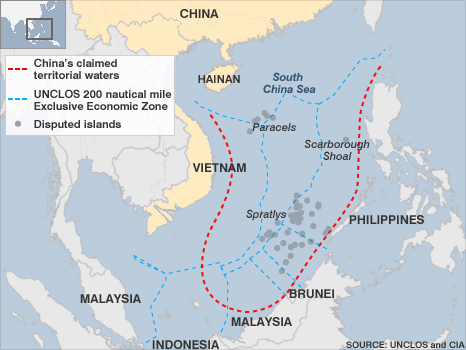
China increases their naval presence near Scarborough Shoal

Filed under: China, Military, Pacific — Tags: , , — Nicholas @ 10:32

I posted an item last month about the stand-off between the Chinese People’s Liberation Army Navy (PLAN) and the Philippine ship BRP Gregorio del Pilar (a former USCG cutter) in the Scarborough Shoal. Now there’s a report from Hong Kong’s largest English-language newspaper that China is sending another flotilla to the area:

China has sent five warships to the disputed Scarborough Shoal off the west coast of the Philippines with the warning that Beijing is ready for “any escalation” of the conflict.

That comes as the outgunned Philippines looks to the United States for naval support in South China Sea territory that may be rich in energy sources.

The five warships are said to be among the most advanced vessels in the Chinese fleet.

They include ships with state-of-the-art systems against attack from the sky, while one is an assault ship that carries 20 amphibious tanks and specialized fighting teams among 800 personnel.

Japanese surveillance aircraft saw the flotilla west of Okinawa and sailing south on Sunday.

Without American support, the Philippine navy is completely out-classed by the PLAN (aside from a large number of in-shore patrol craft, there are only 14 combat-capable ships). And it’s not clear that the US will want to escalate tension at this moment, especially over something like the Scarborough Shoal.

H/T to David Akin for the link.

May 12, 2012

US Postal Service develops a lithium allergy

Filed under: Military, Technology, USA — Tags: , , , — Nicholas @ 08:34

The United States Postal Service has announced that they will no longer allow shipments that include lithium batteries, as of May 16th:

If you want to send an iPad, a Kindle Fire, an iPhone, a laptop, or a similar device overseas, now is the time to send it, because as of next week, the U.S. Postal Service will be banning all electronic gadgets that contain a lithium battery.

The reason? Those lithium batteries can potentially explode or catch fire when devices are shipped with a full charge, improperly stored, or improperly packed. Lithium battery related fire incidents have occurred 17 times on passenger flights since 2004, and have been implicated in at least one major crash of a UPS plane.

As a result of the ban, people who want to ship electronic devices to troops or to family overseas will have to use a private delivery service, such as UPS, DHL, and FedEx, which are pricy alternatives.

[. . .]

USPS’s refusal to ship devices with lithium batteries will have the greatest impact on military serving overseas (DHL and UPS do not deliver to APO or FPO boxes) and commercial resellers, who will have to increase shipping costs and rely on FedEx, DHL, and UPS, which still have challenges in countries like Russia.

May 10, 2012

British aircraft carriers to be equipped with F-35B in policy reversal

Filed under: Britain, Military — Tags: , , , — Nicholas @ 10:30

The two Queen Elizabeth class aircraft carriers being built for the Royal Navy were originally to be equipped with F-35B model which can operate in VTOL mode (like the Harriers used on HMS Ark Royal up to her retirement). This was deemed to be too expensive, so the British government ordered the carriers to be retro-fitted with catapults and conventional landing equipment so the RN could use the (relatively) cheaper F-35C.

The plan has now been revised back to the original:

The Ministry of Defence is to abandon plans to buy the preferred fighter for the Royal Navy’s new aircraft carriers, in an embarrassing U-turn for David Cameron.

The prime minister personally endorsed the decision to equip the over-budget carriers with “cats and traps” so they could catapult and recover a version of the F-35 joint strike fighter (JSF) from their decks.

But the cost of converting the carriers has already reached £2bn, and the JSF model Downing Street wanted has been beset by delays and technical problems.

The aircraft will now not be ready until 2023 at the earliest, forcing the government to revert to Labour’s original plans to buy the less capable jump jet model.

Philip Hammond, the defence secretary, is due to make an announcement in the Commons on Thursday explaining the about-face, which was approved by the National Security Council on Tuesday.

It should be no surprise at all that Lewis Page is ready to call this decision idiotic (and he’s almost certainly right):

It’s well known that the F-35B will cost a lot more to buy and more to run than the F-35C catapult version: and it’s also well known that the main cost of aircraft carriers is not the ships but the planes. So, right out of the gate, we can see that this is a foolish decision.

In fact it’s a lot worse than it seems, as the contest in real life was not between the F-35B and the F-35C: it was between the F-35B and — for the immediate future — one or another cheap, powerful, modern carrier jet already in service. This would most most likely have been the F-18 Hornet as used by the US Navy and many other air forces around the globe, but possibly the French Rafale instead of or alongside Hornets.

In fact the UK will not be able to afford either the F-35B or the F-35C in any large numbers any time soon. Both planes are, after all, brand new supersonic stealth aircraft — only the second make of supersonic stealth aircraft ever built, in fact, and the first ever which can land on ships. They are brand new, bleeding edge kit and will cost accordingly. Both planes are still in flight test at the moment, in fact, and the F-35 programme as a whole has suffered serious cost and time overruns. This has led to delays to US orders, which have in turn pushed up costs for other early purchasers. Production is still at a low rate only.

Thus, if the Royal Navy had managed to get its hands on a catapult carrier, it would have been compelled (very happily!) to buy or lease an interim carrier jet to tide it over until a reasonable number of F-35Cs could be bought for a reasonable price — probably at some point in the 2020s. There would be no need for a full force of F-35Cs any sooner than the 2030s, by which point they would be affordable and there might be a real need for their stealth and other advanced capabilities.

May 5, 2012

HMS Ocean heads up the Thames for Olympic security exercise

Filed under: Britain, Military — Tags: , , , , — Nicholas @ 12:15

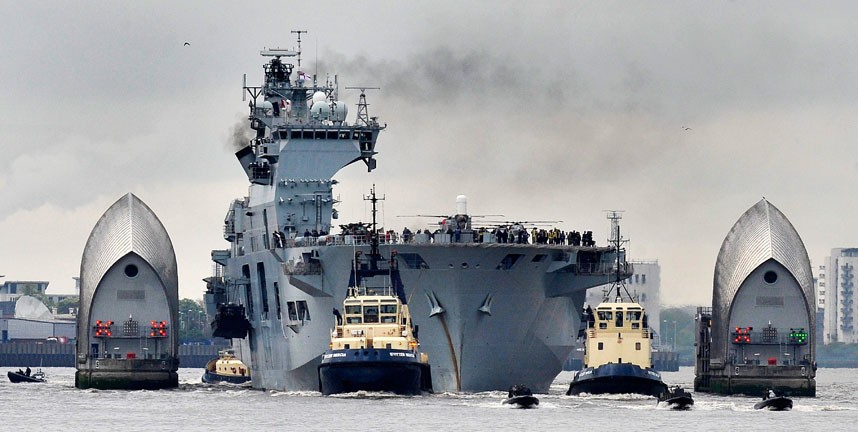
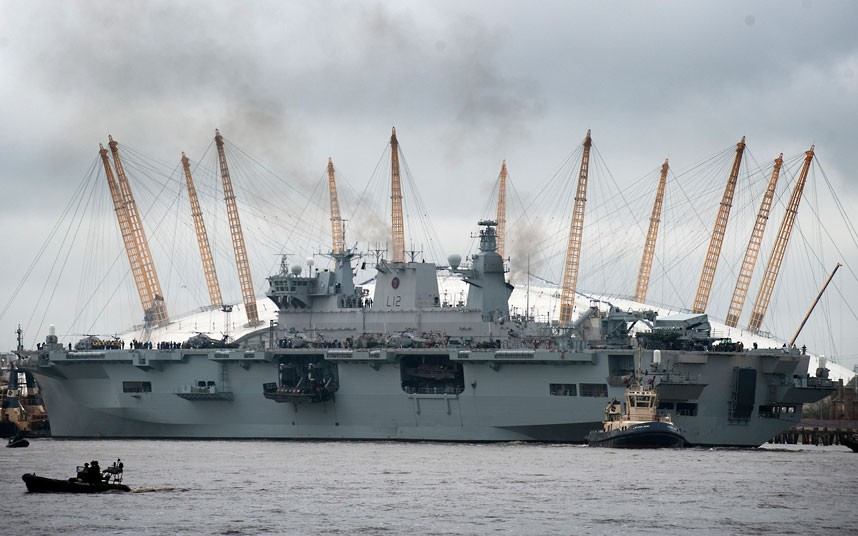
An interesting set of photos in the Telegraph showing the Royal Navy’s largest ship, helicopter carrier HMS Ocean being brought up the Thames for a security exercise in advance of the London Olympics:


A tight squeeze as the tugs work HMS Ocean through the Thames Barrier


HMS Ocean passes in front of the O2 Arena on her way up the Thames

April 28, 2012

The eternal problem of “sea blindness”

Filed under: Britain, Military, Technology, USA — Tags: , — Nicholas @ 16:34

Unlike armies which used to be raised at the drop of a hat (relatively speaking), navies have always been slower to grow at times of need. To build an army in the pre-nuclear age, you called up all your young men, gave them the absolute minimum of training and there’s your army. It might not be particularly capable, but an army it was. You could call up as many men as you liked for your navy, but without the ships and a significantly larger proportion of trained officers and petty officers, you don’t have a navy.

Navies take time to build, and in peacetime few nations are willing to support the kind of naval establishment they may need in wartime. Sir Humphrey at the Thin Pinstriped Line discusses this age-long phenomenon of “sea blindness”:

The first question that comes to mind is ‘what is Sea Blindness’? Arguably it simply means that the public, and by extension Governments of nations do not understand the maritime domain, and do not understand the case for the maritime domain – not just from a military, but also from a wider sector perspective. Personally this author dislikes this term, as it implies a state of permanence towards the public view of the sea. The phrase implies that there is no cure to the notion that the public will never understand the maritime case, and that instead it is the role of senior leaders in the maritime community to act as guides or aids to a public which will never understand the importance of maritime power.

The next question is surely, has the public ever not been sea blind? Arguably since time immemorial the public have been unwilling to support the long term interests of the maritime case – one can only look back through history at the maritime wars fought by the UK, and other nations, and see cases of weak defences needing bolstering at a desperate hour. Conversely, the major combat indicator of a potential threat has often come through the augmenting or enhancing of fleets in other nations. It is rare through history to find examples of nations maintaining powerful fleets in a state of permanent existence – rather it is the case that great fleets are maintained only for the duration of a crisis and thereafter disposed of. Simply look to the case of the Royal Navy after the Napoleonic Wars, where the manpower was disposed of and ships returned to the Reserve. It seems fair to argue that the public have no interest in funding a great fleet when there is no threat – the demands on their pockets are simply too great to bear.

[. . .]

More broadly, this author would argue that ‘Sea Blindness’ when it comes to understanding the maritime domain is not a new condition – people have historically not understood the dependency that humanity has on the sea. In reality, although the UK is an island, very few people relatively speaking actively involve themselves in maritime matters. Outside of the small fishing / trading community, or those who work in the maritime support sector, it is probably fair to argue that most people simply don’t have the professional links to see the sea for what it is – an essential gateway to prosperity and survival. But then again, one could make the argument that few people really investigate or seek to understand the many different networks, links or dependencies that nations have on all manner of objects, trade and supplies. It’s likely that few people in the UK knew that the IT industry was reliant on factories in Thailand to make hard drives until the floods damaged production and prices soared. Similarly the automobile industry is struggling after a fire in a factory in Germany shut down production of resin, reducing the ability to make cars globally. The reality is that we live in an interdependent world on many fronts, but it is so complicated, and so networked that it is almost too difficult to follow.

« Newer PostsOlder Posts »

Powered by WordPress