Quotulatiousness

August 29, 2013

The US Navy’s overstretch

Filed under: Middle East, Military, USA — Tags: , , — Nicholas @ 00:01

Sir Humphrey points out that the Syrian situation actually shows how thin the US Navy’s resources have become:

This crisis has been dominated by impressive images of US warships firing cruise missiles, and maps showing large warships steaming menacingly in the Eastern Med. Publicly we know that four USN escorts are currently in the region, each armed with a significant quantity of missiles. What is so striking though is how this illustrates just how thinly stretched the USN is these days. Until the end of the Cold War, the Med was practically a British, then US lake. Dominated by naval bases, and home to large numbers of carriers, escorts and other vessels, any crisis would quickly have seen an almost overwhelming concentration of US firepower.

Today, the 6th Fleet has no permanently assigned escorts, and is instead reliant on other vessels transiting the area. At present it seems that three US vessels were in the area (although it is unclear I they were taken off other tasks) and one more has joined them. This is the totality of the US escort fleet in the Med (and quite possibly Europe as a whole). It is telling that there is no carrier deployed in the AOR, and that the next nearest escorts and Carrier are deployed in the Gulf. Although they could move, this would leave the Arabian Gulf without a carrier, and it is questionable whether any commander would be willing to see a CVN conduct a Suez transit right now, particularly if strikes against Syria are occurring. Partly this is a result of fewer ships, and also an impact of sequestration, where planned deployments were cancelled. The harsh reality though is that US naval power has been heavily emasculated — claims of the Med being a US lake are simply no longer true.

The worry is that this problem is only going to get worse with time; the USN faces a major challenge in keeping hull numbers up, and more importantly maintained to a reasonable level. The challenge of handling major budget cuts is that this sort of presence will inevitably be reduced. So, perhaps closer attention should be paid to how the US is meeting the response, as this is likely to be the sort of thing we’ll see in future — not overwhelming numbers of ships and aircraft, but a small number of escorts, taken off other tasks in order to do the job. One lesson is clear — the USN remains an immensely potent navy, but its ability to project the sort of power that the world is used to is perhaps far less than many realise.
August 28, 2013

Military deployments near Syria

Filed under: Middle East, Military, USA — Tags: , , , , — Nicholas @ 08:31

Zero Hedge passes on a bit of analysis from Stratfor:

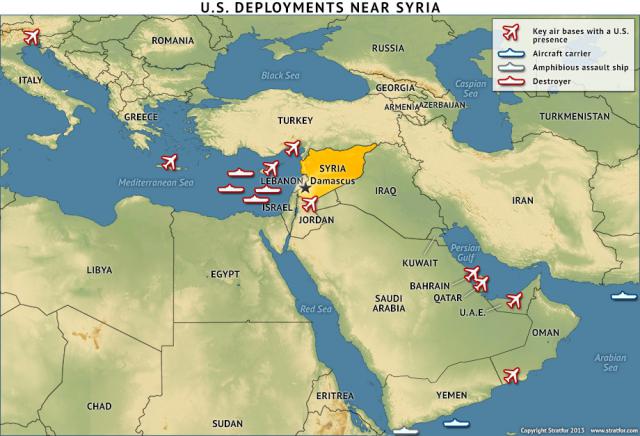
In the event of a punitive strike or a limited operation to reduce Syrian President Bashar al Assad’s chemical weapons delivery capability — for instance, by targeting key command and control facilities, main air bases and known artillery sites — the United States already has enough forces positioned to commence operations.

US deployments near Syria 20130828

Four Arleigh Burke-class destroyers — and probably a nuclear-powered cruise missile submarine — are already within Tomahawk cruise missile range of Syrian targets. In addition, the United States can call upon strategic bombers based in the continental United States as well as B-1 bombers from Al Udeid Air Base in Qatar. In such an operation, the United States would be able to carry out standoff attacks beyond the range of Syrian air defenses, while B-2 bombers could stealthily penetrate the Syrian air defense network to drop bunker-busting bombs with minimal risk.

Considering that al Assad’s forces have a number of ways to deliver chemical weapons, ranging from air power to basic tube and rocket artillery, an operation that seeks to degrade the regime’s ability to launch chemical weapons would necessarily be far wider in scope and scale. This means tactical aviation would have to play a key role in such a campaign, which in turn would entail the deployment of significant enabler aircraft such as aerial refueling tankers and intelligence, surveillance and reconnaissance assets.

In addition, as reported the other day, the French carrier Charles de Gaulle has been ordered to move east from Toulon and the British are reported to have a nuclear submarine in the region as well.

Update: The Iranian Farsnews site says the US military will be in for a serious defeat if they attack Syria.

Syria’s supersonic and anti-ship missiles as well as the Lebanese Hezbollah movement will inflict astonishing damage on any invading force, specially the US Navy’s giant warships, an expert said, adding that the missile capability is working as a deterrent to a US naval attack on Syria.

“The supersonic and long-range anti-ship Yakhont missiles of the Syrian army and the Lebanese Hezbollah (resistance movement) are serious deterrents to a US naval attack by its warships in the Mediterranean Sea,” Dr. Mostafa Zahra, a military analyst and strategic studies expert, told FNA on Monday.

He said that Syria’s Iskandar high-precision ballistic missiles and its anti-ship Scud missiles will also target the US warships in case of a US naval invasion of Syria, reminding that the American military vessels are not equipped with any weapons system to intercept or divert the Syrian anti-ship missiles.

Did you hear that, Great Satan? “Astonishing damage“. You’d better back off now, infidel.

August 26, 2013

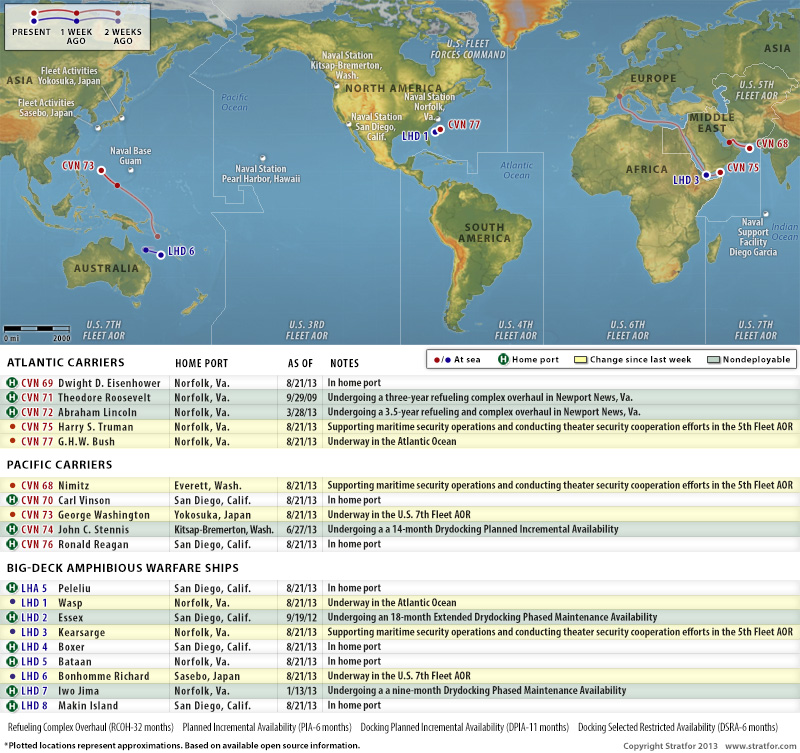
Suddenly of greater interest to the media – where are the carriers now?

Filed under: Britain, France, Middle East, Military, USA — Tags: , , , , — Nicholas @ 08:39

Zero Hedge pulled a quick summary of US, French, and British naval units in light of the rumours of some kind of attack on Syria:

  • A U.S. military source said on Friday the U.S. Navy was increasing its number of cruise missile-carrying destroyers in the Mediterranean to four from three by delaying the return to the United States of the Arleigh Burke class destroyer USS Mahan.
  • The aircraft carrier USS Harry S Truman, by far the most powerful warship in the region, left the Mediterranean last weekend, passing through the Suez Canal into the Red Sea.
  • Defence experts say the carrier could still strike Syria from south of Suez. As well as the strike aircraft carried by the Truman, several of her escort ships are also capable of firing Tomahawk land attack cruise missiles.
  • Since earlier this year, the United States has also had F-16 jets in Jordan, where they remained after a major military exercise this year at the request of the Jordanian government. It also has a major air base at Incirlik in Turkey that could easily house multiple aircraft as part of a wider military campaign.

Carrier locations - late August 2013

The French aircraft carrier Charles de Gaulle is still in or near Toulon, while the Royal Navy is said to have at least one Trafalgar or Astute class submarines in the Mediterranian. The RN no longer has in-service aircraft carriers, so any British air support would have to be from the RAF, possibly based in Cyprus (but subject to local government approval).

Update: This report says that the USS Ramage is also being retained in the Mediterranean along with the USS Mahan.

Update, 27 August: It was just mentioned (no link) that the Charles de Gaulle has been ordered to leave port, bound for the Eastern Mediterranean.

August 19, 2013

US Navy’s littoral combat ship (LCS) program under budget threat

Filed under: Military, USA — Tags: , , — Nicholas @ 12:42

The US Navy is betting big on the eventual success of their Littoral Combat Ship program despite the early teething troubles (earlier posts here and here). The more traditional hull design (there are two distinct designs in the same class) is being built by Wisconsin’s Marinette Marine, as a subcontractor to Lockheed-Martin. The Milwaukee Journal Sentinel reports on the latest political hitch in the program:

The littoral program has been dogged by problems, including early cost overruns. The completed ships have suffered from mechanical problems as well as from delays in producing switchable mission modules aimed at making the ships adaptable to varied types of warfare.

Testing has revealed deficiencies with “core ship systems,” according to the July 25 GAO report, which says Congress should consider restricting funding for additional littoral combat ships until the Navy completes technical and design studies.

Littoral combat ships are meant to be fast and capable of operating in shallow waters close to shore in places such as the Persian Gulf.

“We continue to believe that the acquisition approach for this program, with large quantities of ships and modules being bought ahead of key test events, is risky, especially for a new class of ship like LCS,” Paul Francis, a GAO official, said in recent testimony before a House of Representatives subcommittee looking into the program.

“The current LCS program is not the program envisioned over a decade ago,” Francis said, adding the Navy still doesn’t know how well the ships will perform their missions, how well the unique crew and maintenance concepts will work, or how much it will cost to equip and support the ships.

Further, the Navy is still considering changes to the ships and determining whether there are advantages to having two radically different designs — one built by Lockheed and Marinette, and the other by Austal USA in Mobile, Ala.

“These are things the Navy and Congress should know before contracting for more than half of the ships,” Francis said.


USS Freedom at sea. Click for full-sized image at Wikipedia

August 17, 2013

Delays in India’s submarine program

Filed under: India, Military, Technology — Tags: , , , — Nicholas @ 10:21

In the Times of India, Rajat Pandit reviews the state of the Indian Navy’s submarine fleet:

Is India’s aging fleet of conventional submarines threatening to go the MiG-21 way? The Tejas light combat aircraft (LCA), already 30 years in the making, was slated to replace the obsolete MiG-21 in the 1990s but is still at least two years away from becoming fully-operational.

Similarly, the Navy too was to induct 12 new diesel-electric submarines by last year, with another dozen to follow in the 2012-2030 timeframe. This was the 30-year submarine building plan approved by the Cabinet Committee on Security (CCS) way back in July, 1999. But the Navy has not inducted even one of the 24 planned submarines till now, and is forced to soldier on with just 14 aging conventional vessels.

“The Navy is steadily modernizing in the surface warship and aircraft arenas. But our aging and depleting underwater combat arm is a big worry. But it also must be kept in mind that INS Sindhurakshak‘s accident is the first such incident we have had in over four decades of operating submarines,” said a senior officer.

Sources said INS Sindhurakshak, after Wednesday’s accident, is “a clear write-off”. Of the 13 submarines left now, as many as 11 are over 20 years old. The setback comes when China and Pakistan are systematically bolstering their underwater combat capabilities, with the former being armed with over 55 submarines.

Update: MarineLink reports on the investigation into the INS Sindhurakshak explosion.

The Indian Navy diving teams have been working nonstop to reach into the compartments of the submarine since rescue operations commenced early noon of August 14. The boiling waters inside the submarine prevented any entry until noon that day. Access to the inner compartments of the submarine was made almost impossible due to jammed doors and hatches, distorted ladders, oily and muddy waters inside the submerged submarine resulting in total darkness and nil visibility within the submarine even with high power underwater lamps. Distorted and twisted metal within very restricted space due extensive internal damage caused by the explosion further worsened conditions for the divers. This resulted in very slow and labored progress. Only one diver could work at a time to clear the path to gain access. After 36 hours of continuous diving effort in these conditions, Navy divers have finally reached the second compartment behind the conning tower in the early hours of August 16.

Three bodies have been located and extricated from the submarine from this compartment. The bodies are severely disfigured and not identifiable due to severe burns. The bodies have been sent to INHS Asvini, the naval hospital, for possible DNA identification which is likely to take some more time.

The state of these two bodies and conditions within the submarine leads to firm conclusion that finding any surviving personnel within the submarine is unlikely.

August 14, 2013

Fatal explosion on Indian submarine

Filed under: India, Military — Tags: , , — Nicholas @ 11:21

A report from FirstPost.India on the worst naval disaster in Indian history:

The Indian Navy suffered a huge blow Wednesday when a frontline submarine exploded and sank here at dawn with 18 sailors after two explosions turned it into a deadly ball of fire.

The deep sea attack vessel INS Sindhurakshak, recently refurbished in Russia, suffered an unexplained explosion just after Tuesday midnight and an immediate deafening blast heard almost in the whole of south Mumbai.

Naval officials said the rapid spread of the blaze and the intensity of the explosions left the trapped 18 sailors, including three officers, with apparently no chance of escaping.

“We cannot rule out sabotage,” navy chief Admiral D.K. Joshi told the media after Defence Minister A.K. Antony visited the disaster site at the Mumbai naval dock.

“But indications at this point do not support the (sabotage) theory,” he said. “At this point of time we are unable to put a finger on what exactly could have gone wrong.”

An inquiry set up to probe the disaster will submit its report within four weeks.

The Indian Navy submarine INS Sindhurakshak (S 63) at anchorage off the port city of Mumbai, India

The Indian Navy submarine INS Sindhurakshak (S 63) at anchorage off the port city of Mumbai, India

The most recent update to the Wikipedia page says:

On 14 August 2013, the Sindhurakshak sank after explosions caused by a fire took place onboard when the submarine was docked at Mumbai. The fire, followed by a series of ordnance blasts on the armed submarine, occurred shortly after midnight. The fire was put out within two hours. It is unclear exactly what caused the fire. Due to damage from the explosions, the submarine sank at its berth with only a portion visible above the water surface.[10][14][15] Sailors on board reportedly jumped off to safety. Navy divers were also brought in as there was a possibility that 18 personnel were trapped inside. India’s defence minister confirmed that there were fatalities.[6]

Due to the explosion, the front section of the submarine was twisted, bent and crumpled, and water had entered the forward compartment. Another submarine, INS Sindhuratna, also sustained minor damage when the fire on Sindhurakshak caused its torpedoes to explode.[14][16] Defence minister A. K. Antony briefed the Prime Minister Manmohan Singh on the submarine incident, and would leave for Mumbai to visit the accident site.[17][18]

Official sources said it was “highly unlikely” the submarine could be returned to service.[19]

August 12, 2013

The controversy over Japan’s latest “destroyer”

Filed under: China, Japan, Military — Tags: , , — Nicholas @ 10:32

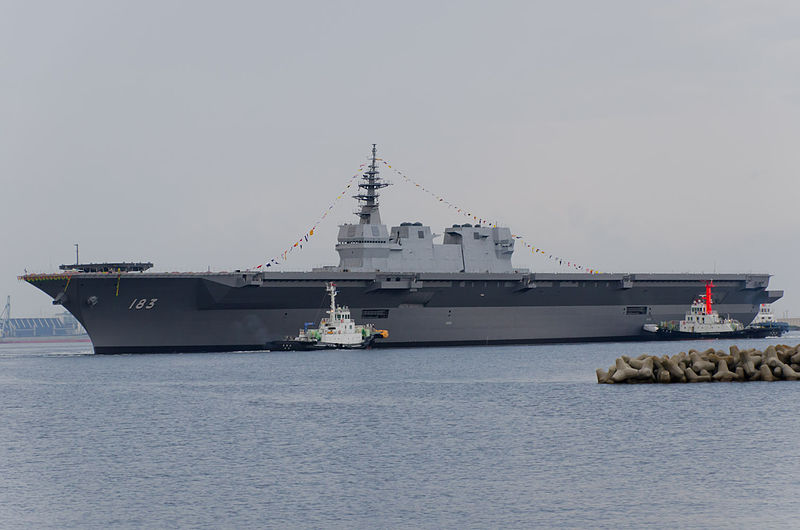
Apparently our eyes can deceive us. For most people looking at this image — at least if they know much about naval vessels — the description that comes to mind is “aircraft carrier”:

JS Izumo DDH-183

JS Izumo DDH-183

However, for constitutional reasons she is officially classified as a “destroyer”. In the South China Morning Post, Stefan Soesanto explains why this classification matters:

The Izumo‘s distinctive features certainly do not resemble anything one would typically classify as a destroyer. Indeed the warship currently under construction in Yokohama harbour is an aircraft carrier in anything but in name. Its size, tonnage and speed are closer to the US Essex aircraft carrier class, than to any of the two previous helicopter destroyers Japan has built so far.

At a cost of US$1.14 billion, the Izumo is officially conceptualised to host up to 14 helicopters whose missions would range from anti-submarine warfare and maritime border surveillance to humanitarian relief operations. In this regard, the Izumo‘s objectives are identical to the two Hyuga-class helicopter destroyers that were put into service in 2009 and 2011.

The current discussion among analysts and military brass as to whether Japan’s helicopter destroyers are considered aircraft carriers is not new. According to The Japan Times, Maritime Self-Defence Force chief of staff Admiral Keiji Akahoshi stated in 2009 that the Hyuga-class falls outside the conventional definition of an aircraft carrier because it lacks a fair degree of offensive functions. This argumentation has been notably employed by the Japanese government to circumvent Article 9 of the peace constitution to portray its helicopter destroyers as purely defensive military assets.

While Beijing’s criticism towards the Hyuga-class has been largely used as a means to support its own aircraft carrier expansion plans, the unveiling of the much larger Izumo has prompted widespread fears in China. Major Chinese media outlets went to great lengths to link Japan’s militaristic past to plans by the Japanese government towards constitutional revision. Indeed, the Chinese defence ministry even put out a statement saying that it is “concerned over Japan’s constant expansion of its military equipment”.

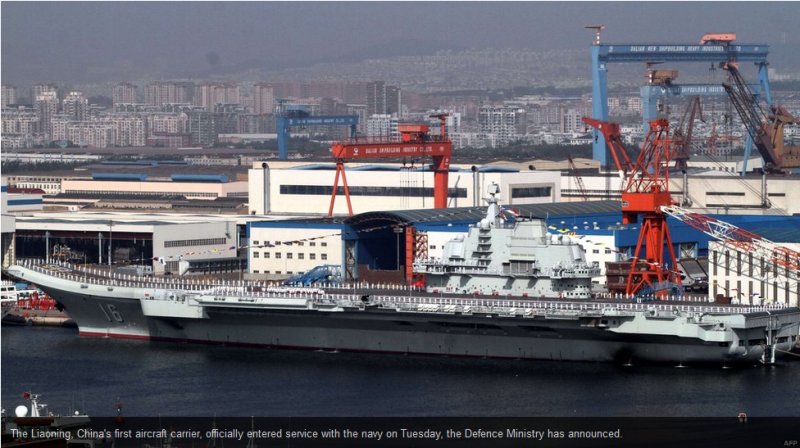
Reflecting on its own aircraft carrier plans, however, Chinese experts such as Li Daguang, professor at the National Defence University of the People’s Liberation Army, seem to make a simple leap of faith by suggesting that “the Chinese aircraft carrier Liaoning was mainly built for training purposes while the Izumo was built for real war”.

Of course, this isn’t a new thing, as a quick glance at the JS Hyūga also shouts “aircraft carrier” rather than “destroyer”:

JS  Hyūga

JS Hyūga

August 11, 2013

Debunking the “Cameron’s gunboat diplomacy” meme

Filed under: Britain, Europe, Media — Tags: , , , — Nicholas @ 09:22

Sir Humphrey points out that the British media’s collective gasp about Royal Navy ships being sent to Gibraltar merely highlights what a slow news month it is:

It’s an amusing irony that the recent row in Gibraltar has suddenly given the Royal Navy more publicity about its forthcoming COUGAR deployment in one evening, than it may have got in several months of deployment. The news that the Response Force Task Group (RFTG) is deploying to the Med has been seen as a clear example of gunboat diplomacy by Fleet Street’s finest, many of whom seem terribly keen on starting a war in order to fill column inches during a slow news month…

Its perhaps worth noting that this deployment is extremely long standing — the sort of planning which goes into deploying a major Task Force will usually commence at around 12 months prior to the event, when the rough outline of a plan is put together on the objectives of the deployment, likely ports, aims and intended outcomes and so on. While maritime power is about flexibility, it’s often forgotten that most RN deployments these days are the end product of months of well co-ordinated planning and staffing to ensure that the UK gets the best possible value from its naval assets.

[…]

What we can perhaps draw from this is that firstly the RN has enjoyed an unexpected boon of coverage, tapping into the nation’s subliminal psyche which holds that sending a grey hull is a key means of solving a crisis, no matter what or where the crisis is. There is perhaps work for some analysts to understand why, almost alone among all major powers, the cries of ‘send a gunboat’ seem to resonate most strongly in the UK (albeit to a lesser extent the same applies with the ‘send a carrier’ debate in the US). While deployments of warships can be seen as a useful indicator of interest in situations, it appears to be held most strongly in the UK — there is, at times, a fervent belief that deploying vessels is akin to the legend of waving the ancient banner three times in order for Arthur and his knights to appear — it makes little practical sense, but is somehow strangely comforting to the people.

August 6, 2013

Second Chinese aircraft carrier appears to be under construction

Filed under: China, Military — Tags: , — Nicholas @ 14:40

Strategy Page has the details:

Recent photos from a Chinese shipyard appear to show a section of a new Chinese aircraft carrier under construction. This appears to be a carrier similar to the American Nimitz class ships (100,000 ton vessels using a catapult rather than a ski jump flight deck for launching aircraft). Large ships, including warships, are often built in sections than the sections are welded and bolted together. The section of what appears to be a carrier does not indicate the exact size of the new carrier other than that it appears larger than the new carrier China commissioned at the end of 2012.

Last September China commissioned its first aircraft carrier, the Liaoning. At the time China was believed to be building the first of several locally designed aircraft carriers but the Chinese officially denied this. The only official announcements have alluded to the need for two or three aircraft carriers, in addition to the Liaoning. Construction of such large ships had not yet been seen in any shipyard. That has changed with the appearance of these new shipyard pictures.

[…]

The new Chinese “larger carrier” apparently means something like the recently decommissioned American USS Enterprise (CVN 65). This was the first nuclear powered carrier and it served as the prototype for the subsequent Nimitz class. It’s unclear if the new Chinese carrier will be nuclear powered. The Enterprise was an expensive design, and only one was built (instead of a class of six). While a bit longer than the later Nimitz class, it was lighter (92,000 tons displacement, versus 100,000 tons). The Enterprise was commissioned in 1961, almost 40 years after the first U.S. carrier (the Langley) entered service in 1923. In the two decades after the Langley there were tremendous changes in carrier aviation. While the innovation slowed after World War II, major changes continued into the 1950s (jet aircraft, nuclear propelled carriers, SAMs). But in the ensuing half century there has been no major innovation in basic carrier design. This has not been a problem because the carriers have proven useful, at least for the U.S. Navy (the only fleet to use such large carriers) and no one else has maintained a force of these large carriers. Only the U.S. has felt a constant need to get air power to any corner of the planet in a hurry. More importantly, no navy has been able to give battle to the U.S. carrier force since 1945. The Soviets built new anti-carrier weapons and made plans to use them but that war never occurred. China is building carriers but is not committed to having a lot of them to confront the U.S. but to intimidate its neighbors.

BBC News has a series of photos of the Liaoning from purchase to commissioning:


Click to see full-size images at the BBC website

Earlier reports on the progress of the Liaoning (under the name Shi Lang) can be found here.

Update: James R. Holmes on why China might be interested in becoming a 21st century naval power.

A couple of years back, when Beijing made its aircraft-carrier aspirations official, the fine folks at Foreign Policy asked me to explain why a historic land power like China cared about flattops. Being a bear of small brain, I reached into my mental bag of tricks and came up with Thucydides’ claim that fear, honor, and interest are three of the prime movers for human actions. Beijing feared U.S. containment, a relic of the Cold War; saw an opportunity to recoup honor lost during the century of humiliation at the hands of the imperial powers; and hoped to add to the naval power it was amassing to advance China’s interests in maritime Asia.

What’s changed since then? Fear and honor are emotional needs. It may be that sending the carrier Liaoning (formerly the Soviet Varyag) to sea helped satisfy China’s need to banish bad cultural memories. But who knows when fear will be at bay? The United States and its allies have ruled the sea in East Asia long enough that their navies may inspire fears disproportionate to their actual margin of supremacy. Or, the Chinese leadership may see value in protesting too loudly, and thus making Western powers fearful of creating a self-fulfilling prophecy, namely Sino-American antagonism.

Most importantly, it may be that having ameliorated anxieties arising from honor and fear grants Beijing the luxury of operating mostly from calculations of interest. Simply deploying a carrier, Liaoning, may forestall fears while satisfying Chinese society’s desire for a capability that every other great power enjoys.

July 29, 2013

Spanish border guards stage virtual blockade of Gibraltar

Filed under: Britain, Europe, Military — Tags: , , , — Nicholas @ 10:18

The Spanish claim to Gibraltar is being pursued by other means, it would seem:

Spanish police stopped every one of 10,000 vehicles leaving Gibraltar for the mainland yesterday, causing six-hour traffic jams in the latest escalation in the standoff over the Rock.

Officers from the Royal Gibraltar Police were forced to impose diversions and create beachside holding areas as Spanish authorities ‘choked’ the border, causing massive tailbacks in 30C heat.

It was the second day that border guards had blocked links to the mainland, in a move that seemed calculated to bring Gibraltar to a standstill.

[…]

Most recently Spanish fishermen sparked a stand-off with the Royal Navy as they attempted to disrupt the creation of an artificial reef in the Bay of Gibraltar last week.

The fishermen used fast boats to weave in between British vessels involved in the reef-laying operation in a bid to create large waves to disrupt the work, the Sunday Express reported.

Intervention by a Royal Navy patrol boat brought an end to the protests. A Gibraltar government spokesman has accused Spain of launching the ‘draconian’ border checks which continued yesterday in ‘retaliation’.

He said the decision to lay the reef, which consists of large concrete blocks sunk to the bottom of the bay, had been taken on environmental grounds.

However, he added, it had infuriated Spanish fishermen since it would also foil any attempts by their vessels to carry out illegal trawling of the bottom of the Bay of Gibraltar.

Criticising the Spanish government’s response, the spokesman added to the Sunday Express: ‘Not only are these measures affecting thousands of innocent Spanish workers who make their living on Gibraltar, but we are extremely concerned about pensioners and families with young children being forced to suffer in this way just because they want to visit the mainland.’

July 25, 2013

Hard times for Somalia’s pirates

Filed under: Africa, Military — Tags: , , , , — Nicholas @ 08:56

Strategy Page on the plight of a number of kidnapped ship crews in the hands of Somali pirates and the hard times those pirates are facing themselves:

Somalia is a sad place and one of the saddest tragedies ever is being played out where pirates in the north are holding 40 sailors and several ramshackle ships that no one will pay a ransom for. These are seagoing fishing boats and small freighters owned by small operators with no insurance to cover ransoms and not enough cash, or inclination, to pay what the pirates demand. The negotiators (who work for the pirates) have explained all this to the pirate chiefs, who are facing hard times themselves and stubbornly refuse to face the fact that they will never get anything for these 40 sailors and their ramshackle ships (one of which recently sank at anchor). Just killing the remaining prisoners (some held for three years) and sinking the ships risks retribution from the anti-piracy patrol off shore. Countries the prisoners are from have been pressured to pay ransom, but all of them adhere to the “no negotiating with terrorists” code. There is growing pressure on the pirates to simply release the unwanted prisoners on “humanitarian grounds” and at least get some good press out of this mess. That’s a bitter solution for the pirates, who have not captured a ship that could be ransomed in over a year. Several pirate gangs have disbanded and those still around have shrunk and cut the payroll considerably.

The big time piracy is largely out of business because warship patrols and better security aboard large ships passing Somalia has made it nearly impossible to seize these vessels. Holding ships for ransom only worked initially because Somalia, a state without a government since 1991, provided small ports on the coast of East Africa where pirates could bring the merchant ships they had captured, and keep them there, safe from rescue attempts, until a ransom could be negotiated.

[…]

Pirates usually function on the margins of society, trying to get a cut of the good life in situations where there aren’t many options. This is usually in areas where state control is weakest or absent, in failing and “flailed” states (a flailing state is something like Nigeria, Indonesia, or the Philippines, where the government is managing to just barely keep things together, unlike a failed state such as Somalia, where there isn’t any government at all).

The solution to piracy is essentially on land, where you go into uncontrolled areas and institute some law and order and remove the pirate safe havens. This has been the best approach since the Romans eliminated piracy in the Mediterranean over 2,000 years ago. Trying to tackle piracy just on the maritime end can reduce the incidence of piracy but can’t eliminate it. In the modern world the “land” solution often can’t be implemented. Who wants to put enough troops into Somalia to eliminate piracy? And flailing states are likely to be very sensitive about their sovereignty if you offer to help them control marginal areas.

A new industry has developed that attempts to “pirate proof” ships operating off Somalia. The most successful (and most expensive) technique is to put a small number of armed guards on each ship. That, and warship patrols, has greatly reduced piracy off East Africa (Somalia). But off West Africa (especially the Gulf of Guinea) the piracy threat is growing because pirates have found ways to get more valuables off ships before security forces (police, coast guard, or navy) can show up.

July 14, 2013

“The very definition of grand strategy is holding ends and means in balance to promote the security and interests of the state”

Filed under: Middle East, Military, USA — Tags: , , , — Nicholas @ 11:18

At the Anti-War blog, John Glaser looks at the ongoing costs of empire:

In Foreign Affairs, Michael O’Hanlon and Bruce Riedel suggest a cost-saving measure for America’s empire in the Middle East: opening more U.S. military bases in the region. Instead of relying as it has on expensive “aircraft carriers in and near the Persian Gulf,” the U.S. should move its military presence back onto land in at least three different Gulf states.

The primary purpose of having U.S. military bases peppered throughout the Middle East has traditionally been to exert control over geo-politically vital oil-rich countries and to allow for a rapid and coordinated use of military force at Washington’s command. As a Top Secret National Security Council briefing put it in 1954, “the Near East is of great strategic, political, and economic importance,” as it “contains the greatest petroleum resources in the world” as well as “essential locations for strategic military bases in any world conflict.”

O’Hanlon and Riedel don’t even consider the legitimacy of America’s military presence in the Middle East; for them, it is a natural law that can’t be questioned. So when faced with strained budgets that can’t support a sprawling, costly, and unwarranted empire, they try to figure minor cost cutting measures around the edges instead of reevaluating our military postures as a whole.

A CSIS report last year took a different tack, arguing that “disappearing finances; rising alternative power centers; declining US military predominance; lack of efficacy of key non-military instruments of power; and reduced domestic patience for global adventures,” all require a rethinking of U.S. grand strategy with an eye towards roll-back.

    The very definition of grand strategy is holding ends and means in balance to promote the security and interests of the state. Yet, the post-war US approach to strategy is rapidly becoming insolvent and unsustainable – not only because Washington can no longer afford it but also, crucially, because it presumes an American relationship with friends, allies, and rivals that is the hallmark of a bygone era. If Washington continues to cling to its existing role on the premise that the international order depends upon it, the result will be increasing resistance, economic ruin, and strategic failure.

That first sentence there is one of the most honest you’ll ever see from an elite DC foreign policy think tank. U.S. foreign policy is ultimately promoting “the security and interests of the state.” It isn’t for your sake. It benefits the government and the private interests aligned with it.

July 12, 2013

Mapping the latest British defence “disgrace”

Filed under: Britain, Germany, Military — Tags: , , — Nicholas @ 14:06

Sir Humphrey on the mapping uproar:

Several UK newspapers reported this week the findings of the UK Parliaments Intelligence & Security Committee report that during OP ELLAMY, the UK had relied on Germany to provide mapping for the RAF to conduct its missions. This was apparently a disgraceful sign of a nation in decline and that we should all be jolly ashamed of ourselves.

The reality (as ever!) is a little different and one worth thinking about. Maps are something that we all take for granted in our daily lives, and they are an utterly indispensable part of modern military operations (even in the hands of a newly appointed young officer). We perhaps take for granted the information on them, without considering how it is obtained. In the UK the Ordnance Survey has over many hundreds of years done a phenomenal job of providing accurate information almost down to the last manhole cover about what lies where. At sea the Hydrographic Service has similarly spent many hundreds of years charting the oceans and waters of the planet — it is not an exaggeration to say that in some of the more remote parts of the globe, the only charts in use date back to the surveys done by Captain Cook or other explorers. As a national asset the Hydrographic Office in particular is absolutely priceless — very few nations run credible hydrographic programmes beyond the UK, US, Russia and China. The Royal Navy, with its extremely effective and very hard worked survey fleet has been able to become a global leader in providing accurate chart information to the world — indeed many countries are enormously reliant on the UK for providing charts for their warships.

But, to put a map or chart together is an enormously complicated piece of work which takes a lot of time and effort. No country on earth currently has the resources to provide a truly global and accurate mapping capability of all the nations and areas that it may need military mapping for. Its not just a case of putting down some generic top level mapping and hoping that’s enough — modern military operations require a lot of detail, and to be able to work effectively, mapping is needed at a very high level of detail. When it comes to targeting, knowing whether a particular target is located at grid reference 123456, or 12345678 can make a huge difference — precision weapons nowadays mean that the chances of hitting the intended spot are much higher than ever before. This means you can destroy a critical node or facility without necessarily doing much in the way of wider damage, which makes rebuilding efforts easier, and also reduces the risk of civilian casualties.

[. . .]

The irony is that amidst the anguish over using German maps, the article skims over the wider point that Defence Intelligence appears to be losing several hundred posts. It is not commonly realised that the DI is responsible for the provision of geographic information to the military, currently via the Defence Geographic Centre in Feltham (for more information see LINK HERE). This sort of service is crucial to help the MOD maintain an edge on operations — it isn’t just about having a good set of weapons, but the ability to know where you are, where you are going and how you can have the best possible military effect that matters. Ironically the papers that got the most irate about the news the UK was relying on the Germans were also the same papers that call the most loudly for ever more civil servants to be fired. The problem is that the people working at the DGC are exactly the sort of civil servants who are not pen pushers, who make a massive, near immeasurable difference to UK security, and who face considerable uncertainty in the future. We perhaps forget at our peril that just because someone doesn’t wear uniform, it doesn’t mean that they don’t play a major role in helping the defence of the UK.

July 2, 2013

Russia’s French amphibious ships

Filed under: Europe, France, Military, Russia — Tags: , — Nicholas @ 08:42

As reported a few months back, the Russian navy will be getting a pair of amphibious ships from France. The deal isn’t going quite as smoothly as the Russians had hoped:

Russia recently bought two French Mistral class amphibious ships. Russia has not bought foreign warships for a long time, but this purchase was largely because of an eagerness to acquire Western shipbuilding technology and construction skills. This has already paid off, although not exactly how the Russians had planned. This became evident when a Russian official recently announced that the first Mistral would be built entirely in France. It had earlier been decided to have Russian shipyards build some sections of the first Mistral. It was quickly discovered that the Russian shipyard was not capable of building to the French specifications or do it according to the French timetable. The Russians expected to learn some valuable lessons from the French and, while embarrassing, this was one very valuable lesson. Russian shipyard officials have had their faces rubbed in the embarrassment of not being able to compete the way using their current practices. Russian experts on Western production methods and techniques have long complained of the antiquated and inefficient methods still favored by Russian shipbuilders. Navy leaders have been complaining for decades about the poor quality of work coming out of Russian shipyards. The Mistral purchase was to put this to the test.

BPC "Bâtiment de Projection et de Commandement" Tonnerre. Photograph by  Yannick Le Bris

The Mistral class BPC “Bâtiment de Projection et de Commandement” Tonnerre. Photograph by Yannick Le Bris

One thing American marines and sailors notice about the Mistral is the wider and higher corridors. This came about because the ship designers surveyed marines and asked what ship design improvements they could use. It was noted that in older amphibious ships, the standard size (narrow) corridors were a problem when fully equipped troops were moving out. That, plus the smaller crew size, makes the Mistrals appear kind of empty but very roomy. That, plus larger living accommodations (made possible by the smaller ship’s crew and marine complement), make the Mistrals a lot more comfortable. The French ships can be rigged to accommodate up to 700 people for short periods, as when being used to evacuate civilians from a war zone.

After the first two, additional Mistrals for the French Navy are being built using more commercial techniques and are expected to cost closer to $500 million each. France has three Mistrals with several more on order. Russia says it plans to base some of its Mistrals in the Far East, where there is an ongoing dispute with Japan over Japanese islands Russia occupied after World War II and never gave back. The Mistrals will probably show up elsewhere, because the Russian fleet is again patrolling the high seas and showing up wherever its government needs some muscle.

The Russians will name their two Mistrals the Vladivostok (initially planned to be based in its namesake city) and the Sevastopol (to be based at Novorossiysk).

June 14, 2013

Nostalgia for a far-distant imperial era

Filed under: Britain, History, Military — Tags: — Nicholas @ 00:01

At the Thin Pinstriped Line, Sir Humphrey pours cold water on the calls to re-establish the Royal Navy’s former fleet and base organizations overseas:

Humphrey has a certain pet hate on some internet sites, and this is the trend to ‘fantasy fleet’ creation. While the merits of discussing possible courses of action are interesting, in recent years these sort of threads have routinely become an excuse to wishlist large numbers of ships, aircraft and vessels in an almost fantasian order of battle which bears no resemblance to any current reality. Almost without exception these threads prove immensely dull to read, and rarely achieve more than listing different types of impressive ships in arbitrary ‘fleets’.

The concept of these so-called ‘fleets’ has often puzzled the author — it is something to which many posters cling to — the notion that the Royal Navy should somehow hark back to its imagined glory days and establish a ‘Far East Fleet’, a Med Fleet and south Atlantic squadrons, along with the supporting bases and dockyards. These impressive sounding titles are bandied around without really thinking what this means. Ironically, those who most loudly advocate the creation of these fleets are the ones who also demand that the MOD cuts the numbers of officials and Admirals to pay for it — as if adding an additional layer of command is going to somehow reduce officialdom.

For this post, Humphrey wants to consider why foreign dockyards and the concept of ‘Fleets’ is perhaps less relevant than ever to the Royal Navy of today, and considers that what may have worked in the past is not necessarily the model of the future fleet structure.

[. . .]

The other point which often crops up in Fantasy Fleet discussions is the keen desire for the RN to establish a network of overseas dockyards which will house whole squadrons of warships (presumably under the command of a newly re-established Fleet HQ). While it is wonderful to look back in history and see where the RN used to have permanent bases, it is hugely misleading to do so.

The author has a very personal view that the RN is in the business of sending warships to sea, and not the business of managing an unnecessarily large property portfolio. Every penny spent on building and sustaining shore infrastructure is a penny not being spent on a warship. While there is a very clear case for a well maintained and modern infrastructure, this does come at a cost. The RN already probably has a surplus of real estate relative to its fleet size, and much of this is buildings that are decades (and in some cases centuries) old, which require updating, refurbishment and refitting.

Historically overseas dockyards made perfect sense — in the early 20th century when communications were slow, it made immense sense to ensure that local dockyards could repair vessels on station, ensuring they were available in short order, rather than waiting weeks or months for spare parts to be sent out. The presence of coal or oil in the days before the RFA was a strategic necessity, while ammunition depots could easily store shells for use. Similarly, the reliance on troopships rather than trooping flights meant that long drafts for overseas personnel made sense — it wasn’t feasible to keep moving people around unless there was good reason to do so. Hence maintaining a strategic network of dockyards and accommodation facilities made enormous sense.

« Newer PostsOlder Posts »

Powered by WordPress