Quotulatiousness

November 6, 2013

Taiwan suffers espionage leak

Filed under: China, Military, Technology, USA — Tags: , , , , — Nicholas @ 09:17

Strategy Page on the most recent intelligence coup by the Chinese military:

Taiwan recently admitted that it had suffered some serious damage when it discovered that one of its air force officers (identified only as “Major Hao”) sold many technical details of the new E-2K AWACS (Airborne Warning and Control System) aircraft to China. Hao did it for money, and Taiwanese counterintelligence found over a dozen other Chinese intel operatives during the investigation that uncovered the E-2K leaks. Since the E-2K contains mostly American technology and is based on the E-2C use on American aircraft carriers, this intelligence disaster is going to cost America a lot as well. Since China now knows the details of how the E-2 electronics work, they can develop better ways to deceive and disrupt E-2 operations.

Earlier this year Taiwan received the last two of four E-2K aircraft from the U.S., where they have been sent for upgrading to the E-2C 2000 standard. The first two E-2Ks were sent in 2009. The upgrade cost about $63 million per aircraft. Taiwan bought two E-2Ks new in 2006 as well.

The Taiwanese E-2K is very similar to the American E-2C, which is being replaced with a newer model. In 2010 the U.S. Navy received its first E-2D aircraft. This is the latest version of the E-2 Hawkeye radar aircraft that was originally introduced in 1964. The two engine, 24 ton E-2 was never produced in large quantities (fewer than a hundred are in use). Six years ago the E-2 fleet reached a milestone of a million flight hours.

[…]

The U.S. usually does not export the latest versions of electronic equipment. Thus the Taiwan leak means the older American E-2C is compromised but not (to a great extent) the most recent E-2D model. But the Taiwanese are justifiably afraid that there will be even more reluctance by the United States to sell Taiwan the latest versions of anything because of the successful Chinese espionage efforts in Taiwan. Then again, maybe not. That’s because that espionage works both ways. The Taiwanese have been very successful using the same tactics (offering cash or using blackmail and other threats) against the Chinese. While the American and Taiwanese tech is more valuable (because it is more advanced) it’s useful to know the details of the best stuff the Chinese have.

November 5, 2013

Lake Michigan’s carrier fleet

Filed under: History, Military, USA, WW2 — Tags: , , , , , — Nicholas @ 12:21

I’d never heard of the US Navy’s carrier training ships that operated on Lake Michigan from 1942-45, so this link to a thread at Warbird Information Exchange from Roger Henry was of great interest:

This thread may give you a nice idea of what that exercise was all about. Many interesting images to study here and quite possibly of interest to those who are involved with the restoration of aircraft that have been recovered from the Lakes. I have also included a page from my dad’s logbook showing his 1st thru 8th carrier landings on the USS Wolverine in July 1944. Sources are the NMNA archives, Library of Congress photo archives, LIFE image archives.

This will be a large photo thread in a few parts so we’ll start with the two principal ships.

WIKI: USS Sable (IX-81) was a training ship of the United States Navy during World War II. Originally built as the Greater Buffalo, a sidewheel excursion steamer, she was converted in 1942 to a freshwater aircraft carrier to be used on the Great Lakes. She was used for advanced training for naval aviators in carrier takeoffs and landings. One aviator that trained upon the Sable was future president George H. W. Bush. Following World War II, Sable was decommissioned on 7 November 1945. She was sold for scrapping on 7 July 1948 to the H.H. Buncher Company.

The steamship 'Greater Buffalo' before it was converted to the 'USS Sable' (IX-81).

The steamship Greater Buffalo before it was converted to the USS Sable (IX-81).

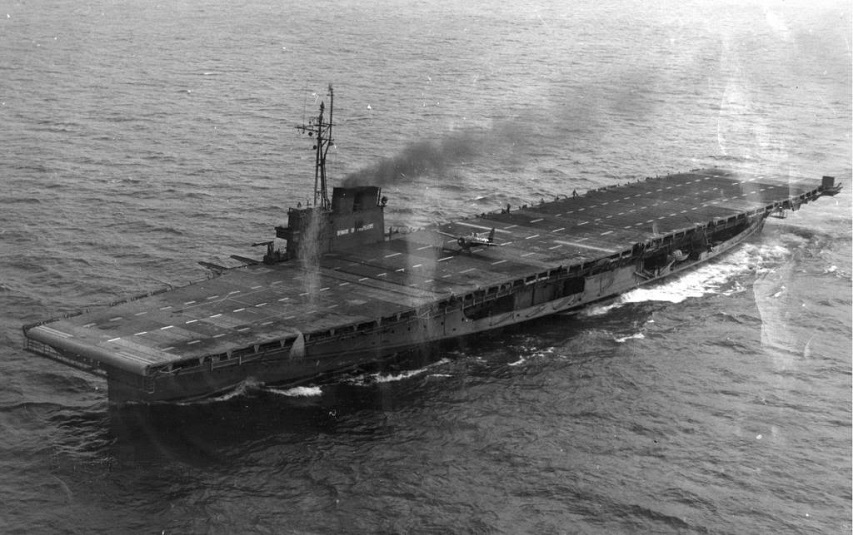
Overhead view of the training aircraft carrier 'Sable' (IX 81) underway on Lake Michigan with an FM Wildcat making a deck launch from the flattop 1945

Overhead view of the training aircraft carrier Sable (IX 81) underway on Lake Michigan with an FM Wildcat making a deck launch from the flattop 1945

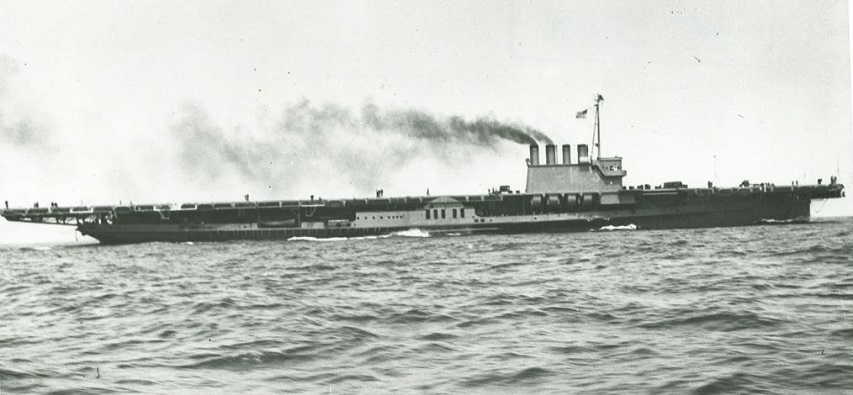
I was initially surprised that both training carriers were converted side-paddle steamers … I’d have thought the extra costs in converting to propeller drive would make them less-than ideal conversion subjects — you can clearly see in the second image that they left the side-paddles in place, so the main cost of conversion was the construction of the flight deck and repositioning the smokestacks to the starboard side (no hangar deck, elevators, or catapults in evidence):

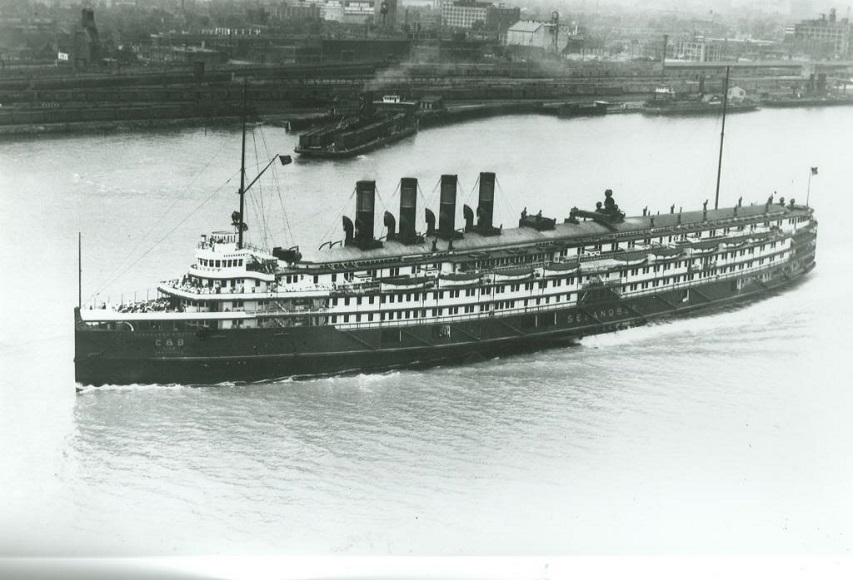
WIKI: USS Wolverine (IX-64) a side-wheel excursion steamer built in 1913—was originally named Seeandbee, a name based upon her owners’ company name, the Cleveland and Buffalo Transit Co.[4] She was constructed by the American Ship Building Company of Wyandotte, Michigan. The Navy acquired the sidewheeler on 12 March 1942 and designated her an unclassified miscellaneous auxiliary, IX-64. She was purchased by the Navy in March 1942 and conversion to a training aircraft carrier began on 6 May 1942.[5] The name Wolverine was approved on 2 August 1942 with the ship being commissioned on 12 August 1942.[5][6] Intended to operate on Lake Michigan, IX-64 received its name because the state of Michigan is known as the Wolverine State.

The steamship 'Seeandbee' before it was converted to the 'USS Wolverine' (IX-64)

The steamship Seeandbee before it was converted to the USS Wolverine (IX-64)

A view of the USS Wolverine (IX-64) while underway in Lake Michigan 1942

A view of the USS Wolverine (IX-64) while underway in Lake Michigan 1942

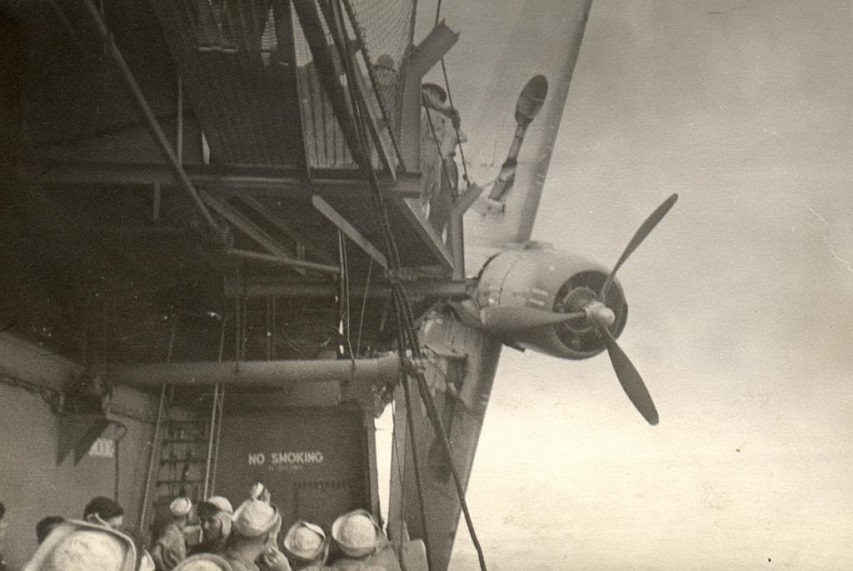
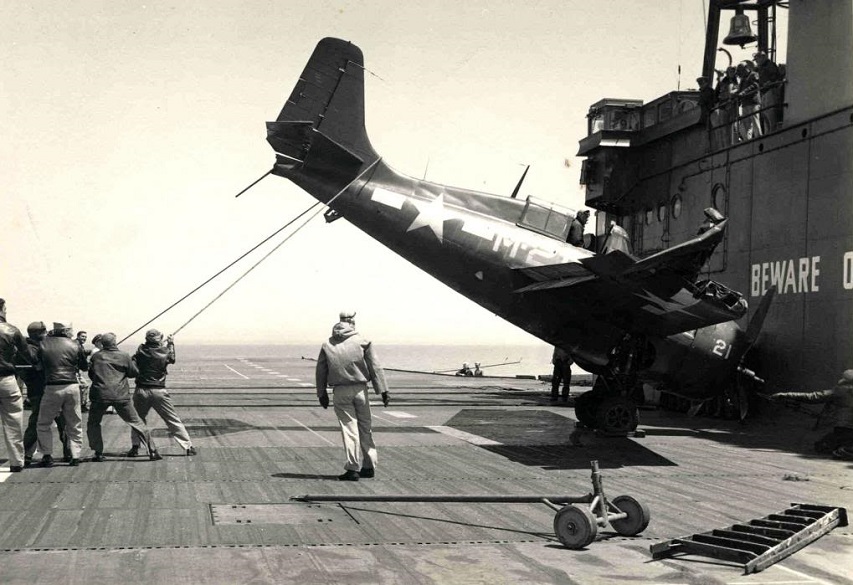
And given that almost all the pilots were still learning their trade — these were training ships, after all — there were more than a few mishaps:

USS Sable (IX 81) showing a TBF hanging over the side after crashing during carrier qualifications on Lake Michigan.

USS Sable (IX 81) showing a TBF hanging over the side after crashing during carrier qualifications on Lake Michigan.

FM-2 Wildcat after crash onboard USS Sable

FM-2 Wildcat after crash onboard USS Sable

November 4, 2013

Law, the military, and the media

Filed under: Britain, Law, Military — Tags: , , , , — Nicholas @ 11:23

Sir Humphrey debunks a recent story in the Telegraph which makes a big deal about the British military hiring more lawyers at the same time as they are disbanding front-line units:

The Forces have always needed effective legal support, and arguably the tiny number of military lawyers provides an utterly vital capability. Its not just about the provision of support to people who understand the arcane intricacies of a military law system which is very complex, and very different to our normal law — though this is extremely important. It’s about the provision of people who bring a vital advisory role to Commanders on the ground, and the wider MOD.

[…]

Similarly, once the direct fighting is over, UK troops often find themselves operating in a very strange environment — one only has to look at Iraq in the aftermath of the initial war fighting phase to realise that its not a clear cut place to operate. The advice offered by in theatre legal personnel can often make a huge difference in helping commanders understand their freedom to operate, and what genuine constraints may affect them. For instance, on a single tour in Iraq, units may have found themselves conducting everything from searches, checking for IEDS, detaining known individuals through deliberate operations, and then engaging in combat — quite possibly in the same day. The requirement for modern troops to adapt very quickly to all manner of situations places a huge burden on them — it is important that they get the best possible guidance to know they are acting correctly. Certainly in this authors experience on both TELIC and HERRICK, the LEGAD advice was often one of the most critical parts of any potential operation.

The same lawyers provide vital services back home — in the Royal Navy for instance, there are a range of in house experts on the Law of the Sea, international maritime disputes and territorial waters and the like. This may sound questionable, but when the RN is daily conducting counter piracy and counter narcotics operations across the globe, or sailing in possible maritime flashpoints where different nations have very different interpretations of maritime boundaries, having a good legal understanding on hand of the art of the possible is absolutely vital.

October 29, 2013

Even selling the USS Forrestal for $1 was a win for the US Navy

Filed under: Economics, Environment, Military, USA — Tags: , , , , — Nicholas @ 07:21

Several people have commented about the headlines proclaiming that the very first supercarrier had been sold for a princely sum of $1, but Strategy Page explains why even that token dollar was better than all the other options:

The U.S. Navy recently sold a decommissioned (in 1993) aircraft carrier (USS Forrestal) for scrap. The ship yard that will take the Forrestal apart (All Star Metals of Texas) paid the navy one cent ($.01) for the ship. That’s because this was the best deal the navy could get. That’s because it will cost many millions to take the ship apart in a legal fashion (being careful to avoid releasing any real or imagined harmful substances into the environment). The other alternative was to sink the Forrestal at sea. But this requires partial disassembly (to remove anything that could or might pollute the ocean), that would be even more expensive.

[…]

Since the 1990s, sending warships to the scrap yard has not been considered a viable alternative. It’s all about pollution, bad press, and cost. That was because of the experience with the largest warship to be scrapped to date, the 45,000 ton carrier USS Coral Sea. This ship took until 2000 (seven years) to be broken up. Thus, the new ecologically correct process was not only expensive but it took a long time. Then the navy discovered that the cost of scrapping a nuclear powered carrier like the USS Enterprise would be close to a billion dollars. This was largely the result of a lot more environmental and safety regulations. With so many navy ships (especially nuclear subs) being broken up in the 1990s, and all these new regulations arriving, the cost of disposing of these ships skyrocketed. This was especially true with carriers.

So for over a decade the navy just tied up retired ships and waited for some better solution to appear. That never happened. In fact, the situation has gotten worse. The navy only has one ship scrapping facility (Brownsville, Texas), so only one carrier at a time can be dismantled. Using official estimates of the time required to dismantle each of the biggest ships, it’ll take seven decades to get rid of the surviving conventionally powered carriers. Note also that the conventional carrier in the absolute worst shape, the USS John F Kennedy, is the one being officially retained in category B reserve (but only until Congress forgets all about her, of course). Name recognition really does count.

It gets worse. With the really vast number of single hull tankers being scrapped and large numbers of old, smaller-capacity container ships laid up and likely to be offered for scrap fairly soon, the market for difficult-to-scrap naval ships is going to shrivel and the price for scrap steel will drop. Efforts to get the navy to include the costs of disposal in the budget for lifetime costs has never caught on and now it’s obvious why not. The real nightmare begins with the first nuclear powered carrier (the 93,000 ton USS Enterprise), which began the decommissioning process in late 2012 (with the lengthy removal of all classified or reusable equipment). The cost of dismantling this ship (and disposing of radioactive components) may be close to $2 billion.

October 10, 2013

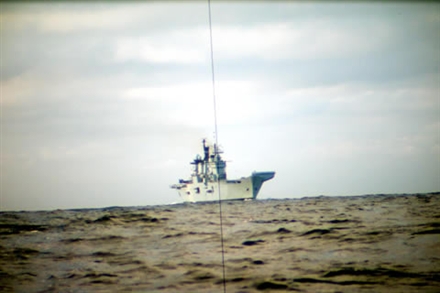
Periscope view of HMS Illustrious, courtesy HMCS Corner Brook

Filed under: Britain, Cancon, Military — Tags: , , , — Nicholas @ 12:55

Submariners love other ships … as potential targets:

In 2007 HMCS Corner Brook, a diesel-electric submarine of the Canadian navy, sneaked up on Illustrious during an exercise in the Atlantic.

HMS Illustrious in HMCS Corner Brook's periscopeTo prove they could have sunk the carrier, Corner Brook’s crew snapped a photo through the periscope — and the Canadian navy helpfully published it. “The picture represents hard evidence that the submarine was well within attack parameters and would have been successful in an attack,” boasted Cmdr. Luc Cassivi, commander of the Canadian submarine division.

Corner Brook, a former British submarine displacing only 2,400 tons, is no more capable than Dallas — and probably much less so once crew training is taken into account. American submariners spend far more time at sea than their Canadian counterparts.

Dallas and Corner Brook scored their simulated carrier kills against allied warships in the context of a scripted exercise. But many other close encounters between subs and flattops have occurred between rival nations deep at sea, in a usually bloodless duel that is nevertheless deadly serious.

Replacing the Sea King – a British alternative

Filed under: Britain, Cancon, Military — Tags: , , , — Nicholas @ 08:21

At Think Defence, Fedaykin wonders if the best solution for the Royal Canadian Navy’s Sea King helicopter might just be the Merlin which is in Royal Navy service:

With the Canadian government threatening to cancel the CH-148 contract, the sending of team to inspect Royal Navy Merlin is an interesting development.

Whilst the Merlin has developed a bit of a reputation for being fragile and expensive to maintain it has nevertheless seen many years of service now and is finally catching its second wind of maturity.

The Royal Navy is upgrading 30 Merlin from HM1 to HM2 standard leaving 8 airframes unchanged. Initially, thinking was these 8 spare airframes would probably form part of Crowsnest getting a permanent AEW fit. Sensibly (in my opinion) the MOD and navy has decided that Crowsnest will instead be a quick fit solution to any of the HM2 fleet ensuring that we don’t end up with “fleets within fleets”.

That leaves 8 standard HM1 going spare and possibly a home for them.

If the Canadian government was to suck up the embarrassment they could buy the AW Merlin HM2 with the 8 HM1 being given to them at a throw away price as a hot swap to get them going.

Once new build HM2 become available off the line the older HM1 in Canadian service can be upgraded to the common standard. The second article does clearly state the Canadian team did look at the HM1 in particular so is a happy solution close to hand.

The main barrier as it stands is the Omni-shambles of the Victoria class procurement, the Canadian public is not exactly happy about that disaster despite a significant proportion of blame being laid at their own door.

The UK does not do enough in terms of defence co-operation with Canada, New Zealand and Australia and there is much we can learn from each other.

H/T to Tony Prudori for the link.

October 8, 2013

The US Navy has its own army…

Filed under: Military, USA — Tags: , , — Nicholas @ 10:19

… and it’s not the US Marine Corps:

The marines are also concerned with their relationship with the U.S. Navy, which has now formed another ground combat force. To understand how this came about, you have to understand the relationship between the navy and the marines. The marines are not part of the navy, as they are often described. Both the navy and marines are part of the Department of the Navy. The Department of the Army and Department of the Air Force each have only one component while the Navy Department has two (the fleet and the marines) who are separate services that are closely intertwined. For example, the navy provides many support functions for the marines which, in the army and air force, are provided by each service. Thus navy personnel serve in marine units (wearing marine combat uniforms) as medics and other support specialists. In the army the medics are soldiers and the air force support personnel are all airmen. The use of the navy for support functions means a much higher proportion of marines are combat troops than in the navy, army or air force. This gives the marines a different attitude and outlook.

[…]

[After WW2,] the Marine Corps was no longer just a minor part of the navy, but on its way to being a fourth service. Over the next half century it basically achieved that goal. But in doing that, the navy lost control of its ground troops. Navy amphibious ships still went to sea with battalions of marines on board. But because the marines are mainly an infantry force, and the war on terror is basically an infantry scale battle, the marines spent a lot more time on land working alongside the U.S. Army.

In response to all this U.S. Navy began building a new ground combat force in 2006, staffed by 40,000 sailors. This is NECC (Navy Expeditionary Combat Command), which is capable of operating along the coast and up rivers, as well as further inland. NECC units have served in Iraq, and are ready to deploy anywhere else they are needed. The 1,200 sailors in the EOD (Explosive Ordnance Disposal) teams are particularly sought after, because of increased use of roadside bombs and booby traps by the enemy. NECC organized three Riverine Squadrons which served in Iraq. NECC basically consists of most of the combat support units the navy has traditionally put ashore, plus some coastal and river patrol units that have usually only been organized in wartime.

This new navy organization, and the strategy that goes with it came as a surprise to many people, especially many of those in Congress who were asked to pay for it. It came as a surprise to many NECC sailors as well. The navy even called on the marines to provide infantry instructors for the few thousand sailors assigned to riverine (armed patrol boat) units. The navy already had infantry training courses for Seabees (naval construction personnel) and members of EOD (Explosive Ordnance Disposal) teams. Now all that was combined in the Expeditionary Combat Skills (ECS) course which is conducted at a base in Mississippi.

October 5, 2013

Reckoning military strength is more complex than counting tanks, ships, or noses

Filed under: Britain, Military, Technology — Tags: , , , , — Nicholas @ 07:44

Sir Humphrey is back from his honeymoon and posts about the unfailing media habit of nostalgically looking back at the military of the Cold War era and contrasting it with the much smaller military of today:

When one looks back over the last 150 years, the possession of large military forces by the UK has been somewhat of an aberration. If you ignore WW1 & WW2, then the only period in which large forces were sustained was from 1945 until the end of the Cold War. This could only be done by relying firstly on large numbers of conscripts, then having to provide very low pay after the end of National Service. It is telling that once military wages began to catch up with, then overtake civilian roles, manpower quickly became increasingly unaffordable. Similarly it is easy to forget that this period is one of the very few in UK history where there was a clearly defined opponent, where UK forces had a clear role to play (e.g. maintain BAOR, defend the home base, conduct ASW) as well as support wider non NATO commitments. It is much easier to justify the retention of larger armed forces when you have a specific role in mind for them, and not just being held at readiness as a contingency.

In the UK we are perhaps guilty of looking back on the Cold War period as halcyon era where we had large armed forces, while forgetting that they existed to do very specific roles, and also encourage other nations to pull their weight too. The post Cold War era wasn’t some wonderful period where UK forces roamed the globe in glorious isolation emulating Palmerston’s views, but a period when the UK had to contribute to an international coalition and work with our partners against a common enemy. This is important to remember, for the argument that 30 years ago we had X frigates, Y jets and Z tanks compared to today’s paltry number is actually misleading. In reality much of this equipment was fully committed to NATO forces, and wasn’t easily available to support wider UK national interests beyond the NATO area. So yes, the UK had capabilities, but they were borne to meet a specific external threat, and not a general role.

Similarly, if one looks at availability, it becomes clear that in real terms UK capability for purely national tasks now isn’t far off what it was at the end of the Cold War. Speaking to a Naval friend who joined in the late 1980s, he pointed out that of the 47 escorts when they joined, nearly a third were usually tied up in refit. Add to this the tasking and working up of escorts for things like NATO commitments, and support to the South Atlantic, and suddenly that’s the best part of another 15 escorts committed. At best there would be a margin of some 10-15 hulls available for national discretionary deployments — not much more than is available today.

Yes, yes, but what about tiny Obscuristan with their 500 tanks? Britain is much bigger than Obscuristan, shouldn’t the British army have more tanks than them? And Fantasia has more ships in their navy than the Royal Navy does!

It is also important to realise when looking at these sorts of papers that nations have very different defence requirements. It is one thing to say we have less soldiers than say, South Korea, but we forget that we do not have a nuclear armed neighbour on our border with a leader who is not always a completely rational actor. It is entirely logical that some nations will have more military personnel than the UK — they have direct ground threats, or their need for manpower for other jobs means it is politically helpful to keep a large army to hand. For instance many states still conscript their troops, meaning on paper their army is vastly larger than the British Army, but this is only achieved through a ready pool of manpower who can be paid a pittance and employed on duties which are often as much about support local agriculture by working on farms, or support public order as it is about being a military force.

There are also many nations out there who on paper have large stockpiles of equipment (particularly in the Middle East) and this can easily be turned into a headline about how a tiny nation has more tanks than the UK. The reality though is that these purchases are little more than an insurance policy designed to coax the nations into feeling an obligation to support the purchaser in a real crisis. If one views defence sales to the Middle East as a means of these nations buying support through economic largesse then that’s probably not far off the mark. Many of these equipment buys are in fact often stored in the desert and left to rust without ever being used. The author has heard many tales of armouries full of weapons never removed from packing crates, or trained on and often forgotten about. On paper this is a capability, and in reality it is little more than a box of life expired spare parts. One difference between the UK and many other nations is that the UK is willing to genuinely use and ‘sweat’ its assets to get the most from its equipment purchases. Just because some nations have impressive arsenals does not equate to a genuine ability to use them to best effect.

September 29, 2013

Royal Navy carrier operations without carriers

Filed under: Britain, Military, USA — Tags: , , , — Nicholas @ 11:01

Strategy Page on the Royal Navy’s need to keep their carrier operation knowledge up while they wait for the first of the two new aircraft carriers to come into service:

These two decisions [switching to catapult operation, then reversing the switch] cost the Royal Navy about $115 million in additional expenses, which is a small part of the cost growth of the two carriers (from $5.8 billion in 2007 to over $8 billion now). The size of the ships has also grown, from 40,000 tons in the first plan (late 1990s), to 58,000 tons when construction started, to 70,000 tons now. There won’t be much more weight increases because the first ship has had its hull largely completed and will leave dry dock next year. Sea trials are planned for 2017 and initial flight operations in 2018. Commissioning is to occur by 2020. Construction on the second carrier (the Prince of Wales) began in 2011. These are the largest warships ever built in Britain and require the efforts of some 10,000 people in 90 companies and 6 shipyards (for building sections of the ships as well as other components).

There are some other problems that required more innovative solutions. For example, in 2011, the Royal Navy retired all its Harrier aircraft and the last aircraft carrier that the Harriers operated from. That presented a problem, as the first of two new carriers won’t enter service until the end of the decade. The admirals knew that once the new carrier (Queen Elizabeth) entered service a new generation of pilots would have to be trained to take off and land on a carrier. While the Harriers could land and take off like a helicopter, they often took off (via a “ski jump” flight deck) so they could carry more weight (especially bombs) into action. To deal with this Britain will have four of its naval aviators serve on American aircraft carriers over the next decade, to maintain Royal Navy knowledge of how pilots operate jet aircraft off carriers. The British naval officers will learn to fly F-18s in order to do this. While Britain and the U.S. regularly exchange fighter pilots, this is a special case. The British know from experience that it’s easier to train new pilots with experienced Royal Navy carrier pilots. Thus the need to maintain that experience by having British aviators flying F-18s off American carriers until the new British carriers arrive.

September 10, 2013

China’s historical model for naval strategy

Filed under: China, History, Middle East, Military, Pacific — Tags: , , , , — Nicholas @ 09:16

At The Diplomat, James Holmes explains the odd fact that China is a “good citizen” in their coalition work with other countries fighting piracy away from home, but bullies its neighbours in the waters closer to home:

The analogy is the doctrine of “no peace beyond the line” practiced in late Renaissance Europe. To recap: in a nifty bit of collective doublethink, European rulers struck up a compact whereby nations could remain at peace in Europe, avoiding the hardships of direct conflict, while assailing each other mercilessly beyond a mythical boundary separating Europe from the Americas. In practice this meant they raided each other’s shipping and outposts in the greater Caribbean Sea and its Atlantic approaches.

It feels as though an inverse dynamic is at work in the Indo-Pacific theater. Naval powers cooperate westward of the line traced by the Malay Peninsula, Strait of Malacca, and Indonesian archipelago. Suspicions pockmarked by occasional confrontation predominate east of the South China Sea rim, a physical — rather than imaginary — line dividing over there from home ground.

A non-Renaissance European, Clausewitz, helps explain why seafaring powers can police the Gulf of Aden in harmony while feuding over the law of the sea in the East China Sea and South China Sea. It’s because the mission is apolitical. Counterpiracy is the overriding priority for the nations that have dispatched vessels to the waters off Somalia. Few if any of them have cross-cutting interests or motives that might disrupt the enterprise. It’s easy to work together when the partners bring little baggage to the venture.

[…]

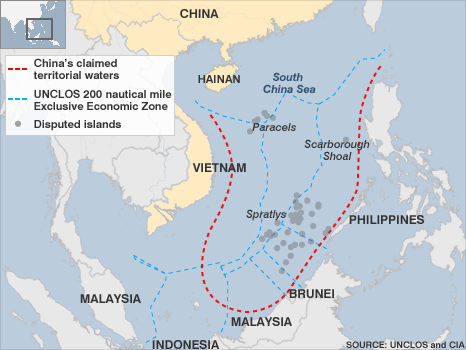
You see where I’m going with this. The expedition to the Gulf of Aden is an easy case. It proves a trivial result, namely that rivals can collaborate for mutual gain when they have the same interests in an endeavor. Now plant yourself in East Asia and survey the strategic terrain within the perimeter separating the Indian from the Pacific Ocean. China views the South China Sea, to name one contested expanse, not as a commons but as offshore territory. Indeed, Beijing asserts “indisputable sovereignty” there.

Such pretensions grate on Southeast Asian states, while the United States hopes to rally coalitions and partnerships to oversee the commons. But if Beijing is serious about the near seas’ constituting “blue national soil” — and our Chinese friends are nothing if not sincere — then outsiders policing these waters must look like invaders. How else would you regard foreign constables or armies roaming your soil — even for praiseworthy reasons — without so much as a by-your-leave?

South China Sea claims

September 9, 2013

When politicians meddle in defence matters

Filed under: Britain, Military, Politics — Tags: , , — Nicholas @ 00:01

An interesting report in Herald Scotland by Kate Devlin illustrates some of the problems created when politicians make decisions without adequately consulting with the civil service:

The man in charge of equipment at the Ministry of Defence (MoD) has warned officials offer “opinion” not fact on defence programmes, including the aircraft carriers being built on the Clyde, because of pressure from ministers.

In recent years the department has become notorious for overspends and procurement problems. But Bernard Gray said that civil servants in his department had “their arms put up behind their backs” to produce hasty costings for projects.

Earlier this week Mr Gray revealed that in 2010, when Tory MP Liam Fox was Defence Secretary, officials were given just hours to estimate the cost of changing the planes to fly from the carriers.

Mistakes in that process led to a humiliating U-turn by Mr Fox’s replacement Philip Hammond last year and have cost the taxpayer at least £74million.

Appearing before a separate committee of MPs, Mr Gray said officials should have been given six months, not a day, to complete the work. He said what was eventually provided was “opinion”.

“People (within the MoD) come under pressure, with people saying, ‘Everybody wants to know, we have to have an answer today,'” he said.

September 6, 2013

Construction report on HMS Queen Elizabeth

Filed under: Britain, Military — Tags: , — Nicholas @ 09:11

BBC News had a report on the aircraft that are supposed to be available for HMS Queen Elizabeth when she is brought into Royal Navy service later this decade. They also included an older video on the state of the ship’s construction, which happily had been posted to YouTube (most BBC videos at their site are non-embeddable):

Published on 10 May 2013

Work on the first of the Royal Navy’s two new Queen Elizabeth Class aircraft carriers is well under way at a dockyard in Rosyth.

The structure is almost complete in what is now the largest engineering project in the UK.

A government U-turn over fighter jets for the carriers cost taxpayers £74m, according to a new report by the National Audit Office.

The BBC’s Defence Correspondent Jonathan Beale saw the progress being made on the ship.

The Press Association also had a video from June:

September 4, 2013

Air-Sea Battle as a response to Chinese military expansion

Filed under: China, Military, Pacific, USA — Tags: , , , — Nicholas @ 13:18

The Diplomat‘s Amitai Etzioni looks at the US Air-Sea Battle plan:

On the face of it, the Pentagon’s Air-Sea Battle plan makes eminently good sense; it is a clear response to a clear challenge. China has been developing a whole slew of weapons (especially anti-ship missiles) over the past two decades that are of great concern to the U.S. military. These weapons, known in Pentagon-speak as anti-access/area-denial (A2/AD) capabilities, could undermine the international right to free passage in China’s surrounding waters or, in the case of a conflict over Taiwan or contested islands in the South and East China Seas, prevent the U.S. from making good on defense commitments to its friends in the region.

In response, the Pentagon developed Air-Sea Battle (ASB), the employment of which entails, according to position papers developed to promote it, a blistering assault on China’s mainland. A report by the Center for Strategic and Budgetary Assessments (CSBA) gives a detailed account of how an ASB-style war with China would unfold. In the opening “blinding campaign,” the U.S. attacks China’s reconnaissance and command-and-control networks to degrade the PLA’s ability to target U.S. and allied forces. Next, the military takes the fight to the Chinese mainland, striking long-range anti-ship missile launchers. Given that this is where the anti-ship missiles are located, it is only logical that the U.S. would target land-based platforms. And to go after them, one of course needs to take out China’s air defense systems, command control centers, and other anti-access weapons. In short, ASB requires a total war with China.

[…]

The main flaw Air-Sea Battle it is not merely that it is a particularly aggressive military response to the anti-access/area-denial challenge. The problem is that ASB is developing in a foreign policy vacuum. If the U.S. were to conduct a thorough review of China’s military capabilities and its regional and global ambitions — and found that the Chinese were planning to forcefully expand their territory or unseat the U.S. as the global power, perhaps Air-Sea Battle might be deemed appropriate.

More on Britain’s aircraft carrier program

Filed under: Britain, Military — Tags: , — Nicholas @ 00:02

The always informative Sir Humphrey responds to yesterday’s Daily Mail and other media reports on the CVF program:

The first thing that struck the author on reading it was that it highlighted the challenges posed in bringing any large piece of equipment into service. There was a lot of comments about the risk posed to the UK by not having the so-called ‘Crowsnest’ AEW capability in service until 2022 which left the platform at risk. It is very easy to focus on the idea that a carrier is late, and that is a relatively simple piece of kit, so why should it take so long to bring into service? In reality the introduction into service of CVF is a watershed moment for the Royal Navy — it will represent a step change in capability, and merge together several very different capabilities which the RN has either not operated for a while, or which it has not operated at all. At its heart the RN is having to simultaneously introduce a brand new class of ship into service, with all the technical risk that this entails. This is then backed up by the near simultaneous introduction into service of the most technically advanced jet the UK has ever operated, and also bring the UK back into the world of fixed wing carrier operations, a skill which even with the mitigation measures in place will still be a challenge to regain. Its also about bringing a new AEW platform into service, after a near 6 year gap in cover, and again with all the very considerable technical risk posed by this. Finally its about bringing the whole package together and working with the rest of the RN to ensure that what exists isn’t just a collection of equipment of very levels of operational utility and capability, but is in fact a fully worked up and integrated system which has an effect far beyond the sum of its parts.

[…]

One thing that reads through very clearly in the evidence is the clear emphasis that CVF is seen as a joint asset for Coalition operations. While obviously it provides a national capability in extremis, it is clear that provision of a CVF hull and airwing is seen as a major means of the UK working with coalition partners. This is an important part of the reality of future naval operations — while we like to fondly imagine that CVF provides the UK with the ability to work in isolation, in reality its an asset that will provide great influence in coalition work. The evidence is clear that in future the UK sees provision of CVF on operations as being part of a wider multi-national force, and particularly early in its life, there is an expectation that capability gaps such as AEW would be met either by working with partner nations, or by wider UK assets (e.g. AEW Sentry).

This is important as it highlights the gradual shift in UK thinking away from funding the provision of an entire wholesale package of capabilities into assuming that risks can be taken in some areas. When one reads the evidence though, it is suddenly clear how far fetched the scenarios sound — for instance it was only under heavy questioning, when the line of assumptions reached ‘fighting an enemy with French and US cover in high seas away from landbased cover’ did we discover that the RN may struggle a wee bit without CROWSNEST. One would hope that between 2020 and 2022 the RN is not going to be re-enacting scenes from a Tom Clancy novel?

September 3, 2013

Britain’s new aircraft carriers in the news again

Filed under: Britain, Military — Tags: , , , , — Nicholas @ 09:16

It’s from the Daily Mail, so a certain level of de-hystericization is called for…along with salt to taste. First, the discovery that the two carriers will initially be without radar for early warning of incoming planes and missiles:

The Royal Navy’s new aircraft carriers could set sail without a crucial radar which warns commanders of incoming enemy warplanes and missiles.

A damning report by MPs reveals the Crowsnest early warning system will not be ready until six years after the first of the £5.5billion Queen Elizabeth-class warships enters service in 2016.

Delays in fitting the ‘eyes in the sky’ system to military helicopters until 2022 were a ‘concern’, the Commons’ Public Accounts Committee (PAC) says today.

And the costs incurred by changing the planned acquisition of F-35 aircraft to equip the carriers is rather eye-watering:

The bill for the two new warships, given the green light in 2008, is almost twice the original £3.6billion — and there are ‘huge risks’ it will increase further, says the report.

MPs heap criticism on the Coalition for wasting money after a U-turn over the type of warplanes to fly from the aircraft carriers.

In 2010 ministers controversially decided to scrap the last Labour government’s plans to buy a fleet of jump jets, which take off and land vertically.

Instead, Prime Minister David Cameron ordered conventional versions of the US-built F-35 Joint Strike Fighter that would need catapults and arrester gear to take off from and land on the vessels.

But this was based on ‘deeply flawed information’, say the committee. When the cost of fitting the ships with ‘cats and traps’ more than doubled to £2billion, Mr Cameron flip-flopped and returned to buying the jump jet.

The move cost a staggering £74million in squandered in lost man hours, administrative costs and needless planning.

Labour MP Margaret Hodge, the PAC’s chairman, said: ‘The Committee is still not convinced that the MOD has this programme under control. It remains subject to huge technical and commercial risks, with the potential for further uncontrolled growth in costs.’

Queen Elizabeth class side and overhead views

Queen Elizabeth class side and overhead views

The switch back to the jump jet was made last year. Back in 2010, I was rather pessimistic that the carriers would even be built and I suggested that India would likely take them off the Royal Navy’s hands once they were complete.

« Newer PostsOlder Posts »

Powered by WordPress