Quotulatiousness

January 11, 2014

Spain downsizes their navy under economic pressure

Filed under: Europe, Military — Tags: , , , — Nicholas @ 13:11

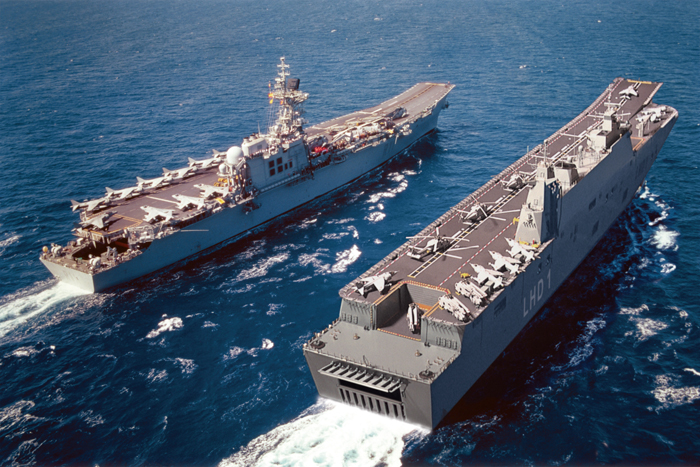
Spain has decommissioned 18 ships over the past six years, including the aircraft carrier Príncipe de Asturias:

Despite increased budgets and investment in certain weapon developments, the Spanish Ministry of Defence states that their overall budget has depleted by 32% since the start of the financial crisis, with 8.4 billion in the kitty in 2008, dropping to a mere 5.75 billion planned for 2014.

As a result, the Ministry says that it has no choice but to reduce costs, thus resulting in a significant reduction in high profile military elements, like the decommissioning of 18 naval ships in the past 6 years.

One of the most iconic ships to be withdrawn last year was the aircraft carrier Príncipe de Asturias, decommissioned after 25 years of service, considered a somewhat tragic sight when she arrived at the Arsenal Militar de Ferrol for final discharge from service. But as the last Captain of the vessel, Alfredo Rodríguez Fariñas, explained, modernization and maintenance of the ‘Prince of Asturias’ cost the MoD a hundred million per year.

Part of the strategy is the withdrawal of these costly and purpose built ships, in favour of more modern craft that meets the needs to the Navy’s international mission, such as the activities in the Indian Ocean where the frigate Álvaro de Bazán and maritime action ship Tornado are currently patrolling, and the ship Cantabria, currently in the sea off the Australian coast.

Spanish navy's Juan Carlos and Principe de Asturias

Spanish navy's Juan Carlos and Príncipe de Asturias

January 10, 2014

US analysis of captured German U-boats after WW2

Filed under: Germany, History, Military, WW2 — Tags: , — Nicholas @ 08:12

Tony Zbaraschuk posted an interesting link to the Lois McMaster Bujold Mailing list (http://lists.herald.co.uk/cgi-bin/mailman/listinfo/lois-bujold):

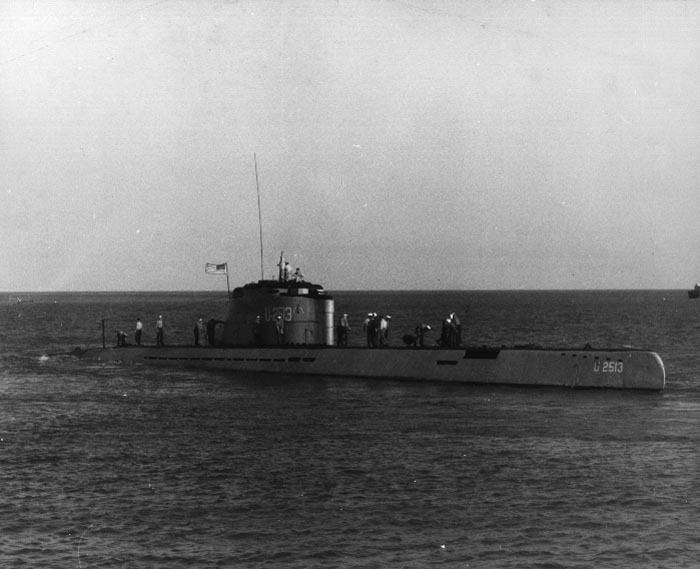
Design Studies of German Submarines by the US Navy

The Design Study of Type IXC U-boats was made available by Scott Sorenson. The Design Study of Type XXI U-boats was made available by the Portsmouth Naval Shipyard Public Affairs Office and the Navy Yard Museum — in particular Debora White, Gary Hildreth, Jim Dolf and Bill Tebo (a member of the US Navy crew of U-2513).

Photographs and documents of surrendered German submarines and their crews were made available by John Cunningham (a member of the US Navy crew of U-2513).

U-2513 off Key West, Florida - 30 October 1946

U-2513 off Key West, Florida — 30 October 1946

January 9, 2014

China asserts “police powers” over most of the South China Sea

Filed under: Asia, China, Military — Tags: , , , , — Nicholas @ 10:02

James R. Holmes on the change in China’s approach to the disputed South China Sea region:

Associated Press reporter Christopher Bodeen chooses his words well in a story on China’s latest bid to rule offshore waters. Beijing, he writes, is augmenting its “police powers” in the South China Sea. That’s legalese for enforcing domestic law within certain lines inscribed on the map, or in this case nautical chart.

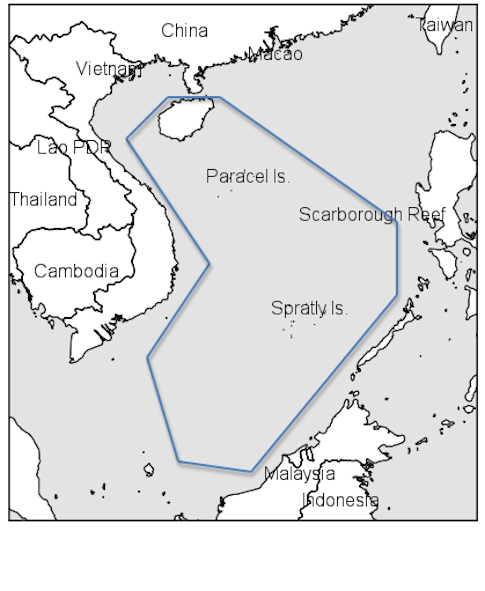
The Hainan provincial legislature, that is, issued a directive last November requiring foreign fishermen to obtain permission before plying their trade within some two-thirds of the sea. Bill Gertz of the Washington Free Beacon supplies a map depicting the affected zone. It’s worth pointing out that the zone doesn’t span the entire waterspace within the nine-dashed line, where Beijing asserts “indisputable sovereignty.”

China imposes fishing curbs: New regulations imposed Jan. 1 limit all foreign vessels from fishing in a zone covering two-thirds of the South China Sea. Washington Free Beacon

China imposes fishing curbs: New regulations imposed Jan. 1 limit all foreign vessels from fishing in a zone covering two-thirds of the South China Sea. Washington Free Beacon

A few quick thoughts as this story develops. One, regional and extraregional observers shouldn’t be too shocked at this turn of events. China’s claims to the South China Sea reach back decades. The map bearing the nine-dashed line, for instance, predates the founding of the People’s Republic of China. It may go back a century. Nor are these idle fancies. Chinese forces pummeled a South Vietnamese flotilla in the Paracels in 1974. Sporadic encounters with neighboring maritime forces — sometime violent, more often not — have continued to this day. (See Shoal, Scarborough.) Only the pace has quickened.

Henry Kissinger notes that custodians and beneficiaries of the status quo find it hard to believe that revolutionaries really want what they say they want. Memo to Manila, Hanoi & Co.: Beijing really wants what it says it wants.

January 8, 2014

China and the deep blue seas

Filed under: China, Military — Tags: , — Nicholas @ 09:26

There has been much debate among analysts about what China is planning to do with their expanding “blue water” navy. At The Diplomat, Henry Holst warns against simplistic interpretations of People’s Liberation Army Navy (PLAN) intentions:

In a 2012 article published in The Diplomat, Andrew Erickson and Gabe Collins claim “China seeks to develop a ‘blue water’ navy in the years to come—but one that is more ‘regional’ than ‘global’ in nature,” and that China does not intend to challenge U.S. naval hegemony. However, analyzing China’s maritime identity, a concept that will be explained below, and it becomes clear that two major long-term goals of the PLAN’s blue-water modernization are to frequently deploy outside East Asia and challenge U.S. naval dominance on the high seas.

Erickson and Collins cite Chinese naval technological inferiority in areas such as anti-submarine warfare and area-air defense vis-à-vis the U.S. navy as evidence that the PLAN does not intend to challenge U.S. naval hegemony, concluding that such a military imbalance would make any challenge futile. Additionally, Erickson and Collins use the small number of PLAN deployments outside of East Asia as proof that in the future Beijing does not aim to frequently outside its immediate environs.

[…]

Analyzing China’s maritime identity provides a superior methodology in anticipating future PLAN strategic interests. Maritime identity is a nation’s inherited maritime traditions, responsibilities, prerogatives, self-concept and strategic interests as a naval power. It frames the strategic discussion that occurs at high levels of government and therefore wields enormous influence over foreign policy. Washington’s willingness to employ naval forces in support of Libyan rebels fighting Gaddafi in 2011 reflected America’s maritime identity, which is famous for supporting democracy, human rights and self-determination worldwide. The American maritime identity is perfectly summed up in the U.S. Navy recruiting slogan: “A Global Force For Good.” In a similar way, analyzing the personality of China’s developing maritime identity is a practical method by which to gauge future Chinese naval strategic interests.

How does one ascertain China’s maritime identity? Analyzing Chinese Communist Party (CCP)-run newspaper articles in the People’s Daily provides an excellent conduit into the strategic thinking of China’s decision-making apparatus. This is because the People’s Daily serves as the mouthpiece of the CCP Standing Committee. For those unfamiliar with China’s system of government, imagine a totalitarian government having an elected body of seven individuals who wield total control over state affairs, and then broadcast their opinions directly through a controlled media body. Analyzing Chinese domestic media discussion on whether China should pursue a full-fledged blue-water navy (蓝水海军), a pursuit both tightly bound to a country’s maritime identity and highly relevant to future PLAN strategic interests, sheds light on the strategic discussions occurring at high levels within the CCP.

December 24, 2013

The challenge facing all modern armed forces

Filed under: Britain, Military — Tags: , , — Nicholas @ 10:04

Sir Humphrey is on-the-money with his disdain for “fantasy fleet” enthusiasts and those nostalgic for the days when the Soviet hordes were poised to descend on Western Europe at the drop of a helmet. While he’s talking specifically about the British army, Royal Navy, and Royal Air Force, the very same issues are being faced in all Western nations. He also explains why cuts to armies are easier to make than cuts to navies or air forces:

In broad terms the General noted the real difficulties for the armed forces in the current operating environment, noting “The advent of more diverse and less state based threats has become an increasing feature of the age. Most mature Western democracies no longer face existential state-on-state threats in classic force-on-force terms. Rather the challenges are more insidious. There are threats which relate to terrorism, to international crime, to energy resources and critical national infrastructure. There are challenges to our human security, our way of life; there are hazards which derive from the dangerous conditions attendant on a warming planet. And these are threats which have emerged in the rising domain of warfare: cyberspace”.

This is a useful reminder to those whose belief that force structures today do not allow us to defend against the encroaching Soviet hordes — there is a very good reason for that! It is genuinely difficult to envision circumstances at present where the UK would be dragged unwillingly into a physically existential battle for survival against another state. Instead our threats are more challenging — if you consider the damage that can be done from a well placed cyber attack, it could be argued that there is no need for a conventional military existential threat now. A well placed cyber unit able to carry out crippling attacks on national infrastructures, power and support services could probably do more damage in one fell swoop than a sustained air campaign could over many months. It may be better to suggest that we simultaneously do not face a credible military existential threat, but there is a very credible existential threat from both nations and third party groups from the cyberspace domain.

The question that always needs to be at the top of the agenda when discussing military spending is “What specific and general threats to the nation need to be warded against?” rather than “How many tanks/planes/ships do we want?” With the F-35 decision looming near for many NATO countries, the initial cost of the planes is only part of the economic picture:

For instance consider the cost of providing a fast jet training pipeline — from the initial flying training through to conversion aircraft and the provision of instructors, tactics schools, opposition jets for sorties etc — to sustain a pipeline for an ever small fast jet fleet looks horrendously expensive. When you consider that most NATO nations are going to be operating fleets of less than 50 fast jets in future, the cost of providing a purely national solution to the pipeline will be an ever larger proportion of the total budget. One can easily see a case for trying to provide a multi-national solution for many of the smaller nations, if only to keep them credibly in the fast jet game, otherwise in a few years time it may well be the case that they simply cannot afford to stay in the fast jet business.

Not to denigrate the army — I was an army reservist in my time — but the cost to train soldiers for the majority of combat or combat support roles is only a fraction of what is needed to train sailors or aircrew:

It is easy to focus on pure numbers and not look beneath at the make up of the force. For instance the Army requires a larger manpower pool, but its manning pyramid is perhaps disproportionately focused on providing lots of junior troops (Pts & Lcpls) who have the lowest salaries and often require the least amount of technical training. There is also some flex in the system in that you can bear a gap of a couple of junior troops or SNCOs on a Company or Battalion sized deployment. By contrast the Royal Navy relies heavily on a very skilled and technical workforce — the days of ships being manned by the press gang being long gone. To operate a Frigate needs highly skilled operators and engineers to run the very complex equipment on board. If you look the collective man years of training required to put a fully effective Frigates crew to sea, you are talking about needing centuries of investment. Even a junior weapons or mechanical engineering rating requires several years of training to be at the stage where they are operationally useful. By contrast an Army private can be doing a role in an infantry unit within a year.

This higher training footprint has several issues — it costs more to run the shore schools like COLLINGWOOD and SULTAN. It means the crews generally require higher salaries and retention incentives to stay in for the medium term, as the private sector will quickly try and lure disaffected sailors with higher pay packets. Additionally the impact of a well-qualified rating leaving can often have a direct impact on the ability of a ship to deploy. For instance, in the nuclear submarine fleet, the loss of a suitably qualified nuclear SNCO watchkeeper could theoretically prevent deployment of a submarine until the gap is filled. It also takes many years to train a replacement — people leaving early will leave gaps in the system that will take years to fill. What this means is that as training cuts bite, and deployments are extended to cover the gaps caused by having less ships available, the pressure on the RN workforce grows. The more people who leave early, the harder it is for the RN to keep ships at sea for the medium term. The problem also grows as the more gaps that exist, the harder those who are left have to work, thus increasing the likelihood of them leaving too.

And the folks whose views of a “proper military” are based on their early collections of Airfix ship and tank models:

It also served as a useful reminder that the ability to rapidly regenerate the front line no longer exists. If you browse the net, you quickly come across ‘fantasy fleet’ sites where discussions quickly veer into the impossible wishlisting of new ships for the RN. What is often forgotten is that to use the ships / tanks / planes, you need the training pipeline in place to support them. People forget that the 2010 SDSR slashed the underpinning training and support services for the front line. Not only were units cut, but the assumptions on how many people would be needed in future was also reduced. This means that the manpower and equipment to rapidly grow the forces doesn’t exist anymore. There is little point in saying ‘we need 20 extra frigates or 3 more Typhoon squadrons’ because the pipeline to produce that many people with the right skills in the right timeline simply isn’t there. The hollow force is a good demonstration of what happens when you focus on buying new equipment over investing in the equally vital support services linked to it.

December 9, 2013

Admiral Grace Hopper on Letterman

Filed under: History, Military, Technology, WW2 — Tags: , , , , — Nicholas @ 17:23

Despite cutbacks, the Royal Navy still internationally active (and valid)

Filed under: Asia, Britain, Military — Tags: , , — Nicholas @ 10:32

Sir Humphrey on how the UK still manages to project force around the world in the wake of the most recent set of budget cuts:

While the numbers may be smaller than in the past, reading the twitter feed [@NavyLookout]and looking at the images of modern vessels, one is left with a genuine sense that the RN remains an immensely capable force by any reasonable standard. The ability to deploy this force globally, and to meet a wide range of missions is extremely impressive. One of the centre pieces of the SDSR was the restructuring of the RN to provide the so-called ‘Response Force Task Group’ (RFTG) which has since establishment proven to be a superb means of deploying a worked up task group around the world and reacting to events.

In this year alone the Royal Navy has been engaged in operations across the globe, and been able to not only rely on warship deployments, but also highlight the value of its wider basing and command and control capabilities. As the year draws to a close, there are by the authors reckoning three 1* command groups deployed out there co-coordinating both UK and Multi-national operations. The facility in Sembewang has once again highlighted its importance to the RN (and the wider UK) as a useful foothold in a region that the RN hasn’t frequented for some years, and HMS DARING and HMS ILLUSTRIOUS have helped restore hope to thousands of people affected by the dreadful events in the Philippines.

While many wish to be downbeat about the RN, given the pace at which it is operating globally, and the way in which it is able to respond so rapidly to so many events, it is hard to see it as a navy in decline. Yes it is smaller, but so are most Navies these days. But to judge a Navy purely by hulls and not by output is misguided — the RN today remains one of the most capable on the planet, and the events of this year have gone to show that it continues to meet the task placed on it with aplomb.

November 28, 2013

Poking holes in the proposed Scottish defence plans

Filed under: Britain, Military — Tags: , , , , — Nicholas @ 08:07

Sir Humphrey says he’s neutral on the political issue of Scottish separatism, but he has a few professional criticisms of the fleet plan contained within the white paper:

At a most basic level, the paper appears to fall foul of what can be described as the ‘fantasy fleet’ syndrome so often found on the internet. In other words, people have taken an order of battle, hived of a reasonable sounding level of equipment and assumed that this would make a good defence force. That’s a great theory, but in reality its likely to be far more complicated than this.

For starters, the British Armed Forces are the product of hundreds of years of evolution, procurement and support. They operate a closely integrated set of equipment, underpinned by a well developed training network, and supported by a very complex set of support contracts to ensure availability. Due to the numbers and amounts of equipment in service, costs can be calculated using economies of scale, and planned workflow, in a way that smaller sized support cannot.

A nascent SDF would find itself operating a truly eclectic collection of units which are not necessarily the most appropriate for its situation. For instance, the proposal that the Navy takes on two Type 23 frigates seems a little odd. The Type 23 is one of the worlds most advanced anti-submarine warfare escorts, and designed to be a submarine killer par excellence. To use it to best effect requires a well trained crew, who have a range of extremely specialised skills. Assuming that no one is forced at independence to join the SDF, the challenge will be recruiting and retaining a core of niche skills to actually employ the vessel in her intended manner. This includes the engineers, weapon systems maintainers, the warfare department and those with the skills and experience at all ranks and rates to use the vessel in its intended manner.

[…]

Similarly, the issue of maintenance will be a complex one. There are no T23s based in Scotland, which means that a great deal of money will be spent creating a permanent support facility for the class in Scotland. In these circumstances the SDF will need to negotiate and establish support contracts, similar to the ones used by the RN, and pay to put in place the complex web of support arrangements in order to keep the vessels available for service. In a small procurement and support budget, it is hard to see where the money will come from for this sort of activity.

The sheer running costs of the vessels will also be a challenge — on average it costs about £20 million per year (source THEY WORK FOR YOU) to keep a Type 23 at sea, and about £3 million for MCMVs and patrol craft. To keep the Scottish Navy afloat, you are looking at an annual running cost of around £60 million — before you consider salary costs of the crew and the shore support infrastructure to go with it. On a relatively small budget of £2.5 billion, it is easy to see how much of a cost it would be just to keep the ships at sea, let alone deploy them.

In a sense, the white paper’s defence plan does appear to have been drawn up with an eye toward “order of battle” and “table of equipment” that would create — on paper, anyway — a scaled-down version of the RN, RAF, and British army. That isn’t the sensible approach for an independent Scotland’s defence needs. The first thing they should have done is analyze what practical tasks their defence forces would be required to undertake, then consider the most cost-effective way to build and equip an organization to accomplish those tasks.

When I was a child, I was obsessed with toy soldiers. I had hundreds and hundreds of them from various eras from Roman versus Celt down to 8th Army versus Afrika Korps. When setting up my “battles”, it was always the soldiers with the cool kit who got to be the heroes: stirring combat poses and cooler weapons were my selection criteria. When I moved on to building models, the same characteristics dictated the particular models I built: more heavily armed ships, bigger tanks, more weapon-studded aircraft. The authors of this portion of the white paper appear to have had similar childhoods … and they’re still influenced by the same selection criteria. What sense does it make for Scotland’s defence forces to operate Type 23 frigates and Typhoon aircraft? They’re cool kit, but do they accomplish the primary protective duties for Scotland cost-effectively? Almost certainly not.

Scotland has a large coastline and significant offshore assets to protect, but it isn’t likely to need the hugely expensive (and admittedly very capable) kit that the Royal Navy and the Royal Air Force need to accomplish their wider tasks. Scotland’s navy is much more likely to end up resembling a strong coastguard than a battle fleet, and their air force will probably not be equipped with top-of-the-line fighter aircraft (especially not F-35 or Typhoon fighters) as they would eat a hugely disproportional share of the defence budget for capabilities the Scots don’t actually need.

I strongly suspect the best course of action for Scotland (in the event of a successful independence vote) would be to negotiate a short-to-medium term deal with the rest of the UK to provide military units to Scotland as an interim solution while a sensible Scottish organization was built-up to take on those roles. It might sting the pride of nationalists to admit that they can’t afford to take on the full trappings of an independent state immediately, but it would be far more practical (and far less expensive) than carving off “their share” of the UK’s existing military.

November 27, 2013

Scottish defence, in a post-independence world

Filed under: Britain, Military — Tags: , , , , , — Nicholas @ 11:35

Think Defence has posted a portion of the Scottish Independence White Paper dealing with defence issues. This includes an outline view of what is thought to be required for Scotland’s (non-nuclear) military establishment at independence:

Maritime forces

One naval squadron to secure Scotland’s maritime interests and Exclusive Economic Zone (EEZ) and contribute to joint capability with partners in Scotland’s geographical neighbourhood, consisting of:

  • two frigates from the Royal Navy’s current fleet
  • a command platform for naval operations and development of specialist marine capabilities (from the Royal Navy’s current fleet, following adaptation)
  • four mine counter measure vessels from the Royal Navy’s current fleet
  • two offshore patrol vessels (OPVs) to provide security for the 200 nautical mile Exclusive Economic Zone (EEZ). However, as the Royal Navy only has four OPVs currently[263], a longer lead time for procurement might be necessary
  • four to six patrol boats from the Royal Navy’s current fleet, capable of operating in coastal waters, providing fleet protection and also contributing to securing borders
  • auxiliary support ships (providing support to vessels on operations), which could be secured on a shared basis initially with the rest of the UK

These arrangements will require around 2,000 regular and at least 200 reserve personnel.

Land forces

An army HQ function and an all-arms brigade, with three infantry/marine units, equipped initially from a negotiated share of current UK assets, and supported by:

  • a deployable Brigade HQ
  • two light armoured reconnaissance units
  • two light artillery units
  • one engineer unit deploying a range of equipment for bridging, mine clearance and engineering functions
  • one aviation unit operating six helicopters for reconnaissance and liaison
  • two communication units
  • one transport unit
  • one logistics unit
  • one medical unit

Special forces, explosives and ordnance disposal teams will bring the total to around 3,500 regular and at least 1,200 reserve personnel.

Air forces

Key elements of air forces in place at independence, equipped initially from a negotiated share of current UK assets, will secure core tasks, principally the ability to police Scotland’s airspace, within NATO.

  • an Air Force HQ function (with staff embedded within NATO structures)
  • Scotland will remain part of NATO‘s integrated Air Command and Control (AC2) system, initially through agreement with allies to maintain the current arrangements while Scotland establishes and develops our own AC2 personnel and facility within Scotland within five years of independence
  • a Quick Reaction Alert (QRA) squadron incorporating a minimum of 12 Typhoon jets based at Lossiemouth
  • a tactical air transport squadron, including around six Hercules C130J aircraft, and a helicopter squadron
  • flight training through joint arrangements with allies

In total this would require around 2,000 regular personnel and around 300 reserve personnel.

Civilian support

In addition to military capability following a vote for independence, the Scottish Government will establish core government capacity for defence functions, such as strategic planning, oversight and policy functions for defence and security. Given the importance of ongoing shared security interests between Scotland and the rest of the UK, we will ensure a partnership approach during the period of transition to independence.

Following a vote for independence, priorities for the Scottish Government capacity dealing with defence will be planning for the strategic security review to be carried out by the first Scottish Parliament following independence, based on the most recent UK National Risk Assessment and input from Scottish experts and academic institutions.

I linked to a couple of posts by Sir Humphrey on this issue that are also worth considering.

November 25, 2013

What hasn’t been told in the official story about drone hit on USS Chancellorsville

Filed under: Military, Technology, USA — Tags: , , , — Nicholas @ 00:01

Recently the guided missile cruiser USS Chancellorsville was hit by a target drone that reported malfunctioned. There were some injuries onboard, but none were said to be serious and the ship was safe and could continue operations. However, as this post shows, there are some pretty big open questions based on what the US Navy’s public relations department has shared:

The Navy tells us the drone malfunctioned, and apparently the combat system on the ship had no problems if the ship remains capable of operations, so based on those details of the press release the officers and crew of the USS Chancellorsville tracked the target missile drone — during the radar tracking exercise — apparently as it scored a direct hit into side of the ship.

But the ship was unable to defend itself? I get it that the safety systems were probably engaged that would prevent the full capabilities of the AEGIS combat system from being employed against the rogue drone, but what about the independent close-in point defenses of the cruiser?

The official story, based on the details as released officially, is that the most advanced AEGIS warship in the world tracked a direct hit by a missile drone and was apparently unable to defend itself successfully. Did the ship even try to defend itself from a rogue drone? We don’t know, because the press release focuses on telling the public the technology of the ship is sufficient enough for the ship to conduct normal operations, but tells us no details at all regarding what the crew did or did not do to defend the ship from a direct hit.

There is a detail that is omitted in the official press release, and because it is a detail of the incident known at the time of the press release, we can only assume the omission is intentional for purposes of protecting a reputation. The ships officers and crew apparently did try to defend the ship. The CIWS apparently fired at the BQM-74 but was unsuccessful in defending the ship. That detail matters, because the omission of that detail is the difference between protecting the reputation of the ships officers and crew who tried to defend the ship, or protecting the reputation of a piece of technology that was unsuccessful — for unknown reasons — in performing the technologies primary role as the last line of defense for the ship.

You can understand why a detail like that would fail to make the cut for what the PR department wanted to release to the media.

H/T to John Donovan for the link.

November 19, 2013

People in glass battleships shouldn’t throw stones

Filed under: Britain, Military, USA — Tags: , — Nicholas @ 16:51

In his NFL column last week, Gregg Easterbrook had a bit of fun-poking at the Royal Navy’s expense, based on a rather silly story in the Daily Mail which reported that Britain had many times more captains than combat ships and asked his readers for the “vessels-to-admirals ratio of the once-mighty Royal Navy”. He follows up this week:

Many readers, including Stephanie Cummings-White of Torqauy, England, suggested I should be asking instead for the admirals-to-vessels ratio, citing this 2008 story noting 41 admirals supervising 40 warships. Nathan Green of Hempstead, Long Island, suggested matters were worse, citing this 2013 story reporting the Royal Navy has “15 times more commanding officers than ships,” with 260 captains and 40 admirals for 19 warships.

The “15 times more” story, from the Daily Mail, lists as warships only “major surface combatants” — destroyers, frigates and the Queen’s lone remaining flattop, a light aircraft carrier scheduled to be retired in 2014. The major-surface-combatants definition excludes support vessels plus the Royal Navy’s strategic nuclear submarines, which bear far more destructive power than all the navies of the world combined during World War II. Paul Meka of Buffalo, N.Y., notes that in total, the Royal Navy has 79 commissioned ships, two vessels for each admiral. Yoni Appelbaum of Cambridge, Mass., compared this to the United States Navy, which has 331 admirals for 285 ships in commission, a worse H.M.S. Pinafore ratio than under the Union Jack.

A common mistake among those who’ve never served in the military is to assume that the appointment as commanding officer of a ship also means that officer is a captain by rank. And the reverse is also assumed to be true: that every captain commands a ship. Modern navies don’t work that way (and probably never did). The rank structure does not imply anything about the command structure other than indirectly. The army always has more brigadier generals than brigades, and not every brigade commander is a brigadier general (although it’s usually the case).

Every western military force in the modern era has more staff in non-combat roles than on the front lines, as they perform essential tasks in ensuring that the warfighters are properly trained, armed, equipped, fed, transported, housed, paid, and have appropriate levels of medical care while they’re doing the fighting (or training). The tail-to-teeth ratio of modern armies is much higher than ever before … and that’s the nature of modern military organizations. Demanding more “teeth” and less “tail” doesn’t mean you’ll get a more capable military — it means you’ll get a less capable one.

Certain armed forces (especially in the Middle East) have relatively huge inventories of weapons and a table of organization implying a much higher “teeth-to-tail” ratio than Western forces. Such armies are not likely to do well in actual combat (and historically have not done well), because they are too brittle and incapable of function after taking some combat losses. The troops run of out ammunition (or water) almost immediately after going into combat, because they don’t have sufficient administrative support to ensure that fresh supplies can be moved to where they’re needed. In many cases, they can’t even move into combat because they don’t have enough vehicles in a fit state of repair and lack the trained mechanical staff to fix anything more serious than flat tires.

Some non-Western navies have relatively large fleets … tied up at the dock almost all the time. They don’t go to sea very often and aren’t able to remain at sea for extended periods. They may have all the outward trappings of a modern navy, but it’s all show and no go. Ships need regular maintenance and ships’ crews need regular training. Sitting in harbour, polishing the brass and looking ship-shape won’t cut it.

November 18, 2013

The Pentagon (accounting) papers

Filed under: Bureaucracy, Military, USA — Tags: , , , — Nicholas @ 17:25

Unlike other branches of the US government, the Department of Defence still isn’t properly accounting for all its expenditure, says Scot J. Paltrow in a Reuters report:

The Defense Department’s 2012 budget totaled $565.8 billion, more than the annual defense budgets of the 10 next largest military spenders combined, including Russia and China. How much of that money is spent as intended is impossible to determine.

In its investigation, Reuters has found that the Pentagon is largely incapable of keeping track of its vast stores of weapons, ammunition and other supplies; thus it continues to spend money on new supplies it doesn’t need and on storing others long out of date. It has amassed a backlog of more than half a trillion dollars in unaudited contracts with outside vendors; how much of that money paid for actual goods and services delivered isn’t known. And it repeatedly falls prey to fraud and theft that can go undiscovered for years, often eventually detected by external law enforcement agencies.

The consequences aren’t only financial; bad bookkeeping can affect the nation’s defense. In one example of many, the Army lost track of $5.8 billion of supplies between 2003 and 2011 as it shuffled equipment between reserve and regular units. Affected units “may experience equipment shortages that could hinder their ability to train soldiers and respond to emergencies,” the Pentagon inspector general said in a September 2012 report.

Because of its persistent inability to tally its accounts, the Pentagon is the only federal agency that has not complied with a law that requires annual audits of all government departments. That means that the $8.5 trillion in taxpayer money doled out by Congress to the Pentagon since 1996, the first year it was supposed to be audited, has never been accounted for. That sum exceeds the value of China’s economic output last year.

November 12, 2013

Corruption watch: US government edition

Filed under: Government, Law — Tags: , , , , , — Nicholas @ 13:10

In his weekly NFL column, Gregg Easterbrook frequently has extended discussions of non-football items like this week’s quick tour of recent US federal, state, and local government agencies’ corruption news:

This column contends that corruption in government is a larger problem than commonly understood — that a reason expenditures at the federal, state and local levels keep smashing records, yet schools and bridges don’t get built, is that a significant fraction of what government spends is not just wasted, it is stolen.

Last week’s news that two senior admirals have been placed on leave on suspicion of corruption, while two Navy commanders and a senior official of the actual NCIS, not the TV show, have been arrested and charged with corruption, might be just the tip of an iceberg, to employ a nautical metaphor. Here’s a quick tour of recent corruption charges:

In federal government, a top EPA official stole nearly $900,000 from the agency, including through his expense account and by not reporting to work for months at a time yet receiving full pay. Absurdly, he was believed at the EPA when he claimed to be on assignment for the CIA. If the CIA needed an environmental specialist, there is a system by which one would be “detailed,” and the EPA would know.

Recently, an Army contractor was sentenced to 20 years in prison for stealing about $30 million using false invoices. Former congressman Jesse Jackson Jr. recently was sentenced to prison for embezzling from campaign funds; his wife was sentenced for income-tax evasion. (The campaign embezzlement did not cost taxpayers anything, the tax evasion did.)

In state government, the Securities Exchange Commission has accused the state of Illinois of pension bond fraud. The S.E.C. has charged the former head of the California state pension fund with fraud. Members of the New York Senate have been arrested on bribery charges. The lieutenant governor of Florida resigned over involvement with a fake charity.

In local government, the former mayor of Detroit just went to prison for corruption. Several members of the Washington, D.C., city council have been jailed or indicted for corruption, including one in jail for stealing from a youth-sports fund. A former California mayor just pleaded no contest to corruption charges. A former Chicago alderman just pleaded guilty in a corruption case. Chicago might be “the most corrupt city in the country,” with kickbacks and embezzlement costing Chicago taxpayers $500 million per year, a rate that works to $185 annually stolen from each resident.

[…]

In a big, complicated world, there will always be some who steal. Most public officials are honest and work hard to administer public funds properly. But we tend to think of theft in government as a problem of bygone days of bosses in smoke-filled rooms. With evermore money flowing into government, evermore corruption might be one result.

November 11, 2013

In memorium

Filed under: Britain, History, Military, WW1, WW2 — Tags: , , — Nicholas @ 11:00

A simple recognition of some of our family members who served in the First and Second World Wars:

The Great War

  • A Poppy is to RememberPrivate William Penman, Scots Guards, died 1915 at Le Touret, age 25

    (Elizabeth’s great uncle)
  • Private David Buller, Highland Light Infantry, died 1915 at Loos, age 35
    (Elizabeth’s great grandfather)
  • Private Walter Porteous, Northumberland Fusiliers, died 1917 at Passchendaele, age 18
    (my great uncle)
  • Corporal John Mulholland, Royal Tank Corps, died 1918 at Harbonnieres, age 24
    (Elizabeth’s great uncle)

The Second World War

  • Flying Officer Richard Porteous, RAF, survived the defeat in Malaya and lived through the war
    (my uncle)
  • Able Seaman John Penman, RN, served in the Defensively Equipped Merchant fleet on the Murmansk Run (and other convoy routes), lived through the war
    (Elizabeth’s father)
  • Private Archie Black (commissioned after the war and retired as a Major), Gordon Highlanders, captured at Singapore (aged 15) and survived a Japanese POW camp
    (Elizabeth’s uncle)
  • Elizabeth Buller, “Lumberjill” in the Women’s Land Army in Scotland through the war.
    (Elizabeth’s mother)

In Flanders fields the poppies blow
Between the crosses row on row,
That mark our place; and in the sky
The larks, still bravely singing, fly
Scarce heard amid the guns below.

We are the Dead. Short days ago
We lived, felt dawn, saw sunset glow,
Loved and were loved, and now we lie
In Flanders fields.

Take up our quarrel with the foe:
To you from failing hands we throw
The torch; be yours to hold it high.
If ye break faith with us who die
We shall not sleep, though poppies grow
In Flanders fields.

Lieutenant Colonel John McCrae, MD Canadian Army Medical Corps (1872-1918)

November 9, 2013

Contemplating a smaller US military

Filed under: Military, USA — Tags: , , — Nicholas @ 10:13

As Robert Heinlein wrote, “The most expensive thing in the world is a second-best military establishment, good but not good enough to win”, which is both obviously true and not very helpful when you are looking at the biggest, best-equipped military force in human history. Since the end of the Cold War, there really has only been one country with a right to the term “superpower” (and for the Soviet Union, in retrospect it was more of a courtesy title anyway). The world still stands in the military shadow of the US Army, US Navy, and US Air Force.

But even superpowers have to face economic reality at some point, so it’s time to consider just how big the US military forces need to be to accomplish US goals. In The Atlantic, Eric Schnurer wonders if the defence budget can be trimmed without endangering national security:

Since protecting citizens’ lives is the first duty of government, public-safety functions are usually the last to feel the effects of tightened budgets. This is especially true at the federal level, where cuts to the defense budget are generally portrayed as assaults on the nation’s very existence. There are a variety of reasons to tread softly on any sort of defense cuts: You only get to err by under-defending the country once. The battlefield edge today, and even more so in the future is a product of advanced — and expensive — technologies. Those who put their lives on the line for the rest of us deserve the best equipment and protective gear, and the most reasonable pay and benefits, that we can afford.

But does that mean that we cannot cut the defense budget without short-changing national security? To hear some tell it the answer is “no.” But the Defense Department is part of the same government that most Americans abjure for its inefficiency, waste, and fraud. In fact, you can find just about everything that’s wrong with government in the defense budget. Oklahoma Republican Senator Tom Coburn, no liberal, has derided the Pentagon as the “Department of Everything” for its wide-ranging activities.

Of all the services that critics complain the Pentagon needlessly duplicates—from schools and rec centers to scientific research and grocery stores — the most expensive is health care. Ten percent of the Pentagon’s non-war budget — $53 billion—goes to health care. As with civilian health care, savings are achievable here but face implacable opposition from military retirees. But as no less a military enthusiast than John McCain said last year on the Senate floor, “We are going to have to get serious about entitlements for the military just as we are going to have to get serious about entitlements for nonmilitary.”

« Newer PostsOlder Posts »

Powered by WordPress