Quotulatiousness

September 6, 2014

HMS Prince of Wales will join the fleet after all

Filed under: Britain, Military — Tags: , , — Nicholas @ 11:03

British PM David Cameron announced that the under-construction aircraft carrier HMS Prince of Wales will be active after completion, reversing the decision from the SDSR in 2010:

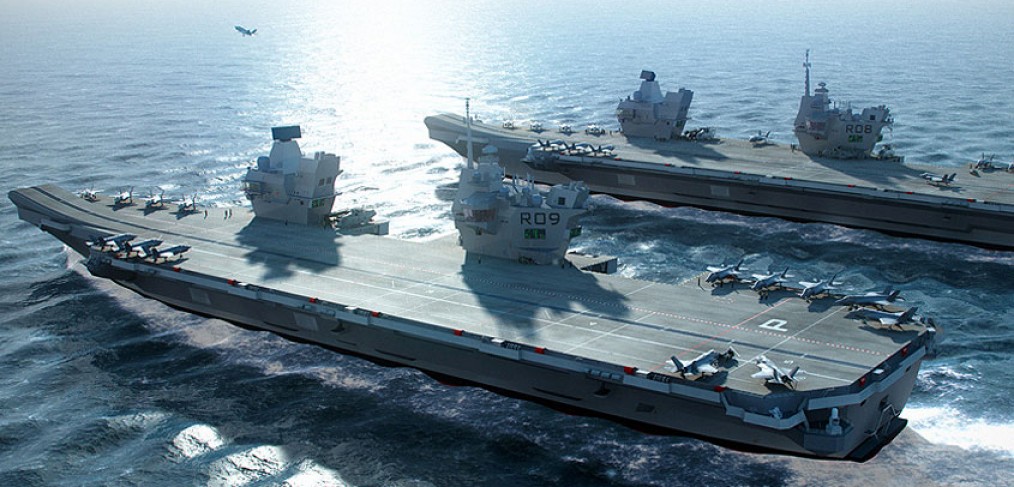
HMS Queen Elizabeth and HMS Prince of Wales

At the close of the NATO summit in Wales this week David Cameron delivered the good news that the Royal Navy will be allowed to retain the second aircraft carrier HMS Prince of Wales. This was another U-turn, reversing one of the many mistaken decisions of Cameron’s 2010 Defence Review that stated the ship would be mothballed or sold. Although undoubtedly good news for the navy, and more importantly the defence of the UK, it is difficult not to be cynical about the entire situation and timing of the announcement.

[…]

The announcement was not accompanied by much detail and leaves a lot of unanswered questions. The RN and its major procurement projects must successfully navigate a general election and the 2015 Defence Review before we can be really certain about HMS Prince of Wales’ future. The biggest unknown is how will the costs of the second carrier be carried by the RN, have the additional costs been found by cuts elsewhere or has this been funded by new money?

The photo above is a computer generated fantasy, apart from the fact carriers would rarely sail in such close formation, it is highly unlikely the RN will ever have the resources to field both carriers simultaneously. Generating the extra crew that the second carrier needs will be one of the first challenges for the RN, already in the throes of a manpower crisis. Although the carrier in refit or maintenance will not require anything like a full crew, it will still require an overlap of manning.

As noted earlier this week, the Royal Navy has shrunk from 38,730 to 33,330 since 2010. It’s going to be a scramble to train (and retain) enough skilled personnel to crew even HMS Queen Elizabeth, never mind at least a cadre for the second aircraft carrier.

Update, 7 September: An interesting, but not surprising revelation from Ali Kefford (retweeted by @NavyLookout).

September 3, 2014

Britain’s shrinking armed forces

Filed under: Britain, Military — Tags: , , — Nicholas @ 08:30

The Secretary of State for Defence was asked in Parliament for a breakdown of the members of the British army, Royal Navy and Royal Air Force. The detailed reply shows some significant changes:

Royal Navy/Royal Marines

Year Total, all ranks
2010 38,730
2011 37,660
2012 35,540
2013 33,960
2014 33,330

Army

Year Total, all ranks
2010 108,920
2011 106,240
2012 104,250
2013 99,730
2014 91,070

Royal Air Force

Year Total, all ranks
2010 44,050
2011 42,460
2012 40,000
2013 37,030
2014 35,230

This may be the only part of British government spending that would actually meet the definition of “austerity”. For reference, the Canadian Armed Forces have about 43,500 regulars across the Canadian Army, Royal Canadian Navy, and Royal Canadian Air Force.

August 26, 2014

Echoes of Star Trek in The Last Ship

Filed under: Media, Military — Tags: , , — Nicholas @ 10:32

In his weekly football column, Gregg Easterbrook usually manages to include lots of non-football stuff, like this:

Sir, I Have Applied My Lip Gloss, Sir! On TNT’s summer ratings hit The Last Ship, about a virus apocalypse that kills most of humanity, when the titular vessel stops at a naval base and aerial recon shows everyone ashore is dead, the XO says, “I don’t like the looks of this.” Really! Then the captain goes along with the landing party, just like on Star Trek. Half the plots on the many Star Trek serials boiled down to this formula:

1. Crew notices something interesting.
2. Captain leads away team that investigates.
3. The thing is not what it seemed! Captain is in grave peril.
4. Remainder of the episode is a rescue mission.

The Last Ship has followed this formula, with its captain several times leading landing parties. At one point a three-person shore party has walked far into the Nicaraguan jungle in search of a rare monkey; two of the three persons are the captain and XO. In another episode, the captain leads a party checking out a derelict fishing boat that might have a clue about the plague destroying the world. Oh no, it’s a trap — he’s captured by the Russians, and the entire next episode is a rescue mission. Scriptwriters: Captains of ships, whether Earthbound or interstellar, do not lead landing parties. Any captain stupid enough to assign himself to a landing party should be relieved of duty!

The 2012 ABC seagoing potboiler Last Resort took considerable liberties with United States Navy vessels. The submarine that was the show’s focus carried both strategic nuclear missiles and cruise missiles (U.S. subs have one or the other), had commando teams (no strategic submarines are equipped to dispatch Marines) and possessed a Star Trek-style invisibility cloak that made it disappear from radar and sonar. The titular vessel in The Last Ship, a Burke-class destroyer with the fictional name Nathan James — it even gets a fictional designation, DDG-151 — is reasonably similar to actual Burke-class destroyers.

The James is depicted as having emergency sails, able to launch two of these — a real boat type but one found on assault ships, not destroyers — and having a main gun that can hit small moving targets, which would allow the James to clean up in any naval gunnery competition. But mostly the ship is realistic, except in that the entire crew is really good-looking.

Female personnel have served on United States surface combatant vessels for about 20 years and on submarines for about two years, so the show’s depiction of a casually mixed-gender complement is accurate. But the women of the James, on active duty aboard a warship during the apocalypse, wear eye makeup and lipstick. Don’t they know loose lips sink ships?

That was one of the things about all the Star Trek shows that bothered me: the captain, first officer, and often chief medical officer being the default configuration for any kind of work away from the ship (along with a few expendable redshirts for brief, tragic death scenes). I don’t know if it’s a carry-over from historical fiction of the Napoleonic wars, where Captain Hornblower seemed to be spending half his time at sea leading boarding parties or cutting-out expeditions, but even then he usually left his first lieutenant in command of the ship in his absence.

August 25, 2014

Want the coolest thing to hit the waves recently? $10 million will be the starting price

Filed under: Military, Technology — Tags: , , — Nicholas @ 14:52

Slashgear‘s Chris Davies says this is just the ticket for up-and-coming Bond villains:

It looks like a half-submerged X-Wing, or maybe a Star Trek Shuttle, but it’s actually Ghost, one American start-up’s vision for what an attack helicopter designed for the navy might look like. Mustering 4,000 HP from two engines on the end of powered legs, Ghost promises to whip across the ocean in a supercavitation bubble, avoiding radar and with a silky smooth ride for the crew inside.

What makes the boat special is how it improves on hydroplane technology, more commonly used in racing boats. Hydroplanes increase their top speed by skimming across the top of the water, rather than burying their hulls in it, reducing drag in the process.

However, that also makes them relatively unstable and prone to flipping — so, Ghost’s manufacturer Juliet Marine Systems turned to supercavitation, which creates a bubble of gas around each of the legs and cuts drag by a factor of 900. Air is pulled down through the struts, while the propellers are at the front of the 62 foot long tubes, effectively pulling the vessel along.

August 5, 2014

Who is to blame for the outbreak of World War One? (Part seven of a series)

Filed under: China, Europe, History, Japan, Military, Pacific, Russia, WW1 — Tags: , , , — Nicholas @ 00:02

I thought we’d be done by now, but there’s still more historical ground to cover on what I think are the deep origins of the First World War (part one, part two, part three, part four, part five, part six). The previous post examined the naval arms race between Britain and Germany. Today, we’re looking at the unhappy Russian experiences in the far East and the dangerous domestic situation it faced after the war.

Russia’s Oriental catastrophe

The Russo-Japanese War of 1904-05 was a huge upset, as all the great powers expected Russia to crush the upstart Japanese and put them back “in their place”. Japan’s stunning naval and military successes at the Battle of the Yellow Sea, Tsushima and Port Arthur left Russia in a potentially disastrous situation, with utter undeniable defeat in the East and revolution brewing at home.

The war came about due to irreconcilable differences in the expansionary plans of the two empires: Russia wanted control of Manchuria and Japan wanted control of Korea, but neither side trusted the other enough to make negotiations work. Japan decided to initiate the conflict with a surprise attack on the Russian naval forces in Port Arthur (now known as the Lüshunkou District of Dalian in China’s Liaoning province). From that point onwards, Japan maintained the initiative, forcing Russia to react and interrupting Russian moves on land and at sea.

The Russian Baltic Fleet passage to and return from the Battle of Tsushima (via Wikipedia)

The Russian Baltic Fleet passage to and return from the Battle of Tsushima (via Wikipedia)

After the defeat of the original Russian fleet in the Pacific, the Baltic Fleet was re-tasked and set out to avenge the loss. The fleet’s luck was terrible to begin with, as shortly after passing between Sweden and Denmark and sailing out into the North Sea, lookouts on the Russian battleships spotted Japanese forces and the fleet opened fire. Twenty minutes, later the enemy was in tatters … unfortunately, the “enemy” were British fishing trawlers. Given the massive firepower of even pre-dreadnought ships, the casualties were surprisingly light: one trawler sunk, two dead, and many wounded. Not long afterward, a Russian ship in the fleet was mis-identified as a Japanese ship and nearly sunk by friendly fire. The nearest Japanese ship was still thousands of miles to the East.

Despite nearly starting a war with the Royal Navy over the Dogger Bank incident (Britain and Japan had signed an alliance in 1902), Admiral Rozhdestvensky was unapologetic and insisted it was the trawlers’ fault and his ships were perfectly entitled to defend themselves from Japanese attackers. As a result of the Russian mistake, Britain refused to allow the fleet passage through the Suez Canal, forcing them to take the far longer trip around Africa instead. If ever a military expedition has had bad omens, the sortie of the Baltic Fleet — now renamed the Second Pacific Squadron for this mission — must be one of the best examples.

When the Russian and Japanese fleets met in the Tsushima Straits, Admiral Tōgō managed to “cross the T” of the Russians, allowing his ships to use their full broadside armament against only the forward-facing guns of the Russian ships. In the end, the Second Pacific Squadron lost all eleven battleships and over 4,000 men killed, another 5,900 captured, and 1,800 interned. Japanese losses were trivial in comparison: three torpedo boats sunk, 117 men killed and about 500 wounded.

There were no major subsequent battles, and Russia was forced to sign the Treaty of Portsmouth to end the war in September 1905. Despite the Tsar’s initial instructions to the Russian delegation, the Russians agreed to recognize Japan’s sphere of influence in Korea, withdraw their troops from Manchuria, and to give up their lease on Port Arthur and Talien. The reaction in both countries was similar: political unrest. Japanese public opinion was that they had been cheated of their full reward from the war, and the government fell in the aftermath. Russians were even more angry and the result was revolution.

The (first) Russian revolution

While the result of the Russo-Japanese war was the trigger for the 1905 Revolution, it was far from being the only grievance. Margaret MacMillan wrote in The War That Ended Peace:

In 1904 the Minister of the Interior, Vyacheslav Plehve, is reported to have said that Russia needed “a small victorious war” which would take the minds of the Russian masses off “political questions”.

The Russo-Japanese War showed the folly of that idea. In its early months Plehve himself was blown apart by a bomb; towards its end the newly formed Bolsheviks tried to seize Moscow. The war served to deepen and bring into sharp focus the existing unhappiness of many Russians with their own society and its rulers. As the many deficiencies, from command to supplies, of the Russian war effort became apparent, criticism grew, both of the government and, since the regime was a highly personalized one, of the Tsar himself. In St. Petersburg a cartoon showed the Tsar with his breeches down being beaten while he says, “Leave me alone. I am the autocrat!” Like the French Revolution, with which it had many similarities, the Russian Revolution of 1905 broke old taboos, including the reverence surrounding the country’s ruler. It seemed to officials in St. Petersburg a bad omen that the Empress had hung a portrait of Marie Antoinette, a gift from the French government, in her rooms.

In December 1904, a strike in St. Petersburg triggered sympathy strikes in other industries, leading to 80,000 workers and supporters protesting in the city. In January 1905, a mass march by the strikers to the Winter Palace was met with rifle fire from the defending troops. Casualty estimates range from 200 to over 1,000 on Bloody Sunday. The strikes and protests spread beyond St. Petersburg, to the point that the government was threatened. Eventually the Tsar was persuaded to offer concessions :

Under huge pressure from his own supporters, the Tsar reluctantly issued a manifesto in October promising a responsible legislature, the Duma, as well as civil rights.

As so often happens in revolutionary moments, the concessions only encouraged the opponents of the regime. It appeared to be close to collapsing with its officials confused and ineffective in the face of such widespread disorder. That winter a battalion from Nichlas’s own regiment, the Preobrazhensky Guards, which had been founded by Peter the Great, mutinied. A member of the Tsar’s court wrote in his diary: “This is it.” Fortunately for the regime, its most determined enemies were disunited and not yet ready to take power while moderate reformers were prepared to support it in the light of the Tsar’s promises. Using the army and police freely, the government managed to restore order. By the summer of 1906 the worst was over — for the time being. The regime still faced the dilemma, though, of how far it could let reforms go without fatally undermining its authority. It was a dilemma faced by the French government in 1789 or the Shah’s government in Iran in 1979. Refusing demands for reform and relying on repression creates enemies; giving way encourages them and brings more demands.

Russia’s economy did recover eventually, but the political solution was not strong enough to stand the strains of another war any time soon. In some ways, it’s hard to imagine what the Russian leaders who advised the Tsar were thinking as the Russians continued to stir the pot in the Balkans…

August 4, 2014

Who is to blame for the outbreak of World War One? (Part six of a series)

Filed under: Britain, Europe, Germany, History, Military, Technology, Weapons, WW1 — Tags: , , — Nicholas @ 00:02

Over the last week, I’ve posted entries on what I think are the deep origins of the First World War (part one, part two, part three, part four, part five). And yes, to be honest, I didn’t think it would take quite this many entries to begin to explain how the world catastrophe of August 1914 came about — putting together this series of blog posts has been educational for me, and I hope it’s been at least of interest to you. The previous post examined the history of the Dual Monarchy of Austria-Hungary, in some detail (yes, it matters). Today, we finally clear the Victorian era altogether and begin to look at the last decade-or-so before the outbreak of the war.

The Anglo-German naval race

Even after the creation of the German Reich in 1871, Germany was not seen (by the British government) to be a major threat to British interests: Germany had no significant presence beyond Europe to worry the Colonial Office, and instead was seen as a potentially useful balancing factor in the European theatre. That all changed with the accession of Kaiser Wilhelm II as explained by Christopher Clark in The Sleepwalkers:

The 1890s were […] a period of deepening German isolation. A commitment from Britain remained elusive and the Franco-Russian Alliance seemed to narrow considerably the room for movement on the continent. Yet Germany’s statesmen were extraordinarily slow to see the scale of the problem, mainly because they believed that the continuing tension between the world empires was in itself a guarantee that these would never combine against Germany. Far from countering their isolation through a policy of rapprochement, German policy-makers raised the quest for self-reliance to the status of a guiding principle. The most consequential manifestation of this development was the decision to build a large navy.

In the mid-1890s, after a long period of stagnation and relative decline, naval construction and strategy came to occupy a central place in German security and foreign policy. Public opinion played a role here — in Germany, as in Britain, big ships were the fetish of the quality press and its educated middle-class readers. The immensely fashionable “navalism” of the American writer Alfred Thayer Mahan also played a part. Mahan foretold in The Influence of Sea Power upon History: 1660–1783 (1890) a struggle for global power that would be decided by vast fleets of heavy battleships and cruisers. Kaiser Wilhelm II, who supported the naval programme, was a keen nautical hobbyist and an avid reader of Mahan; in the sketchbooks of the young Wilhelm we find many battleships — lovingly pencilled floating fortresses bristling with enormous guns. But the international dimension was also crucial: it was above all the sequence of peripheral clashes with Britain that triggered the decision to acquire a more formidable naval weapon. After the Transvaal episode, the Kaiser became obsessed with the need for ships, to the point where he began to see virtually every international crisis as a lesson in the primacy of naval power.

The Royal Navy (RN) had been Britain’s most obvious sign of global dominance, and Britain’s fleets had gone through many technological changes over the century since Waterloo. What had been for centuries a slow, steady process of gradual improvement and incremental change suddenly became the white-hot centre of rapid, even revolutionary, change:

At the same time that you need to add armour to protect the ship, you also need to mount heavier, larger guns. Between placing your order with the shipyard for a new ship, the metallurgical wizards may have (and frequently did) come up with bigger, better guns that could defeat the armour on your not-yet-launched ship. Oh, and you now needed to revise the design of the ship to carry the newer, heavier guns, too.

The ship designers were in a race with the gun designers to see who could defeat the latest design by the other group. It’s no wonder that ships could become obsolete between ordering and coming into service: sometimes, they could become obsolete before launch.

The weapons themselves were undergoing change at a relatively unprecedented rate. As late as the mid-1870′s, a good case could be made for muzzle-loading cannon being mounted on warships: until the gas seal of the breech-loader could be made safe, muzzle-loaders had an advantage of not killing their own crews at distressingly high frequency. Once that technological handicap had been overcome, then the argument came down to the best way to mount the weapons: turrets or barbettes.

The RN’s international prestige invited envious imitators (like Wilhelm) and challengers (the United States Navy and the Imperial Japanese Navy), but the RN was the supreme naval power against which all other nations measured themselves. In 1889, parliament passed the Naval Defence Act, which specified that the Royal Navy would be maintained at the “two-power standard”: that the RN’s fleet of capital ships would be at least equal to the number of battleships maintained by the next two largest navies (at that time, the French and Russian navies). The increased spending allowed ten battleships plus cruisers and torpedo boats to be added to the fleet … but the French and Russian navies added twelve battleships between them over the same period of time. “Another British expansion, known as the Spencer Programme, followed in 1894 aimed to match foreign naval growth at a cost of over £31 million. Instead of deterring the naval expansion of foreign powers, Britain’s Naval Defence Act contributed to a naval arms race. Other powers including Germany and the United States bolstered their navies in the following years as Britain continued to increase its own naval expenditures.”

In The War That Ended Peace, Margaret MacMillan describes the implicit power of the RN in peacetime:

In August 1902 another great naval review took place at Spithead in the sheltered waters between Britain’s great south coast port of Portsmouth and the Isle of Wight, this time to celebrate the coronation of Edward VII. Because he had suddenly come down with appendicitis earlier in the summer, the coronation itself and all festivities surrounding it had been postponed. As a result, most of the ships from foreign navies (except those of Britain’s new ally Japan) as well as those from the overseas squadrons of the British navy had been obliged to leave. The resulting smaller review was, nevertheless, The Times said proudly, a potent display of Britain’s naval might. The ships displayed at Spithead were all in active service and all from the fleets already in place to guard Britain’s home waters. “The display may be less magnificent than the wonderful manifestation of our sea-power witnessed in the same waters five years ago. But it will demonstrate no less plainly what that power is, to those who remember that we have a larger number of ships in commission on foreign stations now than we had then, and that we have not moved a single ship from Reserve.” “Some of our rivals,” The Times warned, “have worked with feverish activity in the interval, and they are steadily increasing their efforts. They should know that Britain remained vigilant and on guard, and prepared to spend whatever funds were necessary to maintain its sovereignty of the seas.”

Admiral Fisher’s new broom
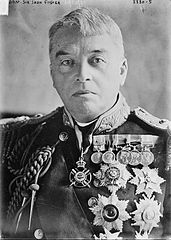
Admiral Sir John "Jackie" Fisher (via Wikipedia)

Admiral Sir John “Jackie” Fisher (via Wikipedia)

In 1904, Admiral Sir John “Jackie” Fisher was appointed as First Sea Lord (the professional head of the RN, reporting to the First Lord of the Admiralty, a cabinet minister). Fisher was a full-steam-ahead reformer, with vast notions of modernizing and reforming the navy. He was brilliant, argumentative, abrasive, tactless, and aggressive but could also be charming and persuasive. “When addressing someone he could become carried away with the point he was seeking to make, and on one occasion, the king asked him to stop shaking his fist in his face.” (Fortunately for Fisher, the king was a personal friend, so this did not hinder his career.)

Margaret MacMillan describes him in The War That Ended Peace:

Jacky Fisher, as he was always known, shoots through the history of the British navy and of the prewar years like a runaway Catharine wheel, showering sparks in all directions and making some onlookers scatter in alarm and others gasp with admiration. He shook the British navy from top to bottom in the years before the Great War, bombarding his civilian superiors with demands until they usually gave way and steamrollering over his opponents in the navy. He spoke his mind freely in his own inimitable language. His enemies were “skunks”, “pimps”, “fossils”, or “frightened rabbits”. Fisher was tough, dogged and largely immune to criticism, not surprising perhaps in someone from a relatively modest background who had made his own way in the navy since he was a boy. He was also supremely self-confident. Edward VII once complained that Fisher did not look at different aspects of an issue. “Why should I waste my time,” the admiral replied, “looking at all sides when I know my side is the right side?”

Fisher had been a maverick throughout his career (which makes it even more amazing that he eventually did rise to become First Sea Lord), as his actions when he took command of the Mediterranean Fleet clearly illustrate:

A programme of realistic exercises was adopted including simulated French raids, defensive manoeuvres, night attacks and blockades, all carried out at maximum speed. He introduced a gold cup for the ship which performed best at gunnery, and insisted upon shooting at greater range and from battle formations. He found that he too was learning some of the complications and difficulties of controlling a large fleet in complex situations, and immensely enjoyed it.

Notes from his lectures indicate that, at the start of his time in the Mediterranean, useful working ranges for heavy guns without telescopic sights were considered to be only 2000 yards, or 3000-4000 yards with such sights, whereas by the end of his time discussion centred on how to shoot effectively at 5000 yards. This was driven by the increasing range of the torpedo, which had now risen to 3000-4000 yards, necessitating ships fighting effectively at greater ranges. At this time he advocated relatively small main armaments on capital ships (some had 15 inch or greater), because the improved technical design of the relatively small (10 inch) modern guns allowed a much greater firing rate and greater overall weight of broadside. The potentially much greater ranges of large guns was not an issue, because no one knew how to aim them effectively at such ranges. He argued that “the design of fighting ships must follow the mode of fighting instead of fighting being subsidiary to and dependent on the design of ships.” As regards how officers needed to behave, he commented, “‘Think and act for yourself’ is the motto for the future, not ‘Let us wait for orders’.”

Lord Hankey, then a marine serving under Fisher, later commented, “It is difficult for anyone who had not lived under the previous regime to realize what a change Fisher brought about in the Mediterranean fleet. … Before his arrival, the topics and arguments of the officers messes … were mainly confined to such matters as the cleaning of paint and brasswork. … These were forgotten and replaced by incessant controversies on tactics, strategy, gunnery, torpedo warfare, blockade, etc. It was a veritable renaissance and affected every officer in the navy.” Charles Beresford, later to become a severe critic of Fisher, gave up a plan to return to Britain and enter parliament, because he had “learnt more in the last week than in the last forty years”.

One of his first changes was to sell nearly one hundred elderly ships and move dozens of less capable vessels from the active list to the reserve fleet, to free up the crews (and the maintenance budget) for more modern vessels, describing the ships as “too weak to fight and too slow to run away”, and “a miser’s hoard of useless junk”. Between his reforms as Third Sea Lord (where he had championed the development of the modern destroyer and vastly increased the efficiency and productivity of the shipyards) and his new role as First Sea Lord, Fisher was able to get more done even on a budget that dropped nearly 10% in the year of his appointment than his predecessor had managed.

HMS Dreadnought and the naval revolution

Fisher was not a naval designer, but he knew how to push new ideas to the front and get them adopted. The one thing that most people remember him for is the revolutionary battleship HMS Dreadnought, the first all big gun, fast steam turbine powered battleship, and when she went into commission, she signified the obsolescence of every other capital ship in every navy from that moment onwards.
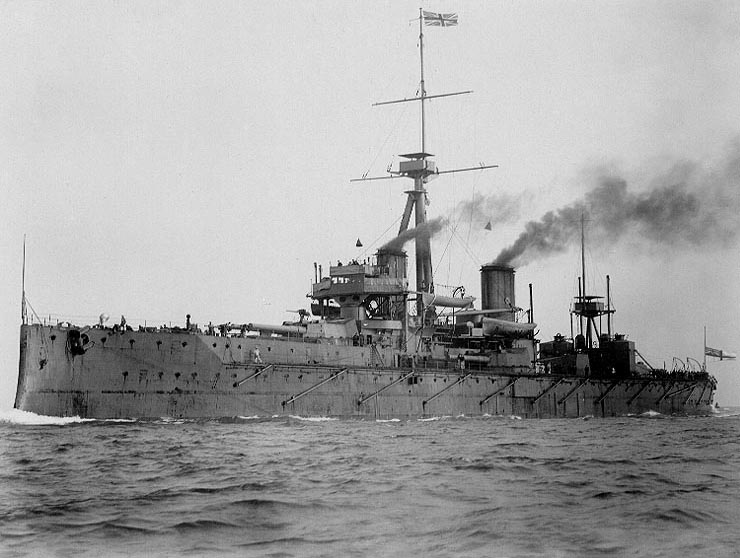
HMS Dreadnought underway, circa 1906-07

HMS Dreadnought underway, circa 1906-07

Dreadnought was the platonic ideal of a battleship: she was faster than any other capital ship in any other navy, her guns were at least the equivalent in range, rate of fire, and throw of shot, and her armour was sufficient to allow her to take punishment from opposing ships and still deal out damage herself. She was the first British ship to be equipped with electrical controls allowing the entire main armament to be fired from a central location. Thanks to Fisher’s earlier efforts with the shipyards, Dreadnought took just a year to build — far faster than any other battleship had been built.

The “entirely crazy Dreadnought policy of Sir J. Fisher and His Majesty”

The Kaiser was not happy with the new British battleship, as it had been German policy since his accession to build up the German navy to at least provide a tool for pressuring Britain (if not for actually confronting the Royal Navy in battle). Now his entire naval plan had been upset by the Dreadnought revolution. Margaret MacMillan:

As far as the Kaiser and [Admiral] Tirpitz were concerned the responsibility for taking the naval race to a new level rested with what Wilhelm called the “entirely crazy Dreadnought policy of Sir J. Fisher and His Majesty”. The Germans were prone to see Edward VII as bent on a policy of encircling Germany. The British had made a mistake in building dreadnoughts and heavy cruisers, in Tirpitz’s view, and they were angry about it: “This annoyance will increase as they see that we follow them immediately.” […] Who could tell what the British might do? Did their history not show them to by hypocritical, devious and ruthless? Fears of a “Kopenhagen”, a sudden British attack just like the one in 1807 when the British navy had bombarded Copenhagen and seized the Danish fleet, were never far from the thoughts of the German leadership once the naval race had started.

German fears of British attack increased almost in lockstep with British fears of German attack (William Le Queux had his equivalents among the German press and popular novelists). The thought had actually occurred to Fisher himself, who outlined a possible coup de main against the German fleet. The king responded “My God, Fisher, you must be mad!” and the suggestion was ignored, thankfully.

The popular worries about an attack from Britain fed the support for the German Navy laws, which funded dreadnought and battlecruiser building programs. In direct proportion, the increased German support for their naval expansion worked to the advantage of British politicians who wanted to build more dreadnoughts of their own. And, in fairness, Britain risked far more by allowing an enlarged German navy than Germany risked by stopping their building program … but in either case, the fear of popular unrest kept the shipyards humming anyway. As Churchill later wrote, “The Admiralty had demanded six ships; the economists offered four; and we finally compromised on eight.”

There we go, finally getting within striking distance of the triggering events of the First World War … and I’m still not sure how many more posts it will take to get us there! More to come this week.

July 27, 2014

Floating HMS Queen Elizabeth for the first time

Filed under: Britain, Military — Tags: , — Nicholas @ 00:02

Three hours of careful work compressed into a short video:

July 26, 2014

Royal Navy commander may have had affair with crew member

Filed under: Britain, Military — Tags: , — Nicholas @ 11:04

From the Guardian, a report on a current investigation into a Royal Navy officer who may have had an affair with a subordinate:

The first female commander of a major Royal Navy warship has left her vessel after claims she had an affair with a shipmate.

Commander Sarah West, 42, took charge of Type 23 frigate HMS Portland in May 2012.

It is understood she has left the ship while the navy investigates the claims. Her second-in-command has taken over the running of the vessel, but West is still the commanding officer.

The navy inquiry will consider whether West breached the armed forces’ code of social conduct, which governs personal relationships within the military. Possible punishments for a breach include a formal warning, reassignment and even termination of service.

A Royal Navy spokesman said: “We are aware of an allegation of a breach of the code of social conduct on board HMS Portland, which we are treating seriously.

“Anyone who is found to fall short of the Royal Navy’s high standards can expect to face appropriate action. It would be inappropriate to comment further.”

West made headlines when she became the first female commander of a frontline warship in the 500-year history of the service.

But earlier this year she explained how work commitments made it difficult to have a relationship.

July 20, 2014

QotD: The Kaiser and the genesis of the High Seas Fleet

Filed under: Europe, Germany, History, Military, Quotations — Tags: , — Nicholas @ 00:01

The 1890s were […] a period of deepening German isolation. A commitment from Britain remained elusive and the Franco-Russian Alliance seemed to narrow considerably the room for movement on the continent. Yet Germany’s statesmen were extraordinarily slow to see the scale of the problem, mainly because they believed that the continuing tension between the world empires was in itself a guarantee that these would never combine against Germany. Far from countering their isolation through a policy of rapprochement, German policy-makers raised the quest for self-reliance to the status of a guiding principle. The most consequential manifestation of this development was the decision to build a large navy.

In the mid-1890s, after a long period of stagnation and relative decline, naval construction and strategy came to occupy a central place in German security and foreign policy. Public opinion played a role here — in Germany, as in Britain, big ships were the fetish of the quality press and its educated middle-class readers. The immensely fashionable “navalism” of the American writer Alfred Thayer Mahan also played a part. Mahan foretold in The Influence of Sea Power upon History (1890) a struggle for global power that would be decided by vast fleets of heavy battleships and cruisers. Kaiser Wilhelm II, who supported the naval programme, was a keen nautical hobbyist and an avid reader of Mahan; in the sketchbooks of the young Wilhelm we find many battleships — lovingly pencilled floating fortresses bristling with enormous guns. But the international dimension was also crucial: it was above all the sequence of peripheral clashes with Britain that triggered the decision to acquire a more formidable naval weapon. After the Transvaal episode, the Kaiser became obsessed with the need for ships, to the point where he began to see virtually every international crisis as a lesson in the primacy of naval power.

Christopher Clark, The Sleepwalkers: How Europe Went To War In 1914, 2012.

July 13, 2014

HMCS Regina at sea

Filed under: Cancon, Military — Tags: , , , — Nicholas @ 10:49

In Maclean’s, Nick Taylor-Vaisey has a video and photos from HMCS Regina‘s most recent tour of duty.

Peter Bregg boarded HMCS Regina on a fateful day for the ship’s crew. Bregg, a former Maclean’s chief photographer who spent 18 days observing Canadian anti-smuggling operations in the Indian Ocean, arrived in Dar es Salaam on April 21. He left the steamy Tanzanian port city the same day Leading Seaman Brandon South, a sonar operator, died in a nearby hospital, while off-duty, of causes not yet released to the public.

The next day, Daniel Charlebois, the ship’s commanding officer, informed the crew. Morale plummeted, says Bregg. “It was really depressing,” he recalls. “I stayed out of their way and put my camera away.” During a memorial service two days later, Bregg was in a Navy helicopter that paid tribute to the late seaman with a flypast. He called the sombre service “almost like a burial at sea.”

South’s death was a rare dark moment aboard Regina, says Bregg, where the 265 sailors normally kept “extremely high” spirits as they went about their business: maintenance, target practice, personal training, and the self-explanatory “Sundae Sundays.” When necessary, they transition easily between the formal chain of command and lighter moments at sea. While sailors chow down on ice cream or unload the ship, rank dissolves.

July 9, 2014

QotD: British nepotism, old style

Filed under: Britain, History, Humour, Quotations — Tags: , , — Nicholas @ 00:01

A problem constantly before the modern administration, whether in government or business, is that of personnel selection. The inexorable working of Parkinson’s Law ensures that appointments have constantly to be made and the question is always how to choose the right candidate from all who present themselves. In ascertaining the principles upon which the choice should be made, we may properly consider, under separate heads, the methods used in the past and the methods used at the present day.

Past methods, not entirely disused, fall into two main categories, the British and the Chinese. Both deserve careful consideration, if only for the reason that they were obviously more successful than any method now considered fashionable. The British method (old pattern) depended upon an interview in which the candidate had to establish his identity. He would be confronted by elderly gentlemen seated round a mahogany table who would presently ask him his name. Let us suppose that the candidate replied, “John Seymour.” One of the gentlemen would then say, “Any relation of the Duke of Somerset?” To this the candidate would say, quite possibly, “No, sir.” Then another gentleman would say, “Perhaps you are related, in that case, to the Bishop of Watminster?” If he said “No, sir” again, a third would ask in despair, “To whom then are you related?” In the event of the candidate’s saying, “Well, my father is a fishmonger in Cheapside,” the interview was virtually over. The members of the Board would exchange significant glances, one would press a bell and another tell the footman, “Throw this person out.” One name could be crossed off the list without further discussion. Supposing the next candidate was Henry Molyneux and a nephew of the Earl of Sefton, his chances remained fair up to the moment when George Howard arrived and proved to be a grandson of the Duke of Norfolk. The Board encountered no serious difficulty until they had to compare the claims of the third son of a baronet with the second but illegitimate son of a viscount. Even then they could refer to a Book of Precedence. So their choice was made and often with the best results.

The Admiralty version of this British method (old pattern) was different only in its more restricted scope. The Board of Admirals were unimpressed by titled relatives as such. What they sought to establish was a service connection. The ideal candidate would reply to the second question, “Yes, Admiral Parker is my uncle. My father is Captain Foley, my grandfather Commodore Foley. My mother’s father was Admiral Hardy. Commander Hardy is my uncle. My eldest brother is a Lieutenant in the Royal Marines, my next brother is a cadet at Dartmouth and my younger brother wears a sailor suit.” “Ah!” the senior Admiral would say. “And what made you think of joining the Navy?” The answer to this question, however, would scarcely matter, the clerk present having already noted the candidate as acceptable. Given a choice between two candidates, both equally acceptable by birth, a member of the Board would ask suddenly, “What was the number of the taxi you came in?” The candidate who said “I came by bus” was then thrown out. The candidate who said, truthfully, “I don’t know,” was rejected, and the candidate who said “Number 2351” (lying) was promptly admitted to the service as a boy with initiative. This method often produced excellent results.

C. Northcote Parkinson, “The Short List, Or Principles Of Selection”, Parkinson’s Law (and other studies in administration), 1957.

July 4, 2014

The Queen formally names the new aircraft carrier HMS Queen Elizabeth

Filed under: Britain, Military — Tags: , — Nicholas @ 07:18

A break with tradition, as the ship was christened with a bottle of Bowmore whisky, rather than a bottle of champagne:

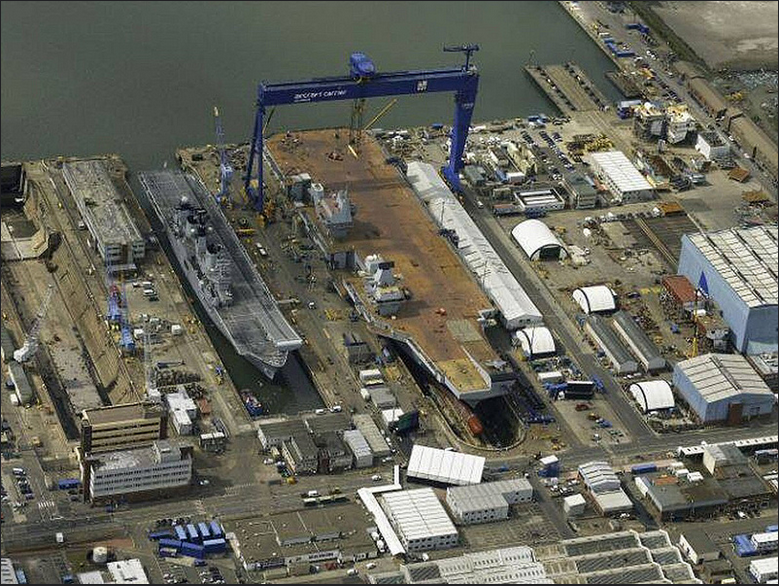
HMS Queen Elizabeth is pictured in Rosyth Dockyard where Queen Elizabeth II will formally name the Royal Navy’s biggest ever ship on July 4, 2014 in Fife, Scotland. With whisky replacing the more traditional champagne at the ceremony, Queen Elizabeth II will smash a bottle of Islay malt whisky against HMS Queen Elizabeth at the event at Rosyth Dockyard, where the 65,000-tonne aircraft carrier has been assembled and fitted out. (Photo by Andrew Milligan – WPA Pool /Getty Images)

A bottle of whisky was smashed on the hull of the 65,000-tonne HMS Queen Elizabeth — the first of two new Royal Navy aircraft carriers being built.

The Red Arrows flew over the dockyard before the ship was officially named.

First Sea Lord Admiral George Zambellas said the ship was “fit for a Queen”.

HMS Queen Elizabeth will be a national instrument of power and a national symbol of authority,” he said in a speech.

“That means she will be a national icon too, all the while keeping the great in Great Britain and the royal in Royal Navy.”

Addressing the audience, the Queen said the “innovative and first class” warship, the largest ever to be built in the UK, ushered in an “exciting new era”.

“In sponsoring this new aircraft carrier, I believe the Queen Elizabeth will be a source of inspiration and pride for us all,” she said.

“May God bless her and all who sail in her.”

And even the bloody BBC gets it wrong: the ship is named for Queen Elizabeth I, not the current monarch … when the Royal Navy names a ship for a monarch, like the battleship HMS King George V for example, it indicates which King George is being memorialized. HMS Queen Elizabeth is the third time the Royal Navy has named a ship for the Virgin Queen: the first being the lead ship of a class of super-dreadnoughts launched just before the outbreak of WW1, and the second being the lead ship of a class of never-built aircraft carriers in the 1960s (no, I don’t know why that counts: ask the RN about that).

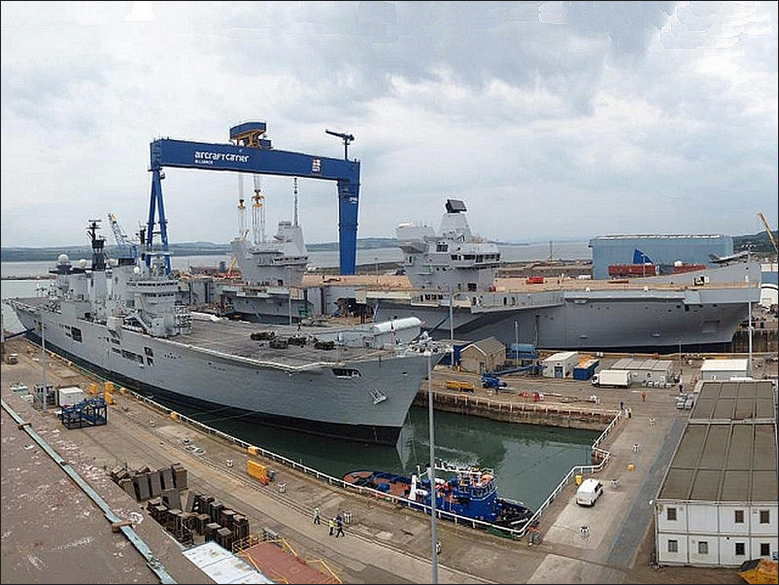
Update 17 July: A few photos from Jeff Head’s Flickr stream show the contrast between the soon-to-be-retired HMS Illustrious and the soon-to-be-launched HMS Queen Elizabeth:

Queen Elizabeth ready for launch, next to HMS Illustrious (Photo by Jeff Head)

HMS Queen Elizabeth ready for launch, next to HMS Illustrious (Photo by Jeff Head)

HMS Queen Elizabeth ready for christening, with HMS Illustrious in the foreground. (Photo by Jeff Head)

HMS Queen Elizabeth ready for christening, with HMS Illustrious in the foreground. (Photo by Jeff Head)

June 21, 2014

New Zealand’s Defense Capability Plan

Filed under: Military, Pacific — Tags: , , , — Nicholas @ 11:05

At The Diplomat, Ankit Panda reports on the recent Defense Capability Plan (DCP) released by the New Zealand government:

The DCP emphasizes enhancing the NZDF’s “proficiency at joint operations and growing its combat, combat support and combat service support capabilities.” The shortest term goal for the NZDF as explained in the DCF is to achieve Joint Taskforce Capability by 2015. In the medium term, by 2020, the NZDF will focus on enhancing its combat capability. According to the DCP, the NZDF will be charged with:

  • defending New Zealand’s sovereignty;
  • discharging [New Zealand’s] obligations as an effective ally of Australia;
  • contributing to and, where necessary, leading peace and security operations in the South Pacific;
  • making a credible contribution in support of peace and security in the Asia-Pacific region;
  • protecting New Zealand’s wider interests by contributing to international peace and security, and the international rule of law;
  • contributing to whole of Government efforts to monitor the international strategic environment; and
  • being prepared to respond to sudden shifts and other disjunctions in the strategic environment.

The DCP sets out some of New Zealand’s longer term procurement concerns. The country will have to replace its aging C-130H and Boeing 757 fleets “in the early 2020s.” Additionally, ANZAC frigates and the highly versatile P-3K2 Orion maritime surveillance aircraft “will also reach the end of their service life in the 2020s.”

The DCP can be read here.

June 18, 2014

Is the RCN “kicking the tires” of the Mistral?

Filed under: Cancon, France, Military — Tags: , , , — Nicholas @ 10:59

The French navy is visiting Canada’s East coast this week, taking part in Exercise LION MISTRAL. David Pugliese reported on the operation a few days ago:

Approximately 200 Canadian Army soldiers from 5 Canadian Mechanized Brigade Group in Valcartier, Quebec will take part in Exercise LION MISTRAL alongside members of the French Navy and Royal Canadian Air Force from June 16-23, 2014, in Gaspé, Quebec, according to a news release from the DND.

  • Canadian Army soldiers, primarily from the 1st Battalion, Royal 22e Régiment (1 R22eR), will board The Mistral, the French amphibious assault ship and helicopter carrier in Halifax on June 18; 

  • Canadian Army troops will conduct littoral operations, including running air-land operations and battle procedures, and establishing a helicopter landing site and a beachhead. Ex LION MISTRAL will also feature a humanitarian assistance air evacuation operation that will help train expeditionary forces to respond to humanitarian disasters;


  • Ex LION MISTRAL will culminate in two disembarkation operations on a Gaspé beach on June 20-21 marking the end of the amphibious exercise. In response to a request by the town of Gaspé, the members of the 1 R22eR will also be offering a static display of their vehicles and equipment on June 21;


  • More than 400 French Navy members of The Mistral and 175 of La Fayette will be participating alongside some 200 Canadian soldiers, including 20 engineers from 5 Combat Engineer Regiment from Valcartier;


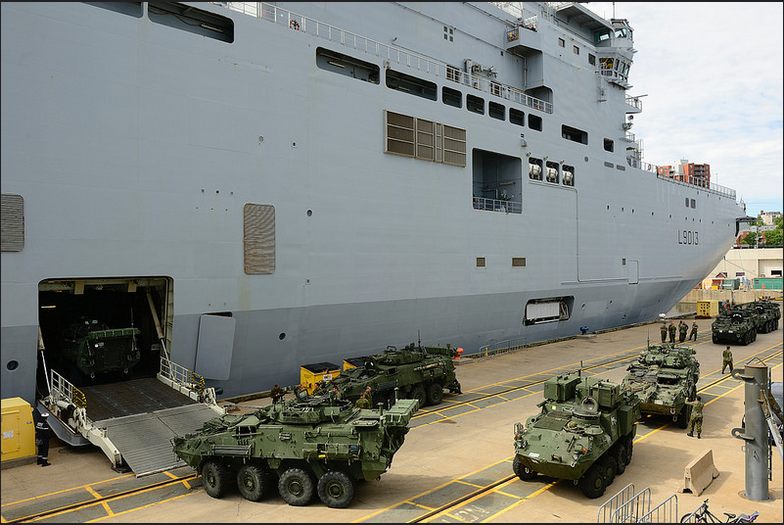
On Flickr a couple of photos from yesterday, as equipment was being loaded onto Mistral in Halifax:

Members of the 1st Battalion, Royal 22e Regiment load light armored vehicles onboard the French Navy amphibious ship Mistral as part of Exercise LION MISTRAL 2014 in Halifax, Nova Scotia, June 17, 2014. Photo: MCpl Patrick Blanchard, Canadian Forces Combat Camera IS2014-3030-06

Members of the 1st Battalion, Royal 22e Regiment load light armored vehicles onboard the French Navy amphibious ship Mistral as part of Exercise LION MISTRAL 2014 in Halifax, Nova Scotia, June 17, 2014.
Photo: MCpl Patrick Blanchard, Canadian Forces Combat Camera IS2014-3030-06

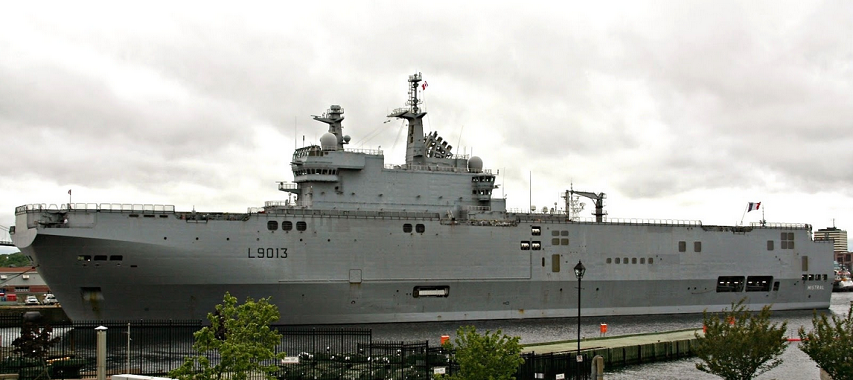
Halifax, Nova Scotia.  FS Mistral (L-9013) is an Amphibious assault ship, and lead ship of her class. She was commissioned in 2006. She features a landing craft dock, and Helicopter facilities. Photo: Halifax Shipping News

Halifax, Nova Scotia.
FS Mistral (L-9013) is an Amphibious assault ship, and lead ship of her class. She was commissioned in 2006. She features a landing craft dock, and Helicopter facilities.
Photo: Halifax Shipping News

Additional photos by M/Cpl Blanchard were posted on the Ottawa Citizen website.

June 9, 2014

Australia gets sensible about military shipbuilding

Filed under: Australia, Economics, Military, Pacific — Tags: , — Nicholas @ 08:51

Australia has similar military issues to the ones Canada faces, but unlike our own government (who view military spending primarily as the regional economic development variant of crony capitalism), Australia is amenable to economic sense when it comes to building the new support ships for the Royal Australian Navy:

The RAN is about to bring 3 large Hobart Class destroyers into service, but it’s the new LPD HMAS Choules and 2 Canberra Class 27,500t LHD amphibious assault ships that are going to put a real strain on the RAN’s support fleet. Liberal Party defense minister Sen. Johnson didn’t mince words when he announced the competition, early in their governing term:

    “With the large LHD’s [sic] – 28,000 tonnes each – we must have a suitable replenishment ship to supply and support those vessels going forward, the planning for this should have been done a long, long time ago.”

The Australian government is explicit about needing “fuel, aviation fuel, supplies, provisions and munitions on these ships,” and they’ve short-listed 2 main competitors to build the ships outside of Australia:
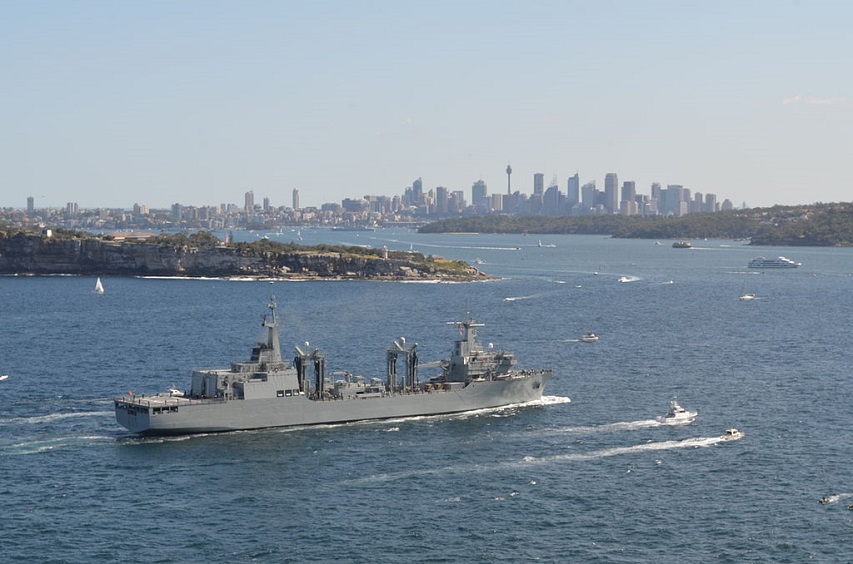
SPS Cantabria entering Sydney harbour in October 2013
Cantabria Class. The Cantabrias are an enlarged 19,500t version of the Patino Class replenishment ship. Fuel capacity rises to 8,920 m3 ship fuel and 1,585 m3 of JP-5 naval aviation fuel. Throw in 470t of general cargo, 280t of secured ammunition, and 215 m3 of fresh water to round out its wet/dry capabilities. These ships also carry a crew medical center with 10 beds, including operating facilities equipped for telemedicine by videoconference, an X-ray room, dental surgery, sterilization laboratory, and gas containment.

Spain already uses this ship type, and Navantia S.A. is already building the Hobart Class and Canberra Class, giving them a deep relationship with Australian industry and the Navy.

Aegir Class. The government named Daewoo Shipbuilding and Marine Engineering (DSME), who are currently building Britain’s MARS 37,000t oiler/support ships based on BMT’s Aegir design. The concept is scalable, and Australia’s government sized the variant they’ve shortlisted at around 26,000t. BMT’s Aegir 26 design offers up to 19,000 m3 of cargo fuel, and 2-5 replenishment at sea stations for hoses and transfer lines. The design itself is somewhat customizable, so it will be interesting to see what the offer’s final specifications and features are.

Recall that HMAS Sirius was also built in South Korea, albeit in a different dockyard. That isn’t surprising, because South Korea arguably has the world’s best shipbuilding industry. Norway and Britain have each purchased customized versions of the Aegir Class ships.

Both the Royal Navy and the Royal Australian Navy are willing to buy ships from Korea. Why not the Royal Canadian Navy’s next ships? Because the government would rather spend many times more money and get smaller, less capable ships as long as they get to spread the money around to cronies:

They won’t be built in Australia, because the government doesn’t believe that the industrial infrastructure and experience is in place to build 20,000+ tonne ships locally. Britain has made a similar calculation, while Canada provides a cautionary example by building smaller supply ships locally at over 5x Britain’s cost.

H/T to Mark Collins for the link. Mark also posted this back in 2013:

To add insult to injury, the Royal Fleet Auxiliary, the civilian-manned support ships for the Royal Navy, are purchasing 4 replenishment vessels under the MARS tanker program to be built in South Korea by Daewoo (arguably the foremost shipbuilder in the world). These ships are slightly larger than the Berlin-class. What is the British government paying for these 4 vessels? £452M or about $686M USD. Not per ship but for all four. The per unit cost is around $170M. If we somehow manage to keep the cost for the JSS at $1.3B per unit, that will still be over 7.5x what the British are paying. If the cost goes up to ~$2B per JSS, we’re looking at almost 12x the cost [though the RCN’s JSS is supposed to have some additional capabilities (already much reduced from 2006 to now, and see the very optimistic timeline here) — but how many of them can the government afford?].

« Newer PostsOlder Posts »
March 2026
S M T W T F S
1234567
891011121314
15161718192021
22232425262728
293031  
  • Recent Comments
  • Red Ensign Brigade
    RedEnsign.gif
  • Categories
  • Most frequently used tags
  • Archives
  • Powered by WordPress