
Published on May 18, 2017
Sponsored by Wargaming! New players: Download World of Warships and use the code EXTRA1 for free goodies! http://cpm.wargaming.net/i3v7c6uu/?pub_id=2017_Video_2
The Bismarck had been sighted, and the British fleet raced to intercept it with their own flagship: the mighty HMS Hood. As Hood and her escort caught up, a harrowing battle between four giant ships ensued.
June 22, 2017
Hunting the Bismarck – II: The Mighty HMS Hood – Extra History
Comments Off on Hunting the Bismarck – II: The Mighty HMS Hood – Extra History
June 18, 2017
Ottoman Soldiers in Europe – Naval Tactics – Officer PoWs I OUT OF THE TRENCHES
Published on 17 Jun 2017
Signup for your FREE trial to The Great Courses Plus* here: http://ow.ly/UYp930acl8m
Another exciting episode of Out Of The Trenches featuring naval tactics, the treatment of officers as prisoners of war and two questions related to the Ottoman Empire.
*The Great Courses Plus is currently available to watch through a web browser to almost anyone in the world and optimized for the US market. The Great Courses Plus is currently working to both optimize the product globally and accept credit card payments globally.
Comments Off on Ottoman Soldiers in Europe – Naval Tactics – Officer PoWs I OUT OF THE TRENCHES
June 17, 2017
Hunting the Bismarck – I: The Pride of Germany – Extra History
Published on May 11, 2017
Sponsored by Wargaming! New players: Download World of Warships and use the code EXTRA1 for free goodies! http://cpm.wargaming.net/i3v7c6uu/?pub_id=2017_Video_1
During World War II, the Bismarck was the pride of the German navy – and the nightmare of Great Britain. It was enormous, overpowered, and a constant threat to the seas. So when they got word that the Bismarck had mobilized, the British raced to stop it.
Comments Off on Hunting the Bismarck – I: The Pride of Germany – Extra History
June 4, 2017
The Battle of Midway, 4-7 June 1942
Last month, Victor Davis Hanson recounted the American side of the Battle of Midway, which many historians see as the turning point of the Pacific War:
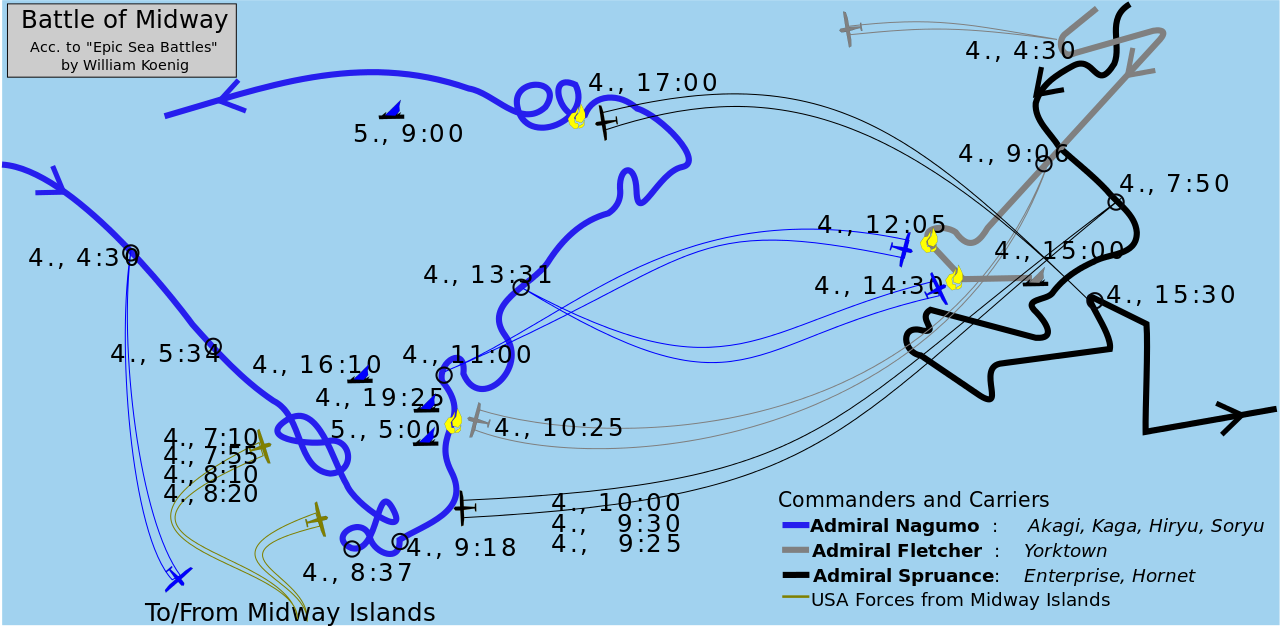
Battle of Midway deployment map, according to Seeschlachten der Weltgeschichte by William Koenig (German version of Epic Sea Battles) via Wikimedia
Seventy-five years ago (June 4-7, 1942), the astonishing American victory at the Battle of Midway changed the course of the Pacific War.
Just six months after the catastrophic Japanese surprise attack on Pearl Harbor, the U.S. crushed the Imperial Japanese Navy off Midway Island (about 1,300 miles northwest of Honolulu), sinking four of its aircraft carriers.
“Midway” referred to the small atoll roughly halfway between North America and Asia. But to Americans, “Midway” became a barometer of military progress. Just half a year after being surprised at Pearl Harbor, the U.S. Navy had already destroyed almost half of Japan’s existing carrier strength (after achieving a standoff at the Battle of the Coral Sea a month earlier).
The odds at the June 1942 battle favored the Japanese. The imperial fleet had four carriers to the Americans’ three, backed up by scores of battleships, cruisers and light carriers as part of the largest armada that had ever steamed from Japan.
No military had ever won more territory in six months than had Japan. Its Pacific Empire ranged from the Indian Ocean to the coast of the Aleutian Islands, and from the Russian-Manchurian border to Wake Island in the Pacific.
Yet the Japanese Navy was roundly defeated by an outnumbered and inexperienced American fleet at Midway. Why and how?
Comments Off on The Battle of Midway, 4-7 June 1942
May 29, 2017
Falklands War – Argentine Perspective – An Inevitable Defeat? (Guerra de las Malvinas)
Published on 12 Apr 2016
The Falklands War (Guerra de las Malvinas) in 1982 as seen by many as an inevitable defeat for Argentina, but taking a closer look at the preparations or better the lack of preparation on the Argentine side reveals that the British could have faced a far stronger opposition and might even had been defeated at least in their initial attacks. This video could also be seen as a how NOT to guide.
Comments Off on Falklands War – Argentine Perspective – An Inevitable Defeat? (Guerra de las Malvinas)
May 23, 2017
The Ally From The Far East – Japan in World War 1 I THE GREAT WAR Special
Published on 22 May 2017
Japan’s participation in World War 1 is an often overlooked part of their history – even in Japan itself. Their service as one of the members of the Entente marked the climax of a development that started with the Meiji Restoration, a way out of isolation and into the global alliance system. This brought Japan more power and was also very lucrative. And after fighting in the Pacific Theatre of World War 1, the Siege of Tsingtao and contributing the Japanese Navy to the war effort, Japan had a seat at the table of the Versailles peace negotiations.
Comments Off on The Ally From The Far East – Japan in World War 1 I THE GREAT WAR Special
May 20, 2017
Top 10 ugliest Warships (Pre 1930’s)
Published on 31 Jul 2015
WARNING! Ugly lives here! My Top 10 ugliest warships (Pre 1930’s) This video showcases some of the ugliest warships ever made. From a sunken barn with a gun mounted on top, to a Russian UFO…these ships look better sunk then floating.
Comments Off on Top 10 ugliest Warships (Pre 1930’s)
May 18, 2017
World of Warships – HMS Hood
Published on 17 May 2017
Look up in the sky! Is it a bird? Is it a plane? No don’t be silly, it’s HMS Hood. Bugger off with your Superman jokes, Jingles.
Comments Off on World of Warships – HMS Hood
May 15, 2017
Comparing Royal Marine field ration packs
A fascinating insight into the way the Royal Marines take care of the troops in the field, showing both enlisted mens’ and officers’ ration packs:
Comments Off on Comparing Royal Marine field ration packs
May 6, 2017
History of the Royal Navy – Steam, steel and Dreadnoughts (1806-1918)
Published on 1 Mar 2013
Here’s also an older post covering the technological challenges faced by the Royal Navy in the post-Napoleonic era, and some of the reasons for all those “weird” ship designs in the Victorian era.
Comments Off on History of the Royal Navy – Steam, steel and Dreadnoughts (1806-1918)
April 7, 2017
The First American Shots Of WW1 – Guam And The Cormoran I THE GREAT WAR Special
Published on 6 Apr 2017
Learn more about Guam in WW1: www.visitguam.com/smscormoranguam/
The Island of Guam was on the other end of the world when the US declared war on Germany in 1917. However, they had been involved in the global conflict for years already. When the Germans lost their colonies in the Pacific, the German merchant raider SMS Cormoran II had no other choice but to seek refuge in the then neutral Arpor Harbour, Guam. For months the German crew around Adalbert Zuckschwerdt stayed on the island and became a kind of sensation. But that all changed on April 6, 1917.
Comments Off on The First American Shots Of WW1 – Guam And The Cormoran I THE GREAT WAR Special
March 30, 2017
Another Japanese “destroyer” joins the fleet
Due to a long-standing aversion to calling certain kinds of vessels by their most appropriate name, the Japanese Maritime Self-Defence Force (because Japan’s constitution prohibits the country having a “navy”, post-1945) commissioned their latest “destroyer” last week:
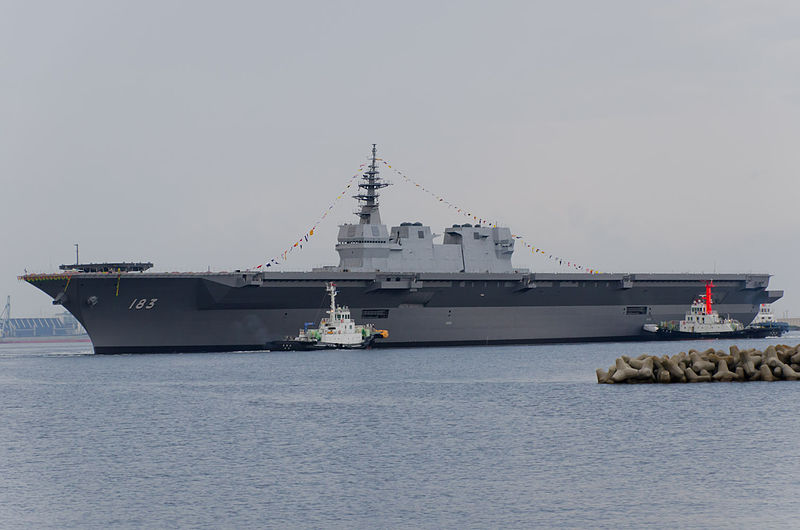
JS Izumo DDH-183, sister-ship of the just-commisioned JS Kaga DDH-184, both helicopter-equipped destroyers, officially.
I know what you’re thinking … “That doesn’t look like a destroyer to me” … but that’s what Japan officially designates ships like this to be, so that’s what they’re called. Strategy Page has more:
On March 22nd Japan put into service a second 27,000 ton “destroyer” (the Kaga, DDH 184) that looks exactly like an aircraft carrier. Actually it looks like an LPH (Landing Platform Helicopter) an amphibious ship type that first appeared in the 1950s. This was noted when Izumo, the first Japanese LPH was launched in 2012 (it entered service in 2015). The Izumos can carry up to 28 aircraft and are armed only with two 20mm Phalanx anti-missile cannon and launcher with sixteen ESSM missiles for anti-missile defense.
LPHs had no (or relatively few) landing craft but did carry a thousand or more troops who were moved ashore using the dozen or more helicopters carried. The first American LPH (the USS Iwo Jima) was an 18,400 ton ship that entered service in 1961, and carried 2,000 troops and twenty-five helicopters. Until Izumo showed up, several nations operated LPHs, and Britain and South Korea still do. The U.S. retired its last LPHs in the 1990s, but still have a dozen similar ships that include landing craft (and a well deck in the rear to float them out of) as well as helicopters. A few other nations have small carriers that mostly operate helicopters but carry few, if any troops.
The Izumos are the largest LPHs to ever to enter service. It differs from previous LPHs in not having accommodations for lots of troops and having more powerful engines (capable of destroyer-like speeds of over fifty-four kilometers an hour). Izumo does have considerable cargo capacity, which is intended for moving disaster relief supplies quickly to where they are needed. Apparently some of these cargo spaces can be converted to berthing spaces for troops, disaster relief personnel, or people rescued from disasters. There are also more medical facilities than one would expect for a ship of this size. More worrisome (to the Chinese) is the fact that the Izumo could carry and operate the vertical take-off F-35B stealth fighter, although Japan has made no mention of buying that aircraft or modifying the LPH flight decks to handle the very high temperatures generated by the F-35B when taking off or landing vertically. The Chinese are also upset with the name of this new destroyer. Izumo was the name of a Japanese cruiser that was a third the size of the new “destroyer” and led the naval portion of a 1937 operation against Shanghai that left over two-hundred-thousand Chinese dead. The Chinese remember all this, especially the war with Japan that began unofficially in 1931 and officially in 1937.
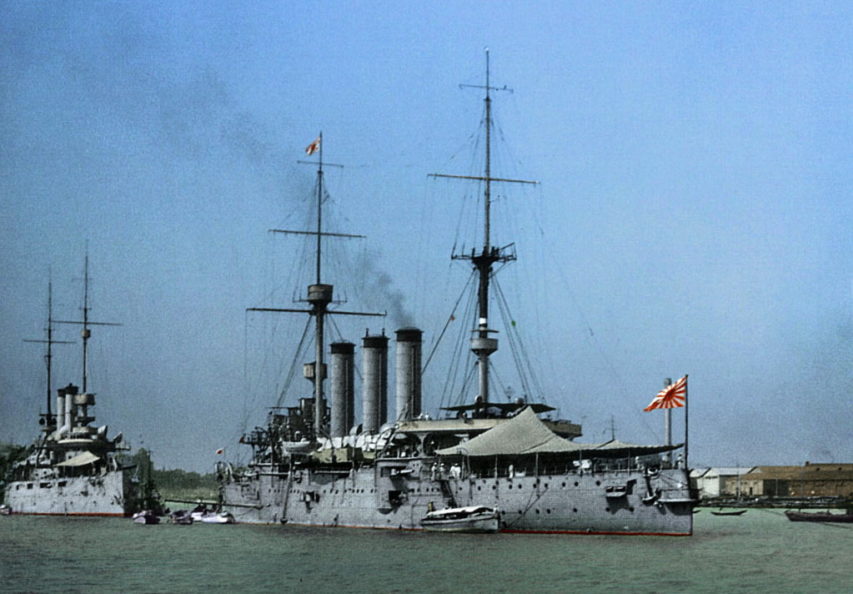
IJNS Izumo at anchor 1932 (Colourized), via Wikimedia
Comments Off on Another Japanese “destroyer” joins the fleet
March 2, 2017
Possible end-game for the British nuclear deterrent
Charles Stross speculates on a few ways that Il Donalduce could trigger the end of Britain’s nuclear-armed ballistic missile submarines:
Working hypothesis #1: Donald Trump is an agent of influence of Moscow. Less alarmingly: Putin’s people have got blackmail material on the current President and this explains his willingness to pursue policies favourable to the Kremlin. Russian foreign policy is no longer ideologically dominated by communism, but focusses on narrow Russian interests as a regional hegemonic power and primary oil and gas exporter.
Clearly, it is not in Russia’s geopolitical interest to allow a small, belligerent neighbor to point strategic nuclear missiles at Moscow. But this neighbor’s nuclear capability has a single point of failure in the shape of the resupply arrangements under the 1958 UK-USA Agreement. Donald Trump has made no bones about his willingness to renegotiate existing treaties in the USA’s favor, and has indicated that he wants to modernise and expand the US strategic nuclear capability. Existing nuclear weapons modernization programs make the first goal pointless (thanks, Obama!) but he might plausibly try to withdraw British access to Trident D-5 in order to justify commissioning four new US Navy SSBNs to carry the same missiles and warheads.
(Yes, this would break the “special relationship” between the USA and the UK for good — but remember, this is Donald Trump we’re talking about: the original diplomatic bull in a china shop who decapitated the state department in his first month in office.)
Trump could present this as delivering on his promise to expand the US nuclear capability, while handing his buddy a gift-wrapped geopolitical easter egg.
Working hypothesis #2: Let us suppose that Donald Trump isn’t a Russian agent of influence. He might still withdraw, or threaten, British access to Trident as a negotiation lever in search of a better trade deal with the UK, when Theresa May or her successor comes cap-in-hand to Washington DC in the wake of Brexit. It’s a clear negative sum game for the British negotiating side — you can have a nuclear deterrent, or a slightly less unpalatable trade deal, but not both.
In this scenario, Trump wouldn’t be following any geopolitical agenda; he’d just be using the British Trident renewal program as a handy stick to beat an opponent with, because Trump doesn’t understand allies: he only understands supporters and enemies.
As for how fast the British Trident force might go away …
Missiles don’t have an indefinite shelf-life: they need regular servicing and maintenance. By abrogating the 1958 agreement, or banning Royal Navy warships from retrieving or delivering UGM-133s from the common stockpile at King’s Bay, POTUS could rely on the currently-loaded missiles becoming unreliable or unsafe to launch within a relatively short period of time — enough for trade negotiations, perhaps, but too short to design and procure even a temporary replacement. It’s unlikely that French M51 missiles could be carried aboard Dreadnought-class SSBNs without major design changes to the submarines, even if they were a politically viable replacement (which, in the wake of Brexit, they might well not be).
Comments Off on Possible end-game for the British nuclear deterrent
March 1, 2017
Yes Prime Minister – Bernard Woolley on defence capabilities
Uploaded on 20 Jul 2010
Comments Off on Yes Prime Minister – Bernard Woolley on defence capabilities
February 28, 2017
Remembering the Royal Navy’s humiliation at the Battle of Chatham
Apparently the Royal Navy’s long unbroken tradition of glorious victories had a few setbacks after all, like the 1667 Battle of Chatham, which a flotilla of Dutch sailing vessels will be commemorating this June:
The Dutch are preparing to invade English seas with a fleet of 90 vessels after a previous expedition boarded the Royal Navy’s flagship and stole the Royal Coat of Arms from her.
In a celebration of Dutch Admiral De Ruyter’s 1667 raid on Chatham Dockyard, which resulted in English flagship HMS Royal Charles being boarded and ransacked by Dutch sailors, their modern-day civilian counterparts are planning a memorial cruise to Chatham.
The raid is known in British naval history as the Battle of Chatham, and formed part of the endless naval scrapping of the middle of the last millennium which eventually forged Britain’s 19th century dominance of the high seas.
In the battle, the numerically superior Dutch fleet sailed right up the River Medway into Chatham, Kent, and generally caused mayhem amongst the laid-up English warships moored there. The English fleet, starved of money and manpower, could not afford to put to sea in numbers despite wreaking havoc on the Dutch in the previous year.
Amongst other booty, the Dutch made off with the English royal coat of arms from fleet flagship HMS Royal Charles, which adorned the warship’s stern. The ornate carving can be viewed in the Netherlands’ Rijksmuseum today.
Comments Off on Remembering the Royal Navy’s humiliation at the Battle of Chatham


