Tom Kratman regretfully says no:
The last several months have seen repeated claims and variants on claims that presidential candidate Donald Trump wants to, and intends to, pull the United States out of NATO. Hillary Clinton made the claim on 28 March of this year, repeating a version of it on 8 May on Face The Nation.
Sad to say, Trump hasn’t said we need to pull out; would that he had. Instead, he’s made far weaker calls to “reconsider” our role in NATO, and to restructure or reform NATO to deal with modern threats, like terrorism, rather than Cold War threats, like the former Soviet Union and Warsaw Pact. These were couched in terms generally reasonable and factual; to paraphrase, NATO other than the US doesn’t pay its fair share.
I’m not so concerned with what politicians may say – and Trump’s become one now – who are vying for political office. See, for example, Hillary’s lies about what Trump actually said, cited above. I’m far more concerned with what they should do following election. In this particular case, though what Hillary has claimed of Trump is a lie, it’s a lie he should follow through on.
NATO has rarely pulled its weight in the past, nor is it pulling its weight in the present. Of twenty-eight NATO countries, only five meet their defense spending goal of two percent of GDP. Even that is begging the question, though; because none of them, not one, come near to our level of spending. Britain, for example, with a GDP of 2.679 trillion, spends about fifty-two billion, or just over two percent. France’s defense budget runs under two percent. Germany, Europe’s largest economy, disgracefully, spends a mere thirty-seven billion, or just over one percent. Some smaller NATO countries, the Netherlands, for example, spend about what Germany does.
We, conversely, spend about three times what Germany does, and even more than that if one tallies in a number of indirect expenditures, like the VA, on which we spend more than twice Germany’s entire defense budget.
Frankly, all of NATO is on a kind of moral defense welfare and has been pretty much since inception.
[…]
But the Truman Doctrine! The Truman Doctrine!
I know a lot of people must have missed it, but the Truman Doctrine wasn’t designed to contain Russia. Neither should one be taken in by flighty rhetoric presented to congress. The Truman Doctrine arose in the context of containing communism. That was done. Communism is no longer an international threat (and if we can keep the Hildebeast out of the White House we may be able to keep it from becoming a domestic threat, too).
But we need European troops!
Some of them have been, indeed, excellent. I am thinking especially of the UK’s, Canada’s, Australia’s, and Denmark’s. I am not thinking of Germany’s, the reports on whom, such as I have seen, are almost uniformly wretched, and I am not thinking of France’s, the reports on which are mixed. However, in accord with their defense budgets, those troop slices were objectively small, and they generally did not come with logistic self-sufficiency. In other words, in huge part, we had to provide the transportation and other support to keep them in the field in Afghanistan and Iraq, and that, especially in Afghanistan, where our own logistic capability was badly strained.
That was bad enough, but there is something much worse. There has grown up over the decades since the Second World War a regime of treaties, advancing what is often called “International Humanitarian Law” – IHL – and purporting to subordinate the law of war to it. Some of those claims are so preposterous as to be unbelievable, except that many, many of the world’s elites do believe in them and do force us to subordinate our own laws to them. A discussion of IHL is beyond the scope of this column. Note, however, two aspects of it that have arisen, the International Criminal Court, created by what is called “the Rome Statute,” and the Protocols Additional to Geneva Convention IV. The former subverts national sovereignty by placing it subordinate to unelected, partisan, largely left wing, jurists. The latter were specifically designed and pushed forward by the former Soviet Union to undermine the west.
We accept neither of these and, in fact, have a conditional declaration of war in place, the American Servicemembers Protection Act, should anyone try to grab our troops for trial before the ICC. Unfortunately, our “allies,” for the most part, have signed onto these obscenities. What that means is that we are constrained from acting with the full rigor of the law of armed conflict by the presence of allies, for whom, should we act in accordance with the law of war but against IHL, makes them complicit in what are, by their own domestic laws, war crimes. This constraint is intolerable, a rotten, stinking albatross tied around our necks. And this is what makes the presence of allied NATO troops not worth the bother, even when those troops are superb.
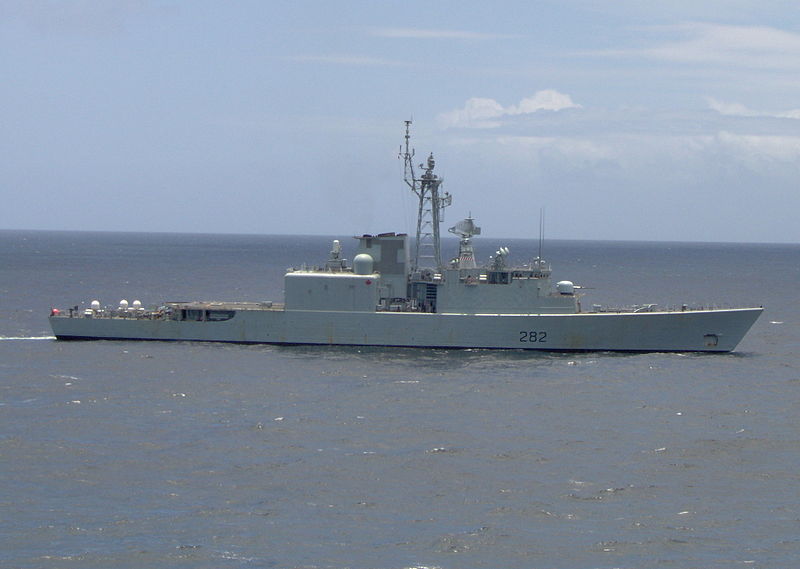
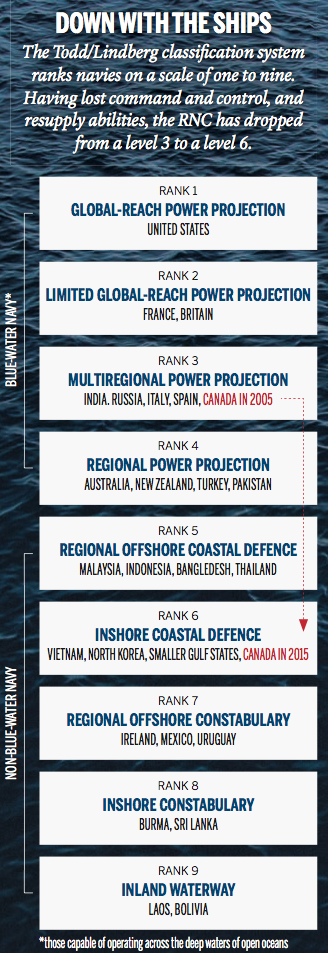 This October, NATO is launching Trident Juncture, its largest and most ambitious military exercise in a decade. The massive land, sea and air exercise will be held in the Mediterranean and will include 36,000 troops from 30 nations. Its goal will be to help the fictitious country of Sorotan, “a non-NATO member torn by internal strife and facing an armed threat from an opportunistic neighbour.” Not surprisingly, this is widely seen as an explicit response to Moscow’s increasingly belligerent pressure on the alliances’ eastern borders. The Canadian government, an outspoken critic of Russian President Vladimir Putin and the invasion of Ukraine, had planned to send its flagship destroyer, HMCS Athabaskan, as “a strong signal to the Russians,” whose ships and aircraft have also been bumping up against Canada’s territorial claims in the Arctic.