Quotulatiousness

May 12, 2014

Evaluating NFL team drafts

Filed under: Football — Tags: , , — Nicholas @ 07:25

It’s said that you can’t evaluate a draft class until three years later, because you need at least that long to see which players have established careers and which ones are no longer in the league, rather than who won the popularity contest before the draft. Despite that, many talking heads on TV have been eagerly assigning grades to the just-concluded NFL draft, and the fans of each team eagerly follow the narrative. Even Arif Hasan has fallen victim to this temptation, although he’s at least trying to follow a methodology to determine the overall strength or weakness of each team’s 2014 draft class.

One of the interesting things about gathering Big Boards across the country and finding the different ways that evaluators grade the players is that it gives us an ability to take a look at the draft from their perspective. There’s a big stigma against “grading the draft,” that I don’t think makes a lot of sense because we’re so willing to share our opinions on the players and teams who drafted them in every other way.

It seems we can give opinions about individual players and their teams without criticism. but as soon as we summarize it in a letter grade, we’re doing something wrong and have to wait. Instead, it may be better to wait three years to judge it.

But that’s no fun, and we want feedback. We just have to acknowledge we have a high band of uncertainty and give our impressions of the draft.

But how about instead of inserting post-hoc opinions about our favorite team, we take a look at a metric we’ve already laid the groundwork for? Let’s compare a team’s draft capital to what the Big Boards accumulated said.

It’s not perfect, especially in a deep draft, but by assigning players in their rankings an amount of points equal to the trade charts’ equivalent pick value, we can find out what players are considered to be worth. Using the NFL Trade Value Chart (put together by Jimmy Johnson way back when), we can compare the amount of draft capital a team entered the draft with to the “value” of players selected. This is perhaps the most appropriate way to gauge the number of “steals” and “reaches” a team makes and quantifying.

Spoiler:
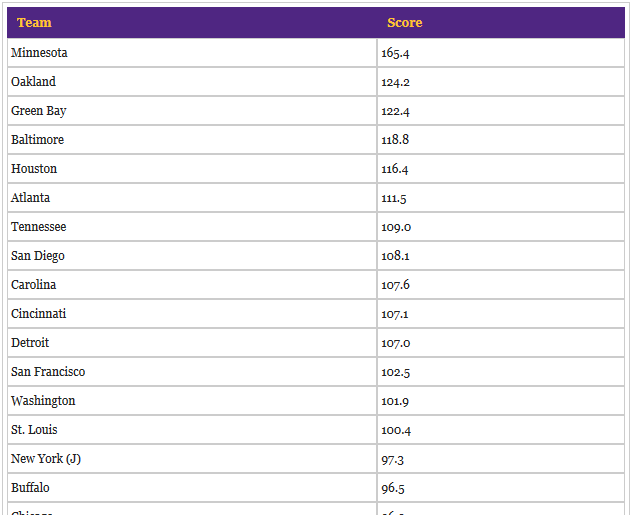
Arif's 2014 draft grades-partial

May 11, 2014

Vikings day 3 draft picks

Filed under: Football — Tags: , , , , — Nicholas @ 09:05

“Trader” Rick Spielman was in full wheel-and-deal mode on Saturday, as the Vikings traded back a few times to stockpile extra picks. Despite some moaning on the part of the fan base, this is something he’s been remarkably consistent about — he likes to have about ten picks in a given draft. He’ll move up to get a particular player (like Harrison Smith in 2012, Cordarrelle Patterson in 2013, and Teddy Bridgewater this year), but in general he prefers to trade down to get more opportunities to draft players for the long term. There was a particularly persuasive article about this at Vox.com a few days back, arguing that teams should always try to maximize the number of players they draft, to increase their chance of getting players who will be around for a long time in the league:

Draft picks can be traded, and the success of any one player picked is highly uncertain. Because of that, their data says that in the current trade market, teams are always better off trading down — that is, trading one high pick for multiple lower ones — but many teams become overconfident in their evaluation of one particular player and do the exact opposite: package several low picks for the right to take one player very early.

“There are one or two teams out there that philosophically follow this idea,” says Massey, who serves as a draft consultant with several NFL teams that he can’t disclose. “But in my experience, teams always say they’re on board with it in January. Then when April rolls around, and they’ve been preparing for the draft for a long time, they fall in love with players, get more and more confident in their analysis, and fall back into the same patterns.”

My only disagreement with this argument is that due to the current Collective Bargaining Agreement, there’s a discontinuity in the data at the bottom of the first round: teams get an optional fifth year on contracts with first round players. For this reason, I think Minnesota was right to trade up to get Bridgewater at the bottom of the first round, to get that option instead of waiting until they were next on the clock (which would have been eight picks later in the second round).

At the Daily Norseman, KJ Segall looks at the draft philosophy being employed by Rick Spielman and Mike Zimmer:

As we agonized through the pre-draft build up, I contemplated the basic two directions the Vikings could go — solving the offense with relatively few moves, or focusing on a defense that had holes everywhere. On one hand, we needed three things to have an offense worthy of contending in the NFC North: a good quarterback, a good offensive guard, and a reliable backup running back. (Not bad when one of the things you need is a backup position.) If we fixed that, then our solid WR corps, strong Oline, and superstar RB would be giving opposing DCs nightmares… but, that would also mean that our defense would have missed out on some upgrades, and many a team might simply outscore us no matter what we could do with the ball. On the other hand, letting the offense be with the adequate Matt Cassel, Charlie Johnson, and (fill-in-the-blank backup running back), all while attempting to plug as many holes on the leaky longship that was our defense could create a relatively well-balanced team that might not scare a lot of people but could still sneak out some surprises.

So it came down to this — be mediocre across the board, or be great at one thing and weak at another. Ultimately, through FA and what has been a shockingly good draft (shockingly because when you get the hands-down best QB available at freakin’ pick 32… well, the mind, it gets blown), they basically have gone with the latter. Yes, we solved our quarterback situation beyond our wildest expectations, and our offense will in fact be much, much better this year (and it wasn’t even all that terrible last year, either). And yes, by drafting Daddy David Yankey and Jerick McKinnon, we did technically solve those other two holes- although McKinnon is most definitely a project at first, and Yankey’s ability to unseat Charlie Johnson yet remains to be seen. (Although he should hopefully do so at some point in the season.) In reality, we focused pretty heavily on defense throughout the draft, starting off with the selection of Anthony Barr. The Bridgewater awesomeness aside, it would appear that the Vikings were determined to work on the defensive upgrades made in free agency as their primary focus.

On to the actual day three picks below the fold.

(more…)

May 10, 2014

Vikings second day draft picks

Filed under: Football — Tags: , , — Nicholas @ 10:47

Having traded away their original second round pick to Seattle to move back up to the bottom of the first round to get Teddy Bridgewater, the Vikings started the evening with only two third round picks. There was some speculation about Rick Spielman trading back up into the second round, but nobody had solid ideas about which player the team might have wanted urgently enough to give up any more later round picks. Spielman later said that they’d tried to “make some movement” but that they couldn’t come up with “a deal we felt comfortable with”.

Scott ChrichtonThe Vikings selected Oregon State defensive end Scott Crichton with the first of their third round picks. The Daily Norseman‘s Eric Thompson says this was a good selection:
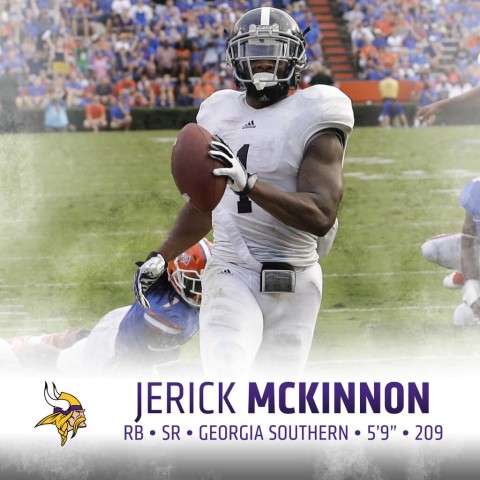
With many fans expecting the team to go after a corner with the 72nd overall pick in the 2014 NFL Draft, the Vikings got another talented pass rusher in Oregon State defensive end Scott Crichton. It was definitely a “value” pick — Crichton had a second round grade on most draft boards and was widely considered one of the best five or six edge rushers available in the draft. Mere moments after being chosen by the Vikings, Crichton jumped on a conference call to talk with Twin Cities beat writers.

[…]

Crichton played a little linebacker his freshman year at Oregon State, but make no mistake about it–he’ll be on the field to get after the quarterback. The Beavers ran a 4-3 defense and Crichton’s bread and butter was his pass rush. “That’s my thing. I love to get after the quarterback.” He played on both sides of the line with the Beavers along with some plays. Like most draft pundits Crichton expected to be drafted in the third round but nonchalantly claimed that the “third round’s fine”. “I’m just grateful for this opportunity. I’m ready to show what I can do and prove people wrong for not picking me earlier.”

At the press conference after the selection, Rick Spielman said “He’s not very nice on the field, which you like to see.”

Jerick McKinnonWith their last pick of the evening, the Vikings selected running back Jerick McKinnon from Georgia Southern. Arif Hasan said that McKinnon had been a stand-out performer at the combine, but that he’ll be a bit of a project (despite “insane measureables”). He’s certainly not a carbon copy of Toby Gerhart, being 5’9″ tall, weighing 209 lbs, and boasting a 4.4 time at the combine. His college football career was an odd one: started out as a cornerback, then eventually becoming a quarterback and running back (Ben Goessling refers to his role as having been “triple-option”, which is a new one on me). His role isn’t as clear-cut as you’d think, despite being drafted as a running back, during the NFL Network draft coverage, Mike Mayock said he could even start at safety in the NFL. On the official Vikings overview, his weaknesses make you think the team has other plans for him: “On the short side. Runs a bit upright and hesitant. Average burst to the perimeter. Not a creative, make-you-miss runner. Very limited career receiving production (10 career catches). Not stout in pass protection.” Those last two items are not what you’d expect if the team was planning to use McKinnon to spell Adrian Peterson on third down. Ideally, your third round running back would be an experienced receiver with good blocking skills.
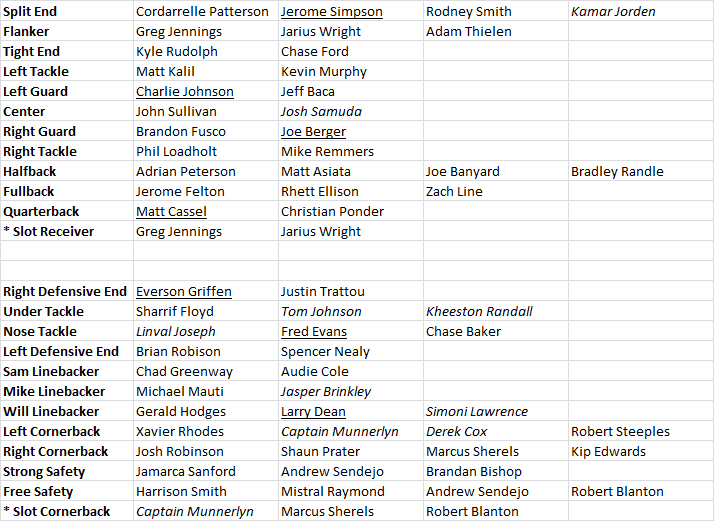
With both Chrichton and McKinnon, the Vikings clearly valued their athletic potential or “upside” over more polished players with lower theoretical potential. That’s a strong indication of confidence that they can teach technique on both sides of the ball. And given the strength of the new coaching staff, that’s a sensible approach. Neither of these players is likely to start as rookies, but they both have versatility in the roles they could fill and given a year of seasoning, they could become useful parts of the puzzle down the road.

The Vikings have four picks remaining in today’s final four rounds of the draft: 145th (5th), 148th (5th), 184th (6th) and 223rd (7th) … before we account for Trader Rick’s taste for wheeling and dealing, anyway.

Update: Arif Hasan profiles Scott Chrichton and Jerick McKinnon. Arif’s always good at analysis.

May 9, 2014

Vikings make two moves in first round of the draft

Filed under: Football — Tags: , , , — Nicholas @ 07:51

The Vikings were busy in the NFL draft once again, as “Trader” Rick Spielman swapped first round picks with Cleveland to select linebacker Anthony Barr (gaining an extra pick in the process), then traded two later round picks for Seattle’s number 32 (the last pick in the round) to select quarterback Teddy Bridgewater. The Barr pick surprised me, as I thought middle linebacker would be a much higher priority, but you could make the case that Barr was the best athlete if not the best overall player available at that spot.

Linebacker Anthony Barr #11 of the UCLA Bruins sacks quarterback Jared Goff #16 of the California Golden Bears at the Rose Bowl on October 12, 2013 in Pasadena, California. Photo by Stephen Dunn, Getty Images.

Barr was one of the top linebacker prospects, despite only having played two years at that position. It’s expected that he’ll take Chad Greenway’s position on the strong side, while Greenway moves to one of the other linebacking spots.

Teddy Bridgewater of the Louisville Cardinals poses with NFL Commissioner Roger Goodell after he was picked #32 overall by the Minnesota Vikings during the first round of the 2014 NFL draft. Photo by Elsa, Getty Images.

For quite a long time in the run-up to the draft, Teddy Bridgewater was seen as not only the top quarterback prospect, but even as the top overall pick until he had a bad outing at his Pro Day, and then his stock began to drop. Each of the three top quarterbacks were linked to the Vikings in many mock drafts, but Bortles was off the board before the Vikings were on the clock, and Manziel was drafted (by Cleveland) in the second half of the round. I had thought the Vikings were more interested in Bridgewater, but many reported that the Vikings had attempted to get back into the first round to get Manziel, but that Cleveland’s extra first round pick meant they couldn’t top that offer without giving away too much. Personally, I doubt that as Manziel would have been the worst fit of the top three in Norv Turner’s offensive scheme — the skills Manziel offered were not the ones that Turner values the most in a quarterback.

One of the most impressive stats on Bridgewater is his performance against the blitz: a 70.1 percent completion rate averaging 11 yards per attempt, for 15 touchdowns and only 1 interception. That’s head-and-shoulders above the other “top two” quarterbacks. However, Rick Spielman said that there’s no expectation that he’ll start right away, and that he’ll be given time to develop behind Matt Cassel. The coaching staff will determine when he’s ready to step up.

(more…)

May 8, 2014

Minnesota Vikings’ 2014 draft needs

Filed under: Football — Tags: , , — Nicholas @ 07:00

Last year, in my annual pre-draft post, I admitted once again that I have no real idea who Minnesota will select, as I don’t follow college football. I’ve been reading the fan sites’ schizophrenic swerving back and forth among the various quarterbacks (this week, Bridgewater is hot garbage, but Bortles is the bomb: last week, Manziel was the man and Bortles was nowhere, etc.), as quarterback is the most obvious long-term need for the team (likely with their first round pick, although trading back to stockpile additional picks is another alternative).

While I don’t have much of a clue about who will be drafted, I do know that the team has certain positional needs that have not yet been addressed in free agency. The Vikings made some good acquisitions during the free agency feeding frenzy, with Linval Joseph at nose tackle and Captain Munnerlyn at cornerback filling two of the biggest deficiencies in 2013. Here are the top positions that should be addressed during the draft (in my opinion, anyway):

  • Quarterback. The Vikings have the 8th pick in the first round and given the depth of the talent this year thanks to a record number of college juniors who have declared themselves eligible for the draft, the talent pool is both broad and deep. There are three quarterbacks who have received the most attention in the run-up to the draft and one or more of them may be on the board when the Vikings are on the clock. They’ve got Matt Cassel under contract for 2014 and 2015 and Christian Ponder still has a year left on his rookie deal: the team chose not to exercise their fifth-year option on Ponder’s contract. I had assumed the team was hoping to trade Ponder for a draft pick this year, which might mean spending two draft picks on quarterbacks, one early and one late. However, in a press conference on Tuesday, Rick Spielman specifically ruled out trading Ponder either before or during the draft (and we’re free to believe him or not). Several bloggers are predicting the team will use the #8 pick on a defensive player and attempt to trade back into the bottom of the first round to take a quarterback (so they get the fifth-year option on his rookie contract).
  • Middle Linebacker. I was surprised to see the Vikings re-sign Jasper Brinkley after he spent a year with Arizona. He’s good against the run, but not very good at all defending the pass. Others on the roster include fan favourite Audie Cole (he of the back-to-back pick-sixes in preseason play as a rookie), and Michael Mauti (who had three ACL tears in his college career). However, the middle linebacker may not be as important to the new defensive scheme as it was in the Tampa-2 variant the Vikings ran last year — or the responsibilities are changed enough that defending receivers isn’t a priority.
  • Safety. Harrison Smith suffered a turf toe injury last year which kept him off the field for half the season, and the team struggled with filling the gap. Andrew Sendejo improved over the season, but drafting a safety to strengthen the passing defence would be a good move.
  • Cornerback. Xavier Rhodes made great strides in his rookie season and should be a fixture on the Vikings defence for several years if he continues to develop. New free agent signing Captain Munnerlyn may fill the role Antoine Winfield did so well: outside corner in base, then switching to slot corner in nickel coverage. Josh Robinson had a truly awful year in 2013, but he was playing in the slot and had reportedly never played that position in college. Drafting an outside corner makes a lot of sense for the Vikings, and it’s another position with good depth this year.
  • Running Back. Adrian Peterson is still the best running back in the game, but he’s getting to the point in his career where the vast majority of running backs start to decline. The Vikings had the luxury of a high-quality backup in Toby Gerhart, but he departed in free agency to get a chance to be a starter. With the new coaching staff, the Vikings are likely to de-emphasize the running game, so it’s unlikely the team would spend a high draft pick at this position, but a mid-round selection would make a great deal of sense.
  • Offensive Guard. The offensive line is one of the strengths of the team, but an upgrade might be in order at the left guard position. Charlie Johnson got a two-year contract to come back, but finding a rookie to be his understudy or even to replace him as a starter would make the line even better than it already is.
  • Tight End. The expensive John Carlson experiment came to a close after injuries kept Carlson off the field far too much and the team didn’t get much production for their big money investment as a result. Kyle Rudolph is very good and still improving, and Rhett Ellison does a good job of imitating Jim Kleinsasser as the big blocking tight end/H-back. It wouldn’t be surprising to see the Vikings invest a mid-to-late-round pick on a pass-catching tight end to pair with Rudolph.

Not on my list of priorities but a position that’s suddenly being discussed over the last few days is defensive tackle (specifically Pitt’s Aaron Donald). This might just be a side-effect of the extra two weeks of speculation caused by pushing the draft back into May, or it might indicate that the Vikings have their doubts about last year’s first rounder Sharif Floyd. Floyd played behind Kevin Williams and didn’t seem to have as much impact as you might hope for a first-round selection. While I don’t see the team spending another high pick on that position with so many other areas to address, I guess it should be considered as a possibility. I’d think trading back for more picks would be a much more likely outcome, however.

At 1500ESPN, Andrew Krammer lists the Vikings’ needs on offense and defence.

This all assumes that the Vikings stick with their current allocation of draft picks (eight, including an extra they got in the Percy Harvin trade from Seattle). There’s a strong sense that the Vikings might trade down to amass more picks in later rounds — Rick Spielman didn’t get the nickname “Trader Rick” for nothing. If they do want to move down in the first round, John Holler covered some of the possibilities (including positions I don’t think are worth a first round pick for the Vikings).

May 3, 2014

Mike Zimmer’s first Vikings mini-camp has even veterans nervous

Filed under: Football — Tags: , , , — Nicholas @ 09:37

As a brand-new head coach, Mike Zimmer is allowed to have a few more early team practices and training sessions than established coaches under the NFL’s bargaining agreement. The first mini-camp was held this week, from Tuesday to Thursday, and even the veteran players were approaching it like the first day on the job:

Matt Cassel has been around the NFL block a few times in his 10 seasons as a quarterback. Not much surprises him anymore, and yet he found himself unable to sleep the night before the Vikings minicamp this week.

“I was excited, jittery,” he said.

Chad Greenway felt those same butterflies. The veteran linebacker compared it to being a rookie or college freshman again.

“It was straight-up nerves,” he said.

Captain Munnerlyn arrived in town as a key offseason acquisition who’s supposed to help fix a shipwrecked defense, and even he felt a weird uneasiness.

“With a new coach, it’s a clean slate for everybody,” he said. “That means every position is open. Except for the running back position.”

Good call. We’ll go out on a limb and suggest that Adrian Peterson probably didn’t need to impress the new coaching staff in order to keep his job. But everyone else convened at Winter Park this week with an overarching sense of anxiety not normally evident at a routine offseason workout.

Imagine your first day with a new boss, one who’s known for his no-nonsense personality and brutal honesty. And salty language.

“You’re on edge and trying to make a good first impression,” Greenway said. “You know the draft is coming in a week. They’ll probably make some decisions based off of this camp.”

If Mike Zimmer’s first on-field introduction made players nervous and uncomfortable, that’s a good thing. This organization had become too lethargic under the previous regime. The atmosphere at Winter Park became stale as losses piled up last season.

April 22, 2014

Rick Spielman and the fine art of pre-draft deception

Filed under: Business, Football — Tags: , , — Nicholas @ 08:16

The last few weeks before the NFL draft — now pushed back to May — are when even the most hearty draftniks start to flag, having sweated out multiple mock drafts, read far too many scouting reports on can’t-miss players who might be their team’s guarantee of playoff dominance for the next decade, and suffered the agonies of indecision as their team’s management gives out hints of their actual draft plans. It’s a time when every team aside from the Houston Texans (who have the first overall pick) tries with varying degrees of success to obfuscate, confuse, and mislead every other team about who they value as potential draft picks. It’s the time of year when every team press release is written in squid ink.

At such a time, Minnesota football fans get to watch one of the greatest practitioners of pre-draft blather, half-truth, sleight-of-tongue, and deception as he weaves his web of disinformation. Rick Spielman is that guru of illusion at draft time, and Mark Craig is on his tail:

Folks, we’re lost in a choppy sea of predraft chatter with no life preserver and an extra two weeks of dog paddling until Houston mercifully makes the first pick on May 8. The fact that no one has any idea what will happen has not stopped everyone from saying they do.

The original draftnik himself, ESPN’s Mel Kiper Jr., has taken four swings at it (and counting?). He has Bortles going to the Vikings twice followed by Bridgewater (once) and Manziel (once). That’s a 4-for-4 guesstimate that Vikings General Manager Rick Spielman is thinking quarterback all the way.

Meanwhile, Spielman sat in his office this week saying, “We don’t need to reach for a quarterback at No. 8. We signed Matt Cassel.” And that makes sense, although beware. This is the time of year when Spielman is capable of stealing your eyeballs and convincing you that you look better without them.

April 5, 2014

“They, and they alone, will decide who the Racists are”

Ace on racism and the unofficial deciders on who is a racist and who is not:

Karl Lueger was the mayor of Vienna at the turn of the century, whose populist politics were often riven with anti-semtism — so much so that he was cited as an inspiration by none other than Adolf Hitler in Mein Kampf.

However, there’s a debate about how anti-semitic he actually was, and how much of an anti-semite he pretended to be for the sake of political positioning.

Lueger is famous for an answer he once gave on this issue. He was asked how he squared that fact that many of his policies were anti-semitic, while he counted many Jews among his close friends.

I decide who is a Jew,” he said, apparently creating his own definition of Judaism.

This flexible opinion on “who is a Jew” permitted him to both debase himself (and Vienna) with populist politics of hatred while simultaneously carving out a space for himself to consort with the Hated Other, as he might choose.

Similarly, today, White “liberals” have decided to sell out liberalism to the leftist, totalitarian goons of the Progressive Speech Police. They’ll join the Progressives’ hate campaigns against free speech and free thought — but only when those campaigns are directed towards non-liberals.

Playing to the Progressive mobs just like Luegar played to the Vienna ones, White Liberals reserve themselves the power to both traffic in hateful intolerance, and except themselves and their friends from the claims they otherwise inflict on others.

They, and they alone, will decide who the Racists are.

In the case of the campaign to get Dan Snyder to rename the Washington Redskins (because it’s an offensive, racist epithet), Ace points out that some racist terms are more equal than others:

Obviously no one names a sports club after something they think is substandard, or shoddy, or weak, or useless. People always object to the Redskins name by using the same example — “Well, what would you say if someone named his baseball team the New York N*****s, huh?”

But that’s stupid. No one does that. No one would do that. Because “N****r” is inherently a demeaning term, and a hateful one, and no one — no one — names their sports clubs after things they hate.

They name them after things they respect, or wish to emulate, or wish to associate themselves with. Thus the large number of teams named after great cats, and bears, and stallions, and even the gee-whiz technology of the 50s (jets, rockets).

And as for clubs named after types of people, all those people have a positive association; in football, especially, a martial-themed sport if there ever was one, those positive associations all have to do with virility and deadliness in battle:

Vikings.

Raiders.

Buccaneers.

Warriors.

Fighting Irish.

Spartans.

You do not see “The San Francisco Coolie Laborers” in the lists of any sports teams, nor the “Boston Drunken Irish Wife-Batterers.” All team names are tributes to the group in the nickname.

Some team names implicitly specify a race/ethnicity — Vikings, Fighting Irish. There is no commotion over this — people understand that when someone names a team the “Vikings,” they mean it a positive way. They are speaking of the fury of the Northmen — and not, for example, their propensity to rape and reduce much of Europe to a constant Twilight in which civilization could never advance too far before being pillaged and raped into rubble.

Nor does anyone seriously think “the Fighting Irish” is really about the Irish’s well-known tendency to over-indulge in alcohol and then get their Irish up. (Oh, what a giveaway.) And that one really does actually step right on up to the line of being a slur against the Irish — but we understand the intent behind it is playful, and positive. (Mostly.)

In fact, White Liberals currently on their jihad against the name “Redskins” make an exception for other teams with Indian nicknames — Braves, Chiefs, Indians, all okay. Not racist, the White Liberals have decided, although it’s unclear how they’ve come to this conclusion.

All three names, after all, do reference a specific race — Native Americans — just as surely as “Redskins” does, and for the exact same reasons.

But White Liberals know the difference. White Liberals can tell you who the Racists are.

March 27, 2014

Jared Allen signs with Chicago, Vikings fanbase in denial

Filed under: Football — Tags: , , , — Nicholas @ 07:19

We all knew that Jared Allen’s time as a Viking had come to a close, as he was at the end of a massive contract and the team had already designated Everson Griffen to take his spot on the defensive line (and given him a big contract). He’d been rumoured to have offers or outlines of offers from several teams and we all expected to see him playing for Seattle or Denver this year. Seattle was the obvious choice for Allen, and not just because of the unwritten NFL rule that says all former Vikings must sign with Seattle, so yesterday’s announcement took everyone by surprise. Arif Hasan, who is making a strong case to take Tom Pelissero’s place as the top writer in Vikings coverage, was uncharacteristically dour:

Someone named Jared Allen signed with the Chicago Bears today to a four-year deal, worth $32,000,000. The structure of the deal is of course important with a player at Allen’s age (31), and it can be voided to a three-year, $24,000,000 deal. $15,500,000 is fully guaranteed — which comes from a base salary guaranteed fully in the first two years and a roster bonus he will receive next March.

On a per-year basis, this is a lower deal than the one he “missed out on” with the Denver Broncos when they offered him and DeMarcus Ware identical, $30,000,000 deals over three years, but it is similar amount of guaranteed money.

This of course means that Allen will play against the Vikings twice a year, an interesting set of circumstances that sees him paired up against his practice sparring partner, Matt Kalil.

This could also imply that Allen’s desire to play was balanced against his desire to go to a contender, as he had choice offers from the Seattle Seahawks and the Dallas Cowboys as well, the first of whom could give him a much better shot at a ring, but less playing time. The Cowboys, short on cap space, were likely in a much more difficult spot in terms of the type of contract they could offer him and the flexibility they had to give him a good deal.


Jared Allen #69 of the Minnesota Vikings looks on before the game against the Detroit Lions on December 29, 2013 at Mall of America Field at the Hubert H. Humphrey Metrodome in Minneapolis, Minnesota. (Photo by Hannah Foslien/Getty Images)

March 24, 2014

Is there a “magic formula” for drafting a winning NFL quarterback?

Filed under: Football — Tags: , , — Nicholas @ 11:28

Short answer … no. But CCNorseman at the Daily Norseman has come up with an evaluation system that looks promising, especially as the Vikings are once again hoping to draft their QBOTF in this year’s crapshoot draft:

First, I created a list of quarterbacks to research to determine what traits they might have had in common coming out of college, both good and bad. I attempted to answer the following question: Were there certain traits that all successful quarterbacks possessed coming out of the draft, and were there any negative traits that can generally be dismissed as not being that important? As it turns out, the answer is yes to both questions.

In compiling a list of quarterbacks to study, I decided to take a look at all of the most successful quarterbacks that have entered the league within the last 15 years, regardless of the round in which they were drafted (or if they were drafted at all). I think most fans can agree that we need a quarterback that can lead the Vikings to the playoffs, and ultimately to the Super Bowl. And most quarterbacks that can achieve consistent playoff appearances or consistent efficiency metrics tend to have the best chance of winning a Super Bowl. So in order to be qualified as “successful” for this study, a quarterback must have either won a Super Bowl, have appeared in at least 10 playoff games, or be ranked in the top 32 of career “adjusted net yards per attempt” (ANY/A) statistic compared to the entire history of the NFL (ANY/A is the statistic that most closely correlates to winning and losing for quarterbacks).

[…]

In any case, from there I scoured the internet for pre-draft scouting reports of all 26 quarterbacks, and unfortunately I drew blanks on 6 of them that were drafted prior to the year 2000 (Kurt Warner, Jeff Garcia, Donovan McNabb, Daunte Culpepper, David Garrard and Matt Hasselbeck). So for the remaining 20 quarterbacks that I could actually find pre-draft scouting reports online, I tracked which attributes were listed as “positive traits” and which attributes were listed as “negative traits” in the various reports. After boiling down the data I began to see which traits occurred most frequently and there were seven attributes that stood out as being the most common as they applied to more than half of the 20 quarterbacks on the list. So, here is a list of the seven most common “positive traits” that successful NFL quarterbacks on the list above possessed coming out of college:

  1. Good Pocket Awareness and mobile around the pocket with an ability to “step up” in the pocket (15 of 20 QBs possessed this trait)
  2. Smart and made good decisions with the football showing patience (14 of 20 QBs possessed this trait)
  3. Good Arm Strength or “Prototypical NFL Arm Strength” (13 of 19 QBs possessed this trait)
  4. Good Attitude, leader and fierce competitor (13 of 19 QBs possessed this trait)
  5. Has good vision, can see the field and read defenses (11 of 20 QBs possessed this trait)
  6. Good accuracy (11 of 20 QBs possessed this trait)
  7. Can throw on the run (11 of 20 QBs possessed this trait)

Some other positive traits that appeared for several of the Quarterbacks on the list (but less than half) were: good size/stature, good ability to scramble and avoid the rush, quick release, good touch passes and good ball placement and timing. But again, those traits were not common for the majority of the quarterbacks on the list with each one being common for only 8 or 9 quarterbacks, total. So in short if we can find a quarterback in the draft that exhibits most (if not all) of the seven traits above, then they will have a lot in common with the 20 most successful quarterbacks drafted over the past 15 years when they were college prospects. And therefore, they should have much better odds of panning out as a draft selection just as these prospects did before them.

He then uses these identified traits to look at current draft prospects and the results are rather different than most mock drafts portray:

In any case where does all of this leave us in regards to the quarterback prospects in the 2014 draft? Which ones are most likely to succeed? Well, in looking at the top 10 QBs from the latest cumulative draft rankings, they all possessed some of the traits above, but none of them possessed all seven (and of the 20 most successful, none of them possessed all 7 coming out of college either). In order to determine with traits were more important, I assigned a point system to each one relative to their frequency in the scouting reports. Below is the point scale.

QB Traits Point Scale
Trait #1, Good Pocket Awareness: 7 points
Trait #2, Good decision making: 6 Points
Trait #3, Good arm strength: 5 Points
Trait #4, Leader and good attitude: 5 Points
Trait #5, Can read defenses: 4 Points
Trait #6, Good accuracy: 4 Points
Trait #7, Can throw on the run: 4 Points
Total: 35 Points Possible

If a quarterback had one of the traits listed above as a positive, they earned that many points. However, if it was listed as a negative part of their game, then I subtracted that many points from their total. If one of these traits simply wasn’t listed as a positive or a negative, then it didn’t count for or against them. Listed below are the seven quarterbacks that scored double digit points based on this rating metric.

It won’t surprise anyone that Christian Ponder’s score using this scale comes out as a magnificent -2 (yes, that’s a negative number). If this scoring system was in use at Winter Park in the coming draft, the Vikings would end up drafting Derek Carr, Fresno State (score 28 out of 35) or Jimmy Garoppolo, Eastern Illinois (who scores 27 out of 35).

March 23, 2014

Joe Webb signs with the Carolina Panthers

Filed under: Football — Tags: , , , — Nicholas @ 09:20

Sad to see him go, but happy he’s at least getting a chance to play quarterback for another team. He was never going to be a franchise quarterback, but it’s difficult to say he ever really got a fair chance with the Vikings. As Ted Glover puts it, “The Joe Webb Era Is Dead. Long Live The Joe Webb Era”:

The semi-legend, who became part super hero, part mythological woodland creature, and part mediocre quarterback and receiver, has a vocal minority of support as strong as any fringe roster guy in NFL history. Earlier this evening he was signed by the Carolina Panthers as a backup to Cam Newton. The Panthers find themselves in need of quarterback depth now that Cam Newton will miss most, if not all of the off-season, due to ankle surgery. According to NFL.com, the Panthers ‘love his skill set’, and like the idea of having another athletic quarterback in the mix behind Newton.

Wait, I could swear I’ve heard a coaching staff rave about his skill set before. I know I have. I JUST KNOW IT.

Of course, Carolina also released WR Steve Smith, and they suddenly find themselves in need of wide receiving depth, too. And with Captain Munnerlyn now on the Vikings, maybe the Panthers need a guy who can return punts, or kicks.

Joe’s done that before, too.

The Vikings installed what they called the “Blazer” package to showcase Webb’s wildcat skills, but it was a remarkably limited package that only seemed to work the first time … because it was totally predictable after you saw it run once: there were no significant variations or options. That’s not Webb’s fault, that’s the fault of the previous offensive co-ordinator and his lack of creativity (or unwillingness to trust Webb with more responsibility, perhaps).


MINNEAPOLIS – NOVEMBER 7: Joe Webb #14 of the Minnesota Vikings runs a route during an NFL game against the Washington Redskins at Mall of America Field, on November 7, 2013 in Minneapolis, Minnesota. (Photo by Tom Dahlin/Getty Images)

Update: Arif Hasan says goodbye to Joe:

Reasons to cheer for him: Joe Webb is a fantastic person with a great attitude. I’ve never heard Webb complain about getting jerked around or being put in a poor position to succeed, despite ample oppurtunity to and didn’t just do what his coaches asked of him — he embraced it enthusiastically. It’s also difficult to forget his more amazing moments, like against Detroit, Philadelphia and Chicago. In some ways, it’s always easy to cheer for a player that gave you so many electrifying moments. He was very probably misused and certainly hurt for not being able to develop as a player with one position. Perhaps sitting behind an offense built for a running quarterback in Carolina will help him better use his exciting skill set.

Reasons to cheer against him: He hasn’t been very good. In all honesty, the great moments he had weren’t sustainable or reasons you could count on him for the future, and he produced one of the worst quarterback playoff performances of all time. Despite a career completion rate lower than 50% and yards per attempt lower than even Christian Ponder’s, he somehow found himself in quarterback controversies a bit too often. Maybe not his fault, but definitely something that inspires some resentment.

Verdict: For. Unless you really, really dislike Carolina, it’s hard not to cheer Joe Webb on. If Cam Newton gets injured and Webb leads the Panthers to the playoffs (or better), that will give us confirmation that the old coaching staff was terrible, and it feels good to be right. For all of his faults, he was probably misused in Minnesota. That isn’t to say he was a good football player, but when he was on the field, the ways he was used were suboptimal. Last thing: it’s kind of cool that Spiderman and Superman are paired together.

March 21, 2014

Vikings continue to add depth to defensive line

Filed under: Football — Tags: , — Nicholas @ 07:16

It’s been an unusually busy free agency period for the Minnesota Vikings, as they announced another signing yesterday: former Chicago defensive lineman Corey Wooton. This is the fourth addition to the DL, joining fellow newcomers Linval Joseph, Tom Johnson, and Kheeston Randall. Wooton’s first career sack was the hit that ended Brett Favre’s career on the icy turf of TCF Bank Stadium in 2010 (co-incidentally, the same venue the Vikings will be calling home for the next two years). It’s a one-year $1.5 million deal for Wooton, and he’ll likely be backing up Everson Griffen and Brian Robison at defensive end (but he has taken snaps at defensive tackle in Chicago).

Before the latest signing, Arif Hasan drew up the likely depth chart:

Vikings Depth Chart 3-20-14 (Arif)

All the new signings leave the Vikings with a reported $12 million for further free agency signings and their 2014 draft class.

March 15, 2014

How the Vikings free agency moves change their draft plans

Filed under: Football — Tags: , , — Nicholas @ 10:13

The Minnesota Vikings have been active in the free agency market — uncharacteristically so, according to some fans — and have addressed some of the most glaring needs through re-signing key free agents of their own and picking up other teams’ free agents as well. Before free agency started, the team ranked almost last in every meaningful defensive metric (points given up, yards given up, etc.), and defensive collapses at the end of several games almost literally made the difference between going to the playoffs in 2012 and finishing in the cellar in 2013. A rational drafting policy would have been to use the draft to plug many of the leaks, but instead the team has used free agency to patch most of them so that — with one big exception — they’re free to take the best available player in the draft.

Unfortunately, the big exception is the quarterback position. Matt Cassel has come back, giving the Vikings stability at QB, but he’s not the long-term answer. He can start (and win), but he’s only under contract for 2014 and 2015. He can, however, act as a mentor for a younger player if the Vikings can find the right draft prospect to groom. That’s more black art than science, as the number of accomplished college quarterbacks who sink without a trace in the NFL clearly demonstrates. Cassel gives the Vikings the luxury of not having to start a rookie, but they need to be lucky on their selection (in the way they weren’t with Christian Ponder).

At the Daily Norseman, K.J. Segall looks at how the Vikings free agent signings will impact their draft strategy:

So what does all of this mean for the upcoming draft? While Spielman’s reputation in free agency was that of a ‘wait and see’ approach, conversely he’s been seen — particularly in the past two drafts — as an extremely aggressive wheeler-and-dealer, netting five first round picks (Kalil, Smith, Floyd, Rhodes, and Patterson) in just two years. But just because that’s been his reputation doesn’t necessarily mean that that’s exactly how he will always approach the draft. To his great credit the aggressive moves for five first round picks have also netted five very solid starters (or, in Floyd’s case, future starters), with nary a bust amongst them. This indicates that he is aggressive only when he and his scout team have identified a target that the team needs, and further indicates that their ability to pick these targets is quite good. Which, of course, further means that he won’t be aggressive unless such a target is available.

In a draft such as the upcoming one, seen as deep at several important positions and with the Vikings having the number 8 overall pick, there is a strong possibility that Spielman will want to swap down and garner more selections. He’s said as much — of course, if you believe Spielman right now, well, then I have a bridge for sale that I’d LOVE to discuss with you.

[…]

While any attempts to read into Spielman’s intended draft strategy beforehand are inevitably going to be half-correct at best (nobody saw a trade down with the Browns in 2012 coming), perhaps we can begin to clarify some likely paths he’s going to take via his actions in free agency.

As it stands right now, you can cross basically any D-line position off our list of needs. That’s not to say we couldn’t use — and won’t pursue — a little more depth, but it’s not very high up there anymore. Furthermore you can bump CB down a bit — it’s still a need, mind you, but not as big as it was before when we basically needed two more starting caliber players as well as depth. The aforementioned QB situation is still glaring, as is LB and OG. (I would list needs starting with those three, in that order.) I don’t see safety being a concern, as Sanford is likely safe for another year — not to mention decent depth like Sendejo in that department. (Sanford… the safety… is safe. See what I did there? Please tell me you saw what I did there.)

He discusses at some length the potential trade-up from the number 8 pick, including the option of trading future draft picks, but if there’s any team in the NFL less likely to go big on a trade like that it’s the team that got the short end of the stick in the infamous Herschel Walker trade (read ’em and weep, or laugh like a manaic if you’re a Cowboys fan).

March 14, 2014

Vikings replenish their cornerback pool

Filed under: Football — Tags: , , , — Nicholas @ 07:39

It was so common to read about the 2013 version of the Minnesota Vikings secondary described in terms of “awful”, “dysfunctional”, “disaster area”, and “dumpster fire”. Even with some good new players over the last couple of drafts, their impact was negated by the poor play of others. Harrison Smith missed the last half of the season due to injury, and Xavier Rhodes only got to see the field regularly late in the season. This situation had to be addressed either in free agency or through the draft. The team has addressed most of their defensive line weaknesses (re-signing DE Everson Griffin and DT Fred Evans and bringing in DT Linval Joseph), so the big needs were for competent-or-better cornerbacks.

The team has lacked a good slot corner since parting ways with the great Antoine Winfield, but hope that they’ve now got someone to fill that role:


CHARLOTTE, NC – DECEMBER 15: Captain Munnerlyn #41 of the Carolina Panthers celebrates after returning an interception for a touchdown against the New York Jets during play at Bank of America Stadium on December 15, 2013 in Charlotte, North Carolina. The Panthers won 30-20. (Photo by Grant Halverson/Getty Images)

The Minnesota Vikings have signed former Panthers cornerback Captain Munnerlyn to a three-year deal, with details pending per Ian Rapaport.

[…]

Munnerlyn resolves arguably the biggest weakness from the 2013 Minnesota Vikings defense, which is pass coverage from the slot position.

Josh Robinson had the majority of the slot coverage duty for Minnesota and did a frankly abysmal job, competing with Robert McClain of the Falcons for some of the worst slot coverage in the NFL. No single cornerback gave up more receptions per snap in coverage or yards per snap in coverage, marking Josh Robinson with the singular distinction of being the worst statistical slot cornerback in the league.

To be fair, Robinson had never played slot in his college or pro career until last year, and he and the team would be far better served if he can move back to the outside.

Captain Munnerlyn is coming off of the best year of his career, and has had consistently fine play at the spot, although no one would mistake him for Leon Hall or Chris Harris, Jr. — perhaps the two best slot cornerbacks in the NFL today. Notably, Leon Hall played for the Cincinnati Bengals under Mike Zimmer, and perhaps Zimmer can turn Munnerlyn from good into great with some coaching.

The deal is relatively cheap, although a little more expensive than I like given that Corey Graham, a very good slot corner who played for the Ravens just signed with the Bills for an average salary one million dollars lower. Nevertheless, it is a team-friendly way to turn one of the biggest weaknesses on their defense into a relative non-issue.

Captain Munnerlyn’s Pro Football Focus grade was 11th of all corners last year, and he gave up league average statisics in yards per target, yards per snap in coverage and receptions allowed per snap in coverage. More importantly, he grew into his role after several seasons of relatively average play. A lot of that grade was due to his ability to stop the run, but it is more important to note that it was an outlier year for Munnerlyn. In coverage grades alone, Munnerlyn had struggled to beat the league average until this year (but was never significantly below average, maintaining consistency in reliable coverage).

But Munnerlyn wasn’t the only cornerback to join the team yesterday:

[Derek] Cox has five years of NFL experience and most recently spent last season in San Diego, playing all 16 games with them. He was a third round selection of the Jaguars in 2009 and was there for his first four NFL seasons. He has 13 career interceptions and appears to be healthy again after some injuries caused him to slump for a couple of seasons.

March 12, 2014

Gerhart moves on and Joseph moves in

Filed under: Football — Tags: , , , , — Nicholas @ 08:29

I was off being a pallbearer in Toronto when the NFL’s free agency period started, so I didn’t get caught up on the early moves until much later in the day. As far as the Vikings were concerned, the two biggest moves were backup running back Toby Gerhart signing a three-year, $10.5 million deal with the Jacksonville Jaguars and former Giant defensive tackle Linval Joseph signing a five-year, $31.5 million deal with the Vikings:

Linval Joseph is 25 years old, and will turn 26 years old midway through the season. He doesn’t have extraordinary statistics that you would more likely see come from an undertackle like Henry Melton or Kevin Williams, but he does plug the run extremely well. He has had 9.0 sacks in the previous three years, which is more than what fellow 1-tech and previous Vikings Pat Williams was able to do in any three-year stretch with the Vikings.

Linval Joseph is unique, in that at 328-pounds, he could have played 3-technique coming out of college. He has a good first step and is both strong and quick with a good understanding of leverage, though was weak at consistently lowering his pads coming out of East Carolina.

He is supposed to be good for a 3-4 or 4-3 scheme because of his ability to anchor, length (with astonishing 34.5″ arms) and quickness, although the Giants have almost exclusively used him in a one-gap role.

If Joseph is as good as hoped for, it will make a huge difference to the Vikings’ defensive line, which has never regained the form it had with “Fat Pat” at the nose. The signing may make it less likely that Kevin Williams returns to the Purple, as many were assuming he could slide over to nose tackle (having had a huge game in that spot last season, when both Letroy Guion and Fred Evans were injured). Williams had said he wasn’t interested in playing the nose, and is an unrestricted free agent.

Also looking for the right contract (as in “pay me”), former Minnesota defensive end Jared Allen is still unsigned. He’d been rumoured to be looking at a deal with Denver, but the Broncos may be more interested in DeMarcus Ware, who is also a free agent this season. The Bears and the Seahawks are also said to be talking with Allen’s agent. Allen hinted that he’d retire rather than play as a situational pass rusher, but Andrew Krammer thinks that’s bluff: “Why I won’t believe Jared Allen would retire: that all-time sack total means too much to him. That list in his locker said so.” Allen kept a regularly updated list in his locker showing where he ranked in the all-time totals.

« Newer PostsOlder Posts »

Powered by WordPress