
Published on 18 Aug 2017
The medieval period produced a lot of powerful dynasties which fought for influence and wealth in Europe. These families where once the most powerful people on the planet, but who and where are they today? Here are 5 Medieval dynasties that still exist today.
September 18, 2017
5 Medieval Dynasties That Still Exist Today
Comments Off on 5 Medieval Dynasties That Still Exist Today
September 17, 2017
Why are some people left-handed? – James May’s Q&A (Ep 39) – Head Squeeze
Published on 20 Sep 2013
“Once thought to be in league with the devil, left-handed people, while not especially evil, are indeed special in many ways. James May explains all in this Head Squeeze video.
In mediaeval times lefties were believed to be in league with Beelzebub himself, this gave rise to the word sinister from the Latin ‘sinistra’ meaning of the left. Later on scientists proposed that left-handed people had their brains wired differently, which turned out to be only partially true.
Most of us, between 75 to 90 percent use the left hemisphere of our brains to speak and understand language. The other hemisphere is used to control our dominant hand. Research has shown however that only 30 per cent of left-handers have reversed brain lateralisation, or indeed no dominant side at all.
Genetics play a big part in your dominant hand. If you have two left-handed parents, there is 26 per cent chance that you will be too. This is double the average odds.
There are some statistical advantages and disadvantages to being left-handed. Schizophrenia, dyslexia and ADHD are more prevalent. However susceptibility to arthritis and ulcers is less.
Left-handed people do well in sport and fighting, as the majority of people are not used to going up against such opponents. There is evidence that they are more creative too with a disproportionate amount of artists painting with their left hand.
In terms of famous left-handed people, four out of the last seven presidents have been – President Obama, Clinton, Bush senior and Ford.
However as only those who are true lefties know, the world is stacked against them. Dozens of daily household items we take for granted, from corkscrews to scissors, even books, are designed for the right-handed majority.
Comments Off on Why are some people left-handed? – James May’s Q&A (Ep 39) – Head Squeeze
September 16, 2017
“Mead” – The Drink That Fell From Favor
Published on 31 Aug 2017
Mead was a very popular drink during the 17th century and before, but fell out of favor by the 18th century due to the rise of Beer and Ale. Nevertheless, recipes for Mead can be found in books written in the 1700’s and today Jon goes in depth on this fascinating drink.
Comments Off on “Mead” – The Drink That Fell From Favor
September 3, 2017
Medieval Castles – Elements of Fortifications
Published on 17 Jan 2017
This episode covers the various elements of castle fortification elements like towers, walls, moats, loopholes, gates, gatehouses, portcullises, battlements, hoardings, draw bridges, etc.
Military History Visualized provides a series of short narrative and visual presentations like documentaries based on academic literature or sometimes primary sources. Videos are intended as introduction to military history, but also contain a lot of details for history buffs. Since the aim is to keep the episodes short and comprehensive some details are often cut.
» SOURCES & LINKS «
Kaufmann, J.E; Kaufmann, H.W.: The Medieval Fortress – Castles, Forts, and Walled Cities of the Middle Ages.
Piper, Otto: Burgenkunde. Bauwesen und Geschichte der Burgen.
Toy, Sidney: Castles – Their Construction and History
Comments Off on Medieval Castles – Elements of Fortifications
September 2, 2017
[Medieval] Castles – Functions & Characteristics (1000-1300)
Published on 30 Sep 2016
» SOURCES & LINKS «
France, John: Western Warfare in the Age of the Crusades 1000-1300#
Ohler, Norbert: Krieg & Frieden im Mittelalter
Contamine, Philippe: War in the Middle Ages
Pounds, Norman J. G. Pounds: Medieval Castle in England & Wales: A Political and Social History
http://faculty.goucher.edu/eng240/early_english_currency.htm
http://www.ancientfortresses.org/medieval-occupations.htm
https://www.britannica.com/technology/castle-architecture#ref257454
http://www.castrabritannica.co.uk/texts/text04.html
https://en.wikipedia.org/wiki/Harlech_Castle
Comments Off on [Medieval] Castles – Functions & Characteristics (1000-1300)
July 26, 2017
April 29, 2017
If Walls Could Talk The History of the Home Episode 4: The Kitchen
Published on 2 Feb 2017
Comments Off on If Walls Could Talk The History of the Home Episode 4: The Kitchen
April 16, 2017
If Walls Could Talk The History of the Home Episode 3 The Bedroom
Published on 1 Feb 2017
Comments Off on If Walls Could Talk The History of the Home Episode 3 The Bedroom
April 5, 2017
If Walls Could Talk The History of the Home Episode 2: The Bathroom
Published on 31 Jan 2017
Comments Off on If Walls Could Talk The History of the Home Episode 2: The Bathroom
April 4, 2017
Archaeological evidence of corpse mutilation in deserted medieval village of Wharram Percy
A bit of gruesome post-death ritual from the middle ages in Wharram Percy:

Wharram Percy, aerial view © Wharram Research Project/Historic England
Archaeologists investigating human bones excavated from the deserted mediaeval village of Wharram Percy in North Yorkshire have suggested that the villagers burned and mutilated corpses to prevent the dead from rising from their graves to terrorise the living.
Although starvation cannibalism often accounts for the mutilation of corpses during the Middle Ages, when famines were common, researchers from Historic England and the University of Southampton have found that the ways in which the Wharram Perry remains had been dismembered suggested actions more significant of folk beliefs about preventing the dead from going walkabout.
Their paper, titled A multidisciplinary study of a burnt and mutilated assemblage of human remains from a deserted mediaeval village in England, is published today in the Journal of Archaeological Science.
Located in the Yorkshire Wolds, Wharram Percy was continuously occupied for about 600 years, and was probably founded in the 9th or 10th century, but had become deserted by the early 16th century as a result of gradual abandonment and forced evictions. The ruined church is the last-standing mediaeval building, beside it remaining the grassed-over foundations of two manors and about 40 peasant houses and their outbuildings.
Since 1948 the settlement has been the focus of intensive research, which has made it Europe’s best-known deserted mediaeval village, and in what may be the first good archaeological find regarding the practice, human remains from the site suggest the predominance of folk beliefs regarding revenants in 11th-13th century England.
Comments Off on Archaeological evidence of corpse mutilation in deserted medieval village of Wharram Percy
February 28, 2017
How to Make Medieval Stocks – Torture Your Friends and Family With This DIY Pillory
Published on 7 Oct 2016
You can make this fun DIY medieval torture device in a weekend! FREE PLANS and full article►► http://woodworking.formeremortals.net/2016/10/how-to-make-medieval-stocks-pillory/
Comments Off on How to Make Medieval Stocks – Torture Your Friends and Family With This DIY Pillory
February 8, 2017
British History’s Biggest Fibs with Lucy Worsley Episode 1 War of the Roses [HD]
Published on 27 Jan 2017
Lucy debunks the foundation myth of one of our favourite royal dynasties, the Tudors. According to the history books, after 30 years of bloody battles between the white-rosed Yorkists and the red-rosed Lancastrians, Henry Tudor rid us of civil war and the evil king Richard III. But Lucy reveals how the Tudors invented the story of the ‘Wars of the Roses’ after they came to power to justify their rule. She shows how Henry and his historians fabricated the scale of the conflict, forged Richard’s monstrous persona and even conjured up the image of competing roses. When our greatest storyteller William Shakespeare got in on the act and added his own spin, Tudor fiction was cemented as historical fact. Taking the story right up to date, with the discovery of Richard III’s bones in a Leicester car park, Lucy discovers how 15th-century fibs remain as compelling as they were over 500 years ago. As one colleague tells Lucy: ‘Never believe an historian!
Comments Off on British History’s Biggest Fibs with Lucy Worsley Episode 1 War of the Roses [HD]
February 2, 2017
QotD: Noblesse oblige
I was raised with noblesse oblige, which, as we all know is a kind of almond and mare’s milk pastry made in the mountains of outer Mongolia and eaten at wedding feasts to assure good luck.
Okay, I lie. Noblesse Oblige is literally – as all of you know! However, let me unpack it, because sometimes it’s good to reflect on things we know – the obligations of noblemen.
In a world in which station was dictated by birth (most of the world, most of the time) the way to keep society from becoming completely tyrannical and the burden of those on the lower rungs of society from becoming unbearable was “noblesse oblige” – that is a set of obligations that the noblemen/those in power accepted as a part of their duty to society. Most of these involved some form of moderation of force.
The amount of moderation depended on the culture itself. For instance, in those lands in which the nobleman got first night rights (or claimed them anyway) it might be noblesse oblige to return the bride after that. It might also be noblesse oblige to stand godfather to the oldest child, who, after all, might be more than a godchild. And in other cultures, though the first night thing wasn’t there, the godchild thing still applied. A small return for faithful service to closer servants and courtiers, etc.
In the same way, while you might treat your serfs or villains like dirt, you forebore to take their last crumb of bread and left them enough to live on. This might not be because you were smart or merciful or whatever, but because someone had dinged it into you.
Noblesse oblige, by that name or others, appears every time there is a gross imbalance of power in human society. Or that is, it appears if society is to survive.
Sarah Hoyt, “Noblesse Oblige and Mare’s Nests”, According to Hoyt, 2015-05-05.
Comments Off on QotD: Noblesse oblige
March 14, 2016
Pink Floyd – Another Brick in the Wall (Part II) (medieval cover by Stary Olsa)
Published on 5 Oct 2015
Stary Olsa performing “Another Brick in the Wall” by Pink Floyd for Belarusian TV-show “Legends. Live” on ONT channel.
Produced by Mediacube Production. (Minsk, Belarus)
If you’ve liked this or the earlier covers, you might like to know that Stary Olsa has a Kickstarter campaign to fund their next album called “Old Time Rock n Roll”, which will include this song and at least the following:
- “One,” by Metallica
- “Another Brick in the Wall” part II, by Pink Floyd
- “Californication,” by the Red Hot Chili Peppers
- “Ob-la-di, Ob-la-da” and “A Hard Day’s Night,” by the Beatles
- “Child in Time” by Deep Purple
- “Smells Like Teen Spirit” by Nirvana
Comments Off on Pink Floyd – Another Brick in the Wall (Part II) (medieval cover by Stary Olsa)
September 20, 2015
The chastity belt – medieval “security” or renaissance in-joke?
The chastity belt was a device invented to preserve the chastity of Crusader knights as they rode off to defend the Holy Land. The chastity belt was an in-joke in theatre performances from the early fifteenth century onwards. One of these two statements is closer to the truth than the other, as Sarah Laskow explains that most of what you’ve heard about the chastity belt is false:
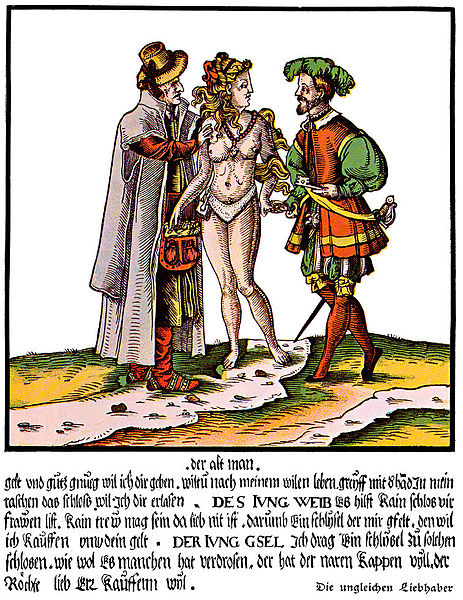
A 16th-century German satirical colored woodcut whose general theme is the uselessness of chastity belts in ensuring the faithfulness of beautiful young wives married to old ugly husbands. The young wife is dipping into the bag of money which her old husband is offering to give her (to encourage her to remain placidly in the chastity belt he has locked on her), but she intends to use it to buy her freedom to enjoy her young handsome lover (who is bringing her a key). (via Wikipedia)
What was the chastity belt? You can picture it; you’ve seen it in many movies and heard references to it across countless cultural forms. There’s even a Seattle band called Chastity Belt. In his 1969 book Everything You Always Wanted to Know About Sex (But Were Afraid to Ask), David R. Reuben described it as an “armored bikini” with a “screen in front to allow urination and an inch of iron between the vagina and temptation.” “The whole business was fastened with a large padlock,” he wrote. With this device, medieval men going off to medieval wars could be assured that their wives would not have sex with anyone else where they were far, far away, for years at a time.
Yes, it sounds simultaneously ridiculous, barbarous and extremely unhygienic, but … medieval men, you know? It was a different time.
This, at least, has been the story that’s been told for hundreds of years. It’s simple, shocking, and, on some level, fun, in that it portrays past people as exceeding backwards and us, by extension, as enlightened and just better. It’s also, mostly likely, very wrong.
“As a medievalist, one day I thought: I cannot stand this anymore,” says Albrecht Classen, a professor in the University of Arizona’s German Studies department. He set out to reveal the true history of chastity belts. “It’s a concise enough research topic that I could cover everything that was ever written about it,” he says, “and in one swoop destroy this myth.”
Here is the truth: Chastity belts, made of metal and used to ensure female fidelity, never really existed.
However, there is a small but thriving trade providing modern day chastity belts to eager BDSM fans, and they’re available in both male and female designs. I nearly described that as “equal opportunity”, but I guess “equal frustration-of-opportunity” is more like it. Feel free to Google image search those if you like, but be prepared for a fair bit of NSFW images if you do.
Comments Off on The chastity belt – medieval “security” or renaissance in-joke?


