Quotulatiousness

July 27, 2012

If Boris wasn’t mayor of London

Filed under: Britain, Media, Sports — Tags: , , , , , , , — Nicholas @ 08:53

Lawsmith imagines what Boris Johnson would write about the London Olympics “major international sporting event” in a “certain major city in the UK” if he were not mayor:

I can imagine his perfect article in this alternative history in my dreams. Written in the Spectator and littered with self-deprecation, references to dead or fictitious Greeks, Liverpool and wiff-waff, Boris would have danced across the pages as he gleefully excoriated the Labour administration for the absurd idea of inviting a bunch of prima donna athletes and bureaucrats, most of them foreign, to compete in an outdoor stadium during the coldest, wettest summer in British history.

He might have pointed out that all this would take place in Newham, a place not altogether unlike Portsmouth and, in any case, one most Londoners consider more alien than Paris, with among the highest incidence of robbery and assault in the entire city. He might have joyfully foretold the pain and suffering of millions of income taxpayers on account of the shut-down of major roads and TfL advising know-nothing tourists to hop the tube at rush hour to make the 10 AM events, and seriously questioned the wisdom of erecting a steel wall around Hyde Park for an entire summer before fouling it up beyond recognition.

In our alternative history he would have savaged, rather than prodded, the implementation of widespread censorship undertaken by a hit squad of intellectual property ninjas; he would have lamented the fact that our police were arresting “marginal” (i.e., possibly innocent) suspects – living, breathing, thinking people – on terrorism charges which they might not be able to prove. If he had really driven it home, he would have pointed out that, under normal circumstances, those arrests would never have been made. He would also have asked why nobody seems to care.

By this point, his oeuvre would have been the most hilarious political essay ever written. He would flay alive in full public view the pathetic, uncritical, fawning news-media industry which crafts its Olympic stories with all the creative flavour of an oak plank, their proxy world to escape from our own inadequacies where professional athletes become “heroes” (seriously, find a different word), washed-up “heroes” become “legends,” and civil liberties violations and government largesse are completely ignored.

July 26, 2012

The “international sporting event” in “the capital of the United Kingdom”

Filed under: Britain, Law, Liberty, Media, Sports — Tags: , , , — Nicholas @ 09:00

Dahlia Lithwick explains why we all need to be careful how we refer to a certain large organized sports extravaganza happening in a major city in England:

At the London Olympics, we’re seeing unprecedented restrictions on speech having anything to do with, erm, the Olympics. There are creepy new restrictions on journalists, with even nonsportswriters being told they should sign up with authorities.

Then there’s the London Olympic Games and Paralympics Games Act 2006. The law was originally aimed at preventing “over-commercialization” of the games, but it seems to have unloosed something of a Pandora’s box of speech suppression. Provisions triggering worries for protesters include sections regulating use of the Olympic symbol “in respect of advertising of any kind including in particular — (a) advertising of a non-commercial nature, and (b) announcements or notices of any kind.” The law further seems to authorize a “constable or enforcement officer” to “enter land or premises” where they believe such material is being produced. It also permits that such materials may be destroyed, and for the use of “reasonable force” to do so.

[. . .]

But it’s not just the Olympic rings that are being protected; it’s also Olympic words. As Nick Cohen recently observed, the “government has told the courts they may wish to take particular account of anyone using two or more words from what it calls ‘List A.’ ” Those words: Games, Two Thousand and Twelve, 2012, and twenty twelve. And woe betide anyone who takes a word from List A and marries it with one or more words from “List B”: Gold, Silver, Bronze, London, medals, sponsors, summer.

Spectators have been warned they may not “broadcast or publish video and/or sound recordings, including on social networking websites and the Internet,” making uploading your video to your Facebook page a suspect activity. Be careful with your links to the official Olympic website as well.

July 24, 2012

Boris Johnson, Mayor of London, welcomes you to the Olympic Games

Filed under: Britain, History, Humour, Sports — Tags: , , , — Nicholas @ 08:12

H/T to Nick Packwood for the link.

July 16, 2012

If this forecast is accurate, we’ll all be nostalgic for global warming

Filed under: Britain, Environment — Tags: , , , , — Nicholas @ 08:05

In his Telegraph column on the current weather in Britain (and what it may or may not do to the Olympic schedule), Boris Johnson shares a long range weather forecast that is chilling — literally:

I have just been on the blower to my old chum, Piers Corbyn, the world’s foremost meteorological soothsayer, and he sounds like Jeremiah with an ingrown toenail. This is the same Corbyn, with a first-class degree in physics, who decisively beat the Met Office in 2010 and accurately forecast the cold and snowy winter — and I am afraid he has been bearish about this summer from sometime in February or March.

According to Piers and his team at Weather Action, we all underestimate the role of the sun. This is set to be just about the wettest July on record, he says, and that is mainly because of things taking place in the nuclear fireball millions of miles away from earth. “Sometime too bright the eye of heaven shines,” says the Poet, and often is his gold complexion dimmed. This is one of the dim moments. The old boy is suffering from some kind of solar acne, called “coronal holes”, and on July 12 he apparently emitted a colossal flare — a cosmic spurt of X-rays and other charged particles; and, by a process that we (or at least I) do not fully understand — perhaps because rain droplets form more easily when there are charged particles around — this distemper in the celestial orb is helping to cause the current inundations.

For the sake of completeness, and so that no one can later accuse me of concealing the bad news (what did he know about the weather, and when did he know it?), I should say that Piers has a general thesis that the current phase of grim weather — cold, snowy winters and wet summers — is just the prelude to something yet more bracing. We are heading, he says, for a mini Ice Age. These wet Julys and frosty Januaries are part of the opening drum roll of a cold period that will set in over the next decades.

Some say it will be upon us by 2045, some say by 2030. Looking at the pattern of the last few years, Piers Corbyn now thinks it could be sooner than that. He does not say that sabretooth tigers will roam the streets of Newcastle. He does not say that the Thames will freeze at London Bridge and that we will have fairs on the ice — unlikely, given how fast the river flows these days. But he does believe that it will get nippier, and that we will see the kind of cold period last experienced in the late 17th century and early 18th century.

July 11, 2012

President Hollande “dwarfed” by Coldstream Guards

Filed under: Britain, Europe, France, Media, Military, Politics — Tags: , , — Nicholas @ 10:08

So much for a honeymoon period in office for French President Francois Hollande:

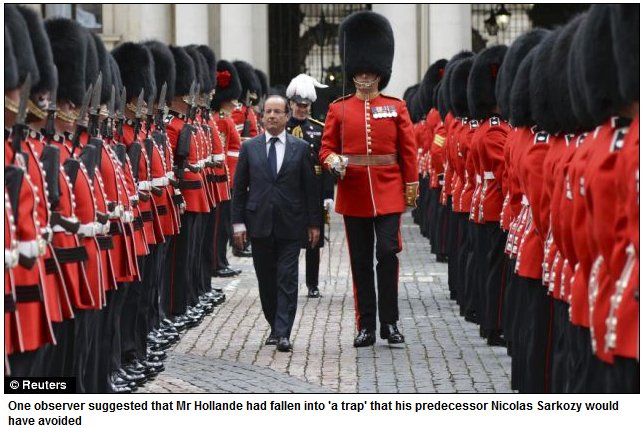
Francois Hollande was ridiculed today after allowing himself to look like a ‘dwarf’ alongside a British regiment which won battle honours at Waterloo and then occupied Paris.

During an official visit to London on Tuesday, the French President inspected a guard of honour from the 1st Battalion of the Coldstream Guards at the Foreign Office.

He then appeared in hugely embarrassing photographs alongside Major James Coleby, who looked around two feet taller than the Gallic head of state.

Comments alongside the image on a website of pictures taken by AFP, France’s national news agency, suggested Hollande had fallen into a ‘trap’ made to make him look ridiculous.

‘Poor France,’ wrote Jean-Marc Rameau, from Paris, while Dmitri Kovaley mocked Mr Hollande, who is 5ft 7ins, with the words ‘Dwarfs rule the world’.

H/T to Nicholas Packwood for the link.

June 26, 2012

Railway engineering, 1947 style

Filed under: Britain, History, Railways, Technology — Tags: , , — Nicholas @ 00:03

London, Midland & Scottish Railway documentary that shows the relaying of St. Pancras Junction with prefabricated trackwork, along with the associated changes to the signalling system.

What struck me while watching this was the ages of most of the track crew: I’d have expected them to be a bunch of teens-to-early 20’s guys, but there are a lot of old gaffers still doing the heavy lifting here. Oh, and of course the work clothes: caps, hats, jackets, and braces. Not a hard hat or much in the way of obvious safety gear in sight. They may or may not have been better men in those days, but they earned their aches and pains honestly.

H/T to Roger Henry for the link, who pointed out “This will get your pulses racing. Also makes you realize that working on the railroad was for real men. Mechanisation has come a looong way since then.”.

June 4, 2012

BBC coverage of the Jubilee Thames Pageant nearly as bad as the CBC coverage

Filed under: Britain, Cancon, Media — Tags: , , , , — Nicholas @ 12:32

I was in the same room as the TV yesterday, which was tuned to the CBC’s “coverage” of the Queen’s Jubilee celebrations along the Thames River. Every time I paid a bit of attention, Peter bloody Mansbridge was committing another linguistic atrocity (HM-C-S Belfast? She’s a former Royal Navy ship, not an RCN vessel, Peter — oh, and she’s a light cruiser, not a “battle cruiser”). And aside from the Royal Barge, and the canoe from Peterborough, the boat that got the most attention was a bloody power boat that apparently was in a James Bond film. Crikey!

It seemed as though every appearance of a maple leaf had to be relayed to viewers — not, mind you, actual footage of the things they were talking about. The mandate seemed to be to keep the faces of the presenters front-and-centre all the time when they weren’t showing the Royal Barge. And on the odd occasion they’d show part of the flotilla, the CBC personalities felt the need to talk as much as possible even while they weren’t on camera.

From the National Post, Scott Stinson on the banality of it all:

Long after the royal barge had passed my vantage point near Chelsea Bridge on Sunday afternoon, I nipped into a London pub to warm up, dry off, and catch the rest of the proceedings on the television.

After the first few times someone on the BBC broadcast gushed about this or that aspect of the Thames Diamond Jubilee Pageant, I chalked it up to a mild case of homerism. The 1,000-boat flotilla was, after all, an impressive spectacle. Then I noticed how often the commentators were using the pronoun “we” when describing things, as in “we are all so anxious to catch a glimpse of Her Majesty.” So much for journalistic detachment. By the time one of the broadcasters was positively marvelling at the skill and ingenuity of the captain who was in the process of docking the royal barge, it was apparent that most of the Beeb’s broadcast team had gone right bloody native.

I mean, shouldn’t docking a boat be part of the job? Would we not expect that the person given the task of piloting the Queen up the Thames be better than decent at it? Yet, here was the commentator, oohing and aahing at the fact that the captain of the Spirit of Chartwell had pulled up alongside the dock and was now moving the boat sideways up to it for a gentle landing. “Look at that!,” he enthused. “It’s amazing!”

Jan Moir in the Daily Mail:

Turn the royal trumpets to the parp and piffle setting. Muffle the funeral drums. For on a molten grey stretch of the Thames, with a global television audience of millions watching, something died yesterday.

It was the BBC’s reputation as a peerless television broadcaster of royal events. It just could not survive under an onslaught of inanity, idiocy and full cream sycophancy uttered, muttered and buttered on thickly by a team of presenters who were encouraged to think that they were more important than the events unfolding around them.

Someone, somewhere thought that their celebrity personalities were enough to see them through this all-day broadcast. How very wrong they were.

‘I’ve just spotted my 70-year-old dad out there,’ gurgled Sophie Raworth, as barges packed with senior royals and VIPs slid by, unremarked upon. Who was in all the other boats? We never did find out.

Yes, the BBC1 coverage of the Diamond Jubilee Thames Pageant was historical — historically awful.

[. . .]

What were Beeb bosses thinking? If ever an event was crying out for a Dimbleby to dimble nimbly in the shallows, with that trademark mixture of gravitas, humour and sagacity, then this was it.

Instead, we got Sophie Raworth and Matt Baker, bouncing around as if they were presiding over the jelly stall at a chimps’ tea party, somehow managing to sound patronising about nearly everything.

June 1, 2012

“Only the enemies of the Euro and of the European political project … dream of such a cataclysm”

Filed under: Britain, Economics, Europe — Tags: , , , — Nicholas @ 13:22

To be a True European, you must believe in the European project wholeheartedly and unreservedly. Any other attitude is unacceptable:

I was once interviewed by one of Le Soir’s best-known journalists, who asked me whether I was in favor of the European project. I said that I would answer if she would tell me what it was. She did not, and we moved on to other subjects. Whatever the European project may be, those who don’t embrace it wholeheartedly — with a fervor that can only be described as mystical, considering that no one can explain or define it in simple terms — are depicted not as skeptics, but as enemies. Thus in Le Soir, we read: “Only the enemies of the Euro and of the European political project, notably the City of London, dream of such a cataclysm [the break-up of the single currency]!”

The City of London — Britain’s equivalent of Wall Street — here plays the role of the bloated plutocrat of Soviet iconography or of the Jewish manipulator of Nazi iconography, pulling the strings behind the scenes in order to achieve its malevolent design of controlling the world. One can make many possible criticisms of the City of London, but a determination to destroy the viability of the euro for some unspecified, atavistic reason is certainly not among them. If the euro is viable, the City couldn’t destroy it; if it is not, the City cannot save it. Besides, the idea that there is a congregation of malign conspirators within the fabled Square Mile who would rejoice at the euro’s implosion is absurd; the prospect is almost universally viewed with apprehension, though it would not come as a surprise to everyone.

This is why I always cheer for whoever is bidding against Toronto to host the Olympics

Filed under: Britain, Economics, Sports — Tags: , , , , — Nicholas @ 00:02

If publicly funded professional sports stadiums are bad for the local economy (and they almost always are), “winning” the bid to host the Olympic Games is far worse:

The history of the modern Olympics (and of other large-scale sporting events) reveals a consistent pattern. Organizers or local politicians in the host city commission “impact studies,” which almost always promise extravagant economic benefits. Studies performed after the event, however, find no positive effect at all — let alone one approaching the initial estimates. So it isn’t surprising that a PriceWaterhouseCoopers study commissioned by the British government forecasts that the Games would add about $9.4 billion to London’s GDP between 2005 and 2016. That seems like a large number until you realize that the London metro area’s GDP is roughly $712 billion annually. If the Games’ benefits were spread evenly throughout the decade, they would increase London’s GDP level by 0.1 percent each year.

Further, that $9.4 billion benefit pales compared with the cost of hosting the Olympics. In 2002, the UK’s Department for Culture, Media and Sport estimated that the cost would be $2.8 billion. Ten years later, London’s budget for hosting the Games is $15 billion. Costs already run above that figure and are likely to rise to approximately $38 billion, according to an investigation by the TV network Sky Sports. That would easily dwarf the economic benefits that the PriceWaterhouseCoopers study predicts. Security alone will be extremely costly: more British troops will patrol London than there are currently at war in Afghanistan. And these figures don’t count many hidden and indirect costs of hosting the Olympics — most prominently, disruption to business and traffic congestion. Traffic in London is already difficult; with special lanes for Olympics-related traffic, daily commutes will become a nightmare. (London’s transportation commissioner, Peter Hendy, helpfully advises commuters to go to the pub to avoid rush hour.)

Update, 5 June: The good news just keeps on coming for the London Olympics:

The boom to the economy that the Government hoped the Games would bring to the capital appears to become a bust with tens of thousands to tourists spurning the hiked prices, congestion and heightened security.

While bookings for July and August are down by 35 per cent on last year other European capitals appear to be prospering from London’s gloom.

French ministers, who lost the Olympic bid to Britain, might be quietly rubbing their hands with glee not only for dodging the £10 billion Games bill but also with a 50 per cent rise in tourism bookings. Similarly Barcelona and Berlin have seen their tourist numbers soar by 100 per cent over the summer.

This is an example of why, when the announcement was made that Paris had lost out on the bid for the 2012 Olympics to London, Reason titled their coverage “Lucky Paris“.

May 29, 2012

QotD: London slang of the 1930s

Filed under: Britain, History, Quotations — Tags: , , — Nicholas @ 00:02

London slang and dialect seem to change very rapidly. The old London accent described by Dickens and Surtees, with v for w and w for v and so forth, has now vanished utterly. The Cockney accent as we know it seems to have come up in the ‘forties (it is first mentioned in an American book, Herman Melville’s White Jacket), and Cockney is already changing; there are few people now who say ‘fice’ for ‘face’, ‘nawce’ for ‘nice’ and so forth as consistently as they did twenty years ago. The slang changes together with the accent. Twenty-five or thirty years ago, for instance, the ‘rhyming slang’ was all the rage in London. In the ‘rhyming slang’ everything was named by something rhyming with it — a ‘hit or miss’ for a kiss, ‘plates of meat’ for feet, etc. It was so common that it was even reproduced in novels; now it is almost extinct1. Perhaps all the words I have mentioned above will have vanished in another twenty years.

The swear words also change — or, at any rate, they are subject to fashions. For example, twenty years ago the London working classes habitually used the word ‘bloody’. Now they have abandoned it utterly, though novelists still represent them as using it. No born Londoner (it is different with people of Scotch or Irish origin) now says ‘bloody’, unless he is a man of some education. The word has, in fact, moved up in the social scale and ceased to be a swear word for the purposes of the working classes. The current London adjective, now tacked on to every noun, is ‘fucking’. No doubt in time ‘fucking’, like ‘bloody’, will find its way into the drawing-room and be replaced by some other word.

1. It survives in certain abbreviations, such as ‘use your twopenny’ or ‘use your head.’ ‘Twopenny’ is arrived at like this: head — loaf of bread — twopenny loaf — twopenny

George Orwell, Down and Out in Paris and London, 1933.

May 24, 2012

Unsupport your unfavourite Premier League team

Filed under: Britain, Football, Soccer — Tags: , , , , — Nicholas @ 13:18

Duleep Allirajah explains why he’s a “90-minute Quisling”:

Years ago, long before Google came to the salvation of lazy football writers who couldn’t be bothered with microfiche searches, the term ‘unsupport’ was coined in the football magazine, When Saturday Comes.

It meant, as the name suggests, the exact opposite of supporting a team. You wished defeat on another team, hated that team with a passion. So, for example, in the last day of the Premiership season, many neutrals wanted Manchester City to win the title. This was not through any great love for the oil-rich upstarts in blue, but because they were unsupporting Manchester United. In the Premiership era, Manchester United are simultaneously the best supported and, at the same time, the most unsupported club in the land. Unsupporting is the football equivalent of Newton’s third law of motion: all the time United are successful, hatred of the side occurs as an equal and opposite reaction.

You can tell a lot about people by the team they hate. Take Manchester United unsupporters. They assume two forms. In the blue half of Manchester or on Merseyside, the Anyone But United (ABU) sentiment is an expression of bitter local rivalry. But throughout the rest of the country, ABU represents an increasing disenchantment with modern football. Manchester United is essentially a proxy for the gentrification and commercialisation of the game. When fans sing ‘Stand up if you hate Man U’, it’s not simply green-eyed envy of United’s success, it’s also a howl of protest against the corporate takeover of football. United embodies everything the traditionalists hate about the Premier League: the hype, the desecration of 3pm kick-offs, the relentless merchandising, the prawn-sandwich munching ‘plastic fans’, and the absentee foreign owners

The constant appearance of Manchester United and Chelsea at or near the top of the English Premier League have always seemed to me to be a good argument in favour of a salary cap in the NFL style: otherwise richer clubs will always be able to buy their way to a higher season finish than poorer teams.

On the other hand, the NFL could learn from the EPL with their promotion/relegation system (I say that in full knowledge that my beloved Vikings would have been relegated after the 2011 season if such a scheme was implemented). Of course, structurally the NFL and EPL have many differences preventing the adoption of the other sport’s practices, but as (I think) Gregg Easterbrook pointed out, Ohio State … sorry, The Ohio State University’s football team could have beaten both of Ohio’s professional teams for much of the last decade.

May 5, 2012

HMS Ocean heads up the Thames for Olympic security exercise

Filed under: Britain, Military — Tags: , , , , — Nicholas @ 12:15

An interesting set of photos in the Telegraph showing the Royal Navy’s largest ship, helicopter carrier HMS Ocean being brought up the Thames for a security exercise in advance of the London Olympics:


A tight squeeze as the tugs work HMS Ocean through the Thames Barrier


HMS Ocean passes in front of the O2 Arena on her way up the Thames

April 30, 2012

New frontiers in border control bureaucracy

Filed under: Britain, Bureaucracy — Tags: , , , , , , — Nicholas @ 09:42

Travelling by air to the UK is a good way to discover the joys of forming queues. The British national pastime of days gone by has been making a stirring new appearance at British airports. The agency responsible is doing everything it can … to suppress information and forbid photography of the queues of people waiting for hours to get through customs:

Heathrow Airport has been ordered by the UK Border Agency (UKBA) to stop handing out to passengers leaflets acknowledging the “very long delays” at immigration, which have become a serious government concern in the runup to the Olympics.

Passengers flying into the airport at the weekend reported having to wait for up to three hours before clearing passport control. But after leaflets apologising for the problem were handed out by BAA, which owns Heathrow, the UKBA warned that they were “inappropriate” and that ministers would take “a very dim view”.

The airport operator was also told to prevent passengers taking pictures in the arrivals hall, according to the Daily Telegraph, which obtained correspondence from Marc Owen, director of UKBA operations at Heathrow. Pictures of lengthy queues have been posted on Twitter by frustrated travellers.

April 2, 2012

The August riots: another study that finds exactly what it expects to find

Filed under: Britain, Government, Media — Tags: , , , , — Nicholas @ 09:01

Neil Davenport on the most recent report on the causes of the August riots in Britain:

Once again, an independent panel, this time set up by the government, rolls out a rehearsed number of ‘social factors’ to explain away the disturbing events: unemployment and lack of opportunities for young people; ‘forgotten families’; police harassment and a widespread ‘culture of materialism’. The panel, which visited 21 communities and interviewed thousands of people affected by the riots, says its wide-ranging recommendations ‘must be enacted together’ if the risk of further riots is to be reduced. In a conclusion that bizarrely echoes Tony Blair’s time in office, panel chair Darra Singh says that everyone must have a ‘stake in society’. It makes you wonder why ‘stakeholder society’ policies didn’t actually work in the first place.

[. . .]

None of the enquiries have examined the broad cultural changes that have taken place in British society which, more often than not, are institutionalised in English schools and other state agencies. In fact, this is the ‘social context’ that ought to preoccupy researchers, not the handwrung staples of poverty and unemployment. To approach the riots in this way is not to rehearse ‘teachers aren’t strict enough’ platitudes. It is to examine the kind of destructive values that have been passed down from the top of society: namely, the fostering of assertive victimhood whereby nobody is expected to be accountable for their own actions. It really is somebody else’s fault.

What every schoolchild learns from an early age is that both emotional hurts and tick-box disadvantages — from minor medical problems to class/ethnic background — constitute a person’s default status. It is only by placing demands on state providers that these ‘hurts’ are temporarily assuaged. This is what is meant by a culture of entitlement — victim status has to be recognised and then rewarded by state providers. The higher the perceived victim status, the greater the expectation that somebody else must make provisions or allowances (or even an educational maintenance allowance). In this sense, looting from JD Sports becomes justified, even acceptable, because of the expectations that somebody must pay for a looter’s inflated sense of grievance.

Indeed, many of August’s looters rolled out a lexicon of ‘hurts’ in order to justify their destructive, anti-social behaviour. According to this cultural script, social solidarities are entirely alien because young people have been socialised to dwell on their self-esteem above all else. Far from other people or a wider community being a source of support, they are more often seen as a target for all sorts of imaginary grievances. Local shopkeepers and random individuals attacked during the August riots were, in some way, being held responsible for young people’s poverty and lack of employment prospects. As one of the blasé looters put it, ‘we wanted to show the rich that we can do what we want’. If young people have grown up with the belief that they are automatically held back by social disadvantages, often promoted by state agencies themselves, then a local community itself can become a target for retribution.

[. . .]

Once again, another report on last August’s riots is an exercise in advocacy research, whereby the research neatly matches already rehearsed conclusions. The government panel’s recommendations, failing to recognise the profound significance of the riots, follow the line of wishful thinking and delusion pursued by radical commentators. Furthermore, the panel’s instinctive elitism simply echoes the radical left’s own distrust of ordinary people. Institutionalising the claim that most people are naturally incapable and useless is what destroyed informal communities in the first place. As the nannying, hectoring tone of the latest report into the riots shows, what could be more morally debilitating and soul-destroying?

March 9, 2012

Dalrymple: “British police have … become simultaneously bullying and ineffectual, a disastrous combination”

Filed under: Britain, Law — Tags: , , , , — Nicholas @ 11:08

Theodore Dalrymple on a recent article by British author China Miéville in the New York Times Magazine decrying the cruel, disproportionate sentences handed out to London rioters:

Some figures: in 2011, there were 12,699 knife attacks in London known to the police (up 13.6 percent from the previous year); 58,160 burglaries (up 8.8 percent); and 68,754 street robberies (up 13 percent). The average national detection rate for burglaries is about one in 12, though even this is an overstatement, due to police manipulation of the figures. Approximately 800,000 domestic burglaries took place in Great Britain in 2009; this means that some 67,000 were detected by the police. In that same year, 6,136 people went to prison in Great Britain for burglary (for an average of 17 months each). Considering the 800,000 burglaries annually, a domestic burglary attracts on average four days’ imprisonment: hardly indicative of judicial ferocity, and not much of a deterrent to burglary.

One cannot say often enough that the victims of crime are, like the perpetrators, more likely to be poor than rich. For example, single-parent households in Britain have a more than one-in-20 chance of being burgled in any given year; and since most burglars are recidivists, indeed multiply so, it follows that the class of victim is much larger than the class of perpetrator. Leniency toward criminals is not therefore a form of sympathy for the poor, but a failure to take either their lives or their property seriously. For Miéville to talk of “panicked reaction” in these circumstances is a form of moral exhibitionism. He is showing off in front of his peers.

The notion that the disorder in London (and elsewhere in the country) is a protest against injustice — a thread that runs through Miéville’s article — is both crude and laughable. It is true that the British police have, after years of liberal-inspired reform, become simultaneously bullying and ineffectual, a disastrous combination.

« Newer PostsOlder Posts »

Powered by WordPress