
As urban rents crept up and the economy reached full employment over the last decade, American offices got more and more stuffed. On average, workers now get about 194 square feet of office space per person, down about 8 percent since 2009, according to a report by the real estate firm Cushman & Wakefield. WeWork has been accelerating the trend. At its newest offices, the company can more than double the density of most other offices, giving each worker less than 50 square feet of space.
As a socially anxious introvert with a lot of bespoke workplace rituals (I can’t write without aromatherapy), I used to think I was simply a weirdo for finding modern offices insufferable. I’ve been working from my cozy home office for more than a decade, and now, when I go to the Times‘ headquarters in New York — where, for financial reasons, desks were recently converted from cubicles into open office benches — I cannot for the life of me get anything done.
But after chatting with colleagues, I realized it’s not just me, and not just the Times: Modern offices aren’t designed for deep work. […]
The scourge of open offices is not a new subject for ranting. Open offices were sold to workers as a boon to collaboration — liberated from barriers, stuffed in like sardines, people would chat more and, supposedly, come up with lots of brilliant new ideas. Yet study after study has shown open offices to foster seclusion more than innovation; in order to combat noise, the loss of privacy and the sense of being watched, people in an open office put on headphones, talk less, and feel terrible.
Farhad Manjoo, “Open Offices Are a Capitalist Dead End”, New York Times, 2019-09-25.
November 1, 2019
QotD: The much-ballyhoo’d open office benefits are a lie
September 3, 2019
When “raising awareness” works too well
Dylan Gibbons reports on a recent finding from the Harvard Business Review:
A new study published by the Harvard Business Review shows that in addition to men’s growing fears about women in the workforce and potentially being falsely accused, women are becoming more aware of the backlash and are actually less likely to hire certain women, specifically attractive women.
“Most of the reaction to #MeToo was celebratory; it assumed women were really going to benefit,” said Leanne Atwater, a management professor at the University of Houston. However, Atwater was skeptical. Rather than seeing an endless trail of steps forward before her, she and her colleagues forecasted a backlash.
“We said, ‘We aren’t sure this is going to go as positively as people think — there may be some fallout.'” And so, they tested their hypothesis.
The study began in early 2018. Two surveys were created, one for men and one for women. These surveys were then distributed to workers in various professional fields. In the end, they collected a large amount of data from 152 male and 303 female responders.
According to the study, 74% of women now say they are more willing now to speak out against harassment, while 77% of men anticipated being more careful about potentially inappropriate behaviour.
As for the idea that men do not know what constitutes harassment, the researchers found the opposite was true. Both genders appear to both know what constitutes harassment, and women may be more lenient with some of their own definitions of what constitutes harassment.
According to the report, “The surveys described 19 behaviors — for instance, continuing to ask a female subordinate out after she has said no, emailing sexual jokes to a female subordinate, and commenting on a female subordinate’s looks — and asked people whether they amounted to harassment.”
“Most men know what sexual harassment is, and most women know what it is,” Atwater says. “The idea that men don’t know their behavior is bad and that women are making a mountain out of a molehill is largely untrue. If anything, women are more lenient in defining harassment.”
Another recent action intended to increase the number of women in STEM subjects at an Australian university — by selectively lowering academic standards for admission — will almost certainly not achieve its stated goals, but will work to increase negative views of those women in the working world:
[A female engineer] also rightly points out that this lowering the bar for women is unfair to men losing the university places to women with lesser qualifications.
She points out that male students will notice that women are struggling more with the course material — the women allowed in because the bar was lowered.
She feels this is a net negative for women in the engineering sector in general, and I have to agree.
How, she asks, can employers be expected to see a woman’s engineering degree the same as a man’s if the employer knows the women got a break getting into the program?
She uses the term “positive discrimination” to describe the leg-up practices, and I really prefer that to “affirmative action” to describe it because the word “discrimination” is plain in it. And that’s exactly what it is. Discrimination against qualified people that will ultimately harm women who are qualified.
As she puts it, the only way to ensure that a woman’s qualifications mean as much as a man’s is to have equal hurdles for women.
I’m completely with her.
August 24, 2019
QotD: Strikes at non-profit organizations
[…]
Which is where we get to see the pay deal matter in the raw. At the auto companies (well, absent those in and near bankruptcy problems) it was indeed possible to start shouting “But what about the workers?” Why should they get less generous pay or terms just so that the capitalists can make out like bandits? But here we’ve got exactly the same problem. And there are no capitalists, there are no profits. The income into NPR is pretty much exclusively used to pay the employees of NPR. There are no leakages to the capitalists so, in the absence of more money, what can be done?
[…]
You can see NPR’s finances here and it becomes obvious that they have available only two of the traditional three ways of dealing with a higher wage bill. In for profit companies there is that possibility of reducing the profit to pay the workers more. In the absence of profiteering this cannot of course happen. Thus, in order to accommodate higher wages they can either raise prices to stations which carry the programs or NPR can employ fewer people at those higher wages. They’re restricted to only two of those ways normally put forward. Something which does rather aid in highlighting why and how companies, for profit ones, react the way they do to forced pay rises.
That NPR is a non-profit aids in highlighting exactly the problems that all organisations have with demands for higher wages. With no profits to cut they can either charge more or employ fewer people, nothing else.
Tim Worstall, “NPR’s Problems – Isn’t It Fun When Workers At A Non-Profit Seek To Strike?”, Forbes, 2017-07-15.
July 6, 2019
Putting global worker pay into perspective
Tim Worstall explains why the headline-friendly numbers in a recent ILO report are nothing to be surprised at:
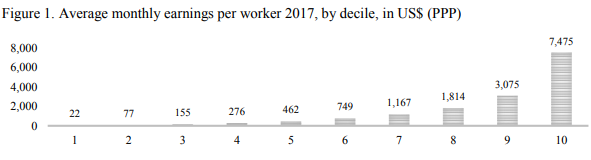
“Nearly half of all global pay is scooped up by only 10% of workers, according to the International Labour Organization, while the lowest-paid 50% receive only 6.4%.
“The lowest-paid 20% – about 650 million workers – get less than 1% of total pay, a figure that has barely moved in 13 years, ILO analysis found. It used labour income figures from 189 countries between 2004 and 2017, the latest available data.
“A worker in the top 10% receives $7,445 a month (£5,866), while a worker in the bottom 10% gets only $22. The average pay of the bottom half of the world’s workers is $198 a month.”
[…]
The explanation? To be in the top 10% of the global pay distribution you need to be making around and about minimum wage in one of the rich countries. Via another calculation route, perhaps median income in those rich countries. No, that £5,800 is the average of all the top 10%.
Note that this is in USD. About £2,000 a month puts you in the second decile, that’s about UK median income of 24,000 a year.
And as it happens about 20% of the people around the world are in one of the already rich countries. So, above median in a rich country and we’re there. Our definition of rich here not quite extending as far as all of the OECD countries even. Western Europe – plus offshoots like Oz and NZ, North America, Japan, S. Korea and, well, there’s not much else. Sure, it’s not exactly 10% of the people there but it’s not hugely off either.
So, what is it that these places have in common? They’ve been largely free market, largely capitalist, economies for more than a few decades. The most recent arrival, S. Korea, only just managing that few decades. It is also true that nowhere that hasn’t been such is in that listing. It’s even true that nowhere that is such hasn’t made it – not that we’d go to the wall for that last insistence although it’s difficult to think of places that breach that condition.
June 10, 2019
QotD: Robert Heinlein on “honest work”
The beginning of 1939 found me flat broke following a disastrous political campaign (I ran a strong second best, but in politics there are no prizes for place or show).
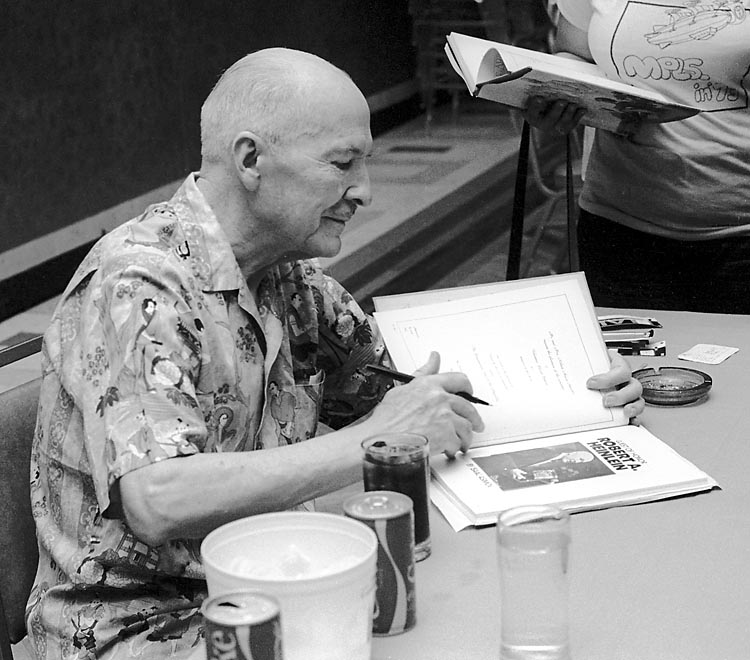
Robert A. Heinlein at the 1976 World Science Fiction Convention
Via Wikimedia Commons.I was highly skilled in ordnance, gunnery, and fire control for Naval vessels, a skill for which there was no demand ashore — and I had a piece of paper from the Secretary of the Navy telling me that I was a waste of space — “totally and permanently disabled” was the phraseology. I “owned” a heavily-mortgaged house.
About then Thrilling Wonder Stories ran a house ad reading (more or less):
GIANT PRIZE CONTEST —
Amateur Writers!!!!!!
First Prize $50 Fifty Dollars $50In 1939 one could fill three station wagons with fifty dollars worth of groceries.
Today I can pick up fifty dollars in groceries unassisted — perhaps I’ve grown stronger.
So I wrote the story “Life-Line.” It took me four days — I am a slow typist. I did not send it to Thrilling Wonder; I sent it to Astounding, figuring they would not be so swamped with amateur short stories.
Astounding bought it… for $70, or $20 more than that “Grand Prize” — and there was never a chance that I would ever again look for honest work.
(“Honest work” — an euphemism for underpaid bodily exertion, done standing up or on your knees, often in bad weather or other nasty circumstances, and frequently involving shovels, picks, hoes, assembly lines, tractors, and unsympathetic supervisors. It has never appealed to me. Sitting at a typewriter in a nice warm room, with no boss, cannot possibly be described as “honest work.”)
Robert A. Heinlein, 1980.
June 6, 2019
New paper on minimum wage effects is bound to be mis-used
In the Washington Examiner, Tim Worstall explains why a new well-researched paper on the minimum wage will be misunderstood and then used to “prove” things it doesn’t actually say:
None of this changes the standard intuition that when there’s a heavy such bite then there will be ill effects. What it does do is then lead us to trying to calculate what is a wage that does have that snarl, that bite? What is a minimum wage that is “too high” in the sense of having an excess of those ill effects upon employment? This is where I predict — no, not fear, not posit, nor surmise, but predict — this paper will be misused.
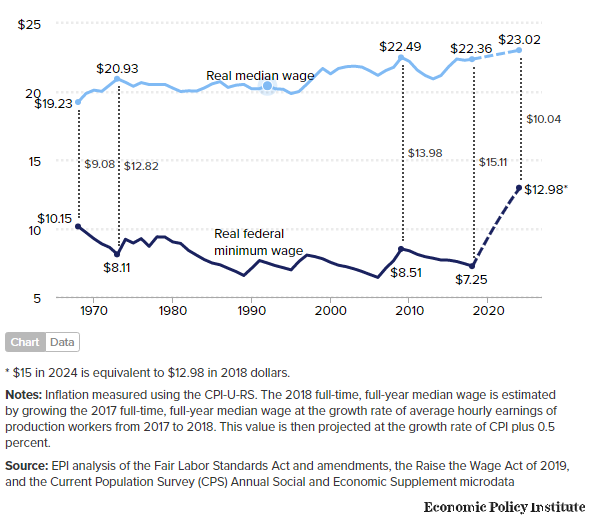
Our thinking is that the effects come from the relationship between the minimum and median wages. If we insist that wages cannot be lower than more than we already pay half the people, then we really are going to have problems. A minimum wage of 100% of the median wage isn’t going to work, that is. That ratio is called the Kaitz Index. This paper shows us that there are few to no such bad things happening up to 0.59 on that Kaitz measure. We can have the minimum wage at 59% of the median wage and know that we’ll have the good effects and only trivial amounts, at worst, of the bad.
You can see what’s going to happen next, can’t you? The Economic Policy Institute tells us that the median wage is about $22 this year, and 59% of that is $13. A bit of rounding and some aspiration, and why not go for a $15 minimum wage?
Except there are two median wages. Part-time and seasonal wages tend to be lower than full-year and full-time ones. The Economic Policy Institute is using that higher full-time one. The one for all jobs is quite a bit lower, $18.58 per hour. Take 59% of that and you get a rather lower level of $10.95 an hour. That’s around and about what McDonald’s, Walmart, and similar establishments pay as entry-level wages, which does seem about right, doesn’t it?
So, the new research paper, from esteemed researchers, published in the world’s top English language economics journal, tells us that minimum wages up to a certain level cause few to no problems. They’ve shown this for up to 59% of median wages. But which median do they mean? Dube himself told me they mean that lower one — specifically, the “median wage of all workers, not just for full time.”
But we all know how this is going to be used, don’t we? As proof that $15 an hour won’t cause any problems — which isn’t what the paper shows at all. Rather, it says that a $10.95 an hour minimum wage shouldn’t cause any problems of note.
The new paper is good empirical work. The fault is in what people will argue it says, not what it does.
June 3, 2019
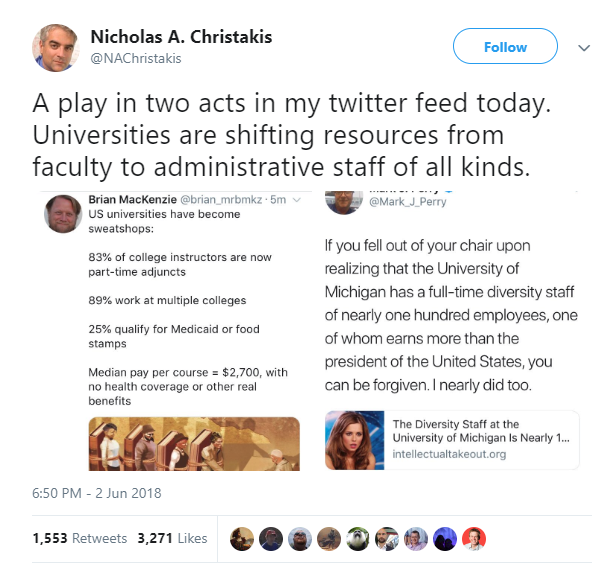
The state of US academia in juxtaposed tweets
American universities have problems, but the solutions they choose do not seem to be addressing those problems (screencapped, in case the tweet doesn’t load correctly):
May 23, 2019
Game of Theories: The Keynesians
Marginal Revolution University
Published on 7 Nov 2017When the economy is going through a recession, what should be done to ease the pain? And why do recessions happen in the first place? We’ll take a look at one of four major economic theories to find possible answers – and show why no theory provides a silver bullet.
May 12, 2019
Mechanisms for redressing employment gender imbalances
We’ve often been told that too many men occupy positions of power and influence in the working world, but what would it take to meaningfully address those imbalances?

Equity … is based on the idea that the only certain measure of “equality” is outcome — educational, social, and occupational. The equity-pushers axiomatically assume that if all positions at every level of hierarchy in every organization are not occupied by a proportion of the population that is precisely equivalent to that proportion in the general population that systematic prejudice (racism, sexism, homophobia, etc.) must be at play. This assumption has as its corollary the idea that there are perpetrators (the “privileged,” for current or historical reasons) who are unfair beneficiaries of the system or outright perpetrators of prejudice and who must be identified, limited and punished.
[…]
Now it doesn’t seem like mere imagination on my part that all the noise about “patriarchal domination” is not directed at the fact that far more men than women occupy what are essentially trade positions. Nor does it seem unreasonable to point out that these are not particularly high-status jobs, although they may pay comparative well. It is also obvious that none of these occupations and their hierarchies, in isolation, can be thoughtfully considered the kind of oppressive patriarchy supposed to constitute the “West,” and aimed at the domination and exclusion of women. By contrast, the trade occupations are composed of cadres of working men, with difficult and admirable jobs, who keep the staggeringly complex, reliable and essentially miraculous infrastructure of our society functioning through rain and snow and heat and gloom of night and who should be credited gratefully with exactly that.
Let’s assume for a moment that we should aim at equity, nonetheless, and then actually think through what policies would inevitably have to be put in place to establish such a goal. We might begin by eliminating pay scales that differ (hypothetically) by gender. This would mean introducing legislation requiring companies to rank-order their sex representation at each level of the company hierarchy, adjust that to 50:50, and then adjust the pay differential by gender at every rank, so that the desired equity was achieved. Companies could be monitored over a five-year period for improvement. Failure to meet the appropriate targets would be necessarily met with fines for discrimination. In the extreme, it might be necessary to introduce staggered layoffs of men so that the gender equity requirements could be met.
Then there are the much broader social policy implications. We could start by addressing the hypothetical problems with college, university and trade school training. Many companies, compelled to move rapidly toward gender equilibria, will object (and validly) that there are simply not enough qualified female candidates to go around. Changing this would mean implementing radical and rapid changes in the post-secondary education system, implemented in a manner both immediate and draconian — justified by the obvious “fact” that the reason the pipeline problem exists is the absolutely pervasive sexism that characterizes all the programs that train such workers (and the catastrophic and prejudicial failure of the education system that is thereby implied).
The most likely solution — and the one most likely to be attractive to those who believe in such sexism — would be to establish strict quota systems in the relevant institutions to invite and incentivize more female participants, once again in proportion to the disequilibria in enrollment rates. If quotas are not enough, then a system of scholarship or, more radically (and perhaps more fairly) women could be simply paid to enroll in education systems where their sex is badly under-represented. Alternatively, perhaps, men could be asked to pay higher rates of tuition, in some proportion to their over-representation, and the excess used to subsidize the costs of under-represented females.
May 3, 2019
The power of the patriarchy
As we are often told, men have distinct advantages in modern society that women are still struggling to achieve for themselves. Daphne Patai doesn’t seem to have got the memo, however:
In contemporary America, women and men still act out ancient roles. From the point of view of the men, the society is a matriarchy: Women have physically less demanding jobs — with the sole exception of childbirth, by now a rare event in the average woman’s life. Women sustain far fewer injuries on the job, are not required to go to war, take better care of their health, and for these reasons and many others enjoy a lifespan significantly longer than that of men.
In this society, men use their physical strength, when necessary, on women’s behalf. Women claim to be equal partners when that suits them and claim to be entitled to special consideration when that suits them. They insist on autonomy in maintaining or aborting pregnancies, but at the same time, they determine the fathers’ duties-and rights, if any. Women claim child support. They can either demand or impede fathers’ continuing involvement with their offspring, as the women see fit. The result is that women have advantages over men in child custody suits, just as they have learned to use charges of child sexual abuse and domestic violence.
Though dozens of studies show that women, by their own account, initiate violence against their domestic partners as often as (if not more often than) men, and cause as much injury when weapons are involved, somehow the social mythologies of this country keep that fact from gaining broad public attention, let alone credence.
But worst of all, in terms of the interactions of daily life, are women’s emotional demands on men. At home, men routinely sit through harangues that demonstrate women’s greater verbal skills and emotional agility. Men, inarticulate, try to figure out what is required of them in a given situation. Not by accident, verbal therapies in this society archetypically began with men listening and women speaking. Even as little boys, males learn to be in awe of girls’ verbal fluency. The feeling of ineptness, of being no match for females at the verbal and emotional level, is the common inheritance of all but a few exceptional males.
The matriarchy here described, structured to protect women’s interests as against men’s (and, ironically, having conned men into defending such a set up) puts a premium on women’s special social and emotional skills. Everywhere, women engage men and one another in personal conversation, offering and receiving disclosures, demanding commiseration, giving advice, spreading censure. Men, trained to keep to their workhorse style, are uncomfortably cornered by women, in the workplace, and at home, demanding that they speak from the heart. When asked “How are you?” women give a detailed and precise accounting. In offices, they spend valuable time discussing personal matters.
April 22, 2019
Internal challenges to Microsoft’s current discriminatory hiring practices
At Quartz, Dave Gershgorn looks at how Microsoft is facing internal dissent over their current hiring practices, which actively encourage discrimination against certain racial and gender groups:

Some Microsoft employees are openly questioning whether diversity is important, in a lengthy discussion on an internal online messaging board meant for communicating with CEO Satya Nadella.
Two posts on the board criticizing Microsoft diversity initiatives as “discriminatory hiring” and suggesting that women are less suited for engineering roles have elicited more than 800 comments, both affirming and criticizing the viewpoints, multiple Microsoft employees have told Quartz. The posts were written by a female Microsoft program manager. Quartz reached out to her directly for comment, and isn’t making her name public at this point, pending her response.
“Does Microsoft have any plans to end the current policy that financially incentivizes discriminatory hiring practices? To be clear, I am referring to the fact that senior leadership is awarded more money if they discriminate against Asians and white men,” read the original post by the Microsoft program manager on Yammer, a corporate messaging platform owned by Microsoft. The employee commented consistently throughout the thread, making similar arguments. Quartz reviewed lengthy sections of the internal discussion provided by Microsoft employees.
“I have an ever-increasing file of white male Microsoft employees who have faced outright and overt discrimination because they had the misfortune of being born both white and male. This is unacceptable,” the program manager wrote in a comment later. The Microsoft employees who spoke to Quartz said they weren’t aware of any action by the company in response, despite the comments being reported to Microsoft’s human resources department.
When contacted by Quartz, Microsoft pointed to comments by three company officials in the message-board threads. A member of Microsoft’s employee investigations team responded to the initial post in January, writing that the company does not tolerate discrimination of any kind. Another Microsoft staff member, who leads the team that helps the board of directors determine executive pay, explained the diversity-based compensation initiative. “Our board and executive leadership team believe diverse and inclusive teams are good for business and consistent with our mission and inspire-to culture,” she wrote. “Linking compensation to these aspirations is an important demonstration of executive commitment to something we believe strongly in.
April 10, 2019
QotD: UBI and the “end of work”
I’m sort of skeptically agnostic about the end of work. Yes, this has been predicted before, and never arrived. On the other hand, history is full of stuff that was predicted and didn’t arrive, until suddenly it did. So maybe this time is really different.
And what do we do if it is? I don’t know. I don’t think UBI [Universal Basic Income] is the answer. We have a fair amount of data about what places look like where large numbers of people are subsidized not to work. The answer is “like nowhere you’d want to live”. The predicted flowering of artistic and community endeavor does not arrive; people are depressed, less social, and spend a great deal of time on activities like watching television.
To this, UBI advocates rejoinder “But what about trust fund babies and old-style aristocrats! Everyone admires their lives of leisure!” To which my answer is “Heck no, I don’t”. The lives of the idle rich are better upholstered than the out-of-work poor, but suffer the same absence of meaning and community. They are not a model to which anyone should aspire.
Megan McArdle, “Ask Me Anything”, Reddit, 2017-04-10.
February 25, 2019
“Alexandria Ocasio-Cortez [is] doing for America what Jeremy Corbyn has done for Britain”
Alex Noble sings the praises of Alexandria Ocasio-Cortez as she does the heavy lifting to bring awareness of socialism to the American people:
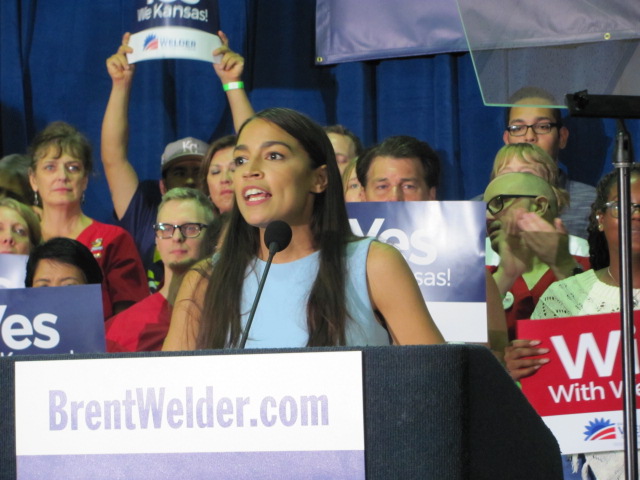
Alexandria Ocasio-Cortez speaking at the Reardon Convention Center in Kansas City, on 20 July 2018.
Photo by Mark Dillman via Wikimedia Commons.
Good old Alexandria Ocasio-Cortez – she’s doing for America what Jeremy Corbyn has done for Britain. Much to the dismay of the secret socialists now entrenched in the Democrat Party, she is stripping away the protective layer of bullshit that socialism normally has to rely upon to keep people from understanding its inherent failings, and is thus laying it bare before the world.
Because she is too ignorant to understand them – she actually believes in socialism, and thinks that if only it is adequately explained to the rest of us, we will love it as she does.
She doesn’t know enough history to know that everyone over the age of forty has seen socialism tried a dozen times in their lifetimes. Her sales pitch is wasted on us – we’ve seen the results before.
So when she told Amazon that their particular brand of crony capitalism was not welcome in New York, she genuinely thought people would admire her.
Instead, even the crony capitalists on the Democrat side of the aisle (i.e those who understand how the game is really played) are very upset with her – she has driven away 25,000 jobs and all the
voteseconomic benefits that would have flowed from them.All because she thinks Amazon should pay more corporation tax.
February 16, 2019
Indian government considers hiking the national minimum wage
Tim Worstall explains why this is a bad idea that won’t do much — if anything — to improve the lot of workers already earning the current minimum wage, and might well make things worse:
It’s not surprising that this is happening, India mooting a rise in the national minimum wage. There is, after all, an election in the offing. Just when we would expect crowd pleasing but bad ideas to surface. The problem here is that the Indian minimum wage is already too high. Increasing something that’s too high is not sensible policy. […]
Sure, we can declare a floor price and that will be valid wherever the government’s writ runs. Which, in the Indian economy, isn’t all that far.
The national minimum wage could be set at Rs 9,750 per month, almost double the current level, along with an additional Rs 55 per day of average HRA for urban workers, an expert committee has submitted. The January report, which went public for suggestions on Thursday, has also suggested an alternate plan, with a range of Rs 8,892-11,622 per month of national minimum wage for five different regions as they have diverse socio-economic and labour market situations, The Indian Express reported.
The specific details don’t matter all that much because the Indian government isn’t that powerful in economic matters.
The point being that any formal minimum wage will only apply to people in the formal economy. Depending upon who you want to believe between 80 and 90% of the Indian economy is over in the informal sector. That’s the part of the economy that doesn’t have health and safety standards, proper contracts and minimum wages. And our proof that the current minimum wage is too high is exactly that, that most of the economy isn’t in the formal sector where it applies.
In one manner raising that Indian minimum wage is an irrelevance because it affects so few people. In another it’s actively bad, as it makes it more expensive to join that formal economy, thus making it less likely. Thus it’s a bad idea either way. But you know, elections, politics.
January 28, 2019
QotD: Inequality in academia
We’ve heard a lot about the problem of inequality in America over recent years. But most of that talk has ignored one of the very worst pockets of inequality in American society. I speak, of course, of the American university system and its treatment of adjunct professors and graduate students.
Academics seem to think that the business world is a feudal environment characterized by huge status differentials and abusive treatment of underlings. They think that because, to be honest, that’s a pretty good characterization of … the modern university, where serfs in the form of adjunct professors toil in the vineyards.
Glenn Reynolds, “Trump should pity the poor PhD: New president should target worker exploitation at American universities”, USA Today, 2017-02-16.


