Quotulatiousness

June 16, 2014

When “victory” isn’t an end-game option

Filed under: Government, Middle East, Military, USA — Tags: , , , — Nicholas @ 08:45

Clive Crook talks about the strengths and weaknesses of US foreign policy for Bloomberg View:

As Iraq unravels, a painful truth about U.S. politics and foreign policy is becoming more evident: The U.S. is very good in all-or-nothing situations, but all-or-nothing situations don’t often arise.

This is a country that can and will meet existential threats with unity of purpose and vast resources. In this regard, even now, it stands alone. Few threats rise to that level. Lesser dangers can still be serious, without commanding or justifying that kind of response. Precisely for that reason, they put greater stress on democratic politics, and U.S. politics seems ever less able to cope.

[…]

Cordesman’s advice on conducting “non-wars against non-terrorists” boils down to this: Lower your expectations and be patient. In many countries, that way of thinking is of necessity the default. In the U.S., it isn’t. Americans want victory, and they want it now. And if they can’t win, they ask, why get involved at all?

In the foreseeable future, there’ll be no victory against jihadism. That’s partly because it doesn’t pose enough of a threat to justify total war against it. Yet the idea that jihadism poses no threat to the U.S. and can simply be ignored is risible. The danger can’t be crushed; it can only be managed. This means confronting it intelligently and patiently — with allies wherever possible, and always measuring the (uncertain) benefits of action against the (uncertain) costs.

“Mission accomplished” illustrates what Cordesman calls the end-state fallacy — the idea that deep-seated conflicts can be brought neatly to an end. So does President Barack Obama’s remark on the U.S. withdrawal from Iraq in 2011: “We’re leaving behind a sovereign, stable and self-reliant Iraq.”

Another fallacy is to organize policy around the idea that every conflict has a good side and a bad side. Foreign policy isn’t a morality play. Nouri al-Maliki in Iraq and Hamid Karzai in Afghanistan exemplify this second error. Perhaps, at the time, both men were better than the alternatives. Even if they were, they were bound to remain part of the problem.

H/T to Jonathan Rauch for the link.

June 14, 2014

Defense One‘s guide to ISIS

Filed under: Middle East, Military, Religion — Tags: , , , , , — Nicholas @ 10:59

The Islamic militant group ISIS didn’t come from nowhere, but most of us only started hearing about them quite recently. Defense One has a guide to the group that has been tearing up Iraq:

Islamic State in Iraq and Greater Syria (ISIS), a predominantly Sunni jihadist group, seeks to sow civil unrest in Iraq and the Levant with the aim of establishing a caliphate — a single, transnational Islamic state based on sharia. The group emerged in the ashes of the U.S.-led invasion to oust Saddam Hussein as al-Qaeda in Iraq (AQI), and the insurgency that followed provided it with fertile ground to wage a guerrilla war against coalition forces and their domestic allies.

After a U.S. counterterrorism campaign and Sunni efforts to maintain local security in what was known as the Tribal Awakening, AQI violence diminished from its peak in 2006–2007. But since the withdrawal of U.S. forces in late 2011, the group has increased attacks on mainly Shiite targets in what is seen as an attempt to reignite conflict between Iraq’s Sunni minority and the Shiite-dominated government of Prime Minister Nouri al-Maliki. Burgeoning violence in 2013 left nearly eight thousand civilians dead, making it Iraq’s bloodiest year since 2008, according to the United Nations. Meanwhile, in 2012 the group adopted its new moniker, ISIS (sometimes translated as Islamic State of Iraq and the Levant, or ISIL) as an expression of its broadened ambitions as its fighters have crossed into neighboring Syria to challenge both the Assad regime and secular and Islamist opposition groups there. By June 2014, the group’s fighters had routed the Iraqi military in the major cities of Fallujah and Mosul and established territorial control and administrative structures on both sides of the Iraqi-Syrian border.

[…]

At odds with al-Qaeda’s aims, ISIS has since expanded its territorial control, establishing a “de facto state in the borderlands of Syria and Iraq” that exhibits some of the traditional markers of sovereignty, note Douglas A. Ollivant and Fishman. Beyond fielding a militia, it provides limited services and administers its ultraconservative brand of justice. Much of Anbar province has remained outside the central government’s authority since January 2014, and in June, ISIS wrested control of Mosul and its environs after the army, hobbled by desertions, retreated overnight. The takeovers highlighted Baghdad’s weakness: In Fallujah, Maliki called on Sunni tribesmen to resist ISIS, and in Mosul, which had been considered a model for the surge and Awakening, he called on the Kurdish security forces, the Peshmerga, to do the same.

Insurgents’ consolidation of territorial control is a concern for the United States, which believes such areas outside of state authority may become safe havens for those jihadis with ambitions oriented toward the “far enemy” — the West. The Obama administration has responded to the regional resurgence by increasing the CIA’s support for the Maliki government, including assistance to elite counterterrorism units that report directly to the prime minister, and providing Hellfire missiles and surveillance drones. After Iraqi forces retreated from Mosul, the insurgents who routed them released more than one thousand prisoners and picked up troves of U.S.-supplied matériel.

June 5, 2014

Conspiracy theorist’s festival day

Filed under: History, Middle East, USA — Tags: , , , , , — Nicholas @ 08:58

Matt Welch on the last few decades that paved the way for a re-expansionist Russia:

On September 10, 1990, U.S. President George Bush and Soviet President Mikhail Gorbachev issued a simple and remarkable joint statement. “We are united in the belief that Iraq’s aggression must not be tolerated,” the former Cold War opponents declared after a seven-hour meeting in Helsinki to discuss Saddam Hussein’s annexation of Kuwait. “No peaceful international order is possible if larger states can devour their smaller neighbors.”

Observers understood immediately the historical significance of two previously antagonistic superpowers agreeing on the principle that countries cannot swallow one another. What was less obvious at the time is that the moment would look like science fiction from the perspective of the future as well.

President Bush — we did not need to differentiate him as “H.W.” back then — was so giddy about the prospects of rules-based global cooperation that on the not-yet-portentous date of September 11, 1990, he gave an unfortunate name to the concept during an address to a joint session of Congress: new world order.

“Most countries share our concern for principle,” he asserted. “A new partnership of nations has begun, and we stand today at a unique and extraordinary moment. The crisis in the Persian Gulf, as grave as it is, also offers a rare opportunity to move toward an historic period of cooperation. Out of these troubled times, our fifth objective — a new world order — can emerge: a new era-freer from the threat of terror, stronger in the pursuit of justice and more secure in the quest for peace. An era in which the nations of the world, east and west, north and south, can prosper and live in harmony. […] A world where the rule of law supplants the rule of the jungle. A world in which nations recognize the shared responsibility for freedom and justice. A world where the strong respect the rights of the weak.”

Because “new world order” sounded creepy and was already a phrase used by conspiracists worried about one-world government, Bush’s larger point got washed away in the ensuing brouhaha. But terminology aside, the creation of an international taboo against subsuming weaker countries was a worthwhile endeavor.

January 8, 2014

Tactical “lessons learned” from combat in Iraq and Afghanistan

Filed under: Middle East, Military, Weapons — Tags: , , , , — Nicholas @ 09:04

A couple of weeks back, Strategy Page posted some of the things that US and allied troops have had to learn from their experiences in combat since deploying to Iraq and Afghanistan. These tactical tips and tricks include:

The list is long and often embarrassing. For example, in peacetime troops are taught to drive carefully, in order to avoid accidents. But in combat the safest form of driving is fast and, to peacetime sensibilities, reckless. Even if commanders seek to practice “combat driving” in peacetime they do so in the knowledge that after a few bad accidents orders will come down to not drive like that because it causes bad publicity.

It’s a somewhat similar situation with battlefield first aid. It’s difficult to provide many troops with realistic training, especially since it’s harder to train on pigs or goats with the animal welfare zealots constantly trying to sue you into training methods that will get more troops killed in combat.

Another bad habit armies tend to drift into during peacetime is using weapons for training less and less. These things are, after all dangerous and with all the safety precautions and restrictions it is understandable why firing practice is cut and cut until it’s a rare event. But once war breaks out you quickly appreciate why sending troops to the weapons range several times a week is one of those lifesaving things you need to do.

[…]

Along with learning how to drive like a madman, you have to practice hard so you can change tires like one as well. In combat you will often have to do this under fire, so you must learn to do it quickly. This does two things. First, you learn how long it takes, even when you are in a hurry. This can be a useful bit of information if you are under fire while changing the flat. Second, practicing it forces you to make sure the spare tire is in good shape, and can quickly be reached (along with any tools needed.)

Then you must learn how Mister Grenade can be your friend, even on the crowded streets of a city like Baghdad or Kandahar. If your vehicle has a glove compartment, re-label it as the “grenade compartment.” Carry one smoke, one fragmentation and one tear gas grenade. If you’re stuck in traffic and the situation outside it starting to look dicey, then drop a smoke grenade out the window and try to get moving. You MUST be moving if you drop the tear gas grenade, because you cannot drive through the tears. Most other drivers will give you a wide berth when they see the smoke or tear gas grenade go off. For those who keep coming, with evil intent, the fragmentation grenade may come in handy (it is good for getting at bad people hiding behind something.) Remember, when using grenades, do not touch the pin until the grenade is outside the window. Accidents happen, and having a smoke grenade go off in your vehicle will ruin your day, at the very least.

July 22, 2013

Examining post-traumatic stress disorder

Filed under: Health, Military, USA — Tags: , , , — Nicholas @ 08:23

In the New Yorker, David J. Morris looks at the psychological chameleon we call PTSD:

As it is understood today, post-traumatic stress disorder is a grab bag of symptoms that emerges after experiencing trauma, like nearly dying or having one’s bodily integrity violated. It includes a persistent sense of hypervigilance and recurrent, intrusive memories of past traumatic events. In the worst cases, veterans with P.T.S.D. may hallucinate the voices of dead comrades, enemy combatants, or their commanding officers. A 1995 study of combat veterans with P.T.S.D. published in Traumatology found that sixty-five per cent of subjects reported hearing voices, including command hallucinations that they felt compelled to obey. As the psychiatrist Jonathan Shay, the author of Achilles in Vietnam: Combat Trauma and the Undoing of Character, put it, “P.T.S.D. can unfortunately mimic virtually any condition in psychiatry.”

But there are a growing number of psychiatrists and researchers who are challenging our understanding of P.T.S.D. — even its very nature as an ailment. Modern psychiatry, they argue, is locked into a mindset that systematically overdiagnoses P.T.S.D. without nurturing veterans’ ability to heal themselves. American culture, meanwhile, vacillates between elevated ideas of hero worship and victimhood in its conception of veterans, which can be destructive to the veterans themselves. One of the chief proponents of this school of thought is Ben Shephard, a leading British historian of military psychiatry. In his provocative book, A War of Nerves: Soldiers and Psychiatrists in the Twentieth Century, he describes a historical cycle that governs the treatment of war stress: “the problem is at first denied, then exaggerated, then understood, and finally, forgotten.” Shephard claims that the West, and America in particular, are deeply mired in the exaggeration phase of that cycle. These skeptics of the prevailing model of P.T.S.D. were described in Scientific American as a “broad array of experts indeed, giants of psychology, psychiatry and epidemiology.” One of the major tenets of this argument is a fact that, on its face, suggests that P.T.S.D. is a culturally determined phenomenon as well as a medical one: American veterans are 2.5 to four times more likely to be diagnosed with P.T.S.D. than British veterans.

[…]

As Jonathan Shay, the author of Achilles in Vietnam, shows in his follow-up, Odysseus in America: Combat Trauma and the Trials of Homecoming, while the problem of returning from war is one of humanity’s oldest struggles, the use of P.T.S.D. to frame a wide variety of traumatic experiences is a relatively recent development. The growing criticism of our current understanding of P.T.S.D. suggests that what was once ignored or treated as a failure of character — the soldier’s weakness — has now been medicalized to the exclusion of discussing its moral and spiritual dimensions. “It feels to me as if the U.S. civilian population has pathologized the veteran experience,” Elliott Woods, an Iraq veteran-turned-reporter, told me not long ago. “One well-intentioned person said to me the other day, ‘I can’t see how anyone could go to Iraq and not come back with P.T.S.D.’

H/T to Tim Harford for the link.

May 5, 2013

Sorcery, conspiracy theories, and a magical worldview

Filed under: Middle East, Religion — Tags: , , , , — Nicholas @ 10:12

Strategy Page looks at some of the widely held beliefs in some Islamic countries:

… in most countries where there is a dominant religion, especially a state approved one, there is usually still a fear that the previous religion (or religions) will try to make a comeback. The former faiths often involved some really old-school stuff, including magic and sometimes animal, or even human, sacrifice. It is not uncommon for there to be civil laws covering those accused to be practicing such sorcery, and severe punishments for those convicted. At the very least, the accused will be driven from any senior government jobs they might hold, and that’s what’s being done to dozens of Ahmadinejad associates.

All cultures have a certain belief in magic and what Westerners call “conspiracy theories” to explain otherwise unexplainable events. In the Islamic world, there is a lot of attention paid to sorcery and magic, and people accused of practicing such things are regularly attacked and sometimes executed. Conspiracy theories are also a popular way to explain away inconvenient facts.

For example, back in 2008 many Pakistanis believed that the then recent Islamic terrorist attack in Mumbai, India was actually the work of the Israeli Mossad or the American CIA and not the Pakistani terrorists who were killed or captured and identified. Such fantasies are a common explanation, in Moslem nations, for Islamic terrorist atrocities. Especially when women and children, and Moslems, are among the victims, other Moslems tend to accept fantastic explanations shifting the blame to infidels (non-Moslems).

[. . .]

American troops arriving in Iraq after 2003 went through a real culture shock as they encountered these cultural differences. They also discovered that the cause of this, and many other Arab problems, is the concept of “inshallah” (“If God wills it.”) This is a basic tenet of Islam, although some scholars believe the attitude was a cultural trait that preceded Islam. In any event, “inshallah” is deadly when combined with modern technology. For this reason, Arab countries either have poorly maintained infrastructure and equipment (including military stuff), or import a lot of foreigners, possessing the right attitudes, to maintain everything. That minority of Arabs who do have a realistic attitude towards maintenance and personal responsibility are considered odd, but useful.

The “inshallah” thing is made worse by a stronger belief in the supernatural, and magic in general. This often extends to technology. Thus many Iraqis believed that American troops wore sunglasses that enabled them to see through clothing, and armor vests that were actually air conditioned. When they first encounter these beliefs, U.S. troops thought the Arabs are putting them on. Then it sinks in that Arabs really believe this stuff. It’s a scary moment.

May 2, 2013

Fraudster who sold fake bomb detectors to Iraq jailed for ten years

Filed under: Britain, Law, Middle East, Technology — Tags: , , , — Nicholas @ 08:54

Under the circumstances, a ten year sentence is pretty lenient:

Fraudster James McCormick has been jailed for 10 years for selling fake bomb detectors.

McCormick, 57, of Langport, Somerset perpetrated a “callous confidence trick”, said the Old Bailey judge.

He is thought to have made £50m from sales of more than 7,000 of the fake devices to countries, including Iraq.

The fraud “promoted a false sense of security” and contributed to death and injury, the judge said. He also described the profit as “outrageous”.

Police earlier said the ADE-651 devices, modelled on a novelty golf ball finder, are still in use at some checkpoints.

Sentencing McCormick, Judge Richard Hone said: “You are the driving force and sole director behind [the fraud].”

He added: “The device was useless, the profit outrageous, and your culpability as a fraudster has to be considered to be of the highest order.”

One invoice showed sales of £38m over three years to Iraq, the judge said.

The bogus devices were also sold in other countries, including Georgia, Romania, Niger, Thailand and Saudi Arabia.

April 30, 2013

QotD: Shades of Yamamoto

Filed under: Middle East, Military, Quotations, USA — Tags: , , , — Nicholas @ 00:01

While the results of the wargames are all well and good, El Reg hopes this won’t induce a sense of complacency. Wargames are just that — games — and reality is going to be much more unpleasant. As the 19th century Prussian military strategist Helmuth von Moltke the Elder noted, “No human acumen is able to see beyond the first battle.”

Barely a decade ago we saw this demonstrated with the Millennial Challenge in 2002 — a simulated land, sea, air and electronic online wargame against a fictional Middle Eastern country (somewhat like Iraq). It was intended to be the first test of the switched-on, network-centric warfare beloved by former US Secretary of Defense Donald Rumsfeld, and in practice it failed miserably.

The Red team, controlled by Marine Lieutenant General Paul Van Riper, refused to play ball — using motorcycle couriers and pre-arranged signals at evening prayers to trigger attacks on the Blue team forces rather than easily-tapped radio or wired signals. By the second day, Van Riper had sunk one aircraft carrier, ten cruisers, and five of six amphibious ships of the attacking force, and the $250m exercise was shut down and reset.

Iain Thomson, “NATO proclaimed winner of Locked Shield online wargame”, The Register, 2013-04-29

April 23, 2013

Seller of fake bomb detectors found guilty of fraud

Filed under: Britain, Law, Middle East, Technology — Tags: , , , , — Nicholas @ 11:01

Back in 2010, I said “There should be a special hell for this scam artist” who mocked up bomb detector kits and sold them for thousands of dollars in Iraq and other areas with a real need for protection against IEDs. It’s taken more than three years, but he’s finally been found guilty:

A Somerset-based businessman has been convicted of three counts of fraud over the sale of bogus bomb detectors after his operation was exposed in a BBC Newsnight investigation in 2010.

This was a scam of global dimensions. James McCormick marketed his fake bomb detectors around the world, selling them in Georgia, Romania, Niger, Thailand, Saudi Arabia and beyond.

But his main market was Iraq, where lives depended on bomb detection and where the bogus devices were, and still are, used at virtually every checkpoint in the capital.

Between 2008 and 2009 alone, more than 1,000 Iraqis were killed in explosions in Baghdad.

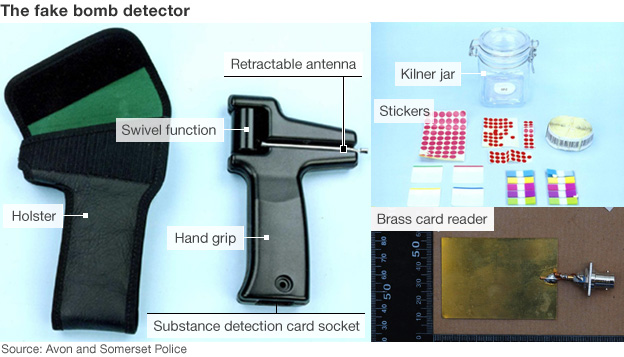
ADE-651 fake bomb detector

How the device was meant to work:

  1. A small amount of the substance the user wished to detect — such as explosives — was put in a Kilner jar along with a sticker that was intended to absorb the “vapours” of the substance
  2. The sticker was then placed on a credit-card sized card, which was read by a card reader and inserted into the device
  3. The user would then hold the device, which had no working electronics, and the swivelling antenna was meant to indicate the location of the sought substance

In other words, a magical dowsing stick that depended on the user to “detect” whatever the device was supposedly seeking. This wasn’t a case of a device that didn’t do what it was designed to do: it was a deliberate fraud with just enough “technological” mumbo-jumbo to appear to be a solution to a real problem:

The court heard that McCormick began his business by buying a batch of novelty “golf ball detectors” from the USA for less than $20 each. In fact they were simply radio aerials, attached by a hinge to a handle. He put the labels of his company, ATSC, on them and sold them as bomb detectors for $5,000 each.

He then made a more advanced-looking version which he was to sell for up to $55,000. The ADE-651 came with cards which he claimed were “programmed” to detect everything from explosives to ivory and even $100 bills. Police say the only genuine part of the kit — and the most expensive — was the carrying case.

To their credit, the police moved to investigate the same day the BBC’s original story broke. Strategy Page explained why the scam had been so easy to sell. Later it was reported that British civil servants and military personnel had been implicated in the fraud.

April 22, 2013

Torture under the Bush administration

Filed under: Middle East, Military, USA — Tags: , , , — Nicholas @ 09:00

Steve Chapman on the brutal legacy of torture of suspected terrorists during the Bush years:

The autopsy gave a spare account of how the 52-year-old man died. He suffered blunt force injuries on his torso and legs, and abrasions on his left wrist indicated he had been tied or shackled down. One of his neck bones was fractured. Death came “as a result of asphyxia (lack of oxygen to the brain) due to strangulation,” and it was ruled a homicide.

It’s too much to hope for justice in this case, though. That’s because the homicide came at the hands of the administration of George W. Bush. The victim was an Iraqi whose demise occurred while he was in American custody. He was one of some 100 people who since 2001 have died while our government was holding them, some of whom were tortured to death.

The advocates of “enhanced interrogation” make it sound simple and effective. An uncooperative terrorist gets waterboarded and quickly agrees to spill vital secrets, or gets weary of being cold and sleep-deprived and divulges plots in time to stop them.

Dick Cheney and Co. never dwell on the captives who were subjected to prolonged and escalating brutality that failed to elicit the desired information — possibly because they didn’t have it. Those who favor this approach don’t mention the inmates who will never talk because they are in their graves.

Some of the tortured survived the ordeal. But living or dead, they have been consistently ignored by the American people, few of whom realize what cruelties have been inflicted in our name.

The victims were ignored again last week when an independent commission issued a report that said, “Perhaps the most important or notable finding of this panel is that it is indisputable that the United States engaged in the practice of torture.” The report was released Tuesday — as the Boston Marathon bombs were eclipsing all other news.

March 30, 2013

The impact of a bayonet charge

Filed under: Britain, Middle East, Military, USA, Weapons — Tags: , , , — Nicholas @ 08:22

Strategy Page on one of the most antique weapons still regularly issued to infantry troops:

Although the U.S. Army dropped bayonet training three years ago, most ground troops world-wide still get some of it. Some army personnel want to bring it back. The U.S. Marine Corps still trains riflemen on how to use the bayonet, as does Britain. In fact, British troops were the last troops to actually use a bayonet charge in combat. This happened in 2004, when a patrol of 20 British troops in Basra, Iraq were ambushed by about a hundred Iraqi Shia militiamen. Help was still on the way when the commander of the British troops realized they were running out of ammo and the Iraqi gunmen were moving closer. So he ordered his troops to fix bayonets and charge. That thoroughly demoralized the Iraqis who after some close combat with the British (Scots, actually) left 35 of them dead, all ran away. Some of the British troops were wounded, but all survived. This, however, was one of the very few such incidents of bayonet use in the last decade. The problem is that Western troops tend to be well trained marksmen and Iraq or Afghan gunmen have learned not to get too close. So opportunities for launching a bayonet charge are increasingly rare.

While the U.S. Army eliminated bayonet drills from basic training, the U.S. Marine Corps has not. The marines did this not so much for developing weapons skills, but for mentally conditioning marines for combat. The bayonet drills are part of larger program emphasizing one-on-one combat. The army does this, to a lesser extent, and now without bayonet training.

The army attitude towards close combat is a bit different, and always has been. While the bayonet and the bayonet charge have a firm place in military history, the reality is rather different. This has had a heavy influence on the army bayonet training decision. Bayonets are often still carried, but rarely attached to the front of a rifle. Most modern bayonets are simply knives, which are handy for all sorts of things on the battlefield. Sticking them in the enemy is rarely one of them. Army leaders saw training new recruits in the battlefield use of the bayonet as misleading and a waste of time. The marines looked beyond the weapon, to the spirit and enthusiasm with which it, and many other implements of destruction, are used in close combat.

March 21, 2013

How Russians view American foreign policy moves

Filed under: Government, Middle East, Politics, Russia, USA — Tags: , , , , — Nicholas @ 00:01

In short, they don’t believe it’s mere ham-handedness, arrogance, and incompetence — they think it’s only supposed to look that way:

It’s instructive to view ourselves through a Russian mirror. The term “paranoid Russian” is a pleonasm. “The fact is that all Russian politicians are clever. The stupid ones are all dead. By contrast, America in its complacency promotes dullards. A deadly miscommunication arises from this asymmetry. The Russians cannot believe that the Americans are as stupid as they look, and conclude that Washington wants to destroy them,” I wrote in 2008 under the title “Americans play monopoly, Russians chess.” Russians have dominated chess most of the past century, for good reason: it is the ultimate exercise in paranoia. All the pieces on the board are guided by a single combative mind, and every move is significant. In the real world, human beings flail and blunder. For Russian officials who climbed the greasy pole in the intelligence services, mistakes are unthinkable, for those who made mistakes are long since buried.

From a paranoid perspective, it certainly might look as if Washington planned to unleash chaos. The wave of instability spreading through the Middle East from Syria is the direct result of American actions. [. . .]

If the Russians sound mad, consider this: there is another substantial body of opinion that sees an evil conspiracy behind American blundering in the Middle East, and it votes for Ron Paul and Rand Paul. I am not suggesting that Sen. Rand Paul is a paranoid, I hasten to clarify: I have never met the man and don’t presume to judge his state of mind. But his popularity stems in no small measure from conspiracy theorists who think that the U.S. government really is planning to criss-cross the continental United States with killer drones and pick off American citizens on their home soil. A lot of the same people think that America invaded Iraq on behalf of the oil companies (who would make a lot more money if Iraq were zapped by space aliens) or by the Israelis (who never liked the project from the outset). A fair sampling of such paranoia gets posted on the comments section of this site.

Thus we have the strangest pair of bedfellows in modern politics, the Russians and the rubes. Try to explain to them that George W. Bush was a decent and well-intentioned man without a clue as to the consequences of his actions, and they will dismiss it as disinformatsiya. Tell them that the New York Times and the Weekly Standard both believed in the Arab Spring as the herald of a new era of Islamic democracy, and they will see it as proof of a conspiracy embracing both the Democratic and Republican establishments. How, the paranoids ask, could two administrations in succession make so many blunders in succession? It stretches credibility. I wish it were a conspiracy. The truth is that we really are that dumb.

February 12, 2013

Palestine as a useful symbol, but Palestinians as inconvenient “guests”

Filed under: History, Middle East, Politics — Tags: , , , , , , — Nicholas @ 09:28

Strategy Page on the paradoxical Arab view of Palestine as worth fighting for, but actual living Palestinians as less-than-welcome pests (or worse):

While most Arabs will admit they hate Israel, they will also deny that this has anything to do with anti-Semitism and has everything to do with the Palestinians. This is not true, as Arabs have long demonstrated a hostility towards the Jews, something which is part of their religion. It’s in their scriptures, the stories of how Jews refused to support Mohammed, the founder of Islam. Long held grudges are popular in this part of the world.

Meanwhile, there are many more recent reasons for Arabs to dislike the Palestinians. When the state of Israel was established in 1947 there began a series of bad decisions by Arab governments that are setting records for failure. Although the UN tried to broker the creation of Israel, Arab nations misjudged their own power and told Arabs in Israel to flee their homes, so that the Arab armies could come in and kill all the Jews. When that didn’t work, the Arabs refused to absorb the 600,000 Arab refugees, and continues to treat (actually, mistreat) them as refugees. At the same time, the Arabs expelled 600,000 Jews who had been living among them for centuries. Most of these Jews went to Israel and become Israelis, and prospered.

Thus began decades of hostility between Palestinians and the rest of the Arab world. The Palestinians that fled to Lebanon proceeded to trigger a 15 year long civil war (1975-90) that devastated the country and left in place a Shia militia in the south (Hezbollah) that prevents the country from being truly united. The Palestinians that fled to Jordan eventually (1970) staged an uprising against the king, and were defeated and largely expelled. The Palestinians that went to Kuwait welcomed the Iraqi invasion of 1990 because Saddam Hussein had always been very loud about wanting to destroy Israel. When Arab and Western troops tossed Saddam out of Kuwait five months later, the Palestinians were forced to flee the vengeance of the Kuwaitis. The Palestinians that went to Iraq also had to flee in 2003, because they had helped Saddam terrorize the Shia and Kurdish majority and were, well, you know the story.

February 7, 2013

QotD: The greatest success of the anti-war movement

Filed under: Media, Middle East, Quotations, USA — Tags: , , , , , — Nicholas @ 10:10

The invasion of Iraq was treated as the greatest crime against humanity in the history of the world, denounced far more frequently and loudly than any act by Saddam Hussein, Bashir Assad, the Iranian regime, or North Korea.

Giant protests in lots of American cities. Giant protests in every foreign capital. The 2004 Guinness Book of Records described the anti-war movement around the globe as the largest mass protest movement in history — eclipsing any popular opposition to any act of the Soviet Union or any other totalitarian regime around the globe, ever. Among the elites in Paris, Berlin, and most corners of London, the Iraq War was the single-most important issue, and denouncing the evil of George W. Bush was the most important goal, not building a stable and peaceful Iraq. You recall Kofi Annan denouncing it, and the United Nations delegates scoffing when Hugo Chavez called our president the devil.

You recall the cries of “Bushitler,” the ubiquitous Code Pink interrupting every event in Washington, as if some ninny shouting during a press conference ever spurred sudden reversals in U.S. national security policy. You recall Hollywood’s relentless cavalcade of movies demonizing the war and those fighting it: In the Valley of Elah, Stop Loss, Green Zone, Redacted, Grace is Gone, Fahrenheit 9/11.

[. . .]

The Davos set is horrified to learn that after spending the better part of a decade screaming at the top of their lungs that an American intervention to topple a bloodthirsty Arab dictator is the absolute worst thing imaginable, suddenly Americans are no longer interested in toppling bloodthirsty Arab dictators.

(Slap, slap) Wake up, anti-war movement! You’ve got what you wanted! The United States is out of the armed intervention business, besides the occasional “leading from behind” in Libya, or the occasional covert mission in Pakistan.

Jim Geraghty, “The Demonization of the Iraq War Ensures No Syria Intervention”, National Review Online, 2013-02-07

January 18, 2013

Camouflage patterns and the patterns of inter-service rivalry

Filed under: Bureaucracy, Military, USA — Tags: , , , , , — Nicholas @ 00:01

In The Atlantic, D.B. Grady reminds us that some patterns are more deeply dyed than others:

Military combat uniforms have two purposes: to camouflage soldiers, and to hold together in rugged conditions. It stands to reason that there’s only one “best” pattern, and one best stitching and manufacture. It should follow that when such a uniform is developed, the entire military should transition to it.

MARPAT woodland patternIn 2002, the Marine Corps adopted a digital camouflage pattern called MARPAT. Rigorous field-testing proved that it was more effective than the splotched woodland pattern in use at the time, and the Combat Utility Uniform (of which it was a part) was a striking change for such a conservative institution.

UCP patternNot to be outdone, the Army drew up digital plans of its own, and in 2005 issued a redesigned combat uniform in a “universal camouflage pattern” (UCP). Three years after the Marines made the change, four years after the invasion of Afghanistan, and two years after the invasion of Iraq, you might think the Army would have been loaded with data on how best to camouflage soldiers in known combat zones. You would be wrong.

In fact, not only did the Army dismiss the requirements of the operating environments, but it also literally chose the poorest performing pattern of its field tests. The “universal” in UCP refers to jungle, desert, and urban environments. In designing a uniform for wear in every environment, it designed a uniform that was effective in none.

[. . .]

Such dysfunction is not unique to the Army. MARPAT was a success not only in function, but also in adding distinction to the Marines wearing it. Naturally the Air Force wanted in on that action, and set about to make its own mark on the camouflage world. It’s first choice? A Vietnam-era blue tiger-stripe pattern. (You know, to blend in with the trees on Pandora.)

After an outcry in the ranks, the leadership settled on a color scheme slightly more subdued. The new uniform did, however, have the benefit of being “winter weight” only, which was just perfect for service in Iraq.

« Newer PostsOlder Posts »

Powered by WordPress