Yes, Moist thought, there would be changes. You’d still find horses in town and Iron Girder couldn’t plough, although for a certainty Mr Simnel could make her do so. “Some people will lose out and others will benefit, but hasn’t that been happening since the dawn of time?” he said out loud. “After all, at the beginning there was the man who could make stone tools, and then along came the man who made bronze and so the first man had to either learn to make bronze too, or get into a different line of work completely. And the man who could work bronze would be put out of work by the man who could work iron. And just as that man was congratulating himself for being a smarty-pants, along came the man who made steel. Its like a sort of dance, where no one dares stop because if you did stop you’d be left behind. But isn’t that just the world in a nutshell?”
Terry Pratchett, Raising Steam, 2013.
December 26, 2015
QotD: Progress
December 10, 2015
Your business model and transformative change
At The Arts Mechanical, there’s a paean to the amazing technological achievement represented by this steam engine:

… and a return to reality by looking at how that amazing steam engine was made utterly obsolete by a humble diesel switcher and its direct descendants:
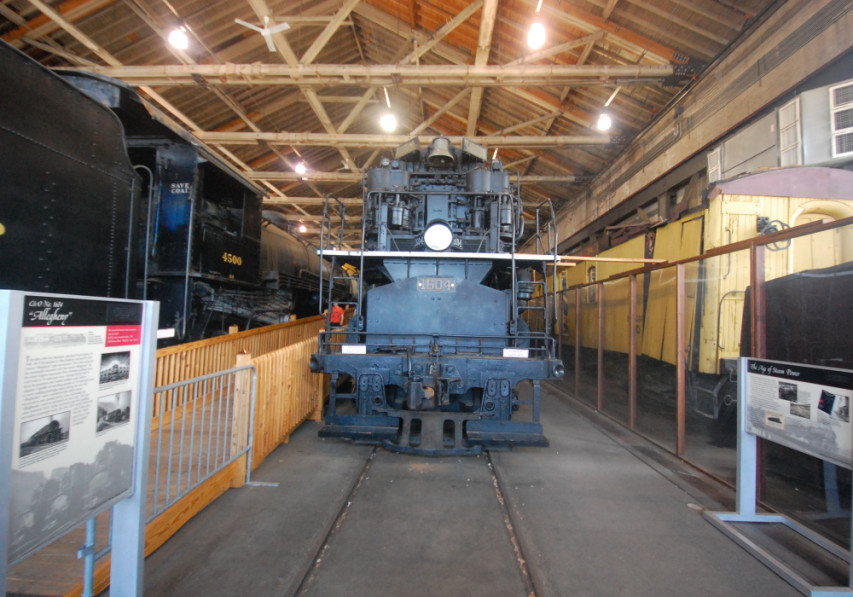
Which brings us to the picture at the head of this post. Anybody ever hear of Lima Locomotive? Here is what they did. That is a C&O RR H8 Allegheny. It is the largest and most powerful steam locomotive ever built. The locomotive was in the shed and there was no way I could get a side shot but the size of it boggles the mind. The firebox is the same size as a small house. The locomotive was designed to move mountains of coal and that’s what it did.
https://en.wikipedia.org/wiki/2-6-6-6
It was also obsolete before it was erected.
November 27, 2015
The Balance of Industries and Creative Destruction
Published on 18 Mar 2015
Why are price signals and market competition so important to a market economy? When prices accurately signal costs and benefits and markets are competitive, the Invisible Hand ensures that costs are minimized and production is maximized. If these conditions aren’t met, market inefficiencies arise and the Invisible Hand cannot do its work. In this video, we show how two major processes, creative destruction and the elimination principle, work with the Invisible Hand to create a competitive marketplace that works for producers and consumers.
November 24, 2015
How’s your food innovation level for American Thanksgiving?
Megan McArdle says you can safely avoid novel and baroque food variations for the most stereotypical American meal of all time:
Every year you’re supposed to come up with something amazing and new to do with the most scripted meal in the American culinary canon. Turkey crusted with Marash pepper and stuffed with truffled cornichons. Deconstructed mashed potatoes. Green bean casserole that substitutes kale for the green beans and a smug expression for the cream-of-mushroom soup. Pumpkin-chocolate trifle with a chipotle-molasses drizzle.
I’m sorry, I can’t. I just can’t.
You know what we’re having for Thanksgiving at our house this year? With minor variations, we’re having the same thing we’ve had every year since my birth in 1973. There will be a turkey, roasted whole, because my oven cannot accommodate a spatchcocked 16-pound bird splayed over a sheet pan full of stuffing. It will be brined in a cooler, stuffed full of stuffing despite all the dire culinary injunctions against it, and cooked in the same undoubtedly subpar way we have always done it. My sister will make her homemade cloverleaf rolls, and stuffing with sausage, ginger and apple. There will be cranberry sauce, little creamed onions, mashed potatoes, and butternut squash, with bok choy for those who want greens. For dessert, there will be pie: apple, pumpkin, and perhaps, if we are feeling especially daring, cranberry-raisin.
Novelty is overrated at holidays. If you want to try planked salmon and braised leeks for the first time this year, then bon appetit. But the idea that we must have novelty, that a good cook is constantly seeking out new and better things, is a curse. The best parts of our lives do not require constant innovation; they are the best because they are the familiar things we love just as they are. When I hug my Dad, I don’t think, “Yeah, this is pretty OK, but how much better would it be if he were wearing a fez and speaking Bantu?”
November 19, 2015
Korea: Admiral Yi – III: The Bright Moonlight of Hansando – Extra History
Published on 10 Oct 2015
While Yi found success at sea, the Korean land army suffered terrible losses. Yi Il, the man who once accused Yi of negligence, lost one battle after another, until finally the regular forces were annihilated at Chungju. The Joseon court that ruled to Korea fled to Pyongyang, on the verge of being pushed out of their own country. But that same day, Admiral Yi tore through a Japanese fleet at Okpo. He moved on to Sacheon, where he baited the Japanese commander into a trap and debuted his turtle ship. The unstoppable turtle ship carried the day, so he used this tactic again and again he destroyed a Japanese fleet while suffering no losses of his own. Finally, Hideyoshi ordered his naval commanders to take Jeolla, Yi’s headquarters. Sadly for him, his general Wakisaka Yasaharu grew too eager and engaged Yi without backup at Gyeonnaeryang Strait, only to find himself lured into an even more sophisticated version of Yi’s bait-and-retreat strategy: a “Crane’s Wing” of ships that collapsed on the overextended target from all sides. In one of the largest naval battles in history, Yi scored a decisive win and again didn’t lose a single ship. He headed to Angolpo to attack Hideyoshi’s two remaining generals and seal his victory, but they refused to be baited. He had to settle for a long range exchange of cannon fire, which worked at the cost of many injuries to his own men. In the end, he destroyed all but a few Japanese ships, and those he only spared to give the Japanese some means to escape and stop raiding in Korea. But he had accomplished his goal: Hideyoshi ordered a halt to all naval operations except guarding Busan, and without this control of the sea, Japan could not re-supply their troops nor hope to resume the assault that would have finally pushed Korea’s leaders out of Korea.
November 18, 2015
Adam Smith – The Inventor of Market Economy I THE INDUSTRIAL REVOLUTION
Published on 22 Feb 2015
Adam Smith was one of the first men who explored economic connections in England and made clear, in a time when Mercantilism reigned, that the demands of the market should determine the economy and not the state. In his books Smith was a strong advocator of the free market economy. Today we give you the biography of the man behind the classic economic liberalism and how his ideas would change the world forever.
November 15, 2015
A countertop home-brewing appliance
Pulkit Chandna reviews the “Brewie”:

In the future, at-home beer brewing will be a set-it-and-forget-it cinch, and not the convoluted mess we have always known it to be. That’s the feeling one gets from looking at Brewie, the latest in a series of countertop appliances designed to automate the process of beer crafting.
The Hungarian startup behind it claims Brewie is better and more automated than the competition — including the PicoBrew Zymatic home brewery we reviewed back in June. That lofty claim has helped the company secure hundreds of pre-orders, worth more than $600,000, across two crowdfunding rounds on Indiegogo. It concluded the first leg in February with a funding tally of $223,878, only to return to the site late last month in search of yet more pre-orders. (Indiegogo, as part of its “InDemand program” allows project creators to accept contributions or orders even after their crowdfunding campaign has ended.)
The Brewie is said to distill the whole brewing process down to a series of simple steps requiring negligible human input, such that even the most hopeless of aspiring brewmasters can get started with it in no time at all. You can control the unit either through its 4.3-inch LCD touchscreen or via the companion app over Wi-Fi.
October 20, 2015
Dilbert‘s Scott Adams on Politics, Philosophy, Hypnosis, and “Failing Towards Success”
Published on 6 Oct 2015
“You can defend an entirely different view of the world using the same data that’s used to defend the standard model. So whenever I can do that, I’m so there,” says Scott Adams. “Because as soon as you realize that the model you’ve been looking at maybe isn’t so firm as you thought… Then you’re free.”
Adams is a man of many talents: Best-selling author behind books such as God’s Debris and How to Fail at Almost Everything and Still Win Big, serial entrepreneur and creator of the time-management system Calendar Tree, and, of course, the man behind Dilbert.
Reason TV‘s Zach Weissmueller sat down with Adams in his home office to discuss Adams’ obsession with Donald Trump (“I see in Trump a level of persuasion technique that is probably invisible to the public” – 1:18), his resistance to political labels (“As soon as I join a group, suddenly all those things that I thought were crazy, I start convincing myself…” – 2:19), his political philosophy (“My preferred political process would be something like business” – 3:08), what Dilbert can teach us about capitalism (“One of those ideas that’s terribly flawed, but we haven’t figured out anything better yet” – 5:22), and the theme that runs through all of his work (“In all cases, I’m interested in the same thing: Is there a different way to look at the familiar?” – 10:05).
Bonus: Here’s Scott Adams’ view that The Donald is a Master Wizard:
October 8, 2015
“[P]harmaceutical companies … make out like bandits from the existence of the patent system”
The current US patent system is set up to create and maintain — for a limited time — monopolies that can be exploited by pharmaceutical companies:
The Wall Street Journal has a puzzling piece complaining about how the pharmaceutical companies seem to make out like bandits from the existence of the patent system. What puzzles is that the entire point and purpose of the patent system, in an economic sense, is so that inventors of things can make out like bandits. The background problem is that of public goods, something I’ll explain in a moment. That problem leads us to thinking that a pure free market in things which are public goods isn’t going to work as well as something a little different. So, we design something a little different. And the point and purpose of our design is so that people who innovate can make vast mountains of cash out of having done so.
It’s then more than a bit odd to point out that our system enables people who innovate to make vast mountains of cash.
[…]
Which brings us to the subtlety of those pricing decisions. With drugs, pharmaceuticals, close enough the cost of manufacturing a dose is zero. All of the costs go in the original research, the clinical testing (the lion’s share) and getting it through the FDA. Profit is therefore determined, since marginal production costs are zero (they’re not, accurately, but close enough for this comparison), by gross revenue. And we want to maximise the incentive for people to innovate, that’s the very reason we’ve got this patent system in the first place, and thus we would rather like the pharma companies to be maximising revenue.
And thus, from this economic point of view, we should be quite happy with people raising their prices. Demand does fall as they do so, yes, but as long as gross revenue increases, the price rises more than compensating for the fall in unit demand, then we should be happy with the way the system is working. Gross revenue is being maximised, profits are being maximised, incentives to innovate are being maximised. That’s what we want our system to do after all.
Far from being worried about this price gouging we should be welcoming it. Because, obviously, someone making bajillions out of having innovated a drug to cure a disease increases the incentives for many other people to go and invest bajillions of their own to cure other diseases. Far from complaining about it we should be celebrating the system working.
October 3, 2015
Great Britons: Isambard Kingdom Brunel Hosted by Jeremy Clarkson – BBC Documentary
Published on 16 Jul 2014
Jeremy Clarkson follows in the footsteps of the great engineer Isambard Kingdom Brunel whose designs for bridges, railways, steamships, docks and buildings revolutionised modern engineering. But his boldness and determination to succeed often led him to repeatedly risk his own life. Jeremy Clarkson, discovers for himself just how terrifying that was.
H/T to Ghost of a Flea for the link.
October 2, 2015
An Orgy of Innovation (Everyday Economics 5/7)
Published on 20 Apr 2015
The list of famous inventions from the last few centuries is long, and you may even be making use of one right now — laptops, smartphones, tablets, and televisions, for instance. There are countless unsung improvements, too, that make our daily lives much easier. We’ve all benefited from zip top sandwich bags, twist bottle caps, and long-lasting batteries, to name a few!
The economic historian Deirdre McCloskey coined the term “innovationism” to describe the phenomenal rise in innovation over the past couple hundred years. While there have always been inventors and innovators, that number exploded after the eighteenth century, contributing to what we’ve described in previous videos as the “Hockey Stick of Human Prosperity.”
Why has innovation grown so rapidly? Economist Douglass North argues it has to do with institutions such as property rights, non-corrupt courts, and rule of law, which lay the foundation for innovation to take place. Others attribute the rise to factors such as education or access to reliable energy. McCloskey argues that what really kicked innovation into high gear is a change in attitude — ordinary people who once celebrated conquerers and kings began to celebrate merchants and inventors.
In this video, we discuss these ideas further. After all, a better understanding of what drives innovation could help poor countries that still live on the handle of the “Hockey Stick” reach a much greater level of prosperity.
September 7, 2015
New Lanark
In The Register, Bill Ray takes a geek’s-eye-view of the town of New Lanark, a key place in the early industrial revolution:
Nestled in the Clyde Valley the village owes its existence to the falls that were harnessed to refine raw cotton sent in from the colonies: a picture-postcard image from a time when Britain was the factory of the world.
But for all its industrial heritage New Lanark is a long way from being a typical “dark satanic” mill, as it marks the end of that time and the dawning of a better age.
Visit the village today and you can see the big machines that kept the empire running. Enormous water wheels; later supplemented by steam engines, connected by belts and ropes to machines which turned raw cotton into usable thread and fabric. However, it’s not industrial history that is celebrated at New Lanark, rather a social revolution, and one driven by one man whose ideas created the working life as we understand it today.
The man was Robert Owen, who, in 1799, bought New Lanark and immediately embarked on his “grand social experiment”. His radical ideas, such as refusing to employ children, providing medical insurance, and educating the workforce, were ridiculed by his competitors who couldn’t see the value in teaching children, let alone adults. But Owen believed that industry should serve the betterment of all men, not just those who owned the factories.
It worked too, rather to the surprise of his peers. New Lanark was a successful mill and profits rose steadily under the beneficent command of Owen. It could be argued, perhaps, that New Lanark would have been even more profitable without the social agenda, but every afternoon at five we should all be grateful for his reforms that made our working lives what they are:
“Eight hours daily labour is enough for any human being, and under proper arrangements sufficient to afford an ample supply of food, raiment and shelter, or the necessaries and comforts of life, and for the remainder of his time, every person is entitled to education, recreation and sleep”
Not that the workers at New Lanark did quite as well as we do; their working day ran ten and a half hours, but once mealtimes had been deducted it was approaching eight and certainly much better than the conditions in other mills around the country.
June 29, 2015
More on the “self-driving truck” issue
In the comments to this post, Tom Kelley provided a worthwhile digression on the topic that I felt deserved a wider audience, so with his permission, here’s Tom’s response:
Given that the trucking industry has been my sandbox for quite some time, I can safely extend Megan’s prognosis to also include the low long-term risk of job losses due to self-driving vehicles.
Frankly, I have to be wary of any “expert” who can’t even get the name of his source (the American Trucking Associations — yes, plural — not the American Trucker Association) transcribed correctly.
Apart from the myriad technical issues standing in the way of driverless trucks, the insurmountable barrier is anti-competitive trucking regulations passed on behalf of the government’s favorite white elephant, the rail industry. Invariably, these regulations are tarted up under some guise of safety (Let’s see, was it a truck or a train that blew the town of Lac-Mégantic off the map??? Hmm).
The bottom line is that any change that would have the slightest possibility of making trucking more productive is quickly met with massive dis-information campaigns, and even more massive lobbying from the rail industry. Even the most minor dimensional changes designed to reflect the current realities of truck freight transportation stand little if any chance of making it past regulators with a permanent disdain for free enterprise.
We can’t have electronically actuated brakes on trucks because the regulators have no grasp of brakes or electronics, and somebody wants to replace the driver with electronics? Seriously? Of course these same folks seen to have no problem flying cross-country at 500 MPH in a commercial jetliner that is literally flown by wire.
And even if the government types were perfect actors in this little tale, then you have the American tort law system, run/regulated by, for, and about the trial lawyers. Even with professional truck drivers who can deftly avoid putting incompetent car drivers on their way to a Darwin award, hundreds of four-wheeler drivers still manage to commit suicide-by-truck every year, followed quickly by their otherwise destitute estates suing innocent trucking companies for millions.
Can’t you just hear the jury summation now: “The eeevvilll trucking company wanted to save a few pennies by outsourcing the driver’s job to a microchip! The must be punished! My client, a fourth cousin of the homeless man who jumped off a bridge in front of a truck MUST be awarded $10 million for the pain and suffering from losing a relative he never met. No justice, no peace!”
No insurance company in their right mind would insure a driverless truck for real-world operation.
There’s no question that the technology is available to make the concept work, I was on-board numerous autonomous vehicles of all sizes back in 1997.
It will take several major societal shifts before any serious degree of autonomy makes it into real world trucking operations.
June 26, 2015
The self-driving truck won’t displace many human truck drivers for years to come
I’m far from being a Luddite, but I find Megan McArdle‘s analysis of the low short-to-medium term risk of job losses due to self-driving vehicles to be pretty convincing:
… my objections are actually to the understanding of the trucking industry works and of self-driving vehicles. Fully automated trucks, with no drivers at all, are probably going to arrive later than Santens thinks, take longer to roll out than he projects, and displace fewer workers than he thinks they will. I’m not saying it will never happen. I’m just skeptical that this is going to be a major policy problem in the next two decades.
Why?
Start with what truckers do, and how many of them there are. Santens quotes the American Trucker Association to get 3.5 million. The Bureau of Labor Statistics puts that figure a bit lower, around 2.8 million. More importantly, only 1.6 million of those are long-haul truckers. The rest are “driver/sales” employees or “Light truck or delivery services drivers.” Those are short-haul services that will not quickly be replaced by automated cars, both because chaotic urban roads are harder for autonomous vehicles to handle and because part of the job is loading and unloading the truck (something that long haul drivers may also do).
Also: Why would we assume that the advent of driverless trucks would be bad for trucking support jobs? Those folks are doing stuff like maintenance or loading that still has to be done. Moreover, other jobs will be created, in designing and maintaining the new systems. Someone has to map all those roads.
But I think it will be a while before we get to a fully autonomous vehicle with no people in it. The “driverless truck” that Santens links is not actually driverless; it’s partially autonomous. If it foresees something it can’t deal with, such as heavy snow, it signals to the driver to take over; if the driver doesn’t respond, it slows to a stop. That’s an improvement in the lives of truck drivers, not a job killer.
June 25, 2015
A different kind of crowd-funding
Christopher Taylor starts off by praising to the skies a movie I’ve never seen … but he goes on to discuss a variant of crowdfunding that might be a significant change to how movies are made:
… the big studios are corporations that answer to a board of stockholders. And the stockholders aren’t interested in great film making, they are interested in making money off their stocks.
So the Broken Lizards guys went to crowdfunding to raise money for their film, and have done quite well. They did so well that they don’t need a big bunch of studio dollars and interference to make the movie.
But here’s where it gets really interesting. See, crowdfunding sites raise money by offering goodies and the joy of helping a product succeed. They are not investment sites so much as a chance to be a patron of something you want to see on the market as well as a chance to get something from the company. Free copies, a mention in the book, a token in the game named after you, and so on.
Well that’s all about to change in a big way.Jay Chandrasekhar writes:
At our meeting, I vented to Slava about my perception of crowdfunding. I told him I wished people could invest in the movie and then own an equity piece of the backend. He said, “I totally agree.” That’s when we hit it off. He said that there is legislation in Washington, as we speak, that if signed, will make equity-based crowdfunding a reality. Think about that.
I’m with Jay here. Think about that. Its very likely that soon you will be able to donate to a crowdfunded project and get money back from its sales. In other words, it will actually be an investment, not just patronizing.
This is a huge key in changing the way that media gets made. All those projects the studios and TV channels pass on because it isn’t hot or doesn’t make sense to them? If this happens, they can have a chance.