Quotulatiousness

September 4, 2013

“Despite a rash of deadly train crashes…”

Filed under: Media, Railways — Tags: , , , , — Nicholas @ 09:15

Coyote Blog indulges in a good old-time fisking of an article built on the claim that there has been a “trend” of increasingly deadly railway accidents:

The best way to explain the phenomenon is with an example, and the Arizona Republic presented me with a great one today, in the form of an article by Joan Lowy of the Associated Press. This in an article that reads more like an editorial than a news story. It is about the Federal requirement for railroads to put safety electronics called Positive Train Control (PTC) on trains by a certain date. The author has a pretty clear narrative that this is an absolutely critical piece of equipment for the public good, and that railroads are using scheming and lobbying to unfairly delay and dilute this critical mandate (seriously, I am not exaggerating the tone, you can read it for yourself.)

My point, however, is not to challenge the basic premise of the article, but to address this statement in her opening paragraph (emphasis added).

    Despite a rash of deadly train crashes, the railroad industry’s allies in Congress are trying to push back the deadline for installing technology to prevent the most catastrophic types of collisions until at least 2020, half a century after accident investigators first called for such safety measures.

The reporter is claiming a “rash of deadly train crashes” — in other words, she is saying, or at least implying, that there is an upward trend in deadly train crashes. So let’s ask ourselves if this claimed trend actually exists. She says it so baldly, right there in the first seven words, that surely it must be true, right?

[…]

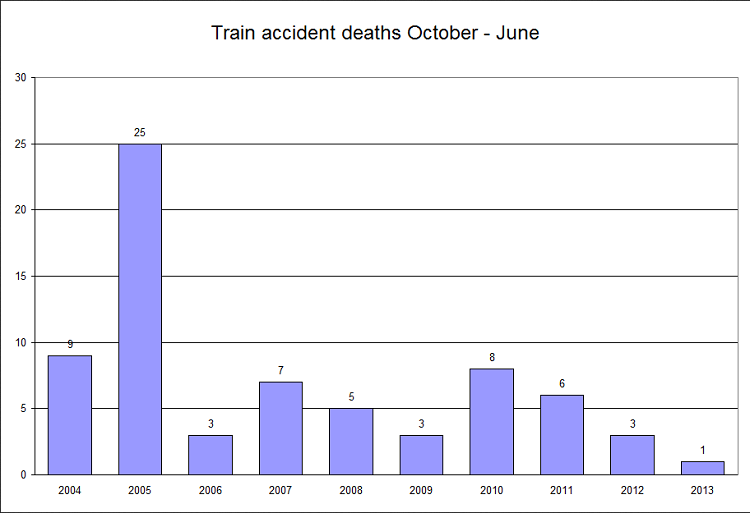
So let’s go to the data. It is actually very easy to find, and I would be surprised if Ms. Lowy did not actually have this data in her hands. It is at the Federal Railway Administration Office of Safety Analysis. 2013 data is only current through June and seems to be set up on an October -September fiscal year. So I ran the data only for October-June of every year to make sure the results were comparable to 2013. Each year in the data below is actually 9 months of data.

By the way, when one is looking at railroad fatalities, one needs to understand that railroads do kill a lot of people every year, but the vast, vast majority of these — 99% or more — are killed at grade crossings. People still do not understand that a freight train takes miles to stop. (see postscript below, but as an aside, I would be willing to make a bet: Since deaths at grade crossings outnumber deaths from collisions by about 100:1, I would be willing to bet any amount of money that I could take the capital the author wants railroads to invest in PTC and save far more lives by investing it in grade crossing protection. People like Ms. Lowy who advocate for these regulations never, ever seem to consider prioritization and tradeoffs.)

Anyway, looking at the data, here is the data for people killed each year in US railroad accidents (as usual click to enlarge any of the charts):

Train accident deaths Oct-Jun

So, rather than a “rash”, we have just the opposite — the lowest number of deaths in a decade. One. I will admit that technically she said rash of “fatal accidents” and this is data on fatalities, but I’m going to make a reasonable assumption that one death means one fatal accident — which certainly cannot be higher than the number of fatal accidents in previous years and is likely lower.

Most of you will agree that this makes the author’s opening statement a joke. Believe it or not — and this happens a surprising number of times — this journalist is claiming a trend that not only does not exist, but is of the opposite sign.

August 7, 2013

Infrastructure does not lead development – it lags

Filed under: Economics, Government, History, Railways — Tags: , , , — Nicholas @ 08:28

In the Wall Street Journal, Larry Schweikart and Burton Folsom correct the misunderstanding that development and growth will follow infrastructure:

History says it doesn’t work like that. Henry Ford and dozens of other auto makers put a car in almost every garage decades before the National Interstate and Defense Highways Act in 1956. The success of the car created a demand for roads. The government didn’t build highways, and then Ford decided to create the Model T. Instead, the highways came as a byproduct of the entrepreneurial genius of Ford and others.

Moreover, the makers of autos, tires and headlights began building roads privately long before any state or the federal government got involved. The Lincoln Highway, the first transcontinental highway for cars, pieced together from new and existing roads in 1913, was conceived and partly built by entrepreneurs — Henry Joy of Packard Motor Car Co., Frank Seiberling of Goodyear and Carl Fisher, a maker of headlights and founder of the Indy 500.

Railroads are another example of the infrastructure-follows-entrepreneurship rule. Before the 1860s, almost all railroads were privately financed and built. One exception was in Michigan, where the state tried to build two railroads but lost money doing so, and thus happily sold both to private owners in 1846. When the federal government decided to do infrastructure in the 1860s, and build the transcontinental railroads (or “intercontinental railroad,” as Mr. Obama called it in 2011), the laying of track followed the huge and successful private investments in railroads.

In fact, when the government built the transcontinentals, they were politically corrupt and often — especially in the case of the Union Pacific and the Northern Pacific — went broke. One cause of the failure: Track was laid ahead of settlements. Mr. Obama wants to do something similar with high-speed rail. The Great Northern Railroad, privately built by Canadian immigrant James J. Hill, was the only transcontinental to be consistently profitable. It was also the only transcontinental to receive no federal aid. In railroads, then, infrastructure not only followed the major capital investment, it was done better privately than by government.

June 12, 2013

Federal government to go ahead with Pickering airport

Filed under: Cancon, Government — Tags: , , , , — Nicholas @ 09:05

As my house is directly under the most likely approach to the new airport, I suspect my property value is about to take a big dive:

After four decades, the long-standing controversial plan to build an airport on the Pickering Lands is scheduled for takeoff.

But that doesn’t mean residents are on board.

At a press conference held on the lands Tuesday, Finance Minister Jim Flaherty announced the 7,500 hectares of land in Pickering, Markham and Uxbridge will be transformed into a new airport and a 2,000-hectare Rouge National Urban Park.

“These lands were acquired by the government more than 40 years ago with the intention of developing an airport, but it never got off the ground,” Flaherty said. “The uncertainty ends today.”

The plan is to begin work immediately, he said. It will take at least 10 years to build the airport in the lower quadrant of the lands with Hwy. 7 and Brock Rd. as a southeastern boundary. No cost has yet been assigned to the construction of the airport.

Of course, our local politicians love it:

Durham Council chairman Roger Anderson said the airport will reduce congestion on Hwy. 401.

“Wouldn’t it be nice if you didn’t have to drive to Mississauga to go to Ottawa?” Anderson said. “For us, it’s a big win. It will show the province Durham should get one job for every three, which we fought about for years and the other thing — It’s not only good for Durham, but for Scarborough and York and Markham.”

The Ajax-Pickering Board of Trade is also backing the airport proposal, but said it wants to study it in more detail and consult with members. The board has been advocating for congestion relief in Durham Region and said the airport would be “a game changer.”

I wonder how long it’ll take after it opens to become the new Mirabel?

It was intended to replace the existing Dorval Airport as the eastern air gateway to Canada; from 1975 to 1997, all international flights to/from Montreal were required to use Mirabel. However, Mirabel’s distant location and lack of transport links made it unpopular with airlines and travellers. Moreover, Montréal’s economic decline relative to Toronto kept passenger volumes from rising to the levels originally anticipated. And so Dorval Airport not only remained viable but resumed handling overseas flights. Eventually, Mirabel was relegated to the role of a cargo airport. Initially a source of pride, the airport became an embarrassment, widely regarded in Canada as being a boondoggle and a white elephant. Ironically, the Dorval Airport was renamed Montréal–Pierre Elliott Trudeau International Airport after the Canadian Prime Minister, Pierre Elliot Trudeau, whose government spearheaded the Mirabel project to replace Dorval.

For “ironically” in the Wikipedia description, read “deservedly”.

June 6, 2013

Rail technology changes on a slower timescale than other transportation systems

Filed under: Business, Railways, Technology — Tags: , , , , — Nicholas @ 09:50

The Economist looks at innovation in the railway business:

Compared with other modes of transport, train technology might seem to be progressing as slowly as a suburban commuter service rattling its way from one station to another. Automotive technology, by contrast, changes constantly: in the past decade satellite-navigation systems, hybrid power trains, proximity sensors and other innovations have proliferated. Each time you buy a new car, you will notice a host of new features. Progress is apparent in aircraft, too, with advances in in-flight entertainment and communication, fancy seats that turn into beds, and quieter and more efficient engines. Trains, meanwhile, appear to have changed a lot less.

Actually, the perception of change is much greater for cars and airplanes, but there are few changes in those areas that are not merely evolutionary rather than revolutionary. Incremental changes are the rule of the day, as neither cars nor planes travel significantly faster than they did thirty years ago … but they do it safer and more comfortably now.

This comparison is not entirely fair. For one thing, people buy their own cars, so they pay more attention to automotive innovation. Carmakers are engaged in a constant arms race, trumpeting new features as a way to differentiate their products. Nobody buys their own trains. Similarly, air passengers have a choice of competing airlines and are far more likely to be aware of the merits of rival fleets than they are of different types of train. In addition, notes Paul Priestman of Priestmangoode, a design consultancy that specialises in transport, trains have longer lives, so technology takes longer to become widespread. The planning horizon for one rail project he is working on extends to 2050. “You have to think about longevity, whereas the car industry wants you to buy a new car in two years,” he says.

Another big difference is that the way railways operate — with a small number of powered units (locomotives) and a very large number of unpowered units (freight cars and passenger cars) that have to be reliably connected to one another and operate successfully. A car can go on any kind of road (or even none, in many places) and a plane can fly in any part of the sky, but a train needs an engineered right-of-way that falls within established standards of curvature, elevation change, and overhead and side clearance. Because of this, any piece of railway equipment that does not run on its own isolated track (like monorails or the various flavours of high speed railways) must always meet the existing standards … which have been slowly evolving since the mid-nineteenth century. With so much capital invested in existing right-of-way and rolling stock, the costs for introducing significant changes can be astronomical.

There’s also the fact that unlike other forms of transportation, passenger and freight trains operate in different and sometimes conflicting ways. Passenger trains need to operate on a known schedule between high population centres at relatively high speed. With higher speed goes a need for better braking systems and more capable signalling methods. Unlike a train full of new cars or iron ore, you can’t just park a train full of living human beings on a siding for a few hours to allow slower trains to clear the way (unless you’re Amtrak or VIA). Passenger trains have to have top priority, which often means the railways have to delay freight traffic to ensure that the passengers are not unduly delayed.

One solution to the problem is to provide separate tracks for the passenger trains, but this can be very expensive, as the places where the extra tracks would be most effective is also where the land is at peak cost: in and around major cities. Most passenger trains are now run by government agencies or corporations acting as agents for local, regional, or state governments, so they sometimes use the power of eminent domain to gain access to the land. This is a politically fraught area, as the more land they need to take, the tougher the process will get.

Brakes are also getting an upgrade. Stopping a train can take so long that locomotive-operators, also known as engineers, often have time to contemplate their fate before an impact. “Your life races before you,” says a former operator who, years ago in Alabama, helplessly watched as his freight train, its emergency brakes screeching, headed towards a stalled truck that ultimately managed to pull off the tracks in time. Stopping a train pulling a hundred cars at 80kph can require 2km of track. Road accidents take far more lives, but 1,239 people were killed in more than 2,300 railway accidents in 2011 in the European Union alone.

Much of the problem is that the faster a train’s wheels are spinning, the hotter its brake shoes get when engaged. This reduces friction and hence braking power, a predicament known as “heat fade”. Moreover, nearly all trains power their brakes with compressed air. When switched on, air brakes activate car by car, from the locomotive to the back of the train. It can take more than two minutes for the signal to travel via air tubes to the last car.

Again, it’s not physically or financially possible to switch over all existing cars to newer technology in one fell swoop, so any updated brake technology must be 100% compatible with what is already in use, or you risk creating more dangerous situations because some brakes may operate out of sequence which will increase the chances of accidents.

Norfolk Southern, an American rail operator, now pulls roughly one-sixth of its freight using locomotives equipped with “route optimisation” software. By crunching numbers on a train’s weight distribution and a route’s curves, grades and speed limits, the software, called Leader, can instruct operators on optimum accelerating and braking to minimise fuel costs. Installing the software and linking it wirelessly to back-office computers is expensive, says Coleman Lawrence, head of the company’s 4,000-strong locomotive fleet. But the software cuts costs dramatically, reducing fuel consumption by about 5%. That is a big deal for a firm that spent $1.6 billion on diesel in 2012. Mr Lawrence reckons that by 2016 Norfolk Southern may be pulling half its freight with Leader-upgraded locomotives. A competing system sold by GE, Trip Optimizer, goes further and operates the throttle and brakes automatically.

This is a good use of computer technology: you add the software on top of the existing infrastructure and use it to detect operational gains without needing to make system-wide changes to all freight cars.

March 31, 2013

Ralph Klein, RIP

Filed under: Cancon, History, Media, Politics — Tags: , , , — Nicholas @ 09:47

In Maclean’s, Colby Cosh talks about the late former premier of Alberta:

Ralph Klein, the former premier of Alberta, has died at 70. He shall not now ever be able to collect on the vast debt of apologies he is owed by calumniators, false chroniclers, lazy pundits, and political enemies. The misunderstandings of Ralph have been copious and mostly deliberate. He is still routinely characterized as an anti-gay social conservative in league with sinister theocratic forces, even though he was personally about as churchy as an alley cat. More importantly, he took a diamond-hard line against the use of the “notwithstanding” clause after the Supreme Court wrote sexual orientation into Alberta’s discrimination law in the Vriend decision; and he insisted the public accept the court’s verdict.

He is accused of failing to maximize the public benefits of Alberta’s resource wealth and “save” oil and gas funds for the future, although government resource revenues grew more than fourfold in his 14 years as premier and the net financial position of the province improved by $43 billion. Both promptly collapsed under his bamboozled successor Ed Stelmach, and have not yet recovered to Ralphian levels. Klein is also charged with failing to pay enough conscious attention to economic diversification, a concept that served as the pretext for a hundred costly boondoggles under earlier Conservative regimes; yet somehow he succeeded in presiding over an Alberta economy whose GDP moved sharply away from energy-dependence, and which saw the emergence of previously unimaginable non-energy businesses like software maker Matrikon and game manufacturer BioWare. Whether or not you care to give an iota of credit to Klein, his rule coincided with Alberta becoming a place young technicians and entrepreneurs don’t have to be stupid not to leave.

[. . .]

There is a basic failure among diehard enemies of the Klein government to accept the evidence that his energy, privatization, and flat-tax policies increased the Alberta government’s capacity to spend and provide services — that the more we got of Klein, the safer and more lavish their cherished government entitlements appeared to be. They are not at all safe now; the profoundest irony of Klein’s demise is that it has arrived at a moment in which present premier Alison Redford faces choices like those Klein confronted when he captured the Progressive Conservative leadership in 1992.

Indeed, when Redford’s heavily obfuscated budget plans are translated into English, one sees that the next few years in Alberta must inevitably resemble the early days of Kleinism. Premier Redford is trying to protect spending on infrastructure to prevent a “deficit” in upkeep on buildings and transport, of the sort that materialized after Klein’s initial austerities. But operational spending, particularly on personnel expenses, is bound to be slashed, Klein-fashion. And the slashes will have to be all the deeper if the bridges are going to get painted. A fierce fight with the public sector (whose unfunded pension liabilities grew 80% between Klein’s last budget and Stelmach’s second) is already taking shape, with teachers, doctors, and pharmacists on the verge of all-out war over their pay envelopes. Haven’t the Klein-haters who fell over themselves to vote for internationalist, socially concerned Alison seen this movie before?

March 27, 2013

The Beeching Report, 50 years on

Filed under: Britain, History, Railways — Tags: , , , , — Nicholas @ 09:36

In 1963, the British government published The Reshaping of British Railways, which became more commonly known as the Beeching Report. It was the trigger for the most substantive cuts in rail service and the focal point for a huge public outcry (and probably tipped the following national election to the Labour Party, too). The British railway system (which had been “rationalized” in 1923 and then fully nationalized in 1948) was bleeding money with little or no chance to pay back the debts it was running up. The operating deficit for British Railways ratcheted up from £16.5 million in 1956 to £104 million in 1962, with no likely end in sight. The Beeching Report was the government’s attempt to address the issue once and for all. History Today linked to this summary of the report and the public’s reaction by Charles Loft from 2003:

The lasting popular view of Beeching is of a cold-blooded accountant, concerned only with finance, whose report examined the railways in a vacuum when what was needed was a study of transport as a whole. One historian has called Beeching’s appointment ‘a tragedy for the nation’ and accuses him of ‘callously’ ignoring the social consequences of closures. Another, in a work entitled The Great Railway Conspiracy, suggests that the closure programme was at least partly motivated by a deliberate anti-rail bias on the part of the Conservative government of the day.

Such suspicions have been fuelled by a number of factors. Prior to 1962 closure proposals had (in effect, although not in law) to be approved by the relevant local Transport Users’ Consultative Committee. These committees rarely exercised a veto, but their hearings provided such an effective forum for critics of railway management, and took up so much time and effort, that they deterred railway managers from a vigorous pruning of the system. In 1956 the Ministry suggested that it might be better to publish a closure programme as part of a plan à la Beeching and have ‘one big row’ about it, than to fight a series of individual battles, but the British Transport Commission decided to experiment with diesel railbuses and other economies instead. Yet by 1959 it was clear that such measures were insufficient and therefore attempts were made to accelerate the rate of closures. [. . .]

Beeching’s apparent disregard for the social consequences of closure was merely a reflection of the fact that his report was a statement of what the railways should do as a business. What they should do as a social service was for ministers to decide, as only they could weigh the resulting costs against competing demands on the Exchequer. Because Beeching had little to say about social need and there was no legislative provision for subsidising loss-making services, the idea took root that the issue had simply been ignored. However, it was always accepted that many loss-making lines would have to be retained, particularly in urban areas where it was recognised that rail performed a vital role in reducing road congestion. Of course, the point at which hardship justified a loss was bound to be open to dispute; and in cases where losses were high and hardship affected relatively few, those few were unlikely to be consoled by the logic behind the process.

The Treasury’s concern over public spending levels also led it to initiate a series of studies of long-term demand in various sectors, in order to prioritise public investment. No such study of transport had been undertaken in Whitehall since the war and an initial attempt in 1957 revealed little more than officials’ lack of information or expertise on the subject. This problem proved difficult to solve. Such expertise could not be acquired overnight, and Whitehall was unable to establish a common measure for judging investment in road and rail. Instead, transport planning quickly crystallised around a choice between investing in rail and restricting road transport, or investing in roads and leaving the railways to perform only those tasks which they could accomplish profitably. As one Treasury under-secretary put it, the growth of road traffic in the 1950s meant that ‘Whitehall is … collectively fumbling after a new policy to meet new conditions which threaten to overwhelm us – indeed they may already have done so’.

[. . .]

In comparison to the lack of transport planning that typified the mid-1950s, the Beeching era represented a high point in transport policy-making. This is not to say that the resulting policy was unequivocally correct. Better roads were needed, but motorway-building did not offer a straightforward solution to congestion, and it is easy to point to regrettable rail closures. Some lines, such as Nottingham-Mansfield, have reopened, others, such as Oxford-Cambridge, may do so in the future; and the isolation of towns such as Hawick and Louth from the rail network was an act of dubious wisdom.

If these were errors, they were not Beeching’s, but politicians’. However, ministers of transport can never hope to satisfy our demand for unlimited road space and excellent public transport, as the availability of the former increases the latter’s cost. The lasting opprobrium heaped upon the memory of Dr Beeching is testimony to this fact — and to the gulf between the images conjured up by politicians’ talk of modernisation and the pains which, in reality, it all too often involves.

February 6, 2013

Why does every infrastructure project cost more?

Filed under: Bureaucracy, Government, USA — Tags: , , , , — Nicholas @ 00:01

In his nominally NFL-related column, Gregg Easterbrook usually manages to insert interesting topics that are not in the least related to football:

Where Is the Bridge to Nowhere When You Really Need It? Another reason unprecedented increase in the national debt is not resulting in newly built infrastructure to help the economy grow is that government projects keep taking longer and costing more. Two years ago on Reuters, your columnist opined, “A combination of top-heavy bureaucracy, union rules, cost-plus profits and graft have made recent federally funded construction projects insanely expensive and slow. When the funding comes from borrowing by Washington, then businesses, unions and local petty officials have a self-interest in running up the cost while dragging their feet.

That column ended by noting the slow pace and cost overruns in plans to replace the Tappan Zee Bridge on the Hudson River north of New York City.

Now two years have passed, and guess what’s happened to the Tappan Zee Bridge replacement project? It’s no closer to beginning. New York Magazine reports that $88 million has been spent just to study a bridge replacement — not for architecture drawings, just study. The original Tappan Zee Bridge, completed in 1955, cost $675 million in today’s dollars and required three years to complete. New York State officials are saying the replacement will cost at least $3 billion and take five years to build. New York Magazine warns the price is lowballing for an expected cost much higher.

New York is demanding that the federal government fund most of the new bridge. Borrowed funny-money would be used; contractors and unions would have every incentive to drag their feet, running up the bill, while corrupt politicians would want the project to last as long as possible, so there was more funny-money to steal.

Meanwhile the existing Tappan Zee Bridge continues to crumble and nothing’s being done. At the current snail’s pace, a new bridge is many years away. What if the existing bridge collapses? Politicians will claim they were never warned, just as they claimed they were never warned before storm surge from Hurricane Sandy smashed up lower Manhattan, Long Island and Hoboken, N.J. Running up the national debt is bad enough; not building what the country needs is even worse. But politicians observe that behaving recklessly, then blaming others, is what advances their careers. Barack Obama acted recklessly with the nation’s finances, and was re-elected. Chris Christie did nothing to prepare New Jersey’s low-lying city from storm surge, then blamed others, and made the cover of Time magazine. Where is the political leader who will place acting responsibly ahead of self-promotion?

January 29, 2013

Economic analysis of Imperial Rome

Filed under: Economics, Europe, History — Tags: , , , , , — Nicholas @ 09:43

A post by Jasmine Pui at History Today discusses a new online tool for economic analysis of the Roman Empire:

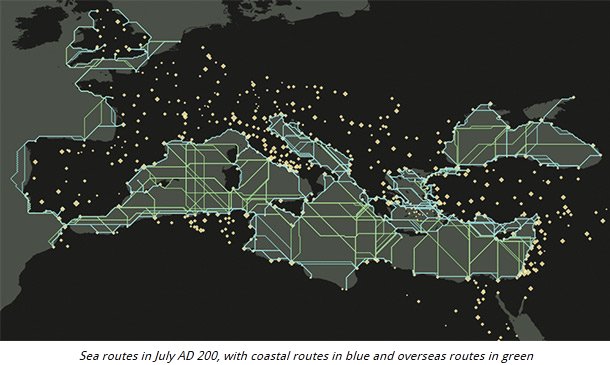
Sea routes in July AD 200

A recently launched online interactive research source, ORBIS, the Stanford Geospatial Network Model of the Roman World, has made it possible to analyse data about the Roman Empire in new ways that reveal the fragility of Roman communication and freight systems. Conventional maps are often unable to capture the environmental constraints that govern the flows of people, goods and information. Museum and ancient sites usually include titbits of information about the wide-ranging origins of artefacts, hinting at the relative cost of goods and labour in the Roman era, but factors such as sailing times and inland routes for freight cannot be precisely revealed through archaeological finds, Roman coins, taxation records or riot reports.

The first resource of its kind, ORBIS offers comprehensive graphic tools to portray the transport and communication infrastructure that underpinned the Roman Empire’s existence. By typing in a starting point, destination, an imagined weight of goods to transport and the time of year, the site shows whether such a movement would have been feasible and at what cost. Studying movement during the course of the empire’s existence suggests it was far more difficult to hold an empire together than to expand one. There are few scenarios where marching and conquering is not easier and less costly than moving goods and slaves between regions. Cost, rather than distance, was the principal determinant of connectivity in the Roman world.

ORBIS is based on a simplified version of the giant network of cities, roads, rivers and sea lanes that framed movement across the Roman Empire. The Stanford team has relied on data such as historical tide and weather information, size and grade of road surfaces and an average walking distance of 30 kilometres per day. Hundreds of cities, ports and routes, vehicle speeds for ships, ox carts and horses, as well as the variable cost of transport have been logged. The data mainly focuses on the period around AD 200, when Septimius Severus expanded control of Africa and Roman power was at one of its peaks.

January 28, 2013

India’s Chinese border to be reinforced

Filed under: China, Economics, India, Military — Tags: , , — Nicholas @ 09:43

Strategy Page on the Indian government’s planned upgrades along the shared border with China:

The Indian Army wants $3.5 billion in order to create three more brigades (two infantry and one armored) to defend the Chinese border. Actually, this new force is in addition to the new mountain corps (of 80,000 troops) nearing approval (at a cost of $11.5 billion). The mountain corps is to be complete in four years. The three proposed brigades would be ready in 4-5 years. By the end of the decade India will have spent nearly five billion dollars on new roads, rail lines and air fields near the 4,057 kilometer long Chinese border.

The Indian Army currently has 37 Divisions including; 4 RAPID (Reorganised Army Plains Infantry Divisions) Action Divisions, 18 Infantry Divisions, 10 Mountain Divisions, 3 Armored Divisions and 2 Artillery Divisions. There are also 12 independent combat brigades (five armor and seven mechanized infantry). Most of the army has been organized and trained to fight the Pakistani army in flat terrain. The Chinese border is largely mountainous.

Three years ago India quietly built and put into service an airfield for transports in the north (Uttarakhand) near their border with China. While the airfield can also be used to bring in urgently needed supplies for local civilians during those months when snow blocks the few roads, it is mainly there for military purposes in case China invades again. Uttarakhand is near Kashmir, and a 38,000 square kilometer chunk of land that China seized after a brief war with India in 1962. This airfield and several similar projects along the Chinese border are all about growing fears of continued Chinese claims on Indian territory. India is alarmed at increasing strident Chinese insistence that is owns northeastern Indian state of Arunachal Pradesh. This has led to an increased movement of Indian military forces to that remote area.

India quickly discovered that a buildup in these remote areas is easier said than done. Moreover, the Indians found that they were far behind Chinese efforts. When they took a closer look three years ago, Indian staff officers discovered that China had improved its road network along most of their 4,000 kilometer common border. Indian military planners calculated that, as a result of this network, Chinese military units could move 400 kilometers a day on hard surfaced roads, while Indian units could only move half as fast, while suffering more vehicle damage because of the many unpaved roads.

November 23, 2012

The bridge that eats trucks

Filed under: Railways, Randomness, USA — Tags: , — Nicholas @ 09:38

It’s a bridge so fearsome that it has its own website for breathtaking footage of trucks coming to grief at 11’8″:

If you’re paying attention this week when you drive that tall truck down South Gregson Street, you’ll get fair warning about the low bridge ahead.

A series of yellow diamond signs, starting a block in advance, will tell you about the 11-foot, 8-inch clearance.

Then the yellow lights will go crazy, the ones with an overhead sign that says: OVERHEIGHT WHEN FLASHING.

You’ll have one last chance to escape disaster. You can turn onto Peabody Street, just before Gregson runs beneath the railroad bridge that carries freight and passenger trains across downtown Durham.

But if you’re not paying attention — you dummy! — you’ll make plenty of noise as you crash into that low bridge. It will peel the roof off your moving van. It will scatter the hay bales or building supplies stacked much too high on your flatbed.

It might leave your box truck wedged beneath the overpass. The tow-truck driver will have to deflate your tires before he can haul your sorry self away.

You can watch a collection of truck decapitation clips here: http://11foot8.com/

October 25, 2012

A contrarian view of the proposed Detroit-Windsor bridge

Filed under: Cancon, Government, Liberty, USA — Tags: , , , , — Nicholas @ 10:02

Terence Corcoran points out that the proposed new bridge connecting Detroit and Windsor is not quite the simple story of Canadian generosity to cash-strapped Michigan:

In this view, Mr. Harper as Captain Canada had vanquished not only the state of Michigan and its governor, Rick Snyder. He had also declared war on the real battle target, the private corporation that controls the other Detroit-to-Windsor crossing, the Ambassador Bridge owned and controlled by the Moroun family, headed by 83-year-old billionaire Manuel Moroun.

Mr. Moroun, whose family has owned the bridge since the late 1970s — maintaining it and collecting all tolls — is portrayed as an influence-buying Tea Party capitalist who seeks tax breaks to prosper, a monopolist who wants to keep out competition, a symbol of all that is wrong with America’s special-interest dominated governments. Mr. Harper and Canada stand as principled, influence-free promoters of international trade, commerce and the public good.

It takes a lot of ideological twisting to reach that conclusion, especially for Conservatives who portray Mr. Harper as the economic good guy — despite all evidence to the contrary that Mr. Harper is the heavy-handed statist attempting to cripple a private entrepreneur. What Mr. Harper is really doing is using government power to do what Canadian governments have wanted to do for at least five decades: thwart the private ownership — and if possible take control — of the Ambassador Bridge.

[. . .]

So Mr. Harper, by moving in to fund a competing bridge using taxpayers’ dollars, is re-enacting the Trudeau policy, using more direct methods. Ottawa will pay to build a second bridge, potentially driving the Moroun family out of business.

Being a billionaire, Manuel Moroun isn’t a sympathetic figure. He is described, among other things, as being a fake capitalist, a rent-seeking monopolist who does not want to face competition. It’s a charge that belittles Mr. Moroun and elevates the dubious intentions of the government. When a foreign national government shows up on your door, with the support of the governor of your state and likely the president of the United States, to announce that “We’re from the government and were here to compete with you,” Mr. Moroun has good reason to run to the courts and the political process.

For doing so, Mr. Moroun has been described as litigious, a wealthy manipulator and a purchaser of political favours. When it comes to manipulation, however, it’s hard to beat Ottawa and the massed forces of special-interest industries, unions and government bureaucrats who have joined to promote and build a new bridge at government expense.

October 24, 2012

Persuading Michigan voters to refuse a new free bridge to Canada

Filed under: Cancon, Politics, USA — Tags: , , , , , , , — Nicholas @ 10:05

The announcement back in June must have appeared too good to be true: a new bridge between Detroit, Michigan and Windsor, Ontario to be completely funded by Canada. Michigan voters are being urged to refuse the deal:

Canada, understand, has agreed to pay for the bridge in full, including liabilities — and potential cost overruns — under an agreement that was about a decade-in-the-making and officially announced to much fanfare, at least on the Canadian side of the border, by Prime Minister Stephen Harper and Michigan Governor Rick Snyder in Windsor/Detroit in mid-June.

For Michigan, it is a slam-dunk arrangement. As Mr. Norton told one audience: ‘‘If this proves to be a dumb financial decision, it’s on us, not on you.’’

It’s a free bridge, a vital new piece of publicly owned infrastructure — for both countries — and yet one that is in grave danger of being demolished before construction even begins when Michigan voters head to the polls for a ballot initiative attached to the Nov. 6 elections.

[. . .]

Manuel (Matty) Moroun, an 85-year-old self-made billionaire who owns the 83-year-old Ambassador Bridge, is Cynic-in-Chief. The Ambassador is currently the only transport truck-bearing bridge in town. Twenty-five percent of Canadian-American trade, representing about $120-billion, flows across it each year.

It is a perfect monopoly for the Moroun family, a golden goose that just keeps on laying eggs, putting upwards of $80-million a year in tolls, duty free gas and shopping sales in their pockets. Allowing a Canadian-financed competitor into the ring without a fight isn’t an option.

August 13, 2012

Did China peak in 2008?

Walter Russell Mead wonders if the Chinese economy actually hit its peak in 2008 and will not be able to get back to that level of performance:

According to The Diplomat, the long term outlook is even more depressing. China will have to confront a series of structural challenges if it is to continue to achieve the kind of dynamic growth that lifted the country from economic backwater to emerging great power in just three decades.

The most obvious challenge is demographics. A RAND study observed that the proportion of the Chinese population of working age peaked in 2011 and began slowing this year. The share of the elderly population is rising. Healthcare and pension costs will soar as a result. So will labor costs. Investment and savings will diminish. In short, China may face the prospect, unknown in human history, of growing old before it gets rich.

The environment presents another dilemma. Like many rapidly industrializing economies, China sacrificed environmental protection at the altar of economic growth. But the effects of this approach have taken a toll: already, argues The Diplomat, ”Water and air pollution today cause 750,000 premature deaths and around 8 percent of GDP.” And as Via Meadia recently pointed out, the political costs of this approach are starting to mount as well. An outbreak of NIMBYism has forced many local officials to cancel major industrial projects as ordinary Chinese citizens demand an end to environmentally unsound development.

Of greater concern is that China has backed away from market reforms in the last decade and embraced a version of “state capitalism” that emphasizes the state far more than it does capitalism. But as state-run entities have become more powerful, their political backers — and financial beneficiaries — have an even greater stake in blocking attempts at reform.

H/T to Jon, my former virtual landlord, for the link.

August 6, 2012

India’s blackouts are a sign that reform is desperately needed

Filed under: Economics, India — Tags: , , , , — Nicholas @ 10:20

The Economist on the massive blackouts in India recently:

FOR an aspiring economic superpower, there can be few more chastening events than electricity cuts as massive as those that struck northern and eastern India this week. An area (including the capital, Delhi) in which more than 600m people live faced blackouts over two days. Infrastructure, from traffic lights to trains, stopped working. Hospitals, sanitation plants and offices ground to a halt. Airports and factories had to rely on backup generators, often fuelled by truckloads of diesel.

The impact on India’s economy goes far beyond lost output. The blackout will badly damage the country’s reputation, and highlights the rotten infrastructure that is hobbling its efforts to catch up with China.

[. . .]

At one end, not enough cheap coal is being dug up and gasfields are sputtering. At the other, the national transmission grid needs investment. Meanwhile the “last mile” distribution companies, largely state-owned, that buy power and deliver it to homes and firms, are financial zombies. Much of their power is pinched or given away free. Local politicians put pressure on them to keep tariffs low, which leads to huge losses. Squeezed between a shortage of fuel and end-customers who are nearly bust, those private generating firms are now cutting back on vital long-term investment in new plants.

[. . .]

The solution is to cut graft, tackle vested interests and allow markets to work better. The coal monopoly needs to be broken up and local distribution firms privatised. Yet despite the looming crisis, for a decade the government has shirked doing what is clearly necessary, just as it has failed to implement key tax reforms, cut public borrowing or open the retail sector to competition. It has allowed corruption and red tape to damage other vital industries, such as telecoms.

July 13, 2012

The only long-term answer to road congestion: real-time tolls

Filed under: Cancon, Economics, Politics, Technology, USA — Tags: , , — Nicholas @ 00:04

I know, I know … I hate paying road tolls as much as the next driver. But the current road pricing scheme is broken and getting broken-er. Andrew Coyne points out the unpleasant realities:

… the demand for road use — traffic — is not a fixed quantity. Like anything else, it fluctuates with the price. And the price to use the roads, under present policies, is denominated in time: that is, by how long people are prepared to stew in traffic. This is, when you think about it, perverse. The people who get first claim on the roads are the ones who put the lowest value on their time. Or in other words, the people who need them the least.

That’s why analysts have long recommended pricing roads in more conventional terms, i.e. dollars and cents. But there are lots of ways of getting even this wrong, so we need to eliminate a couple more alternatives, such as:

More taxes. Many people’s first response to the notion of pricing roads is to say “but I already pay a gas tax.” The more knowledgeable will point to statistics showing that revenues from gas taxes more than pay for the cost of building and maintaining the roads.

But these are far from the only costs at issue, or even the most important. As far as congestion is concerned the cost that matters is not the cost of building the road, but the cost of using it. Every time you use the road, you impose a cost on other drivers, so far as you make the roads that much more crowded — as they, of course, do you. Add up those costs over millions of drivers every day — costs measured not only in delays, but in more collisions, more wear and tear, more pollution, and so on — and we are well into the billions, according to several estimates.

[. . .]

What’s really needed, then, is a more comprehensive approach. With modern technology, there’s no reason to toll only some roads and not others. Using GPS-style in-car transponders and satellites, it’s now possible to charge drivers to use the roads generally, with the highest charges applying in downtown centres and at rush-hour — just as you pay a higher charge to use your cellphone depending on the location and time of day. You’d even get a monthly bill in the mail.

Far-fetched? Britain and the Netherlands have each been on the verge of adopting similar schemes in recent years. That each backed down in the end tells you something of the political sensitivities involved: It’s always hard to get people to pay for things they are used to getting for free. But the roads aren’t free. We’re paying more and more to use them every year.

Pay in congestion, in time and noise and aggravation — or pay by credit card. Once you think of it that way, the choice should be easy.

« Newer PostsOlder Posts »

Powered by WordPress