
World War Two
Published 1 Apr 2023As the Allies prepare to close in on Germany from all fronts, a shake up of the German military leadership can only achieve so much…
(more…)
April 3, 2023
Goodbye Manstein… Hello Model – WW2 – Week 240 – April 1, 1944
Comments Off on Goodbye Manstein… Hello Model – WW2 – Week 240 – April 1, 1944
March 27, 2023
Frommer Pistolen-MG Model 1917: A Crazy Villar Perosa Copy
Forgotten Weapons
Published 23 Nov 2022After encountering Italian Villar Perosa machine pistols in the field, Austro-Hungarian troops requested a similar weapon. The project was given to FÉG to work on, and the result was the Pistolen-MG Model 1917: a pair of Frommer Stop pistols with long barrels and 25-round magazines, redesigned to fire from the open bolt, mounted to an adorably tiny tripod and spade grips.
Only a few dozen of these were made for testing, and they were not accepted for military service. Many thanks to Joschi Schuy for giving me access to film that fantastic surviving example for you!
(more…)
Comments Off on Frommer Pistolen-MG Model 1917: A Crazy Villar Perosa Copy
March 26, 2023
Germany Invades Hungary – WW2 – Week 239 – March 25, 1944
World War Two
Published 25 Mar 2023Germany occupies Hungary this week to prevent any possible Hungarian defection from the war, the Soviets continue pushing back the Axis in Ukraine, pressing them ever more toward Romania, the Japanese advance on Imphal and Kohima continues, but Allied attacks in Italy and Japanese ones on Bougainville come to their ends.
(more…)
Comments Off on Germany Invades Hungary – WW2 – Week 239 – March 25, 1944
March 19, 2023
The Japanese Invade India! – WW2 – Week 238 – March 18, 1944
World War Two
Published 18 Mar 2023Operation U-Go, Renya Mutaguchi’s invasion of India, is in full swing this week, as his men aim at Imphal and Kohima; three Soviets Fronts batter their way through the Axis positions all over Ukraine; and there is a huge Allied bombing campaign at Cassino in Italy, which mistakenly kills a lot of Allied soldiers. That’s one busy week.
(more…)
Comments Off on The Japanese Invade India! – WW2 – Week 238 – March 18, 1944
March 5, 2023
MacArthur and Nimitz Go Head-to-Head – Week 236 – March 4, 1944
World War Two
Published 4 Mar 2023The American attacks against the Admiralty Islands are successful, but this causes real tensions between commanders Douglas MacArthur and Chester Nimitz. Much of this week is taken up by planning and meetings on both sides — Adolf Hitler plans the occupation of Hungary, Josef Stalin plans new offensives in Ukraine, and the Allies plan to reconfigure their whole front in Italy. It’s all the prelude to an explosion of action.
(more…)
Comments Off on MacArthur and Nimitz Go Head-to-Head – Week 236 – March 4, 1944
March 3, 2023
African Opinion in the War, Minor Axis Partners, and Foreign Ships in the British Navy – OOTF 30
World War Two
Published 2 Mar 2023How did the British manage their multinational Merchant Navy who are the non-American operators of Liberty ships? How did Kenyans, South Africans, and others from Britain’s Sub-Saharan empire view the war? And what is going on in Slovakia and Hungary right now? Find out in this episode of Out of the Foxholes.
(more…)
Comments Off on African Opinion in the War, Minor Axis Partners, and Foreign Ships in the British Navy – OOTF 30
July 18, 2022
John von Neumann, The Man From The Future
One of the readers of Scott Alexander’s Astral Codex Ten has contributed a review of The Man From The Future: The Visionary Life of John von Neumann by Ananyo Bhattacharya. This is one of perhaps a dozen or so anonymous reviews that Scott publishes every year with the readers voting for the best review and the names of the contributors withheld until after the voting is finished:
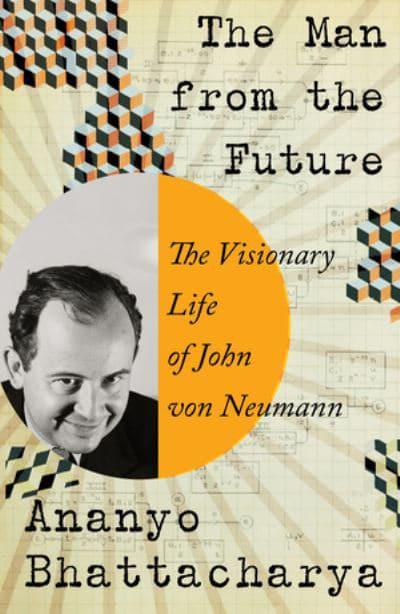
John von Neumann invented the digital computer. The fields of game theory and cellular automata. Important pieces of modern economics, set theory, and particle physics. A substantial part of the technology behind the atom and hydrogen bombs. Several whole fields of mathematics I hadn’t previously heard of, like “operator algebras”, “continuous geometry”, and “ergodic theory”.
The Man From The Future, by Ananyo Bhattacharya, touches on all these things. But you don’t read a von Neumann biography to learn more about the invention of ergodic theory. You read it to gawk at an extreme human specimen, maybe the smartest man who ever lived.
By age 6, he could multiply eight-digit numbers in his head. At the same age, he spoke conversational ancient Greek; later, he would add Latin, French, German, English, and Yiddish (sometimes joked about also speaking Spanish, but he would just put “el” before English words and add -o to the end). Rumor had it he memorized everything he ever read. A fellow mathematician once tried to test this by asking him to recite Tale Of Two Cities, and reported that “he immediately began to recite the first chapter and continued until asked to stop after about ten or fifteen minutes”.
A group of scientists encountered a problem that the computers of the day couldn’t handle, and asked von Neumann for advice on designing a new generation of computers that was up to the task. But:
When the presentation was completed, he scribbled on a pad, stared so blankly that a RAND scientist later said he looked as if “his mind had slipped his face out of gear”, then said “Gentlemen, you do not need the computer. I have the answer.” While the scientists sat in stunned silence, Von Neumann reeled off the various steps which would provide the solution to the problem.
Do these sound a little too much like urban legends? The Tale Of Two Cities story comes straight from the mathematician involved — von Neumann’s friend Herman Goldstine, writing about his experience in The Computer From Pascal to von Neumann. The computer anecdote is of less certain provenance, quoted without attribution in a 1957 obituary in Life. But this is part of the fun of reading von Neumann biographies: figuring out what one can or can’t believe about a figure of such mythic proportions.
This is not really what Bhattacharya is here for. He does not entirely resist gawking. But he is at least as interested in giving us a tour of early 20th century mathematics, framed by the life of its most brilliant practitioner. The book devotes more pages to set theory than to von Neumann’s childhood, and spends more time on von Neumann’s formalization of quantum mechanics than on his first marriage (to be fair, so did von Neumann — hence the divorce).
Still, for those of us who never made their high school math tutors cry with joy at ever having met them (another von Neumann story, this one well-attested), the man himself is more of a draw than his ergodic theory. And there’s enough in The Man From The Future — and in some of the few hundred references it cites — to start to get a coherent picture.
Comments Off on John von Neumann, The Man From The Future
April 7, 2022
The EU only cares about democracy as long as the voters make the “correct” choice
In Spiked, Tom Slater points out the most recent proof that the EU’s principled defence of democracy fades out quickly when the voters don’t vote the way they’re “supposed to”:
Remember the other day when the European Union was pretending to care about sovereignty and democracy? When Russia’s imperialist invasion of Ukraine had supposedly united European elites in their staunch, unflinching belief in a people’s right to determine their own destiny and shape their nation? You’ll be shocked to learn that they didn’t really mean it, at least if their reaction to the Hungarian election is anything to go by.
On Sunday, Viktor Orbán and his ruling Fidesz party won a landslide victory. Already the longest-serving EU leader, Orbán is now heading into a fourth consecutive term, with a two-thirds majority in parliament and an increased mandate. United for Hungary – an opposition coalition stretching from ex-communists to ex-fascists – defied the raised expectations of Euro elites and put in a dreadful showing, capped by gaffe-prone leader Péter Márki-Zay failing to win his own constituency race.
In the election, Orbán presented himself as a doughty defender of Hungarian national identity and interests against a meddlesome European Union and international set. Budapest and Brussels have been locked in a years-long battle over alleged “rule of law” breaches and LGBT rights. The EU is currently withholding €7 billion of coronavirus recovery funds from Hungary as part of a bitter legal standoff. In this, Márki-Zay was an all-too-willing foil, arguing that his government would be a “grand prize” for the EU.
In February, the European Court of Justice rejected a challenge by Hungary and Poland, upholding the legality of withholding funds from member states if they fail to adhere to “core values”. It sent a clear message to the Hungarian electorate in the run-up to the election: reject – or at least humble – this troublesome government or else. Now that Hungarians have politely refused to be pushed around, the European Commission has said it will press ahead with the formal mechanism that will deprive Hungary of the funds indefinitely.
Meanwhile, the European liberal media took a break from piously intoning about the defence of democracy in Ukraine to decry the election result in Hungary. Timothy Garton Ash even linked the ballot-box revolt to the barbarism in Bucha. “The Ukrainian horrors are clearly far worse than the Hungarian miseries, but the two are fatefully connected”, he wrote in the Guardian, accusing Orbán of being a Putin stooge. “Europe should now get tough on both the Russian enemy without and the Hungarian enemy within.” A Guardian editorial similarly called for swift EU action against this pesky central European state.
Comments Off on The EU only cares about democracy as long as the voters make the “correct” choice
January 16, 2022
Food for Leningrad, Breaking the Siege! – WW2 – 177- January 15th, 1943
World War Two
Published 15 Jan 2022Soviet attacks are launched this week to destroy the Hungarians, all while the German desperation at Stalingrad and Velikie Luki continues, but in the far north the Soviets have broken through the siege of Leningrad after 16 months. And the Casablanca Conference begins, a meeting to guide the war’s future progress.
(more…)
Comments Off on Food for Leningrad, Breaking the Siege! – WW2 – 177- January 15th, 1943
November 12, 2021
More on the populist success of Hungary’s Victor Orbán
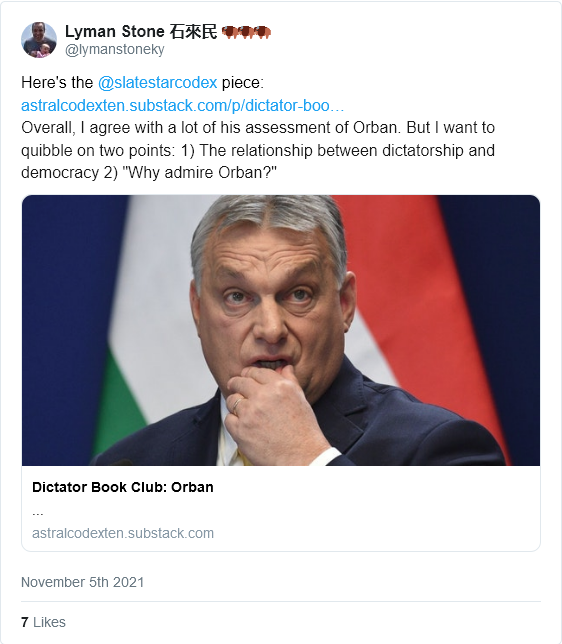
Last week, Scott Alexander looked at a couple of recent biographies of Hungarian politician Victor Orban (linked here). He got some quite interesting responses from his readers, including a long Twitter thread from Lyman Stone, which he’s converted into plain text for ease of reading:
I won’t make you read it all in tweet format. He continues:
1) Dictatorship and democracy. The arguments about Orban cheating in elections might be totally true. I dunno. But that’s sort of irrelevant. Neutral opinion polls nobody disputes show he would have gotten 2/3 under almost any system.
His crude poll share was about 60% before the 2010 election, but given the threshold effects, he’d likely have ended up at a supermajority under almost any system. And as @slatestarcodex [says], a lot of the initiatives that the EU most despises under Orban are initiatives that *everyone agrees* have supermajority public support among Hungarian voters.
Moreover, I agree with @slatestarcodex that if public opinion turned in Hungary, Orban would probably turn on a dime too. The dude loves power. But that should inform our read of what’s going on in Hungary. *Hungarians wanted* a right-nationalist authoritarian leader, *and so they voted for one*, and the electorate has *wanted* recurrent intensifications of that regime. So is it a dictatorship? Or is it a democracy?
This gets at the problem with “democracy” as a concept. Hungary is undeniably Democratic: there is widespread public support for the regime, which is selected by elections, the results of which are a decent approximation of trustworthy and neutral opinion polls. But I think it’s still possibly reasonable to call Orban a dictator. He wields enormous *personal* power, there are few checks on his power, and he uses power to create a *personal* clique of supporters to perpetuate that power and enfeeble the competition.
But this is the point: Democracy and dictatorship aren’t opposites. In fact, they are natural companions! So much so that before the 20th century, “democracy” was often used *literally as a synonym* for “authoritarian and demagogic rule”! Orban is a great example of why the word “democracy” came into ill repute in the past: because it was widely understood that “the people” (often pejoratively “the mob”) will often vote for a strongman to stomp his boot on the face of disliked others. That’s not so much a disagreement with @slatestarcodex as just a comment where I think the modern western liberal mindset obscures understanding the phenomenon of populist leadership.
2) Why admire Orban? Here I think @slatestarcodex misses some important stuff, perhaps because his biographies miss it. Yes, Orban was incompetent in the 90s. So were MOST immediate post-Soviet leaders! And while Orban may have been corrupt, you can compare the personal wealth of the Fidesz clique to the cliques that looted Russia or Ukraine and realize that Hungary got a better class of corrupt leaders than much of eastern Europe. Moreover, Hungary actually had competitive elections with changes of power and leaders who *respected* those results! Maybe they were dirty but, like, it happened! This wasn’t universally true!
So why might Hungarians admire a dissident-cum-parliamentarian who competed for their votes and when defeated responded democratically by adapting to try to win the next election? Because … duh?
But it’s not just that. The big factor that’s absent in all these culturalist accounts of Hungarian politics is … the economy. Hungary went from below-average unemployment rate for its region under Orban 1 to way above-average under the socialists to again below-average under Orban 2.
This is extremely important. A part of Orban’s appeal is that, whether by coincidence or art, he has managed to preside over periods where Hungary’s economic performance was better than a lot of its neighbors, and often fairly obviously so. That is, supporting irredentist nationalism in the form of Orban hasn’t imposed costs on Hungarians: they aren’t like facing sanctions or something or enduring deep economic hardship to stand by their dictator. He’s delivered (comparatively) good times!
So when you have a leader who 1) seems marginally-less-corrupt than regional peers, 2) delivers marginally-better-results than regional peers, and 3) adopts policies that are widely popular … that leader will be popular! Duh!
Update: Fixed broken link.
Comments Off on More on the populist success of Hungary’s Victor Orbán
November 6, 2021
Choose your college roommates well
Scott Alexander on the unlikely rise of Victor Orbán:
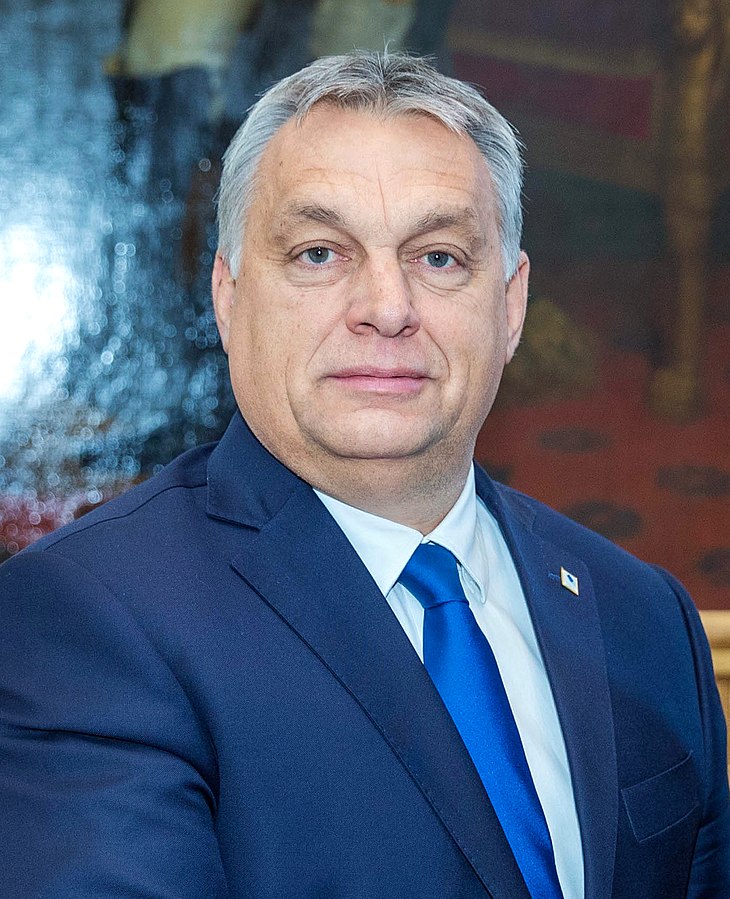
Viktor Orbán at the European People’s Party Summit in Brussels, December 2018.
Wikimedia Commons.
Some are born great. Some achieve greatness. And some are Victor Orbán’s college roommates.
Orbán: Europe’s New Strongman and Orbánland, my two sources for this installment of our Dictator Book Club, tell the story of a man who spent the last eleven years taking over Hungary and distributing it to guys he knew in college. Janos Ader, President of Hungary. Laszlo Kover, Speaker of the National Assembly. Joszef Szajer, drafter of the Hungarian constitution. All of them have something in common: they were Viktor Orbán’s college chums. Gabor Fodor, former Minister of Education, and Lajos Simicska, former media baron, were both literally his roommates. The rank order of how rich and powerful you are in today’s Hungary, and the rank order of how close you sat to Viktor Orbán in the cafeteria of Istvan Bibo College, are more similar than anyone has a right to expect.
Our story begins on March 30 1988, when young Viktor Orbán founded an extra-curricular society at his college called The Alliance Of Young Democrats (Hungarian abbreviation: FiDeSz). Thirty-seven students met in a college common room and agreed to start a youth organization. Orbán’s two roommates were there, along with a couple of other guys they knew. Orbán gave the pitch: the Soviet Union was crumbling. A potential post-Soviet Hungary would need fresh blood, new politicians who could navigate the democratic environment. They could get in on the ground floor.
It must have seemed kind of far-fetched. Orbán was a hick from the very furthest reaches of Hicksville, the “tiny, wretched village of Alcsutdoboz”. He grew up so poor that he would later describe “what an unforgettable experience it had been for him as a fifteen-year-old to use a bathroom for the first time, and to have warm water simply by turning on a tap”. He was neither exceptionally bright nor exceptionally charismatic.
Still, there was something about him. To call it “a competitive streak” would be an understatement. He loved fighting. The dirtier, the better. He had been kicked out of school after school for violent behavior as a child. As a teen, he’d gone into football, and despite having little natural talent he’d worked his way up to the semi-professional leagues through sheer practice and determination. During his mandatory military service, he’d beaten up one of his commanding officers. Throughout his life, people would keep underestimating how long, how dirty, and how intensely he was willing to fight for something he wanted. In the proverb “never mud-wrestle a pig, you’ll both get dirty but the pig will like it”, the pig is Viktor Orbán.
Those thirty-six college friends must have seen something in him. They gave him his loyalty, and he gave them their marching orders. The predicted Soviet collapse arrived faster than anybody expected, and after some really fast networking (“did you know I represent the youth, who are the future of this country?”) Orban got invited to give a speech at a big ceremony marking the successful revolution, and he knocked it out of the park.
He spoke about freedom, and democracy, and the popular will. He spoke against the older generation, and the need for a rupture with the crumbling traditions of the past. And also, he spoke against the Russian troops remaining in the country — the only speaker brave enough to say what everyone else was thinking. The voters liked what they heard: in Hungary’s first free election, he and several of his college friends were elected to Parliament on the Fidesz ticket.
Unfortunately, he wasn’t a very good liberal MP.
Separated from his pomp and platform, he was just a 27 year old kid without a lot of political experience. There was a glut of liberal democrats in Hungary — the country had just had a successful liberal democratic revolution — and Orbán and Fidesz couldn’t differentiate themselves from the rest of the market. Most liberal democrats wanted cosmopolitan intellectual types; Orbán — despite his herculean efforts to lose the accent and develop some class — was still just a hick from Hicksville. During the next election, Fidesz did embarrassingly badly.
So Viktor Orbán got everyone from his liberal democratic party together and asked — what if, instead of being liberal democrats, we were all far-right nationalists?
Wait, what?
Comments Off on Choose your college roommates well
August 25, 2021
July 26, 2021
Eastern Front Deployments, July 1942 – WW2 Special
World War Two
Published 25 Jul 2021It is what it says it is, the front line deployments of the Axis and Soviet forces in the Southern Part of the Eastern Front in late July 1942. Hitler’s forces invading, and Josef Stalin’s on defense.
(more…)
Comments Off on Eastern Front Deployments, July 1942 – WW2 Special
April 15, 2021
Eichmann in Budapest
Alexander Faludy outlines the horrific “success” of Adolf Eichmann’s activities in Hungary in 1944:
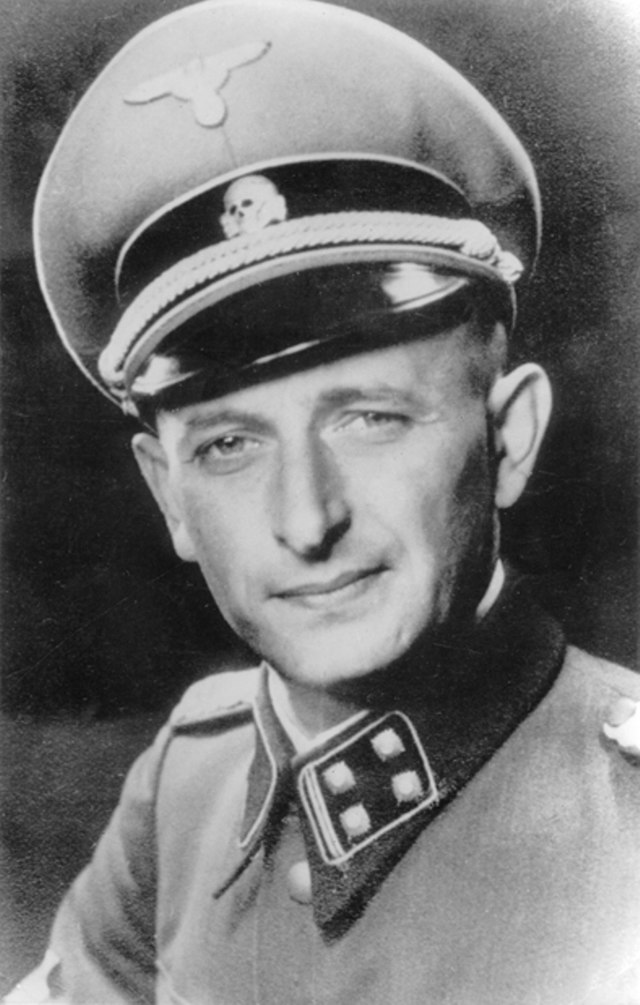
SS-Obersturmbannführer Adolf Eichmann (1906–1962), head of Reichssicherheitshauptamt (RSHA, Reich Security Central Office) Department IV B4 (Jewish affairs), who organized the deportation of Jews to the Auschwitz concentration camp in German-occupied Poland during the Holocaust. Taken in or around 1942, this appears to have been Eichmann’s official RSHA ID photograph.
Photographer unknown, public domain image via Wikimedia Commons.
SS Obersturmbannführer (Lt. Col.) Adolf Eichmann, head of Reich Security Main Office IV.B.4 (Jewish Affairs), arrived at Budapest’s Keleti railway station together with 19 subordinates on 21 March 1944. Just 48 hours had passed since German troops had marched into the country, and a car was waiting to take Eichmann to the city’s Astoria Hotel close to the Pest riverbank. From these incongruously elegant surroundings Eichmann would commence the most feverous episode in the Final Solution of the Jewish question in Europe: the destruction of the Jews of Hungary, the only chapter in its history he was to supervise in person and in full.
For speed and scale the deportations went unmatched: 424,000 people were despatched by train in just 52 days, from 14 May to 9 July. In this fleeting window Hungarian Jews became the single largest group gassed at Auschwitz. The crematoria couldn’t cope with such “over-supply”, and Commandant Rudolf Höß ordered special fire pits dug — filling the camp with noxious smoke. According to Primo Levi, “there were weeks when only Hungarian was heard in Auschwitz”.
Physical annihilation was undergirded by Eichmann’s elaborate psychological strategy. Sophisticated Budapest Jews who might escape or resist were pacified by newspaper reports that only “ost Juden” from Hungary’s nether regions were being removed as “undesirables”. Many only saw through the lie, if at all, when deportations reached Budapest’s outer suburbs in early July — just before Admiral Miklós Horthy, Hungary’s Head of State, halted them under diplomatic pressure from the Western Allies and neutrals.
Throughout the deportations, and across Hungary’s length, Eichmann deluged Jews with ever more complex regulations covering the minutiae of daily life. These instilled a false sense of permanence which inhibited hiding or escape: “why would the authorities go to all this trouble if they were just going to get rid of us?”
Even as deportations rolled on, Eichmann conducted elaborate negotiations for fanciful “rescue schemes” including, but not limited to, the infamous “Blood for Trucks” project involving Rudolf Kastner — the proposed barter of one million Jewish lives for 10,000 Western motor vehicles for use on the Eastern front against the USSR. The aim, Eichmann later acknowledged, was not just to split Western powers from the Soviets, but also to distract Hungary’s Jewish leaders from counter-organising: keeping minds busy and hopes alive.
All the while Eichmann treated Jewish leaders in Budapest to flashes of menace. One day he promised them a return to normality “after the war”, the next he would snarl “Do you know who I am? I am a bloodhound!” With studied cruelty Eichmann arranged the ghettoisation of Hungary’s Jews to begin on Sunday, 16 April: the first day of Passover, 1944.
Eichmann did many things in Hungary; the one thing he did not do was simply “obey orders” — indeed over time he defied them with gathering frequency. That autumn as inevitable defeat became ever more apparent Eichmann, helped by local enthusiasts, intensified his efforts, instigating newly inventive means of eliminating Jews in Hungary and the Balkans through “death marches” and localised killing sprees. In doing so, Eichmann subverted instructions from Himmler who ordered cessation as part of a delusional plan to negotiate with the allies.
This “Eichmann in Budapest” should be recalled while contemplating the later Eichmann in Jerusalem.
Comments Off on Eichmann in Budapest
October 8, 2020
DicKtionary – K is for Killer – Elizabeth Báthory
TimeGhost History
Published 7 Oct 2020Elizabeth Bathory was a Hungarian noblewoman who holds the world record as the most prolific female murderer. This is her gruesome life story.
Join us on Patreon: https://www.patreon.com/TimeGhostHistory
Hosted & Written by Indy Neidell
Director: Astrid Deinhard
Producers: Astrid Deinhard and Spartacus Olsson
Executive Producers: Astrid Deinhard, Indy Neidell, Spartacus Olsson, Bodo Rittenauer
Creative Producer: Joram Appel
Post-Production Director: Wieke Kapteijns
Research by: Indy Neidell
Image Research by Karolina Dołęga
Edited by: Karolina Dołęga
Sound design: Marek KamińskiVisual Sources:
– Wellcome Images
– Paul K from Flickr https://cutt.ly/Paul_K_Flickr
– Andreone93 from Wikimedia https://cutt.ly/Andreone93_Bathory
– Cleveland Museum of Art
– Metropolitan Museum of Art
– Lluís Ribes Mateu from Flickr https://www.flickr.com/photos/lluisri…
– Yvette Hoitink from Flickr https://www.flickr.com/photos/yhoitink/
– Civertan from Wikimedia https://cutt.ly/Civertan
– Jean Louis Mazieres https://www.flickr.com/photos/mazanto/
– Icons from The Noun Project: anti trust by Angelo Troiano, Castle by Vicons Design, Waiter by ProSymbols, Nun by Wolf Böse, Priest by Luis Prado, reject by Alice Design, User by Round Pixel, Zoo by Eugene Dobrik, User by Round Pixel.“The Wedding March” – Traditional
“Stranger Days” – Alexandra Woodward
“Rise Of The Titan” – FormantXArchive by Screenocean/Reuters https://www.screenocean.com.
A TimeGhost chronological documentary produced by OnLion Entertainment GmbH.
Comments Off on DicKtionary – K is for Killer – Elizabeth Báthory


