Forgotten Weapons
Published 10 Aug 2016Sold for $6,900.
The story of the development of the Barrett M82 .50 BMG semiauto rifle is really a neat story — much more interesting than most people probably expect, and reminiscent of many firearms development stories of the 1800s. Ronnie Barrett was working as a photographer in the late 70s, and became interested (perhaps obsessed?) with the idea of a semiauto .50 caliber rifle after a photo session with a Vietnam War jungle patrol boat (which was armed with a pair of M2 .50 caliber machine guns). At the time, the only civilian options for the .50 BMG cartridge were conversions of WWII antitank rifles like the Boys and PTRD.
Barrett, with basically no formal engineering background, sketched up a design and approached some machine shops for advice and assistance. He started working in his garage, and after a couple years had a functioning prototype completed. He sold the rifles commercially at gun shows and through publications like Shotgun News until making his first military sale in 1989, to the Swedish government. The following year he received an order from the US military, and sales took off from there.
Contrary to common expectation, the Barrett M82A1 is not really a “sniper” rifle — as a semiautomatic design with a recoil-operated action it’s potential accuracy is much less than that of a bolt action precision rifle — and this is amplified by the lack of a precision .50 BMG cartridge in US military service. In practice, the M82A1 will shoot about 3 MOA with normal ball ammunition, and about 1.5-2 MOA with good handloads. It is used primarily as an EOD rifle to detonate heavy-walled unexploded shells at a safe distance, and as an anti-material rifle to attack light vehicles and infrastructure at a long distance. These are relatively large targets, which require the large payload of a .50 BMG projectile but not the extreme accuracy of a true “sniper’s” rifle.
September 29, 2020
Light Fifty: the Barrett M82A1
September 26, 2020
Perdition to Conspirators! Magnificent 14-Barrel Flintlock
Forgotten Weapons
Published 29 May 2020http://www.patreon.com/ForgottenWeapons
https://www.floatplane.com/channel/Fo…
Cool Forgotten Weapons merch! http://shop.bbtv.com/collections/forg…
Colonel Thomas Thornton was a wealthy and somewhat flamboyant character in England in the late 18th and early 19th century. He commanded a militia unit with which he had some disagreement, and which mutinied against his comment at Roborough Camp in 1795. Some years later, he commissioned this quite unique firearm from Dupe & Company of London.
The gun is a single stock with two flintlock actions, two triggers, and two clusters of seven .30 caliber rifled barrels each. Each trigger fires a complete barrel cluster simultaneously. In addition to the firepower of this very remarkable weapon, he also had it finished in a truly magnificent fashion, including the fantastic line “PERDITION TO CONSPIRATORS” on ons of the barrel clusters — clearly he harbored some resentment towards his unruly militia subordinates even years later.
In addition, he had a second stock made to fit just one lock plate and barrel cluster, for when 14 barrels might be a bit of overkill. That stock is even more decorated that the first, with beautiful wooden relief carvings and the motto “A Verite Gagner“, meaning something to the effect of “Truth From Victory”.
This gun is part of the Liege arms museum’s display of civilian arms, and I’d like to thank them for taking it out of their display so I could show it to you! If you are in Liege, stop in and see the museum:
Contact:
Forgotten Weapons
6281 N. Oracle #36270
Tucson, AZ 85740
September 22, 2020
An idea for the blighted 21st century — Radio Free Earth and an updated “Liberator” pistol
In the most recent edition of the Libertarian Enterprise, L. Neil Smith considers a couple of ways to help oppressed peoples all around the world:

An example of the original Liberator pistol from WW2.
Screen capture from a Forgotten Weapons video.
The first is an idea that I originally read about in the 1950s in a short story by Arthur C. Clarke, author of 2001: A Space Odyssey. There’s a satisfying irony about using it against the Chinese communists,since Clarke himself was an ardent collectivist (among other nasty things) and wrote about it as a way that communists might bring Western Civilization to its knees. Building on Clarke’s original concept, imagine a tiny radio receiver, tuned only to a single frequency, with no moving parts, small enough to fit almost entirely into the human ear, and with the right coloration to be virtually invisible.
Now imagine a geostationary satellite standing 22,300 miles in space over China. The basic idea is like Radio Free Europe, but with significant differences. Instead of dull propaganda (I listened to some of those RFE and Voice of America broadcasts), there would be readings by celebrities like James Earl Jones and Dennis Haysbert from the works of Thomas Paine, Thomas Jefferson, George Mason, and other Founding Fathers. Nineteenth century thinkers like Herbert Spencer, Auberon Herbert, Lysander Spooner, and Benjamin Tucker would be featured, as well, along with H.L Mencken, Ludwig von Mises, Rose Wilder Lane, Ayn Rand, Friedrich Hayeck, and Milton Friedman from the twentieth century.
Very importantly, these lessons in liberty would be interspersed by good, old-fashioned action-adventure radio drama, featuring the works of individualist scribblers like Robert A. Heinlein, H. Beam Piper, Poul Anderson, and little old me, Underdog. Jammed in there just to keep the comrades listening avidly, there would be what I like to think of as “weaponized pornography”, high-quality dramatic readings of Pauline Reage’s Story of O, among others. If it works in Chinese, it will work in Arabic or Farsi, as well.
The geostationary satellite would beam all these offerings down twenty-four hours a day to the millions of little radios that we have air-dropped or otherwise smuggled to the citizenry. Sailors on their brand-new ships would probably listen in, as well. The Chicoms would try their damnedest to outlaw them and maybe even shoot the satellite down, but 22,300 miles is a long way away, and battle-lasers can defeat missiles laboring at the peak of their climb. Such satellites are relatively cheap and replaceable, especially if they can prevent World War III, and we’d keep sending the Chinese those little radios.
That’s Idea #1. Idea #2 involves a World War II project most gun enthusiasts know about called the “FP-45 Liberator Pistol”. A million of the crude, stamped, single-shot firearms, unrifled and chambered for the .45 automatic pistol cartridge, were manufactured by the Guide Lamp Division of General Motors at a total cost of $2.10 apiece (that’s $31.55 today). The whole package contained a few spare cartridges, a wooden ejection rod, and a comic book illustration showing how to use it: sneak up on a Nazi soldier, blow his brains out, and steal his rifle.
You were supposed to throw the pistol away, but me, I would have kept it. You never know when you might need it. The Liberators are so scarce today that the bidding starts at $600, meaning that there are hundreds of thousands of the ugly little roscoes still tucked away in barns and attics in eastern Europe. Wikipedia, no bastion of liberty, claims that they were all rounded up and destroyed by Allied troops (which probably cost more than the guns did). If true, it means that I was right when I wrote in my first novel, The Probability Broach, that WWII was basically a conflict between competing brands of fascism.
September 21, 2020
The Iconic “Burp Gun” – Shooting the PPSh-41
Forgotten Weapons
Published 16 Dec 2017http://www.patreon.com/ForgottenWeapons
Cool Forgotten Weapons merch! http://shop.bbtv.com/collections/forg…
The Soviet PPSh-41 submachine gun is most distinctive for its very high rate of fire — approximately 1250 rounds/minute — and large drum magazine. What may come as a surprise to those who have not tried it is how this very high rate of fire does not actually make the weapon difficult to control or hold on target. In fact, the PPSh-41 is an easier SMG to shoot effectively than the later PPS-43, at least in my opinion.
The Soviets and the Germans made quite different choices in magazines and rate of fire with the PPSh and the MP40, but both turned out to be very good submachine guns. The glaring weak point of the PPSh are its magazines, and the difficulty in finding a drum that would run reliably in this particular example is why today’s shooting session is done with one of the 35-round stick magazines instead.
Thanks to Marstar for letting me examine and shoot their PPSh-41!
If you enjoy Forgotten Weapons, check out its sister channel, InRangeTV! http://www.youtube.com/InRangeTVShow
September 16, 2020
QotD: Firearms apocrypha
Certain models of Smith & Wesson have bits of apocryphal lore that become permanently entwined with them. You can’t see a top-break .44 Russian without someone telling you that the weird hook on the trigger guard was to parry saber slashes.
People like to repeat the myth that the tiny M-frame .22 “Ladysmith” was discontinued because a puritanical D.B. Wesson heard that it was popular with “ladies of the night”, because that’s sexier than the fact that it was selling poorly, expensive to make, and constantly broke when people ran the then-new .22 Long Rifle cartridges through the fragile little guns.
Similarly, there’s a legend involving Mr. Wesson that’s attached to the final iteration of the .38 Double Action […] In this case, the story goes, D.B. heard the tale of a police officer who, while arresting a miscreant, had the offender reach over and pop the latch on his top-break Smith, dumping the rounds on the ground, like Jet Li with the slide of a movie prop Beretta. The officer, goes the legend as it was told to yours truly, was killed in the ensuing struggle.
Moved by the fate of the dead officer, the apocryphal tale has Mr. Wesson designing the Perfected Model top-break. This model features a Hand-Ejector style cylinder latch that must be operated in conjunction with the more normal “T”-shaped barrel toggle in order to break the revolver open.
This origin myth is almost certainly, to use the technical term, a load of hooey.
Tamara Keel, “Sunday Smith #60: .38 Double Action Perfected Model”, The Arms Room, 2020-06-14.
September 12, 2020
Shooting the ZB-26: A Jewel of an Interwar Light Machine Gun
Forgotten Weapons
Published 27 Oct 2017Sold for $34,500 (transferrable).
Today we have a chance to do some shooting with a ZB-26, a German-occupation 8mm light machine gun made at Brno in Czechoslovakia. The ZB-26 does not get nearly as much attention as LMGs made by the better known powers during the war, but it is an excellent weapon. In addition to being adopted by the Czech military, the gun was sold to about two dozen other countries and used in significant numbers by the Waffen SS.
As one would expect form its reputation, the ZB was smooth, reliable, and very controllable. For all the reasons discussed in yesterday’s history and disassembly video [here], it is a top notch firearm.
http://www.patreon.com/ForgottenWeapons
Cool Forgotten Weapons merch! http://shop.bbtv.com/collections/forg…
If you enjoy Forgotten Weapons, check out its sister channel, InRangeTV! http://www.youtube.com/InRangeTVShow
September 10, 2020
Could a Tankgewehr Really Take Out a British MkIV Tank?
Forgotten Weapons
Published 6 May 2017The Tankgewehr antitank rifle was developed by the Mauser company and adopted by the Imperial German military as an emergency measure to counter the introduction of tanks to the WW1 battlefield. The question is, did they really work? Could a 13.2mm AP bullet from a Tankgewehr really perforate the armor of a British tank? Well today we find out!
The armor on a British tank was steel plate of 6mm, 8mm, and 12mm thickness, through-hardened to Brinell 440-480. We have replicated this with a plate of AR450 (ie, Brinell 450) armor, which we will be shooting at a distance of 50 yards. The ammunition we are using is original 1918 production German AP, and the rifle is a Tankgewehr captured by Allied troops late in the war and brought home as a souvenir.
This video was only made possible with help from three very helpful folks:
MOA Targets provided the steel (and on short notice!): https://www.moatargets.com
Mike Carrick of Arms Heritage Magazine provided use of the T-Gewehr: https://armsheritagemagazine.com
Hayes Otoupalik provided the original ammunition: http://www.hayesotoupalik.com
Cool Forgotten Weapons merchandise! http://shop.bbtv.com/collections/forg…
http://www.patreon.com/ForgottenWeapons
If you enjoy Forgotten Weapons, check out its sister channel, InRangeTV! http://www.youtube.com/InRangeTVShow
September 5, 2020
Chinese 7.62mm Sten Gun
Forgotten Weapons
Published 13 May 2020http://www.patreon.com/ForgottenWeapons
https://www.floatplane.com/channel/Fo…
Cool Forgotten Weapons merch! http://shop.bbtv.com/collections/forg…
During World War Two, Canada supplied some 73,000 Sten guns (made by the Long Branch arsenal) to Chinese Nationalist forces in an effort to help them fight the Japanese. These Stens were standard MkII pattern guns, chambered for the 9x19mm Parabellum cartridge. However, many of these were eventually converted to 7.62mm Tokarev ammunition, especially after the victory of the Communist forces over the Nationalists. The conversion involved a new barrel and new magazine and magazine well. The 7.62mm barrels were typically longer than the original ones, and the magazine of choice was that of the PPS-43. Some were done by installed a magazine adapter into the original magazine well, and some (like this one) were done by cutting off the original magazine well and replacing it with a new one. In addition, some Sten guns were made domestically in China, both in 9mm and 7.62mm. The 7.62mm Tokarev cartridge was popular both from Russian pistols and submachine guns and also from China’s long military use of the dimensionally-identical 7.63mm Mauser cartridge in C96 pistols.
Many thanks to the Royal Armouries for allowing me to film and disassemble this interesting submachine gun! The NFC collection there — perhaps the best military small arms collection in Western Europe — is available by appointment to researchers:
https://royalarmouries.org/research/n…
You can browse the various Armouries collections online here:
https://royalarmouries.org/collection/
Contact:
Forgotten Weapons
6281 N. Oracle #36270
Tucson, AZ 85740

September 2, 2020
Luger Model 1902 Carbine
Forgotten Weapons
Published 2 Sep 2016Failed to sell at auction.
With the advent of successful self-loading pistols, one of the additional markets that many companies tried to appeal to was the compact carbine. Self-loading rifles in proper rifle cartridges would not be developed as quickly as the pistols because their much greater chamber pressures represented a more difficult engineering problem. However by simply attaching a stock and long barrel to a pistol, many ambitious manufacturers hoped to sell a weapon as a sporting carbine. These were done by DWM with the Luger, as well as Mauser’s C96, Mannlicher 1894 pistol, and many others.
Model 1902 was the designation of the major batch of commercially made Luger carbines, although there were several small batches of prototypes prior. Only a couple thousand were made, and they ultimately took quite a long time to all sell — it turned out this type of firearm was simply not very popular for its cost. The same story was true with the other contemporary pistol-carbines — none would be very successful. DWM did make another group of carbines in the 1920s, although those were made from various leftover parts and are both not as nice as the original 1902 guns (which were mostly made in 1904 and 1905) and widely faked.
August 31, 2020
Why was Europe better with guns? – The History of Guns
History Clarified
Published 3 Dec 2018China invented gunpowder (combustible powder), so why was it the European nations that went out and conquered the world using firearms?
This video looks at some geographical factors to examine what allowed Europe to innovate while China and most of the world fell behind with gunpowder weapons.
This focuses heavily on Kenneth Chase’s Book, Firearms: A Global History to 1700. He tries to get away from just looking at drill, organization, and state production of firearms to see how geography helped create the necessary conditions for those other innovations.
Interested in your own copy? Check out the link below:
DISCLAIMER: This video description contains affiliate links, which means that if you click on one of the product links below, I’ll receive a small commission.
The map of Japan is under Creative Commons 4.0.
August 29, 2020
Durs Egg Ferguson – The Rifle That Didn’t Shoot George Washington
Forgotten Weapons
Published 27 Oct 2018http://www.patreon.com/ForgottenWeapons
Cool Forgotten Weapons merch! http://shop.bbtv.com/collections/forg…
Captain Patrick Ferguson was a British officer who designed and patented a breechloading rifle in 1776, which would actually see service in the American Revolution at the Battle of Brandywine. Ferguson presented two rifles to the British military for consideration, one of them being this specific gun. In a shooting demonstration on a windy, rainy day he convinced the Board of Ordnance of the viability of his rifle, and a field trials was set in motion. One hundred Ferguson rifles were made for the Crown, and Ferguson was detached from his regiment to be given command of a company of specially trained elite riflemen. His men were drilled in accurate shooting as well as use of the bayonet, they were organized in small groups to make use of cover and concealment, and they were fitted with green uniforms to blend into the terrain. This unit deployed to the American colonies in 1777, and saw action in the Battle of Brandywine.
Unfortunately for Ferguson and his ideas, the unit didn’t make any particularly notable impact on the battle, although not by any fault of their own. Worse, Ferguson was wounded, and because the unit was so heavily dependent on him it was disbanded while he recuperated. He did see service again at the Battle of King’s Mountain, where he was killed in action. This particular Ferguson rifle was made by the noted London gunsmith Durs Egg, and is one of the two guns presented to the Board of Ordnance that began the whole series of events.
Contact:
Forgotten Weapons
PO Box 87647
Tucson, AZ 85754If you enjoy Forgotten Weapons, check out its sister channel, InRangeTV! http://www.youtube.com/InRangeTVShow
August 26, 2020
London-Made Lorenzonis Repeating Flintlocks
Forgotten Weapons
Published 26 Aug 2016Sold for $28,750 (for the pair).
A 7-shot repeating handgun before cartridges had been invented? Yep, long before. These two pistols are London-made examples of the Lorenzoni system, in which a gun was made with internal magazines of powder and projectiles and a rotating central loading spindle like a modern reloading powder throw. By rotating a lever on the left side of pistol 180 degrees and back, a shooter could load a ball into the chamber, load powder behind it, recock the action, prime the pan, and close the frizzen all in one automated sequence.
This system originated with a German gunsmith named Kalthoff in the mid 1600s, but it was an Italian by the name of Lorenzoni who made it more practical and began building pistols of the type. Lorenzoni is the name that has been generally applied to the system as a result. These two were made by a gunsmith named Glass in London in the mid 1700s — in those days of hand-made firearms, ideas and systems like this would slowly spread and be adopted by craftsmen who were capable of producing them and thought they could find an interested market for them.
The Lorenzoni system offered unmatched repeating firepower for its time, but was hampered by its complexity. Only a very skilled gunsmith could build a reliable and safe pistol of the type, and this made them very expensive.
August 24, 2020
Why the British Army was so effective in 1914 – Learning lessons from the Boer War
History West Midlands
Published 10 Oct 2014When Britain despatched an Expeditionary Force (the BEF) to the Continent in August 1914, the German Kaiser issued an order of the day to his generals to “walk over General French’s contemptible little army”.
But despite being heavily outnumbered, this small force, including many men from the West Midlands, played a vital role in stopping the seemingly overwhelming German advance across Belgium and into France.
Small in size compared with the much larger armies of France and Germany, the BEF was highly effective. This was in stark contrast to the disasters that the British Army had experienced a few years earlier at the start of the Second Boer War (1899-1902) in South Africa.
August 23, 2020
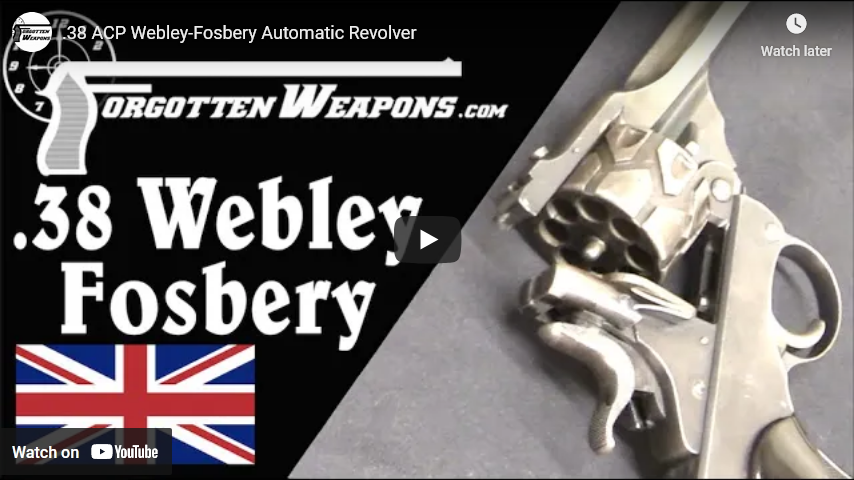
Variations of the .455 Webley Fosbery Automatic Revolver
Forgotten Weapons
Published 17 Apr 2020https://www.instagram.com/rockislanda…
https://www.youtube.com/user/RockIsla…
These are lots #558, 559, 1585, 1586, 3535, and 3536 in the upcoming RIA Premier Auction. It was scheduled for April, but has been postponed — check their web site for upcoming Online Only auctions every month, though!
Today we are taking a look at the different variations in .455 caliber Webley-Fosbery automatic revolvers. The two main types are the Model 1901 and Model 1903 (the Model 1902 was the very rare .38 caliber version). The main change between the two is the change from a coil mainspring to a V mainspring, to improve reliability when dirty; done in response to British military testing. In addition the 1903 has an improved fire control mechanism, a lower hammer profile and a new cylinder removal system.
Within the Model 1903, there is also a change from a standard frame and cylinder to shortened versions of both. These changes occurred at about serial number 3350, in 1912. The shortened cylinder was made to fit the new Webley MkII ammunition, which was notably shorter than the MkI type — and a shorter cylinder reduced weight.
http://www.patreon.com/ForgottenWeapons
https://www.floatplane.com/channel/Fo…
Cool Forgotten Weapons merch! http://shop.bbtv.com/collections/forg…
Contact:
Forgotten Weapons
6281 N. Oracle #36270
Tucson, AZ 85740