
Quotulatiousness

April 9, 2013

Britain’s wartime rationing was the actual start of the modern welfare state

Filed under: Britain, Bureaucracy, Food, Government, History, WW2 — Tags: , , , — Nicholas @ 08:31

In the Telegraph, Daniel Hannan shows that the wartime coalition government led by Winston Churchill actually laid the groundwork for the post-war “creation” of the welfare state:
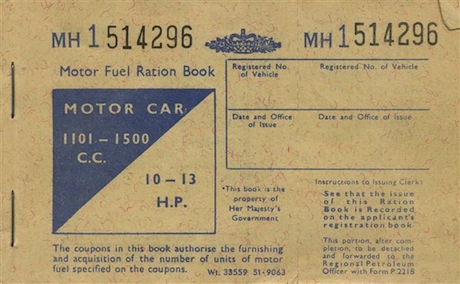
British WW2 Fuel ration book cover

It wasn’t the 1945 Labour Government that created the welfare state, that Saturn which now devours its children. The real power-grab came in 1940.

With Britain’s manpower and economy commandeered for the war effort, it seemed only natural that ministers should extend their control over healthcare, education and social security. Hayek chronicled the process at first hand: his Road to Serfdom was published when Winston Churchill was still in Downing Street.

Churchill had become prime minister because he was the Conservative politician most acceptable to Labour. In essence, the wartime coalition involved a grand bargain. Churchill was allowed to prosecute the war with all the nation’s resources while Labour was given a free hand to run domestic policy.

The social-democratic dispensation which was to last, ruinously, for the next four decades — and chunks of which are rusting away even today — was created in an era of ration-books, conscription, expropriations and unprecedented spending. The state education system, the NHS, the Beveridge settlement — all were conceived at a time when it was thought unpatriotic to question an official, and when almost any complaint against the state bureaucracy could be answered with “Don’t you know there’s a war on?”

All quite true, and all quite necessary at the time. Without significant amounts of imported food, Britain could not feed its people. Even with imports, the amount of available food was subject to unpredictable fluctuations as losses at sea interrupted supply and left empty shelves in grocery stores. Although losses were relatively low early in the war (early U boats were unable to stay at sea for long periods, and German bases were a long way from most British trade routes), the writing was on the wall if the war continued for years.

To fight a totalitarian regime, Britain had to emulate some of its methods (ironically, full rationing wasn’t introduced in Germany until much later in the war). For the middle classes, this was an unwelcome intrusion of the state into private affairs, but generally accepted due to the war. For the working classes, in many cases it was actively welcomed. While the rations were small, there was the promise — and generally a fulfilled promise — that some would be made available even in the poorest areas of the country. My mother was nine when the war began, and she remembers seeing more food in the stores of Middlesbrough after rationing was introduced. After the deprivations of the Great Depression, many people in the north and in Scotland were better fed and clothed during the rationing period than they had been for nearly a decade.

Given that information, it should not be surprising that so many people voted for Labour in the 1945 elections: they’d had what they believed to be a live demonstration of the benefits of socialism for six years of war, and didn’t want to go back to the pre-1940 status quo.
March 18, 2013

Will the Cyprus bailout set the fuse to a new Great Depression?

Filed under: Economics, Europe, History — Tags: , , , — Nicholas @ 00:01

History may not repeat itself, but it’s quite likely that it paraphrases itself instead:

So, this is going to be a very sour reading of what has happened in Cyprus this weekend. It will also be a very partisan one, possibly even a partial one. But if Milton Friedman and Anna Schwartz were right in their insistence that it was actually the Federal Reserve that caused the Great Depression (which is something that Ben Bernanke himself has insisted that the Fed will not repeat) then one way of interpreting what has happened is that the European Central Bank has just set us all up for another Depression. The trigger is that “tax” of a little over 6% on all depositors.

This isn’t an analysis that you’ll be able to get all economists to sign up to. But the basic story told by Friedman and Schwartz in A Monetary History of the United States was that the 1929 crash was indeed a serious crash. But it would not have led to the Great Depression without the Federal Reserve making some serious mistakes. Two of which were to allow the intertwined collapses of both the money supply and the banking system. Given that it is the banks that create credit and thus the wider money supply they are, to a great extent, the same thing.

[. . .]

But please note the central part of Friedman’s argument. Yes, there was the crash. Yes, there would have been a deep and painful recession as a result. But the tipping of that recession into depression was a result of the cascading series of bank failures in the absence of deposit insurance: that led to the calamitous shrinking of credit and the money supply.

So let us now look at Europe and the eurozone. Certainly there’s been a crash (or even a Crash). We’ve so far avoided the depression part (although not everywhere. Greece is certainly in one, Spain possibly and looking out my window at rural Portugal I see certain signs of a reversion to a non-cash economy.) but the important question is whether we manage to continue to do so?

[. . .]

Yes, I do know, they’ve called it a tax: but here we’ve got to make reference to that duck thing. The difference between a 6% or more “tax” on your bank deposit and a failure of the previously agreed deposit insurance to protect your deposit is quackery enough that it’s a duck.

As I’ve said before the importance of this is moot at present. It depends on who believes what. If the citizenry believe that they don’t have deposit insurance any more (whether we call this a tax or a duck) then we will see more mass withdrawals from banks and we will see more bank failures. And cascading bank failures are exactly the thing that will tumble us into a new depression.

May 25, 2012

Herbert Hoover, far from a poster boy for laissez faire government

Steven Horwitz in The Freeman debunks the “high school history” notion that President Hoover was a proponent of laissez faire capitalism which caused the Great Depression. They’ve got the right culprit, but the wrong crime:

One of the most pernicious myths in the economic history of the twentieth century is the belief that the Great Depression was caused, or at least worsened, by Herbert Hoover’s dogmatic commitment to a “do nothing” laissez-faire policy in the aftermath of the stock market crash. This argument is part and parcel of the set of beliefs about the Great Depression that I have dubbed the “high school history” version of that event. (It includes the claims that laissez faire caused it, Hoover’s inaction worsened it, the New Deal did wonders, and World War II got us all the way out.) This claim about Hoover’s dedication to laissez faire is, as I have suggested, utterly false.

In fact Herbert Hoover was long known as a Progressive who favored much more government intervention in the economy. From his days with the U.S. Food Administration in World War I through his time in the 1920s as secretary of commerce, Hoover constantly pushed his beliefs that laissez faire did not work and that government must take a more active role. When the economy went south during his first year as president, it came as no surprise that he put those beliefs into action.

Hoover not only signed the Smoot-Hawley Tariff, as everyone knows, he also encouraged businessmen to keep wages up, expanded the real amount of government spending, reduced immigration to near zero, set up all manner of government lending facilities, and increased the budget deficit. Along with the Federal Reserve System’s failure to do its job, resulting in a 30 percent drop in the money supply, these Hoover interventions were responsible for turning what might have been a severe, but short recession into a Great Depression. So the “high school history” story is right to blame Hoover — but it does so for exactly the wrong reasons.

But it’s been a great way to tarnish free market advocates and effortlessly refute their arguments, because “everybody knows” that laissez faire doesn’t work. Our high school teachers wouldn’t have mislead us all about that, would they?

May 8, 2012

Celebrating the birthday of F. A. Hayek

Filed under: Economics, History, Humour, Media — Tags: , , , , — Nicholas @ 08:16

And the sequel, which some think is even better than the original, Fight of the Century:

March 14, 2012

The culture of Goldman Sachs

Filed under: Economics, History, Humour, USA — Tags: , — Nicholas @ 11:31

Joshua M. Brown responds to the “why I’m leaving x” meme, specifically about Goldman Sachs variants:

The “culture” of Goldman Sachs was, is and always will be about making money, often at the expense of a client. Do you even know where the term “wirehouse” originally came from? Let me help you out with that. In the 1920’s, there was no CNBC or internet — there was only news delivered by wire and cable, stock market news and prices included. The “wirehouse” firms like Goldman would transmit stock and bond prices to their far-flung offices around the country from Wall Street where the action was taking place. It is a peculiar and yet telling fact of history that during the Crash of 1929, not a single major Wall Street brokerage firm went under. Wanna know why? Because when the sell-off began, they dumped all their holdings prior to wiring the news out to the rest of the investing public and their clientele across the country. Sound familiar, motherfucker? THAT is your firm’s culture, going back a hundred and fifty years.

Deal with it or leave and open an Etsy store.

March 3, 2012

Three persistent myths about the Great Depression, the New Deal, and World War 2

Filed under: Economics, Government, History, USA, WW2 — Tags: , , , — Nicholas @ 00:08

Historian Stephen Davies names three persistent myths about the Great Depression. Myth #1: Herbert Hoover was a laissez-faire president, and it was his lack of action that lead to an economic collapse. Davies argues that in fact, Hoover was a very interventionist president, and it was his intervening in the economy that made matters worse. Myth #2: The New Deal ended the Great Depression. Davies argues that the New Deal actually made matters worse. In other countries, the Great Depression ended much sooner and more quickly than it did in the United States. Myth #3: World War II ended the Great Depression. Davies explains that military production is not real wealth; wars destroy wealth, they do not create wealth. In fact, examination of the historical data reveals that the U.S. economy did not really start to recover until after WWII was over.

February 3, 2012

Reason.tv: A non-hagiographic analysis of FDR, the New Deal, and the expansion of federal power

Filed under: Economics, History, USA, WW2 — Tags: , , , , — Nicholas @ 14:16

December 21, 2011

It’s A Wonderful Life is a movie that only an Occupod could love”

Filed under: History, Humour, Media — Tags: , , , — Nicholas @ 11:31

Michael Graham explains why the much-loved Christmas movie It’s a Wonderful Life is actually awful:

Consider George Bailey. In your mind, you see him after a lifetime of poverty, grief and bad luck, running through Bedford Falls shouting “Merry Christmas you old Building and Loan,” just happy to have a family he loves.

Well I agree that having a loving family can help us all get through crises. (Remember the stewardess in the disaster-film spoof “Airplane?” “At least I had a husband . . . ”)

But the name of the film is “Wonderful Life,” not, “Well, Things Could Be Worse.” And in George Bailey’s case, things are truly tragic.

Smart, ambitious George gets stuck at the modest Building and Loan back in Hickville when his brother marries into a cushy corporate gig and his father dies. After years of dreaming of going off to college, traveling the world and becoming a top engineer or architect, his life is spent scraping by, and helping others do the same.

Somehow the movie — like the Occupiers of today — tries to turn that into a virtue. Despite his wife and kids, George turns down $20,000 a year so he won’t have to work for that “evil banker,” Mr. Potter.

Occupy Bedford Falls!

August 7, 2011

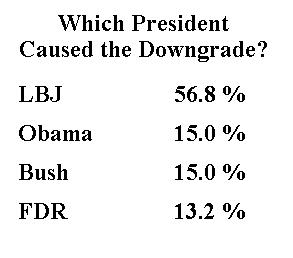
Mitchell: Obama bears only 15% of the blame for the downgrade

Filed under: Economics, Government, History, USA — Tags: , , , , , , , — Nicholas @ 17:57

In a blog post guaranteed to tick off members of both parties, Daniel Mitchell tries a first approximation of where the blame should be assigned:

Well, it turns out that Social Security is a relatively minor part of the problem, so even though President Roosevelt’s policies exacerbated and extended the Great Depression, the program he created is only responsible for a small share of the fiscal crisis. To give the illusion of scientific exactitude, let’s assign FDR 13.2 percent of the blame.


The health care numbers are much harder to disentangle because it’s not apparent how much of the increase is due to Medicare, Medicaid, Bush’s prescription drug entitlement, and Obamacare. A healthcare policy wonk may know these numbers, but the CBO long-run forecast didn’t provide much detail.

So with a big caveat that these are just wild estimations, I feel reasonably comfortable in saying that both Bush and Obama made matters worse with their reckless entitlement expansions, but that they merely deepened a fiscal hole that was created when President Johnson imposed Medicare and Medicaid.

October 25, 2010

Amity Schlaes’ (condensed) The Forgotten Man

Filed under: Books, Economics, History, Politics, USA — Tags: , , , , , — Nicholas @ 13:07

An article encapsulating some of the key points of Amity Schlaes’ The Forgotten Man in PDF form:

We all know the traditional narrative of that event: The stock market crash generated an economic Katrina. One in four was unemployed in the first few years. It resulted from a combination of monetary, banking, credit, international, and consumer confidence factors. The terrible thing about it was the duration of a high level of unemployment, which averaged in the mid teens for the entire decade.

The second thing we usually learn is that the Depression was mysterious — a problem that only experts with doctorates could solve. That is why FDR’s floating advisory group — Felix Frankfurter, Frances Perkins, George Warren, Marriner Eccles and Adolf Berle, among others — was sometimes known as a Brain Trust. The mystery had something to do with a shortage of money, we are told, and in the end, only a Brain Trust’s tinkering with the money supply saved us. The corollary to this view is that the government knows more than American business does about economics.

Another common presumption is that cleaning up Wall Street and getting rid of white-collar criminals helped the nation recover. A second is that property rights may still have mattered during the 1930s, but that they mattered less than government-created jobs, shoring up home-owners, and getting the money supply right. A third is that American democracy was threatened by the rise of a potential plutocracy, and that the Wagner Act of 1935 — which lent federal support to labor unions — was thus necessary and proper. Fourth and finally, the traditional view of the 1930s is that action by the government was good, whereas inaction would have been fatal. The economic crisis mandated any kind of action, no matter how far removed it might be from sound monetary policy. Along these lines the humorist Will Rogers wrote in 1933 that if Franklin Roosevelt had “burned down the capital, we would cheer and say, ‘Well at least we got a fire started, anyhow.’”

To put this official version of the 1930s in terms of the Monopoly board: The American economy was failing because there were too many top hats lording it about on the board, trying to establish a plutocracy, and because there was no bank to hand out money. Under FDR, the federal government became the bank and pulled America back to economic health.

When you go to research the 1930s, however, you find a different story. It is of course true that the early part of the Depression — the years upon which most economists have focused — was an economic Katrina. And a number of New
Deal measures provided lasting benefits for the economy. These include the creation of the Securities and Exchange Commission, the push for free trade led by Secretary of State Cordell Hull, and the establishment of the modern mortgage format. But the remaining evidence contradicts the official narrative. Overall, it
can be said, government prevented recovery. Herbert Hoover was too active, not too passive — as the old stereotypes suggest — while Roosevelt and his New Deal policies impeded recovery as well, especially during the latter half of the decade.

H/T to Monty for the link.

October 24, 2010

How the contents of your closet helped you get through the recession

Filed under: Economics, Randomness, USA — Tags: , , , — Nicholas @ 10:31

Virginia Postrel reveals how the glut of western “stuff” we’ve been accumulating over the last decade may have helped ease us through the recession:

In today’s sour economy, however, what once seemed like waste is starting to look like wealth: assets to draw on when times get tough (and not just because of all those ads promising top dollar for your gold jewelry). Material abundance, it turns out, produces economic resilience. Even if today’s recession approached Great Depression levels of unemployment, the hardship wouldn’t be as severe, because today’s consumers aren’t living as close to the edge.

Take clothes. In 2008, Americans owned an average of 92 items of clothing, not counting underwear, bras and pajamas, according to Cotton Inc.’s Lifestyle Monitor survey, which includes consumers, age 13 to 70. The typical wardrobe contained, among other garments, 16 T-shirts, 12 casual shirts, seven dress shirts, seven pairs of jeans, five pairs of casual slacks, four pairs of dress pants, and two suits — a clothing cornucopia.

Then the economy crashed. Consumers drew down their inventories instead of replacing clothes that wore out or no longer fit. In the 2009 survey, the average wardrobe had shrunk — to a still-abundant 88 items. We may not be shopping like we used to, but we aren’t exactly going threadbare. Bad news for customer-hungry retailers, and perhaps for economic recovery, is good news for our standard of living.

By contrast, consider a middle-class worker’s wardrobe during the Great Depression. Instead of roughly 90 items, it contained fewer than 15. For the typical white-collar clerk in the San Francisco Bay Area, those garments included three suits, eight shirts (of all types), and one extra pair of pants. A unionized streetcar operator would own a uniform, a suit, six shirts, an extra pair of pants, and a set of overalls. Their wives and children had similarly spare wardrobes. Based on how rarely items were replaced, a 1933 study concluded that this “clothing must have been worn until it was fairly shabby.” Cutting a wardrobe like that by four items — from six shirts to two, for instance — would cause real pain. And these were middle-class wage earners with fairly secure jobs.

October 19, 2010

The less-visible effects of workplace demographic changes

Filed under: Economics, History, USA — Tags: , , , , , , — Nicholas @ 12:12

Monty points out that we’ve passed a significant equilibrium point in employment statistics:

Women are vital to the American workforce, and have been since at least the 1940’s, but this recession may have shifted the balance of economic power decisively to women. Men have been the traditional household “breadwinners”, with the wife’s income being seen as augmenting the male’s income, but this recession has hit men disproportionately harder than women. Women are far more likely to work in industries (like services and healthcare) that are more insulated from the downturn, whereas men are far more likely to work in the hard-hit trades and manufacturing sectors. Women also have many more protections — both regulatory and social/cultural — than men do. There are many deep ramifications to this change — the impact of long-term male unemployment on the family; the loss of status, power and prestige that goes with being unemployed; the male self-image and value to society. (Studies of unemployed men during the Great Depression are not happy reading — many of the chronically unemployed males left their families rather than assume a lower status in the family, and were also far more likely to be dictatorial and violent towards their wives and children.)

Social support agencies are not well-equipped to deal with this change, and it will continue to disrupt “normal” life for years to come, unless the economy is allowed to right itself — yet another excellent reason to tell the politicians to stop meddling.

Another valuable observation from the same post:

This is a point I’ve made many times: the economic demographic most impacted by immigrant labor are teens. Low-end “starter” jobs tend to be low-skill, low-paying, part-time jobs, and adult immigrants are often favored over teens for these jobs by employers (they often have families to support, are considered more reliable, etc.). This means that the teen labor-participation percentage has fallen from 50% in 1970 to 25% today. (And even 25% is probably too high.) When faced with this lack of job opportunities, teens often opt to go back to school — but this in turn saddles them with a lot of debt for (in many cases) not much gain. For many teens, it’s simply a way of deferring adulthood, not a way to gain additional skills or knowledge. (I had my first paying job at 14; my first “real” W2 job at 16. I worked nearly full-time all the way through college, and worked full-time during the summers. I wonder how rare this is now?) Another interesting aspect to the immigrant/teen issue: the language barrier. If you’re a teen who doesn’t speak Spanish, just try and get a landscaping or construction job in the Southwest. The same goes for many fast-food crews and oil-change/tire-repair places. Still, we’re not the only ones with immigrant troubles.

Another side to the increasing longevity of western culture is the delayed start to “adult” life: now that a college diploma or university degree has about the same relevance that a high school diploma did a generation ago, young folks are entering the workforce several years later than earlier generations. This delays family formation, children, home-buying, and all the other aspects of independent-from-the-parents life.

No wonder so many of the “rules” no longer seem to apply with so many things changing.

August 13, 2009

This is a mind-boggling level of debt

Filed under: Economics, USA — Tags: , — Nicholas @ 09:58

As soon as the money being discussed passes a billion dollars, for most people it might as well be imaginary . . . here’s a bit of perspective:

To put some context on a new estimate that puts this year’s federal deficit at $1.8 trillion, consider this: That amount had never been spent by the federal government in a single year until 2000, let alone borrowed.

That’s right. As the decade began, the US government spent $1.8 trillion in a year for the first time. Now it’s poised to spend that much in excess of its tax revenues.

The Treasury released the latest figures Wednesday, showing spending of about $3 trillion in the past 10 months, and revenues of only $1.74 trillion.

With two months to go in the fiscal calendar, the Obama administration is projecting that the imbalance will end up totaling $1.84 trillion, more than four times last year’s record-high. The monthly deficit for July, also reported this week, came in a bit above what economists had expected.

Now all the talk about replacing the US dollar with some other currency as the international reserve makes rather more sense. The US government is going to be a long, long time paying off all that new debt . . . or repudiating it and triggering a world-wide financial melt-down. Either way, prudent investors will be looking at non-US investments for future attention. This will make it that much harder for the US economy to grow its way out of debt.

It will take a lot of political courage to stay the course, pay down the accumulated debt and avoid going for what the domestic audience will see as the easy option (declaring national bankruptcy). It’s hard to imagine any current American politician with the fortitude to take the hard option (cutting government spending and paying off the debt).

July 14, 2009

Random links of possible interest

Filed under: Randomness, Space — Tags: , , , , — Nicholas @ 09:26

Just a few links to provide you with click-therapy:

(Cross-posted to the old blog, http://bolditalic.com/quotulatiousness_archive/005579.html.)

« Newer Posts

Powered by WordPress
