I’m not much of a fan fiction reader, but I was quite amused at this crossover between George MacDonald Fraser’s Flashman series and George R.R. Martin’s Game of Thrones:
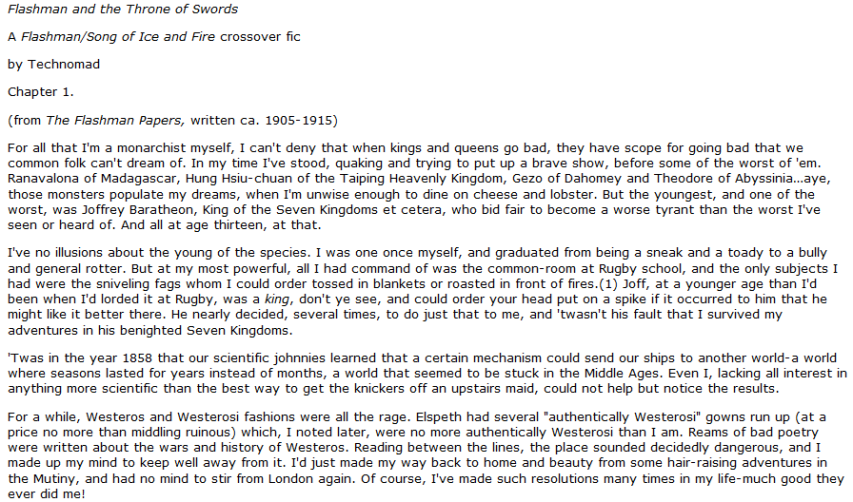

I’m not much of a fan fiction reader, but I was quite amused at this crossover between George MacDonald Fraser’s Flashman series and George R.R. Martin’s Game of Thrones:
In the Telegraph, Dominic Selwood explains the Norman Invasion of 1066 and the many shades of grey (or red) that are missing from the traditional story of the rise of the Normans:
As we wait for the next series of Game of Thrones, I cannot help but think I have seen it all before — dynastic families so intermarried that the members’ only loyalty is to self; ambitions so uncompromising that war is the inevitable result; and carnage so total that the threat of defeat is existential. But whenever the story takes me to the throne room in the Red Keep at King’s Landing, all I see is Westminster Abbey — because this is an old, old story.
We like to think that Anglo-Saxon England was brutally cut down in 1066 — unexpectedly — in a battle lasting just one day. To reinforce our assumptions, we still revel in Victorian and Hollywood melodrama stereotypes of dastardly Normans persecuting flaxen Saxons in box-sets of Ivanhoe or Tolkein’s thinly disguised versions set in Middle Earth.
The reality, of course, is far more complex.
[…]
The road to Hastings began ordinarily enough. A man lay dying. As it happened, it was Edward the Confessor. But what marked the event out as singular was that he had failed in one of his key royal responsibilities — he was leaving the world childless. To no one’s surprise, as the end approached, he nominated as heir his brother-in-law, the 46-year-old Earl Harold Godwinson of Wessex.
Harold was the kingdom’s richest noble, and a great military commander who had subjugated Wales in 1063. The Witenagemot promptly proclaimed him king, and Archbishop Stigand of Canterbury crowned him at Edward’s gleaming new Westminster Abbey the following day, the 6th of January 1066, the same day Edward was buried there.
But the dead king’s ineffectual leadership had passed Harold a major headache, as one of Edward’s favourite political strategies had been to promise all sorts of people he would make them his heir. Given his strong attachment to Normandy, it is no surprise that he had, most likely in 1051, promised the throne to Duke William of Normandy, a distant cousin. In fact, Norman sources go further, saying that in 1064 Edward had even sent Harold to Normandy to confirm the arrangement. At the same time, in front of William and on a box of relics, Harold apparently swore a sacred oath to uphold William’s claim to the English throne.
The headache did not end with William. There were other claimants, too. King Harald III “Hardraada” (the ruthless) of Norway had a claim to the throne via an earlier agreement between Harthacnut (king of England and Denmark) and Magnus I (king of Norway and Denmark). Over in Hungary, Edgar the Ætheling had a claim as grandson of King Edmund II “Ironside”. And in exile in Flanders and Normandy, Tostig Godwinson, Harold’s rebellious brother, was nursing a venomous grievance against the Anglo-Saxon establishment.
I haven’t been watching Game of Thrones, but I’ve seen enough of it that James Delingpole‘s observations seem rather accurate:
Consider some of the Isis footage now doing the rounds on the internet. One video is filmed from the point of view of some young men in car, driving along a highway outside a town somewhere in northern Iraq, looking for cars to shoot up with their AK-47s. The innocent drivers clearly aren’t expecting this. By the time they’re aware what’s going on, it’s too late: soon, their bullet-riddled cars are veering off the roads, their dead or wounded drivers slumped at the wheel. Next, eager as puppies, out pop the jihadis to inspect the damage, gleefully filming their dying victims and then finishing them off. It’s like an episode of Grand Theft Auto Mosul, only acted out for real.
What kind of mindset do you need to carry out this kind of barbaric violence? Well I hesitate to say a “Medieval” one because then the Medievalists get all upset. But let’s agree shall we that it is a mindset almost completely alien to Western Judeo-Christian culture. Yes, there are exceptions to every rule: the obvious one being Germany in World War II. At the risk of crudely generalising though, I’d say that however much society breaks down in the West I can’t ever see any of us reaching the point where we start machine gunning road users just for the sheer hell of it, any more than I can ever imagine us beheading or crucifying prisoners. We got all that stuff out of our system, over the centuries, in a succession of savage conflicts like the Thirty Years War and the Wars of The Roses.
It’s from the Wars of the Roses, of course, that George RR Martin gets a lot of his gory detail, including the kill-or-be-killed mindset of his protagonists. They don’t think like us because they don’t enjoy the luxury of living in a society as advanced as ours. What to us might seem like basic human decency would strike the Game of Thrones protagonists as fatal weakness. Hence, for example, the House Bolton’s practice of flaying its prisoners: a) a dead enemy is never going to kill you and b) it so terrifies your foes that — as Isis have found in Iraq — they would rather flee for their lives than face you in battle.
This kind of insight is, I’m sure, one of the main reasons why Game of Thrones has grown to achieve its status as unmissable, landmark television. Yes, of course, the fine acting, great locations, pert breasts and CGI dragons are a big draw too. But what really makes it stick out is that, unlike almost any other fiction set in the past, it chooses not to imbue its characters with the liberal values of the present. This brutal honesty is at once exhilaratingly novel but also deeply unsettling, for it opens a window onto a world where people may look like us and apparently share the same hopes, dreams and fears as us, but where the progressive pieties to which we’ve become accustomed in the post-war years simply don’t apply. Not only do they not apply but they actually look foolish, counterproductive, suicidal.
“The game of thrones in general is a game of cronyism because it’s all about forming political alliances, especially with people who can make you better off economically speaking,” says Auburn University Economics Instructor Matthew McCaffrey.
McCaffrey has recently written about the economics involved in the popular Game of Thrones novels by George R.R. Martin as well as the HBO series based on the books. He sat down with ReasonTV’s Tracy Oppenheimer to discuss the various economic concepts that develop alongside the character-driven plot line, such as sin taxes, coin clipping, and the ever-present cost of borrowing.
According to McCaffrey, Martin extensively researches historical economic systems to make “the Realm” as plausible as possible.
“As part of his process he ends up uncovering a lot of historical details that usually get lost in a fantasy book of this kind,” says McCaffrey, “just practical difficulties of running a kingdom, how public finance works, how the game of thrones corrupts the people who play it and how it ends disastrously for the people who don’t play it well.”



Powered by WordPress