Quotulatiousness

June 12, 2018

G7 minus one

Justin Raimondo on the well-shared image of Angela Merkel and her associates apparently trying to browbeat Donald Trump at the G-7 meeting (this version from Raimondo’s article):
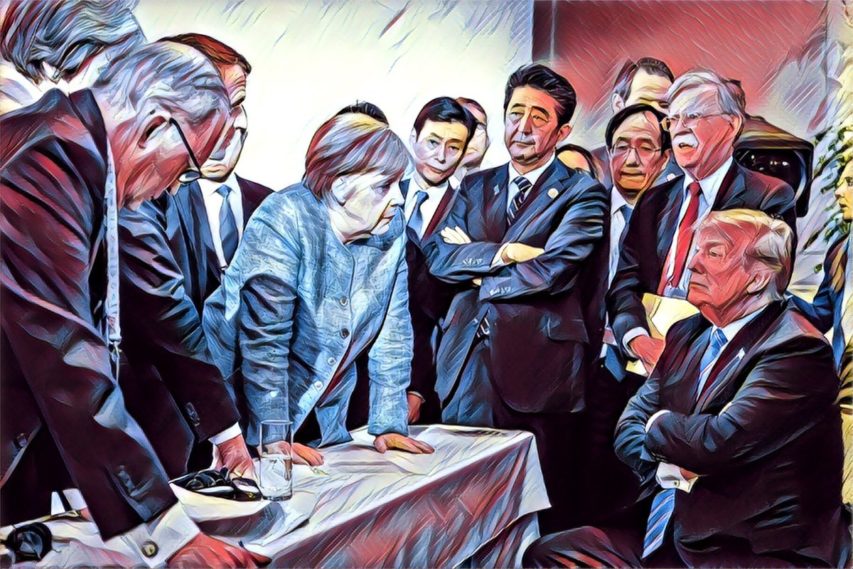
All the Very Serious People are tweeting and retweeting this “iconic” photo of Trump surrounded by the Euro-weenies, with Angela Merkel seeming to lecture the President while the rest of our faithless “allies” look on. It’s “America Alone” – the visual representation of the internationalist worldview: Trump’s policy of “America First” is “isolating” us, and, according to clueless leftists like Michael Moore, Merkel is now the “leader” of the “free world.”

This last is good news indeed, for if Merkel is the new leader of the “free world” then the stationing of 35,000 US troops in Germany – at a cost of billions annually – is no longer required and we can bring them home. This also means Germany, rather than the US, will be sending troops all over the world to fight “terrorism” – a move that is sure to cause consternation in certain regions with a history of German intervention, but hey, somebody has to do it!

The political class is screaming bloody murder over Trump’s performance at the G-7 meeting in Canada, where he reportedly spent most of the time detailing how much the US was paying for the defense of our vaunted “allies,” not to mention the high tariffs imposed on American goods. He then proposed a “free trade zone” in which member countries would drop all tariffs, subsidies, and other barriers to trade: the “allies” didn’t like that much, either. Nor did the alleged advocates of free trade here in the US give him any credit for ostensibly coming around to their point of view. Which reminds me of something Murray Rothbard said about this issue: “If authentic free trade ever looms on the policy horizon, there’ll be one sure way to tell. The government/media/big-business complex will oppose it tooth and nail.”

Of course the Euro-weenies don’t want real free trade: after all, they practically invented protectionism. What they want is a free ride, at Uncle Sam’s expense, and the reason they hate Trump is because they know the freebies are over. However, what really got the Usual Suspects frothing at the mouth was Trump’s insistence that Russia be readmitted to the G-8:

    “I think it would be good for the world, I think it would be good for Russia, I think it would be good for the United States, I think it would be good for all of the countries in the G-7. I think having Russia back in would be a positive thing. We’re looking to have peace in the world. We’re not looking to play games.”

The “experts” went crazy when he said this: our “allies” are being insulted, they wailed, while our “enemies” are being “appeased.” It’s sedition! Russia! Russia! Russia!

Eric Boehm says that the White House’s justification for imposing tariffs on national security grounds may have been undermined through Trump’s tweets hitting back after what he clearly felt was Justin Trudeau’s hissy fit (although Trudeau didn’t exactly break new ground or say anything radically different in his comments):

The Trump administration has spent months trying to construct a rather flimsy argument that steel and aluminum imports from Canada and other close American allies constitute a national security threat. More than a handy way to drum up public support for trade barriers, the “national security” claim is a crucial bit of the legal rationale for letting the president impose tariffs on those goods without congressional approval.

Then, as he was departing this past weekend’s G7 summit, Trump took to Twitter to air some grievences with Canadian Prime Minister Justin Trudeau. In doing so, the president may have significantly kneecapped that legal argument.

The last sentence of Trump’s tweet is the one that really matters.

The White House slapped a 25 percent tariff on imported steel and a 10 percent tariff on imported aluminum by invoking Section 232 of the Trade Expansion Act of 1962, which gives the president legal authority to impose tariffs without congressional approval when it’s for the sake of national security. That line of argument, outlined by Commerce Secretary Wilbur Ross in a February report, says that America needs aluminum and steel to make weapons of war, and that protecting the domestic steel and aluminum industries is the only way to ensure the country will be able to defend itself if attacked.

That is pretty weak, as I (and others) have written before. But as long as Trump makes that claim — no matter how strained the logic might be — the law seems to be on his side. Invoke “national security” and the president can do what he wants with trade.

Except now Trump seems to have admitted that it’s not about national security at all. His tweet plainly states that “our Tariffs [sic] are in response to his of 270% on dairy!”

Chris Selley points out that up until this eruption, Canadian politicians were still carrying on as if nothing was really at stake (especially Conservative leader Andrew Scheer, who re-swore his allegiance to ultra-protectionist supply management at all costs, and damn actual free trade):

So utterly obsessed are Canadian politicians by the small differences between them that federal Conservative leader Andrew Scheer recently demanded Prime Minister Justin Trudeau explain what he meant when he suggested Canada might be “flexible” on the issue of supply management in the dairy industry, in the face of new demands from Washington. It’s preposterous: you can’t fit a processed cheese slice between the three major party’s total devotion to the dairy cartel.

Because, as we all know, what unites Canadians from coast-to-coast is our universally shared determination to pay significantly higher prices for dairy products, to ensure that Quebec farmers are not overly bothered by pesky competition from uppity foreigners who don’t even speak Joual

June 5, 2018

QotD: Protectionism is a form of bullying

Filed under: Economics, Quotations — Tags: , , — Nicholas @ 01:00

Bullying and protectionism have a lot in common. They both use force (either directly or through the power of the law) to enrich someone else at your involuntary expense. If you’re forced to pay a $20-an-hour American for goods you could have bought from a $5-an-hour Mexican, you’re being extorted. When a free-trade agreement allows you to buy from the Mexican after all, rejoice in your liberation. To compensate your former exploiters is to succumb to Stockholm syndrome.

Steven Landsburg, The Big Questions, 2009.

June 4, 2018

The economic damage of tariffs

Filed under: Economics, History, Politics, USA — Tags: , , , , — Nicholas @ 05:00

Tim Worstall fisks a recent Pat Buchanan brain fart article on the glories of erecting tariff walls against foreign trade:

Pat Buchanan has been going on for decades about how wondrous tariffs are and if only they were brought back then things would be just peachy. Sadly, this all seems to be based on his not understanding trade, tariffs, nor apparently even history. That’s not a good set of recommendations for a policy about trade and tariffs, one that has been tried many a time in history.

Now, it is entirely true that if we returned to a more Hamiltonian policy era then we’d all be richer. But that wouldn’t be because we had tariffs which paid for government rather than an income or corporate tax. It’s because government would be confiscating a very much smaller portion of what we all produce to pay for itself. If the Feds took 3% of everything we do instead of the current 18% or so then sure, we’d all be richer. But that’s true however that tax is raised.

[…]

His argument is that, protected from foreign competition, American business was able to develop and grow into being world beaters. No, I don’t think this is true – I insist that behind tariff barriers companies stagnate. Indeed it’s standard economics that the medium to long term effects of trade are that the competition from foreigners is what makes the domestic companies stronger and more productive. But put that argument to one side. Assume that Buchanan is correct.

For his conclusion to be correct then it must have been true that the total costs of trade were rising in that time period. Total costs being tariffs plus transport. Only if the total costs were rising was protection rising. The tariffs are only part of the story. And as it happens total protection was falling over this time period. The falls in the costs of transport – for the US externally primarily the steam ship – were greater than the rises in the tariffs. Thus the US was becoming more open to trade at this time when industry was booming and growing to world class levels.

That’s not an argument in favour of trade protection now, is it?

    The U.S. relied on tariffs to convert from an agricultural economy in 1800 to the mightiest manufacturing power on earth by 1900.

Well, it’s also true that what the US was inside those tariff barriers was the largest free trade area in the world. I’m the guy insisting that free trade makes places grow, Pat the opposite. And the place with more free trade among more people than anywhere else grows fastest? That’s a point in my favour, no, not Pat’s? Remember, the US Constitution expressly forbids the individual states from having tariffs between them…..that regulation is left to the Feds who have never imposed them.

    How have EU nations run up endless trade surpluses with America? By imposing a value-added tax, or VAT, on imports from the U.S., while rebating the VAT on exports to the USA. Works just like a tariff.

No, a VAT does not work like a tariff. In no manner at all does it do so in fact. As every economist keeps trying to point out. Within the EU all goods and services, no matter where they’re made, pay the exact same rate of VAT. Well, OK, ladies unmentionables pay a lower rate than motor cars, that’s true, but all unmentionables pay the same rate, all cars. There is no difference made between domestic and foreign production. It’s entirely unlike a tariff therefore, the crucial component of which is that distinction made between home and foreign production.

Stuff made in the EU and sold in the US pays no VAT. Stuff made in the US and sold in the US pays no VAT. Again, we’ve no distinction by source or origin, this is entirely and completely unlike a tariff.

May 11, 2018

QotD: Protectionism is by nature, zero-sum

Filed under: Economics, Quotations — Tags: , — Nicholas @ 01:00

A Protectionist is Someone Who… is so hopelessly – indeed, comically – confused about trade that he assumes that Americans who support free trade do so only out of a willingness to sacrifice the welfare of fellow Americans in order to improve the welfare of people in poorer countries. The protectionist does not grasp the fact that voluntary trade occurs only when each party to each trade believes that he or she will be made better off by the trade. The protectionist, unable to escape from the antediluvian superstition that trade is a zero-sum exercise, self-righteously – if ridiculously – accuses free-traders in rich countries of discounting or disregarding the economic well-being of their fellow citizens. The protectionist is an intellectual prisoner of his silly presumption that if people in poor countries gain from freer trade, people in the rich countries must thereby lose.

In short, a protectionist is someone who denies the reality of gains from trade.

Don Boudreaux, “A Protectionist is Someone Who…”, Café Hayek, 2018-04-09.

April 22, 2018

The balance-of-trade hobbyhorse

Filed under: Economics, Government, Media — Tags: , , , , — Nicholas @ 03:00

Don Boudreaux doesn’t have much sympathy with people who agonize over or — worse — set their national economic policies based on the balance of trade:

No concept in economics is responsible for more confusion and policy mischief than is the so-called “balance of trade.” The many fallacious beliefs about a trade deficit include the notion that –

– aggregate demand drains from each economy that runs a trade (or current-account) deficit, thus causing overall employment to fall in each country that runs a trade deficit;

– the GDP of a country that runs a trade deficit is lowered by that trade deficit;

– the denizens of a country that runs a trade deficit spend too much on consumption and save too little;

– a trade deficit is evidence of poor policy in any country that runs such a deficit;

– a country’s trade deficit would be ‘cured’ if only the people of that country were to save more or to buy fewer imports;

– a trade deficit in the home economy is evidence of ‘unfair’ trade practices by that country’s trading partners;

– a trade deficit means that each country that runs one is “losing,” and that to “win” at trade means running a trade surplus (or, at least, to not run a trade deficit);

– a trade deficit run by the home economy means that that economy’s trading partners who have trade surpluses are being enriched at the expense of the people in the home economy;

– a trade deficit necessarily makes the citizens of any country that runs one more indebted to foreigners;

– a trade deficit involves a net transfer of capital or asset ownership from citizens of each country that runs a trade deficit to citizens of countries that run trade surpluses;

– each dollar (or each yen, or each euro, or each peso, or each pound, or each you-name-the-currency) of a country’s trade deficit today means that the people of that country must sacrifice that much consumption sometime in the future;

– bilateral trade deficits have economic meaning and relevance;

– a trade deficit is something that should be “fixed” – that is, reduced or eliminated – through government policy, including especially through trade restrictions.

None of the above-listed beliefs about trade deficits is supportable. None. Not one. Not in the least. Each and every one of these beliefs is easily refuted with either basic economics or, in many cases, with simply a clarification of the definitions of terms and concepts used in national-income accounting. And yet these – and no doubt other – false beliefs about trade deficits (and about the so-called “balance-of-payments” generally) are widespread and spill daily from the mouths and keyboards of politicians, pundits, professors, and propagandists.

The belief that trade deficits cause economic problems in countries that run them – and that trade deficits necessarily reflect poor policies or profligacy by the people of those countries – is the economic equivalent of, say, the belief that the world is ruled by sorcerers who ride fire-breathing dragons and who marry their daughters off to centaurs. Both sets of beliefs are pure madness, yet one of them serves as the basis for real-world policies.

April 21, 2018

QotD: “Pitiless” globalism

Filed under: Business, Economics, Politics, Quotations — Tags: , — Nicholas @ 01:00

Kathleen Parker rightly criticizes Republicans for becoming a party of angry, fear-lathered excluders (“The GOP is becoming the party of exclusion,” July 31). But when she laments “the pitiless evolutionary march of globalization” not only does she reveal her own misunderstanding of the economy, she gives aid and comfort both to GOP excluders and to Sandersnistas who suffer many of the same misunderstandings.

In what way is globalization “pitiless”? Is it because it creates an ever-growing abundance of new goods and services that consumers choose to buy? Is it in the fact that it lowers the prices of food, clothing, furniture, electronics, communications, and (for example, by expanding the sizes of pharmaceutical-companies’ markets) medicines?

Is globalization “pitiless” because it allows many desperately poor workers in the developing world to earn incomes that enable them and their families to live above subsistence? Or perhaps globalization is “pitiless” because it obliges entrepreneurs and workers in the developed world – nearly all of whom are multiple times richer (thanks to globalization!) than are the foreigners about whom they complain they must compete – to adjust their actions to the choices of the consumers whom they serve?

Globalization is no more or less pitiless than is economic competition generally and what Deirdre McCloskey calls “market-tested innovation” – the same competition and innovation that over the past few centuries crafted our current high standard of living. So unless Ms. Parker believes that it is gentle and just for rich first-world workers to prevent poor third-world workers from improving their lives – unless Ms. Parker thinks it humane for consumers to be forced to accept whatever products are offered, and at whatever prices are demanded, by existing producers rather than motivate producers to work hard and creatively to please consumers – she should not describe globalization as “pitiless.”

Donald J. Boudreaux, letter to the Washington Post, 2016-07-31.

April 8, 2018

QotD: Just and unjust profits

Filed under: Business, Economics, Quotations — Tags: , , , — Nicholas @ 01:00

“Progressives’” hostility to free trade would be amusing were its consequences less baneful: deeply distrustful of the motives of business people, and convinced that profits are ethically suspect, Sandersnistas and many other “Progressives” are in the front lines of the troops who are intent on using trade restrictions to protect business people from competition and, thus, to enhance business people’s prospects of earning excess profits – profits that truly are ethically unjust because they are the fruits of the forced removal from consumers of choices on how they, consumers, may spend their own money. (Of course, the very same economically damaging and ethically unjust consequences spring from trade restrictions supported by Trumpkins and many other conservatives. The tales that each of these economically ignorant groups tell to each other to justify their mercantilist policies differ, but the policies and the harmful results are identical.)

Don Boudreaux, “Quotation of the Day…”, Café Hayek, 2016-07-30.

March 15, 2018

QotD: The self-harming reality of tariffs

Filed under: Business, Economics, Quotations, USA — Tags: , , , — Nicholas @ 01:00

Unintended harm to American companies is a recurring problem with tariffs, even those meant to protect American jobs from competition that our government deems unfair. After Bush imposed steel tariffs, steel-consuming industries pointed out that they employed far more Americans than the steel industry itself, and argued that the net effect of the policy on jobs was negative.

Anti-dumping laws, which put tariffs on foreign imports that are supposedly being sold at too low a price, usually target intermediate goods and therefore make the downstream American producers that use them less competitive. Daniel Ikenson, a trade-policy analyst at the Cato Institute, notes that the government, perversely, is forbidden by law from considering the impact of tariffs on these producers before levying the tariffs.

Then there’s the question of costs. Gary Hufbauer and Sean Lowry, a senior fellow and research associate, respectively, at the Peterson Institute for International Economics, calculated [PDF] that Obama’s tariffs on Chinese tires cost American consumers at least $900,000 for every job they saved for one year. That’s before taking account of job losses caused by lower spending by consumers on other products and by retaliatory Chinese tariffs. This very high cost per job, they point out, is consistent with research on other instances of trade protection.

In an interview, Hufbauer notes that our efforts to protect industries from competition have typically not resulted in their revival and impose extremely high costs for any jobs they save. He cites the textile and maritime industries, both of which have been protected for decades, as examples of these disappointing results.

Ramesh Ponnuru, “The High Cost of U.S. Protectionism”, Bloomberg View, 2016-07-01.

February 25, 2018

QotD: Trade deficits

Filed under: Economics, Quotations — Tags: , — Nicholas @ 01:00

No economic statistic is reported more dolefully these days than the country’s trade balance.

Ever on the alert for signs of impending economic disaster, the press routinely couples reports of record monthly trade deficits with warnings of experts and Government officials of the dangers of the deficit.

Just what is so dangerous about receiving more goods from foreigners than we give them back is never actually explained, but it is often suggested that that it causes a loss of American jobs.

News reports sometimes even provide estimates of the number of jobs lost owing to every billion dollar increase in the trade deficit. Heaven only knows how these estimates are made, but presumably they are based on the assumption that imports deprive Americans of jobs they could have had producing domestic substitutes for the imports.

It almost seems tedious to do so, but it apparently still needs to be pointed out that buying less from foreigners means that they will buy less from us for the simple reason that they will have fewer dollars with which to purchase our products.

Thus, even if reducing imports increases employment in industries that compete with imports, it must also reduce employment in export industries.

Moreover, the notion that the trade deficit destroys domestic jobs is contradicted by the tendency of the deficit to increase during economic expansions and to decrease during contractions.

The demand for imports rises with income, so imports normally tend to rise faster than exports when a country expands more rapidly than its trading partners. The trade deficit is a symptom or rising employment — not the cause of rising unemployment.

That balance-of-trade figures are misunderstood and misused is not surprising, since their function has never been to inform or to enlighten. Their real purpose is to provide spurious statistical and pseudo-scientific support to groups seeking protectionist legislation. These groups try to cloak their appeals to protection with an invocation of the general interest in a favorable balance of trade.

David Glasner, “What’s So Bad about the Trade Deficit?”, Uneasy Money, 2016-06-02 (originally published in the New York Times in 1984).

January 28, 2018

QotD: Protectionism

Filed under: Economics, Quotations — Tags: , , , — Nicholas @ 01:00

All protectionism is rooted in the mistaken presumption not only that existing, domestic producers have a moral right – enforceable by the state – to the patronage of domestic consumers, but also that no future domestic producers have such a right as against current domestic producers. This right, were it real, implies that consumers exist to please existing domestic producers; it implies that continued or expanded production of that which is currently produced domestically is the end, while consumption is only the means of encouraging such production.

Only the widespread, if unthinking, acceptance of this presumption gives credence to the demands of domestic producers that some “unfair” practice by a foreign rival or foreign government justifies the imposition by the home government of punitive taxes on domestic consumers who purchase imports. Only a widely shared, if seldom articulated, belief that current domestic producers have a right to some minimum portion of domestic-consumers’ incomes explains the nodding of the heads of many people of all political persuasions when they hear some politician or pundit or preacher demonize foreign producers for selling wares to domestic citizens.

Don Boudreaux, “Protectionism”, Cafe Hayek, 2016-05-27.

January 27, 2018

The difference between being “pro-free market” and “pro-business”

Filed under: Business, Government, Liberty — Tags: , , , , — Nicholas @ 05:00

It’s a distinction that really does make a difference, argues Jonah Goldberg:

One of the most difficult distinctions for people in general and politicians in particular to grasp is the difference between being pro-free market and pro-business.

There are many reasons for this confusion. For politicians, the key reason is that businesspeople are constituents and donors, while the free market is an abstraction. Also, because capitalists tend to lionize successful people, we assume they share our philosophical commitments. But it is a rare corporate titan who favors a free market if doing so is bad for his or her bottom line.

Adam Smith recognized this in his canonical 1776 work, The Wealth of Nations. “People of the same trade seldom meet together, even for merriment and diversion,” he wrote, without the conversation ending “in a conspiracy against the public, or in some contrivance to raise prices.”

This doesn’t mean that capitalists are evil; it means they’re human beings. Virtually every profession you can think of has a tendency to dig a moat around itself to protect its interests and defend against competition. A few years ago, the American Academy of Pediatrics came out against affordable health care for children. Retail chains like Walmart and CVS started opening in-store clinics to provide affordable basic health care like vaccinations. The pediatricians rightly saw this as a threat to their monopoly over kids’ medical care. Obviously, the pediatricians didn’t think they were villains; they simply found rationalizations for why everyone should keep paying them top dollar for stuff that could be done more cheaply.

Similarly, most teachers like kids, but that doesn’t stop teachers unions from doing everything they can to protect themselves from competition or accountability. Indeed, unions, by design, are conspiracies against the public to defend the wages and perks of their members. NIMBYism (Not in My Backyard) is another manifestation of this phenomenon.

[…]

Smith understood this too. After noting how people of the same trade conspire to raise prices, he added: “It is impossible indeed to prevent such meetings, by any law which either could be executed, or would be consistent with liberty and justice. But though the law cannot hinder people of the same trade from sometimes assembling together, it ought to do nothing to facilitate such assemblies; much less to render them necessary.”

What both Smith and the founders understood is that such conspiracies can only last with the help of government. As the economist Joseph Schumpeter argued, in a system of free competition, monopolies cannot long endure without government protection.

January 15, 2018

The postwar “international order”

Filed under: Britain, Economics, History, USA — Tags: , , , — Nicholas @ 03:00

Niall Ferguson on the notion of a post-1945 international liberal order:

The phrase international order reminds me of the phrase Western civilization. As Indian independence icon Mahatma Gandhi wittily replied when asked about Western civilization, “It would be a good idea.” The notion that international order exists or has ever existed seems highly questionable to me. The notion of a liberal international order is even more questionable because it is neither liberal, nor international, nor very orderly.

It is often claimed by political scientists that the liberal international order came into existence in 1945. The argument goes that American and British statesmen, having learned from the terrible mistakes of the 1930s and 1940s, decided to make the world anew by creating a series of remarkable international institutions: the United Nations, the International Monetary Fund and later the World Bank. According to this narrative, Donald Trump’s election as US president in 2016 was a wrecking ball directed at the liberal international order created by the generation of 1945.

Yet this is a fairy tale. For one thing, there was nothing very liberal about the economic order that was established in 1945. It was devised by people – notably John Maynard Keynes – who had repudiated classical liberal economics and believed that international trade should be limited and capital movements controlled.

It was also not a truly international order. After 1945, it very quickly became a bipolar order that divided the world. There was nothing international about the Cold War. It was a battle between two empires and two ideologies, and the rest of the world’s nations had to choose sides.

In short, the notion of a liberal international order, born in 1945, is a historical fantasy. The reality is that it was only in 1991 when the Soviet Union collapsed and the Cold War ended that it was possible to create a liberal international order. The era of truly free trade, truly free capital flows and large-scale migration across borders did not begin until the 1990s.

December 9, 2017

The Trudeau sideshow in China

Filed under: Cancon, China, Economics, Politics — Tags: , , , — Nicholas @ 05:00

Colby Cosh on figuring out why Justin Trudeau’s trip to China didn’t end in the glory he and his handlers were clearly anticipating:

My favourite part of the fair has always been the sideshow. And when it comes to Justin Trudeau’s official visit to China, the sideshow definitely turned out to be the most interesting part of the proceedings. Interpreting the outcome of the visit involves a certain amount of old-fashioned Kremlinology, applied to both sides, but it seems fairly clear that Trudeau was gulled into providing Chinese leadership with some celebrity glamour in exchange for a big pile of nothing on Chinese-Canadian trade.

He came to China with hopes for progress on a future trade deal that would involve China accepting new labour, gender, and environment standards. But he collided with the newly aggressive Xi Jinping doctrine — a change in the official Chinese mood that insists on the country’s superpower status. China-watchers know that over the past year, in a process that culminated at the 19th Chinese Communist Party Congress in October, China has become more explicit, and more chauvinist, in claiming to pursue an independent, indigenous alternative model of economic and social progress.

[…]

Western commentators on China have, for a long time, had an implicit vision of a re-emerging bipolar world, with China in the old place of Russia as an ideological challenger to Western democracies. Xi is taking them at their word. China’s aspirations are no longer to follow or imitate the West, but to out-compete it on its own terms, without any of the untidy, politically dis-unifying elements of Western life — independent universities, newspapers that aren’t trash, multiple political parties, and the like.

Given this background, Trudeau arguably arrived in China at exactly the wrong moment. Formal talks on a China-Canada free trade agreement would have been the first ever between China and a G7 country. It turned out that there was more value for Xi in slapping the hand of friendship. The Global Times, an organ of the party’s People’s Daily newspaper network, published a cranky English-language editorial in the midst of Trudeau’s visit.

The editorial attacked the “superiority and narcissism” of Canadian newspapers, as an alternative to jabbing the prime ministerial guest in the eye personally. But it is easy enough to read between the lines. “Trade between China and Canada is mutually beneficial, more significant than the ideology upon which the latter’s media has been focusing,” wrote the tabloid’s editor, Hu Xijin. “When Canada imports a pair of shoes from China, will Canada ask how much democracy and human rights are reflected in those shoes?”

If Trudeau had been hoping to wipe away memories of his embarrassing stunt at the TPP negotiations by a Pierre-Trudeau-like Chinese breakthrough, the Chinese government clearly saw him coming a few thousand miles away and ensured that no such PR coup would be allowed.

November 5, 2017

QotD: Explaining comparative advantage

Actually, it’s dead easy. No math, no arithmetic. It is in fact the soul of common sense. But you have to understand that comparative advantage is the principle of cooperation, as against competition. The word “advantage” gets us thinking of competition, which is perfectly reasonable in our own individual lives — we do compete with other businesses or other writers or whomever. But the system as a whole, whatever it is, does well of course by cooperating, in business or science or family life. It’s not all we do, admittedly. We also compete. But within a household or a company or a world economy the job is to produce a result in the best way, cooperatively. If you are running a household or a sports team or a world economy, you would want to assign roles to the various contributors to the common purpose sensibly. It turns out to be precisely on grounds of comparative advantage.

Consider Mum and 12-year old Oliver, who are to spend Saturday morning tidying up the garage. Oliver is incompetent in everything compared with Mum. He cannot sweep the floor as quickly as she can, and he is truly hopeless in sorting through the masses of rubbish that garages grow spontaneously. Mum, that is, has an absolute advantage in every sub-task in tidying up the garage. Oliver is like Bangladesh, which is poor because it makes everything — knit goods and medical reactors — with more labor and capital than Britain does. Its output per person is 8.4 percent of what it is in Britain. So too Oliver.

What to do? Let Mum do everything? No, of course not. That would not produce the most tidied garage in a morning’s work. Oliver should obviously be assigned to the broom, in which his disadvantage compared with Mum is comparatively least — hence “comparative advantage.” An omniscient central planner of the garage-tidying would assign Mum and Oliver just that way. So would an omniscient central planner of world production and trade. In the event, there’s no need for an international planner. The market, if Trump does not wreck it, does the correct assignment of tasks worldwide. Bangladesh does not sit down and let Britain make everything merely because Britain is “competitive” absolutely in everything. And in fact Bangladesh’s real income has been rising smartly in recent years precisely because it has specialized in knit goods. It has closed its ears to the siren song of protecting its medical reactor industry. It gets the equipment for cancer treatment from Britain.

Comparative advantage means assigning resources of labor and capital to the right jobs, whatever the absolute productivity of the economy. It applies within a single family, or within a single company, or within Britain, or within the world economy, all of which are made better off by such obvious efficiencies. Following comparative advantage enriches us all, because it gets the job done best. Policies commonly alleged to achieve absolute advantage lead to protection — that is, extortion, crony capitalism, and the rest in aid of “competitiveness.”

Dierdre N. McCloskey, “A Punter’s Guide to a True but Non-Obvious Proposition in Economics”, 2017-10-16.

November 2, 2017

QotD: Free trade versus modern “Free Trade” agreements

Filed under: Economics, Environment, Politics, Quotations — Tags: , , , , , , — Nicholas @ 01:00

Once upon a time, free-trade agreements were about just that: free trade. You abolish your tariffs and import restrictions, I’ll abolish mine. Trade increases, countries specialize in what they’re best equipped to do, efficiency increases, price levels drop, everybody wins.

Then environmentalists began honking about exporting pollution and demanded what amounted to imposing First World regulation on Third World countries who – in general – wanted the jobs and the economic stimulus from trade more than they wanted to make environmentalists happy. But the priorities of poor brown people didn’t matter to rich white environmentalists who already had theirs, and the environmentalists had political clout in the First World, so they won. Free-trade agreements started to include “environmental safeguards”.

Next, the labor unions, frightened because foreign workers might compete down domestic wages, began honking about abusive Third World labor conditions about which they didn’t really give a damn. They won, and “free trade” agreements began to include yet more impositions of First World pet causes on Third World countries. The precedent firmed up: free trade agreements were no longer to be about “free” trade, but rather about managing trade in the interests of wealthy First Worlders.

Eric S. Raymond, “TPP and the Law of Unintended Consequences”, Armed and Dangerous, 2016-04-12.

« Newer PostsOlder Posts »

Powered by WordPress