Quotulatiousness

January 2, 2024

Nobody will like the new rules

Chris Bray points out just how bad the “new rules” are going to be … and not just for the Bad Orange Man:

The danger is that you concede an argument about a personality or an event, then find at some future point that you’ve accepted new systems and structures that are far more broadly applicable than you noticed at the moment you accepted the new rules. Everyone of every political persuasion should see the weapon on the table, because it’s going to be pointed at you and yours: libertarians, anti-war leftists, populists, paleocons, others too weird to name. Outliers. If your votes and your views fall outside an extremely narrow band of corporate-state “centrism”, what follows is about you.

So.

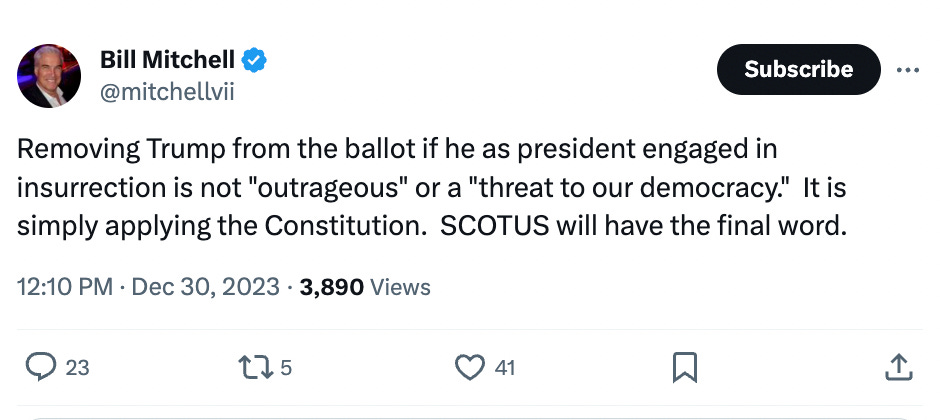
Bill Mitchell, a media figure and DeSantis supporter, doesn’t see the big deal:

The problem is that Trump is “super toxic”, so whatever. Orange Man is bad, so the things you do to Orange Man are unobjectionable. Of course you can take him off the ballot — he’s a jerk. That’s, like, the Constitution.

But the constant background music for me in these discussions is that the government of Canada construed a peaceful protest against vaccine mandates as a national emergency, on par with a foreign invasion, and started freezing bank accounts and mobilizing force for mass arrests. A “Western democracy”, hearing dissent, started turning off the dissenters’ money, which means that government took away the ability of peaceful protesters to pay for things like housing and food. The patience of the global political class for disagreement is narrowing, fast and hard. (Cf. e.g. Ardern, Jacinda.)

So see what’s happening in the United States, and see where it points. On January 6, thousands of protesters turned into maybe hundreds of rioters; many people at the Capitol were peaceful and calm, while some weren’t. Almost none were armed, none used guns, and the question of law enforcement infiltration, provocation, and entrapment remains open.

But no one published a manifesto calling for the violent overthrow of the United States government, and the crowd didn’t line up at the Capitol with rifles and homemade bombs to launch waves of armed attacks on Congress. Compare: here’s Bernardine Dohrn of the Weather Underground declaring war on the United States, and announcing on the radio that “our job is to lead white kids into armed revolution”. Find me that moment on January 6, the explicit declaration of armed revolution aimed at the destruction of the federal government. No one has been charged under the Insurrection Act because no one has violated the Insurrection Act. The “insurrection” is a political construction, not a legal case.

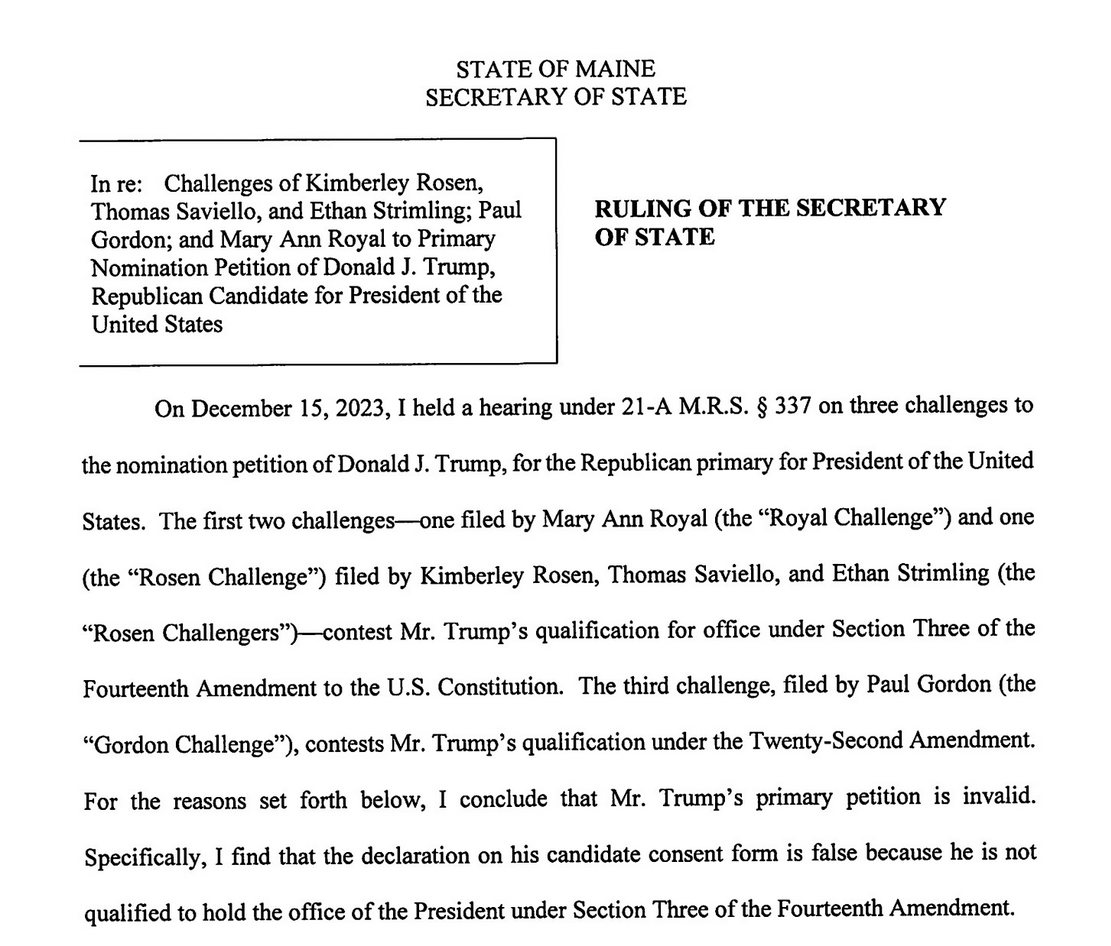
So a riot can be an “insurrection”, in the complete absence of insurrection charges and convictions, if Maine Secretary of State Shenna Bellows (D-Longhouse) feels like an insurrection happened. She can “rule” on that.

Lone officials can unilaterally declare that American citizens are ineligible for participation in elections, because the activities of [insert name of bad people here] can be politically construed as insurrectionist — in the absence of due process and a jury trial.
December 28, 2023

“Lich and Barber … now hold the record for the longest “mischief” trial in Canadian history”

“Autonomous Truck(er)s” describes the “Lawfare Archipelago” as Justin Trudeau’s government persecutes Tamara Lich and Chris Barber for their part in organizing the Freedom Convoy movement in 2022:

It has been almost two years since Canada’s Freedom Convoy took the country, and the world, by storm. In what has been hailed around the globe as the most popular protest anywhere against the international Covid Regime, represented in Canada by the venal and vindictive Prime Minister Justin Trudeau, the Truckers of the Freedom Convoy still occupy a place as heroes to millions.

Everyone remembers how the Freedom Convoy was crushed by Trudeau’s invocation of the Emergency Measures Act, and how bank accounts were frozen, credit cards, insurance, the entire financial lives of hundreds of people that were completely shut down. The police crackdown on peaceful protesters, smashing of windows and other vandalism committed against the protesters vehicles, trampling people with horses, the beatings, the arrests; an overwhelmingly disproportionate and wholly unnecessary asymmetric response.

In December of 2023, however, a number of those truckers and their supporters are still facing adversity and punishment, including potential jail time, with ongoing court cases, and in the situation with The Coutts 4, a trial which hasn’t even started yet.

These cases are illustrative of the corruption of the Canadian political system, the media, the courts and ‘justice system’, and the subversion of some of the founding pillars of western civilization.

Canada is no longer a free country by any stretch of the imagination.


Part 1 : Tamara Lich and Chris Barber

On Thursday, November 30, just a few weeks ago, I traveled to Ottawa to take part in an interview for a documentary film being made by former CBC journalist and now freelance podcaster Trish Wood, whose working title is The Trials of Tamara Lich. Trish had stumbled upon my writings and podcasts here at Substack, and invited me on her show to discuss the situation with the Coutts men being held as political prisoners. Impressed with my work on that, as well as my history in trucking and perspectives on the deeper meaning behind the Freedom Convoy, she wanted me to appear in this documentary; I was honored to be asked and happy to oblige.

As of this writing, the trial is on Christmas break, and may, possibly resume in March 2024. It should be noted that for the primary charges that Lich and Barber are facing, in their roles as organizers of the Ottawa portion of The Convoy, a 100% peaceful protest whose only acts of violence or property damage came at the hands of the police, they now hold the record for the longest ‘mischief’ trial in Canadian history.

Given the actions of our government, perhaps it is they who should be the accused.

Chris “Big Red” Barber, a trucker from Saskatchewan who specializes in hauling oversize agricultural equipment, became one of the faces of the Freedom Convoy through his frequent TikTok videos, sharing news about the protest to his many followers online.

It is these TikTok videos that appear to be the bulk of the evidence the Crown has against Mr Barber, though sharing information on a publicly available platform seems the kind of “crime” one would expect to be prosecuted in the country where TikTok is headquartered, The People’s “Republic” of China. The basic dictatorship, we should recall, that is “admired” by Prime Minister Trudeau.

Quelle surprise, coming from Cuba’s most infamous son.

The deeply unsurprising lack of evidence on the part of the Crown is one reason why this case continues nearly two years later; Trudeau, and the Laurentian Elite by whom he was groomed for glory, cannot accept that they went way out over their skis in the gross mismanagement of Covid, and their utterly disgusting treatment of the Freedom Convoy.

An example must be made of Barber and Lich, who are both facing ten years in prison should the Crown get the convictions they desire. “Copping a Tenner”, as they used to call a trip to one of Stalin’s Gulag Camps, is quite a cost to satiate Trudeau’s latent authoritarian proclivities and his narcissistic vanity. One wonders if this is not also an effort to prove to his real constituency, the forces of global corporatism and control exemplified by WEF leader Klaus Schwab, that Trudeau will preserve the image of the brand.

November 7, 2023

The “slopes of Lyle”, and why they matter

Filed under: Cancon, Media, Politics — Tags: , , , , — Nicholas @ 05:00

In The Line, Matt Gurney explains what Paul Wells christened the “slopes of Lyle” and why Canadian political discourse is so hypocritical so often:

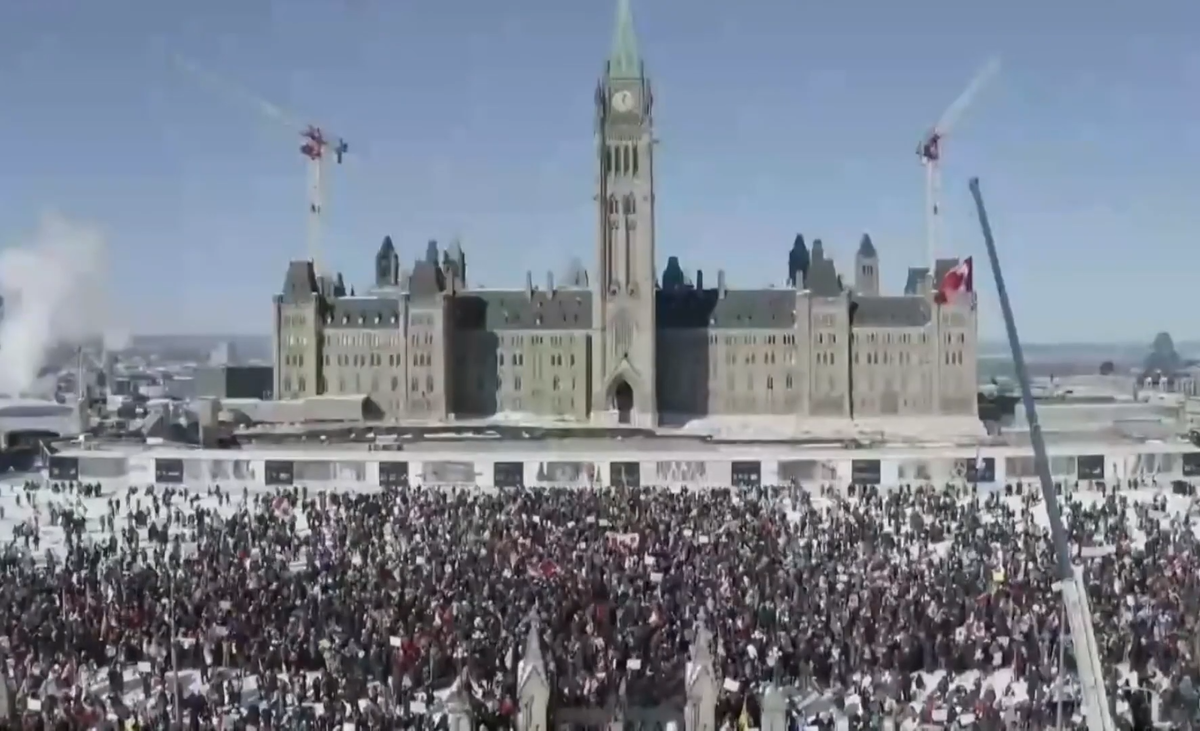
A screenshot from a YouTube video showing the (pick your team’s preferred term) [protest | insurrection] in front of Parliament in Ottawa on 30 January, 2022.
Photo via Wikimedia Commons.

It was a bit over a year ago when Paul Wells, in one of the best pieces of his I’ve ever read, created the concept of the “slopes of Lyle”. The “Lyle” refers to some polling published by Greg Lyle, of Innovative Research Group. I won’t spend a ton of time recapping the polling or what Paul drew from it, beyond the necessary: Lyle found and could graph what amounts, in effect, to political hypocrisy. Using the example of whether governments should meet with protesters, even if those protesters have broken the law, Lyle found that one’s opinion on the matter hinged less on any overall value-neutral philosophical belief and more on the specifics of the protesters. Left-leaning Canadians (NDP and Liberal voters, in Lyle’s poll) were a lot more sympathetic to a government that would meet with Indigenous Canadians (and supporters) protesting a new pipeline than they were with the Ottawa convoy protesters. CPC-supporting Canadians — and who’da thunk it?! — felt the reverse. Graphing out these positions resulted in those slopes Paul noticed — left-wing and right-wing support for governments meeting with protesters tanked when you changed who the protesters were.

The slopes of Lyle.

It’s been basically a month since the appalling assault by Hamas into southern Israel. Israel’s war against Hamas grinds on, and is producing the kind of horrible collateral damage we all feared. People across the West, including very much here at home in North America, are devastated by what they’re seeing, hearing and reading, and of course they are. It’s awful, every bit of it. There have been large rallies and protests and from them, we’re starting to see some of those Lyle-ian slopes emerge. It’s predictable, but it’s still bad, and it’s worth noting. Because we can do better, and it’s not hard to try.

Consider one issue: whether or not a protest is defined by the worst elements within it. Personally, I say no. Any large group of people necessarily becomes impossible for any organizer to control, and if terrible people show up to wave terrible signs, chant terrible slogans and do terrible things, I don’t think that reflects badly on everyone who showed up. That’s my overall philosophical view on such matters. I felt that way about the convoy in Ottawa, as some of you may remember — I tried really hard in my pieces from the capital to hammer home how the crowd there was a blend of the nasty and the harmlessly well-meaning. At the time, many were portraying the entire event as harmless — just a bunch of bouncy castle fans, folks! Others were portraying every last one of them as Confederate Nazis. Neither was accurate, and I said so then, and I’ve said so since.

Ditto with the protests we’re seeing in Canadian cities of late. I have no problem agreeing that many, probably even most, of the people showing up are good people, motivated by genuine concern over the plight of the Palestinian people, both in the broader sense of their aspirations for a better future but also over their current endangered state, as the war grinds on around them. I’m also not blind to the fact that some of what we’ve seen — some of the flags, some of the chants and slogans, some of the signs being waved, and some of the behaviour — has been wildly inappropriate, perhaps even illegal, and has absolutely gone well beyond simple criticism of Israel into outright antisemitism. There’s just no way to deny that we’ve had antisemites marching through our streets, saying and doing antisemitic things. Loud and proud, out in the open.

And yet I’ve noticed some, ahem, difficulty in admitting this or acknowledging this. And that’s interesting, because some of the very same people who will go to their deathbed believing the convoy was a Nazi uprising get very upset at the suggestion that there’s much to be worried about in the anti-Israel protests or that we should read much into people who want Jews killed for the mere fact of their Judaism.

So that’s a conundrum, eh? I don’t care what side you take. I really don’t. I just want you to be consistent. So I’ll just ask the question: does the presence of a radical group with a larger protest invalidate the protest and even tarnish the cause, or nah? Again, I don’t care which way you vote. But kindly put yourself on the record.

October 5, 2023

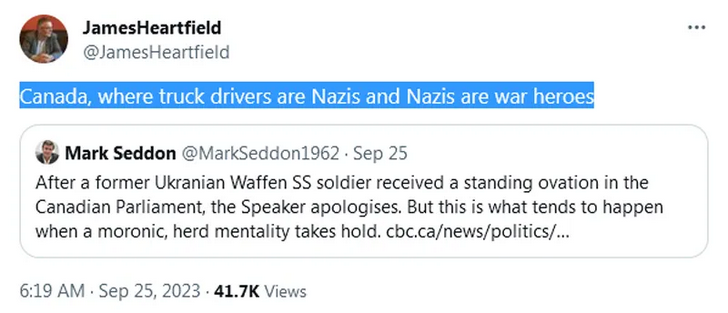
“Canada, where truck drivers are Nazis and Nazis are war heroes”

Filed under: Cancon, Law, Liberty, Politics — Tags: , , , — Nicholas @ 05:00

Donna LaFramboise on the “Coutts Four” — bona fide political prisoners of the Canadian state:

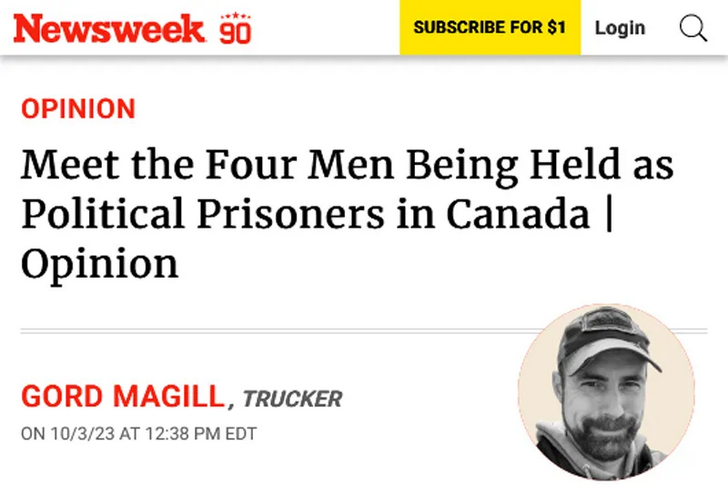
Gord Magill has a lengthy article over at Newsweek titled Meet the Four Men Being Held as Political Prisoners in Canada. These individuals are jointly accused of conspiring to murder police officers during a protest in Coutts, Alberta around the same time that the Freedom Convoy truckers were in Ottawa.

That’s a very serious charge, of course, but evidence appears scarce. I’ve not personally investigated this matter, but a former Toronto police detective named Donald Best has. In July, he outlined a long list of concerns, in addition to pointing out that “Everybody makes bail in Canada” — including the man “currently accused of the first degree murder of Toronto Police officer Jeffrey Northrup”.

Yet the Coutts men — three of whom have no criminal record — have been held without bail for nearly 600 days. Since they are legally innocent until proven guilty, this is horrifying.

As Gord writes in Newsweek, we are a country in which hard-working Canadians are called Nazis by the same Prime Minister whose government recently recognized an actual Nazi with a standing ovation in the House of Commons. What a strange state of affairs.

After speaking to each of the Coutts four, Gord provides a wealth of new info about them. These are working class guys — a power lineman, the owner of a small construction company, a master electrician, and a contractor. Three of them have children as young as 9, 10, and 11. Gord says only two of them “knew each other prior to their arrest”. It’s difficult to imagine a more unlikely group of cop-murder conspiracists.

June 10, 2023

Remember the Freedom Convoy of 2022?

The media worked very hard to demonize the grassroots protests that coalesced into the Canadian Freedom Convoy in early 2022, and they’ve continued to push the notion that either the movement was an utter failure or that it was a maple-flavoured January 6 “insurrection” righteously suppressed by our beloved Dear Leader and his stormtroops. Someone using the handle “Kulak” wants to remind you that the convoy wasn’t a failure and in fact was the catalyst for great changes both in Canada and around the world:

A screenshot from a YouTube video showing the protest in front of Parliament in Ottawa on 30 January, 2022.
Photo via Wikimedia Commons.

I keep encountering this misconception from people who don’t follow Canadian politics …

That somehow the Trucker convoy was defeated.

The Freedom Convoy was the most wildly immediately successful protest in Canadian history, maybe WORLD history.

People remember Trudeau’s crackdown, old ladies having their skulls cracked with batons, Disabled indigenous grandmothers trampled by police horses, Bank accounts frozen and public employees investigated for mere donations …

And there’s a big reason people remember this … It was dramatic, and the media and the regime certainly wanted you to think resistance was futile …

What people don’t remember is what happened in the immediate aftermath: The government caved on absolutely everything within a week for the most important things, and then a month or so for the rest.

First off there was the massive political shift that happened as the convoy was occurring:

Jason Kenny, the pro-lockdown Premiere of Alberta (Canada’s most conservative province) was forced to announce his resignation, and Alberta immediately lifted all its lockdown impositions.

Erin O’Toole the pro-lockdown leader of the Conservative Party was likewise forced to resign, his temporary replacement Candice Bergen (not to be mistaken with the actress) being a longtime rival opposed to lockdowns, and his main rival who replaced her after intra-party elections was Pierre Poilievre, the politician after Maxime Bernier who was quickest to embrace the Truckers and their cry for freedom.

As the convoy was ongoing Trudeau invoked the Emergencies Act (the Act which replaced the War Measures Act for invoking Martial Law) … Now these grant the government almost unlimited powers, famously the War Measures Act was invoked by Trudeau’s Father to detain Quebeckers and raid hundreds of homes without warrants during the FLQ separatist crisis of 1972 … the catch is that while the follow on Emergencies Act can be invoked by a Prime Minister Parliament has to sign off on the act’s continued use within one week.

Well skulls were cracked, accounts frozen, and as the week passed things came down to the deadline … On the very last night … Trudeau managed to get sign-off (without the Conservative opposition) from the House of Commons, but it had to go to the Upper House, the Canadian Senate.

NOW. The Canadian Senate is a shameful institution.

It’s like the British House of Lords but without the nobility.

A Senate seat is a lifetime appointment, by the Prime Minister … and that’s it. Little to no review, no democratic input, and this is supposed to be equivalent or superior to our elected House of Commons …

Naturally the go-to use of the Senate is as a spoils system for cronies. Do some shameful favour for a Prime Minister, raise a lot of money for the party, be politically connected to a provincial gov the PM wants to buy off … get a Senate seat.

One of the longest-standing political agreements in Canada is how badly the Senate needs to be abolished … but can’t be because Quebec is nominally overrepresented in the Senate, and abolishing it would cause a constitutional crisis.

H/T to Donna Laframboise for the link.

March 1, 2023

If the Freedom Convoy “actually was what it has often been portrayed as on social media — a horde of thousands of literal Nazis and Confederates set on violently overthrowing our democratically elected government — then [we’d] be living in the Confederate Republic of Nazi Canada by now”

In The Line, Matt Gurney explains how going through Justice Paul Rouleau’s Public Order Emergency Commission report in detail leads to some uncomfortable realizations about Canadian goverment and policing — at all three levels — failed to meet minimal expectations of competency and capacity:

A screenshot from a YouTube video showing the protest in front of Parliament in Ottawa on 30 January, 2022.
Photo via Wikimedia Commons.

The convoy crisis — and I’m mostly speaking here about the events in Ottawa, though the situation at the border crossings fit the same general pattern — forced Canadian police and political leaders to respond quickly to evolving circumstances. And Rouleau’s report is just a relentlessly brutal catalogue of the ways they failed.

Is it really necessary at this point to recap the failure of the Ottawa police? We at The Line have long maintained that the complete failure of the Ottawa police to plan for and control the protest not only allowed the convoy to entrench itself, but also established the psychological paradigm that would define the crisis for weeks: the convoyers held the initiative (not to mention the capital) and the Canadian state was befuddled and adrift. From that, a national crisis was born. Rouleau is just devastating. “The OPS [Ottawa Police Service]’s planning challenges,” he notes on page 56 of the first volume, “were compounded by a general breakdown of command and control.” Super.

He’s even more brutal on page 185 of the second volume: “The influx of Freedom Convoy vehicles and the disruptive behaviour by some protesters threw the OPS operational command at the NCRCC [a command centre] into a state of dysfunction. OPS Inspector Lucas described the atmosphere at the NCRCC as chaotic and explained that he and his team had neither the capacity to process the incoming information nor the resources to respond to the needs it was facing. In the late afternoon of January 29, the OPP’s [Ontario Provincial Police] representative at the NCRCC, Inspector Dawn Ferguson, reported to OPP Superintendent Abrams that OPS members in the NCRCC were panicked and were swearing and yelling orders at each other and at partner agencies.”

Huh.

Moving up a level of government, much has already been written about the cowardice of the Ford government. If any agency performed semi-well, it was the Ontario Provincial Police. The OPP was the force that was generating most of the critical intelligence used (or ignored) during the crisis. It was quick to realize that command-and-control had collapsed in Ottawa (see above), and to begin working with the RCMP on a plan — eventually a series of plans — to restore order. You can’t read POEC and conclude the OPP performed perfectly. Far from it. It was probably the best we had, though, but because Ford took a gander at the mess in Ottawa and decided to mosey on off to the cottage, it couldn’t do much.

Huh.

And that leaves us with the feds. I have maintained since last year that the federal government hasn’t received nearly enough attention in our understanding of what the hell went wrong last year. This has caused a fair degree of pushback, especially from Liberal supporters who read any reference to the “federal government” as “our beloved prime minister”. But no — while I don’t think the prime minister or the federal cabinet did particularly well during the crisis, the real federal failures were in the officials that supported the PM and his ministers.

Among the many other failures, the inability of the various government and police organizations to organize and properly share the information they were handling is perhaps the most disturbing:

If you want to see it yourself, check out pages 38 and 39 of the third volume. For those in a hurry, though, it turns out that even within the government, the flow of information was so bad that the clerk of the privy council, and the prime minister, noted that staff were learning about the convoy not via internal reports, but social media. The federal government had, as Juneau and Rigby have noted, “intelligence gaps” that “hampered the government’s ability to understand, anticipate, and respond to the situation, and to reconcile conflicting information such as contradictory reports about the size of the convoy”. The federal government didn’t have the software to process and analyze online posts, even public ones.

And then there was this (my emphasis added):

    [National Security and Intelligence Advisor] Thomas also described an information-sharing gap between law enforcement and government. Assistant Secretary to the Cabinet, Security and Intelligence, Michael MacDonald recalled a significant delay in receiving updates from the RCMP, due to the RCMP’s obligation to consult with each intelligence agency that has provided the RCMP with information prior to sharing that information further (known as the “third party rule”). The NSIA’s office did not receive situation reports, project reports, or other forms of information, such as Project Hendon reports, that the RCMP obtained from other law enforcement agencies. Prior to the events of the convoy, the NSIA was not aware of Project Hendon. …

    NSIA Thomas further stated that it was sometimes difficult to know how to interact with law enforcement agencies. She recognized that government must not interfere in operational matters, but thought that there was nonetheless useful information that could have been provided to decision makers without encroaching upon police independence. However, senior officials were uncertain how to obtain that information, and were concerned about “crossing the line” both in requesting information and in discussing solutions.

… huh.

And that doesn’t even cover our now-outgoing national commissioner of the RCMP being so clueless she decided to just not mention germane information during a critical meeting because … well, we never really got a good explanation for that one. Oh well. Enjoy your retirement, Commissioner Lucki!

February 19, 2023

“Enjoy the report”

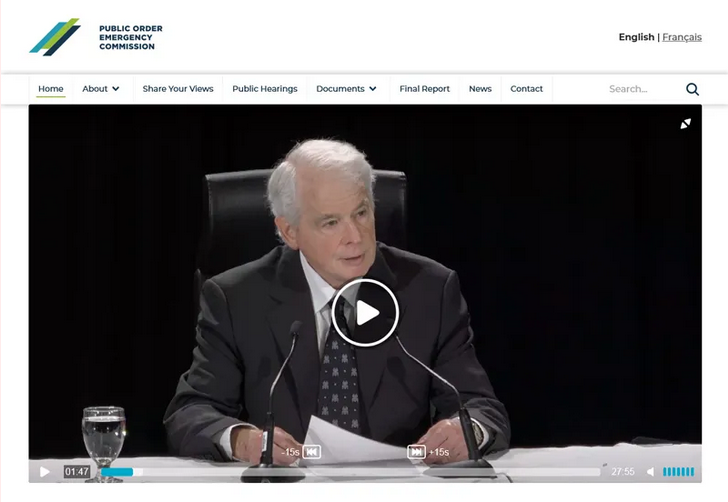
When the Canadian federal government invoked the Emergencies Act in February 2022, it began a legal timer for the government to set up a formal inquiry into the situation that triggered the use of the act which was intended to provide some clarity on whether the government was justified to do so. This inquiry had no legal powers to punish wrongdoing, but was merely supposed to uncover what went on both in public and behind the scenes at this time last year. The head of the commision, Paul Rouleau, was a long-time Liberal who’d once worked for former Liberal Prime Minister John Turner and had been appointed to the judiciary during Jean Chrétien’s premiership. It was perhaps too much to hope that he might return a report that made Trudeau or his government look bad.

Donna Laframboise started the Thank You, Truckers! Substack to record the events of the Freedom Convoy and the reports of participants, supporters, and opponents of the protests. She clearly wasn’t surprised at this outcome from the commission:

“Enjoy the report”. Those were the last words Commissioner Paul Rouleau uttered before rising and leaving the room yesterday. The room in which he cheerfully announced that the Canadian government was justified when it invoked the Emergencies Act against festive, peaceful, working class protesters a year ago.

Which part did he imagine we’d enjoy? The knowledge that there’s absolutely no accountability in our political system? The knowledge that a vast network of supposed checks and balances (funded year in and year out by the sweat of working Canadians) offers us no protection from tyrannical, rogue politicians?

Three months ago I wrote: Let us fervently hope Commissioner Rouleau is a man of integrity. One who understands that this is his moment. History will judge him by what he does here.

[…]

Given the opportunity to help resuscitate the limp, battered carcass of public trust, this gentleman instead extended every benefit of the doubt to the government, to the establishment, to police goons who crossed lines that should never, ever be crossed.

This is very bad news. Because, as Martin Luther King Jr observed 60 years ago, when peaceful protests get shut down some individuals

    will seek expression through violence; this is not a threat but a fact of history.

Many Canadians predicted this result. They had few expectations. They said Commissioner Rouleau was hopelessly compromised by long association with the Liberal Party of Canada. They said that, because the Liberal government had sole discretion to select its own judge, real accountability was never on the table.

The cynics were correct.

In the preview to The Line‘s weekly dispatch, the editors take a less pessimistic view of their initial sampling of the report:

Justice Paul Rouleau’s report on the federal government’s decision to invoke the Emergencies Act was published Friday. It is thousands of pages long. We have not read it all yet. But we have tackled parts of it, with an eye to answering two questions, for ourselves and for our readers. What the hell happened last year — what went wrong? And: do we agree with Justice Rouleau’s decision that that the federal government’s decision to invoke the act was indeed appropriate?

We’ll get to those questions, but let’s say a few things first.

First: if you sat down to read the Rouleau report to find evidence for what you’d already decided, you’ll find it. We believe that Justice Rouleau has written a fair and balanced report. He is clearly struggling, as we were a year ago, to accurately describe and probably even to fully perceive and understand just what “the convoy” was. Line editor Gurney, in reading Rouleau’s efforts to describe how the protest was both a largely peaceful and lawful assembly and also a meeting place for radical extremists, including some dangerous ones, found himself nodding along in recognition of Rouleau’s thought process. This nuance and complexity was precisely what he tried to convey from Ottawa last year.

Second: the same very much applies to political blame. There’s some for everyone here, folks. The federal government comes in for less than some others, but we don’t see in that any bias, but instead a recognition that none of this should have been the federal government’s problem. If the convoy protests had been effectively handled by local and provincial officials, it wouldn’t have been a federal issue at all. This has long been The Line‘s position, but we have also been critical the Trudeau government’s nasty habit of seeing in moments of crisis not a threat to be defused, but instead, a wedge to be eagerly seized upon and exploited. Justice Rouleau is kinder to the Liberals than we are. Perhaps he is simply less cynical. But he did make a point of criticizing Justin Trudeau for inflammatory language, and we were glad of that.

[…]

Third: Justice Rouleau’s finding that the federal government acted appropriately is more conditional and guarded than we think the overall tone of the report, and much of the attendant media coverage, suggests. We’ll get into this in more detail in a minute, but we wanted this front and centre before we start doing the heavy lifting: Rouleau does indeed side with the government, but it’s a pretty nuanced and cautious alignment. A win is a win, and the Liberals got their win here, but Rouleau’s report isn’t an endorsement of how the feds handled anything last year. It would be better for literally all of us if we tried to remember that.

The legacy media’s ability to sway public opinion has waned, but it still has some strength and this was especially so during the lockdowns where people had less opportunity to see for themselves or to talk with others outside the curated gardens of sites like Facebook. If the media had given the Freedom Convoy coverage the same credibility it chose to give to the violent riots, uh, I mean “mostly peacful protests” after the death of George Floyd, the federal government would not have treated the convoy participants and supporters as cavalierly as they did.

Only one federal political party dared to show any significant support for the protest, and the other day PPC leader Maxime Bernier posted a retrospective on the Freedom Convoy to YouTube:

Individual Conservative MPs may have expressed a bit of timid support but were noteworthy by their unwillingness or inability to do anything in Parliament to force the government to at least talk to the protest leaders or give them any benefit of the doubt.

January 22, 2023

One year later

Last year, the Freedom Convoy 2022 from all parts of Canada began to assemble and move toward Mordor, er, I mean Ottawa. Patrick Carroll remembers:

It’s hard to believe, but the one-year anniversary of the Canadian Freedom Convoy is upon us. It was January 22, 2022 when the convoy began to form across the country. Over the following week, thousands of trucks made their way to Ottawa, and on January 29 they arrived in the nation’s capital, loud and determined as ever.

The following month was one of the most tumultuous times in modern Canadian history. Downtown Ottawa was completely gridlocked, bridges were blocked, and politicians along with the media took every opportunity to smear the protesters.

Four weeks later, it ended quite a bit faster than most people expected. Armed with special powers from the never-before-invoked Emergencies Act, the government successfully dismantled the protest in a matter of days.

In hindsight, the practical effect of the protest on legislation is difficult to detect. Some Covid policies were probably relaxed a few months earlier than they otherwise would have been, but for the Convoy organizers, this was far from a decisive victory.

A debate has been raging in Canada ever since: were the protestors within their rights to do what they did? Those who support the convoy argue that they were, since the Canadian Charter of Rights and Freedoms guarantees the right to freedom of expression and freedom of peaceful assembly. Those who oppose the convoy largely agree with these freedoms, but argue that such freedoms should be subject to certain reasonable restrictions. Major obstructions to traffic, and especially obstructions to critical infrastructure such as bridges, are simply going too far in their view. Is the government supposed to stand by and let a group of hooligans bring the country to its knees?

That’s certainly the line the governments (city, provincial, and federal) generally chose to take and the media were almost chanting the governments’ line in unison. Of course, the governments were not all that well synchronized, which led to some blatant examples of deliberate misinformation/disinformation/gaslighting from one or another level, as Donna Laframboise points out:

During the inquiry into the use of the Emergencies Act, witnesses talked about misinformation as if it were a problem confined to contrarians on social media. But the Closing Submission of former Ottawa police chief Peter Sloly shows that government officials are, themselves, a fertile source of misinformation.

If someone in our federal government had demonstrated genuine leadership by going out and talking to the truckers, the protesters would likely have dispersed after the first weekend. Instead, a government that meets with professional lobbyists on 24,000 occasions a year refused to have a single meeting with working people who’d driven thousands of miles to the nation’s capital. Rather than being a grownup, the Prime Minister called them names. Rather than negotiating with the protesters, he told police to get rid of them.

According to Chief Sloly, the Ottawa force was understaffed at the best of times. Even after cancelling vacations and days off, there still weren’t enough personnel to deal with a significant, extended protest on top of normal duties.

From the beginning, the media failed to behave responsibly. It whipped up hysteria. It smeared and sneered. It sowed suspicion and fear of small town Canada, of those who see the world differently, of people who’d reached their breaking point. Big surprise a portion of the public did, in fact, become hysterical. As the protest dragged on, the pressure became intense. In lieu of pursuing a political resolution to what were clearly political grievances, slimy politicians pointed fingers at the Ottawa police. While simultaneously hamstringing them behind the scenes.

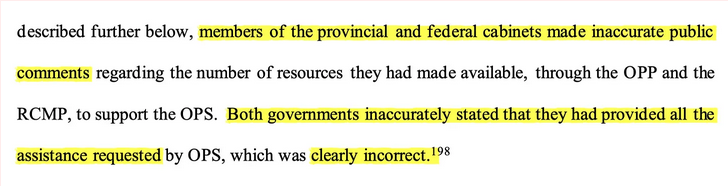
Page 43 of Chief Sloly’s Closing Submission says federal Public Safety Minister Marco Mendicino falsely told the world — on February 3rd — that the Royal Canadian Mounted Police (RCMP) had provided all the resources the Ottawa police had asked for. Four days later — on February 7th — he insisted 250 RCMP officers had been dispatched to Ottawa.

But the reality was quite different. Until mid-February, say his lawyers, the maximum number of RCMP officers available to the Ottawa force on any given day was 60 — far less than the number required.

It was the same story with the Ontario Provincial Police (OPP). On February 6th, Ontario’s Solicitor General Sylvia Jones falsely stated in an official document that “more than 1,500” OPP personnel had already been sent to Ottawa. In the words of Chief Sloly’s lawyers, this was “grossly inaccurate” (pages 80, 107).

Government ministers at both the provincial and federal level, they insist, made misleading statements about the degree of assistance Ottawa police had received. Statements that were “clearly incorrect” (page 53).

Which means Cabinet ministers were spreading misinformation. Misinformation that just happened to deflect blame away from themselves. That just happened to make the Ottawa Police Service look incompetent while turning the chief into a scapegoat. Ottawa’s first black police chief, a Jamaican immigrant, got thrown under the bus.

January 16, 2023

“The Commission has no power to find liability. Its report will not bind the government”

Filed under: Cancon, Government, Law, Liberty, Media — Tags: , , , , , , — Nicholas @ 03:00

Donna Laframboise continues to cover the Emergencies Act inquiry submissions, including one from Queen’s University law professor Bruce Pardy:

A screenshot from a YouTube video showing the protest in front of Parliament in Ottawa on 30 January, 2022.
Photo via Wikimedia Commons.

Shortly after the Emergencies Act commission finished listening to witnesses, he authored a grim opinion piece in the Toronto Sun.

His expectations are exceedingly low. In his words, the commission’s

    mandate is not to rule on the legality of the government’s actions but to inquire into “the circumstances that led to the declaration being issued and the measures taken for dealing with the emergency”. The Commission has no power to find liability. Its report will not bind the government. The Commission is ritual, and the purpose of ritual is performance not outcome – to make it appear that there is accountability without having to provide it. [bold added]

Let us hope he’s mistaken, and that Commissioner Paul Rouleau has a pleasant surprise in store for us. Whatever happens, Pardy’s article provides a useful history lesson. It describes the series of events that prompted the use of similar legislation the last time around:

    Between 1963 and 1970, the Front de libération du Québec (FLQ) committed hundreds of bombings and several robberies, killing six people, including Quebec deputy premier Pierre Laporte. In response, Pierre Trudeau’s government invoked the War Measures Act.

Six murders – including the politically motivated kidnapping and execution of a deputy premier. Seven years of violence. Hundreds of bombings. Compare and contrast to the three-week festive, bouncy-castle, hot-tub trucker protest in which not a single person was robbed, bombed, or murdered.

Times sure have changed. Today, the same Canadian federal government that talks constantly about equity, diversity, and inclusion failed to do a single thing to make the protesting truckers feel as though their concerns, perspectives, or lives mattered. Diversity is something the government preaches, but doesn’t practice. Disagree with the Prime Minister and you’re a fringe minority with unacceptable views. Inclusion is a fancy word that makes politicians feel good about themselves, but it isn’t a principle that informs their actual behavour.

December 28, 2022

The Twitter Files – “How does anyone run a business under these conditions?”

Chris Bray on the sheer magnitude of government(s) meddling in Twitter’s business (even though, yes, Twitter’s management was totally on-board politically with most or all of this meddling):

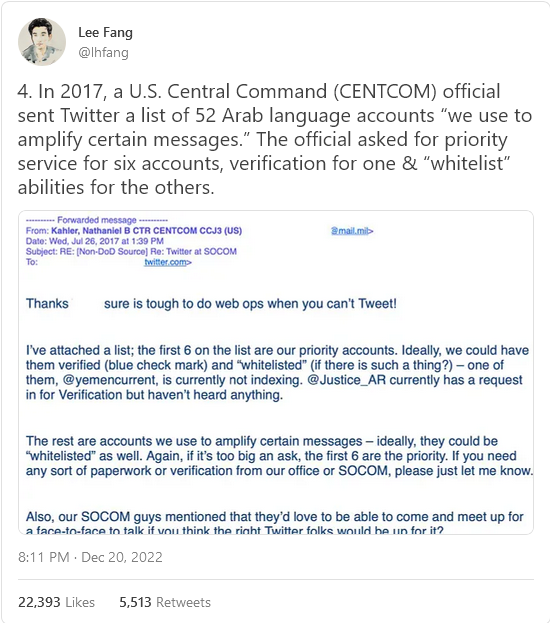
[…] Twitter has been constantly flooded with requests from at least dozens of separate federal entities, all of them needy and pushy and consuming the company’s time and energy: CENTCOM wants a meeting this week and CDC wants a meeting this week and NIH wants a meeting this week and the FBI wants a meeting this week and the White House wants a meeting this week and DHS wants a meeting this week and DOD wants a meeting this week even though CENTCOM already has one, and several members of Congress have some concerns they want the senior team to address this week, and …

Now: Twitter is a global platform. I would bet a kidney that there’s a Twitter Files equivalent for the Ottawa Police Department during the Freedom Convoy, and an RCMP file, and a Trudeau government file, and that Chrystia Freeland had some thoughts to share about some tweets she didn’t like. I would bet the other kidney that Twitter has equivalent files, in dozens of languages, from multiple government agencies in Iran and New Zealand and Australia and the Netherlands and the UK and Brazil and on and on an on.

As for my third kidney — just go with it, and we’ll clean up the biological metaphors later — state and local governments also expect Twitter to act on their content concerns and complaints about disinformation, which means fifty governors and attorneys general and state directors of public health and state police commanders picking up the phone, and 3,243 sheriffs and district attorneys and public health directors expecting to be able to reach out to their partners at Twitter, and close to 20,000 mayors and police chiefs, and thousands of state legislators and tens of thousands of city councilmembers, and on and on and on. “You tell this Jack Dorsey that I’m the damn mayor pro tem here in Glendale, and I want my concerns to be dealt with.”

And so, if we accept the premise that governments have special rights to demand content moderation, if the staff director of a legislative committee in the Arkansas state legislature and a sheriff in Maryland and the flag officers at all the MACOMS and Jen Psaki’s deputy assistant and a member of a county board of supervisors in Oregon and the chief of staff to the governor of Rhode Island, being Very Important People, all expect to by God get a direct meeting with Twitter executives because @buttchug623 is saying some things that they do not like at all, and oh by the way the prime minister of the Democratic Republic of the Congo is holding on line 6 and he’s pissed and when can you pencil in a half-hour with Turkmenistan’s finance minister, then how much does it cost to manage all of those relationships?

The regulatory affairs staffing buries the business — you can’t pay for that much face time with that many self-important officials. We need to schedule the senior management team for a meeting with the White House this week, ’cause they don’t like Alex Berenson. How does anyone run a business under these conditions? “Before you cook that cheeseburger for order number seven, the deputy assistant secretary for sustainable agriculture would like to share some thoughts on the environmental trajectory of industrial protein cultivation. And about that milkshake …”

In addition to the free speech problem and the pathologies of gleichschaltung, the Twitter files are about the way government without boundaries consumes resources from every entity it touches.

Twitter’s path to bankruptcy runs through the premise that every government official who doesn’t like a tweet deserves a meeting.

December 13, 2022

Unacceptable Views trailer

Filed under: Cancon, Government, Health, Media, Politics — Tags: , , , — Nicholas @ 04:00

Donna Laframboise:

Unacceptable Views is a fantastic new documentary film about the Freedom Convoy protest. All 100 minutes of it can be watched for free on Rumble here. Sharp, marvelous footage. Great interviews with truckers who went to Ottawa.

One of my favourite scenes occurs around the 19:20-minute mark. A Polish immigrant talks about being arrested as a teenager in Poland during the 1981 freedom protests in that country. She looks into the camera and says:

    I’m so proud that the young generation finally have balls and they stand up for the freedom …

The next gentleman who appears on screen, a Sikh, denies witnessing any misogyny, racism, anger, or violence in Ottawa. Instead, he describes the protest as “heaven on Earth, the energy was supreme”.

(more…)

December 7, 2022

The media: they hate you, they really hate you

Filed under: Cancon, Media, Politics — Tags: , , , — Nicholas @ 03:00

In a follow-up to yesterday’s post at Thank You Truckers!, Donna Laframboise provides more details on one of the individual cases highlighted by Douglas Murray in the Munk Debates last week:

Collectively, those examples demonstrate three things: Egregious journalistic bias. A frightening inability to empathize with the working class. And a bizarre eagerness to slander and dismiss fellow human beings.

Because the examples cited by Murray are vile, I didn’t amplify them. But those of you who watched the three-minute clip heard about them. On further reflection, therefore, I’m going to highlight one of them. Simply to make the point that Murray wasn’t exaggerating. When he used the words rancid and corrupt to describe our current media environment, he was wholly on target. Here’s a small portion of Murray’s remarks, including some third party profanity:

    You had a Toronto Star columnist saying, quote (sorry for the language), it’s a homegrown hate farm that was then jet-fuelled by an American right-funded rat-fucking operation

Yup, that was a real tweet from Bruce Arthur, who earns his living as a sports writer, currently for the Toronto Star. Below is his full reply to comments made by another Canadian journalist, Jeet Heer, who writes for The Nation, a far-left US publication:

I worked with both these gentlemen 20 years ago, in the earliest days of the National Post. It was a large newsroom. I didn’t get to know either of them.

The day after they catapulted these deluded, venomous tweets into the world, I arrived in Ottawa. I spent a week there, taking photos and actually talking to people. The Freedom Convoy protesters I met were supremely decent human beings. Since then, I’ve formally interviewed many of them. I’ve learned about their lives, their triumphs, their troubles, their sorrow.

My conclusion? If I were stranded on a desert island — or if a nuclear bomb detonated anywhere near me — I’d be sticking close to folks like these. People who know how to fix things, how to build things, and how to get things done. People sufficiently concerned about right and wrong to put themselves at risk. People of faith, many of them, who show us religion at its finest — a stable, calming force. A source of courage, strength, and big picture perspective.

Those who protested in Ottawa were human beings, not saints. That’s true of every large gathering. But overwhelmingly, they were decent, salt-of-the-earth people.

Even the members of the Canadian media still trying to be more even-handed in their coverage felt obligated to go looking for the red-hatted Trump supporters, the “hard men”, and the potential trouble-makers to the point that those relatively few people seemed disproportionally represented in the published articles. Of course, all of them spent a lot of time and effort desperately searching for more idiots like that paid government agent who’d briefly been able to get on-camera waving his Nazi flag …

December 6, 2022

The outcome of the latest Munk Debates

Filed under: Cancon, Media, Politics — Tags: , , , , , , , — Nicholas @ 03:00

Donna Laframboise summarizes what happened last week in the Munk Debates as Matt Taibbi and Douglas Murray spoke in favour of the proposition “Be it resolved, don’t trust mainstream media” while Malcolm Gladwell and Michelle Goldberg argued against:

Last week, an old fashioned public debate took place here in Canada. The topic:

Be it resolved, don’t trust mainstream media.

Journalists Douglas Murray (UK) and Matt Taibbi (US) argued the pro/agree side.

Journalists Malcolm Gladwell (Canada) and Michelle Goldberg (US) argued the con/disagree side.

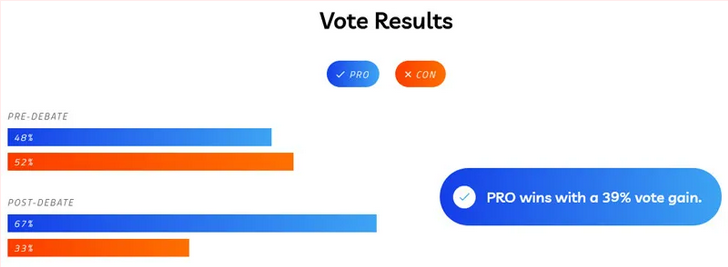
The event was sponsored by Munk Debates, which has been holding these events since 2008. Before the debate commences, audience members vote. Two hours later, they vote again.

On this occasion, the opinion swing was dramatic. The “don’t trust” side grew by 39% — apparently the largest swing ever in a Munk debate. At the beginning, slightly less than half of the in-house audience held this opinion (48%). Afterward, it was two-thirds (67%).

(When two-thirds of a population agrees on anything, you’re in supermajority territory — a number large enough to change constitutions.)

Here’s the key point: the winning side of the debate placed great emphasis on the scandalous manner in which Canada’s mainstream media covered the Freedom Convoy. Residing as he does in Britain, Douglas Murray had no trouble cutting through the nonsense. In the 3-minute video clip at the top of this post, he says our Prime Minister started by calling protesters names, and ended by invoking the Emergencies Act. Here’s what he says next:

    At such a time, what would the mainstream media do? It would question it. It would question it. The Canadian mainstream media did not.

    The Canadian mainstream media acted as an Amen chorus of the Canadian government. I will give you a couple of examples, but ladies and gentlemen I could go on for hours with examples of this. You had a CBC host describing the Freedom Convoy as a quote feral mob

    Why is this so rancid? Utterly, utterly rancid and corrupt. Because in this country, your media, your mainstream media is funded by the government. A totally corrupted system.

November 29, 2022

Prime Minister Justin Trudeau, expert projectionist

Filed under: Cancon, Government, Law, Liberty, Media, Politics — Tags: , , , — Nicholas @ 03:00

Donna Laframboise on part of Prime Minister Justin Trudeau’s performance last Friday at the Public Order Emergency Commission’s hearings in Ottawa:

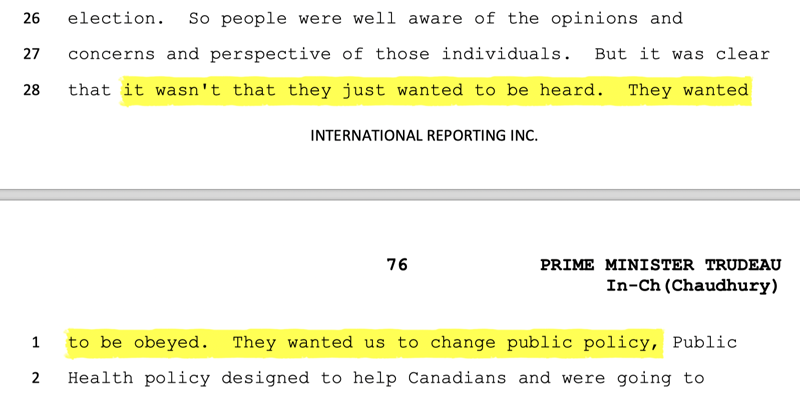
There’s a concept in psychology known as projection – accusing others of your own shortcomings. Last week Canada’s Prime Minister, Justin Trudeau, told an Emergencies Act hearing that Freedom Convoy protesters didn’t just want to talk. They wanted, he said, to be obeyed.

That was a strange word for him to use. About people he’d never spoken to. Yet it sums up his own posture rather nicely: Don’t bother trying to change my mind. I’m in charge, you must obey. Conversation over. Case closed.

According to Mr. Trudeau, the Freedom Convoy didn’t deserve a face-to-face meeting with his government because it wanted to change public policy. How terrible that free people, in a free country might want some influence over the increasingly draconian COVID rules they were required to follow. How unreasonable for them to come to Ottawa in an attempt to communicate the depths of their desperation.

A Prime Minister who received less than 33% of the votes cast during the federal election a mere four months earlier chose to thumb his nose at these protesters. Get lost, peasants. You will not be changing public policy.

[…]

We need to recognize what has happened here. The same federal officials who meet with corporate lobbyists by the thousands refused to have a single meeting with the truckers.

This, ladies and gentleman, is the state of Canada’s democracy.

November 25, 2022

“… no Canadian should trust any government enough to settle for a ‘trust me’ on matters this serious”

Filed under: Cancon, Government, Law, Liberty, Media, Politics — Tags: , , — Nicholas @ 05:00

Matt Gurney at TVO Today on the likely outcome of the Public Order Emergency Commission’s deliberations after testimony ends on Friday with whatever Prime Minister Justin Trudeau is planning to say:

A screenshot from a YouTube video showing the protest in front of Parliament in Ottawa on 30 January, 2022.
Photo via Wikimedia Commons.

We can’t simply outsource decision-making to federal agencies, particularly intelligence services! The federal cabinet has the right to disagree with CSIS’s conclusions, especially as it may consider a broader range of information. That’s why we elect leaders. That’s democracy.

But a democracy is supposed to empower the people. We are citizens, not subjects. And there is something very worrisome in Vigneault’s comments. He noted that he had information that informed his decisions — information that cannot be publicly disclosed. This apparently includes legal opinions that the federal government has not disclosed (citing attorney-client privilege) and also, reportedly, classified information.

Attorney-client privilege is important. So is secrecy on matters of national security. Both of these things are essential for a society to function. But, in this case, they are corrosive to democracy and public faith in the federal government.

The Trudeau government’s case for invoking the Emergencies Act isn’t a slam dunk. It’s not bulletproof. I’ve been swayed by some of its arguments and some of the testimony and documents that have been produced. But it hasn’t sealed the deal. And if its final argument hinges on legal advice and classified information, that’s … awful. That’s just a terrible situation. That would amount, in effect, to Trudeau saying, “We can’t tell you why we did this incredibly rare and controversial thing, but trust us.”

No.

That’s it. Just no.

I don’t trust this government. That’s partially, I grant, a criticism of this particular government, which I am not a fan of. It is often high-handed, arrogant, and incompetent, and I do not trust it won’t try to duck criticism by hiding dirty laundry behind privilege and secrecy. Its conduct over the past seven years in office simply has not earned it any benefit of the doubt.

But there’s a deeper truth here: no Canadian should trust any government enough to settle for a “trust me” on matters this serious. That’s not how a democracy is supposed to work. Bluntly, if that’s how your democracy is working, it isn’t working or a democracy.

« Newer PostsOlder Posts »

Powered by WordPress