Quotulatiousness

September 12, 2025

Canada’s temporary foreign worker programs

Filed under: Bureaucracy, Cancon, Education, Government, Health, Media, Politics — Tags: , , , , , , — Nicholas @ 05:00

At Acceptable Views, Alexander Brown calls for the end to the Canadian federal temporary immigration scam programs:

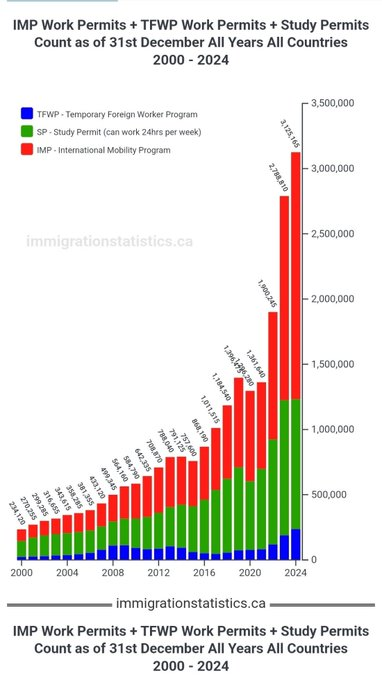
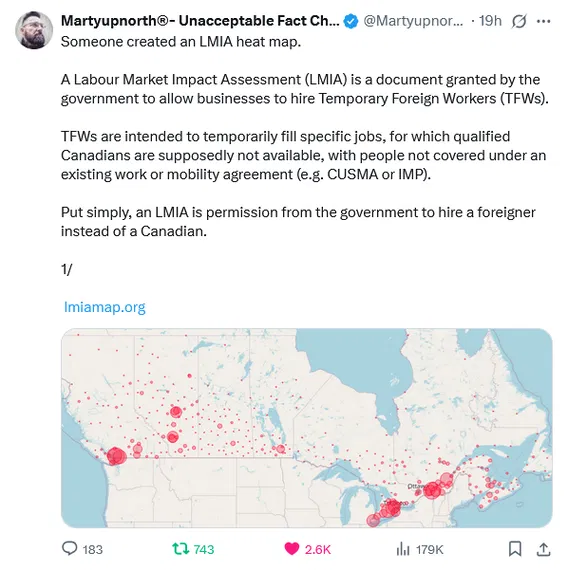
It’s not hyperbole to say that Canada has built an entire economy on exploiting cheap, foreign labour through TWFP, as well as the International Mobility Program (IMP). These are two slightly different programs that allow foreign nationals to work in Canada, with most going to Ontario. But contrary to its name, there is nothing “temporary” about the TFWP. Its original purpose was to remedy proven labour shortages while Canadians were hired and trained to eventually do the jobs in question. Meanwhile, the IMP allows international students to work—with or without a proven labour shortage—while they’re studying in Canada.

Between 2019 and 2023, the TFWP increased by 88 percent and the IMP increased 126 percent. They account for close to 1.58 million work permit holders, equal to roughly 7 percent of Canada’s labour force.

Taken together, the results of the TFWP and IMP are deplorable. The TFWP allows foreign nationals to be recruited abroad in vast numbers, brought to Canada, housed in degrading conditions, paid the minimum wage, forced to work long hours, pressured into not joining a union, and required to work for only one employer. Yes, the IMP is more flexible, but it’s more pernicious because it does not even pretend to address labour shortages.

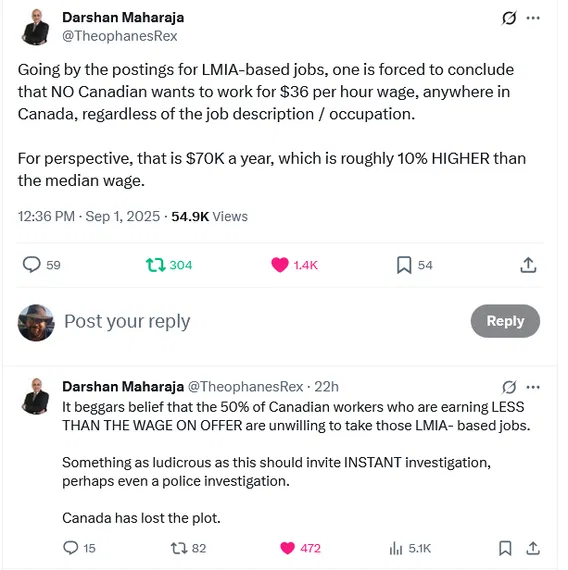
Both schemes are also of course bad for Canadians themselves. The problem is especially grievous for young Canadians trying to get started in the labour market. Canada lost 40,800 jobs this past July, the unemployment rate is now 6.9 percent, and youth unemployment (those between 15 and 24 years old) is now 14.6 percent.

Both the TFWP and IMP are used as business models. Hiring foreign nationals at minimum wage keeps prices low and profits high—most notoriously in the hospitality and trucking sectors, but no industry seems untouched now.

Addicted to cheap foreign labour

The use of the TFWP in the healthcare sector, for example, has grown by an appalling 1,700 percent since 2000. That dramatic rise has no doubt been abetted by the absence of uniform standards and credential recognition among Canadian provinces. If medical personnel could move easily from one province to another, shortages could be filled by Canadians. But historically this has not been possible, and so medical institutions have had to turn to the TFWP. Ontario’s recent determination to solve this problem by speeding up recognition of 50 “in-demand” professions from other provinces is a step in the right direction, and hopefully not too little too late.

Meanwhile, the IMP is a vehicle for outright fraud, ranging from fake acceptance letters from bogus “colleges” to elaborate human-trafficking schemes. Not long ago, nearly 50,000 holders of foreign student visas were working and attempting to settle here, rather than studying at any Canadian university or college. Most were migrants from India, and some were trying to cross the border illegally into the United States. The RCMP is now working with Indian law-enforcement to investigate alleged links between dozens of “colleges” in Canada and two “entities” in India allegedly facilitating passage into the U.S. When we reflect that an astounding 4.9 million temporary visas are set to expire this year, we have reason to believe that this abuse, exploitation, and fraud are on a much larger scale that we understand.

The consequences for young Canadians

Both the TFWP and the IMP serve to keep wages artificially low and profits high, and to price Canadians out of the job market. It wouldn’t be wrong to view these programs as distortionary government subsidies or welfare for unproductive businesses. The effects disproportionately harm younger Canadians who are priced out of the labour market, given that temporary workers overwhelmingly earn less than the median wage. And yet, we’re constantly hectored about labour shortages, Canadians’ “unwillingness” to do certain jobs, and the need for foreign workers.

It shouldn’t take much intellectual effort to see that the use of foreign labour and the difficulties of employing younger Canadians are two sides of the same ugly coin. Foreign workers are more cooperative because they are bound to their employers like serfs. They face normally insurmountable barriers to joining unions and have no attachment to the community in which they’re expected to work. In comparison, the domestic population is generally better educated and rooted in the local community.

Young Canadians can afford to be discriminating and should rightly expect higher wages than foreign nationals. Employers should instead work harder to invest in and reward their domestic workforce. In any other era, this would have been obvious. But now there is little incentive for businesses to look beyond cheap, foreign labour.

To get an idea of the magnitude of our collective failure here, consider the following fact. A 2024 study by RBC Economics revealed that Canadian businesses are sitting on a stockpile of cash worth almost a third of our country’s GDP. In other words, Canadian companies have the means to invest in hiring and training Canadians, but simply refuse to do so. The results of this refusal are stagnant wages, structural unemployment, and a de-skilling of the domestic population.

September 5, 2025

End the “temporary” foreign worker scam!

Filed under: Bureaucracy, Business, Cancon, Government — Tags: , , , , — Nicholas @ 05:00

In the National Post, Chris Selley explains why Pierre Poilievre and the federal Conservatives should be hammering their demand to eliminate the much-abused temporary foreign worker program:

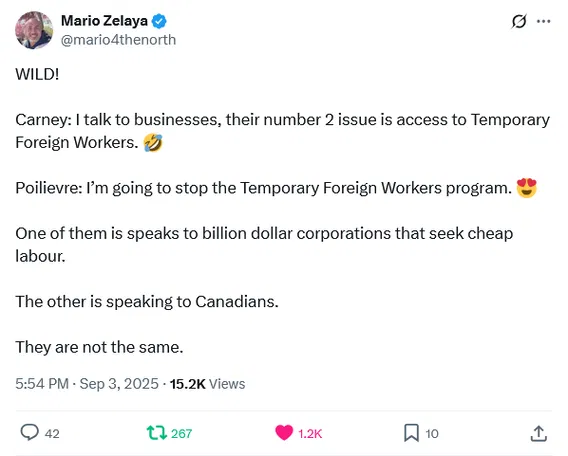
Youth unemployment stands at 14.6 per cent, according to Statistics Canada’s latest release. That’s the highest non-pandemic July figure since 2009 (15.9 per cent), at the nadir of the Great Recession. It makes nothing but good sense that Conservative Leader Pierre Poilievre would position himself, as he did on Wednesday, foursquare athwart bringing in any more temporary foreign workers to fill positions that certain employers swear blind they cannot fill with younger Canadians at any conceivable price.

“Why is (the government) shutting our own youth out of jobs and replacing them with low-wage temporary foreign workers from poor countries who are ultimately being exploited?” Poilievre asked, rhetorically, on Wednesday. By rights it ought to be a solid populist pitch to Canadians, and no-brainer policy besides.

Companies who use TFWs will insist it’s not about finding “cheaper” help, but about finding any help. Tim Hortons defended itself Wednesday noting that less than five per cent of its national workforce were TFWs — which seems like a very high number, right? It’s not just me? — and those hires tended to be clustered “in small towns and communities where local candidates are not available”.

But an odd sort of small town or community, surely, that can’t live without a Timmy’s, but that doesn’t have enough people to work at it. And it’s an odd sort of remedial program, surely, to bring in employees not from other parts of Canada but rather from halfway around the world. Especially since groups like the Canadian Federation of Independent Business (CFIB) swear blind they’re not after an hourly wage discount, just anyone who’s willing and able to fill the position. It was certainly a very odd kind of fishing resort, it struck me, that claimed this summer it couldn’t find any Canadian employees and needed the TFW program instead.

Didn’t kids used to flock en masse cross-country to take outdoorsy jobs every summer? Have I not read 150 tiresome baby-boomer op-eds on the topic?

The special pleading sometimes beggars belief. And unemployed young Canadians aren’t free to you and me, after all — whoever’s fault it is, if anyone’s, they’re an anchor on the economy. A Deloitte study commissioned by the King’s Trust Canada, published in November, estimated “that under the right conditions, overall real GDP could increase by $18.5 billion by 2034 — more than Canada’s entire arts, entertainment and recreation sector — and (Canada could) add an additional 228,000 jobs in the process” if “youth engagement in the workforce” significantly increased.

August 29, 2025

Memories of Bournemouth

Filed under: Britain, History, Media — Tags: , , , , , — Nicholas @ 05:00

It’s nearly sixty years since my family emigrated, but I still have golden memories of the family trips to the seaside, although my family went to Scarborough, Whitby, and Redcar rather than the Bournemouth of Pimlico Journal‘s childhood:

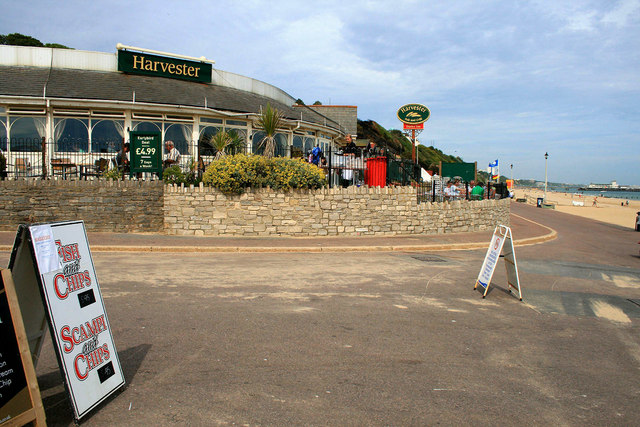
“Harvester at Durley Chine” by David Lally is licensed under CC BY-SA 2.0 .

At every possible opportunity in the summer weekends of my childhood, my father would take our family down to the coast. Our route to the sea was normally through the medieval city of Salisbury, across the chalk downs of Hardy’s Wessex, and into the piney moors of the New Forest. The destination would nearly always be Bournemouth, the prim, stately model of the British seaside town, perched magisterially on Dorset’s sandstone cliffs, above a long golden strand lapped by the warm waves of the Channel.

Our favourite beach was at Durley Chine, where we could park (for free, greatly appealing to my father) among obscured mansions in the shade of thick-smelling conifers, and make our descent to the shore, where the chine gives way to the rows of huts that line the promenade, and a reassuringly lower-middle class Harvester restaurant. We would while away the hours on the sand until the sky was orange, my mother reading, my father swimming, and my brother and I playing whatever games we could devise, mostly involving the throwing of sand. The day would end with fish and chips under the pines, watching the sun sink over the jurassic cliffs past Poole harbour, the gateway to King Alfred’s stronghold at Wareham.

These were among the most precious times of my early life, and the sights and sounds and smells of that part of the world and the accompanying hazy, worriless bliss are cherished sensations. Though the beach is public, it was one of those places that felt special and individual to my family, as if we had somehow carved out our own summer fief on the crowded shore.

It was on Durley Chine beach, on 24 May 2024, that two innocent women, Amie Grey and Leanne Miles, were attacked by Nasen Saadi, a criminology student from Croydon of Iraqi and Thai heritage. Saadi murdered Grey and left Miles in critical condition, and was sentenced this year to thirty-nine years in prison for his crimes. The incident was part of an escalating pattern of violence, particularly sexual violence, in the Bournemouth area over the past few years, with the beach as the focal point, a pattern which had begun in July 2021 with the brutal rape of a 15-year-old girl by Gabriel Marinoaica, a young man from Walsall who dragged his victim into the sea to commit his attack. Another notable incident occurred eight months later. Afghan asylum seeker and convicted killer Lawangeen Abdulrahimzai (he had shot two fellow Afghans while living illegally in Serbia in 2018, before fleeing to Norway, where his asylum claim was rejected, then travelling to Britain and successfully claiming asylum by pretending to be an unaccompanied fourteen-year-old, despite being an adult) stabbed Thomas Roberts (a local man and qualified precision engineer who had recently applied to join the Royal Marines) to death outside a Subway in the city centre, in a dispute over an e-scooter.

The news stories become relentless from that point. Among many depravities are the sexual assault of a 17-year-old boy by a group of Asian males on 17 June 2023, accompanied the same day by an attempted assault on a 16-year-old girl outside the fish and chip shop on the seafront. A week later, two girls, aged just 10 and 11, who would have been in primary school at the time, were sexually assaulted while swimming in the sea. As far as I can tell, none of these crimes have yet been prosecuted.

Two months after the murder of Amie Grey, on 19 July 2024, a day of delirious warmth culminated in violent clashes between youths, many coming in from London, on the seafront — clashes which were filmed and circulated on social media. In the chaos, a teenage girl was sexually assaulted. Jessica Toale, the freshly-elected Labour MP for Bournemouth West, a seat which had been Tory since its creation in 1950, said after the events of 19 July that crime and anti-social behaviour had become a ‘huge issue’ in contrast to the safe Bournemouth she remembered as a girl, stating that ‘… parents had told [her] that they are concerned about letting their daughters go to the town’. These are almost reactionary words from a Labour MP, and reflective of the mood of anxiety and decline that seems to have enveloped the city, a mood founded on the series of despair-inducing events plaguing residents and visitors. On 30 June, disorder similar to that witnessed in July last year returned to the seafront, with police making arrests across the country in the aftermath.

A week later, on 6 July, a young woman was raped in a public toilet adjoining the beach. The police have charged Mohammed Abdullah, a Syrian asylum seeker living in West London, with the crime.

August 18, 2025

Canadian grocers are “maple-washing” products to hide their actual origin

Filed under: Business, Cancon, Food — Tags: , , — Nicholas @ 03:00

Sylvain Charlebois on the new phenomenon of grocery stores going to great lengths to pretend that items for sale are Canadian when they’re not — “maple-washing”:

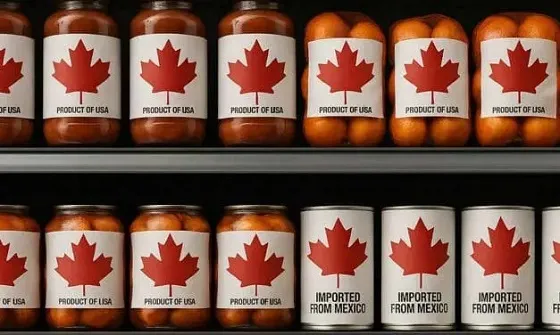
Image by Troy Media via Todayville

Canadian grocery retailers are misleading shoppers about where their food really comes from. Behind the patriotic packaging lies a growing problem: “maple-washing” — using Canadian symbols to suggest products are homegrown when they’re not. It’s eroding consumer trust and must end.

That’s why more Canadians are paying closer attention to what labels actually mean. Awareness around origin labelling has grown as people learn the difference between “Product of Canada”, “Made in Canada”, and “Prepared in Canada”. The Food and Drugs Act requires labels to be truthful and not misleading. A “Product of Canada” must contain at least 98 per cent Canadian ingredients and processing. “Made in Canada” applies when the last substantial transformation happened here, while “Prepared in Canada” covers processing, packaging or handling in Canada regardless of ingredient source.

The differences may seem technical, but they matter. A frozen lasagna labelled “Prepared in Canada”, for example, could be made with imported pasta, sauce and meat — packaged here but not truly Canadian. These rules give consumers the clarity they need to make informed choices.

Armed with this clarity, many Canadians have become more selective about what they buy. That vigilance has emerged alongside a surge in consumer nationalism, spurred partly by geopolitical tensions and anti-American sentiment. Even with U.S. giants like Walmart, Costco and Amazon dominating Canadian retail, many shoppers are deliberately avoiding American food products. The impact has been significant: NielsenIQ reports an 8.5 per cent drop in sales of American food products in Canada over just a few months. In an industry where sales usually shift by fractions of a per cent, such a drop is extraordinary. It shows how quickly Canadians are voting with their wallets.

That kind of shift, rare outside of crises, caught many grocers off guard. The sudden change left supply chains long dependent on U.S. products under pressure, and store-level labelling grew inconsistent. Early missteps — like maple leaves displayed beside imported goods — were excused as logistical oversights. But six months later, those excuses no longer hold. Persisting with misleading displays and false origin claims has crossed the line into misrepresentation. Instances of oranges or almonds labelled as Canadian, with prices quietly adjusted after complaints, show the problem is systemic, not accidental.

June 25, 2025

QotD: Marie Antoinette and the “Diamond Necklace” scandal

Filed under: France, History, Quotations — Tags: , , , — Nicholas @ 01:00

Today, the Diamond Necklace affair has been relegated to the status of sensational footnote in history books about the French Revolution. Throughout the 19th century, however, the scandal was widely believed to have been a major factor in the overthrow of the Bourbon monarchy. Decades after the French Revolution, Napoleon observed from the vantage point of his post-Waterloo exile: “The Queen’s death must be dated from the Diamond Necklace trial”. […] And here’s the irony: While the Diamond Necklace affair was the scandal that most tarnished Marie Antoinette’s reputation, it was one in which she was almost certainly guiltless.

The origins of the affair stretched back to Louis XV, who wished to lavish on his mistress, Madame du Barry, a splendid diamond necklace containing 647 stones and weighing 2,800 carats (worth roughly $15 million today). But Louis XV died before the sale of the necklace was concluded. And when young Louis XVI took the throne, the Paris jewelers Boehmer and Bassenge hoped the new king would purchase the same necklace for his own queen, Marie Antoinette. However, she refused to accept a piece of jewelry that had been created for the previous king’s mistress.

Meanwhile, a socially ambitious minor aristocrat named Jeanne de la Motte was plotting to get her hands on the necklace. Married to the Comte de la Motte, she was also the mistress of Cardinal de Rohan, former French ambassador to Marie Antoinette’s native Austria. Madame de la Motte managed to convince Cardinal de Rohan not only that Marie Antoinette wished to possess the necklace, but that she was acting on the Queen’s behalf. He could ingratiate himself at court, she insisted, by obtaining it. Cardinal Rohan foolishly purchased the necklace on credit, under the naive belief that he’d be repaid by Marie Antoinette. The scam concluded with Madame de la Motte stealing the necklace from the cardinal and, using her husband’s louche connections, selling it in pieces through fences in England.

This tawdry business was closer to comic opera than an affair of state. But when the fraud was discovered, the scandal gripped Parisian society. Louis XVI was so infuriated that he had Cardinal de Rohan arrested and imprisoned in the Bastille, which only heightened public interest. Marie Antoinette was already being caricatured in pamphlets as a depraved nymphomaniac. It was now open season.

In some caricatures, she appeared as a wild beast, a tiger feeding on the French nation. In others, she was depicted as an ostrich, a French wordplay with her home country Autriche, for Austria, which reads like autruche for ostrich. Even worse, she was depicted in pornographic postures, legs open and genitals gaping, cuckolding her obese husband with a succession of lovers, including lesbian trysts. Allusions to her sexual appetites suggested a carnal relationship with Satan. Robespierre’s publication Le Journal des hommes libres described her as “more bloodthirsty than Jezebel, more conniving than Agrippina”. The pamphlets blamed Marie Antoinette for all the nation’s misfortunes, including economic recession. She was so hated by the French public that there were serious concerns for her physical safety.

[…]

Cardinal de Rohan, meanwhile, was tried for his role in the Diamond Necklace affair. Astonishingly, he was acquitted. The scheming Madame de la Motte met a different fate. She was found guilty of theft and sentenced to be whipped and branded on the shoulder with the letter V for voleuse (thief). She was also incarcerated in the Salpêtrière prison in Paris, but escaped to London. In 1789, she published a book, Mémoires justificatifs, a scathing tell-all memoir about Marie Antoinette. It was a good year to attack the French monarchy, for the revolution was just getting going. Madame de la Motte was never returned to France to face justice. Exiled in London, she died in 1791 after falling from a window, apparently fleeing debt collectors. She was buried in St. Mary’s Churchyard in south London.

Matthew Fraser, “Marie Antoinette: Figure of Myth, Magnet for Lies”, Quillette, 2020-06-24.

June 19, 2025

QotD: Peer review and the replication crisis

Filed under: Bureaucracy, Education, Media, Quotations, Science — Tags: , , , , — Nicholas @ 01:00

But what about the error correction function of peer review? Surely it’s important to ensure that the literature doesn’t fill up with bullshit? Shouldn’t we want our journals to publish only the most reliable, correct information – data analysis you can set your clock by, conclusions as solid as the Earth under your feet, uncertainties quantified to within the nearest fraction of a covariant Markov Chain Monte Carlo-delineated sigma contour?

Well, about that.

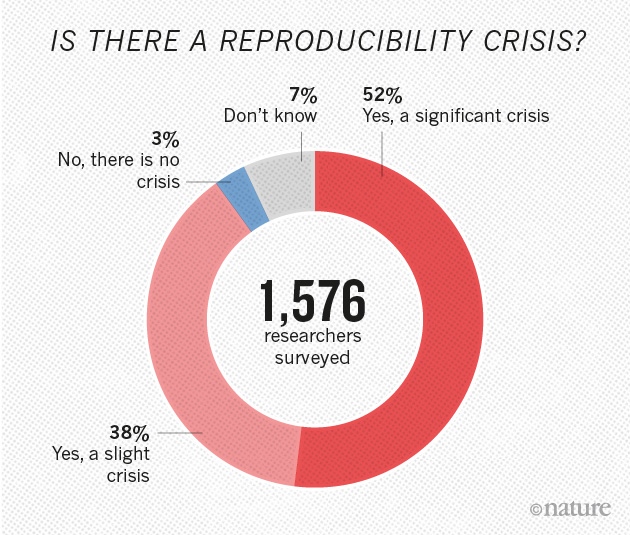
The replication crisis has been festering throughout the academic community for the better part of a decade, now. It turns out that a huge part of the scientific literature simply can’t be reproduced. In many cases the works in question are high-impact papers, the sort of work that careers are based on, that lead to million-dollar grants being handed out to laboratories across the world. Indeed, it seems that the most-cited works are also the least likely to be reproduced (there’s a running joke that if something was published in Nature or Science, you know it’s probably wrong). Awkward.

The scientific community has completely failed to draw the obvious conclusion from the replication crisis, which is that peer review doesn’t work at all. Indeed, it may well play a causal role in the replication crisis.

The replication crisis, I should emphasize, is probably not mostly due to deliberate fraud, although there’s certainly some of that. There was a recent scandal involving the connection of amyloid plaques to Alzheimer’s disease which seems to have been entirely fraudulent, and which led to many millions – perhaps billions – of dollars in biomedical research programs being pissed away, to say nothing of the uncountable number of wasted man-hours. There have been many other such scandals, in almost every field you can name, and God alone knows how many are still buried like undiscovered time bombs in the foundations of various sub-fields. Most scientists, however, are not deliberately, consciously deceptive. They try to be honest. But the different models, assumptions, and methods they adopt can lead to wildly divergent results, even when analyzing the same data and testing the same hypothesis. Beyond that, they can also be sloppy. And the sloppiness, compounded across interlinked citation chains in the knowledge network, builds up.

Scientists know quite well that just because something has received the imprimatur of publication in a peer-reviewed journal with a high impact factor doesn’t mean that it’s correct. But while they know this intellectually, it’s very difficult to avoid the operating assumption that if something has passed peer review it’s probably mostly okay, and they’re not inclined to spend valuable time checking everything themselves. After all, they need to publish their own papers – in order to finish their PhD, get that faculty position, or get that next grant – and papers that are just trying to reproduce the results of other papers, that aren’t doing something novel, aren’t very interesting on their own, hence unlikely to be published. So instead of checking carefully yourself, you assume a work is probably reliable, and you use it as an element of your own work, maybe in a small way – taking a number from a table to populate an empty field in your dataset – or maybe in an important way, as a key supporting measurement or fundamental theoretical interpretative framework.

But some of those papers, despite having been peer reviewed, will be wrong, in small ways and large, and those erroneous results will propagate through your own results, possibly leading to your own paper being irretrievably flawed. But then your paper passes peer review, and gets used as the basis for subsequent work. Over time the entire scientific literature comes to resemble a house of cards.

Peer review gives scientists – and the lay public – a false sense of security regarding the soundness of scientific results. It also imposes an additional, and quite unnecessary, barrier to publication. It frequently takes months for a paper to work its way through the review process. A year or more is not unheard of, particularly if a paper is rejected, and the authors must start the whole process anew at a different journal, submitting their work as a grindstone for whatever rusty old axe the new referee is looking to sharpen. Far from ensuring errors are corrected, peer review slows down the error correction process. A bad paper can persist in the literature – being cited by other scientists – for some time, for years, before the refutation finally makes it to print … at which point some (not all) will consider the original paper debunked, and stop citing it (others, not being aware of the debunking, will continue to cite it). But what if the refutation is itself tendentious? The original authors may wish to reply, but their refutation of the refutation must now go through the peer review process as well, and on and on it interminably drags …

As to what is happening behind the scenes, no one – not the public, not other scientists – has any idea. The correspondence between referees and authors is rarely published along with the paper. Whether the review was meticulous or sloppy, whether the referee’s critiques warranted or absurd, is entirely opaque.

In essence, the peer review process slows down the publication duty cycle, thereby slowing down scientific debate, while taking much of that debate behind closed doors, where its quality cannot be evaluated by anyone but the participants.

John Carter, “DIEing Academic Research Budgets”, Postcards from Barsoom, 2025-03-17.

April 29, 2025

QotD: The confidence game

Filed under: Law, Media, Quotations, Technology, USA — Tags: , , , — Nicholas @ 01:00

… the basics of the confidence game have not changed all that much with the new technology. The confidence man gets his name because he is adept at winning the confidence of the mark. The mark then lowers his defenses and foolishly trusts the con man, rather than his own natural skepticism. The mark is manipulated into thinking the con man is a friend or at least someone who can be trusted. The con man then uses that trust to exploit the mark.

The way in which the con men does this is by flattery. The mark trusts the con man, because the con man finds small ways to confirm the beliefs of the mark. The adept grifter will be a good listener and pick up the little things that the mark thinks are important, like religious beliefs or opinions about personal matters. Seemingly out of the blue, the con man will express those same opinions, which flatters the mark. After all, everyone likes being told that their private opinions are smart.

That’s something you see with the internet grifters. They often have worn a lot of masks as they seek out on-line audiences. […]

Another aspect of the con that remains constant is how the con man uses his alleged status as a victim to work the mark. Con men will use their mark’s natural empathy to win their confidence. Today that often means claiming the big bad tech companies are censoring them. Alternatively, they will claim evil trolls are haunting their internet activity, causing them harm. The term troll has been changed from meaning someone seeking attention to something almost supernatural.

The Z Man, “Carny Town”, The Z Blog, 2019-12-29.

February 26, 2025

The more DOGE uncovers, the more we see that western governments are really vast graft machines

Filed under: Bureaucracy, Government, Media, Politics, USA — Tags: , , , , , — Nicholas @ 05:00

Elizabeth Nickson discusses the ramifications of all the wasted money uncovered by DOGE in the first month of investigations and what it almost certainly confirms about the actual value taxpayers are getting for their money:

So essentially the entire town of Washington, D.C. has been stealing. The anomalies are those who are not stealing. $4.7 trillion, almost impossible to trace, represents two-thirds of the annual U.S. budget. And if it’s happening in the U.S., it is happening everywhere: France, Canada, the U.K., Germany, where budgetary processes are probably even more opaque than those of the U.S.

How does the Department of Defence have a $35 trillion black hole?

I used to think of people who worked for the government with a kind of veiled contempt or, in a more benign mood, compassion. I thought of them as pity jobs for those without initiative, as jobs paying off lefty campaigners, as a warehouse for the barely competent. In my own dealings with them, I found them punitive and extractive, papering me with demands to spend more and more money to hire more and more of their pet contractors, to get approval. In my working life, looking at the results of their involvement in America’s rural areas, I hated them for the hell they visited on people unable to fight back. They forced bad science on good people, and refused to see reason. They ruined forests, water courses, fisheries, and township after township turned to dustbowl status. The misery in rural sitting rooms in every state in the U.S. was palpable, long lasting; the green Blob ruined families for generations.

But I did not think of them as being embroiled in a theft so large as to be unparalleled in world history.

The level of the theft has now to be dawning on everyone not living off the public purse which is, what, 60%, 70% of us? The anger setting in is soul-deep, and very very powerful. People who live straightened lives, the poorly pensioned, those living off the laughable social security stipend, those waiting for health care, those whose children can’t even dream of an education, of college, of a six-figure salary which is now subsistence in the ruined cities. Those facing cancer treatment because of the vaccine, and don’t have excess funds. Their families, despairing, hurting, broke.

This isn’t going to go away. It affects everyone. Not addressed down to its deepest level, you are looking at a tax revolt, a national strike. A revolution. A real one, not a papered paid-for color revolution, which is what they have been doing to us.

Those living on social security should have five times the pension they do.

Can you count how many of those there are? Can you?

And meanwhile this:

Is this true? To this date, unknown; the digging continues. Look at this ghastly creature. She apparently has an account in the Cayman Islands. Look at her all compassionate and condescending. She started a war that killed 1.5 million people so far. And apparently got rich from it. A mass murderer celebrated at Upper East Side dinner parties.

Memes like this rocket around, and every one is now suspect. At this point who cares if it’s true, it’s truthy, it makes sense that she made out like a bandit, that Alexandra Ocasio-Cortez and Ilhan Omar have millions hidden somewhere. Ocasio can say “I only have $500,000!” all she wants, but we don’t believe her. If the Wall St Journal says it is false, we don’t believe them. Do you actually think they’d have the money sitting in their savings account? No, it would be buried off-shore. The media is not only complicit, it is the principal actor in this scam. It built the fantasy world we live in, where people read The Guardian, the Times and the Globe and Mail and think they’re informed.

No, they are being propagandized. And as a result, no one sane believes anything any legacy newspaper or television or media says anymore. They hid the theft. They did not report on it. No one trusts a thing they say.

Update: Fixed broken link.

October 1, 2024

TikTok’s Dissociative Identity Disorder (DID) community

Filed under: Health, Media — Tags: , , , , , , — Nicholas @ 05:00

The more we experience the joys of widespread social media, the more people seem to discover ways to bring attention to themselves for genuine or dishonest reasons. Freddie deBoer looks at the DID-sufferers on TikTok and assesses the chance that such a rare disorder can have had so many newly discovered sufferers:

Let me turn back to the TikTok “systems”, the strange, maybe-shrinking world of adolescent women on social media who pretend to have an incredibly rare and debilitating mental illness and treat it as a fun and quirky alternative lifestyle.

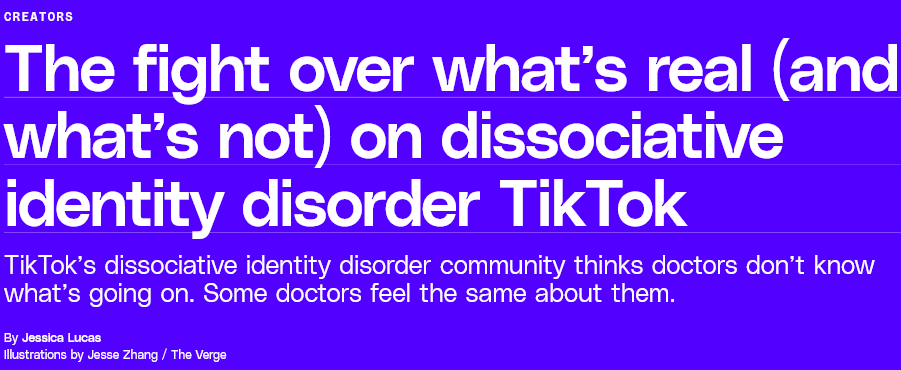
This piece from The Verge, though a little misguided, is a good jumping off point for this topic. The basic story is pretty simple. Dissociative identity disorder (DID), long referred to as multiple personality disorder, is a remarkably controversial diagnosis that has long captured the public imagination. It’s not hard to see why; the idea of someone who switches from one personality to the other is lurid and dramatic, making it easy fodder for television. (The number of episodes of legal dramas about DID is immense.) The condition also invites a particularly stark consideration of the question of individual agency and culpability for bad deeds. As you can imagine, pretending to have “alters” can be very convenient; a notorious case involved an embezzler whose only defense for his crimes was that he had multiple personalities and one of them stole the money. There have long been researchers and clinicians in psychiatry who doubt the very existence of DID, and even among those who are friendlier to the concept, the disorder is known to be incredibly rare. Many prominent cases of DID have proven in time to be fraudulent. The most famous American case, that of “Sybil“, was particularly tragic. The woman who supposedly suffered from the disorder, who faced a childhood of abuse and neglect, would go on to admit to her psychiatrist that she had made the alternate personalities up. (We know because we have the letters.) But the doctor, who had been made wealthy and famous thanks to her work with Sybil, threatened to withdrawn her financial support if Sybil did not recant that confession. Having no other choice, she did.

What DID TikTok asks us to believe is that, in the span of maybe half a decade, tens of thousands of adolescent women developed DID, an exceedingly rare disorder marked by symptoms entirely unlike those on your For You page. The Verge article, written by Jessica Lucas, is typical of the media’s take on this issue, to the degree that they’ve written about it at all: relentlessly sympathetic to the DID TikTok adolescents even when grudgingly admitting that there’s a lot of fakery. And admit that she does, as it would be essentially impossible to pretend otherwise. Even the wokest wokie couldn’t help but look at this shit and conclude that a lot of it is bullshit.

The cases of DID that are considered to be particularly valid or believable are very few, and the people who have suffered in them have been people living absolutely wasted lives, lives filled with abuse and instability and addiction and misery; the overwhelming majority of DID TikTokers appear to be living perfectly stable and successful adolescent lives. Those with DID have almost never professed to be able to switch from one alter to another on command; many DID TikTokers playact that exact behavior for their viewers. Alters are notoriously uncooperative towards each other; TikTok DID videos routinely feature alters happily participating in “roll calls” in which they switch from one identity to the next, conveniently timed for the creation of #content. (The DID people claim that really they’re just opportunistically capturing organic switches, but a) it’s very clear that many of these videos are filmed in one day and b) that would still require alters to willingly turn the camera on and get into the costume etc, which is not at all how alters have traditionally acted.) In the DID literature alters are almost never aware of what’s happening when another alter is “fronting”; on DID TikTok they almost universally are, justified with the convenient idea of “co-consciousness,” which is one of many evolutions of DID these people have implemented to allow their little pageant to continue. Most people with DID diagnosis, historically, have not been photogenic women with an interest in getting more followers. I could go on.

Lucas’s piece is particularly useful for the remarkable, remarkably depressing story of Dr. Matthew Robinson, a clinician and researcher from Harvard Medical School’s McLean Hospital. (The site of Girl, Interrupted, among other things.) Like a lot of people in psychiatry, Robinson noted with alarm that his hospital had “been inundated with referrals and requests from schools, parents, and our own adolescent treatment and testing services to assess for symptoms of what [patients] call DID.” He proceeded to discuss the difficulties this sort of situation provokes in an already-overtaxed mental health system, and spoke frankly about the fact that a considerable number of the people presenting with this disorder obviously do not in fact have it. He stated plainly that which many are too circumspect to say, which is that these TikTokers are faking. The consequence, of saying this in a lecture with his professional peers, was review-bombing of the hospital online, threats, a call to have Robinson’s medical license revoked, and sufficient harassment that McLean pulled online videos of the lecture. The online mob engaged in the typical social justice-vocabulary freakout campaign, McLean folded, and as stated in the piece, most researchers are now too scared to publicly comment on this absurd situation. If someone tells you that there is no such thing as a social justice-inflected cancellation campaign, you can point to this exact scenario and to the vicious and vengeful disability rights movement in general.

To be clear, I think that probably literally zero of the people who perform DID on TikTok have the disorder. Zero. I imagine that a significant portion of them have deluded themselves into thinking they do. But I’m quite confident that most of them are very well aware that they’re faking.

May 26, 2024

“Naked ‘gobbledygook sandwiches’ got past peer review, and the expert reviewers didn’t so much as blink”

Jo Nova on the state of play in the (scientifically disastrous) replication crisis and the ethics-free “churnals” that publish junk science:

Proving that unpaid anonymous review is worth every cent, the 217 year old Wiley science publisher “peer reviewed” 11,300 papers that were fake, and didn’t even notice. It’s not just a scam, it’s an industry. Naked “gobbledygook sandwiches” got past peer review, and the expert reviewers didn’t so much as blink.

Big Government and Big Money has captured science and strangled it. The more money they pour in, the worse it gets. John Wiley and Sons is a US $2 billion dollar machine, but they got used by criminal gangs to launder fake “science” as something real.

Things are so bad, fake scientists pay professional cheating services who use AI to create papers and torture the words so they look “original”. Thus a paper on “breast cancer” becomes a discovery about “bosom peril” and a “naïve Bayes” classifier became a “gullible Bayes”. An ant colony was labeled an “underground creepy crawly state”.

And what do we make of the flag to clamor ratio? Well, old fashioned scientists might call it “signal to noise”. The nonsense never ends.

A “random forest” is not always the same thing as an “irregular backwoods” or an “arbitrary timberland” — especially if you’re writing a paper on machine learning and decision trees.

The most shocking thing is that no human brain even ran a late-night Friday-eye over the words before they passed the hallowed peer review and entered the sacred halls of scientific literature. Even a wine-soaked third year undergrad on work experience would surely have raised an eyebrow when local average energy became “territorial normal vitality”. And when a random value became an “irregular esteem”. Let me just generate some irregular esteem for you in Python?

If there was such a thing as scientific stand-up comedy, we could get plenty of material, not by asking ChatGPT to be funny, but by asking it to cheat. Where else could you talk about a mean square mistake?

Wiley — a mega publisher of science articles has admitted that 19 journals are so worthless, thanks to potential fraud, that they have to close them down. And the industry is now developing AI tools to catch the AI fakes (makes you feel all warm inside?)

Fake studies have flooded the publishers of top scientific journals, leading to thousands of retractions and millions of dollars in lost revenue. The biggest hit has come to Wiley, a 217-year-old publisher based in Hoboken, N.J., which Tuesday will announce that it is closing 19 journals, some of which were infected by large-scale research fraud.

In the past two years, Wiley has retracted more than 11,300 papers that appeared compromised, according to a spokesperson, and closed four journals. It isn’t alone: At least two other publishers have retracted hundreds of suspect papers each. Several others have pulled smaller clusters of bad papers.

Although this large-scale fraud represents a small percentage of submissions to journals, it threatens the legitimacy of the nearly $30 billion academic publishing industry and the credibility of science as a whole.

May 16, 2024

The replication crisis and the steady decline in social trust

Theodore Dalrymple on the depressing unreliability — and sometimes outright fraudulence — of far too high a proportion of what gets published in scientific journals:

Until quite recently — I cannot put an exact date on it — I assumed that everything published in scientific journals was, if not true, at least not deliberately untrue. Scientists might make mistakes, but they did not cheat, plagiarise, falsify, or make up their results. For many years as I opened a medical journal, the possibility simply that it contained fraud did not occur to me. Cases such as those of the Piltdown Man, a hoax in which bone fragments found in the Piltdown gravel pit were claimed to be those of the missing link between ape and man, were famous because they were dramatic but above all because they were rare, or assumed to be such.

Such naivety is no longer possible: instances of dishonesty have become much more frequent, or at least much more publicised. Whether the real incidence of scientific fraud has increased is difficult to say. There is probably no way to estimate the incidence of such fraud in the past by which a proper comparison can be made.

There are, of course, good reasons why scientific fraud should have increased. The number of practising scientists has exploded; they are in fierce competition with one another; their careers depend to a large extent on their productivity as measured by publication. The difference between what is ethical and unethical has blurred. They cite themselves, they recycle their work, they pay for publication, they attach their names to pieces of work they have played no part in performing and whose reports they have not even read, and so forth. As new algorithms are developed to measure their performance, they find new ways to play the game or to deceive. And all this is not even counting commercial pressures.

Furthermore, the general level of trust in society has declined. Are our politicians worse than they used to be, as it seems to everyone above a certain age, or is it that we simply know more about them because the channels of communication are so much wider? At any rate, trust in authority of most kinds has declined. Where once we were inclined to say, “It must be true because I read it in a newspaper”, we are now inclined to say, “It must be untrue because I read it in a newspaper”.

Quite often now I look at a blog called Retraction Watch which, since 2010, has been devoted to tracing and encouraging retraction of flawed scientific papers, often flawed for discreditable reasons. Such reasons are various and include research performed on subjects who have not given proper consent. This is not the same as saying that the results of such research are false, however, and raises the question of whether it is ethical to cite results that have been obtained unethically. Whether it is or not, we have all benefited enormously from past research that would now be considered unethical.

One common problem with research is its reproducibility, or lack of it. This is particularly severe in the case of psychology, but it is common in medicine too.

March 16, 2024

Canadian courts bracing for a “tsunami” of Pretendians

Filed under: Cancon, Law — Tags: , , , — Nicholas @ 03:00

Tristin Hopper on the dawning realization among Canadian provincial courts that they are facing a huge increase in the number of offenders hoping to take advantage of the reduced sentences available to First Nations people:

“The Pretendians”, a CBC documentary – https://www.cbc.ca/passionateeye/episodes/the-pretendians

A B.C. judge has warned that a “tsunami” of fake Indigenous people are set to hit the Canadian court system as offenders increasingly claim Indigenous status in a bid to obtain lighter treatment.

“A Tsunami is coming; driven by the desire of non-Indigenous people to get what they perceive to be the benefits of identifying as Indigenous,” B.C. Provincial Court Judge David Patterson said in a decision published this week.

Patterson warned his fellow judges “to be alive to the issue of Indigenous identity fraud” and begin demanding “proof” that offenders are “entitled to be sentenced as an Indigenous person”.

The decision was in regards to a Prince George, B.C., pastor, Nathan Legault, who was convicted of several charges related to the sexual victimization of young girls under his supervision, including a conviction for the making of child pornography.

But before the sentencing, Legault told the court he now self-identified as Métis, and should thus be subject to Gladue Rights — a system wherein judges are required to consider lighter and “alternate” sentences for Indigenous offenders.

First written into the Criminal Code in 1995 and then encoded in the 1999 Supreme Court decision R v. Gladue, these principles were explicitly introduced to reduce rates of Indigenous incarceration by requiring judges to consider “the circumstances of Aboriginal offenders” before applying a legal sanction.

R v. Gladue states specifically that the principle is “not to be taken as a means of automatically reducing the prison sentence of aboriginal offenders”. The decision also says that it’s “unreasonable to assume that aboriginal peoples do not believe in the importance of traditional sentencing goals”.

Nevertheless, lighter sentences and more ready bail are often the effect — to the point where the Gladue process has been criticized by Indigenous women’s groups for favouring Indigenous male offenders at the expense of Indigenous female victims.

February 28, 2024

The rise of the “Pretendian” is an inevitable consequence of academia’s ultra-woke culture

Filed under: Bureaucracy, Cancon, Education, Media, Politics, USA — Tags: , , , , , , — Nicholas @ 05:00

Freddie deBoer summarizes why we’ve seen a vast increase in the number of Pretendians in western academia, but especially in Canada and the United States (and we can be almost certain that there are a lot more who haven’t yet been revealed, because the incentives to pretend are so enticing):

“The Pretendians”, a CBC documentary – https://www.cbc.ca/passionateeye/episodes/the-pretendians

  1. Certain jobs in academia are highly prized
  2. There are far more applicants than openings for those jobs and so competition for them is incredibly fierce
  3. Representing yourself as a member of an underrepresented minority significantly improves your odds of getting such a job, and in certain fields representing yourself as a person of indigenous descent improves those odds dramatically
  4. Indigenous identity is easy to fake and difficult to disprove, and the cost of accusing someone else of faking it, in academia, can be very high indeed
  5. Most crucially of all, the social culture of academia strongly prohibits speaking frankly about these facts

Jay Caspian Kang’s new piece on the “Pretendian” crisis in academia is deeply researched and compulsively readable, and read it you should. But fundamentally everything you need to know about the problem is in the numbered list above. You’ve created a fiercely competitive process in which a segment of people are given a very large advantage, there are few if any objective markers that can disprove that someone is a member of that segment, and you’ve declared it offensive to question whether someone really is a member of that segment, outside of very specific scenarios. (When I was in academia people spoke very darkly about the concept of ever questioning someone’s indigenous identity, called it the act of a colonizer, etc etc.) The obvious question is … what did you think was going to happen? Humanities and social sciences departments have, through the conditions described above, rung the dinner bell for people pretending to have indigenous heritage. They now act shocked when such people show up. I find it disingenuous and untoward. This behavior is the product of the incentives that you yourself built. Of course it’s a stain on the integrity of the fakes. But you made it inevitable that this would happen. Reap what you sow.

February 14, 2024

The ARRIVESCAM scandal will probably not matter politically for Trudeau

Filed under: Bureaucracy, Cancon, Government — Tags: , , , — Nicholas @ 04:00

If there’s one thing we should have learned about Justin Trudeau, it’s that he’s got world class Teflon coating when it comes to any kind of scandal that would destroy other politicians. Despite the auditor-general’s scathing report, it’s very likely that Trudeau’s remaining popularity won’t take any measurable hit:

It is into this context that we insert Karen Hogan’s Monday report on the government’s ArriveCan app.

Hogan looked into the government’s troubled COVID-19 ArriveCan app and found nothing.

Actually nothing. The auditor’s exact words: “The Canada Border Services Agency’s documentation, financial records, and controls were so poor that we were unable to determine the precise cost of the ArriveCAN application.” That means the accountant whose job it is to tell taxpayers what the government is spending money on, could not complete her task. Why?

Well, she also said, “That paper trail should have existed … Overall, this audit shows a glaring disregard for basic management and contracting practices.” The auditor general could not tell taxpayers what the app cost, who decided who got paid, who did the work and what the money was ultimately spent on.

Mob contracts have more detail than the auditor general was able to piece together for her ArriveCan report. But, then again, mobsters keep two books.

The Canadian Border Services Agency appears to have burned, lost or had several goats eat pertinent records that pertain to Canadian taxpayers spending tens of millions of dollars on a phone app that never worked, kept no one safe, and has mostly come to symbolize an Ottawa where no one really feels accountable to anyone.

As someone who regularly sat down with the civil service to discuss transfer payment agreements a fraction of the size of the almost $60 million — or more, who knows?! — that is speculated to have been spent on ArriveCan, this fails to pass any kind of credibility test. ArriveCan was a priority government initiative in 2020 and 2021. We were trying to get the border back open. The tourism sector was on the brink. The idea that this was a couple rogue CBSA agents who were just funnelling taxpayer dollars to a firm with whom they had connections is a convenient, but drastically incomplete, telling of the story.

Tens of millions of dollars disappearing in a matter of weeks-to-months, and no one in the civil service asked a question? No one in the minister’s office got a briefing on the app’s progress? There isn’t a single PowerPoint deck anywhere in the government? The civil service — especially the federal civil service — issues CYA memos to cover bathroom breaks but no one had any earthly idea what tens of millions of dollars going out the door on a priority government initiative were being spent on?

It is to laugh.

February 7, 2024

A disturbing proportion of scientific publishing is … bullshit

Tim Worstall on a few of the more upsetting details of how much we’ve been able depend on truth and testability in the scientific community and how badly that’s been undermined in recent years:

The Observer tells us that science itself is becoming polluted by journal mills. Fools — intellectual thieves perhaps — are publishing nonsense in scientific journals, this then pollutes the conclusions reached by people surveying science to see what’s what.

This is true and is a problem. But it’s what people publish as supposedly real science that is the real problem here, not just those obvious cases they’re complaining about:

    The startling rise in the publication of sham science papers has its roots in China, where young doctors and scientists seeking promotion were required to have published scientific papers. Shadow organisations – known as “paper mills” – began to supply fabricated work for publication in journals there.

    The practice has since spread to India, Iran, Russia, former Soviet Union states and eastern Europe, with paper mills supplying ­fabricated studies to more and more journals as increasing numbers of young ­scientists try to boost their careers by claiming false research experience. In some cases, journal editors have been bribed to accept articles, while paper mills have managed to establish their own agents as guest editors who then allow reams of ­falsified work to be published.

Indeed, an actual and real problem:

    The products of paper mills often look like regular articles but are based on templates in which names of genes or diseases are slotted in at random among fictitious tables and figures. Worryingly, these articles can then get incorporated into large databases used by those working on drug discovery.

    Others are more bizarre and include research unrelated to a journal’s field, making it clear that no peer review has taken place in relation to that article. An example is a paper on Marxist ideology that appeared in the journal Computational and Mathematical Methods in Medicine. Others are distinctive because of the strange language they use, including references to “bosom peril” rather than breast cancer and “Parkinson’s ailment” rather Parkinson’s disease.

Quite. But the problem is worse, much, much, worse.

Let us turn to something we all can agree is of some importance. Those critical minerals things. We all agree that we’re going to be using more of them in the future. Largely because the whole renewables thing is changing the minerals we use to power the world. We’re — to some extent, perhaps enough, perhaps not enough — moving from using fossil fuels to power the world to using rare earths, silicon, copper and so on to power the world. How much there is, how much useable, of those minerals is important. Because that’s what we’re doing, we’re changing which minerals — from fossil to metallic elements — we use to power the world.

Those estimates of how much there is out there are therefore important. The European Union, for example, has innumerable reports and task forces working on the basis that there’s not that much out there and therefore we’ve got to recycle everything. One of those foundational blocks of the circular economy is that we’ve got to do it anyway. Because there’s simply not enough to be able to power society without the circular economy.

This argument is nads*. The circular economy might be desirable for other reasons. At least in part it’s very sensible too – if it’s cheaper to recycle than to dig up new then of course we should recycle. But that we must recycle, regardless of the cost, because otherwise supply will vanish is that nads*.

But, folk will and do say, if we look at the actual science here we are short of these minerals and metals. Therefore etc. But it’s the science that has become infected. Wrongly infected, infested even.

Here’s the Royal Society of Chemistry and their periodic table. You need to click around a bit to see this but they have hafnium supply risk as “unknown”. That’s at least an advance from their previous insistence that it was at high supply risk. It isn’t, there’s more hafnium out there than we can shake a stick at. At current consumption rates — and assuming no recycling at all which, with hafnium, isn’t all that odd an idea — we’re going to run out sometime around the expected date for the heat death of the universe. No, not run out of the universe’s hafnium, run out of what we’ve got in the lithosphere of our own Earth. To a reasonable and rough measure the entirety of Cornwall is 0.01% hafnium. We happily mine for gold at 0.0001% concentrations and we use less hafnium annually than we do gold.

The RSC also says that gallium and germanium have a high supply risk. Can you guess which bodily part(s) such a claim should be associated with? For gallium we already have a thousand year supply booked to pass through the plants we normally use to extract our gallium for us. For germanium I — although someone competent could be a preference — could build you a plant to supply 2 to 4% of global annual germanium demand/supply. Take about 6 months and cost $10 million even at government contracting rates to do it too. The raw material would be fly ash from coal burning and there’s no shortage of that — hundreds of such plants could be constructed that is.

The idea that humanity is, in anything like the likely timespan of our species, going to run short in absolute terms of Hf, Ga or Ge is just the utmost nads*

But the American Chemistry Society says the same thing:


    * As ever, we are polite around here. Therefore we use the English euphemism “nads”, a shortening of “nadgers”, for the real meaning of “bollocks”.

« Newer PostsOlder Posts »

Powered by WordPress