I first saw this years ago and thought it was amusing but probably useless. However, according to data at this site (which may or may not be authoritative), a cotton T-shirt is far better than nothing as far as DIY masks are concerned:


I first saw this years ago and thought it was amusing but probably useless. However, according to data at this site (which may or may not be authoritative), a cotton T-shirt is far better than nothing as far as DIY masks are concerned:
Sarah Hoyt explains why any computer model involving actual human beings might as well begin with “Assume a Spherical Cow of Uniform Density in a Frictionless Vacuum“:
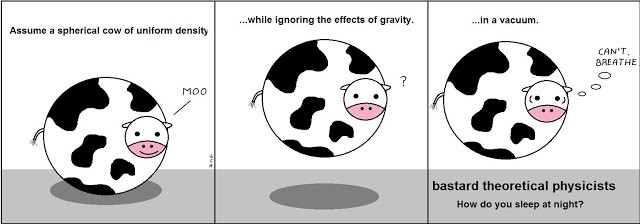
Image from https://worldbuilding.stackexchange.com/questions/96644/plausibility-of-floating-whales
What I do know is that — are you ready? — human societies, involving multiple nations or even our own culturally diverse, geographically spread out nation, are not now nor will they ever be a spherical cow of uniform density in friction-less vacuum.
So … why is it that even now that they admit the scary Imperial model is insane, our authorities, from federal on down are treating the US as though it were just that mythical cow, and on top of that exactly the same as the cow in Italy, Spain or France.
[…] but here’s the thing: Italy has a completely different culture. Yes, it also has a sclerotic, understaffed and just impoverished healthcare system. (Yes, every time I post that I have to spam a million comments telling me how well the WHO ranked Italy — which is great, except the WHO ranks a single payer system above everything else, including outcomes — and how Lombardy is the envy of Italy or something, which leads me to say “Sucks to be you.”)
However, that’s just a factor in the debacle. The other factor is culture and no one is taking it into account. Multi-generational families live together (I should throw stones, yes) or in the same house which becomes a sort of compound. (This is common to all Mediterranean cultures. I grew up in such a compound until the age of six.) which means that while Grandma isn’t abandoned to the tender mercies of Haitian health workers, it’s also really hard to isolate her when little Guido gets the never-get-well at school and cheerfully brings it home. Even when they don’t live together, extended families have a level of closeness that freaks out even the closest American families. If you and your relatives live within driving distance of each other and don’t see each other every other day, there’s something wrong.
Every house is a continuous cacophony of visiting relatives and friends. In safer times, we just left the back door unlocked because it was easier than answering the doorbell every five minutes. When I first got married, I had the TV on all day, because otherwise the house was so silent, it freaked me out. (I left Disney channel on all day, because it was less likely to startle me with explosions or evil laughter. This led my inlaws to believe I only understood “English for children” (rolls eyes.) I wasn’t even in the room with it. I just needed that noise, or I freaked out, because of the habit of a lifetime.
The freakiest thing in my exchange student years was that my family never had people drop by, several times a week, just because.
On top of that, of course, a lot of the younger people live in stack-a-prole apartments with shared air, and most people commute by train or bus or something.
Now, in Portugal at least most trains and buses aren’t as full as they were in my youth. You are rarely packed in like sardines. But it’s still public transport, and at rush hour every seat is taken and there are people standing.
As much as I get sick here, I got sick way more often there, and had a few really close calls, starting at about thirteen. Because you live in each other’s pockets.
And I understand that in Italy, as in Portugal, as in, for instance, France, people kiss a lot more. Adult men might not, unless they’re close(ish) relatives, but women and children get kissed by everyone from close kin to total strangers.
All of those create conditions for the virus to explode. In Italy, in France, in Spain. I understand it’s not exploded nearly as much in Portugal, but I also wonder how much of that is Portuguese reluctance to go to the doctor or the hospital. Because “the hospital is where you die.” (Yes, sue me. Some cultural assumptions remain. Which is why my husband is the one who normally drags me to the hospital.) Because, you see, we DO know for at least one of the clusters, the hospital was making it worse. Go to the hospital for any other reason, catch Winnie the Flu.
A guest post at Catallaxy Files on the madness of taking the Precautionary Principle as your guide:
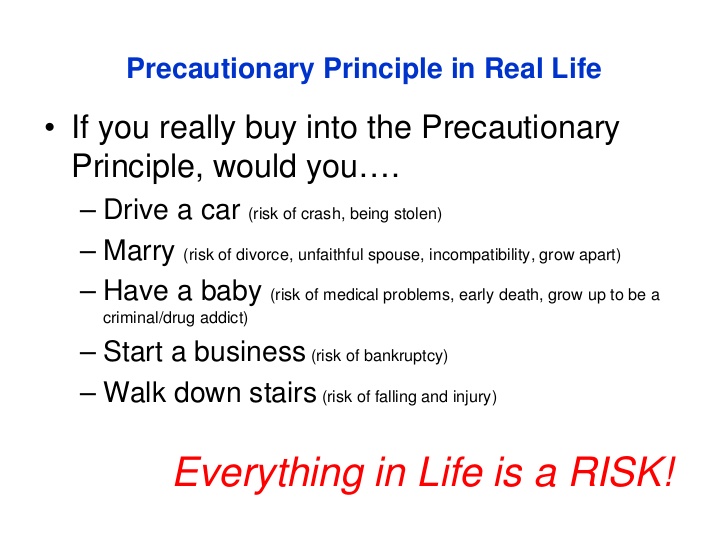
Slide from a presentation by Patti Gettinger, 2011-07-11.
Original slideshow at https://fr.slideshare.net/regsgridlock/the-precautionary-principle-8656034
In the unprecedented trampling of rights characterised by the response to the global pandemic of COVID-19, the common justification is that it will save lives, as though no measure is too great to save even one life.
This has echoes of the Precautionary Principle, which has pushed aside ubiquitous risk management principles in such areas as climate change, invariably to justify unlimited spending which risk management principles would otherwise limit. In other words, it’s a principle which can be used to justify any measure. And here we are.
One fundamental difference between the competing principles is the concept of marginal benefit, which, simply put, is the point where the benefits of an action no longer outweighs the cost. Our new “rules” from the newly formed National Cabinet, of which no legal or constitutional standing exists, has far surpassed the point of marginal benefit.
A person fishing off the coast alone in a small boat is in breach of the rules, as is a person playing golf alone, or a person sunbathing on a rock in the outback, yet in none of these examples can any measurable likelihood of spreading it or catching the disease be identified. These situations would fail any risk management approach, but not the Precautionary principle. Any risk, that is, any potential risk that can not be confidently identified as absolute zero, is a risk not worth taking, but that is not how we live our lives, because we understand that everything involves risk. Driving a car, catching public transport, having a job, not having a job, leaving your house or indeed staying in it involves some level of risk.
Also central to risk management is the concept of mitigation; the potential actions that can reduce, transfer or eliminate identified risks. In the case of COVID-19, many mitigation measures have been identified, and implemented. Such mitigations implemented are travel bans (belatedly), banning large crowds (belatedly), temperature screenings, washing hands, social distancing, pandemic announcements (belatedly, again), face masks (very belatedly), and fit-for-purpose hospitals (you guessed it). All of these easily demonstrate a benefit greater than worst-case scenario costs, yet after being bystanders for weeks, leaders across the globe then overreacted far beyond the demonstrable benefits. At least benefits to us.
Chris Selley on the surprisingly solid performance of Ontario premier Doug Ford during the Wuhan Coronavirus epidemic response:
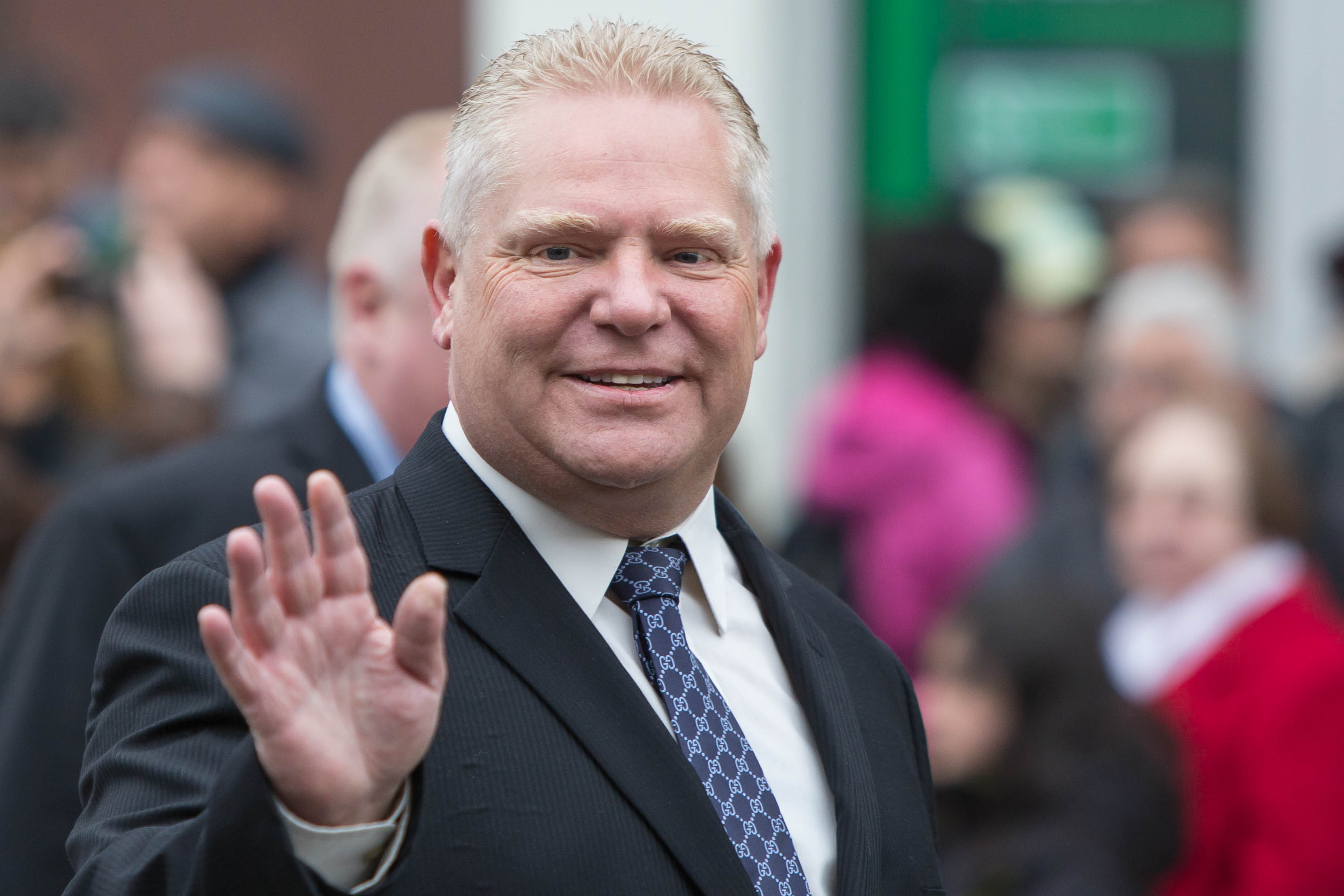
Ontario premier Doug Ford as new Progressive Conservative leader at the 2014 Good Friday procession in East York, Canada.
Photo via Wikimedia.
The premier has attracted much praise for his performance during this crisis, and it is deserved. His last misstep was advising families to head off on March Break as planned, viruses be damned, but that might as well have been 100 years ago. We were all clutching at optimism. Former premier Kathleen Wynne, who clearly understands Ford, graciously said she heard a man “trying to calm the waters … out of the goodness of his heart.”
Since then Ford has struck the right tone: often visibly alarmed, but calm, scripted and plain of speech. He has been gracious to everyone on the right side of the fight, from doctors and nurses to supermarket clerks and frantic, unemployed people stuck at home, to Prime Minister Justin Trudeau, to his fellow premiers of all political stripes, and even to journalists. And he has been galvanizingly withering to those on the wrong side, most notably a few price-gouging businesses who have been helpful enough to offer themselves up as common enemies.
More than a few people have remarked: “Wasn’t this guy supposed to be Canada’s Donald Trump?”
Indeed, once upon a time, those comparisons flew thick and fast. But they were always absurd — a toxic by-product of the Canadian media’s mortifying obsession with all things American. No First World politician is remotely like Donald Trump. I have filed many thousands of words over the past decade on what I view as Doug Ford’s inadequacies as a politician, and it would never have occurred to me to compare him to such a transparently awful president.
Ford, too, has levelled many vastly over-the-top accusations against his opponents. But he has basically set them all aside now. While federal Conservatives continue battling federal Liberals on the carbon tax file, Ford has refused to discuss it and happily applauds the feds’ anti-coronavirus efforts. Where once Ford railed at his media critics, now he praises their efforts covering the crisis and informing Ontarians. His relatively plain talk is noticeably more reassuring than the messaging some other Canadian heads of government, who fancy themselves far more polished, are dishing out — Trudeau in particular.
Kurt Schlicter — who, spoiler, isn’t a fan of our news media in general — on the demands by newsbeings for the impossible to be done immediately:
We Americans are truly blessed by having a mainstream media full of brilliant renaissance men, women, and gender non-specific entities who are masters of so many varied and intermittently useful skills and who are eager to share their knowledge with us benighted souls. The pandemic has revealed that every urban Twitter blue check scribbler, MSNBCNN panelist, NYT/WaPo doofus, and barely legal “senior editor” of a website you never heard of, is a Nobel Prize-winning epidemiologist, a master logistician, and a diversity consultant to boot.
[…]
Another hitherto unknown skill that the media believes it possesses is logistics. “Why hasn’t Trump commanded a million ventilators to appear?!” the reporters demand. It’s pretty easy to see where they might have gotten the idea that the moment one articulates a desire to possess something that it magically appears. Capitalism has pretty much made that a reality. If you want something, you can go to a store and get it 24/7, or you can go on Amazon and it’ll be at your Manhattan apartment in 48 hours. Since they have never built anything or transported anything or distributed anything, only benefited from the labor of the unhip people who do those things, it’s only natural that the delayed adolescents who make up our media class imagine that material goods can be simply wished into being. After all, for all practical purposes during normal times, because of the efforts of Americans they look down upon, material goods pretty much can be simply wished into being. But prosperity takes work, not that the media would know.
[…]
Apparently, the media class thinks there are giant warehouses with an endless supply of goods just sitting there, somewhere, waiting. They have no idea about how logistics work, how goods flow quickly from producer to market and how expected resupply levels need a few days to adjust from a 10 percent daily turnover to a 30 percent daily turnover. They have zero appreciation for inventory management because no one they know does unglamorous stuff like that.
It’s all much easier in a socialist command economy. You get nothing and like it. Or don’t like it. Whatever. Here’s your weekly bean allowance. Workers of the world unite. You have nothing to lose but access to toothpaste and toilet paper.
The best part is when the media – the same media that was collectively soiling its Dockers because that mean old Trump was barring direct flights from China because of racism and stuff – demands to know why, back in December, Trump was not commanding a zillion Wuhan Flu tests, a zillion masks, and a zillion ventilators be created, while locking down all of America. Leaving aside the whole lack of an enumerated power to do that thing, in what world would have Trump have convinced anyone – least of all the media that was slobbering over his bogus impeachment at the time – that some bat soup-derived pathogen in BumFoo, China, was going to black swan all over America’s economy? The lack of seriousness by the people who presume to be reporting the news to us is more breathtaking than the damn ChiCom grippe.
In the latest Age of Invention newsletter, Anton Howes relates how a mistaken belief still led to a significant improvement in health:
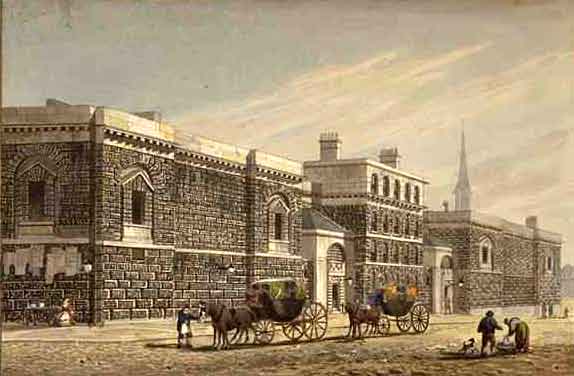
The west view of Newgate Prison, circa 1810, by George Shepherd (1784-1862).
Wikimedia Commons.
One of the most worrying diseases of the mid-eighteenth century was typhus. We now know that it is spread by lice or fleas, but at the time, like so many other diseases, it was thought to be caused by noxious air — “malaria”, for example, literally means “bad air”. This was not a silly theory. It was based on empirical observation, which perhaps explains why the belief in such noxious miasmas persisted for so long — well into the late nineteenth century, if not the early twentieth, before finally being ousted by germ theory. Our ancestors were not stupid, no matter how strange their beliefs might appear in hindsight. (Also take alchemy, or the belief that some animals spontaneously generated.)
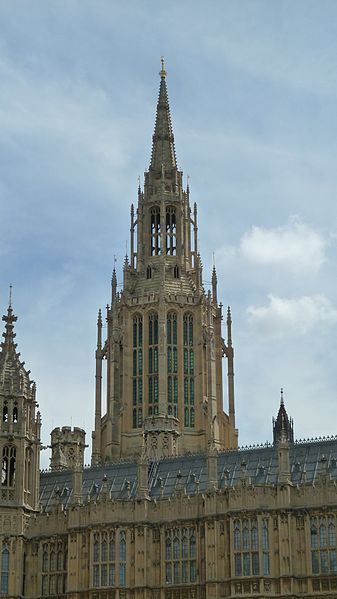
The Central Tower of the Palace of Westminster is actually a disguised ventilator.
Photo by Cary Bass via Wikimedia Commons.Typhus fit the miasma theory especially well because it frequently appeared in confined spaces, like ships’ holds, prisons, mines, workhouses, and hospitals. The disease was thus often called “gaol fever”, or “hospital fever”. And there was the fact that at least one of the solutions designed to combat miasmas, the ventilator, actually seemed to work. This ventilator was not the kind that is in such high demand right now, used to help feed oxygen into patients’ lungs, but instead a machine used to get the air flowing in and out of confined spaces — like a 1740s air-conditioning unit.
At first glance, removing the stale air from a space shouldn’t do anything against typhus. But mortality declined drastically in the prisons and ships to which the ventilator was introduced. It halved the number of deaths per year in Newgate prison, where the bellows-like machinery was powered by a windmill, and the inmates of the Savoy prison fared even better. On ships, too, mortality declined among mariners, passengers, soldiers, and especially among the group that suffered most from long voyages across the eighteenth-century Atlantic: slaves.
But it’s not clear exactly why. After all, the ventilator did not kill the typhus-ridden lice or fleas. I have a few theories as to what must have been going on. Perhaps, by improving the supply of oxygen to confined spaces, people’s bodies were simply better served to deal with all manner of diseases. Surgeons aboard slave ships sometimes noted that, without proper ventilation, many slaves would simply die in the night of suffocation. Or perhaps the ventilator’s effectiveness had something to do with its drying effect. The machine was used to prevent grain stores from becoming humid, thus staving off damp-loving weevils. The ventilators might thus have staved off typhus through a similar means: although I’m not so certain about body lice, humid conditions are preferred by fleas. Regardless of the real reasons, the ventilators worked, and even when they did not reduce mortality, they made confined spaces more bearable for those who had to endure them. Ship captains reported that they did not even have to force their sailors to pump the ventilator’s bellows, because they liked the cool air so much. Ventilators were soon installed in the House of Commons, and in many of London’s theatres.
From the Wikipedia entry on architectural ventilation:
The development of forced ventilation was spurred by the common belief in the late 18th and early 19th century in the miasma theory of disease, where stagnant ‘airs’ were thought to spread illness. An early method of ventilation was the use of a ventilating fire near an air vent which would forcibly cause the air in the building to circulate. English engineer John Theophilus Desaguliers provided an early example of this, when he installed ventilating fires in the air tubes on the roof of the House of Commons. Starting with the Covent Garden Theatre, gas burning chandeliers on the ceiling were often specially designed to perform a ventilating role.
Mechanical systems
A more sophisticated system involving the use of mechanical equipment to circulate the air was developed in the mid 19th century. A basic system of bellows was put in place to ventilate Newgate Prison and outlying buildings, by the engineer Stephen Hales in the mid-1700s. The problem with these early devices was that they required constant human labour to operate. David Boswell Reid was called to testify before a Parliamentary committee on proposed architectural designs for the new House of Commons, after the old one burned down in a fire in 1834. In January 1840 Reid was appointed by the committee for the House of Lords dealing with the construction of the replacement for the Houses of Parliament. The post was in the capacity of ventilation engineer, in effect; and with its creation there began a long series of quarrels between Reid and Charles Barry, the architect.Reid advocated the installation of a very advanced ventilation system in the new House. His design had air being drawn into an underground chamber, where it would undergo either heating or cooling. It would then ascend into the chamber through thousands of small holes drilled into the floor, and would be extracted through the ceiling by a special ventilation fire within a great stack.
Reid’s reputation was made by his work in Westminster.
Tom Mullen on the efficient functioning of prices in a free market economy:
Market prices are the foundation of civilization. They are the signal that tells producers how much of any one thing to produce. They tell consumers how much to consume or whether to consume a product at all. The reason retailers don’t normally throw away 80 percent of their stock is because market prices tell them how much to have on hand at any one time to meet current demand.
When they miscalculate and buy a little too much, they still don’t typically waste their stock. They put it on sale and meet the demand at a lower price.
To the extent the market is allowed to set prices, producers generally produce what consumers want to buy in the quantities they want to buy. When all supply is consumed and large amounts of consumers are not left with unmet demand, it is referred to as the market “clearing.”
The government is always and everywhere at war with market prices. Regulations creating barriers to entry limit supply, artificially inflating prices. Price controls, including “anti-price gouging” laws override market prices, creating shortages. Subsidies to producers (farm subsidies, for example), allow producers to limit supply, artificially inflating the price.
But when the market works properly, it often delivers news to consumers and to governments that is unpopular, and governments frequently attempt to “hold back the sea” by introducing market distortions:
All these price adjustments by the market are essential for our well-being. They are the cure for the economic disease caused by the government response to the virus and the previous 12 years of monetary inflation and artificially low interest rates.
What is the government doing in response? It is escalating its usual, conventional war on market prices to a nuclear war. It is punishing suppliers of essential goods for raising prices. It is ramping up monetary inflation to historic levels to keep stock prices artificially high and unprofitable businesses alive to go on producing products for which there is no demand. At a time when market prices are more essential to our survival than ever, the government is doing more to override them than ever.
This is not an academic theory that only works on a graph in a classroom. This plays out before our very eyes in the form of essential goods not available to us at any price.
Why is there no toilet paper available? Ask most people and they will say it is because of “hoarders.” These are people who bought far more than they needed in anticipation of future shortages. The people who arrived at the store after the toilet paper is sold out vilify them. Others might just call them prudent.
The same people who vilify hoarders also vilify “price gougers.” They don’t seem to grasp the obvious cause/effect relationship here. If it weren’t for artificial limits on price, i.e., “anti-price gouging” laws, the price of toilet paper would rise dramatically with the surge in demand and the so-called hoarders would not be able to buy nearly as much. That would leave far more for everyone else. The toilet paper market would find the optimal price level where the greatest number of people could get what they need.
The Ontario government, of course, is doing everything they can to obstruct the market from operating freely.
Chris Selley finds a few of the changes to business practice in Ontario to be definite improvements that we should retain once the panic subsides:

“The Beer Store” by Like_the_Grand_Canyon is licensed under CC BY-NC 2.0


Prepping my urban coronavirus hermitage involved packing my freezer with comforting made-ahead delights: pulled pork, chili, various pasta sauces including a life-altering Bolognese ragout recipe from Marie in Quebec City, who runs foodnouveau.com. Mostly, however, I’ve found myself wanting to eat … a bit more downscale. Supplies of Pogos and Bagel Bites are shamefully depleted, well ahead of schedule. And I do love that chicken from Popeye’s.
My superb local fried chicken joint has come up with a very simple and reassuring way to fill walk-up orders. It’s explained on the locked door: You phone in your order from outside, then retreat eight feet; an employee comes to the door with the credit/debit machine, makes eye contact, demonstratively puts on a fresh pair of gloves, opens the door and places the machine on a stool outside, along with the box of gloves. The customer dons a pair of the gloves, completes the transaction, discards the gloves in the waste basket provided, and retreats eight feet again. The employee, wearing fresh gloves, returns with the order and places it, with a smile, on the stool.
This is neither particularly ingenious nor unique. The food-delivery industry has taken to calling it “contactless delivery,” which is an amusingly jargon-y term for “pay in advance and we’ll leave it wherever you tell us and run.” I found myself weirdly impressed, though. Popeye’s system might not scale to Ronald’s place across the street, and I’m certainly not questioning McDo’s decision to shut down everything in Canada except delivery and drive-through. But especially living in a city where most everyone seems to be treating COVID-19 with suitable respect, it’s nice to appreciate the ingenuity that will keep those of us lucky enough to be sentenced to house arrest as comfortable as possible.
And it has been striking to see governments getting out of the way. Ontario, where change is generally about as welcome as a dry cough and fever, is all of a sudden a jurisdiction where licensed foodservice establishments can sell alcoholic beverages with takeout or delivery meals. It’s a place where supermarkets licensed to sell booze can do so as of 7 a.m. British Columbia made the same call on booze delivery and takeout. Alberta has allowed restaurants to sell their booze, period.
It’s hard not to notice that these loosened restrictions come as government-run bottle shops in Ontario and Quebec shorten hours. In Ontario, the Beer Store, a foreign-owned quasi-monopoly, has reduced hours and refuses to refund empty bottles. (There is no other place to refund empty bottles in Ontario.) They say you find out in a crisis who your friends are.
blogTO shows how some Toronto restaurants are getting creative with wine and food delivery options.
The all-hysteria, all the time media will have much to regret once the worst of the Wuhan Coronavirus epidemic has run its course:
- The data we have sucks, and thus any conclusions we are drawing mostly suck too. The data is worse than just being incomplete or bad — if it was randomly distributed, we could live with that. But the lack of test kits and how we have deployed the few we have means that the data is severely biased. We are only testing people who are strongly symptomatic. If there is a normal distribution of outcomes from this disease, we are only testing on the right side of the distribution. We have no idea where the median is or how long the tail is to the left side of asymptomatic outcomes. The only thing we absolutely know about the disease is its not as deadly as the media is portraying as we are missing hundreds of thousands of cases in the denominator of the mortality rates. The media has also been terrible about reporting on risk factors of those who died. When a bunch of people died suddenly in Seattle, one had to read down 5 paragraphs into the story to find that they were all over 70 in an old-age home. Or when prime-of-life people die, facts such as their being type 1 diabetics — a known severe risk factor for this virus (and one that makes it different from the flu) are left out.
- The media is constantly confusing changes in measurement technique and intensity with changes in the underlying progress of the virus itself. Changes in case numbers have as much to do with testing patterns and availability than they do with the real spread of the disease.
- While COVID-19 is likely worse than the normal flu, our perceptions of how much worse are strongly affected by observer bias. Frankly, if every news broadcast every night spent 15 minutes reciting flu deaths each day, we would all be hiding in our homes away from flu. They present a healthy man in his thirties dying clearly as the tragedy it is, but the spoken or unspoken subtext is, “this is abnormal so this thing is much worse.” But it seems abnormal because we do not report on the very real stories of healthy young people who die of the flu. My nephew who was 25 years old and totally healthy with no pre-existing conditions died of the flu last month — and no one featured this tragedy on the national news.
- The data we are getting sucks worse because the media has decided, as one big group, that for our own good they are going to limit all facts about the virus to only the bad ones. There is a strong sense — you see it on Twitter both in Twitter’s policies as well as Twitter group attacks — that saying anything that might in any way reduce one’s fear of the disease should be banned for our own good. One of the more prominent examples was Medium removing an article NOT because it was proven wrong but because it took one side of a very open question and it was obviously decided it was “unsafe” to allow that side to even be aired.
David Zaruk wrote last week for Science 2.0 Europe:
Two decades of the precautionary principle as the key policy tool for managing uncertainties has neutered risk management capacities by offering, as the only approach, the systematic removal of any exposure to any hazard. As the risk-averse precautionary mindset cements itself, more and more of us have become passive docilians waiting to be nannied. We no longer trust and are no longer trusted with risk-benefit choices as we are channelled down over-engineered preventative paths. While it is important to reduce exposure to risks, our excessively-protective risk managers have, in their zeal, removed our capacity to manage risks ourselves. Precaution over information, safety over autonomy, dictation over accountability.
- Whatever happened to “Keep out of reach of children”? Now we cannot be trusted and all products must be child-safe.
- Whatever happened to “Handle with care”? Now safety by design has removed the need for individuals to exercise common sense or risk reduction measures.
- Whatever happened to trust? Now individuals are no longer left with the capacity to make their own decisions in managing personal risks.
“These are good things” precaution advocates would retort “since people often make mistakes and bad things can better be prevented!”. While continuous improvement of safety systems has its value, the bigger the fences, the less autonomously the individuals will react (creating a society of docile followers). The precautionary approach implies a lack of trust in individuals’ capacities to make their own (rational) choices. The over-engineered risk-management process would remove any situation where choices could be made. Fine for cases where there are no trade-offs, disruptions or loss of benefits (when the sheep have plenty of grass in their field), but in times of crisis (exposure to hazards), when precaution is your only tool, then sacrifice is the only solution.
[…]
When the public now sees everything of modern life (work, school, public events …) cancelled in a knee-jerk precautionary impulse, is it any wonder they are panicking? Enter the opportunist to sell you the silver solution or the naturopath detox remedy to put your mind at ease. Enter the quack to tell you to drink bleach. Enter the racist who will use the fear to mobilise outrage. Exit rationality and risk management.
With no bullets left in the risk-management gun, the only thing left to do is run … or as it is more commonly called: apply the precautionary principle. Precaution should only be applied after other risk management measures have failed but given how horribly inadequate our capacities to govern have become, it is the only strategy our regulators have come to know.
Slide from a presentation by Patti Gettinger, 2011-07-11.
Original slideshow at https://fr.slideshare.net/regsgridlock/the-precautionary-principle-8656034
H/T to Johnathan Pearce for the link.
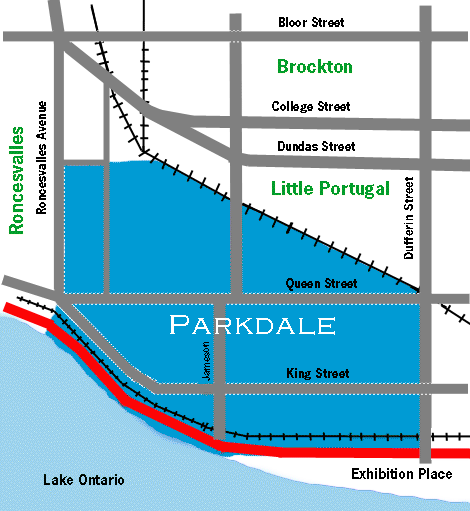
David Warren provides a glimpse of what life is like in the Toronto neighbourhood of Parkdale during the Wuhan Coronavirus epidemic:
Is gentle reader bored with pathogens yet? At some point in the proximate future, death will lose its sting. While there are plausible economic reasons for people to return to work, there is also a dark secret. The most restless society since the invention of restlessness cannot cope with “downtime.” This is what gives me my monopoly on Idleness. Without the “events” which help to distinguish one day from another, we will need to start a war.
The Parkdale neighbourhood of Toronto.
Map by Alaney2k via Wikimedia Commons.Had we books, and to have developed the habit of using them, we might read history instead; and even a bit of poetry on the side. But now, at loose ends, we are inspired to do something. Also, please note, the doctrine of original sin. I’m a big fan.
My political dogma has surely been established by now. I am against “doing” anything. Fight for a world in which nothing exciting happens, other than the pursuit of beauty, goodness, and truth. Fight relentlessly — by example.
Here in Parkdale, Toronto’s go-to centre for the criminally insane, there is always entertainment. From my balconata I can spy several half-way houses, and for variety, a Tibetan temple. The streets get quieter every day, especially the throb of the superhighways. It has been softening, as the economy bleeds away; and there are clear days with no contrails in the sky.
The “Green Nude Eel” is being accomplished. Superficially, this might seem like a good thing.
But because Parkdale has been unable to start a war with our bourgeois neighbour — Liberty Village, where the childless young professionals live in sterilized apartment blocks — we have had to look for excitement elsewhere. By calling 9-1-1 frequently, the Vallishortensians (demonym for “Parkdale”) are able to keep the sirens blaring, and little knots of emergency vehicles collecting, to no definable purpose here and there. Due to my Scottish genetic endowment, I follow these skits as I would a taxi-meter: How much have we cost the taxpayers today?
Chris Selley notes the abject failure of Canada’s “national broadcaster” to rise to the occasion during the Wuhan Coronavirus epidemic:

I scuttled into National Post headquarters Wednesday night to liberate some things from my desk before Postmedia’s meatspace newsrooms officially locked their doors “until further notice.” (I and my housebound colleagues remain at your service in the meantime.) Among my correspondence was a copy of David Taras’ and Christopher Waddell’s new book, The End of the CBC? It argues that Canada’s public broadcaster must rapidly and quite savagely reinvent itself or risk “oblivion.” And it is nothing if not timely reading.
On Wednesday, in a moment history may well note as Mother Corp’s rock bottom, CBC announced it was scuppering all its local television newscasts. Instead it would feed us all Canadians a mixture of national and local news from the same Toronto-based spigot.
Basically, CBC ended itself. It almost beggars belief.
Brodie Fenlon, editor-in-chief of CBC News, took to his blog to explain the decision — but didn’t, really. He talked of “staffing challenges” stemming from employees self-isolating and working from home. “Television is especially resource-intensive, and many jobs are difficult to do at home,” Fenlon wrote. “Our systems are overtaxed.”
[…]
This coronavirus has turned a harsh, bright light on several defects in Canadian society that we’ve been happy enough to ignore. We should be keeping a list of those things, and vowing to address them comprehensively once we’ve beaten COVID-19 back. A full-on top-to-bottom mandate review for the Canadian Broadcasting Corporation, especially its English TV operations, ought to be on that list — and the status quo must not be an option.
… besides the wall-to-wall hysteria in the mainstream media, I mean. Severian discusses the insights of “perverted old cokehead” Sigmund Freud on anxiety and its effects, then segues to our current, shared, plight:
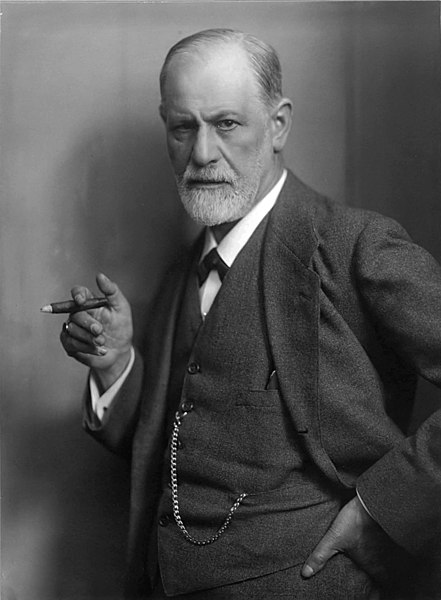
Photographic portrait of Sigmund Freud, signed by the sitter (“Prof. Sigmund Freud”) by Max Halberstadt (c. 1921)
Wikimedia Commons
Everyone who has thought about it for five minutes knows that something’s not right. […] As y’all have noted, actual hard information on the coronavirus is hard to come by. Is it fully air-transmissible? What are the infection rates? Hell, what are the death totals? And speaking of the death totals, even if you trust China’s figures (which no reasonable person can possibly do), they seem … low. Like, really low. I actually trust Italy’s government to deliver some vague approximation of the truth, and even there, where they’re in full-blown freakout mode, it seems to kill off old folks with compromised immune systems and lung problems at a fractionally higher rate than your garden-variety flu.
So, you know … it’s the flu. Not great by any means, and more infectious (possibly) than some other flus in our recent past, but for all that just the flu. The ongoing sky-is-falling global freakout has next to nothing to do with the actual bug. We live in a deeply anxious age, and that anxiety has to discharge somehow. It’s global hysteria — classic hysteria, Freudian hysteria, an excess of stress that must be discharged by “converting” it into behavior.
The people who are freaking out about it aren’t worried about dying from it. No, really, they’re not. Nor should they be — no reasonably healthy person under age 70 has any reason to be worried about that. Instead, what they’re worried about is powerlessness. We’ve all long suspected that we’re ruled by idiots and grifters. We’ve all long sensed that our “leaders” hold us in deep contempt. And we’ve long known that none of our problems are worth anything to the global pirate capitalist class. The only reason those bastards care if we all drop dead from the plague is that they can’t sell enough iCrap to each other to keep the company stock price up.
We know this. But we can’t say it, and we can’t act on it, because doing so goes against our self-image. Our media, our education system, our “culture” (such as it is) has spent the last half-century telling us what special and unique snowflakes we all are, even as it’s forcing us into ever-greater conformity. We’ve broken all the taboos, transgressed all the boundaries, liberated all the oppressed. If there ever were to be such a thing as “social justice,” then truly we’ve achieved it, here in this best of all possible worlds where you can lose your job for not addressing your co-worker as a wingless golden-skinned dragonkin and 6’2″ dudes with beards down to their collarbones can go wee-wee in the little girls’ room …
… and yet. And yet. And yet feminists (just to stick with a theme), despite running everything for the last 30 years, still can’t get that lousy 25 cent raise. Seven out of every five college girls are sexually assaulted the minute they step on campus, despite boys being as rare as sasquatches on most campuses (and despite the ever-growing clamor for free college for everyone). You’re free to — hell, you’re practically required to — make up your own pronouns, but you’re not allowed to ask just how a degree in “gender studies” could be worth even one dollar in student loan debt, let alone one hundred thousand dollars. We keep agitating for change, keep voting for it, keep tweeting about it … and nothing happens.
That profound sense of powerlessness is exactly, and I do mean exactly, what screwed up Anna O. She hated her father for not allowing her any personal agency. In her heart of hearts she wanted him dead. And yet she knew herself to be a loving daughter, so that overwhelming sense of relief — indeed, of joy — she felt when he kicked the bucket sent her around the bend.
Severian has some fun discussing current events with a nephew:
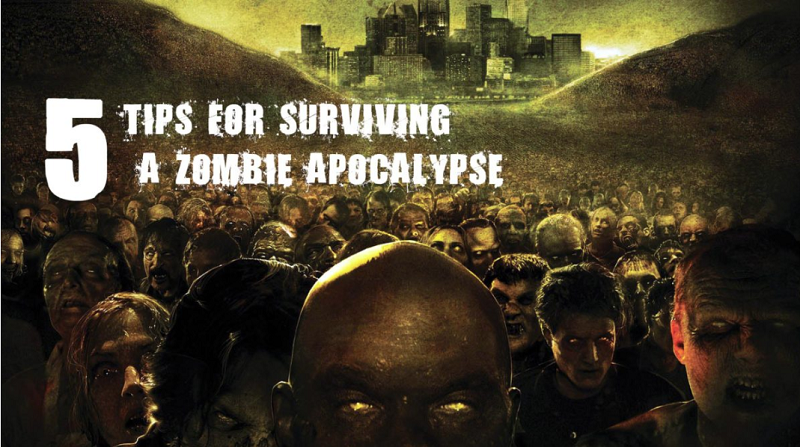
Image from Castle of Chaos – https://castleofchaos.com/blog/5-tips-for-surviving-a-zombie-apocalypse/
Just recently I had some fun with one of my nephews, who’s unexpectedly home for “Spring Break.”
Let’s take this Wuhan Flu thing seriously, I said. But since that hits a little too close to home, let’s pretend it’s a zombie outbreak. I want you to take it 100% seriously. The zombie virus has made it to our shores. It’s not too bad yet, but there’s definitely a walking dead situation. So … what do you want the government to do?
Nephew of course starts rattling off all the Chuck Norris fantasies young college guys have. Close the ports, call out the army, firebomb the streets wherever infected are sighted, yadda yadda. All of this is translated from the teenager, but you get the gist of it:
Me: Ok. Now, since we’ve stipulated that we’re taking this 100% seriously: Do you really want to give the government the power to do all that?
Nephew: Of course!
Me: Ok. Well then, do you really want to give Donald Trump the power to do that?
Nephew: Oh my god no!!! Orange Man bad!!!
Me: Now wait a minute, Nephew. You just said you’re taking this 100% seriously. You just said you want the government to have the power to set up flamethrower checkpoints on all major roads. Well, who is the current head of the government?
Nephew: But … but … but … Orange Man BAD!!!!
Me: Remember, Nephew, you promised to take this 100% seriously. So are you seriously telling me that the first thing you’d do, in the event of the zombie outbreak, is call an emergency presidential election, in the hopes that someone — Joe Biden, Bernie Sanders, Tulsi Gabbard, somebody — would win, so that the right kind of person could take all those measures you said were so very, very, very immediately necessary?
Nephew: Uhhhh … no, I guess not.
Me: So you do want to give Donald Trump that power, since he is, in fact, the current head of the United States government?
Nephew: Oh my god no! Orange Man BAAAAAAADDDD!!!!
Me: Well then I guess you’re just not serious about this zombie outbreak, are you?



Powered by WordPress