Quotulatiousness

February 1, 2025

DOGE’s first week

Filed under: Bureaucracy, Government, USA — Tags: , , , , — Nicholas @ 04:00

J.D. Tuccille on the odd position DOGE finds itself in, as many Americans seem conflicted about cutting back the federal government:

The new Department of Government Efficiency (DOGE) is off to a quick start, if we consider the advisory board’s claimed savings in federal spending and the voluntary buyout of workers that could reduce the ranks of federal employees with a minimum of drama. But while the public agrees that corruption, inefficiency, and red tape are serious problems for the government, DOGE itself enjoys mixed popularity and majorities believe the government spends too little on big-ticket items, leaving little room for savings. The American people themselves are a big obstacle to paring the federal government to size.

DOGE Off to a Good Start

“DOGE is saving the Federal Government approx. $1 billion/day, mostly from stopping the hiring of people into unnecessary positions, deletion of DEI and stopping improper payments to foreign organizations, all consistent with the President’s Executive Orders,” the DOGE X feed boasted this week. “A good start, though this number needs to increase to > $3 billion/day.”

The Trump administration also sent a letter to the majority of the federal government’s roughly three million workers, offering a “deferred resignation” plan. Those who accept the deal could stop working for the government as of February 6 and still be paid through September of this year. The administration expects up to 10 percent of workers to take the offer. The voluntary nature of the plan blunts inevitable complaints from unions about “purging the federal government of dedicated career civil servants”.

We will have to see what the results will be in the coming months and years. But if that works out, it’s a pretty good launch for an administration and its advisory board that are less than two weeks old. Unfortunately, Americans aren’t sure where they stand on all this.

The Public Frets About Corruption, Inefficiency, and Red Tape …

According to AP-NORC polling, majorities believe that corruption (70 percent), inefficiency (65 percent), and red tape such as regulations and bureaucracy (59 percent) are “major problems within the federal government.” These findings square with the results of other surveys revealing that “nearly 2/3 of Americans fear that our government is run by corrupt officials” (Babbie Centre at Chapman University, Spring 2024), that 56 percent of Americans say government is “almost always wasteful and inefficient” (Pew Research, June 2024), and that “55% of Americans say the government is doing too much” (Gallup, November 2024). That’s exactly what the Trump administration created DOGE to combat, so it should be a good sign for the project.

But Americans are torn over DOGE. Asked by AP-NORC to share their opinions of “an advisory body on government efficiency led by Elon Musk and Vivek Ramaswamy” (before Ramaswamy left to run for office), only 29 percent support the venture while 39 percent oppose it. That seems to reflect its leadership. Fifty-two percent of those polled have an unfavorable opinion of tech titan Musk, while 36 percent view him favorably.

Why the hate? Musk’s problem may be that he’s a high-profile rich guy with things to say at a time when that type of person isn’t especially popular. Sixty percent of respondents believe it would be a bad thing “if the president relies on billionaires for advice about government policy”. That disapproval crosses over into opinions about DOGE, even if people say they support its goals.

January 30, 2025

The MAGA movement as “America’s Thermidorian Reaction”

Filed under: Cancon, Media, Politics, USA — Tags: , , , , — Nicholas @ 03:00

Fortissax lays out the case for Canada remaining separate from the United States, in what he says is the longest single article he’s written. It is indeed a long piece, from which I’ve selected a small portion that helps identify the US MAGA movement as something other than just pro-Trump activism:

“Canada’s national identity is rooted in Order, as expressed in its national motto, Peace, Order, and Good Government, conceived by Sir John A. Macdonald. This stands in contrast to the United States, whose core value is Liberty, reflecting its liberal and individualist foundations in the pursuit of life, liberty, and the pursuit of happiness.”

The MAGA movement, as explored in my colleague and fellow Canadian Endeavour’s article, can be understood not as a counter-revolutionary or genuinely reactionary force, but as America’s Thermidorian Reaction — a movement within the post-WWII liberal order to purge its own radical excesses. Endeavour draws parallels to the French Revolution, where the Thermidorian Reaction was not a restoration of the monarchy but a moderation of the Reign of Terror’s extremism, and to the Soviet Union’s Destalinization, which sought to distance the regime from Stalin’s radical policies without abandoning communism.

Similarly, MAGA does not aim to dismantle the liberal framework established during the cultural revolution of the 1960s, marked by the Civil Rights Act and Hart-Celler Act, but instead seeks to address the instability caused by the radicalization of this framework during the “Great Awokening” of the 2010s. Its faith in “colourblind meritocracy” is rock solid. Just as the Thermidorians and Khrushchev’s regime sought to preserve their respective systems by eliminating destabilizing elements, MAGA represents an attempt to recalibrate the liberal order by challenging excessive ideological commitments like open borders, identity politics, and globalist policies.

While MAGA appeals to traditionalist sentiments, it ultimately operates within the boundaries of the same liberal system it critiques, lacking the philosophical depth to present a true alternative. Trump’s 2016 campaign was fueled by widespread dissatisfaction with the establishment and a sense of cultural alienation among, working-class European-Americans. As an outsider candidate, Trump faced opposition from both political parties and the media but managed to channel populist anger into an unexpected victory. However, his presidency revealed that he posed less of a threat to the system than many anticipated. Trump’s administration implemented some reforms but fell short of disrupting the liberal order, leading many elites to reframe him as a tolerable alternative to the increasing instability caused by radical left-wing movements. The 2024 campaign differs significantly from Trump’s earlier runs because he has garnered support from influential elite factions. Figures in Big Tech, such as Elon Musk and Peter Thiel, and segments of the Zionist lobby, see Trump as a tool to stabilize the system without fundamentally altering it. While Trump continues to appeal to his populist base, his elite backers are likely to exert more influence over his presidency than grassroots supporters.

The Four Agendas of America’s Elite

Endeavour outlines four major agendas driving the U.S. political landscape, which often overlap but also compete for dominance:

  1. The Anti-White Agenda (Wokeism)
  2. This agenda promotes diversity, equity, and inclusion (DEI) as core principles, advocating for identity politics, demographic transformation, and the demonization of traditional Western cultural norms. Organizations like the NAACP, SPLC, and Open Society Foundations champion this cause.

  3. Managerialism
  4. Focused on centralized control, managerialism, coined by James Burnham, expands bureaucratic oversight in both public and private sectors. The COVID-19 pandemic epitomized managerial overreach, as policies enforced compliance on an unprecedented scale. Key proponents include BlackRock, the World Economic Forum (WEF), and the Bill & Melinda Gates Foundation.

  5. The Zionist Lobby
  6. Primarily concerned with ensuring unwavering U.S. support for Israel, the Zionist agenda overlaps with wokeism in promoting leftist social causes but diverges when these causes conflict with Israeli interests. Organizations like AIPAC and the ADL straddle this divide.

  7. Big Tech
  8. Initially aligned with wokeism, Big Tech has begun to push back against its most radical elements due to its impact on innovation and competence. Elon Musk’s purchase of Twitter (now X) symbolizes this shift, as does growing discontent with DEI mandates within the tech sector.

While these agendas are not inherently unified, they collectively uphold the liberal framework established in the 1960s, even as they compete for dominance within it. I’ve defined these forces in the past as left-liberalism vs right-liberalism, which I covered here: MAGA & Wokism

Parallels to Historical Thermidorian Reactions

MAGA’s role is likened to historical Thermidorian Reactions, where moderates sought to rein in revolutionary excesses to stabilize their regimes. For example:

  • The Thermidorians ended Robespierre’s radical Reign of Terror, easing persecution and executions while maintaining the republic.
  • Khrushchev’s Destalinization moderated Stalin’s authoritarian rule but preserved the communist system.

Similarly, MAGA seeks to temper the radicalism of woke managerialism without challenging the core tenets of the liberal order. The “Great Awokening,” characterized by intensified DEI policies, identity politics, and cancel culture, parallels the Reign of Terror and Stalinist purges in its ideological zeal. Trump’s 2024 campaign represents an attempt to dial back these excesses and restore a degree of moderation.

Challenges Facing the Thermidorians

Despite its goals, MAGA faces significant hurdles in moderating the system:

  • Demographic Shifts: The growing influence of progressive, non-white voting blocs entrenches leftist policies.
  • Institutional Entrenchment: Managerial bureaucracies are staffed with ideologues deeply committed to woke principles, making reform difficult.
  • Superficial Reforms: Even if MAGA eases censorship and curbs DEI mandates, it is unlikely to reverse structural changes such as demographic transformation or the Civil Rights Act.

Endeavour contends that MAGA’s moderation of woke managerialism may improve short-term conditions but will not address deeper contradictions in the liberal order. For example:

  • The Zionist lobby’s support for both Israeli ethno-nationalism and woke policies in the U.S. creates unsustainable contradictions.
  • Universalist egalitarianism remains fundamentally flawed, and attempts to reform it, like Gorbachev’s Perestroika in the USSR, may inadvertently accelerate systemic collapse.

While MAGA may temporarily stabilize the United States, it will not fundamentally alter the trajectory set in motion during the cultural revolution of the 1960s. The deeper issues of demographic change, cultural alienation, and institutional decay remain unresolved. Trump’s vision—and likely that of most within the MAGA movement—is rooted in nostalgia for the 1980s and 1990s, a romanticized era cherished by many baby boomers. This idealized vision imagines a time when race was purportedly invisible, the black middle class thrived, and patriotism unified Americans across racial lines. This narrative conveniently ignores the darker realities of that period, including the L.A. race riots and the rise of militant groups like the Black Panther Party. At the same time, this Thermidorian Reaction is being leveraged to solidify control over America’s imperial vassals, with the Anglosphere serving as its primary appendages and European nation-states as key dependencies. Populist movements across Europe echo rhetoric nearly identical to that of MAGA, with many receiving direct or indirect support from individuals and entities affiliated with the movement. Figures like Elon Musk have actively amplified some of these efforts, like promoting the Alternative für Deutschland party and bolstering independent actors aligned with MAGA’s agenda, thereby expanding its influence across the Western world. Not ideal, but a means to an end for sure.

January 15, 2025

German democracy continues to reel under continued pressure from Elon Musk

Filed under: Germany, Media, Politics — Tags: , , , — Nicholas @ 03:00

Wasn’t it just the other day that the progressive legacy media in the US were accusing Elon Musk of being Hitler? Apparently his day job(s) aren’t keeping him busy enough because the German progressive legacy media are singing the same song:

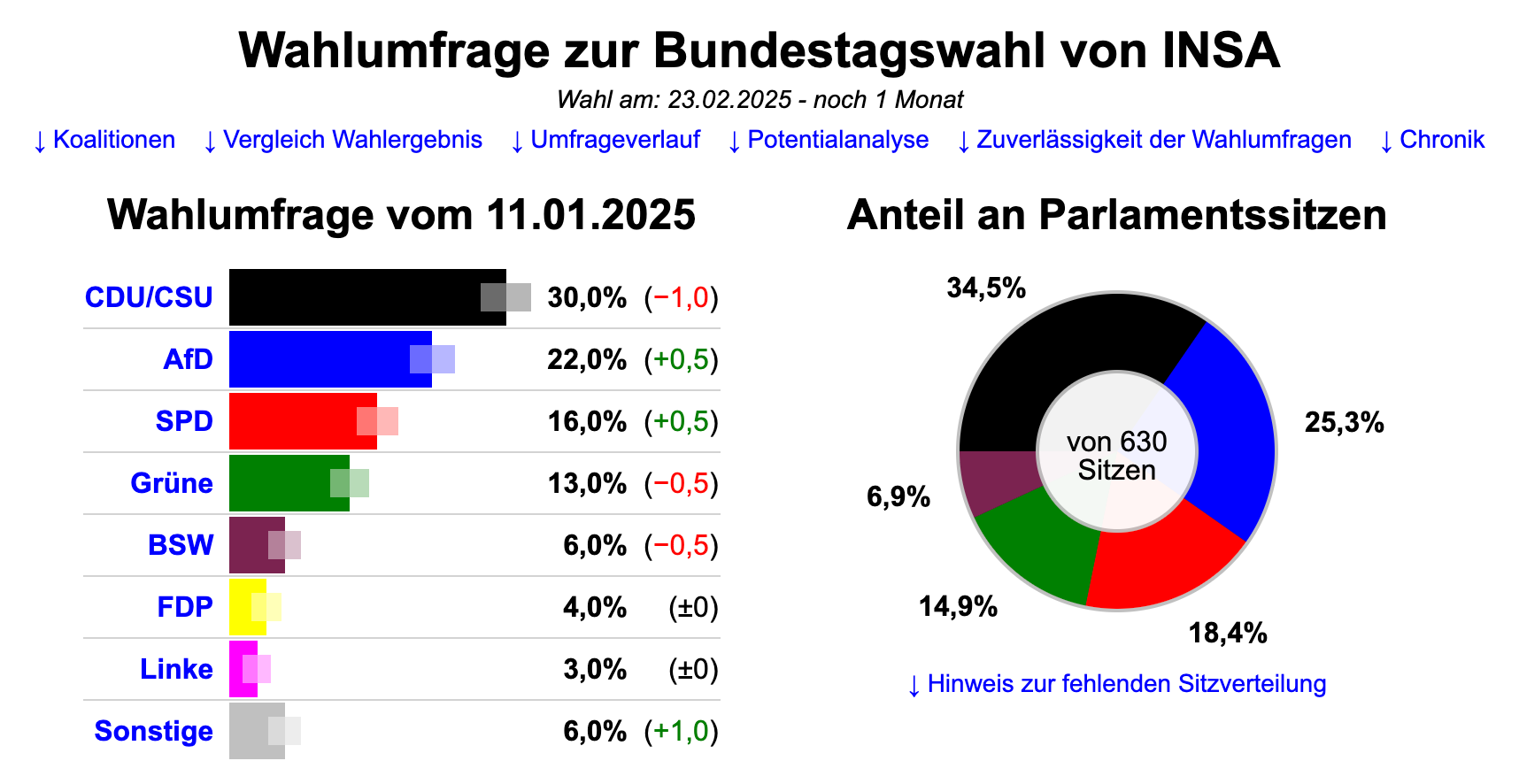
The Christmas holidays are over, the politicians and the media have awakened from their winter sleep, and Germany finds itself in the thick of an election campaign. Almost every day there is a new poll, and in almost every new poll, Alternative für Deutschland gets stronger. An Infratest dimap poll published on 9 January (survey conducted from 6–8 January) pegs them at 20%; a Forschungsgruppe Wahlen poll published on 10 January (survey conducted from 7–9 January) has them at 21%; and the latest INSA poll, published today (survey conducted from 6–10 January) places them at 22%:

For the centre-right CDU and CSU, the story is the opposite – one of a steady decline from the low- to mid-30s in December, to around 30% or just below in the latest surveys. The right-leaning vote overall is holding steady, at around 51%. Support is merely wandering from the acceptable Union parties behind the cordon sanitaire. Every day the establishment loses a few more seats; they vanish into the abyss of the Brandmauer, and the hurdles to the lusted-after CDU/CSU-Green coalition grow ever higher.

Some of this is surely down to the Musk Effect. Musk’s endorsement of the AfD and his conversation with Alice Weidel on Thursday (however much a disappointment I found it be) has surely normalised the party for a small but significant number of German voters. The media vilification of the American tycoon is as unbalanced and hysterical as it is unconvincing …

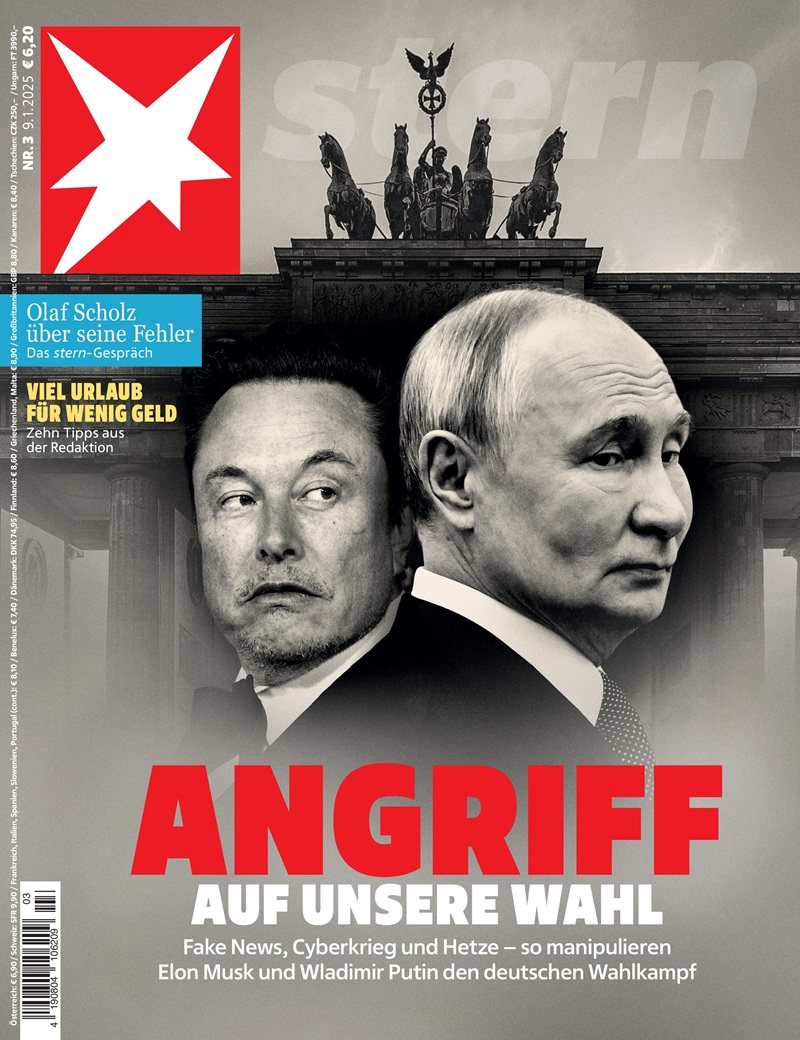
The latest cover of Stern magazine: “Attack on our election: Fake news, cyber warfare and rabble-rousing – this is how Elon Musk and Vladimir Putin are manipulating the German election.”

… and it comes all too late. Until December, Musk enjoyed mainstream credibility in Germany; our rulers eagerly celebrated his Gigafactory in Berlin-Brandenburg as a sign that all was not so terrible for German industry after all. They made Musk into a symbol for the carbon-free, electrical-vehicle future that awaits us all. It is hard to turn around in an instant and reconstruct the man as literally Hitler.

January 5, 2025

German democracy hanging by a thread after vicious attacks by Elon Musk

Filed under: Germany, Media, Politics — Tags: , , , , , — Nicholas @ 03:00

German politicians are growing ever more desperate as evildoers like Elon Musk continue to undermine the political stage by calling for antidemocratic things like free speech:

Alice Weidel, the federal leader of Germany’s “far-right” AfD, has approximately the same policy prescriptions as Donald Trump. Chiefly they are to return to the bourgeois habits that used to make free market states prosperous. But she subscribes to these in mainland Europe, which has been easily spooked since the Nazis offered policies that were not bourgeois.

“Humankind cannot bear very much reality,” as the far-right poet, T. S. Eliot, wrote in Burnt Norton, now the better part of a century ago. (He was arguably plagiarizing the far-right German poet, Johann Wolfgang von Goethe.)

One could recommend that my readers look her up on YouBoob, or better search for print, and form their own opinion on this Frau Weidel. (Who speaks English, and Chinese, fluently.)

Compare her, for instance, to the British prime minister, Keir Starmer, who rose to power as the prosecutor protecting Muslim “grooming gangs”, and now puts people in gaol who protest on behalf of their rape and murder victims. The idea that Mr Starmer should have a rôle in the government of a civilized country, is as absurd as the idea that the 14-year-old narcissist who has ruled Canada, or the 82-year-old senescent who has ruled the United States, are respectable members of the human race.

And closer to the scene of crisis, eugyppius reports on the latest Muskian outrage against peace-loving German politicians:

For days, the German establishment have been in an absolute uproar over Elon Musk’s profoundly antidemocratic election interference. You cannot turn on the television or open any newspaper without enduring all manner of wailing about the grave danger Musk poses to German democracy.

The naive and the simpleminded will say that all of this is crazy and that the Federal Republic has become an open-air insane asylum – a strange playground of political hysterics the likes of which the Western world has never seen before. That is because they don’t understand what’s at stake here. Musk did not just say the odd nice thing about Alternative für Deutschland, oh no. He also said various German politicians were fools and traitors, he called for resignations and he published an untoward newspaper editorial. It is amazing the German democracy has not yet collapsed in the face of this unrelenting campaign, and still the absolute madman shows no signs of stopping.

Elon Musk’s frontal assault on the German constitution began on 7 November, when he tweeted four antidemocratic words – “Olaf ist ein Narr” (“Olaf [Scholz] is a fool”) – in response to news that the German government had collapsed. Three days later, he tweeted the same thing about Green Economics Minister and chancellor candidate Robert Habeck, after Habeck gave a speech calling for widespread internet censorship.

Thereafter, all was quiet for a time. German democrats allowed themselves to hope these were but isolated indiscretions and that Musk would allow them to get back to their arcane business of promoting feminism abroad, changing the weather and eliminating “the extreme right”. Lamentably, the peace turned out to be a false one. Musk renewed his campaign against democracy with a vengeance on 20 December, tweeting in the wake of the Magdeburg Christmas market attack that “Scholz should resign immediately” and that he is an “incompetent fool”. That very same day, Musk tweeted for the first time that “Only the AfD can save Germany”, a sentiment he repeated also on 21 December and on 22 December, delighted at the nationwide freakout his casual remarks had incited.

In the course of this freakout, German President Frank-Walter Steinmeier hinted darkly that “outside influence” constitutes “a danger for democracy”:

    Outside influence is a danger for democracy – whether it is covert, as was recently apparent in the elections in Romania, or open and blatant, as is currently being practised with particular intensity on the platform X. I strongly oppose all external attempts at influence. The decision on the election is made solely by the eligible citizens in Germany.

The indefatigable Naomi Seibt, who appears to be Musk’s primary informant about German politics, brought these remarks to the evil fascist billionaire’s attention, and he promptly responded that “Steinmeier is an anti-democratic tyrant”. Musk then delivered his coup-de-grace the next day, with an editorial in Welt am Sonntag – the most devastating piece of political prose that Germany has witnessed since Hitler penned Mein Kampf.

By my count, Musk may have directed as many as 700 words against the noble if surprisingly rickety edifice of German democracy – an assault few political systems could withstand. The self-appointed guardians of our liberal order accordingly declared a five-alarm fire, and they have betaken themselves to their keyboards to defend what remains of our free and eminently democratic political system, where anybody can say anything he likes and vote for any party he wishes, so long as what he likes and those for whom he votes have nothing to do with major political parties supported by millions of Germans like Alternative für Deutschland.

January 2, 2025

DOGE has a lot of low-hanging fruit to pick

Filed under: Bureaucracy, Economics, Government, Politics, USA — Tags: , , , , — Nicholas @ 03:00

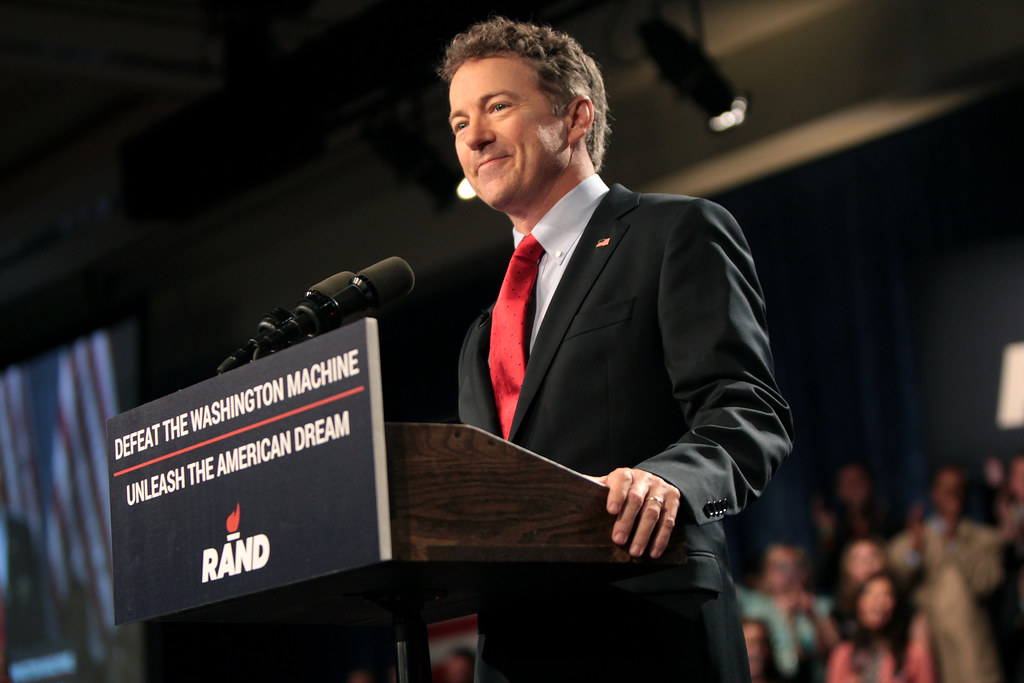
Patrick Carroll selects some of the least-defendable ways the US government has been spending taxpayer money from Senator Rand Paul’s 2024 Festivus Report, including pickleball courts, $10B in unused office space, DEI initiatives for birdwatchers, crop fertilizer in foreign countries, and literal circus performances:

Rand Paul by Gage Skidmore is licensed under CC BY-SA 2.0 .

Why does such government waste persist year after year? A significant part of the explanation traces back to the concept of concentrated benefits and dispersed costs. Essentially, the beneficiaries tend to be a small, concentrated group, so they lobby hard for these outlays because they stand to gain a lot from them. Taxpayers, on the other hand, tend to be dispersed and only minimally affected by any single expense, so it’s not usually worth it for them to lobby against the spending, or even learn about it in the first place.

Economist Gordon Tullock famously illustrated this concept with his fictional Tullock Economic Development Plan. The plan “involves placing a dollar of additional tax on each income tax form in the United States and paying the resulting funds to Tullock, whose economy would develop rapidly”.

Think about the incentive Tullock would have to advocate for this plan, compared to the incentive that an ordinary taxpayer would have to look into it and voice their objections. With campaign contributions and votes to be gained from the special interest beneficiaries, is it any wonder politicians often go for these kinds of wealth transfers?

The ubiquity and stubborn persistence — year after year — of all this waste, combined with the economic theory that explains why it happens, suggests that there is a fundamental problem with the process of government as we know it. This is not, as many are itching to believe, a “Democrat” problem or a “Republican” problem. The degree of government waste changes very little with changing administrations. No, this is a problem with the government as such.

To solve this problem, we need to ask not just who should run the government, but what the government should be allowed to spend money on in the first place, given what we know about its entirely predictable and repeatedly demonstrated propensity for waste and dysfunction.

Milei has already started that conversation in Argentina. Let’s hope that with the new Trump administration and DOGE, that’s a conversation we can have here as well.

January 1, 2025

Mark Steyn – “This is not a healthy development in world affairs”

Mark comments on the ongoing political punch-up over the US government’s H1B visa program for foreign workers:

Elon Musk and Vivek Ramaswamy as the figureheads of D.O.G.E.

As you’ll have noticed, the world’s most uniquely unique peaceful transition of power turned suddenly violent over Christmas with various of America’s super-brainy Indians beating up on each other: Nikki Haley, the Boeing board’s token Sikh, lit up Hindu monotheist Vivek Ramaswamy’s tweet like Air Canada overhead baggage in objection to Vivek’s remarks on US “mediocrity”. The offending Ramaswamy tweet was in response to MAGA objections to Trump’s appointment of Madras techie and open-borders fanatic Sriram Krishnan as his AI advisor. This was a very 2025 brouhaha: while you knuckle-draggers down in flyover country were arguing about sub-minimum-wage Hispanics turning down the sheets at Motel Six, the Hindu billionaires have been busy taking over the country.

Is everyone in this all-American punch-up an Indian? Well, no, eventually a South African weighed in. The Boers don’t like the Hindus, do they? I think I got that from Gandhi. Ah, but in this case Elon agrees with Sriram and Vivek.

A couple of very general observations:

1) The MAGA base intuits that H1B visas are a racket. Why wouldn’t they be? Everything else the federal government touches is — from presidential pardons to West Point to Jan 6 justice. America is the third largest nation on earth — a third-of-a-billion people, officially (rather more in actual reality). Why does it need to hire entry-level workers from the first and second largest nations? Yes, yes, too many Americans graduate in non-binary studies rather than any serious academic discipline but simply because you’ve bollocksed up your entire education system is no reason to (as my former National Review colleague John Derbyshire puts it) “import an overclass“.

The MAGA objections to mass immigration (ie, not just illegal immigration) are primarily cultural. They didn’t like it eight years ago when Trump would add to his wall-building promises the line about “and that wall will have a big beautiful door”, and he should have got that by now. Besides, to address the counter-argument more seriously than it merits, a nation of a third-of-a-billion that “needs” to import entry-level accountants is so structurally dysfunctional that no amount of immigration can save it. How about entry-level lawyers? Do we need more of those?

As an aside to that, for all you Constitution fetishists, I’m increasingly sceptical that a Constitution designed for an homogeneous population of two-and-a-half million people can be applied to a third-of-a-billion with a cratering fertility rate of 1.6. The only two more populous nations — China and India — are both more or less conventional ethnostates. Which is a great advantage. America is the only large-scale polity founded on a proposition — that, simply by setting foot on US soil, one becomes American. Immigration on the present transformative scale will nullify the Constitution. So the Dance of the Constitution Fetishists will get even sadder.

The Constitution is increasingly for judges rather than citizens. May be time to import more Supreme Court justices.

2) Besides, H1B is what the government calls, correctly, a “nonimmigrant” visa. One of Rupert Murdoch’s minions offered me an H1B thirty years ago. I looked up the terms and declined to sign on to indentured servitude. You’re not importing “the best and brightest”. You’re assisting well-connected corporations in advantaging themselves at the cost of the citizenry among whom they nominally live. [NR: Emphasis mine.]

3) Have you noticed that almost everyone involved in this spat is a billionaire? Today’s rich are not just rich in the old Scott Fitzgerald they-are-different sense. They approximate more to the condition articulated by Lord Palmerston in his observation that England had no eternal friends or enemies, only eternal interests. For a billionaire, friends and enemies come and go, but, like any medium-sized nation-state, he has his interests.

To most Americans, Elon was largely unknown until he started weighing in on and then buying social media; Vivek was entirely unknown until he ran for president; Sriram is still unknown. But they are far above not just the schlubs who lost their jobs to cheaper H1B types but also to the more famous political class whose poll numbers in Iowa so obsess the hamster-wheel media but which are increasingly irrelevant to anything that matters. Among Sriram Krishnan’s minor claims to “fame” is that he’s the guy who introduced Boris Johnson (remember him?) to Elon Musk — and you can bet that was after desperate wheedling and pleading from the Shagger, not because Elon had any desire for dating tips.

This is not a healthy development in world affairs.

4) Vivek Ramaswamy’s sweeping paean to American “mediocrity” as manifested by everything from prom queens to sitcoms was probably ill-advised but it was certainly entirely sincere — and would be widely shared by his fellow members of the Hindu overclass. The Indian tycoon (and David Cameron advisor) Ratan Tata, who died in October, is best remembered in the UK for his 2011 Vivek-like attack on the natives’ “work ethic“. As Sir Ratan marvelled after buying Jaguar-Land Rover:

    I feel if you have come from Bombay to have a meeting and the meeting goes till 6pm, I would expect that you won’t, at 5 o’clock, say, ‘Sorry, I have my train to catch. I have to go home.’

    Friday, from 3.30pm, you can’t find anybody in the office.

That may well be true, as Vivek’s musings re Urkel and football jocks may be true. On the other hand, as a rather precocious lad, I observed to my mum that, five years after the Gambia’s independence, nothing seemed to work as well as it did under colonial rule. True, conceded my mother, then added: “But in the end people want to be themselves, as themselves. At least it’s their chaos.”

December 28, 2024

How the H1B visa argument follows an earlier political struggle

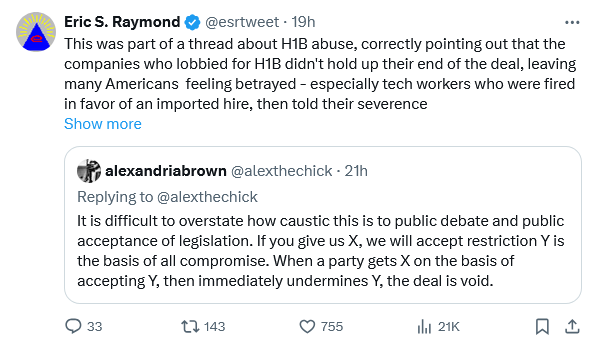
On the social media platform formerly known as Twitter, ESR points out that the arguments over US work permits for foreigners might well have been prefigured by the now-receding tide of attempts to gut the second amendment:

    alexandriabrown @alexthechick
    It is difficult to overstate how caustic this is to public debate and public acceptance of legislation. If you give us X, we will accept restriction Y is the basis of all compromise. When a party gets X on the basis of accepting Y, then immediately undermines Y, the deal is void.

This was part of a thread about H1B abuse, correctly pointing out that the companies who lobbied for H1B didn’t hold up their end of the deal, leaving many Americans feeling betrayed — especially tech workers who were fired in favor of an imported hire, then told their severance pay would be denied if they didn’t train their replacements.

I am, however, irresistibly reminded of another betrayal. One I’ve written about before — but maybe at least part of this story needs to be told again.

Today in the 21st century most of the American gun culture is bitterly, even fanatically opposed to more “gun control” laws, and howling for all of them clear back to the National Firearms Act of 1934 to be repealed. Donald Trump earned huge support with his promise to get national concealed-carry reciprocity pushed through Congress.

We weren’t always like that. Long ago, before 1990, many of us were less resistant to new gun control measures. Sometimes major gun-rights organizations would even help lawmakers draft legislative language.

(Yes, I was a gun owner then. So I’m not going by legends, but by lived experience.)

What changed?

The quid-quo-pros we were offered were many variations of “If you will accept this specific restriction X, we will stop pushing. We will stop trying to undermine your Second Amendment rights in general. Help us save the chilllldren!”

That promise was never kept. Gradually, we noticed this. It always turned out that the minority of angry suspicious people who said “This won’t be enough, they’ll come back for another bite!” were right.

Eventually, some documents leaked out of one of the major graboid organizations that revealed a conscious strategy of salami-slicing — instead of challenging gun rights directly, they intended to gradually make owning personal weapons less useful and more onerous until the culture around them collapsed.

So nowadays we’re pretty much all angry and suspicious. Even restrictions that do little harm and might be objectively reasonable (bump stocks, anyone?) touch off tsunamis of protest.

People offering us more “deals” (just give up this one little thing, mmmkay?) now have negative credibility.

Are you paying attention, Big Tech? (Particularly you, @elonmusk, and you, @VivekGRamaswamy.) Because you’re almost there, now. Too many people see that H1B has become an indentured-servitude fraud that victimizes both the workers it imports and the Americans it displaces.

You credibility isn’t as shot as the gun-banners’ yet. You still have some room for recovery on “high-skilled immigation” in general, but it’s decreasing.

Your smart move would be to sacrifice H1B so you can keep the O-1 “genius” visas. I advise you to take it, because if you dig in your heels I think you are likely to lose both.

And on the reason so many Americans have become angry about blatant and exploitive H1B visa abuse:

Today’s big beef is between tech-success maximizers like @elonmusk and MAGA nationalists who think the US job market is being flooded by low-skill immigrants because employers don’t want to pay competitive wages to Americans.

To be honest, I think both sides are making some sound points. But I’d rather focus on a different aspect of the problem.

When I entered the job market as a fledgling programmer back in the early 1980s, I didn’t have to worry that some purple-haired harpy in HR was going to throw my resume in the circular file because I’m a straight white male.

I also didn’t have to worry that a hiring manager from a subcontinent that shall not be named would laugh at my qualifications because in-group loyalty tells him to hire his fourth cousin from a city where they still shit on the streets.

It’s a bit much to complain that today’s American students won’t grind as hard as East Asians when we abandoned meritocracy more than 30 years ago. Nothing disincentivizes working your ass off to excel more than a justified belief that it’s futile.

Right now we’re in and everybody-loses situation. Employers aren’t getting the talent they desperately need, and talent is being wasted. That mismatch is the first problem that needs solving.

You want excellence? Fire the goddamn HR drones and the nepotists. Scrap DEI. Find all the underemployed white male STEM majors out there who gave up on what they really wanted to do because the hiring system repeatedly punched them in the face, and bring them in.

Don’t forget the part about paying competitive wages. This whole H-1B indentured-servitude thing? It stinks, and the stench pollutes your entire case for “high-skill” immigration. You might actually have a case, but until you clean up that mess Americans will be justified in dismissing it.

These measures should get you through the next five years or so, while the signal that straight white men are allowed to be in the game again propagates.

I’m not going to overclaim here. This will probably solve your need for top 10% coders and engineers, but not your need for the top 0.1%. For those you probably do have to recruit worldwide.

But if you stop overtly discriminating against the Americans who could fill your top 10% jobs, your talent problem will greatly ease. And you’ll no longer get huge political pushback from aggrieved MAGA types against measures that could solve the rest of it.

Doesn’t that seem like it’s worth a try?

December 21, 2024

German democracy tottering on the brink (again) after latest attack by Elon Musk!

Germany is, yet again, convulsed with political unrest as politicians react strongly to foreign interference in German affairs by … dun-dun-duuuuuun … Elon Musk:

“German flag” by fdecomite is licensed under CC BY 2.0 .

German democracy, which has existed undeterred since 1949 but is somehow always shaken to its foundations whenever anybody sings the wrong song or holds a televised debate with the wrong person, is once again on life support.

Christian Lindner, head of the market-liberal Free Democrats, did much to trigger the present catastrophe on 1 December, when said that the Free Republic should “dare more Milei and more Musk“. Because there is little distinction between praising Milei and Musk and demanding the return of National Socialism, there ensued a brief period of establishment hyperventilation.

Less than a week later, CDU chief and probable future German chancellor Friedrich Merz, did his part to denounce Lindner’s political wrongthink in a statement to Deutschlandfunk:

    So neither the Argentinian president nor, how shall I put it, the American entrepreneur Elon Musk – let’s put it plainly – are role models for German politics in my view. I don’t see where we can find similarities in German politics. What Christian Lindner meant will probably remain his secret.

The next day, Merz repeated the same denunciations, only more harshly, explaining to one of our extremely adult and far-sighted pantsuit talkshow hosts that “To be honest, I was completely appalled that Christian Lindner made that comparison“. Milei, Merz said, is “really trampling on the people there”.

Yesterday, all of this came to the notice of the (honestly rather tiresome) influencer Naomi Seibt, who posted a video statement to X rehearsing all of this old news to her largely American audience:

Elon Musk then brought down the hammer on the German democratic order, retweeting Seibt’s video and remarking that “Only the AfD can save Germany“.

Today a lot of very important and influential people got out of bed and took to their keyboards to denounce Musk’s election interference. His statement might be illegal, at any rate it is very likely fascist and certainly it is beyond the pale for an American to voice an opinion about German politics. Germans absolutely never, ever, utter the slightest word about American politics and certainly would never advance negative opinions about the American president in the middle of an election campaign. Our Foreign Office would never try to fact-check an American presidential debate! Our journalists would never depict President Donald Trump dressed as a Ku Klux Klan member or offering the Hitler salute or decapitating the Statue of Liberty! That’s just not done!

Like a great stream of green diarrhoea, the outrage is pouring fourth. Matthias Gebauer, who writes for Der Spiegel, observes that “Elon Musk … is openly promoting the AfD” and concludes that “Putin is not the only one who loves this party”. Erik Marquardt, head of the Green faction in the European Parliament, says that “The EU Commission and EU member states should no longer stand by and watch as billionaires misuse media and algorithms to influence elections and strengthen and normalise right-wing extremists”. This “is an attack on democracy”, and “has nothing to do with freedom of expression”. Dennis Radtke, CDU representative in the European Parliament, concludes that “Musk … is declaring war on democracy” and that “the man is a menace”. We are also under siege via “interference from Putin”; “the erosion of our democracy is being fuelled from both within and without”. Julian Röpcke, who writes for BILD, believes that “This is interference in the German election campaign by a tech billionaire who uses algorithms to decide what gets heard”. If Germany does not “respond with penalties, there will be no help for our eroding democracy”.

November 30, 2024

The mission of DOGE

One of Donald Trump’s more interesting announcements shortly after winning the federal election early in November was that he was going to give Elon Musk and Vivek Ramaswamy a formal position to do to the US government’s vast array of bureaucratic organizations what Javier Milei did to Argentina’s bloated national government. Here, scraped from the social media platform formerly known as Twitter, is Devon Eriksen‘s thoughts on how to go about pruning back the “fourth branch” of government:

Since the framers of the Constitution created a federal government with three branches, not four, there are no Constitutional checks on the emergent fourth branch.

Currently, the fourth branch is in many ways the most powerful, and certainly the most destructive, arm of the government.

– It has the privilege of targeting individual citizens on its own initiative, which is forbidden to the three other branches.

– It can interfere their lives in any way it wishes by making a “ruling”.

– The only recourse against a “ruling” is to take the bureaucracy in question to court.

– But the process is the punishment, because this takes months if not years and costs tens if not hundreds of thousands of dollars.

– Until recently, courts have deferred to bureaucrats as a matter of legal precedent. Now they merely do so as a matter of practice.

– But should the bureaucracy lose anyway, the only punishment the court inflicts is that they are told they have to stop doing that specific thing.

– Any fines or legal costs imposed on them punish the taxpayer, not the agent or even the agency.

– And the next, closely related, thing the bureaucracy thinks of to do is once again fair game, until the courts are once again brought in, at further cost, to tell it to stop.

All of this creates a Red Queen Effect.

Citizens must establish their own organizations, and raise donations to engage in constant lawfare, just to retain the rights they haven’t lost yet. And they must win every time to maintain the status quo.

Bureaucrats, on the other hand, can fight endless legal battles using money taken from their victims by the IRS, at no cost to themselves. Any victory they claim, they may keep permanently, while any loss may be refought endlessly simply by a slight variance of the attack.

Obviously, if this system is not changed, all power will accrue to the bureaucracy over time. They will constitute a totalitarian authority over every aspect of the life of every citizen.

This is why the name “DOGE” (Department of Government Efficiency) is a serious mistake.

Look, Elon, I like a joke as much as the next guy, and I do think irreverence is a load-bearing component of checking the bureaucracy, because a false aura of gravitas is one of their defenses against public outrage.

But words mean things.

When you create a check on the bureaucracy and call it the department of government efficiency, you focus the attention, and the correction, on the fact that the bureaucracy is stomping on people’s lives and businesses inefficiently, not on the fact that they are doing so at all.

But the name isn’t my decision. The power of the vote isn’t that granular. I can only elect an administration, not protect it from tactical errors by weighing in on individual policy decisions.

Unless someone with direct power happens to read this.

So, regardless of the name, here’s how an organization might be set up to effectively check federal bureaucracies.

1. DOGE must be responsive, not merely proactive.

Being proactive sounds better in the abstract, but it is much easier for a federal agency to gin up some numbers to fight a periodic overall audit, than it is to fight an investigation of a specific case.

2. DOGE must have direct oversight.

If it must take agencies to court, it is merely a proxy for the citizens whose money is being wasted, and whose rights are being trampled.

Imagine the level of inefficiency, waste, and delay, if your process for addressing bureaucratic abuse simply results in one part of the federal government pursuing an expensive court case against another.

Instead, DOGE must have the power to simply make a ruling, via its own investigation hearing process, which is binding on federal agencies.

Any appeals to the court system must be allowed to trigger their own DOGE investigation (for wasting taxpayer fighting a ruling).

3. DOGE must have the power to punish the agent, not just the agency.

“You have to stop that now” is not a deterrent. Neither is fining the agency, because such fines are paid by the American taxpayer.

DOGE must follow Saul Alinsky’s 11th rule: target individuals, not institutions.

Why?

Because agencies are agencies. They consist of agents.

An agent is someone who acts on behalf of a principal — someone whose interests the agent is supposed to represent.

When the agent is incentivized so that his interests diverge from those of the principal, he will be increasingly likely to act in his own interest, not the principal’s.

This is the Principal-Agent Problem.

An agency is a construct, a theoretical entity. What Vonnegut would call a “granfalloon”.

Agencies do not act, they do not make decisions, they do not have incentives they respond to. Any appearance to the contrary is an emergent property created by the aggregate action of agents.

Every decision, whether we admit it or not, has a name attached to it, not a department. It is that person who responds to incentives.

Agents will favor their own incentives over those of their principal (the American people) unless a counter incentive is present for that specific person.

For this reason, DOGE should, must, have the power to discipline individual employees of the federal agencies it oversees.

This doesn’t just mean insignificant letters of reprimand in a file. It means fines against personal assets, firing, or even filing criminal charges. No qualified immunity.

Yes, you read that right. DOGE must be able to fire other agencies’ staff. I recommend that anyone fired by DOGE be permanently illegible for any federal government job, excluding only elected positions.

4. DOGE investigations must be triggerable by citizen complaints.

This is self-explanatory. It gives DOGE the practical capability to redress individual injustices, and it crowdsources your discovery problem.

Establish a hotline.

5. DOGE must have sufficient power to protect and reward whistleblowers, and punish those who retaliate against them.

6. Bureaucrats must be held responsible for outcomes, not just for following procedure.

Often, procedure is the problem. The precedent must be established, and clearly enforced, that because agents have agency, agents are responsible for using their discretion to ensure efficient, just, and sane outcomes, not just for doing whatever departmental policy allows.

7. DOGE must have an adversarial relationship with the bureaucracies is oversees.

This eliminates the phenomenon of “we investigated ourselves and found no wrongdoing”.

Following the previous recommendation is almost sure to make this happen.

The point is not for DOGE to address every instance of waste or wrongdoing, it is to make bureaucrats act responsibly because they fear an investigation.

In essence, I am imagining DOGE (or some superior name that better reflects the mission) as an entity with a license to treat bureaucrats the way bureaucrats currently treat citizens.

November 25, 2024

In search of bluer skies

Filed under: Humour, Media, Politics, USA — Tags: , , , , — Nicholas @ 04:00

In The Critic, Benedict Spence channels his inner David Attenborough to document the majestic migration of American progressives from their habitual grazing lands to friendlier territory:

What will Twitter do without its smuggest inhabitants?

And so we come to it again. It is that time of year when we put on our David Attenborough voices, and talk in low, slightly wistful tones about the great migration that is about to unfold. Everywuh you look, creatures great and small are beginning their treacherous juhneys across a vast and inhospitable wilduhness to happiuh hunting grounds and more pleasant pastures under the clear blue skies. The hullabaloo that accompanies them is impossible to miss — across the plains, the cries go up from elders to alert the rest of the herd of the imminent departure.

Though some may never return from this arduous trek, most will. Disavow yourself of the mental image of elephants and zebras crossing the African savannah — that’s not what we’re here for. This migration is metaversical in nature: it is time, once more, for people to announce they are leaving Twitter.

This year’s exodus came later than usual, prompted by Donald Trump’s bulldozer of a victory over Kamala Harris in the US presidential election, with grown men and women across the country — and its second largest airbase, the UK — deciding that Elon Musk, the platform’s owner and the Orange Man’s endorser-in-chief, was at least partly responsible for this travesty. Not the economy, you understand, oh no. Nor immigration, nor the preoccupation by Democrats with shoulder-chewingly stupid culture war issues the average voter thinks are at best mad and at worst satanic.

No, no, it is all about Musk — who is at once the world’s wealthiest evil genius and also a gibbering moron, according to people who thought Cacklin’ Kamala was a born winner. Musk, we are told, has ushered in a stream of “hate” ever since buying Twitter and rebranding it 10, warping the minds of the impressionable and irreparably damaging the future of the West by facilitating Trump’s return.

This is not Musk’s only crime, though. He has also tweaked other aspects of X’s features, including the block function, making it possible for those on the receiving end of this internal exile to see the posts of their nemeses again without being able to interact with them. This was for a fair few blockees how they were reminded of the existence of their blockers, many of whom they had long since forgotten. Often, in the same instance, it was also how they learned said blocker was off somewhere else.

Musk has also moved to erode the power of institutions and individuals who lived their lives high on the power of credentialism, and the authority this brought them. The changing of blue tick criteria and the emphasis on community notes now means many who were once feted on the site by virtue of who they were must now work harder for their dopamine. But above all else, Musk has refused to silence a swathe of right wing voices who always existed but lived their X lives in the shadows. The platform became more right wing, and for many that was just too much. Having been reliably told throughout the past year that the crude reply guys were just Russian bots and that their gal would ride over them on a wave to victory, they and their allies over here — the infamous adults back in charge of the UK — are doing the grownup thing and going off in a huff to play somewhere else.

November 13, 2024

“The term ‘Maple MAGA’ is a derogatory slur used by Canadian liberals”

Filed under: Cancon, History, Media, Politics, USA — Tags: , , , , , — Nicholas @ 03:00

I have to admit I was only vaguely aware of the “Maple MAGA Mafia” identified by Canadian Deputy Prime Minister Christia Freeland, so I’m glad Fortissax is here to provide some background for me:

An insignificant yet loud minority among right-wing Canadian populists on Xitter are calling themselves “Maple MAGA”, with some expressing a reasonable desire for Canada to restore itself with a “MAGA ideology”. The term “Maple MAGA” is a derogatory slur used by Canadian liberals, coined by Chrystia Freeland, Deputy Prime Minister — Wicked Witch of the North — and is not intended as a term of endearment. The more extreme accounts are even calling for the outright annexation of Canada by the United States, which all Canadians should oppose if they value their dignity and self-respect. I’d invoke the memory of our Fathers of Confederation, the innovation behind the Avro Arrow (once the world’s most advanced bomber interceptor), possessing the fourth largest navy in the world after WWII, Samuel de Champlain’s great expedition and exploits, the Filles du Roi, and the Loyalist Americans who, like Aeneas leading the Trojans after the fall of Troy in the Iliad, marched north to Canada after the Revolutionary War to found a new civilization. Yet, if they already knew or identified with our glorious past, they wouldn’t be so quick to support an even greater loss of independence and sovereignty to the almighty American empire.

Make no mistake, I admire and appreciate the United States, if that wasn’t clear. There are no people more similar to the Canadian people in the world than Americans. They are Canada’s largest trading partner. Both countries were born of Albion’s Seed, sharing the North American frontier experience, and forming a family of five great Anglo nations spread on four continents, once united under a single imperial government, and now vassals of its successor. Had the United States not elected Donald J. Trump, it would have continued down a path unopposed, as bad or worse than Canada under the liberal party. There is a very real opportunity for this American Caesar to reverse much of the socioeconomic and cultural damage wrought upon it by enemies foreign and domestic. Elon Musk’s acquisition of Twitter, now X, once the bias was removed quickly became a right-wing dominant forum where truths long-feared would embolden many, everywhere to speak their minds. Elon fulfilled the ancient internet prophecy that all public forums with no censorship become right wing, simply because of the objective truths.

Elon didn’t turn it right-wing, he simply removed the government censorship of the DEI cultist board, and their allied state goons in the intelligence agencies from suppressing stories and information from reaching the American public, and the world. The Counter-Elite, a loose alliance of the Paypal Mafia, Peter Thiel, Elon Musk and MAGA populists, in America are a force of nominal good, a positive for right-wing dissidents around the world fighting their own existential struggles against local managerial regimes. If Trump and the cast of would-be heroes succeeds, the United States will enter an era of unprecedented recovery for the forseaable future—though it’s not a magic bullet for the civilizational decline as recently written about by fellow Substacker Dave Green, aka The Distributist.

The United States was Canada’s first, and arguably still its greatest, existential threat — ironically, mostly through no fault of its own, but rather due to its Jupiterian gravity beside little Canada. Canada may be the second-largest country on the planet after the Russian Federation, but it’s a small nation, with only an estimated 28 million ethnic Canadians, 90% of whom live within 200 kilometres of the U.S. border, as much of the country is an inhospitable wasteland of spruce bog and rock, almost impossible to settle due to permafrost. The habitable areas are extremely hot in summer, or extremely cold in winter. Canadians have often looked southward at the Titan with a sense of fatalism. Many intellectuals and journalists over the centuries have wondered when, if, how, and where Canada would meet what felt like its “inevitable” dissolution into the hands of the Yankees. Despite these fears, that dissolution never came.

Yet whispers of provinces seceding — making the “great escape” from the failing post-national economic zone Canada has become to join the booming, recovering United States — are on the lips of some Canadians. If not outright secession, than abandoning the monarchy, establishing a constitutional republic modelled off of the United States of America, copying the constitution, and pathetically copying its culture. I believe the majority of right-wing Canadians would favour constitutional reform to enshrine our own equivalent of legally protected freedom of speech and the right to bear arms. These are ancient English traditions of the “Yeoman” or Free Man, with roots visible in free speech and weapon-carrying practices across the ancient Germanic world. They are by no means exclusive to the United States. Canada and England had considerably relaxed gun laws until recent decades, and changes like these wouldn’t require us to sacrifice our sovereignty to the U.S.

October 24, 2024

It’s called “piercing the corporate veil” and it’s a terrible idea

Filed under: Business, Europe, Government, Media, Politics, Technology — Tags: , , , , , — Nicholas @ 04:00

Tim Worstall explains why the EU’s latest brain fart is not just a bad idea in its own right, but a truly horrific precedent for the future:

Elon Musk at the 2015 Tesla Motors annual meeting.
Photo by Steve Jurvetson via Wikimedia Commons.

… But now, this, now this is even more important than that. We can deal with free speech by the judicious use of lampposts. This is worse:

    The European Union has warned X that it may calculate fines against the social-media platform by including revenue from Elon Musk’s other businesses, including Space Exploration Technologies Corp. and Neuralink Corp., an approach that would significantly increase the potential penalties for violating content moderation rules.

    Under the EU’s Digital Services Act, the bloc can slap online platforms with fines of as much as 6% of their yearly global revenue for failing to tackle illegal content and disinformation or follow transparency rules.

In English law that’s known as “piercing the corporate veil”. It’s also something we don’t do. Because that corporate veil is the very thing, the only thing, that makes large scale economic activity possible.

It has actually been said — and not just by me — that the invention of the limited company is the third grand invention of all time. Agriculture, the scientific method, the limited company.

Before the limited co everything was done through partnerships. Every individual involved in the ownership of something was liable for all of the debts of that thing. Which, when you’ve got 5 or 10 blokes trading isn’t that bad an incentive upon them to be honest.

Now think of large scale activity. We want a blast furnace — plenty of folk say Britain should have one after all. £3 to £5 billion these days. OK. No one’s got that much. So, we need to mobilise the savings of many thousands of people to go build it. But without limited liability that means all of those thousands are liable for all the debts — off into the future — of that blast furnace.

“Invest £500 in the new, new British Steel. And if we fuck up then in 10 years’ time they’ll come and take your house.”

Err, yes.

Large scale economic activity depends upon being able to separate the debts of one specific activity from the general economic life of all its backers. If this is not true then no one will invest in large scale economic activity. Therefore we won’t have large scale economic activity. Which would, you know, be bad.

September 30, 2024

“This quite obviously proves that free speech is a tyrannical concept”

Filed under: Liberty, Media, Politics, Technology — Tags: , , , , , , — Nicholas @ 04:00

At The Critic, Titania McGrath decries the manifest horrors of letting ordinary people say whatever they want … without punishment:

“Titania McGrath” and Andrew Doyle

The government has repeatedly pointed out that the riots in the UK were directly caused by bad words on the internet. One of those arrested was an elderly retired midwife from Devon, who had accidentally read an inflammatory Facebook post whilst browsing for cupcake recipes. Within ten minutes, she found herself punching Persian toddlers and throwing grenades at a mosque.

For all the endless whingeing of free speech extremists, Starmer appreciates that words must be controlled to ensure that his subjects behave themselves. Surely most reasonable people would rather have their liberties restricted than live in a fascist state?

The next step is to see Elon Musk extradited. It was bad enough that he renamed Twitter as “X”, which is just a swastika with a few bits chopped off. But he has also allowed users to say whatever they like. As a result, wrong opinions are being duplicated at an alarming rate.

“Regulators around the world should threaten Musk with arrest if he doesn’t stop disseminating lies and hate on X,” wrote Robert Reich in the Guardian. Although I don’t approve of his surname, he makes a valid case.

Back in 2013, Starmer was quoted as saying that too many Twitter prosecutions could “have a chilling effect for free speech”. These were dangerous words, and although Starmer has since changed his mind, he should probably be calling for his own prosecution.

If you don’t want to be arrested, don’t say the wrong things. It really is that simple.

August 23, 2024

The EU’s bureaucratic aristocrats agree “Spaceship Man Bad!”

Filed under: Bureaucracy, Europe, Media, Politics — Tags: , , , , — Nicholas @ 03:00

As eugyppius explains, the “Eurocrats are having a very big sad” and Spaceship Man Bad isn’t deferring to their autocratic whims:

The Brussels Eurocrats around Emmanuel Macron are having a big sad about Twitter right now. They fear the platform fuels “the amplification of hateful content” and “disinformation”, which are multisyllabic ways of saying that there is too much unapproved and uncurated discourse on the site. You cannot just have people taking to their keyboards to type, like and retweet whatever they want. You especially cannot have that in Europe, where we suffer under the immensely liberal and democratic Digital Services Act, which mandates all manner of social media censorship to protect traditional European freedoms, like freedom of expression.

Twitter is a useful website; I use it to try out ideas and also for news-gathering purposes. As much as I’ve benefitted from the platform, however, I find the establishment derangement surrounding it to be extremely bizarre. There is little chance that Elon Musk’s relaxed moderation regime will lead to fascism, and still less chance that heavy censorship there will do anything about tHe ExtREmE RiGhT. The real reason that Twitter bothers establishment pundits and politicians, is its inherently confrontational nature. Our smug and self-satisfied oligarchs don’t like getting dragged and dunked on by the rabble. They want to tweet their lunacies without anonymous anime-themed accounts showing them up for the fools that they are, and they are very, extremely, fulminously enraged that Musk won’t do anything to improve their user experience.

One of these dissatisfied users is Thierry Breton, the Macron-appointed Commissioner for the Internal Market of the European Union. As everybody knows, on 12 August, Breton posted a letter to Musk ahead of Musk’s Twitter discussion with Donald Trump, to remind the American entrepreneur of his obligations to censor content. Breton has long been a thorn in the side of his EU colleagues, who regard him as a shallow self-promoter, and his game rapidly backfired. The next day, the EU Commission clarified that “The timing and the wording of the letter were neither co-ordinated nor agreed with the president nor with the [commissioners].” The American House Judiciary Committee then added to Breton’s humiliation by condemning his “threats” and his “attempt to intimidate individuals or entities engaged in political speech in the United States”. Musk also had some choice words for the EU Commissioner:

The Macronistes don’t care that they are wildly unpopular and that everybody hates them. They just don’t want to hear about it. They could simply delete their Twitter accounts, but people would still be saying mean things about them on the internet somewhere. They’d have to lie awake in bed at night, staring at the ceiling and stewing about it. Better by far would be to delete Twitter itself, or at least to block access to the platform across all 27 EU member states.

August 16, 2024

After the Trump livestream, Elon Musk’s been “charged with coercive chuckling, a legal first”

Filed under: Government, Law, Media, Politics, Technology, USA — Tags: , , — Nicholas @ 03:00

Chris Bray has been following the legal sideshow of the United Auto Workers union filing charges with the US National Labour Relations Board (NLRB), alleging that Trump and Musk made threats against organized labour during the recent livestreamed event:

The UAW complaints against Tesla and Trump for President 2024 have been listed on the NLRB website. They really did it, and I got it wrong. The delay in listing the complaints, and the lunacy of the charges, led me to the wrong conclusion. The complaints are real: there are forms with vague and obviously ridiculous complaints on them, and they filed the things.

But they’re still functionally fake, and they’ll die quickly. Anti-Trump organizations have been doing this for years, without success; this is the third complaint filed with the NLRB against Trump campaign organizations.

In the first of those previous cases, the NLRB raised the obvious question about jurisdiction, expressing doubt (“without deciding”) that they can police presidential campaigns using labor law:

The NLRB has previously declined to pursue labor complaints against Trump for President, and the UAW has filed a labor complaint against Trump for President. We can make educated guesses about what happens next. I’ve emailed professors who teach labor law to ask them if the National Labor Relations Act governs the political speech of presidential candidates, but they haven’t responded.

As for the complaint against Tesla, Elon Musk had a livestreamed discussion with Donald Trump in which Trump said that striking workers should be fired; Musk laughed, but didn’t say anything in response. This news report includes audio of that exchange. The complaint alleges that Musk therefore made coercive statements

« Newer PostsOlder Posts »

Powered by WordPress