Quotulatiousness

April 21, 2011

News topic for today: the rise in NDP support in Quebec

Filed under: Cancon, Politics — Tags: , , , , , , — Nicholas @ 08:04

It may be just another blip in the polling, or it could really be the NDP benefitting from weaker BQ numbers. Lots of trees will be consumed in this debate, and many electrons will be inconvenienced. The national numbers don’t show the pattern all that well, but the NDP may finally be close to that popularity breakthrough they’ve been hoping for since the brief taste of power they got in the Trudeau years. Instead of asking the Liberal leader how many NDP cabinet seats he’d need to give to Jack Layton, we might be asking Jack how many Liberal cabinet ministers he’d have in his coalition.

Jack Layton’s New Democratic Party has surged past Gilles Duceppe’s faltering Bloc Quebecois and is now in first place in Quebec, according to an Ekos public opinion poll released exclusively to iPolitics.

The poll, conducted earlier this week, found the New Democrats have jumped 10 percentage points since the eve of the leaders debate to 31.1% while the Bloc has dropped like a rock by 7.4 percentage points to 23.7%.

The Liberals are steady at 20.6% while the Conservatives have dropped slightly to 16.9%.

While the margin of error is higher at the city level, in Montreal the NDP is at 32.9% while the Bloc is at 29.7%.

Nationally, the NDP is now in a statistical tie with the Liberals at 24.9% to 25.8%. Both lag well behind the Conservatives who were preferred by 34.5% of respondents.

Update: Jane Taber has more on the regional breakdown:
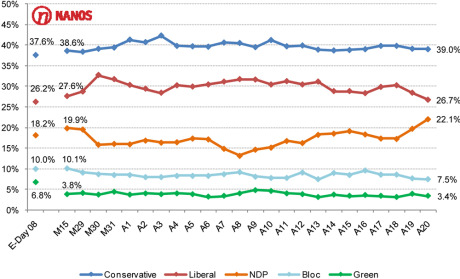
Atlantic Canada now is shaping up to be a three-way race, with the NDP gaining every day for the past seven days. The Tories are at 36.3 per cent followed by the Liberals with 33.1 per cent and the NDP at 28.3 per cent. (There is a margin of error of plus or minus 9.7 percentage points, 19 times out of 20 in the regional sample.)

In British Columbia, the Liberals have dropped significantly — Mr. Ignatieff has seen his support decrease from 33.5 per cent Monday to 22.7 per cent Wednesday night. The Conservatives have 43.5 per cent support and the NDP are at 29.6 per cent, up from 24.7 per cent the night before. (The margin of error in that province is plus or minus 7.9 percentage points, 19 times out of 20.)

In Quebec, Mr. Layton remains strong although the Bloc is still in first place with 32 per cent support compared to 23.4 per cent for the NDP, 20.8 per cent for the Liberals and 17.5 per cent for the Conservatives. “At 32 per cent it would be the worst ever showing for the BQ in a federal election,” Mr. Nanos said, noting that their previous worst showing was in 1997 where they won 37.9 per cent of the vote.‬

If all of this isn’t just a blip, it’s terrible news for Michael Ignatieff. That grinding noise you hear is the knife-sharpening back at Liberal HQ.

Update, the second: If the initial news was promising for Jack Layton, the poll done for La Presse must have been like a big shot of adrenalin:

A new poll by CROP for La Presse suggests that the enthusiasm for Mr. Layton is such that the NDP has now overtaken the Bloc Québécois in voting intentions for the first time in Canadian history. The online poll suggested that the NDP is now first choice for 36% of Quebecers, compared to 31% for the Bloc, 17% for the Conservatives and a mere 13% for the once mighty Liberal Party.

Having heard the NDP boast about “historic breakthroughs” over the years, I’m loath to get too carried away until these numbers are confimed by other pollsters. In 2008, Mr. Layton was in a statistical tie with Stéphane Dion two weeks before election day but ended up trailing by eight points and 40 MPs.

Yet there are signs this time might be different. In Quebec in particular, the Liberal brand is damaged goods and the Bloc is looking like a tired, one-trick pony. There is nowhere else to go for left-of-centre voters.

Update, the third: Forum Research says that the NDP is already in second place nationally:

“The Tories are ahead everywhere except Quebec, it’s all going to come down to what happens in Quebec,” says Mr. Bozinoff, noting the tradition of Quebec voters to move en masse when they have sharply changed preferences in past elections.

The survey of 2,727 voting-age Canadians was conducted Wednesday evening. It was an interactive voice response survey with a margin of error of plus or minus 2.2 per cent 19 times out of 20. The margin of error for regional and provincial breakdowns is slightly higher, but in such a large survey, with 348 citizens reached in the GTA alone, it is a reliable indicator of election trend lines.

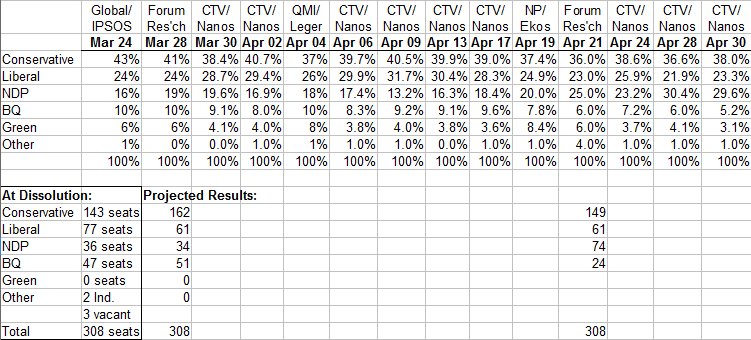
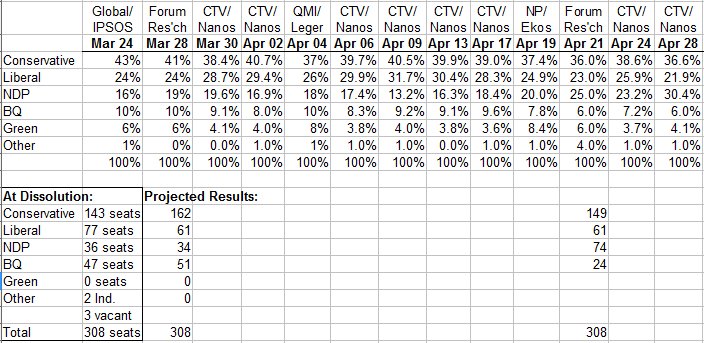
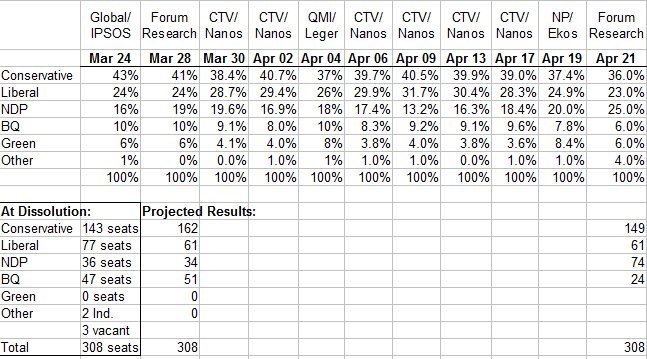
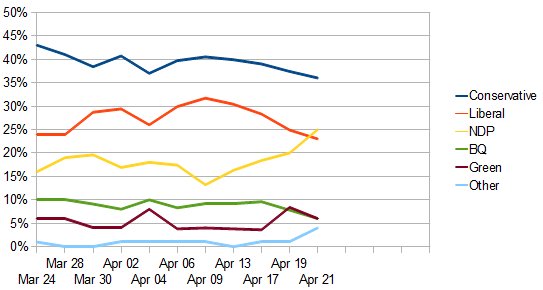
Nationally, the survey gave the Conservative Party support from 36 per cent of decided and leaning voters, 25 per cent for the NDP, 23 per cent for the Liberal party, and six per cent each for the Green Party and the Bloc Québécois. A separate Forum Research analysis, based partly on ridings won and lost in the 2008 election, suggest the survey results would give the Conservatives 149 of the 308 Commons seats if an election were held today, with 71 seats for the NDP, 64 for the Liberals and the Bloc Québécois would have 24 seats.

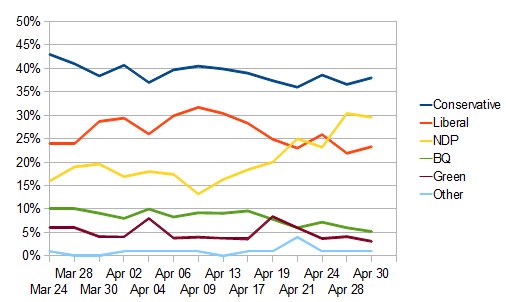
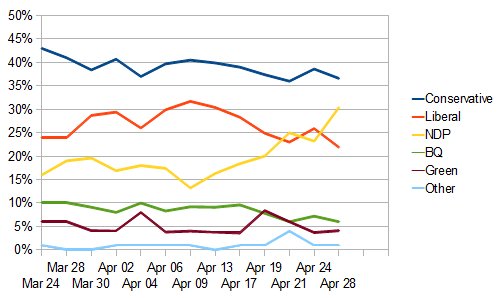
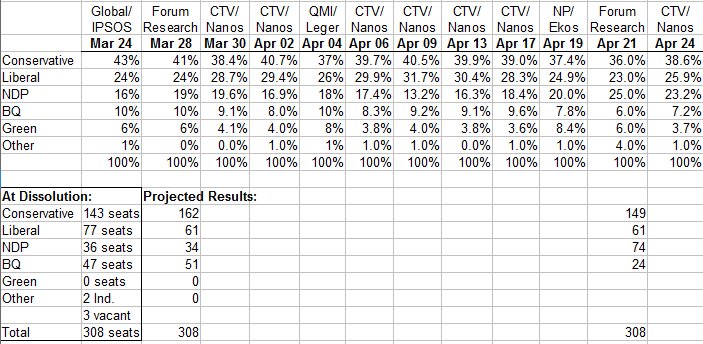
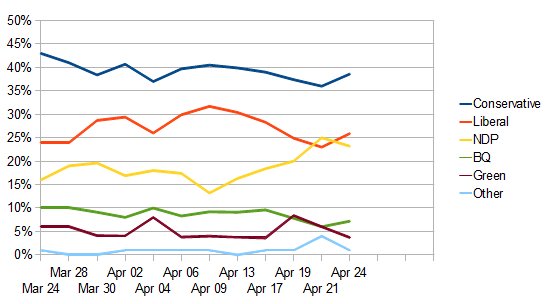
My occasionally updated percentage tracker, now (thanks to commenter request) with a graph to match:

April 19, 2011

Things that keep on rising in price … like healthcare costs

Kevin Libin points out that Michael Ignatieff may have been even more accurate than he himself realized:

The politicians are finally talking about it, but if you listened to what Mr. Ignatieff said during last week’s English-language debate, you might have found yourself feeling a bit depressed. Perhaps because the Liberal leader effectively argued that if Canadians wanted to keep getting decent medical treatment, they were going to have to learn to live without lots of other things.

“This comes down to a moment of choice,” Mr. Ignatieff intoned. Canadians could either vote for personal income tax breaks, planned corporate income tax cuts, new equipment for the Canadian Forces, all promised by the Conservatives, or, he said, “you can support health care.”

To be accurate, he used language that was far more politically loaded (“multi-million dollar expenditure on prisons … big gifts to upper-middle class Canadians”), but his message was the same: affording public health care means sacrificing other possible priorities.

There’s certainly much to suggest he’s got a point.

If our healthcare costs keep rising, unbounded by any kind of cost control, it will either consume the economy, or cause its collapse. And, of course, the large number of soon-to-retire Baby Boomers are about to need much higher health spending as the natural aging process starts taking its inevitable toll. Fun times ahead, folks.

Already, nine out of 10 provinces spend the majority of their own source revenues (which excludes federal transfers) on health care, according to the Fraser Institute’s report “Canada’s Medicare Bubble.” Only Alberta is just barely under 50%; Nova Scotia spends 88%.

With all the good will in the world, the government can’t keep increasing their healthcare spending . . . they’re almost out of money already.

April 18, 2011

True Finn party surges to 39 seats in Finnish election

Filed under: Europe, Politics — Tags: , , , , — Nicholas @ 15:53

From nowhere to third-largest party:

The True Finns finished just behind the conservative NCP and the Social Democrats on around 19%.

While the Social Democrats have called for changes on EU bail-outs, including the planned Portuguese rescue, True Finns opposes the plans altogether.

A hostile Finnish government could theoretically veto the package.

Unlike other eurozone countries, Finland’s parliament can vote on whether to approve the measures.

Correspondents say the increased sway of Euro-sceptics in Finland’s parliament could hold up any further bail-out deals.

As the biggest party, the NCP is tipped to lead the next government with former Finance Minister Jyrki Katainen likely to become prime minister of whatever coalition emerges, replacing Mari Kiviniemi of the Centre Party.

Gavin Hewitt called it a “tremor” with an “epicentre” in Finland:

A few years ago the True Finns were a fringe party, that received almost no attention. So what happened? The vote was not just about the bailout. There was anxiety about unemployment and fears of a jobless economic recovery. Reductions in pensions had angered many workers. The party also tapped into fears about immigration.

What makes this election so significant is that it follows a pattern across Europe. Establishment and incumbent parties are being rejected. Nationalist parties are gaining influence.

In the Netherlands, the anti-Islam MP Geert Wilders leads the country’s third largest party. In Italy the Northern League — hostile to immigration and wary of the EU — is increasingly powerful. In France, Marine Le Pen — who wants to abandon the euro — is showing strong support in the polls.

Recently, writing in the Financial Times, Peter Spiegel questioned whether we were seeing the emergence of a European Tea Party. Certainly there is a strong sense of alienation and dissatisfaction. Immigration is a key factor. It is shaking governments. There are more than 24 million people without work in the EU and there is no appetite to welcome new arrivals. That is why the migrants from Tunisia are sparking such tension between Italy and France.

As important as immigration is unemployment. In countries like Italy and Spain there is talk of a “lost generation” that cannot find work. There is a growing awareness that Europe may be a low-growth area.

H/T to Elizabeth, who reminded me that I had an obligation to report the final results after having posted links to the election race twice before.

April 17, 2011

Steve Paikin on moderating the leaders’ debate

Filed under: Cancon, Media, Politics — Tags: , — Nicholas @ 09:55

Everyone is watching the debate to hear what the leaders say. Nobody tunes in to watch the moderator, so the best moderator is the one who manages to keep the debate moving smoothly but remains mostly invisible to the viewers. Steve Paikin was the moderator for the leaders’ English language debate this time around. He has a post on his experiences:

I’ve had the honour of moderating two previous federal leaders’ debates, and both times, the four minutes of waiting for the top of the clock can be agonizing. It’s not an exaggeration to say that in 2006 — the first time I ever participated in a leaders’ debate at any level — I felt like vomiting during those four minutes. Yes, I was that petrified.

So I cracked a joke.

“I don’t know what you guys are so nervous about,” I said to them. “You’ve all done this before. I never have.”

For all the criticism that he’s wooden and humourless, it was actually then opposition leader Stephen Harper who had a funny comeback.

“Yeah,” he said, “but you’ve got someone talking in your ear to help you. We’ve got nothing.”

So how about that whole “being invisible” part of the moderator’s role?

For some reason, I always seem to mess something up. The first time in 2006, I had forgotten to turn off my BlackBerry. As I was reading the introduction, I felt it buzz. How embarrassing was it going to be to have my phone ring as I was 30 seconds into my script. Somehow, I reached down and silenced it as I was reading the intro. Then the TelePrompter broke, so I quickly had to find my place in the script and keep reading, trying to make it all look seamless. Was someone trying to give me a heart attack?

This year, I somehow managed to kick the wiring out of the monitor on my desk, again, while reading the intro, meaning I spent the entire two hours flying blind. I couldn’t see the videos of the questions and couldn’t see what shots were being used during the broadcast. I spent the first five minutes of the debate playing with the wires, trying to reattach them, hoping the camera wasn’t catching me trying to play technician. Ultimately, I gave up.

Was the debate a good television experience? I don’t know. I never saw it.

Latest polling data

Filed under: Cancon, Politics — Tags: , — Nicholas @ 09:38

April 15, 2011

Finnish election still up for grabs

Filed under: Europe, Politics — Tags: , , — Nicholas @ 15:11

Remember I mentioned the “True Finns” party in passing last week? The election is this weekend and it looks like a four-way race:

Finland votes on Sunday in its most closely watched general election in years, with the campaign hijacked by a Eurosceptic maverick riding roughshod over the consensus that has long characterised the country’s politics.

Timo Soini has alarmed the European and Finnish elites by leading his True Finns party into a neck-and-neck position with the three mainstream parties that traditionally dominate Finnish politics.

The quadrupling of support for the True Finns since the last election in 2007 puts Finland firmly in line with the cardinal trend in politics across Europe in the past year — the emergence of the populist far right combining nostalgia for disappearing values and traditions with anti-immigrant and anti-EU appeal.

An opinion poll on Friday put the True Finns at around 16% in a coalition system, soaring from 4% in 2007 albeit sliding a little from their position in surveys last week. That put True Finns neck and neck with the Centre party of the prime minister, Mari Kiviniemi, and the opposition social democrats, and a few points behind the poll leaders, the National Coalition party led by the finance minister, Jyrki Katainen.

Steve Paikin interviews Rick Mercer

Filed under: Cancon, Humour, Media, Politics — Tags: , , — Nicholas @ 14:26

April 13, 2011

Surprisingly little movement in the polls

Filed under: Cancon, Politics — Tags: , — Nicholas @ 12:07

So far, based on the three-day sample Nanos works with for their daily poll release, there hasn’t been a lot of identifiable shifting support among the parties in spite of the leaked AG report:

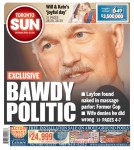
Update: Of course, not all polls agree, but the Compas poll for the Toronto Sun has radically different numbers based on the regional breakdown:

H/T to David Akin for the image (via Twitpic).

Leaders’ debate provides no significant changes

Filed under: Cancon, Media, Politics — Tags: , , , , , — Nicholas @ 07:26

I didn’t bother watching the first debate on TV last night, as I didn’t think there would be any purpose in doing so. Lots of people seem to have felt the same way, as polling immediately after the debate showed little change in support:

It was Stephen Harper’s debate to lose — and he did not.

It was Michael Ignatieff’s debate to win — and he did not.

A poll done exclusively for QMI Agency immediately after Tuesday night’s English-language debate shows that English-speaking Canada was, by and large, unmoved by the two-hour duel among the four party leaders.

Asked who won the debate, 37% of those surveyed by Leger Marketing said Harper was the victor. About 21% said Ignatieff won.

Those numbers roughly mirror voter support in polls Leger has done before and during the election campaign.

April 11, 2011

Election bombshell in leak of Auditor General’s report?

Filed under: Cancon, Government, Law, Media — Tags: , , , — Nicholas @ 13:01

The Winnipeg Free Press has a potentially explosive article about a leak of part of the Auditor General’s report:

The Harper government misinformed Parliament to win approval for a $50-million G8 fund that lavished money on dubious projects in a Conservative riding, the auditor general has concluded.

And she suggests the process by which the funding was approved may have been illegal.

The findings are contained in the draft of a confidential report Sheila Fraser was to have tabled in Parliament on April 5. The report analyzed the $1-billion cost of staging last June’s G8 summit in Ontario cottage country and a subsequent gathering of G20 leaders in downtown Toronto.

It was put on ice when the Harper government was defeated and is not due to be released until sometime after the May 2 election. However, a Jan. 13 draft of the chapter on the G8 legacy infrastructure fund was obtained by a supporter of an opposition party and shown to The Canadian Press.

This could be the big break that the opposition parties have been waiting for: the leak is just about perfectly timed for maximum effect (just before the first debate), and the Auditor General has refused to discuss the news story or to give any interviews during the election campaign.

Budget was over-optimistic, but promises based on that budget are fantasies

Filed under: Cancon, Economics, Politics — Tags: , , — Nicholas @ 10:36

Over at the consistently interesting Economy Lab blog at the Globe and Mail, Stephen Gordon casts scorn equally on Liberal, Conservative, and NDP campaign promises:

All parties are using the March 22 budget as a baseline for their scenarios; their platforms enumerate tax and spending plans in terms of deviations from the budget scenario. So the first problem to point out is that the budget’s scenario of freezing nominal expenditures for five years without cutting services or programs is at best implausibly optimistic.

The Liberal platform [. . .] builds on that implausible baseline by overestimating anticipated revenues from an increase in the corporate income tax (CIT) by a factor of 2.5.

The Conservative platform’s variation on its own budget is a promise to identify and implement savings worth $4-billion a year within the next three years without cutting programs or reducing services. No other explanation is offered, but then again, neither do they seem to be able to explain the cuts that were announced in the budget.

But the prize for budgetary opacity must surely go to the New Democrats’ “costing document”. Firstly, their estimate of $9-billion a year from increasing the CIT rate is even more implausible than that of the Liberals: an overestimate by a factor of at least three. The next largest source of revenue — “Tax Haven Crackdown” — is supposed to produce more than $3-billion in 2014-15. I cannot offer you any more in the way of explanation behind that number, because the NDP platform is completely silent on the matter. No measures are announced, no reasoning is offered to explain why those measures might be sensible, and no research is offered to justify the $3-billion estimate. The same goes for the “Ending Fossil Fuel Subsidies” entry: $2-billion a year in extra revenues, again with no explanation, discussion or research.

April 10, 2011

QotD: The real issue of the election

Filed under: Cancon, Government, Politics, Quotations — Tags: , — Nicholas @ 00:08

What is the issue in this election? Why, the same as in all elections, my libertarian self exclaims. In the last 45 years, the only question has been whether the government implementing the NDP’s policies will be Liberal or Conservative.

OK, my libertarian self exaggerates. Does it exaggerate by much? I don’t think so.

The NDP may do abysmally in federal elections, but the NDP’s ideas flourish. Canada is governed from the middle, yes, but the middle is on the left. The politicians who form our next government will be statist — socialists in all but name — because there are no other kinds running. Our statists may vary in degree, but not in kind. Since the 1960s, classical liberals or conservatives either haven’t entered the arena or changed their policies afterwards. They wouldn’t have had a chance otherwise.

Here’s the irony, though: If socialists called themselves socialists, they wouldn’t stand a chance either. Canadians are funny that way. They’ll buy nothing but socialist policies and practices, but never from socialists. Calling things what they are isn’t politically polite in Canada.

George Jonas, “In Canada, socialists don’t win elections. But their policies do”, National Post, 2011-04-09

April 9, 2011

Latest poll: Liberals up, NDP down

Filed under: Cancon, Politics — Tags: , — Nicholas @ 11:22

The Liberals appear to the party primarily benefitting from a slackening in NDP support:

Upheaval in Finnish politics?

Filed under: Europe, Government, Media, Politics — Tags: , , , , — Nicholas @ 00:03

Ilkka is enjoying the spectacle of the “right-thinking” (i.e., left-thinking) folks in Finland who are horrified at the rise of a new party:

Canada will have yet another federal election that will bring yet another minority government, and back in the old country, the parliamentary elections have begun with the first early voting days, and the right-wing protest party True Finns is predicted to grab a significant chunk of the parliamentary seats. The impotent tantrum of the SWPL greens and leftists, along with the media that they still mostly control, reacting to the cognitive dissonance of the working class abandoning them has certainly been a laugh riot. Besides, this whole surge illustrates how just one voice of just the right pitch can smash a sufficiently ossified, smug and complacent echo chamber to little shards of glass by its mere existence. One can only imagine what the Finland of the 1970’s would have been like, had the Internet existed back then to give these voices a voice, as all leftism and progressivism can keep the reality at bay only if they get to have a totalitarian control of all media to constrain the parameters of debate.

April 8, 2011

Graphic illustrating why I don’t expect my MP to change

Filed under: Cancon, Politics — Tags: , , , , — Nicholas @ 00:06

Whitby-Oshawa 2008 votingWhitby-Oshawa 2008 legendHere’s the riding of Whitby-Oshawa in the 2008 election. Notice all that deep blue colour? As the legend says, the opacity of colour indicates the strength of the party in that area. Up in the Brooklin area, you can barely see the underlying road pattern for all the blueness.

You can find how blue (or red, or whatever) your riding is by using the cyberpresse.ca Interactive map (this is now available in English: the original was in French). It’s another illustration of how to use Google Maps to display geographical data in interesting ways.

This time around, I’ll at least have a Libertarian candidate to vote for: Josh Insang is running for the Libertarian Party. Check the LPC Candidate page to see if you have a Libertarian running in your riding.

« Newer PostsOlder Posts »

Powered by WordPress