Quotulatiousness

May 1, 2011

Repost: Ballot Box Irregularities

Filed under: Cancon, Law, Politics — Tags: , , — Nicholas @ 13:46

I first posted this article in 2004. I repost it every election:

Ballot Box Irregularities, Canadian Style

This article in Reason Hit and Run talks about the recent decision to allow partisan ballot-challengers to monitor the voting in Ohio. In Canada, these people are called “scrutineers” and they have a vital job.

No, I’m not kidding about the vital part. Each candidate has the right to appoint a scrutineer for every poll in the riding (usually only the Liberal, NDP, and Conservative parties can manage to field that much manpower). I was a scrutineer during a federal byelection in the mid-1980’s in a Toronto-area riding, but I had five polls to monitor (all were in the same school gymnasium). This was my first real experience of how dirty the political system can be.

The scrutineers have the right to challenge voters — although I don’t remember any challenges being issued at any of my polls — similar to the Ohio situation, I believe. They also have the right to be present during the vote count and to challenge the validity of individual ballots. Their job is to maximize the vote for their candidate and minimize the vote for their opponents.

Canadian ballots are pretty straightforward items: they are small, folded slips of paper with each candidate’s name listed alphabetically and a circle to indicate a vote for that candidate. A valid vote will have only one mark inside one of the circles (an X is the preferred mark). An invalid vote might have:

  • No markings at all (a blank ballot)
  • More than one circle marked (a spoiled ballot)
  • Some mark other than an X (this is where the scrutineers become important).

After the polls close, the poll clerk and the Deputy Returning Officer (DRO) secure the unused ballots and then open the ballot box in the presence of any accredited scrutineers. The clerk and DRO then count all the ballots, indicating valid votes for candidates and invalid ballots. The scrutineers can challenge any ballot and it must be set aside and reconsidered after the rest of the ballots are counted.

A challenged ballot must be defended by one of the scrutineers or it is considered to be invalid and the vote is not counted. The clerk and DRO have the power to make the decision, but in practice a noisy scrutineer can usually bully the DRO into accepting all their challenges. I didn’t realize just how easy it was to screw with the system until I’d been a scrutineer and watched it happen over and over again.

This is the key reason why minor party candidates poll so badly in Canadian elections: they don’t have enough (or, in many cases, any) scrutineers to defend their votes. In my experience in that Toronto-area byelection, I personally saved nearly 4% of the total vote my candidate received (in the entire riding) by counter-challenging challenged ballots. We totalled just over 400 votes in the riding (in just about 100 polls) — 21 of them in my polls. I got 15 of those votes allowed, when they would otherwise have been disallowed by the DRO.

There was no legal reason to disallow those votes: they were clearly marked with an X and had no other marks on them; they were challenged because they were votes for a minor candidate. As it was, I had a heck of a time running from poll to poll in order to get my counter-challenges in (I probably missed a few votes by not being able to get back to a poll in time).

The Libertarians only had six or seven scrutineers, covering less than a third of the polls in this riding. If the challenge rate was typical in my poll, then instead of the 400-odd votes, we actually received nearly 2000 votes — but most of them were not counted.

Yes, even 2000 votes would not have swung the election, but 2000 people willing to vote for a “fringe” party would be a good argument against those “throwing away your vote” criticisms. Voters are weird creatures in some ways: they like to feel that their votes actually matter. Voting for someone who espouses views you like, then discovering that only a few others feel the same way will discourage most voters from voting that way again in future.

Another reason that minor party votes matter (that I neglected to mention in the original post) is that parties receive funding based on their vote totals in the previous election. Disallowing minor party votes also deprives those parties of the funding they would otherwise be entitled to next time around. For the bigger parties, this is trivial, but for minor parties, this may be critical to them being able to stay active — and visible to voters — between elections.

Don’t vote?

Filed under: Cancon, Politics — Tags: , — Nicholas @ 13:32

As the old joke has it, “Don’t vote: it only encourages them“:

“Why should youth vote in the upcoming federal election?” asks a series of Go Vote! actors. “I’m voting because I want to address bullying in schools and communities across the country,” answers one youth, as if school bullying is a ballot question this year, or as if it obviously should be, given that in Canada schools and communities more properly fall under provincial responsibility. Other answers, by other Go Vote! youths, do fall under federal jurisdiction, and also within Public Policy Forum’s bigger-government mindset. The video has one youth wanting government support for the arts. Another for sports. Another for youth entrepreneurs.

None of the Go Vote! actors said “I’m voting to stop the high taxes that cause youth unemployment to soar,” or “I’m voting to stop unfunded pensions and other government giveaways to the older generation that are stealing the future from us youths.” The Go Vote! video exhorts youth to vote without exhorting them to become informed, as if the right choice of candidate is too obvious to name. Little wonder that the current fads on campus are termed mob voting. Mob voting, and the mob rule it promotes, can only delegitimize the authority of democratically elected leaders. The higher the vote turnout, in other words, the less legitimate the government.

Go Vote! claims “Everyone needs to vote.” In fact, no one who cares about Canada should vote if their vote isn’t well informed. Voting is a small part of being a good citizen, and a relatively unimportant part, especially if the goal is to keep government leaders accountable. Joining a lobby organization or writing letters to the editor or to elected representatives can be far more effective in putting politicians on the spot, if that’s your sort of thing.

Whether or not you’re informed, don’t vote if you don’t want to. You don’t become unworthy if you don’t obey the election scolds, just as you don’t become worthy by casting a mindless vote at the behest of others.

I’m voting tomorrow, as I’ve voted in every federal and provincial election since I became old enough to cast a vote. And, as usual, I’ll be “wasting my vote” on a candidate who almost certainly won’t win (Josh Insang, Libertarian Party of Canada). I’m encouraging others to vote, even if they’re going to “waste” their votes for candidates who won’t win. But I’m totally opposed to the idea that voting should be mandatory (as Australian law requires). If there’s no party or candidate that you feel deserves your vote, then you should have the right not to vote.

Final pre-election poll numbers

Filed under: Cancon, Politics — Tags: , — Nicholas @ 12:17

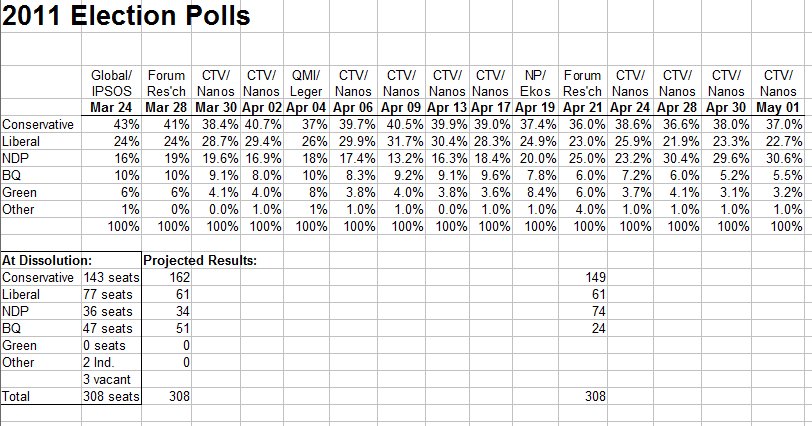
Tomorrow looks like an interesting day:

Click thumbnail to view full size table
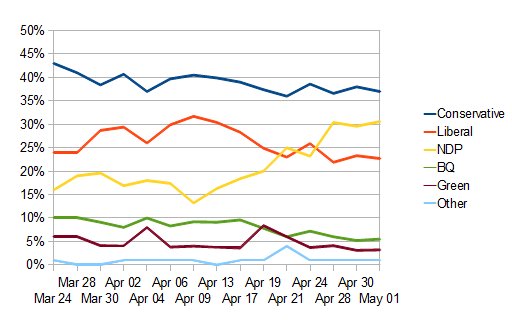

Update: To further emphasize how interesting tomorrow’s vote may be, Colby Cosh points out that nobody is confident in their predictions:

Are you ready to stay up late May 2? Do you have good coffee and plenty of snacks laid in? This may be the election with the highest quantity of uncertainty in my adult experience. The NDP’s dazzling polling gains simply have no obvious recent precedent. I’m not sure a national party has ever made strides of this magnitude and nature in such a bewilderingly short time.

Think about the questions you have to ask to estimate the impact, in terms of Commons representation, of a shift like this; you have to form ideas about the sincerity of the polling subjects’ intentions, the efficiency of the resulting gains in various regions, and the pure logistical power of the party to get out its vote, all while taking into account the activity and the relative positions of three or four other parties.

And then, as if all that weren’t enough, some old flatfoot comes along and tells some TV guys about Jack Layton getting naked in a place he ought not to have been naking around in. Nobody knows what will happen on May 2 — and I don’t mean that in the usual perfunctory way. This time, really, nobody has any idea. Having messed around with election models, I could tell you plausible stories that involve the NDP winning 120 seats; I could tell you stories of roughly equal plausibility that put them at 55.

Of course, there are limits. I am just about ready to rule out a Diefenbaker-like cross-country rampage by the Conservatives. I am just about ready to promise that Michael Ignatieff will not look happy on Monday evening. (Though even then: how stupefyingly low are expectations for him at this point?) What I can tell you is what how I would bet, if I had to bet. I believe, halfway through the weekend, that the Conservative push for a majority will come down to the wire. And I think they are a little more likely to get there than not.

April 30, 2011

The Toronto Sun goes full gonzo on Jack Layton

Filed under: Cancon, Media, Politics — Tags: , , , — Nicholas @ 11:52

In an earlier post, I was wondering if the mainstream media was going to give Jack Layton and the NDP the same kind of coverage that they had been devoting to the Liberal and Conservative campaigns. Instead of doing the same thing, one of Toronto’s newspapers decided to channel their British tabloid counterparts:

Jack Layton was found laying naked on a bed by Toronto Police at a suspected Chinatown bawdy house in 1996, a retired Toronto police officer told the Toronto Sun.

The stunning revelation about the current leader of the New Democratic Party comes days before the federal election at a time when his popularity is soaring.

When the policeman and his partner walked into a second-floor room at the Toronto massage parlour, they saw an attractive 5-foot-10 Asian woman who was in her mid-20s and the married, then-Metro councillor, lying on his back in bed.

Layton was cautioned by police and released without being charged.

So no crime was committed, no charges were laid, and it happened in 1996. Perfect time to pull it out at the very end of an election campaign.

Latest poll numbers

Filed under: Cancon, Politics — Tags: , — Nicholas @ 11:25

What looks like a weakening of the NDP surge may just be an artifact of the Nanos three-day polling window. We won’t know until Monday:

Click to see full size
Click image to embiggen (the table is getting too wide to show at full size)

April 29, 2011

Stephen Gordon: Layton needs to avoid disruptive monetary policies

Filed under: Cancon, Economics, Politics — Tags: , , , , — Nicholas @ 13:20

It’s almost as if nobody bothered to read what the NDP had in their platform until last week . . . and paying even less attention to what Jack Layton said on the campaign trail. They’re paying attention now:

In my recent post on the prospects of a possible NDP government, I came to the conclusion that not very much would change; their platform had none of the transformational elements that had been a feature of so many NDP campaigns in the past.

But if recent reports are correct, and if Jack Layton seriously thinks that it would be a good idea for a Prime Minister to instruct the Bank of Canada to keep interest rates low, then this benign assessment no longer holds. Such an intervention would be a serious mistake that would seriously endanger the recovery, and could generate another spiral of higher inflation and higher interest rates.

The first thing that would happen after such an order is that Governor Mark Carney would have no choice but to resign. This would be a serious shock to the financial system, and unless his successor could extract a promise that no further orders would be forthcoming, the Bank of Canada’s credibility would simply disappear.

You remember all those smug, self-congratulatory pieces about how well Canada had weathered the recession and how well positioned the country was to take advantage of economic growth? Perhaps this is the imp of the perverse coming back for a revision of all that hearty back-patting.

NDP surge extremely taxing for . . . NDP candidates?

Filed under: Cancon, Media, Politics — Tags: , , , , , , , — Nicholas @ 11:35

I’ve worked on political campaigns for minor party candidates (provincial and federal Libertarians) who had to keep their campaigning to the weekend and after-work slots because they still had to earn a living during the election. I find it hard to believe that so many candidates for a “major” party are running part-time candidacies:

There’s a standard-bearer in Quebec who went on a Las Vegas vacation for a week because she didn’t want to lose her deposit. She also reportedly spoke French so poorly that a local radio station had to scotch an interview rather than air the exchange. Another candidate went to the Caribbean and one travelled to France. There’s a Toronto candidate who has not campaigned at all, can’t be reached, and, judging by a Toronto Star report, quite possibly is an apparition. There are all kinds of students who, presumably, did not have the pesky constraints of full-time work that weighed down Mr. Larkin.

None of these things are unusual — third-place parties usually have a fair bit of cannon fodder — but it is unusual for anyone to be asking about them. And that’s what’s happening to the NDP. People are asking about them, and about the party and its platform, far more than they were last month, or even early last week.

It’s what naturally happens when an also-ran finds itself suddenly very much in the running. The key question for the NDP is: Can it manage four days of impromptu scrutiny?

That will depend on how the traditionally Liberal media handles this unexpected surge from the left: they know how to find awkward quotes and disreputable connections for candidates on the right, but generally have treated leftists with a faint air of “isn’t that cute?” rather than as serious campaigners. Can they apply the same standards in a mirror image?

It’s possible that they will give Jack Layton a much rougher ride than they have so far:

Jack Layton himself is also now facing a different sort of question about his own policies from reporters travelling with him. He was asked on Thursday about how his platform, which calls for a price on carbon, would affect gasoline prices. One analysis says the NDP plan would add 10¢ a litre at the pumps. Mr. Layton insisted that an ombudsman would be able to keep oil companies from raising prices for consumers, but he disagreed that he was proposing to regulate gasoline prices. Reporters described the exchange, which included questions about the AWOL candidates, as “testy” and “heated,” which has been rare for the NDP leader thus far. And testy exchanges lead to stories about how a leader is “on the defensive” or “responding to critics.” Eventually they can become “embattled.” (In the case of Mr. Ignatieff, a report on Thursday referred to him as “beleaguered.”)

“Tone matters,” explains Prof. Matthews. “People do respond to the media. Not everyone, of course, not the partisans and not the people who aren’t paying any attention, but there are people who take their cues from the coverage.”

Update: Publius points out that the situation could be at least as good as last season’s CBC offerings:

Everyone has been stunned by the NDP surge. The newly minted Sun News has started calling it an “Orange Crush,” which is a gross insult to a fine fizzy beverage. No one has been more surprised than the NDP. For years the party has run non-entity place holders in most ridings, as they did this time around. One of them is a Quebec barmaid who took a vacation mid-campaign, which says everything you need to know about the NDPs organization in Quebec. Now some of those ridings are competitive. We could have MPs in the next Parliament that were “accidentally” elected. There’s a sitcom in there somewhere.

April 28, 2011

Kevin Milligan: Corporations are not really people

Filed under: Cancon, Economics, Law, Politics — Tags: , , , — Nicholas @ 12:02

The notion that corporations are “legal persons” is useful for legal purposes, but terribly misleading when politicians are trying to formulate tax policies:

Pretending that corporations are people leads to tax policies with perverse consequences; some can even produce the opposite of what the policy is intended to do.

[. . .]

Some people want to tax corporations heavily because the corporations are ‘rich.’ But, if corporations are not people, they can’t be rich. The owners or employees of the corporation can be rich, but not an artificial legal entity. As my Economy Lab colleague Stephen Gordon wrote, “Claiming that ‘wealthy corporations’ pay [corporate taxes] makes about as much sense as claiming that ‘rich buildings’ pay property taxes.”

This is not an obscure debate. The owners of corporations do not all wear top hats and monocles like the fellow from the Monopoly game. In reality, Bay Street IPO-mongers quake in fear of two large stockholders. One is the Ontario Teachers Pension Plan. The other is the Canada Pension Plan Investment Board. These two pension plans are the largest holders of corporate equity in Canada, and their stakeholders are broadly middle income. Tax policy that hurts the dividends of Canadian corporations has a direct impact on the vast Canadian middle that hold pensions through these two, and similar, pension entities. Of course, many high-income Canadians also own corporate equities. But, if we desire to change the tax burden on high income individuals, though, it is best to do so directly through the personal income tax rather than taxing things high income people may or may not own.

Latest Nanos poll confirms NDP gains

Filed under: Cancon, Politics — Tags: , — Nicholas @ 11:20

While not quite as dramatic as some of the headline polls over the last couple of days, the Nanos three-day tracking poll confirms that the NDP surge is real, knocking the Liberals decisively back into third place:


April 27, 2011

Crunching the advance polling data

Filed under: Cancon, Politics — Tags: — Nicholas @ 07:51

David Akin rounds up the information available from the advance polls over the Easter weekend:

Glen McGregor does all political junkies a favour by crunching the numbers on the advance poll turnout. The turnout was way up over 2008 and Glen ranks all 308 ridings based on the difference in advance poll turnout in 2008 compared to 2011.

I sliced Glen’s chart a little differently and attached a party affiliation based on which party held the riding at dissolution and then sorted the same list based simply on the number of ballots cast at advance polls in 2011.

[. . .]

The Conservatives, by most observers’ reckoning, have the best ground game of the major parties, followed by the NDP. A well-organized ground game means you get your supporters to the ballot box at the earliest opportunity. The Conservatives have done that before and appear to be doing that again. Eleven of the 20 highest turnouts are Tory ridings.

I find it notable that Simcoe-Grey, where independent Helena Guergis is trying to hold on has a very high turnout. Her Conservative opponent Kellie Leitch is a long-time Ontario and federal party activist and worker and, presumably, she has inherited a strong GOTV (get out the vote) organization. Or, interestingly enough, did Guergis hold on to some of that GOTV swagger she used to enjoy?

April 26, 2011

CBC headline: “Layton open to constitutional talks with Quebec”

Filed under: Cancon, Government, Politics — Tags: , , , , , — Nicholas @ 13:32

Oh, crikey. Because that’s exactly what we need to do to continue our recovery from the recession — re-open the constitutional debate all over again:

NDP Leader Jack Layton is willing to reopen talks on the Canadian Constitution in an effort to get Quebec to sign the document once there was a “reasonable chance of success.”

Layton was asked about the issue of constitutional talks on Tuesday in Montreal, where he is trying to capitalize on an apparent sharp increase in support for the NDP in recent public opinion polls.

The NDP leader, however, said he does not think the federal government should enter into constitutional negotiations with the provinces until “there is some reasonable chance of success.”

“It’s not a question of appeasing anybody. We have an historic problem. We have a quarter of our population who have never signed the Constitution. That can’t go on forever,” Layton said.

Less door-to-door canvassing this time around?

Filed under: Cancon, Politics — Tags: — Nicholas @ 08:45

It just occurred to me the other night while watching the Joe Volpe story that we’ve been uniquely blessed in this election: not a single canvasser for any candidate has come to our door. The only contact with a candidate I’ve had in this whole election was when I contacted my local Libertarian candidate (Josh Insang). This may be a function of how strongly my particular poll voted Tory last time, but it’s a bit surprising.

April 25, 2011

Rational debate on tax policy MIA in this election

Filed under: Cancon, Economics, Politics — Tags: , , — Nicholas @ 10:33

Stephen Gordon wishes there was a way to disentangle sensible tax policy discussions from politics:

The Conservatives implemented two major tax cuts in the past five years: the two-point reduction in the GST, and the three-point reduction in the corporate income tax (CIT) rate. The GST cut was almost certainly a mistake, but no opposition party has challenged this decision in the election campaign.

On the other hand, every opposition party has promised to increase the CIT — the tax that is most harmful to economic growth. What is going on?

I see two answers to that question, and both are based on the presumption — possibly well-founded — that voters do not understand the concept of tax incidence. If you don’t understand how corporate taxes are passed onto workers, then the idea of taxing ‘wealthy corporations’ has a certain appeal: “I’m not a wealthy corporation, so it’s no skin off my nose.”

But of course, it is. So the only question is whether or not the opposition parties campaigning on increasing corporate tax rates understand who actually pays the CIT. If they do not understand that higher CIT rates reduce wages, then their competence as a government-in-waiting leaves something to be desired. If they do understand, then they are being less than honest about what the effects of their proposals will be.

The most efficient tax is broad-based and as close to non-distorting as possible. That is also the most hated form: the Goods and Services Tax. The Tory cut in the GST was terrible economics, but great politics. There, in a nutshell, is why stupid tax policies are the only ones on offer in the election campaign — because sensible policies require people to actually face up to the costs of the government they want. People much prefer the illusion that “someone else” is paying for the goodies.

April 24, 2011

Duceppe throws down the gauntlet: “This election is a battle between… Canada and Quebec”

Filed under: Cancon, Media, Politics — Tags: , , , , , , — Nicholas @ 13:20

The rise of the NDP in Quebec is forcing Bloc Québécois leader Gilles Duceppe to take a much stronger line against Jack Layton:

The NDP’s newfound status proved jarring enough for Duceppe to make a strident, emotional appeal to his base Saturday:

“This election is a battle between… Canada and Quebec,” said a message Saturday from the Bloc leader’s Twitter account.

He later erased that note and replaced it with a toned-down appeal for all sovereigntists to back his party. The message is a clear departure from previous campaigns that saw Duceppe work to broaden his appeal beyond sovereigntist voters.

“This election is not a left-right battle, but a battle between federalists and sovereigntists,” said the later message from Duceppe’s account. “Between the parties of the Canadian majority and Quebec.”

There are even anti-NDP attack ads, including a new one from the Liberals featuring a yellow traffic light and the message, “Not so fast, Jack.”

The Liberals have been forced to pay more attention to the NDP than they had planned, especially with the parties in a statistical tie in the latest polls. Liberal Leader Michael Ignatieff was even booed loudly at at hockey game last night, which has only been lightly mentioned in the media. His low personal popularity is starting to be seen as a big reason for the Liberals’ plight in the polls — although it can’t be the only reason.

The NDP’s financial promises are one area the Liberals can safely attack:

The Liberals are pointing out a series of alleged exaggerations in the NDP platform, saying the promises are based on invented revenues like a supposed $3.6 billion that would come in the first year of a climate cap-and-trade system. The Liberals call it, “fantasy money.”

The Liberals also heaped ridicule on the NDP promise to hire 1,200 new doctors and 6,000 nurses for the bargain-basement rate of $25 million.

They said the NDP promise to save $2 billion by slashing subsidies to the oil sands overstates the possible savings by four times, and that the math is similarly wonky on the NDP’s pledge to crack down on foreign tax havens.

“It’s time to take a close look at what Jack Layton’s saying to the Canadian people. The numbers add up and up and up,” Ignatieff said.

“Mr. Layton has got a platform that when you look at it closely has . . . $30 billion of spending, which we think is not going to be good for the economy and he derives it from sources we just don’t think are credible.

“He’s got a cap-and-trade system that’s going to deliver $3.5 billion in the first year. We don’t even have a cap and trade system. It’s science fiction.”

Latest poll shows Liberals in statistical tie with NDP

Filed under: Cancon, Politics — Tags: , — Nicholas @ 12:41

If you wanted an interesting election, this one is certainly shaping up as the most interesting in the last ten years:


« Newer PostsOlder Posts »

Powered by WordPress