Quotulatiousness

September 11, 2021

Thursday’s debate was “a grand Kabuki theatre, increasingly divorced from any grounded reality about our fiscal situation, or our ability to deliver on complex programs or problems”

Filed under: Cancon, Media, Politics — Tags: , , , , , , — Nicholas @ 03:00

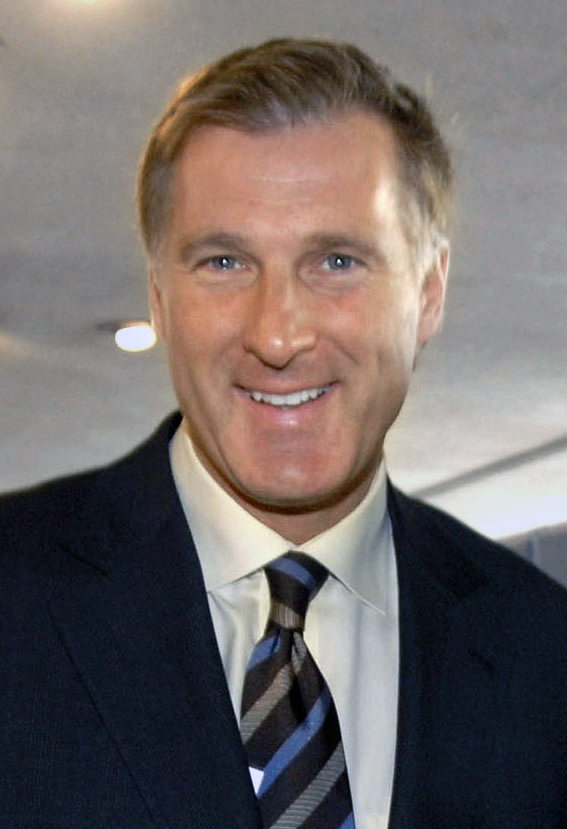
In The Line, Jen Gerson offers her observations of the debate on Thursday night among most of the federal party leaders — missing, of course, the participation of the PPC’s Maxime Bernier who was pointedly not invited:

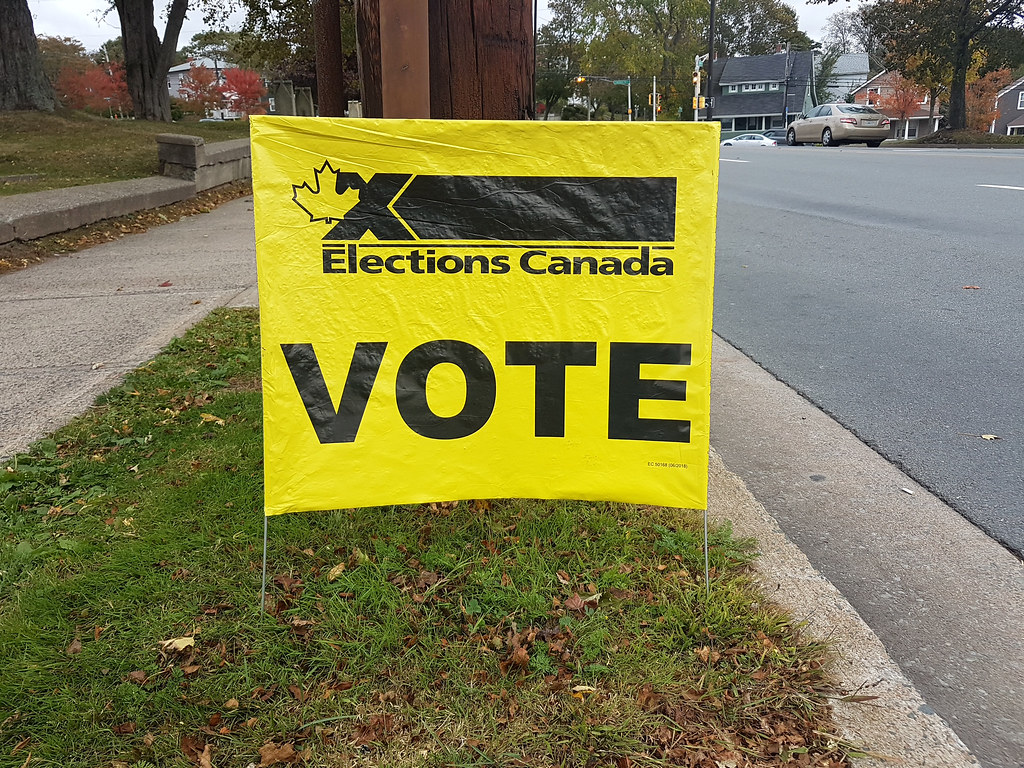
“2019 Canadian federal election – VOTE” by Indrid__Cold is licensed under CC BY-SA 2.0

No one can be said to have “won” such an exercise. You “win” these “debates” not by proposing the best policies, or offering competing philosophies, or even by presenting the best rhetoric. Rather, a “winner” is determined by who comes off the best to a general public that largely doesn’t follow the minute differences of respective platforms.

By that measure, no one really won Thursday’s debate, but Trudeau especially did not win it. I imagine that one of the problems of being raised as a spectacle of wealth, privilege and popularity is that it doesn’t quite prepare you for the moment when the worm turns, when people learn to dislike you for all the right reasons; when you are no longer given the proper deference and respect you feel is owed to you.

Trudeau came off as defensive, and flustered, taking hit after hit from other party leaders on topics ranging from his record, reconciliation and, especially, his self-interested decision to call a party in the first place. That he lacks a credible answer to why we’re holding this election at all three weeks into this campaign is a deep failure, one large and deep enough to consume his prospects of forming a majority government — and his hold on the party leadership along with it.

Annamie Paul offered the best performance of the night by far, and demonstrated that the Green party as a whole is unworthy of her. Whatever private internal dramas that may be unfolding, in public that party condemns itself to obscurity by refusing to get behind a woman who is, by every measure, impressive.

Bloc leader Yves-François Blanchet made himself into an idealized avatar of a whiny and aggrieved Quebec nationalism that puts Alberta to shame. It takes a real special lack of self-awareness to imagine that Quebecers have had it rougher in this country than Indigenous people. Or that Blanchet, by virtue of his French ancestry, has suffered from greater oppression than, say, Annamie Paul. One day, the rest of Canada is going to stop humouring these insulated, thin-skinned delusions — but not before Quebec’s seat count declines relative to the rest of the population’s. In the meantime, Blanchet’s ability to beam pure DGAF energy into the English debates at least made him seem like a human, albeit a delusional and unpleasant one.

By this measure, Erin O’Toole “won” the debate by not losing it. I can’t remember a single thing he actually said, and in such a setting this can only work to his favour.

I mean, what is there to say? On actual substantive policy issues, I couldn’t escape the sense of watching a grand Kabuki theatre, increasingly divorced from any grounded reality about our fiscal situation, or our ability to deliver on complex programs or problems.

September 10, 2021

By Gandhi’s reckoning, the PPC is entering stage three (“First they ignore you, then they ridicule you, …”)

Filed under: Cancon, Liberty, Media, Politics — Tags: , , , , — Nicholas @ 03:00

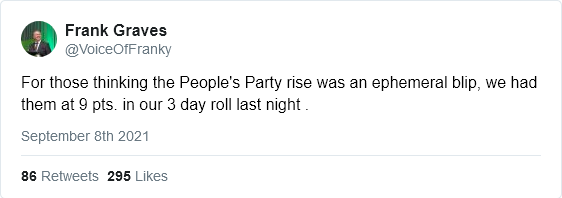
In The Line, Matt Gurney says that the dying media will have to start taking Maxime Bernier and the PPC much more seriously if the recent “blips” in the polls turn out to be accurate:

To riff off the old song, there’s something happening here, though what it is ain’t exactly clear. Like it or not, we’re going to have to start paying attention to the People’s Party of Canada and its leader, Maxime Bernier. If polls are to be believed, they’re having a great election.

The PPC hasn’t warranted much attention before. It has largely served as a vanity vehicle for Bernier, who probably can’t believe he’s been able to keep himself out of an ordinary job this long. The party is a mixture of populist outreach and pie-in-the-sky pseudo-libertarianism. It has proposed a smattering of policies, but none of them are much more than a talking point or meme. They are often summed up as a “far-right” party — or at least further right than the Conservative Party of Canada — but it feels overly generous to place them firmly anywhere in particular on the political spectrum. Their organizing principle has seemed to be anger with the status quo, and a feeling of alienation from the majority consensus on most political views.

The PPC took just under 300,000 votes in the 2019 election, or 1.6 per cent of ballots cast. It was a rounding error on a fringe, and seemed set to stay that way. This, combined with a history of dogwhistle racism, is why journalists and political analysts paid it little attention (and that includes yours truly).

Something seems to be happening, though. The party has climbed in the polls, with some showing they’ve climbed by a lot. There are important caveats: Some of this can be written off as within-the-margins-of-error blips in the numbers. Perhaps there is some methodological quirk that is causing polling companies to overestimate the PPC’s standing. Maybe frustrated people are parking their vote there for a time but will come back to one of the traditional parties when actually making their x on a ballot.

So yeah. There’s all kinds of ways to rationalize this into a nothingburger, if you’re so inclined, but the fact remains there is a trend, consistent across different polls, from different companies, and over an extended period of time. It really does seem as though the party is set to double, triple or maybe even quadruple its support, relative to the last election. The latest Ekos poll has them at nine per cent. That’s an outlier on the high side, but if they came even close to that, the PPC would eclipse the Green Party of Canada’s best-ever showing. By a lot.

My friend John Wright is a pollster with decades of experience, and the executive vice president at Maru Public Opinion. He called me this weekend to tell me that something was up with the PPC’s numbers — I’d already realized the same, at least on an intuitive level, but he had the numbers to back it up. His numbers are broadly similar to what’s showing up in other polls. I asked him what he could tell me about the typical PPC voter, and he said there isn’t a ton of information about them, but pulled what data he could find.

The typical PPC supporter, based on polls as recent as last month, is … pretty normal, actually, at least demographically. They are fairly evenly distributed across every segment of Canadian society. No province has a wildly high or low number of PPC supporters (Alberta was a bit higher than the others, but only a very small bit, and with an overall small sample size). They are found fairly consistently across all age groups and economic and educational classes. The only really notable divergence in Wright’s numbers was on gender lines — men are twice as likely to support the PPC as women.

September 8, 2021

The Line‘s She-lection Bullshit Bulletin No. 3 … scary black fully semi-automatic assault machinegun edition

Filed under: Cancon, Law, Media, Politics, Weapons — Tags: , , , , , — Nicholas @ 03:00

The folks at The Line continue their good work in pointing out some of the bullshittiest bullshit the politicians spew on the campaign trail. This week has been all about politicians promising to crack down even harder on the hunters and sport shooters who keep driving their pickup trucks (plastered with Trump bumper stickers, of course) into downtown Toronto to shoot their scary black fully semi-automatic AK-15 or AR-47 assault machineguns with chainsaw bayonets at innocent gang-bangers at 3 in the morning:

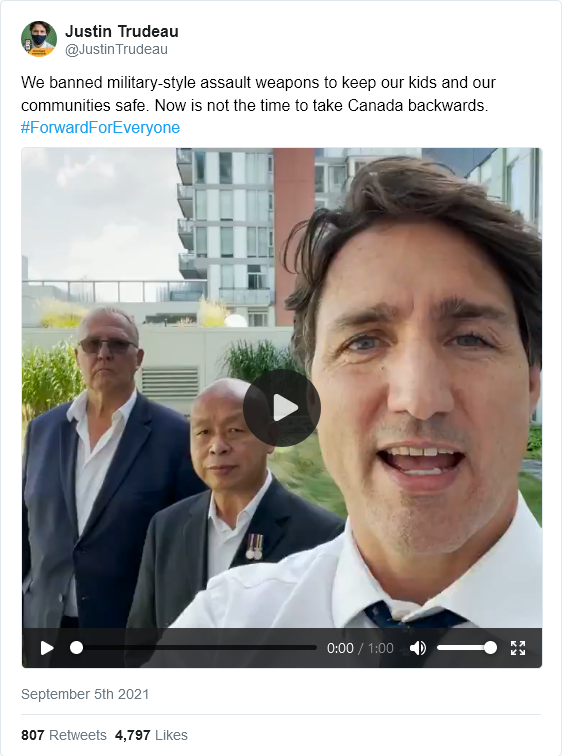
It is hard to know where to even begin picking through the bullshit that Canadians have had dumped atop their heads this week on the gun-control file. Both the Liberals and Conservatives hurled their share, but the worst offenders were by far the incumbents who claimed to ban “military-style assault weapons”.

Let’s start with this: Canadian law categorizes guns into three categories depending on their technical specifications: length, ammunition calibre, mode of operation, and the like. The categories are licensed and regulated differently. It can get pretty complicated. Despite their near-constant use, the terms “assault rifle”, “assault weapon” or the even-scarier sounding “military style assault weapon/rifle” have no specific or universally recognized meaning, including under Canadian law and firearms regulations. They aren’t part of or used by the categorization system.

This is essential to understand: because the terms have no specific and universally held meaning, these campaign-ready phrases can be appended to pretty much any type of rifle, whatever its actual legal category under our law. And that’s how we all found ourselves aspirating bullshit this week.

Most gun experts would generally classify an assault rifle/weapon as a rifle that fires medium-powered (or higher) ammunition and is capable of a “full auto” mode — that is, the weapon will continue firing as long as the trigger is held down. This results in a rapid volley of bullets at a cost of diminished accuracy (the recoil makes the firearm difficult to hold on target). These firearms typically have their ammunition kept in detachable magazines of 20 or 30 rounds each. When a magazine is emptied, it can be replaced by a practiced user in moments.

These sorts of weapons have been banned in Canada since the 1970s.

In 2020, the Liberals used an executive order — an Order in Council — to change the classification of several broad categories of until-then legal rifles, with the effect of preventing sales and further restricting most lawful uses for owners. None of these firearms were assault rifles/weapons by any reasonable standard. All are capable of semi-auto operation only, meaning one round is fired for each pull of the trigger. Under Canadian law, the magazines are limited to five rounds (there are some rare exceptions but five is the law).

Sigh. Still with us?

So the Liberals chose firearms linked to tragic events in Canada or abroad, like the AR-15, deemed these “assault weapons” and then banned them. But there was nothing meaningful or rational about this ban; it was was entirely a matter of political messaging. Numerous other rifles — firing the exact same ammunition from the exact same size of magazine at the exact same semi-automatic pace — remain legal and for sale to any licensed would-be purchaser. This isn’t an oversight. It’s just that the Liberals’ political goals were met by simply banning rifles linked to tragedies and ignoring the rest.

That’s the key thing to understand about what the Liberals did — it was always bullshit policy. But it sounds good to Canadian voters who don’t know fuck-all about guns. In that way, it’s meeting the Liberals’ needs.

Conservative leader Erin O’Toole quickly abandoned his party’s pledge to revoke the Liberals’ 2020 order-in-council once someone noticed and called attention to it. This should not be a surprise to anyone who has paid attention to O’Toole in the past … he’s what we used to call a “Red Tory” — really just a Liberal wearing a blue suit.

September 3, 2021

“Watching our feminist prime minister uncomfortably defend and explain away decidedly unfeminist behaviour has become an evergreen moment for our nation”

Filed under: Cancon, Media, Politics — Tags: , , , , — Nicholas @ 03:00

The NP Platformed newsletter is in the hands of Kathryn Marshall while Colby Cosh is on vacation, and she offers yet another golden moment of hypocrisy on the part of Justin Trudeau:

Standing in the fenced-in corner of a backyard during a press conference this Tuesday, Justin Trudeau was cornered in more ways than one.

Faced with questions from the media as to why he was allowing an incumbent Liberal candidate who had been repeatedly accused of sexual harassment to run for his party, an exasperated Trudeau was once again faced with his hypocrisy when it comes to his feminist credentials.

Only the day before, Trudeau was touting the Liberals “zero-tolerance” policy for sexual harassment. Of course, that was in the context of a Conservative candidate who had been accused of sexual misconduct. Notably, that candidate was very swiftly given the boot by leader Erin O’Toole, which was the correct response.

Now Trudeau finds himself in the exact same position that the Conservative leader was in. Following a CBC report, it has come to light that one of the Liberal candidates, two-term MP Raj Saini, has been the subject of numerous sexual harassment allegations from a number of staff going all the way back to 2015. I have no idea if these allegations are true, but they are deeply disturbing and should be taken seriously. As reported by the CBC, there are seven different sources who “described four different cases where Saini allegedly made unwanted sexual advances or inappropriate comments.” One of the allegations involves a former staff member who filed a human rights complaint with the Canadian Human Rights Commission and tried to end her own life.

It should be a ludicrously easy call for Trudeau. The Liberal party has a zero-tolerance policy for sexual harassment, right? Obviously, Saini needs to go and an individual who is facing allegations of this nature is in no position to be running for public office, period.

Except for one small hiccup. The allegations have come to public light after the candidate cut-off date for the election, which was Monday. So if Trudeau gets rid of Saini, it means they can’t replace him with someone else, and the result is no Liberal candidate on the ballot in a safe Liberal seat. Call me cynical, but if I had to guess, I would say this likely has something to do with the fact that overnight, the Liberal’s “zero-tolerance” policy appears to have evaporated into thin air.

September 1, 2021

Larry Elder’s campaign for governor hit with accusations of “white supremacism”

In City Journal, Heather Mac Donald looks at the recent hysterical attacks on gubernatorial hopeful Larry Elder based on the notion that he is somehow a kind of stalking horse for white supremacists:

Larry Elder at Camp Pendleton for the ceremony presenting the Congressional Gold Medal posthumously to his father, Staff Sergeant Randolph Elder, U.S.M.C., 16 August, 2013.
US Government photo in the public domain via Wikimedia Commons.

The possibility that Larry Elder may win California’s recall election against Governor Gavin Newsom is generating acute anxiety in the mainstream media and among the activist Left. Elder’s foes are responding with their favored means of destruction: by playing the race card. Never mind that the nationally syndicated talk show host is black. A series of opinion columns and editorials have accused him of being a white supremacist, or at the very least a shill for other white supremacists. Elect Elder and California will reinstate Jim Crow, state senator Sydney Kamlager, a Democrat from Los Angeles, has warned.

The media have focused particularly on Elder’s views about crime and policing. The self-described “Sage from South-Central” maintains that criminals, not the police, are the biggest threat in the black community. According to Elder, the false narrative about lethal police racism has only led to more black homicide deaths. “When you reduce the possibility of a bad guy getting caught, getting convicted and getting incarcerated, guess what? Crime goes up,” he said recently at a campaign event in Orange County.

Elder also rejects the charge that white civilians are gunning down blacks, as LeBron James maintained in a tweet during the George Floyd riots: “We are literally hunted everyday, every time we step outside the comfort of our homes.” Elder has a different take. If a “young black man is eight times more likely to be killed by another young black man than [by] a young white man,” Elder told the Orange County Republicans, then “systemic racism is not the problem.”

Such statements are anathema to the establishment Left, deeply invested as it is in the idea that blacks have little agency in the face of ubiquitous white racism. Few subjects are more taboo in elite discourse than the elevated rate of crime among blacks, as it suggests cultural pathologies that — at the very least — complicate the victim narrative. To the Left, black crime is little more than a racist fiction. Los Angeles Times columnist Jean Guerrero claims that the crime statistics Elder has cited “over the decades to support his views and policy proposals are misleading, if not outright false, casting Black people as unusually crime-prone.” Black people are not “more inclined toward violent crimes,” nor do blacks “disproportionately victimize whites,” Guerrero wrote, citing Columbia law professor Jeffrey Fagan and other criminal experts. (Fagan was the plaintiff’s expert in a trilogy of lawsuits against the New York Police Department in the 2010s.) Fellow Times columnist Erika Smith sneered that Elder “keeps trotting out statistics that purport to show that Black people are particularly prone to murdering one another.”

Unfortunately for Elder’s critics, the statistics showing vastly disproportionate rates of black crime and victimization come from some of the Left’s favorite sources. CDC data show that in 2015, for example, the homicide victimization rate for blacks aged 10–34 (37.5 per 100,000) was 13 times the rate for whites (2.9 per 100,000). That disparity is undoubtedly much greater now, given the record-breaking increase in homicides since the George Floyd riots — an increase disproportionately affecting blacks.

Those black victims of homicide are not being killed by cops or whites. They are being killed by other blacks. In Los Angeles, blacks this year have committed 46 percent of homicides whose offender is known, even though they are just 9 percent of the Los Angeles population. Whites make up 28 percent of the Los Angeles population but have committed 4 percent of homicides, mostly involving domestic violence. These data, reported by the Los Angeles Times, mean that a black Angeleno is 35 times more likely to commit a homicide than a white Angeleno. Homicide data are the gold standard for crime statistics. Alas for Jeffrey Fagan and the Los Angeles Times‘s other experts, the statistical conclusion that blacks are “more inclined toward violent crimes” is indisputable.

August 31, 2021

The Line‘s She-lection Bullshit Bulletin No. 2

Filed under: Cancon, Humour, Media, Politics — Tags: , , , , , — Nicholas @ 03:00

Yes, it’s time to publish some of the silliest political bullshit our “leaders” and their parties are slinging around in the federal “she-lection”:

Let’s start with an interesting one.

We’d recommend watching the whole clip (and we’d also note that there’s a second video clip further down in the thread; technical limitations broke one long clip into two shorter ones). But there’s two piles of dung here, and it’s worth breaking them out separately.

The first is, of course, the patented non-answer to a direct question. Glen McGregor asked Trudeau about our people in Afghanistan who were in that very moment in immediate danger. Trudeau talked about something nice he did in 2015. We understand that this is a campaign, but imagine you or someone you love is stuck Afghanistan in now, and the leader of the country is asked about you/them, and that’s the answer? Really?

The second pile of scat is more nuanced. Check out the part of the clip starting at 1:25. Trudeau says that O’Toole and the Conservatives are “promising to end the very program that brought in tens of thousands of Syrian refugees, the very program we’re using to bring in tens of thousands of Afghans fleeing to [safety] in Canada. That doesn’t make sense.”

Well, we mean … it doesn’t make sense because it’s not true.

The Tories are proposing changes to how Canada accepts refugees. Specifically, they want to shift to more heavily rely on privately sponsored refugees, citing research that shows these refugees more easily and more quickly settle into Canada. There would be both government-sponsored and private-sponsored refugees under what the CPC is calling a “joint model” model. This is broken out in the CPC’s campaign platform on page 129.

This seems … pretty reasonable? The Tories are not only promising to maintain current funding levels and numbers of accepted refugees, they just want to structure it differently. Not even very differently, at that: of the 62,000 Syrian refugees that Canada has resettled since Trudeau came to office, half were privately sponsored. The CPC platform also very specifically notes that this wouldn’t apply in “cases of emergency”, which the fall of Afghanistan clearly is. You can criticize that as policy, or even doubt they’ll follow through. Just saying they’ll cancel the program, though, is nonsense.

Of course, Trudeau isn’t the only bullshitter on the campaign trail, so RTWT for the rest of the antics that The Line felt were bullshitty enough to register this week.

August 29, 2021

Justin Trudeau discovers for himself the truth of Harold Macmillan’s dictum on the most difficult thing about being Prime Minister

Filed under: Asia, Cancon, Politics — Tags: , , , , — Nicholas @ 05:00

Former British Prime Minister Harold Macmillan was asked what was the most difficult thing about his job and is reported to have said, “Events, my dear boy, events.” Justin Trudeau had everything he wanted in the Canadian political situation in early August so he put his early election plans into action … and along came those unpredictable events:

“2019 Canadian federal election – VOTE” by Indrid__Cold is licensed under CC BY-SA 2.0

What would have happened in the election of 2021 if Afghanistan hadn’t fallen? If the writ had been drawn up just a few weeks before, or a few weeks after August 15, the day Kabul fell to the Taliban?

This is the sort of question political science nerds will debate over weak beer for decades to come. It’s no great mystery why the Liberals went forward with the election even as armed fighters began to stream into the capital city of a country in which Canadians have sacrificed so much time, blood and treasure.

But I can picture the scene in the war room now and the logic is inescapable. The meeting with the governor general had been set, the news leaked, the campaign messaging laid out, the suits pressed and the planes booked. Besides, as we all know: “nobody cares about foreign affairs.” That old cant, repeated, like a charm.

Most of the time, it’s true.

Canadians hadn’t thought about Afghanistan for a decade. We’d all stopped paying any mind to some poor nation on the dark side of the world, that disputed chunk of mountain and desert besieged by misery and war since the time of Alexander the Great.

Nobody cares about such things. Until they do.

And what’s the difference between a foreign affair that we care about, and one that we do not? The answer is not flattering. We are selfish and solipsistic creatures. We care about current events abroad when what’s happening has some connection to ourselves or our interests — or when the news reflects something about ourselves.

I would not be the first pundit to point out the parallel between the fall of Kabul and the death of Alan Kurdi, the three-year old Syrian refugee boy whose body washed ashore after drowning in the Mediterranean Sea in September of 2015, in the midst of the federal election that brought Justin Trudeau to power. That child’s doll-like body, face-down on a beach, destroyed us, and the tragedy was made more pointed with the discovery that his family had been trying to reach Canada. And that his asylum application had been rejected by officials in Stephen Harper’s government.

In our own bureaucratic nightmare, and Harper’s dispassionate response, we saw reflected our own lack of compassion.

What we are confronting now in Kabul is our lack of competence.

August 28, 2021

Flagging enthusiasm

Filed under: Cancon, Media, Politics — Tags: , , , , — Nicholas @ 05:00

In Friday’s NP Platformed newsletter, Colby Cosh considers the suddenly politically relevant position of the Canadian flag:

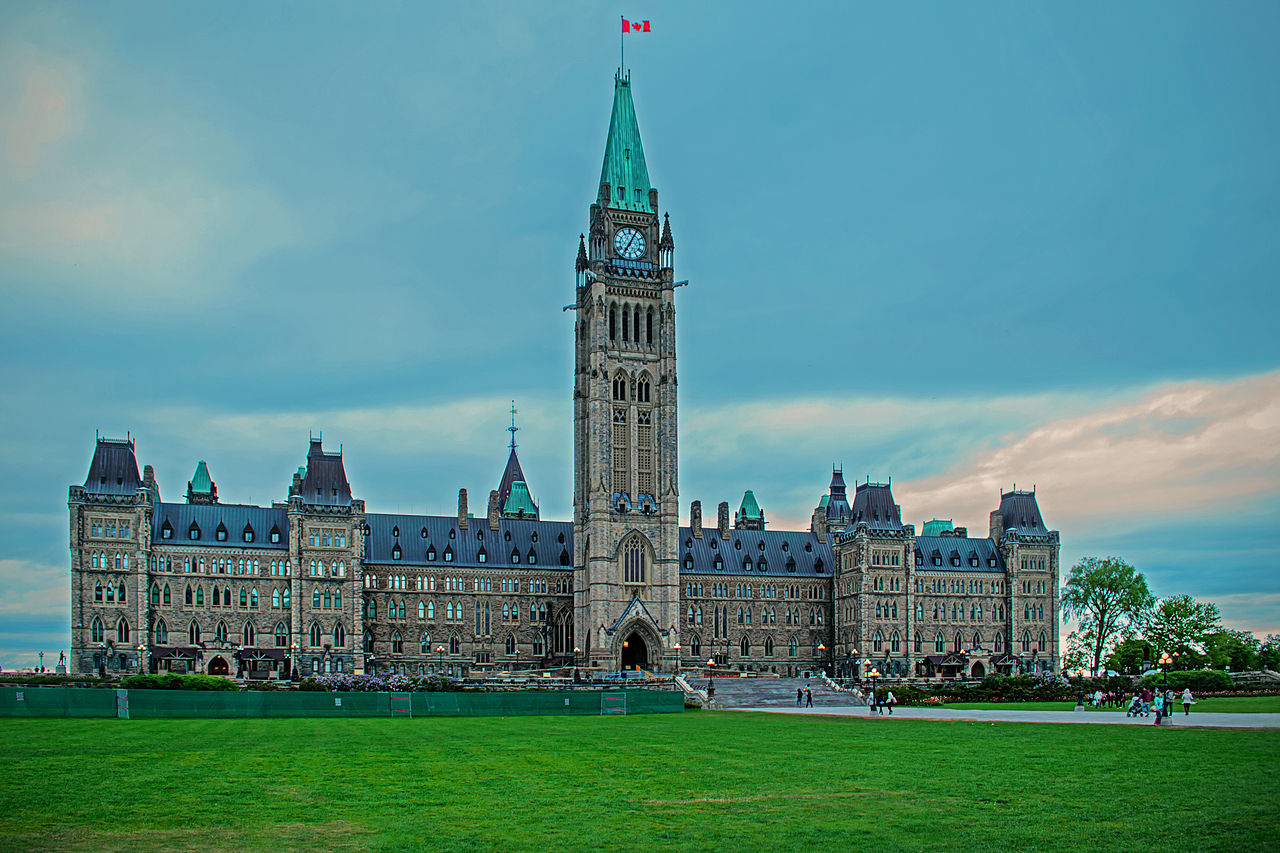
The other day, Conservative Leader Erin O’Toole made mention of the fact that the Canadian flag atop the Peace tower in Ottawa has been flying at half-staff for almost three months and that as prime minister he would put it back up — countermanding the specific order Justin Trudeau gave on May 30. O’Toole’s remark was a brief one dropped in at the end of a longer statement, but he did say we should be proud of our flag, which some people still think of as a Liberal contrivance, and he made the point that being proud of Canada goes hand in hand with wishing to improve it.

I saw this the other day and commented on social media that “I expect the Canadian dying media to be All. Over. This. — Conservative leader Erin O’Toole just called for the Canadian flag to be raised (they’ve been at half-staff officially since the end of May). If the media have their way, this will guarantee a huge majority government for their crush, Justin Trudeau.”

I admit, this was a bit glib, and not all the Canadian media are in the tank for Justin, but (as the old joke about lawyers had it) the 90% give the other 10% a bad name.

First of all, if sticking up for the proper display of the flag counts as wrapping oneself in it, doesn’t using it for gestures of regret (or the dreaded “virtue signalling”) really qualify as the mirror image of this? Trudeau made a point of making sure we knew the lowering of the flag was his own initiative. Liberals have spent a couple of generations working their asses off to constantly remind us that it’s a Liberal flag, which is precisely why conservatives in Ontario towns starting with “B” love the Red Ensign. It is natural to wonder whether, given the apparent Liberal sensitivity about our blood-soaked banner, we won’t get a third national flag before everyone’s finished adapting to the second one. […]

Canada is a place where literal Conservatives can’t “wrap themselves” too tightly in the literal flag: this isn’t the United States, where the positioning and context of the flag in ads or on stage will let you know instantly whether you’re at a Republican or a Democratic event. (The presence of an eagle is always a good clue.) Yet our Liberals have manoeuvred themselves into a position, somehow, in which it is awkward to fly the flag too high.

Can Trudeau now set a date for the raising of the flag to its position of respect and dignity, having plumb forgotten to do so in the first place? And if he is the renewed choice of the Canadian people as prime minister, will he be able to hoist the thing back up? Will this happen the day after the election? The first week? After prolonged consultations with First Nations, perhaps involving a royal commission?

You see, there is an aspect to this that goes beyond politicians battering at one another with flagpoles and other national paraphernalia. O’Toole’s comment didn’t just remind us that we’re Canadians and we should like our flag. It reminded us that we have a government that often seems to have a big problem thinking 30 seconds ahead, let alone six months.

August 26, 2021

Rigging the rules to exclude Maxime Bernier from the leaders’ debate

Filed under: Cancon, Media, Politics — Tags: , , , , , — Nicholas @ 03:00

Jamie Clinton asks why Maxime “Mad Max” Bernier’s People’s Party is being excluded at the same time as the self-destructing Green Party is included by the Leaders’ Debate Commission:

However, before the commission came out with their announcement, the People’s Party had polled at or above four per cent in 13 out of 20 polls. It has only looked worse for the commission since the decision was made. The PPC has averaged five per cent in the six polls done since then. Including one poll that had them at 6.6 per cent, exactly double the floundering Green Party’s numbers.

It is very likely that if the Leaders’ Debates Commission had made their decision a few days later they would have allowed Maxime Bernier to be at the debates. Or, at least, they would have using the criteria they ultimately settled on.

For reference, in the 2008 federal election, Elizabeth May, then leader of the Green party, was allowed to participate in the debates even though her party did not have a seat. And yes, this time the rules are different. But it’s not as if MP’s voted on the debates’ rules or anything. The rules are completely arbitrary decisions that change every election cycle based on the whims of the Leaders’ Debates Commission.

In the 2019 federal election, with a different set of rules, the commission gave Bernier the benefit of the doubt and allowed him to participate in the debates. This time around, that is no longer needed.

Even if the PPC is technically under the four per cent threshold, the fact that they are outpolling both the Green party and Bloc Québécois in an increasing number of polls should be enough. Or at should at least raise the question as to whether or not the Greens and Bloc should remain in the debates.

The Bloc’s position is unique, on the basis of their geographically efficient vote. The Greens are another matter. Often, when an election rolls around, the media and Debates’ Commission go out of their way to distinguish the Green party as a major party. This has been true even when the GPC is polling at and receives under four per cent of the national vote. This happened in 2011 and 2015.

By this consideration, the People’s Party should definitely be allowed at the debates. It seems there are two different sets of rules, one concerning the Greens and the other for the PPC.

August 24, 2021

Tracking the bullshit in the ongoing “she-lection”

Filed under: Cancon, Humour, Media, Politics — Tags: — Nicholas @ 03:00

Ever watchful of opportunities, the folks at The Line quickly realized that there was a critical tracking metric going un-reported in the 2021 federal election and They. Are. On. It.

“2019 Canadian federal election – VOTE” by Indrid__Cold is licensed under CC BY-SA 2.0

At The Line, we’ll be continuing to send out our weekly dispatches for the duration of the campaign. Columnist Jen Gerson will also be doing a weekly recap of major events. We’ll be running articles by other contributors as they come in — not all will be about the election, but many will. And we’re happy to do this. But we felt that something — something we couldn’t quite put our finger on — was missing from our plan. We felt there was more that we could do.

It was our friend over at The Hub, a new media startup, that set us on the right course. The Hub is going to be doing “Policy Pulse”, which they describe as “tracking all the policy announcements from the major parties, with instant analysis from our crew of experts.” Great idea! But the more we thought about it, the more we realized that, you know, that doesn’t quite catch it all. There’s something else that needs to be carefully tracked and analyzed. So we at The Line are proud to bring you our first Bullshit Bulletin, where we’ll note and mock all the incredibly dumb stuff that crops up along the way. This will be an evolving process, and we don’t pretend to see everything, so if you want to send us suggestions, tweet us at @the_lineca, and add #bullshitbulletin, or drop us a note at lineeditor@protonmail.com, with Bullshit Bulletin in the subject field.

And to be clear, all you smart asses out there, no, don’t just tag the entire campaign or every statement made by every member of a party you’re not voting for and write it off as bullshit. There’s degrees of wiggle room and salesmanship and base-mobilizing in every election. We’re not going to worry about that. We’re looking for the egregious examples, and the really weird stuff that comes tumbling out of the partisan mind.

On that note, let’s get started.

Note that although they’re careful to exclude bullshit reports on comments “made by every member of a party you’re not voting for” — which is fair and sensible — they are (one assumes) open to bullshit reports on comments made by members of the party you are planning to vote for … because if it’s enough to set off your partisan-biased bullshit meter when it comes from your “side”, then it’s got to be prime quality bullshit.

August 23, 2021

The dying media’s strange obsession with the Green Party

Filed under: Cancon, Media, Politics — Tags: , , , — Nicholas @ 03:00

The Green Party gets far more media attention in Canada than their vote totals or influence on goverment policy could possibly justify. Their ongoing attempts to commit media character assassination of their own leader might be the first time in living memory that the party’s antics might — might — justify it. The Line explains some of the dramedy in Greentopia:

“Annamie Paul with Green Party of Canada supporters” by Annamie Paul is licensed under CC BY-SA 4.0

One of us, just a couple of days ago, was standing around in our increasingly tattered casual wear and making a sandwich with the TV on in the background. A local news channel was showing Green party leader Annamie Paul speaking. So we changed the channel, because the Greens are irrelevant. But the next channel was also showing the same feed. We tried two others. It was all the same goddamned feed. And two of those networks were national. Viewers from coast to coast had a chance to hear, for an extended period, from a woman so thoroughly doomed that she’s not even pretending to run a national campaign. All she can muster is an attempt to win her seat in downtown Toronto.

Look, we don’t know who needs to hear this, but at the national level, the Greens are zeroes. Sorry, not sorry. Frankly, the Greens have long gotten too much attention in Canadian politics, which is a result of a few quirky things all aligning in their favour: Elizabeth May’s admittedly effective relentless self-promotion, the coffer-stuffing effect of the per-vote-wage subsidy, and, the politeness of Canadian media leaders who felt awkward saying no to Lizzie.

This is not to say that there are not serious Greens, nor that the Green party has not put forward some serious policy proposals. There are, and they have. The issue is that under our electoral system, the Greens don’t matter. And their strident complaining about their irrelevancy doesn’t actually make them relevant.

We glanced at recent vote tallies. The Greens generally get around five per cent or so, sometimes a point or two higher, sometimes a point or two lower. That ain’t nothing. But it is not enough to make them a meaningful electoral force in anything but a tiny handful of seats — or in really weird, bizarre vote-splitting scenarios, and those are very rare. We don’t believe there’s some magic level of popular support at which a party deserves serious consideration or not, it all depends on the context. The Bloc doesn’t get a ton of votes, either (though never less than the Greens), but since they only run candidates in Quebec, their efficient vote means they have a pretty consistently good chance of winning enough seats to matter in parliament. The Greens … don’t.

And that is in normal times. These aren’t normal times. Annamie Paul is a perfectly serious, credible person. The fact that her party is trying to back a cement truck over her in full view of 38 million witnesses simply confirms our instinct to ignore the party she leads. Most elections, you could argue that it’s a shame that the Greens don’t have an actual chance. This election, we’re thanking God for it.

Deciding how much attention to give a candidate or party is usually pretty easy. Outside Quebec, the big three — Tories, Liberals and NDP — get proper coverage, within the context of local circumstances and the dynamics of individual campaigns (ignoring a CPC also-ran in deepest Toronto isn’t going to break any hearts, nor the sacrificial Liberal in rural Alberta). The gamut of weirdo fringe parties are basically ignored. In Quebec, the Bloc warrants consideration alongside the big three.

What screws all this up, though, are the Greens and the People’s Party. They don’t warrant serious consideration, per se, but they will draw a fair number of voters. What to do with these?

August 15, 2021

QotD: A bold new electoral strategy for the US Republican party

Filed under: Humour, Politics, Quotations, USA — Tags: , — Nicholas @ 01:00

To save our country from President *’s reign of error, the Republican Party is going to have to think outside the box, push the envelope, and execute other similar cliches. I have a suggestion for an innovative strategy for the 2022 election cycle that might well overcome the usual GOP establishment tendency toward failure. I say – and you may want to sit down – that this time we should pick some candidates that don’t suck.

Hear me out. It’s kind of crazy, but it just might work.

A nominee who doesn’t suck has certain advantages over the usual losers we see all too often idioting up our ballots. One of those advantages is that people are more likely to vote for someone who is not terrible than one who manifestly is. And getting more votes than the Democrat – who is always terrible – is a very, very important part of electoral victory, though you would not know that from the GOPe’s actions. Its members seem to think the goal is polite defeat, but us unwashed Jesus people who like guns and America and don’t live near Washington have this weird notion that candidates should attempt to win their elections.

Maybe we should try that in 2022.

Kurt Schlichter, “Idea: In 2020, Let’s Nominate Candidates Who Aren’t Awful”, TownHall.com, 2021-05-12.

August 10, 2021

Elections not for changing things but merely for “sending messages”?

Filed under: Cancon, Government, Media, Politics — Tags: , , , , — Nicholas @ 03:00

Jay Currie on the election that Justin Trudeau clearly itches to call at any moment:

“2019 Canadian federal election – VOTE” by Indrid__Cold is licensed under CC BY-SA 2.0

Apparently Justin Trudeau thinks that the best use of the nation’s time as we head into a Delta driven 4th wave of COVID is to have an election. Okay, I never thought he had any judgement and an election call at the moment would confirm that but here we are.

There are huge issues facing Canada. Unfettered immigration, useless but expensive carbon taxes, deficits to 2070, price inflation, real estate markets which have put housing in the luxury goods category, a stalled First Nations reconciliation process, the collapse of any number of energy projects, increased homelessness, opioid deaths, a health care system which seems incapable of dealing with even a fairly mild pandemic, senior care in a shambles where our elderly died in droves as much from neglect as COVID and on and on.

Judging from the Liberals activities in the run up to the election, while those issues get the occasional nod, the strategy seems to be to spend lots of money in seats the Libs either hold or would like to win. As to substance, the Libs seem very committed to “doing something” about climate change, keeping immigration levels up over 400,000 per year and not being racist. Unfortunately, this is also pretty much the substantive position of the Conservative Party. The CPC’s big selling point is getting rid of Justin and his gender balanced Cabinet of flakes.

Conservative leader Erin O’Toole (who also happens to be my local MP) seems to believe the only way he’s going to topple Trudeau and the liberals is by offering exactly the same policies but wrapped in false Tory blue instead of Liberal red. As far as I can tell, he’s the reddest of Red Tories to lead the party in decades (disclaimer: I’ve met O’Toole a few times and chatted about non-political topics … he seems a decent sort and he’s probably a good neighbour and an upstanding citizen in his private life). He’s certainly no Stephen Harper — and I wasn’t much of a Harper fan, but I’d strongly prefer Harper to O’Toole as Tory leader. I certainly don’t plan on voting for him, and unless the Libertarians scare up a candidate in my riding I’ll be voting PPC this time around:

You will notice I do not mention Max Bernier or the Peoples’ Party. I don’t because the PPC plays outside the consensus. The PPC and its supporters think that significant change is absolutely required and that issues like the deficit, immigration, economic development, First Nations policy, housing and health care need new thinking. […] In terms of seats and outcomes, while I would be delighted to see the PPC win a few seats, the real target for the PPC is the national and regional popular vote. Yes, I do know that does not matter electorally. After all, the CPC won the popular vote in the last federal election. (My own sense is that the Maverick Party has some chance of winning seats in Alberta and Saskatchewan which will be discussed in that subsequent post.)

Max and the PPC need to crack the 5% barrier this time out. If they can do that and Max can win in Beauce, they will have sent a huge message to the CPC. That message is important. Now, if Max and the PPC manage to cut through and beat the Greens – not an unrealistic goal – the message that there are real problems which need real solutions will go mainstream whether the gatekeepers like it or not.

There are really two elections coming up: the Tweedledum and Tweedledee, paid for media, horse race and a vote on whether Canada is a serious country.

February 10, 2021

QotD: Wells’s Rules of Canadian Politics

Filed under: Cancon, Humour, Politics, Quotations — Tags: , — Nicholas @ 01:00

There have been questions about my Rules of Politics around here in the last few days. Okay, not a lot of questions, but still. Here is the full list of rules. About a year after I came up with the original two, I added two more, which was probably a mistake. Sometimes I come up with candidates for additions to the list, and here today I will reveal one I considered adding, before deciding against it. But I think it’s time to show a little discipline, so the canonical list will stop at four. Four shall be the number thou shalt count, and the number of the counting shall be four. Ready?

1: For any given situation, Canadian politics will tend toward the least exciting possible outcome.

2: If everyone in Ottawa knows something, it’s not true.

3. The candidate in the best mood wins.

4. The guy who auditions for the role of opposition leader will get the job.

Paul Wells, “Wells’s Rules, annotated”, Maclean’s, 2009-05-21.

January 24, 2021

QotD: The “returned ballot”

Filed under: Cancon, Politics, Quotations — Tags: , — Nicholas @ 01:00

In Canada we used to have — still have, according to a friend who should know — the excellent institution of the “returned ballot.” It is my usual way of voting. I can write with some confidence that it has never won.

Here’s what you do. You go into the polling station, show your ID (in Canada voters must identify themselves). The officer crosses you off the voting list, and gives you a ballot. Then you say, “I wish to return this ballot.” He says, “Thank you, sir,” and takes out his returned ballot book. (It need be nothing special: a school exercise book will do.) He copies your name into that, along with your address. (It is the only way to get your preference recorded.) You thank him, then wander off through the boobs who came to vote for somebody.

One has oneself, in effect, just voted for “none of the above.” This is the theory.

In practice the officer, who may or may not speak English or French, but probably needed the money, looks puzzled and a little frightened. He has no idea what you are talking about. You dig in, to provide a patient lesson in elementary civics. He won’t have a book, but you have brought along a cahier with “Returned Ballots” written on the cover in large capitals with a felt pen, and some heraldry doodled above it. To be helpful, you have already written your name and address on the first line. He consults all the other polling staff then says, “Thank you, sir.”

When, later, you check the results, you will not find a single returned ballot mentioned. Perhaps you were counted among the spoilt ones.

Now if you had been counted, and had persuaded a plurality of your fellow citizens to do likewise in, say, the riding of Parkdale (about one-in-four would triumph in most Canadian ridings; one-in-six if the turnout were low enough), the election is annulled. A by-election must then be called, in which none of the previous candidates may stand.

David Warren, “Let’s be practical”, Essays in Idleness, 2018-09-15.

« Newer PostsOlder Posts »

Powered by WordPress