
Truth is the first casualty of war, no doubt, but so it is also of elections — or perhaps of political life tout court. During elections, though, lying changes from the chronic phase to the acute. Impossible things before breakfast are shamelessly promoted and emotive slogans intoned in the hope and expectation that they will be uncritically accepted.
Walking in Paris just before the French election, I was handed some leaflets and stickers by partisans of Jean-Luc Mélenchon, the demagogic left-wing candidate. “The rich pollute,” said one of them, “the people pay.”
Am I one of the rich, I wonder? Or one of the people? What about the customers chatting over lunch in the nearby café? Are they rich or are they of the people? Mélanchon’s slogan is founded on the old lie, as Wilfred Owen calls Dulce et decorum, etc., that society is divided neatly into two distinct categories with interests diametrically opposed.
No lie appeals more to the dissatisfied than this, offering as it does the illusory hope of a confiscatory solution to life’s little problems. The best that can be said of it is that it permits the dissatisfied an access of hatred and moral outrage, which is always enjoyable and gratifying to experience.
Theodore Dalrymple, “Election bumf”, The Critic, 2022-04-29.
August 16, 2022
QotD: The first casualty of political campaigns
June 28, 2022
Pierre Poilievre … not the Canadian Trump?
Allan Stratton points out to sheltered central Canadian urban voters that populism has a long history in Canadian politics, and didn’t need to be imported from the US:

Conservative MP Pierre Poilievre at a Manning Centre event, 1 March 2014.
Manning Centre photo via Wikimedia Commons.
Conservative leadership candidate Pierre Poilievre is oft accused of importing divisive American right-wing populism to our politics. His endorsement of the trucker protest against vaccine mandates — though not the legal violations of its organizers — has been portrayed as a play for Christian nationalists, racists and fascists. Likewise, his attacks on Davos and the World Economic Forum are said to welcome Trumpian conspiracy theorists, anti-Semites and Great Replacement nativists.
Common wisdom suggests that this strategy may win Poilievre the Conservative party leadership, but will render his party toxic to respectable, mainstream Canadian voters.
There’s a lot of smoke and at least some fire to this critique: The People’s Party of Canada will find it hard to tag Poilievre as a centrist squish.
But thanks to our constitution, the Supreme Court and our general political culture, all more liberal than their American counterparts, social conservative attacks on abortion and LGBT rights seem off the table.
Further, far from a Trumpian nativist, Poilievre is in favour of immigration and wants to cut the red tape that blocks immigrants from employment in their fields, something the current federal government has failed to accomplish into its third mandate.
My fear, as someone who shares many concerns about the prospect of a Poilievre government, is that commentators are misreading the broad appeal of his populism, leading Liberals to unwarranted overconfidence.
Sure, Poilievre’s strategy shares some Trumpian elements, but it’s equally rooted in a progressive Canadian tradition that dates back to the early 19th century and was prominent in the last half of the 20th.
If the Liberals don’t course correct, they may discover that while they are attacking Poilievre as a far-right extremist, he is eating their traditional liberal, working-class lunch.
In broad strokes, I imagine Poilievre channelling Louis-Joseph Papineau and William Lyon Mackenzie during the Rebellions of 1837-38. Instead of the Château Clique and the Family Compact, I see him fighting the Laurentian Consensus, another powerful, unelected group, this time composed of academics, bureaucrats, media apparatchiks and Central Canada think-tankers who dominate our culture and financial establishment — and who arrogate to themselves the right to determine Canadian values and the ways in which we are allowed to describe and think about ourselves as a nation.
For those of us who grew up on the left under Mike Pearson, Tommy Douglas, Pierre Trudeau and David Lewis, it is hard to stomach the recent illiberal turn in elite liberal discourse. It once assumed the importance of free speech, understanding that censorship has always been used by the powerful to suppress the powerless. Yet today, in academia and the arts, free speech has been recast as “hate speech”, and our Liberal government is passing C-11, which seeks to regulate what we read and how we express ourselves online.
June 12, 2022
“Culture is upstream of politics; and the culture is clearly changing”
In the free-to-cheapskates segment of Andrew Sullivan’s Weekly Dish, he discusses some of the cultural sea change convulsing American society and how that will inevitably feed into the political situation in an election year:
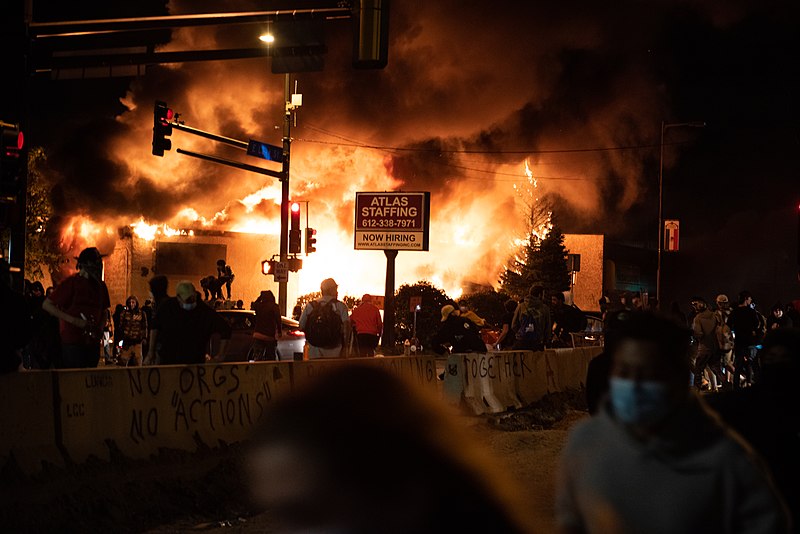
A building burning in Minneapolis following the death of George Floyd.
Photo by Hungryogrephotos via Wikipedia.
We]re now two years out from what may in retrospect be seen as peak “social justice”. In the summer of 2020, a hefty section of the elite was enthralled with the idea of the police being defunded, demobilized and demonized. Critical theory’s critique of liberal democracy as a mere mask for “white supremacy” everywhere. Countless people were required to read woke tracts — from DiAngelo to Kendi — as part of their employment. Corporate America jumped in, shedding any pretense of political neutrality; mainstream media swiftly adopted the new language and premises of critical theory. The Trump madness, and his attempted sabotage of an election, largely silenced liberals in their clash with the left. They had a more immediate threat. And rightly so.
But now look where we are.
Last year, Eric Adams became mayor of New York City, propelled by minority voters horrified by surging crime and chaos. This past week, DA Chesa Boudin, scion of leftwing terrorists, was ousted by minority voters in San Francisco, after he allowed much of the city to become a chaotic hellhole in pursuit of “racial justice”.
Recent polling suggests a sea-change in attitudes. Pew found that only three percent of African-Americans put “racism/diversity/culture” as the most important issue to them while 17 percent cited “violence/crime”, and 11 percent said “economic issues”. (Among Democrats overall, “49% now view racism as a major problem, down from 67% about a year ago”.) New York City voters now put “crime” ahead of “racial inequality” as their most urgent concern by a huge ratio of 12:1. Polling in San Francisco found that 67 percent of Asian-Americans wanted Boudin gone — a sign that the Democrats’ ascendant coalition of non-whites is now fast-descendant.
Hispanics also appear to be fleeing the left. In the usually Dem-friendly Quinnipiac poll last month, “48% of Hispanic registered voters said they wanted Republicans to take control of the House of Representatives, while just 34% said they wanted Democrats in power. In addition, 49% of Hispanic voters said they wanted the GOP to win the Senate, while 36% said they wanted Democrats to remain in control of the chamber.” Biden’s approval among Hispanics is now 24 percent. I’m not sure what to make of this, but even if it’s half true, it’s an electoral emergency for Democrats.
Some Dem pols have noticed the vast cultural gap between most Latino voters and wealthy white leftists, and adjusted. Democratic Congressman Ritchie Torres last week criticized the use of the absurd term “Latinx” — because denying the sex binary is not exactly integral to a culture where the language itself is divided into masculine and feminine. AOC, of course, demurs.
Elite imposition of the new social justice religion — indoctrinating children in the precepts and premises of critical race and gender theory — has also met ferocious backlash as parents began to absorb what their kids were being taught: that America is a uniquely evil country based forever on white supremacy; that your race is the most important thing about you; that biological sex must be replaced by socially constructed genders of near-infinite number; and that all this needs to be taught in kindergarten. Yes, some of this was politically exploited or hyped by the right. But if you think there is no there there in this concern about schooling, you’re dreaming.
Across the country, school boards are thereby in turmoil, with those supporting less ideological education on the march. On the question of trans rights, there is broad support for inclusion — but most Americans are understandably uncomfortable with pre-pubescent kids having irreversible sex changes, and with trans women competing with women in sports. For which those normies are called “hateful”.
June 4, 2022
Ontario’s election – “This was a weird campaign during a weird moment in history. Adjust your hot-takes accordingly, friends.”
From the Ontario election wrap-up post from the editors of The Line:
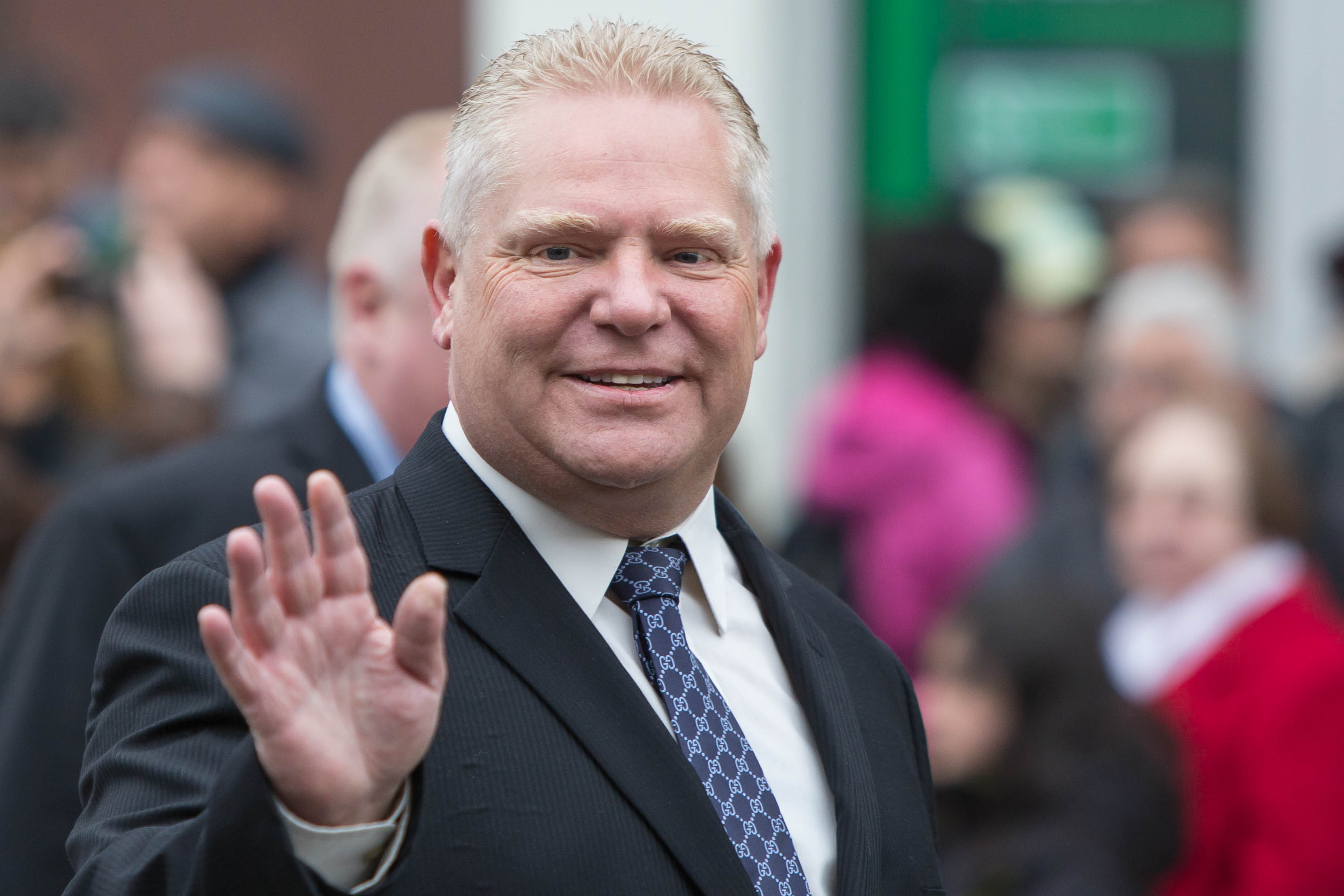
Newly re-elected Ontario Premier Doug Ford, seen here at the 2014 Good Friday procession in East York, Canada.
Photo via Wikimedia.
Doug Ford and the Ontario Progressive Conservatives obviously feel pretty good this Friday. They really did about as well as they could possibly have hoped to do. Still, we urge our readers and all the analysts and pundits out there not to overreact to Ford’s victory. He’s not a political genius, he’s not some sort of colossus standing astride our politics, and he is not the man who must be immediately beamed into the federal Conservative leadership so that he can slay Trudeau’s government and win 200 seats.
Doug? He’s just a guy who got lucky last night. (Politically, we mean. Get your minds out of the gutter.)
We’re not taking anything away from Ford, or his campaign leadership, or all the people who worked hard for the PCs over the last month. They did a lot of smart things, they did them well, and they are reaping the benefits. It was an effective campaign. It rubbed a lot of people the wrong way, but your Line editors suspect it rubbed people the wrong way precisely because it was an effective campaign. Keeping Ford out of sight, avoiding a lot of questions, keeping things low-key … these weren’t accidents. These were deliberate decisions. You have to start any analysis of the PC campaign by granting that. Yeah, it was well conceived and well executed. A hat tip to the people behind it.
But the point that we want to make, and it shouldn’t take away from anything said above, is that the Progressive Conservatives maxed out the luck-o-meter. If this election had been a year ago, coming off the government’s catastrophic handling of Ontario’s third wave, it probably would have been Doug Ford resigning last night. The government caught an enormous break because factors well beyond its control shifted the public’s focus off its greatest vulnerability, the management of the pandemic, and put it solidly on economic and cost-of-living issues that the PCs are much, much more comfortable talking about.
So yeah, the PCs had a good campaign, but you couldn’t buy that kind of luck. None of it happened in Ontario or even Canada. This was a global trend. After two years of pandemic, people are tired and they’re getting worried about other things. The timing for Ford could not have been better. So we absolutely give full credit to his campaign for a good job, but we also insist on acknowledging the huge role of luck and timing. We don’t know if it’s better to be lucky than good. But we certainly know it’s nice to be both at once.
We raise this as a note of caution before the punditry gets too carried away. This election is undoubtedly a huge victory for the Tories. But it is also a really, really weird election. The circumstances of it are very unique. The combination of low turnout, pandemic fatigue, Ford’s personal political brand in Ontario, bizarrely lacklustre campaigns by the opposition, and a confluence of global trends that all netted out in Ford’s favour don’t tell us anything about the state of the conservative coalition in Canada, who would make a good federal leader, or what’s going to happen at the next federal election. This was a weird campaign during a weird moment in history. Adjust your hot-takes accordingly, friends.
Campaigning from your basement worked very well for Joe Biden, and now it’s done the job for Doug Ford. It probably wouldn’t work for Justin Trudeau — if he’s not performing for the camera, it’s not clear whether he actually exists. Ford certainly benefitted from the small attention his opponents on the right — the New Blue and Ontario parties — although minor parties have pretty much always been a non-factor in Ontario politics. They were summoned into existance by the way Ford and the Progressive Conservatives governed during the pandemic … almost indistinguishable from the federal Liberals under Justin Trudeau. The PCs seemed to rely on their “progressive” urges at the expense of anything remotely “conservative”.
Moving on to the other two major parties … it’s not pretty:
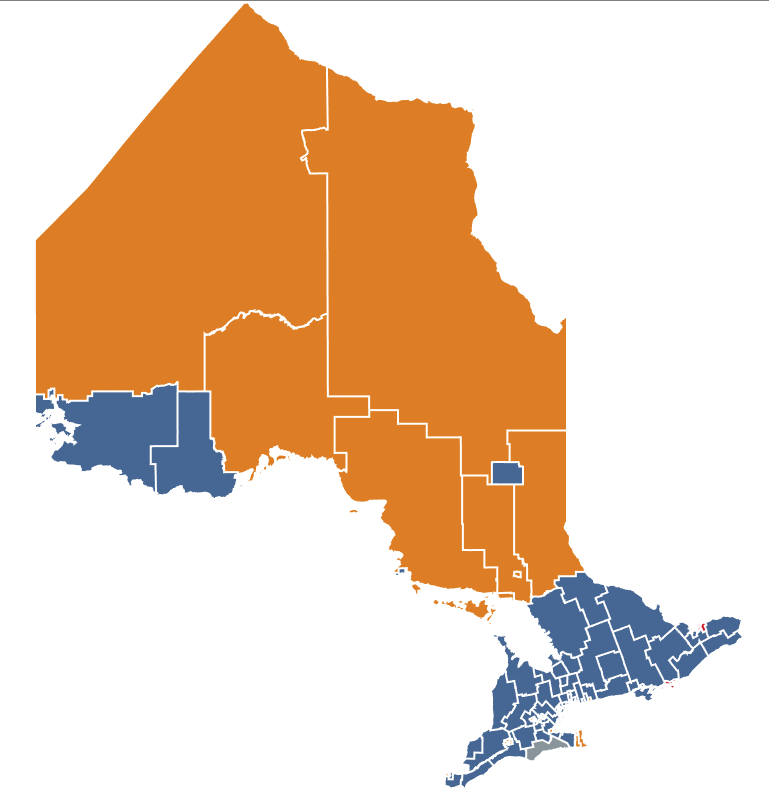
Preliminary riding-by-riding results from the 2022 Ontario election.
Blue – Progressive Conservative, Orange – New Democratic Party, Red – Liberal Party, Green – Green Party
Okay, let’s do the NDP first. The NDP is probably feeling pretty good today. We get it. Even a week or two ago polls were suggesting they were about to lose their hold on official opposition to the Liberals. That would’ve been a disaster for the party. There’s no way around that. They’ve avoided that fate. The NDP has remained in second, although they lost a bunch of seats to the PCs (see above). In the days to come, the party is going to have to take a few cold showers, give their heads a vigorous shake, and realize that warm feeling they’re enjoying right now isn’t the afterglow of victory, it’s the fading adrenaline rush of a near-death experience. Avoiding annihilation shouldn’t be good enough. But that’s all they did.
Andrea Horwath, long-time leader of the party, has already announced that she is stepping down. And rightly so. The Line has some fondness for Andrea. God knows we’ve had the opportunity to get to know her during her tenure as provincial NDP leader, which basically overlaps entirely with our entire careers in journalism. She is a decent person with a better sense of humour than often comes across in public, and she has nothing to be ashamed about. She has taken the party as far as she can, and it’s time for someone else to take over and deal with what might be a changing environment — one that is not obviously changing in the NDP’s favour (again, see above).
[…]
Writing critically about the Liberal campaign today feels a little bit like flogging a dead horse, and then shooting it a bunch of times, and then setting it on fire, and then hunting down all of its little horsey relatives and shooting all of them too. And then peeing on them. But still. It was a really bad campaign by the Liberals. The leader was bad. We’re sorry, but he was. If Steven Del Duca ever encountered charisma we suspect his body would reject it like a donated kidney. The party’s campaign platform was a weird mishmash of stuff that sounded vaguely on point for 2022, but also often read like something copied and pasted directly out of Ontario Liberal campaign platforms going back as far as the 1990s.
Some of the problems the campaign experienced had easy explanations. The party’s 2018 performance was so terrible they lost official party status, and the access to budgets and staff in the legislature that goes along with that status. The party has been trying to rebuild with at least one hand tied behind its back ever since. The campaign team was quite lean, and as a series of ejected candidates show, it was not able to properly vet the full slate of candidates it ran. You can understand how the lack of personnel and money contributed to those problems. But what we can’t understand is why the campaign insisted on making so many weird decisions. Handguns and abortion as campaign issues? In a provincial campaign? Talking up free transit rides, which will only appeal in the deepest downtown cores, where all they could do was hurt the NDP? A mid-campaign pledge to make COVID-19 vaccinations mandatory for school children, which was then never really mentioned again?
The NDP ran a bad campaign, but the Liberals just seemed to be totally disjointed, as if there wasn’t any agreement among the party leadership on what the platform should be so random unrelated items got floated as trial balloons on almost a daily basis, with no follow-up on most of them. Perhaps the party couldn’t afford the cost of proper in-depth pre-election polling or perhaps this was the party leadership’s belated buyer’s remorse over the leader they’d elected.
May 30, 2022
The Line on Pierre Poilievre’s campaign for Conservative leader
I honestly haven’t been paying much attention to the never-ending leadership contest the federal Conservatives have been running for what feels like years at this point. If I had to choose, Pierre Poilievre would probably be my choice — since Mad Max won’t go back to the party that stabbed him in the back — and he appears to be the one to beat as the contest enters its third decade. In the abbreviated-for-nonpaying-cheapskates weekly post from The Line, the editors have concerns about Poilievre and how he may operate first as the leader of the Official Opposition and then potentially as Prime Minister:
Conservative MP Pierre Poilievre at a Manning Centre event, 1 March 2014.
Manning Centre photo via Wikimedia Commons.
We at The Line are going to preface this little blurb about CPC leadership contender Pierre Poilievre with the following two points; firstly, we suspect he’s going to win the leadership race. Secondly, we suspect he’s probably on a trajectory to become prime minister. The usual caveats apply: campaigns matter, polls can be wrong, it’s a long time to go and anything can happen. Of course, of course. But at this godforsaken moment, PP’s got the mo. The gatekeepers are down at heel, and the populists are on the march. We don’t have to agree with any of this, or even like it, to acknowledge that we can feel the current of the wind.
So take these critiques with those expectations in mind. Still: Skippy had a bad week.
Look, the general assumption of the Canadian punditocracy to date has been that Pierre Poilievre is not only dangerous and corrosive — but that he’s also full of shit, that he’s disingenuously stoking populist anger in order to win the leadership of the CPC. Most — who happen to think he’s too smart to actually fall for any of his own rhetoric — genuinely believe he’ll slip back to some kind of sensible, slightly more tribal, but still broadly sane centrist form of conservatism after he scores the leadership mandate. Win from the right, govern from the centre: this is generally a winning formula for Conservatives.
We have a different take.
What if Poilievre is 100 per cent genuine in his beliefs about bitcoin, central bankers, the WEF, banning foreign oil, the lot of it? We’ve said it here at The Line before: COVID has driven everybody a little bit nuts. What if this week, we really just started to see the mask slip?
Because if that’s the case, this is what we could be looking at by 2025, or sooner: a prime minister who probably doesn’t respect imperfect institutions well enough to leave them alone, whether those institutions be the central bank or the Supreme Court. We’d have a prime minister more inclined to take his financial cues from Robert Breedlove than Tiff Macklem; we’d have a prime minister who seems to genuinely believe that the World Economic Forum is some kind of sinister cabal of (((globalists))) led by Klaus Schwab, and is pulling the strings of government because the forum bestowed ego-stoking titles like “Young Global Leaders” on a bunch of up-and-coming Canadian politicians — including Conservative politicians. And it means we’re looking at a prime minister who thinks that banning the import of foreign oil, potentially cutting ourselves off from the global market and forcing western producers to supply energy resources to Canadians first, sounds like a dandy idea. (Does the term: “integrated North American Energy Market” hold any sway, here? You know how much a refinery costs? Just don’t call it a National Energy Program, we guess.)
Look, we think that Pierre is ahead for a reason. On the general sweep of the state of politics, we suspect he’s got the best grasp of his electorate. He’s young, he’s smart, and he’s willing to litigate serious problems and entertain novel ideas to solve them. We’re heading into a period of increased inflation, war, and potentially global famine, and Poilievre could use his considerable intellect to identify Canada’s crucial problems, and steer us in a credible direction.
But not if he’s acting like a goddamn lunatic. Because nothing says “conservatism” like protectionist economic policies, conspiracy theories, and railing against norms and institutions, right?
So Poilievre, Jenni, if you’re listening (are you listening?) don’t make the mistake that Jason Kenney did in Alberta. Don’t win on promises you can’t deliver on and by talking about problems you only half understand. Don’t insulate yourself with people who don’t challenge you intellectually. If you’re going to actually be prime minister, you’re going to need to work with the very experts and gatekeepers that you hold in such obvious contempt. You’re going to need to network with major global leaders — perhaps even at major global conferences hosted to discuss economic and geopolitical issues — without being beholden to said fora’s attendees and organizers. You’re going to need to be able to determine fact from fantasy and critique from conspiracy.
We don’t doubt Poilievre’s ability to win. Rather, we’re getting awfully nervous about his ability to govern once/if he does.
April 22, 2022
Pierre Poilievre’s social media campaign is going well
In The Line, Rahim Mohamed wonders if Poilievre’s campaign for the leadership of the federal Conservatives might follow a similar path to the flash-in-the-pan that was the Andrew Yang campaign:
Conservative MP Pierre Poilievre at a Manning Centre event, 1 March 2014.
Manning Centre photo via Wikimedia Commons.
It may be hard to believe, but the race to crown the next leader of the Conservative Party of Canada is now well into its third month. If there is one clear takeaway that can be drawn from the campaign so far, it’s that one candidate, frontrunner Pierre Poilievre, has dominated social media.
By any metric, Poilievre’s social media presence dwarfs that of the other candidates in the race. He boasts nearly 340,000 followers on Twitter and more than half-a-million on Facebook. By comparison, none of his opponents has cracked six-figures on either platform. Poilievre’s personal YouTube page, which houses a growing library of hundreds of videos, has garnered over 39 million views since it was launched in 2011. As digital advocacy guru Cole Hogan tweeted earlier this month, “if you’ve watched Canadian political content on YouTube, you’ve seen Pierre Poilievre”.
And Poilievre has not just lapped his opponents in terms of quantity. The contrast between the polished, professional content that his digital team consistently puts out and the amateurish social media fare offered by the other candidates could not be more stark. Earlier this week, the Poilievre campaign released this excellent five-minute video targeting housing affordability, filmed on-location in Vancouver (the world’s third most unaffordable housing market). The video drew praise from unlikely corners of the Twittersphere. For instance, left-leaning Washington Post Canadian politics correspondent David Moscrop quote-tweeted the video, adding; “God I hope you lose but you’re onto something here.”
Poilievre has strategically highlighted issues that appeal disproportionately to the “very online”. For instance, housing policy is a preferred topic of conversation among the aging millennials who dominate YIMBY Twitter — many, ironically, tweeting from their parents’ basements. He has also embraced cryptocurrency; promising to make Canada the “blockchain capital of the world” and purchasing a shawarma with Bitcoin at a recent campaign stop in London, Ontario.
But before he uncorks the champagne, Poilievre would be prudent to take heed of lessons learned the hard way by another social media darling: failed New York City mayoral candidate Andrew Yang.
April 21, 2022
EU accuses Le Pen of financial skulduggery, in what I’m sure must be purely co-incidental timing
Theodore Dalrymple on the surprisingly frequent “charges made against anti-EU politician late in election campaign” phenomenon that seems to have become standard practice in France:
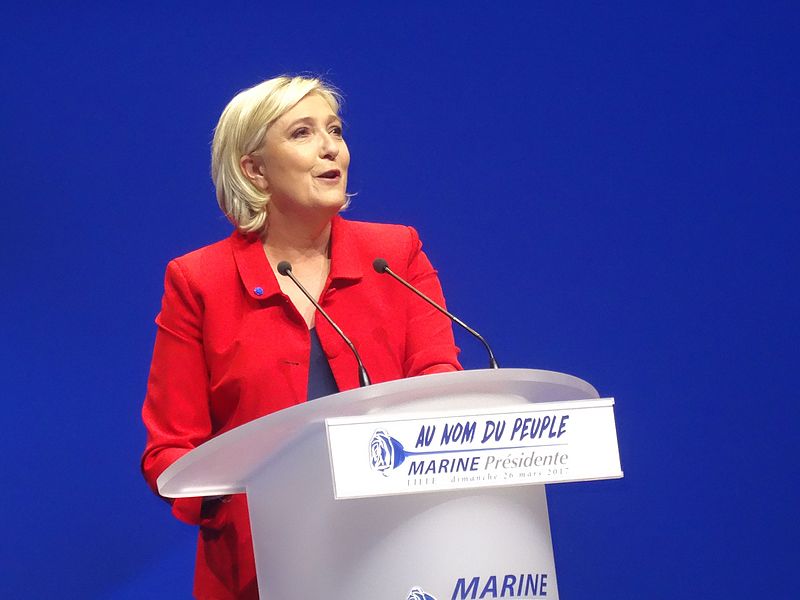
Marine Le Pen speaking in Lille during the 2017 French presidential election
Photo by Jérémy-Günther-Heinz Jähnick via Wikimedia Commons
A disturbing pattern has emerged in French presidential elections: A credible candidate is found almost at the last minute to have committed an illegal act, the revelation of which is intended to spoil or destroy altogether the candidate’s electoral chances.
The latest “victim” of this pattern is Marine Le Pen, who is facing the incumbent president, Emmanuel Macron, in the forthcoming second round of the French presidential election, a repeat of the contest of 2017. The main difference between the two contests is that, this time round, the polls give Le Pen at least some slight chance of victory, while last time Macron gained not only an overwhelming victory, but from the first had also appeared likely to do so. The outcome was never in any kind of doubt, as it is now.
Le Pen is usually described as being of the far right, though in fact her economic ideas are in some respects not very different from those of the candidate of the far left, Jean-Luc Mélanchon, who came not very far behind her in the first round of the election, in which the two candidates who receive the most votes go forward to the second, and decisive, round.
Perhaps economic affinity helps to explain why almost as many voters for the far-left candidate say they will vote for the candidate of the far right as say they will vote for the centrist candidate, Macron. Mélanchon himself has expressed the wish that not a single one of his voters should vote for Le Pen, without, however, having asked them to vote for Macron. He seems, then, to be hoping for a high rate of abstention, which would strengthen his argument that the current French political system is undemocratic and illegitimate, and that the country needs yet another new constitution.
Le Pen has just been accused by the European Union’s antifraud office of malversation of funds, 136,993.99 euros (about $148,000) of the Union’s money to be precise, while she was a member of the European Parliament between 2004 and 2017. For example, she is accused of having claimed 23,100 euros (about $25,000) for the purchase of little objects such as pens and bags to be given out at her political party’s annual conference in 2014, which is not allowed under the rules.
It might be a coincidence that the accusation of something that was allegedly done eight years ago has emerged in the week before the election, but I do not think many people will be found to believe it. After all, Le Pen is decidedly hostile to the European Union, while Macron is almost a religious devotee of it. There are no prizes for guessing, then, which of the two candidates the Union would prefer to win.
April 20, 2022
De Tocqueville once called it “sleeping on a volcano”
Joel Kotkin looks at the first round results of the French Presidential election and wonders how long the working classes are going to put up with everything the elites dish out:

Whatever the final outcome, the recent French elections have already revealed the comparative irrelevance of many elite concerns, from genderfluidity and racial injustice to the ever-present “climate catastrophe”. Instead, most voters in France and elsewhere are more concerned about soaring energy, food and housing costs. Many suspect that the cognitive elites, epitomised by President Emmanuel Macron, lack even the ambition to improve their living conditions.
The French elections reflect the essential political conflict of our time. On one side, there is a powerful alliance between the corporate oligarchy and the regulatory clerisy. On the other, there are two beleaguered and angry classes – the small-business owners and artisans, and the vast, largely unorganised service class. The small-business class generally tends to favour the populist right, whether in America, Australia or Europe. These people want the government out of their business and to be left alone. Meanwhile, workers tend towards the populist left, which promises to relieve their economic pain.
The common feature is the politics of anger and resentment. In the first round of the French elections, a majority voted either for Marine Le Pen and other rightist candidates, or for the old Trotskyist warhorse Jean-Luc Mélenchon and other candidates of the hard left. The establishment parties, like the centre-left Parti Socialiste and the Gaullist Républicains, were left way behind. The ultra-green Parti Socialiste mayor of Paris, Anne Hidalgo, won less than two per cent – a pathetic performance from the onetime ruling party. Intriguingly, voters under 35 went first for Mélenchon and then Le Pen, leaving the technocrat Macron in dismal third place among the young. Macron only won decisively among voters over 60.
We may, as de Tocqueville put it during the early stages of the Industrial Revolution, be “sleeping on a volcano”. A still inchoate rebellion from below against the concentration of wealth and power above seems to be gathering momentum. Across the 36 wealthier countries of the Organisation for Economic Cooperation and Development (OECD), the richest citizens have taken an ever-greater share of national GDP in recent years as the middle class has become smaller. Heavily in debt, mainly because of high housing costs, the middle class “looks increasingly like a boat in rocky waters”, suggests the OECD.
One key indicator of the declining middle class is rates of home ownership, which are stagnant or plummeting, particularly among the young, in the United States, the United Kingdom and Australia. In the United States, the chance of middle-class earners moving up to the top rungs of the earnings ladder has dropped by approximately 20 per cent since the early 1980s. Life expectancy in the US has dropped to the lowest levels in a quarter of a century.
April 13, 2022
Theodore Dalrymple visits the barber to find out what happened in the French elections
Rather than depend on the untrustworthy political analysis available in the legacy media, Theodore Dalrymple prefers to get the straight story from his Paris barber:

“barber pole” by triviaqueen is licensed under CC BY 2.0

My barber is highly intelligent and from the way he talks, I should guess that he received a decent education in Morocco. I mean no disrespect either to him or to barbers when I say that, in other circumstances, he might have occupied a more elevated position in society. The last time I went to him, we discussed French politics over the snip-snip of the scissors.
“Since I arrived in this country,” he said, “I have heard the same discussions on the same subjects by the same people.”
“France,” he continued, “is like a man who has complained of toothache for 25 years but hasn’t found the time to go to the dentist.”
I suppose, when you come to think of it, that captures the situation in more than one Western country. Naturally, I was eager to hear what he had to say about the election results, which would be as penetrating as that of any professional commentator.
Another customer, in his late sixties I should guess, entered the shop immediately after me. I was worried that his presence might inhibit the discussion, but once in the barber’s chair, my bib around me, I asked the barber, “Did the election results please you?”
I needn’t have worried about inhibition. No sooner were the words out of my mouth than the other customer exploded with anger. He almost trembled with rage, all of it directed against the incumbent (and winner so far), Emmanuel Macron. I don’t recall ever having witnessed a reaction like it.
I knew that those who didn’t like or approve of Macron were said to hate him: Few people, it seems, are merely indifferent to him. I’m no great admirer of him myself, and I think in his own way he’s potentially dangerous: He’s determined to push ahead with European integration that will, sooner or later, lead to an explosion. But to witness the visceral hatred toward him nevertheless shocked me.
He has long been accused of being the president of, or for, the rich. That he once worked for the Rothschild bank only encourages this view. There is in the accusation the larger assumption that the interests of the rich and those of everyone else are diametrically opposed and necessarily irreconcilable.
Few people can escape entirely or for very long thinking of an economy as a cake, such that a larger slice for you is necessarily a smaller one for me and vice versa. And since the slices of the supposed cake that most of us have are distinctly modest by comparison with those of the rich (the rich being those with at least five times as much as we), the room in our minds for resentment is ample. And even though I know that the metaphor of an economy as a cake is a dangerous one — how many millions were killed in the name of economic egalitarianism in the 20th century! — still I catch myself occasionally feeling resentful at the pharaonic incomes of people who seem to me not to deserve them, though I’m not myself yet on the breadline and have no desire either for great wealth.
April 12, 2022
Mark Steyn on the first round of the French Presidential election
It must seem uncanny to Americans that the French can hold a vote, count all the votes, and announce the results all within the same 24-hour window …
Say what you will about la République française but, unlike America, its election operations are not a rusted malodorous sewer of brazenly corrupt practices. So the election was held, the votes were counted in hours, and the official result was known by 1am Paris time. There are no unmarked vans motoring the Dordogne or the Pas de Calais in the dead of night bearing additional votes sufficient to the need.
That speaks well for any nation. Alas, not much else about yesterday does. The Top Three is as follows:
Emmanuel Macron 27.6 per cent; Marine Le Pen 23.41 per cent;
Jean-Luc Mélenchon 21.95 per cent.Mme Le Pen is designated by the BBC “far right” and M Mélenchon “hard left”. I am unclear whether, in Beeb parlance, it is worse to be “hard” than “far. But, be that as it may, they could at least cease applying the label “mainstream” to candidates who can’t crack five per cent, which is the threshold below which your election expenses are not covered by the French state.
On Friday’s Clubland Q&A I mentioned en passant that I’m all about the urgency: The west will die unless we change what we’re doing very fast. Yesterday was yet another of those election nights when the people turn but passing slow. Especially after the buzz about a Le Pen surge and a looming Macron humiliation, last night she didn’t have a spectacular breakthrough and he survived.
There will now be a fortnight to the run-off in which the forty per cent of French voters who cast their ballots for “hard left”, soft left, Green left and nutso left will be told that a vote for other than Macron is a vote against democracy itself. Mme Le Pen ran the blandest, most inoffensive campaign she has ever run, leaving it to the “even farther right” Éric Zemmour to do all the heavy lifting on la fenêtre d’Overton. And in the end all that got her was a couple of extra points in the first round.
We will see how well that approach withstands the onslaught already under way. The one man who could make a difference is the soi-disant “hard leftie”, M Mélenchon. His own surge attracted less attention in the last week or two, but it’s likely that, had not M Zemmour bungled his response to the war, the even-more-far rightist would have drawn enough votes from Mme Le Pen to enable Mélenchon to come through the middle and give France a run-off between a bloodless globalist and a full-bore Marxist.
In pocketbook terms, the gap between “hard left” and “far right” is now barely detectable: Mme Le Pen is pledging that no one under thirty will pay tax. There is surely plenty of overlap between the Mélenchon and Le Pen voters. Yet his priority was plain at last night’s speech, because he said it four times:
Il ne faut pas donner une seule voix à Mme Le Pen.
Not a single vote for Marine!
So even the hardcore class-warrior shrugs: Better the globalist you know …
April 7, 2022
Alberta’s recall law
Recall laws are not common in Canada, with Alberta’s new law being only the second example:

The Recall Act, which was part of a 2019 UCP platform pledge to “strengthen democracy and accountability in Alberta” mirrors the terms of the recall law enacted in B.C. after the 1991 election that swept a scandal-plagued Social Credit party out of power (and, a few years later, out of existence). Like Alberta’s law, the B.C. law requires the signatures of 40 per cent of eligible voters in a constituency gathered within a 60-day period to trigger a by-election. In B.C., this barrier has not yet been cleared despite 26 recall initiatives (although, in a few cases, politicians have resigned rather than fight).
Recall laws are not unique to Canada. The United Kingdom has had recall legislation since 2015, but it differs from the Alberta and B.C. laws in that it is triggered not by disgruntled voters but by MP wrongdoing, including being convicted of expense fraud, suspended from the House of Commons or sentenced to prison. Despite this extra requirement, the apparent criminal propensity of U.K. politicians plus a low threshold of 10 per cent of voters to trigger a by-election mean that the law has already been used successfully twice.
You may also remember the California vote last summer, in which the oleaginous Governor Gavin Newsom comfortably survived a state-wide recall. After some early uncertainty, California’s fit of popular pique ended in exactly the same place as the gubernatorial election three years earlier — literally, to the decimal place — with 61.9 per cent support for Newsom. After 18 months and half a billion dollars, all the process proved was that the period of appointed military governors from 1847-1850 remains the high-water mark for good governance in California.
The argument against recalls starts with the fact that they bear the same relationship to democracy that a mulligan does to the rules of golf. We already have regular elections to vote out unpopular politicians. A recall is for people who can’t wait four years to admit their own mistake. It is an impetuous power for impatient people. Besides, voting the bums out is the chief joy of democracy — surely we can wait a few years to savour the moment.
Some elected politicians are unworthy of the trust placed in them. But that is our fault as voters. Venting our frustrations at the people we elected is a cop out. Mencken infamously wrote that “Democracy is the theory that the common people know what they want, and deserve to get it good and hard.” He was right. In an hereditary aristocracy, you can blame the bad luck of the genetic lottery, and in an autocracy you can fume about the injustice of might making right. But in a democracy, we have no one to blame but ourselves. We voted ’em in, and now we deserve to get it good and hard … for four years at least.
December 7, 2021
How are things going in Honduras?
For those not following the Honduran experiment with ZEDEs (las Zonas de Empleo y Desarrollo Económico — Zones for Employment and Economic Development) also known as “charter cities” or “model cities”, Scott Alexander provides a handy summary of the situation in the wake of the recent Honduran elections:
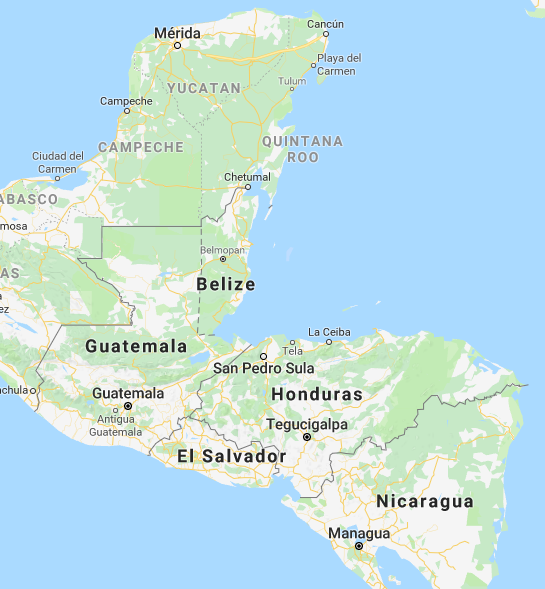
Honduras, Guatemala and El Salvador
Image via Google Maps.
The socialist opposition has won Honduras’ election and pledges to fight against charter cities there. “Immediately upon assuming the presidency, we are going to send the National Congress an initiative for the repeal of the ZEDE law,” incoming president Xiomara Castro said.
This was what everyone was afraid of. But the last party tried pretty hard to protect ZEDEs from trigger-happy successors, and the constitution currently says that the only way to get rid of them is to win two consecutive 2/3 votes to do so, then give the existing projects ten years to wind down.
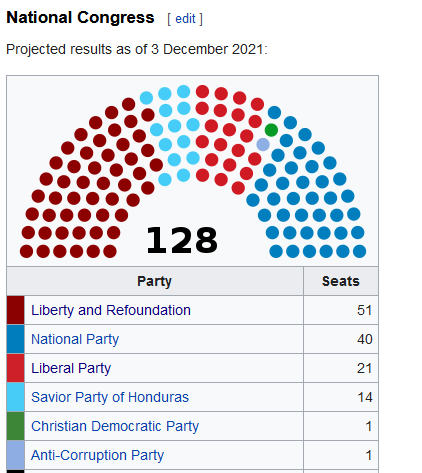
Can the socialists get a 2/3 majority? Wikipedia predicts the incoming Honduran Congress will look like this:
Liberty and Refoundation (the socialists) will probably enter into a coalition with the Savior Party and have 65/128 seats for a bare majority. They need 86 votes for a 2/3 majority, which in theory they can get if the Liberal Party agrees. The Liberal Party seems centrist and hard to pin down, but this article includes the following great quote:
“The Liberal Party opposes the ZEDEs because, above all, they undercut our national sovereignty, and because we don’t want them to become hideouts for extraditable criminals,” said [Liberal Party leader Yani] Rosenthal, who served a three-year prison sentence in the United States for money laundering and participating in a criminal scheme with the Los Cachiros cartel.
Rosenthal kind of goes back and forth elsewhere, but in the end I think he’ll vote with the socialists on this. Still, there’s some speculation that his party might not vote as a bloc, and even a few defectors would be enough to prevent a supermajority.
In theory, even if the socialists win two consecutive votes, they have to give the projects ten years to wind down. Ten years is forever in politics, and probably before then the capitalists will get back into power and say never mind, everyone can keep doing what they’re doing. The socialists are aware of this and say that their supplementary strategy is to have everything about the ZEDE law declared unconstitutional.
This should be a hard sell, because ZEDEs are a constitutional amendment, plus the current Supreme Court explicitly ruled a few years ago that they were constitutional. But apparently the Honduran Supreme Court can declare constitutional amendments unconstitutional if it really wants. And the new government will get to appoint a new Supreme Court in two years, and although the exact process is complicated, they may be able to get people who agree with them on this.
Also, incoming president Castro is married to Manuel Zelaya, a former president who tried to pull an Andrew Jackson after the Supreme Court ordered him to stop holding an illegal referendum to change term limits in his favor. He ordered the military to hold the referendum anyway, and was only ousted after the military couped him instead. So this is not exactly a family known for their deep respect for the exact wordings of laws or court rulings (not that anyone in Honduras has really excelled on that front). See further speculation eg here and here. And here’s Mark Lutter from Charter Cities Institute on the elections and the future.
December 2, 2021
If there are no restrictions on voting age, what other expansions of the franchise might amuse the Supreme Court of Canada?
In Wednesday’s NP Platformed newsletter, Colby Cosh suggests that, given the SCC’s demonstrated preference for getting rid of restrictions on voting rights, we may be in for some interesting legal times:
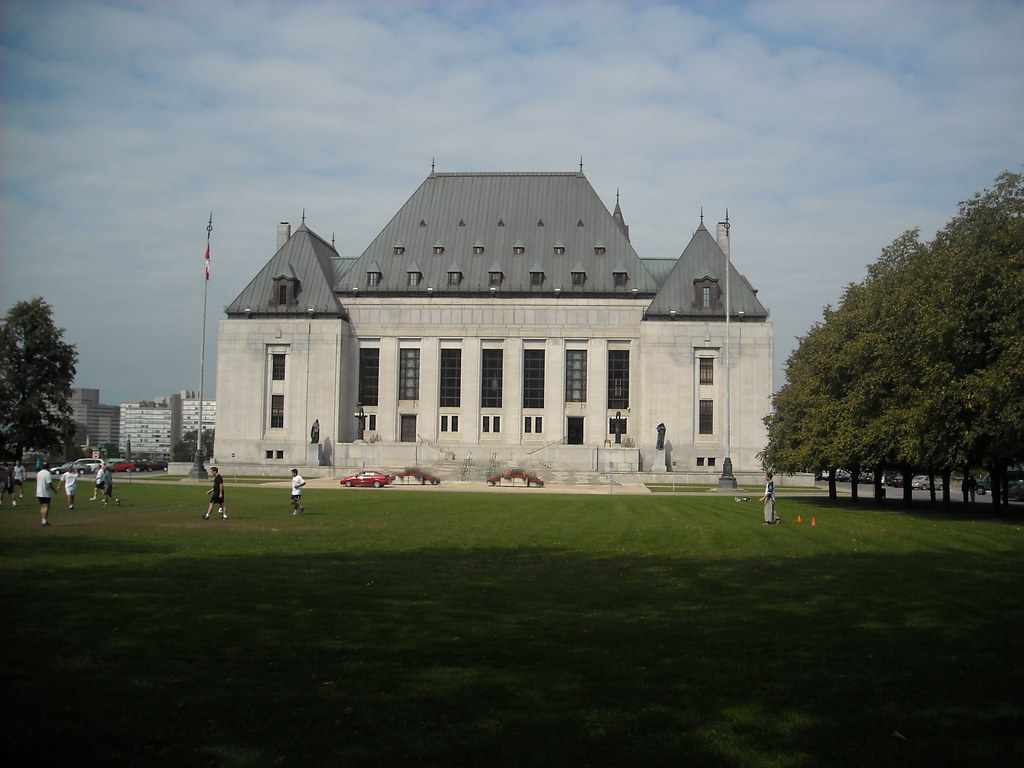
“Supreme Court of Canada, Ottawa” by daniel0685 is licensed under CC BY 2.0

A band of plucky teens, we are told, are suing to have Canada’s voting age lowered. They are not the first to try, and it goes without saying that the youngsters are a front for a gaggle of do-gooder groups who think that it would somehow purify our democracy in the fires of justice if 16-year-olds could vote. NP Platformed thinks this is a terrible idea that has logical problems on its face. If the age-18 voting limitation can’t be defended, how can any such limit be defended?
Rest assured that the grown-up lobbyists who have a sore bum about the voting age won’t be recruiting four-year-old boys to articulate their cause or serve as litigants. It will all be photogenic, politically sophisticated, fantastically unrepresentative teenagers.
But let’s set the snark aside for a moment. You may be asking, as we here at NP Platformed world headquarters did, how a charter challenge to the voting age can happen at all. Surely there’s solid caselaw about this? If you look into the matter, as we did, you might find yourself saying “Uh oh.” As we did.
The most revealing discussion we could find is tucked away in a footnote in a 2019 paper by University of Ottawa Prof. Michael Pal. Within this wad of small print, Prof. Pal outlines the whole issue. The charter says flat out that “Every citizen of Canada” has the right to vote in elections, and various species of legal voting disability have been removed over time, leaving persons under 18 as the only citizens within Canada who cannot exercise this right.
[…]
“The analogy between youth voting restrictions and inmate disenfranchisement breaks down because the type of judgment Parliament is making in the two scenarios is very different. In the first case, Parliament is making a decision based on the experiential situation of all citizens when they are young. It is not saying that the excluded class is unworthy to vote, but regulating a modality of the universal franchise. In the second case, the government is making a decision that some people, whatever their abilities, are not morally worthy to vote — that they do not ‘deserve’ to be considered members of the community and hence may be deprived of the most basic of their constitutional rights. But this is not the lawmakers’ decision to make.”
We’re just gonna say it: “regulating a modality of the universal franchise” is drivel. If this is the bedrock on which age restrictions on voting rest, age restrictions on voting are in trouble.
The constitutionality of a voting age was also discussed in the Supreme Court’s 2019 Frank case, which annihilated the voting eligibility restrictions for Canadian citizens living abroad. In that case it was dissenters, specifically justices Suzanne Côté and Russell Brown, who brought the matter up. If legislatures can’t restrict the voting rights of Canadians who have been living in Cucamonga or Timbuktu, how can they impose any limit at all?
The dissenting pair quietly pointed out (at paragraph 144) that the phrase “regulating a modality” is gaseous nonsense, and that the Supreme Court, in its endless lust for making the franchise more inclusive, seems to have made any restrictions at all untenable. (Why, indeed, should the franchise be limited to citizens? Municipalities are already asking this question!)
November 20, 2021
QotD: Cheating with both hands
Batches of counted votes can be very unbalanced towards either candidate or they can be large, but there is a strong inverse relationship between the two. The paper analyses a lot of data to show the improbability of both very unbalanced and very large. This is a good test because it tends to get past fraudsters, who are focussed on the raw margin of votes more than the ratio or the batch size.
A secondary tell – and this one is already well-known in fraud detection in third-world countries – is improbable ratios of the losing candidate to minor candidates, e.g. Trump getting little more than twice as many votes as the minor candidates in the second Michigan anomaly when the state’s average (calculated including that data point) was 31 to 1. The paper finds this combination of grossly-violated size-margin ratio and grossly-violated Trump-to-third-party ratio particularly suspicious (as do I). It also computes what happens if you pull these four data points in towards merely the 99th percentile of the size-margin relationship – leaving them still anomalous but not so wildly implausible. (Biden loses his alleged lead in all three states.) It also notes some related statistical oddities.
My guess is that the idea of the US waking up to what I’d woken up to – Trump the heavy odds-on favourite – terrified his enemies. Their pre-election narrative was that Trump would at first “appear” to win, after which “days and weeks of counting” (Zuckerberg) would show he had lost. But while Zuckerberg promised to “educate” America to believe in that, I think someone in the early hours of the 4th panicked that if the US electorate woke up to a bookies-call-it-for-Trump breakfast on Wednesday morning, that would never be erasable from the US mind, no matter how many votes they then “found”. So they made sure that didn’t happen. (You never know: it might yet be that what they did to prevent that becomes equally hard to remove from America’s consciousness. You don’t have to be a statistician to think a sudden step function in a smooth graph looks odd.)
So the good news is that my memory for numbers is working fine. The bad news is that I may lose a night’s sleep next election. The very first of the four anomalous points went into the Georgia vote totals soon after 6:30 AM my time – half-an-hour after the normal rising time of Donald Trump and Margaret Thatcher, I am told. (I guess the reason I’m not PM or president is that I’m usually asleep then.) When I first glanced at the results, I thought Georgia was surprisingly close given e.g. the Florida result, but if I’d missed the other three oddities as completely as Georgia’s, I’d have been far less cautious in reviewing the outcome.
Niall Kilmartin, “Good News! I can believe my eyes”, Samizdata, 2020-12-01.
November 2, 2021
Election day in Virginia
Mark Steyn writing about the Tuesday state elections being held in Virginia, which certainly seemed to become much more competitive as larger concerns about the school system energized a lot of parents, and a Republican-in-name-only group plays dirty tricks on the Republican candidate for governor:
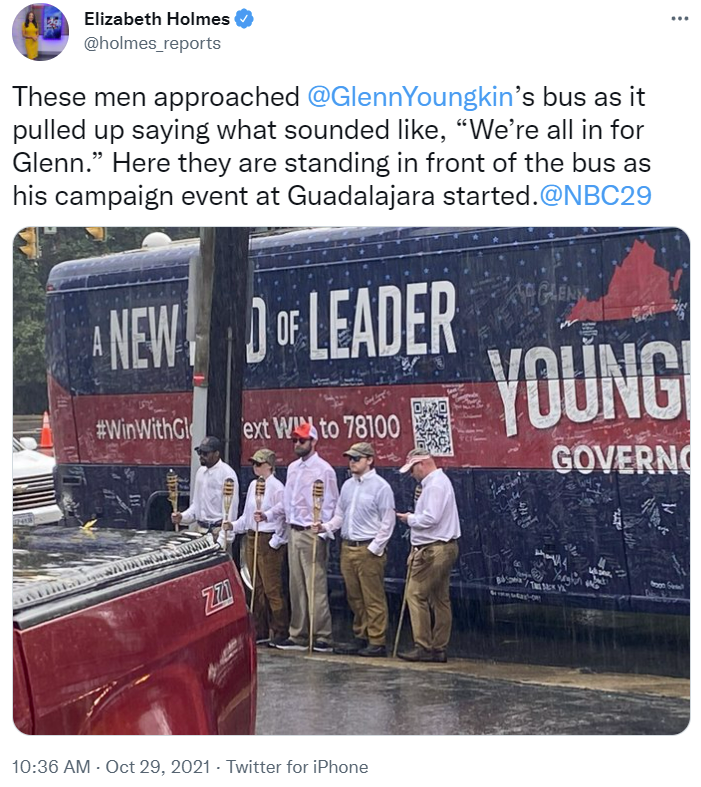
“Republican” group trolls Republican candidate in the Virginia election campaign, October 2021.
Tuesday is what less evolved societies than Virginia still quaintly call “Election Day”. The Democrat candidate, the unlovely Clinton bagman Terry McAuliffe, claims that “we are substantially leading on the early vote”. In the fullness of time he will also be substantially leading on the late vote, if he isn’t already.
That leaves the votes on Voting Day up for grabs. The Republican candidate, Mr Youngkin, is a squish of no fixed beliefs who will govern as Mitt did in Massachusetts or Pataki did in New York. But he has been handed a winning issue that he would probably not have chosen save for public outrage — the state of Virginia schools in an age of “critical race theory” and trans-mania. It’s bigger even than an education issue: The left is so boundlessly ambitious that it is abolishing biological sex, and if it gets away with it will leave an awful mountain of human wreckage in its wake, bigger even than its other innovations.
Every Virginian should vote on Tuesday — because Youngkin’s campaign is a classic example of Milton Friedman’s dictum: in politics you don’t wait for the right people to do the right thing, you create the conditions whereby the wrong people are forced to do the right thing. That is what parents at school-board meetings have been doing, and they deserve to be rewarded for it.
Virginia is a state where a rapist gets transferred to another school because he/she belongs to a protected class, rapes again, and, when you protest the anal rape of your daughter by a known rapist, you’re the guy who gets thrown to the ground and arrested. Whether one finds the foregoing objectionable shouldn’t really be a Republican/Democrat thing, but such is the moral depravity of the cultural heights that Dems are all in on the convicted sodomizer and only squaresville low-status GOP candidates can muster even pro forma objections. So in 21st-century Virginia insouciance about schoolgirl anal rape is now a partisan thing.
Of course, it remains to be seen whether the state’s election system is sufficiently honest to reflect fairly that public outrage. If at, say, 10pm on Tuesday night Youngkin is narrowly ahead but you wake up on Wednesday morn to find McAuliffe has been the beneficiary of all the 3am votes, well, Republicans will be forgiven for suspecting that “fortifying” the “two-party system” into something rather more streamlined is here to stay.
I say that as an immigrant who never feels more foreign than on America’s hideously chaotic yet oddly purposeful election nights. But then in Northern Virginia a quarter of the population is now foreign-born, and half of those arrived in the last twenty years. That’s a remarkable statistic for a so-called “Old Dominion”. Demography is destiny, and in an ever more tightly circumscribed public discourse there are decreasing opportunities even to raise the topic.


