Quotulatiousness

August 24, 2021

Tracking the bullshit in the ongoing “she-lection”

Filed under: Cancon, Humour, Media, Politics — Tags: — Nicholas @ 03:00

Ever watchful of opportunities, the folks at The Line quickly realized that there was a critical tracking metric going un-reported in the 2021 federal election and They. Are. On. It.

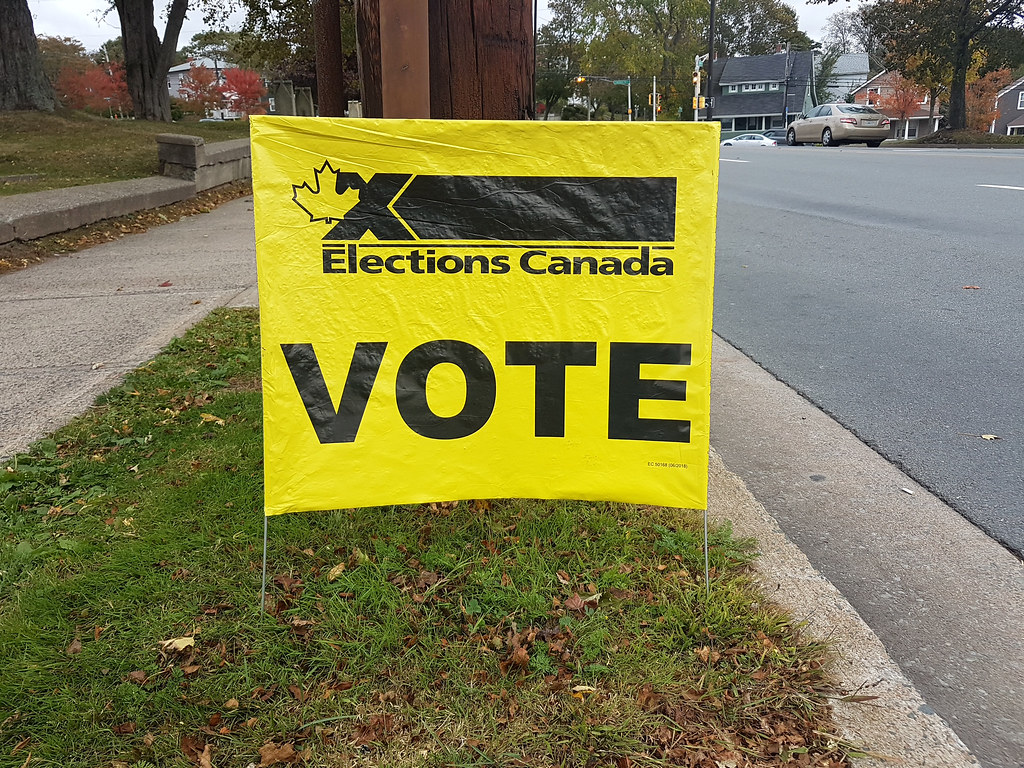
“2019 Canadian federal election – VOTE” by Indrid__Cold is licensed under CC BY-SA 2.0

At The Line, we’ll be continuing to send out our weekly dispatches for the duration of the campaign. Columnist Jen Gerson will also be doing a weekly recap of major events. We’ll be running articles by other contributors as they come in — not all will be about the election, but many will. And we’re happy to do this. But we felt that something — something we couldn’t quite put our finger on — was missing from our plan. We felt there was more that we could do.

It was our friend over at The Hub, a new media startup, that set us on the right course. The Hub is going to be doing “Policy Pulse”, which they describe as “tracking all the policy announcements from the major parties, with instant analysis from our crew of experts.” Great idea! But the more we thought about it, the more we realized that, you know, that doesn’t quite catch it all. There’s something else that needs to be carefully tracked and analyzed. So we at The Line are proud to bring you our first Bullshit Bulletin, where we’ll note and mock all the incredibly dumb stuff that crops up along the way. This will be an evolving process, and we don’t pretend to see everything, so if you want to send us suggestions, tweet us at @the_lineca, and add #bullshitbulletin, or drop us a note at lineeditor@protonmail.com, with Bullshit Bulletin in the subject field.

And to be clear, all you smart asses out there, no, don’t just tag the entire campaign or every statement made by every member of a party you’re not voting for and write it off as bullshit. There’s degrees of wiggle room and salesmanship and base-mobilizing in every election. We’re not going to worry about that. We’re looking for the egregious examples, and the really weird stuff that comes tumbling out of the partisan mind.

On that note, let’s get started.

Note that although they’re careful to exclude bullshit reports on comments “made by every member of a party you’re not voting for” — which is fair and sensible — they are (one assumes) open to bullshit reports on comments made by members of the party you are planning to vote for … because if it’s enough to set off your partisan-biased bullshit meter when it comes from your “side”, then it’s got to be prime quality bullshit.

August 23, 2021

The dying media’s strange obsession with the Green Party

Filed under: Cancon, Media, Politics — Tags: , , , — Nicholas @ 03:00

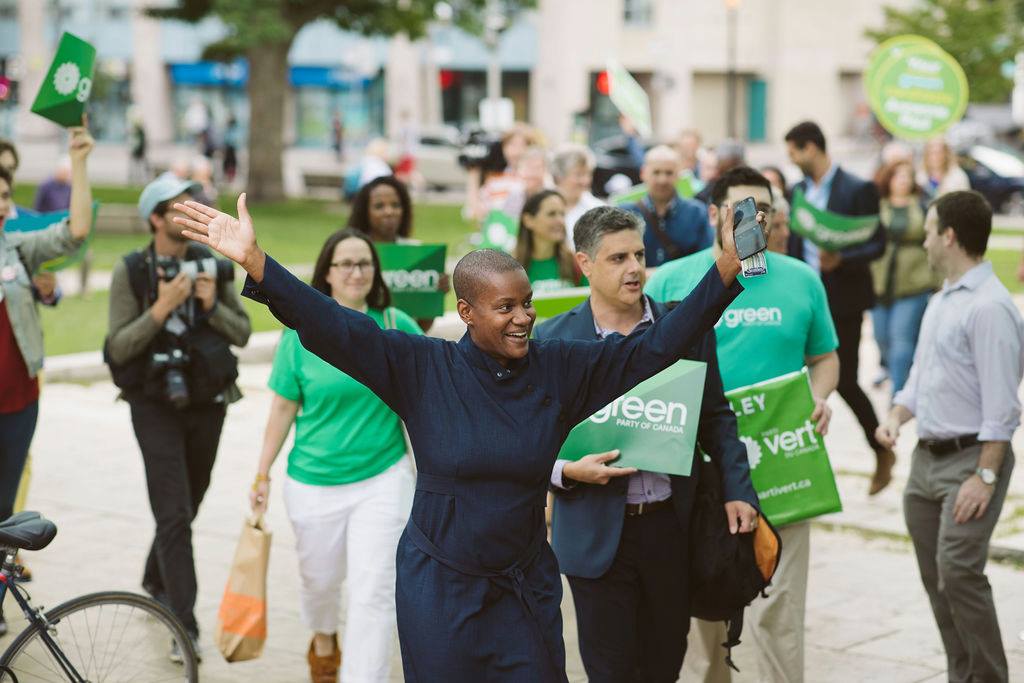
The Green Party gets far more media attention in Canada than their vote totals or influence on goverment policy could possibly justify. Their ongoing attempts to commit media character assassination of their own leader might be the first time in living memory that the party’s antics might — might — justify it. The Line explains some of the dramedy in Greentopia:

“Annamie Paul with Green Party of Canada supporters” by Annamie Paul is licensed under CC BY-SA 4.0

One of us, just a couple of days ago, was standing around in our increasingly tattered casual wear and making a sandwich with the TV on in the background. A local news channel was showing Green party leader Annamie Paul speaking. So we changed the channel, because the Greens are irrelevant. But the next channel was also showing the same feed. We tried two others. It was all the same goddamned feed. And two of those networks were national. Viewers from coast to coast had a chance to hear, for an extended period, from a woman so thoroughly doomed that she’s not even pretending to run a national campaign. All she can muster is an attempt to win her seat in downtown Toronto.

Look, we don’t know who needs to hear this, but at the national level, the Greens are zeroes. Sorry, not sorry. Frankly, the Greens have long gotten too much attention in Canadian politics, which is a result of a few quirky things all aligning in their favour: Elizabeth May’s admittedly effective relentless self-promotion, the coffer-stuffing effect of the per-vote-wage subsidy, and, the politeness of Canadian media leaders who felt awkward saying no to Lizzie.

This is not to say that there are not serious Greens, nor that the Green party has not put forward some serious policy proposals. There are, and they have. The issue is that under our electoral system, the Greens don’t matter. And their strident complaining about their irrelevancy doesn’t actually make them relevant.

We glanced at recent vote tallies. The Greens generally get around five per cent or so, sometimes a point or two higher, sometimes a point or two lower. That ain’t nothing. But it is not enough to make them a meaningful electoral force in anything but a tiny handful of seats — or in really weird, bizarre vote-splitting scenarios, and those are very rare. We don’t believe there’s some magic level of popular support at which a party deserves serious consideration or not, it all depends on the context. The Bloc doesn’t get a ton of votes, either (though never less than the Greens), but since they only run candidates in Quebec, their efficient vote means they have a pretty consistently good chance of winning enough seats to matter in parliament. The Greens … don’t.

And that is in normal times. These aren’t normal times. Annamie Paul is a perfectly serious, credible person. The fact that her party is trying to back a cement truck over her in full view of 38 million witnesses simply confirms our instinct to ignore the party she leads. Most elections, you could argue that it’s a shame that the Greens don’t have an actual chance. This election, we’re thanking God for it.

Deciding how much attention to give a candidate or party is usually pretty easy. Outside Quebec, the big three — Tories, Liberals and NDP — get proper coverage, within the context of local circumstances and the dynamics of individual campaigns (ignoring a CPC also-ran in deepest Toronto isn’t going to break any hearts, nor the sacrificial Liberal in rural Alberta). The gamut of weirdo fringe parties are basically ignored. In Quebec, the Bloc warrants consideration alongside the big three.

What screws all this up, though, are the Greens and the People’s Party. They don’t warrant serious consideration, per se, but they will draw a fair number of voters. What to do with these?

August 15, 2021

QotD: A bold new electoral strategy for the US Republican party

Filed under: Humour, Politics, Quotations, USA — Tags: , — Nicholas @ 01:00

To save our country from President *’s reign of error, the Republican Party is going to have to think outside the box, push the envelope, and execute other similar cliches. I have a suggestion for an innovative strategy for the 2022 election cycle that might well overcome the usual GOP establishment tendency toward failure. I say – and you may want to sit down – that this time we should pick some candidates that don’t suck.

Hear me out. It’s kind of crazy, but it just might work.

A nominee who doesn’t suck has certain advantages over the usual losers we see all too often idioting up our ballots. One of those advantages is that people are more likely to vote for someone who is not terrible than one who manifestly is. And getting more votes than the Democrat – who is always terrible – is a very, very important part of electoral victory, though you would not know that from the GOPe’s actions. Its members seem to think the goal is polite defeat, but us unwashed Jesus people who like guns and America and don’t live near Washington have this weird notion that candidates should attempt to win their elections.

Maybe we should try that in 2022.

Kurt Schlichter, “Idea: In 2020, Let’s Nominate Candidates Who Aren’t Awful”, TownHall.com, 2021-05-12.

August 10, 2021

Elections not for changing things but merely for “sending messages”?

Filed under: Cancon, Government, Media, Politics — Tags: , , , , — Nicholas @ 03:00

Jay Currie on the election that Justin Trudeau clearly itches to call at any moment:

“2019 Canadian federal election – VOTE” by Indrid__Cold is licensed under CC BY-SA 2.0

Apparently Justin Trudeau thinks that the best use of the nation’s time as we head into a Delta driven 4th wave of COVID is to have an election. Okay, I never thought he had any judgement and an election call at the moment would confirm that but here we are.

There are huge issues facing Canada. Unfettered immigration, useless but expensive carbon taxes, deficits to 2070, price inflation, real estate markets which have put housing in the luxury goods category, a stalled First Nations reconciliation process, the collapse of any number of energy projects, increased homelessness, opioid deaths, a health care system which seems incapable of dealing with even a fairly mild pandemic, senior care in a shambles where our elderly died in droves as much from neglect as COVID and on and on.

Judging from the Liberals activities in the run up to the election, while those issues get the occasional nod, the strategy seems to be to spend lots of money in seats the Libs either hold or would like to win. As to substance, the Libs seem very committed to “doing something” about climate change, keeping immigration levels up over 400,000 per year and not being racist. Unfortunately, this is also pretty much the substantive position of the Conservative Party. The CPC’s big selling point is getting rid of Justin and his gender balanced Cabinet of flakes.

Conservative leader Erin O’Toole (who also happens to be my local MP) seems to believe the only way he’s going to topple Trudeau and the liberals is by offering exactly the same policies but wrapped in false Tory blue instead of Liberal red. As far as I can tell, he’s the reddest of Red Tories to lead the party in decades (disclaimer: I’ve met O’Toole a few times and chatted about non-political topics … he seems a decent sort and he’s probably a good neighbour and an upstanding citizen in his private life). He’s certainly no Stephen Harper — and I wasn’t much of a Harper fan, but I’d strongly prefer Harper to O’Toole as Tory leader. I certainly don’t plan on voting for him, and unless the Libertarians scare up a candidate in my riding I’ll be voting PPC this time around:

You will notice I do not mention Max Bernier or the Peoples’ Party. I don’t because the PPC plays outside the consensus. The PPC and its supporters think that significant change is absolutely required and that issues like the deficit, immigration, economic development, First Nations policy, housing and health care need new thinking. […] In terms of seats and outcomes, while I would be delighted to see the PPC win a few seats, the real target for the PPC is the national and regional popular vote. Yes, I do know that does not matter electorally. After all, the CPC won the popular vote in the last federal election. (My own sense is that the Maverick Party has some chance of winning seats in Alberta and Saskatchewan which will be discussed in that subsequent post.)

Max and the PPC need to crack the 5% barrier this time out. If they can do that and Max can win in Beauce, they will have sent a huge message to the CPC. That message is important. Now, if Max and the PPC manage to cut through and beat the Greens – not an unrealistic goal – the message that there are real problems which need real solutions will go mainstream whether the gatekeepers like it or not.

There are really two elections coming up: the Tweedledum and Tweedledee, paid for media, horse race and a vote on whether Canada is a serious country.

February 10, 2021

QotD: Wells’s Rules of Canadian Politics

Filed under: Cancon, Humour, Politics, Quotations — Tags: , — Nicholas @ 01:00

There have been questions about my Rules of Politics around here in the last few days. Okay, not a lot of questions, but still. Here is the full list of rules. About a year after I came up with the original two, I added two more, which was probably a mistake. Sometimes I come up with candidates for additions to the list, and here today I will reveal one I considered adding, before deciding against it. But I think it’s time to show a little discipline, so the canonical list will stop at four. Four shall be the number thou shalt count, and the number of the counting shall be four. Ready?

1: For any given situation, Canadian politics will tend toward the least exciting possible outcome.

2: If everyone in Ottawa knows something, it’s not true.

3. The candidate in the best mood wins.

4. The guy who auditions for the role of opposition leader will get the job.

Paul Wells, “Wells’s Rules, annotated”, Maclean’s, 2009-05-21.

January 24, 2021

QotD: The “returned ballot”

Filed under: Cancon, Politics, Quotations — Tags: , — Nicholas @ 01:00

In Canada we used to have — still have, according to a friend who should know — the excellent institution of the “returned ballot.” It is my usual way of voting. I can write with some confidence that it has never won.

Here’s what you do. You go into the polling station, show your ID (in Canada voters must identify themselves). The officer crosses you off the voting list, and gives you a ballot. Then you say, “I wish to return this ballot.” He says, “Thank you, sir,” and takes out his returned ballot book. (It need be nothing special: a school exercise book will do.) He copies your name into that, along with your address. (It is the only way to get your preference recorded.) You thank him, then wander off through the boobs who came to vote for somebody.

One has oneself, in effect, just voted for “none of the above.” This is the theory.

In practice the officer, who may or may not speak English or French, but probably needed the money, looks puzzled and a little frightened. He has no idea what you are talking about. You dig in, to provide a patient lesson in elementary civics. He won’t have a book, but you have brought along a cahier with “Returned Ballots” written on the cover in large capitals with a felt pen, and some heraldry doodled above it. To be helpful, you have already written your name and address on the first line. He consults all the other polling staff then says, “Thank you, sir.”

When, later, you check the results, you will not find a single returned ballot mentioned. Perhaps you were counted among the spoilt ones.

Now if you had been counted, and had persuaded a plurality of your fellow citizens to do likewise in, say, the riding of Parkdale (about one-in-four would triumph in most Canadian ridings; one-in-six if the turnout were low enough), the election is annulled. A by-election must then be called, in which none of the previous candidates may stand.

David Warren, “Let’s be practical”, Essays in Idleness, 2018-09-15.

December 7, 2020

QotD: American politics as “the playoffs”

Filed under: Liberty, Politics, Quotations, USA — Tags: , , , — Nicholas @ 01:00

Like other Americans, however, many libertarians think of political parties like sports teams. They want their own team to root for and cannot root for the other teams. Voting Libertarian gives them psychological satisfaction, while in the aggregate diminishing their political impact.

Libertarians should stop thinking of parties as teams and think of them instead as the playoffs. In NFL football terms, The Democrats are the AFC and the Republicans the NFC. To get into the Superbowl, you have to survive the season and the playoffs in your respective conference. In effect, Libertarians want to form their own league which no one but themselves is interested in watching. And they assure themselves of never making the playoffs much less the Superbowl.

Randy Barnett, “Parties Are Not Sports Teams — Parties are the Playoffs”, The Volokh Conspiracy, 2005-02-24

December 4, 2020

Canada used to have a “none of the above” option in federal elections … let’s bring it back

Filed under: Cancon, Government, History, Liberty, Politics — Tags: , — Nicholas @ 03:00

David Warren describes how the “returned ballot” functioned as a “none of the above” vote in Canadian federal elections:

“2019 Canadian federal election – VOTE” by Indrid__Cold is licensed under CC BY-SA 2.0

Back to the polling station, where the electoral officer is now passing me a ballot, with a hint on how to make an X on it. I am directed to a voting stall.

But I refuse to go there. Instead, I turn earnestly to the officer and say: “I am returning this ballot.”

Chances were, even decades ago, he would be thrown into confusion. So one would explain his job to him. He was supposed to have a book, entitled “Returned Ballots.” Into this he was supposed to transcribe one’s name and address. Getting into the book was one’s only way to avoid the secret ballot. But it was important to get in, to be recorded correctly, rather than as a “spoilt ballot,” as one is counted now if one’s ballot has no X.

After voting, I would check the result, and if not even one returned ballot had been recorded, I could doubt it was legitimate.
Now comes the good part. For returned ballots were supposed to be a separate category in the election tally. It was competing with all the other candidates. If it won a plurality — more returned ballots than the leading candidate — the election was to be formally thrown out, and a by-election called, in which none of the candidates for the thrown out one were allowed to run again. Too, voters could “theoretically” do this over and over, until at least one Party chose a candidate we could stomach.

In theory, this was an excellent way for voters to “drain the swamp,” directly, by eliminating the political sleaze in successive groups. In practice — aheu — it was never used. The political sleaze nevertheless spotted the possibility, and had it taken off the books, at both Dominion and Provincial levels. What can I say? They are sleaze.

So the first thing we must do is campaign for the return of the returned ballot, up here; and for its institution in all the other Western nations. Then the second is to impartially, but massively, campaign for its use. It could be the greatest thing since the ancient Athenian ostracon.

November 26, 2020

Fixing the US federal election mechanism to prevent errors or fraud from distorting the results

Filed under: Government, Law, Politics, USA — Tags: , — Nicholas @ 03:00

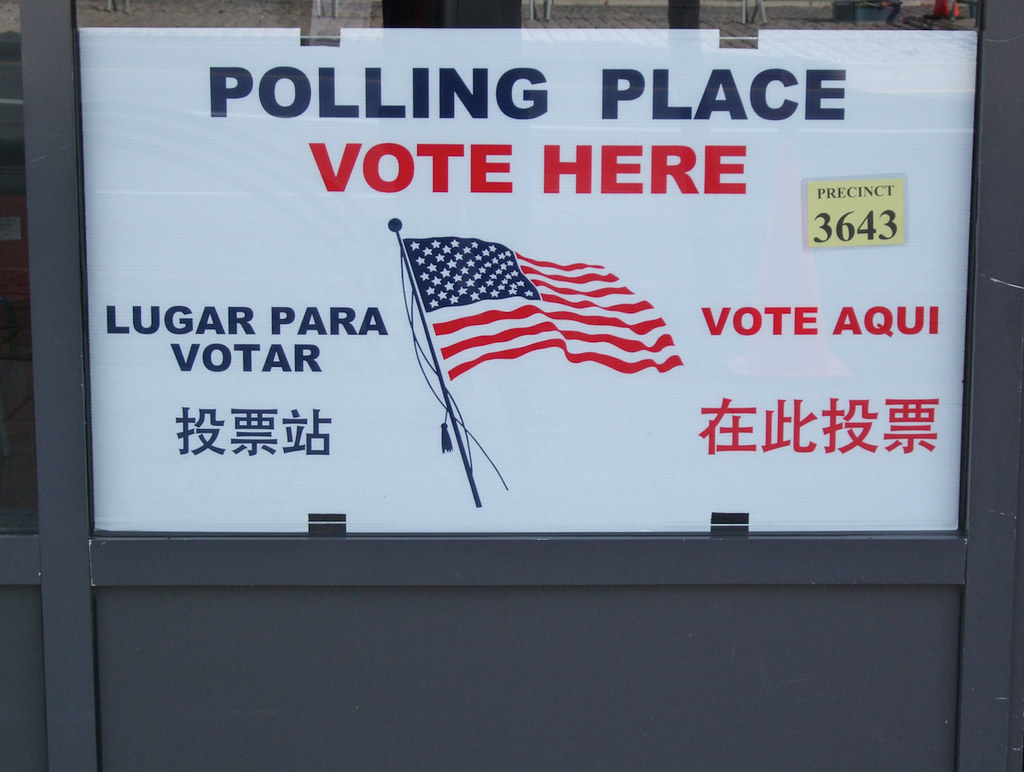
Down south, our American neighbours held a federal election at the beginning of November. Ignoring the Associated Press trying to annoint the winner, we still don’t legally know who won and the tallies in several states are still being challenged. This is an embarassing situation for the “leaders of the free world” and common sense changes to the way the vote is conducted seem to be the best way to ensure that the results are known quickly and that the results will fairly represent the way the voters chose to exercise their franchise. At Steyn Online, Tal Bachman has a fairly concrete set of suggestions that would be a significant improvement over the system in place today:

“Polling Place Vote Here” by Scott Beale is licensed under CC BY-NC-ND 2.0

First, it’s run by a single-purpose, rigorously impartial, devoutly transparent federal entity overseeing federal elections (about which more below).

Yes, I know we’re all sick of the federal Leviathan. I know it already has far too much power. It’s just that in this case, we don’t have much choice, do we? We’re going on well over a century of chronic Democrat Party presidential vote-rigging; and it appears they just ran one of their classic tricks again just a few weeks ago. At some point, pro-America voters have to stop making excuses for why they shouldn’t try solutions to these nation-destroying problems, and just try them.

Yes, I know this would require a constitutional amendment. But let’s assume for now we could get one of those passed.

Second: The new federal entity — let’s call it Elections USA — would then divide the nation into voting districts of equal size for purposes of federal election (that could occur within pre-existing congressional districts). Elections USA would then further subdivide the voting districts into smaller units. Working with the postal service, Elections USA would then draw up a list of voters in each unit, and designate a voting station for residents of that particular unit.

Third: In preparation for election day, Elections USA would send out flyers informing households of where to vote. The information would also be made available on the Elections USA website.

Fourth: On election day, voters travel to their designated voting stations: an elementary or high school, a union hall, a community center, whatever.

Each voting station is watched over by police or other security guards.

As voters approach, they join a quick-moving line. At the front, they present two pieces of government issued ID, at least one with a photo. A volunteer finds the voter on her list of voters for that unit. (If they’ve come to the wrong polling station, they are redirected to the right polling station).

The voter then approaches the voting station in a large, open room, where another volunteer hands him a paper ballot. Picking up the provided pencil, he marks the ballot behind a screen, folds the ballot, and drops into the voting box in full view of the poll clerk and attendant witnesses sitting a few feet away—typically, a few volunteers from political parties who act as “scrutineers”, or official observers and verifiers. The voter then leaves. The entire process never takes more than fifteen minutes.

Once polls close, no one is allowed to enter or leave the premises until the vote count is completed.

The poll clerk — still in full view of the scrutineers — dumps the ballots on to a table and sorts them into piles according to the candidate/party voted for. She then counts the votes for each, showing them to the scrutineers as she goes. Once the votes are counted, a supervisor is called over to the table. After verifying that the scrutineers are satisfied with the counting, and resolving any lingering concerns, the supervisor signs off on the count, and the ballots are immediately placed in a special, sealed envelope. The sealed envelope is then stamped, and cannot be opened without subsequent detection.

The ballot count numbers are then phoned into Elections USA, right then and there, again in view of the scrutineers, who verify that the numbers called in match the numbers they witnessed during the count.

Once all the numbers are called in to Elections USA — a process which never takes more than two hours — the supervisor then physically transports the sealed envelopes (each marked with information like Voting Desk #4 at Poll Station #15) to the Elections USA depot, where she hands them over.

“2019 Canadian federal election – VOTE” by Indrid__Cold is licensed under CC BY-SA 2.0

The sealed envelopes are then transported to Elections USA employees, who will then verify, and eventually formally certify, that all the numbers called in from each desk of each polling station of each voting district in the country matches the number of actual ballots. In the unlikely event any question arises about accuracy, the ballots can be accessed and counted again.

In a simple process like this, the media will have accurate election results within two hours of the polls closing, and there is virtually no opportunity for fraud. I can attest to that, because I myself have witnessed this exact process in real life quite a few times, and am friendly with several people who volunteer as election workers on election days. What I described is how elections are conducted in Canada, but not only in Canada: an identical or similar process is used in most other English-speaking countries. A few simple security protocols — not least of which is, no computerized voting machines — and your election is as fraud-proof as this mortal realm would ever allow.

When you compare this typical voting procedure to the morass of conflicting voting regulations representing fifty states, many of which — incredibly — do not even require that the voter present identification before voting, and which are being manipulated by the very state party hacks tasked with preventing fraud, you begin to see just how desperately America needs electoral reform. Credible stories of poll watchers being denied access, for example, in any normal country, would be regarded as completely unacceptable, to the point where the votes in that area would be likely thrown out as a matter of course. And yet, that type of chicanery is now so common in the United States, most people take for granted it goes on. That’s how far the window of acceptable behavior has moved.

November 17, 2020

Cancel culture comes for Donald Trump’s lawyers

Filed under: Law, Liberty, Politics, USA — Tags: , , , , — Nicholas @ 05:00

Mark Steyn reported yesterday that the Lincoln Project’s latest doxxing has been successful and that a law firm representing President Trump in one of his Pennsylvania suits has been intimidated into withdrawing from the case:

Donald Trump addresses a rally in Nashville, TN in March 2017.
Photo released by the Office of the President of the United States via Wikimedia Commons.

Back in the summer I mentioned on The Mark Steyn Show that “cancel culture” was increasingly literal: It used to mean you got kicked off Twitter or Facebook; then it progressed to losing your job or television show or book contract. By 2020 it had advanced to being denied domain registration on the Internet, credit-card services, bank accounts and other basic necessities of modern life. Now, in a country with more lawyers than the rest of the planet combined, the supposedly “most powerful man on earth” wakes up and finds his counsel just canceled:

    Lawyers with Porter Wright Morris & Arthur LLP submitted a filing late Thursday stating they were withdrawing as counsel in a federal suit seeking to block Pennsylvania from certifying its vote. No reason was given. In a statement issued Friday, the firm confirmed the filing but did not say why it was exiting the case.

Powerline‘s John Hinderaker reckons the reason is pretty obvious:

    Porter Wright is a mid-sized law firm with offices in eight cities across the country. But apparently it lacked the courage to stand up against the Twitter mob. The “Lincoln Project” doxxed the two Porter Wright lawyers who signed the Pennsylvania complaint, tweeting their pictures, addresses and telephone numbers, and encouraging leftists to harass them. Reportedly there also were employees at the law firm who objected to representing President Trump. Porter Wright’s abandonment of its client is shameful conduct for which I suspect it will receive little but praise.

[UPDATE: A Powerline reader with knowledge of the situation says that Porter Wright has withdrawn from only one of five suits.]

As John points out, in America everybody from 9/11 plotters to celebrity pedophiles, Boston bombers to Oscar-winning serial rapists gets hotshot law firms and nobody bats an eyelid. But not Donald J Trump, who is apparently unfit for legal representation.

If you like the sound of all that “unity” and “healing”, this is what it boils down to — unity in the sense the Soviets meant it: the absence of opposition. And, when they’re done with Trump, they’re serious about that “Truth & Reconciliation” enemies list. To reiterate a point I’ve made for months: on free speech and related issues, things are going to head south very fast. I carelessly assumed they’d wait till the inauguration, but it seems “the Office of the President-Elect” is already on the case.

November 15, 2020

Mark Steyn is looking for an argument

Filed under: Britain, Media, Politics, USA — Tags: , , , , — Nicholas @ 05:00

I somehow missed this when it went up on Mark’s website:

“Polling Place Vote Here” by Scott Beale is licensed under CC BY-NC-ND 2.0

One of Mrs Thatcher’s great insights was: First you win the argument; then you win the election.

To win the argument, you have to make it. In the Westminster system, you make the argument for three or four years, then you have a six-week election campaign. That’s when the system’s functioning, which it certainly wasn’t under, say, Andrew Scheer’s Tory leadership in Ottawa.

But, even when it’s not functioning, somebody’s making an argument. Thus the fatal miscalculation of David Cameron when he decided that the Brexit referendum would be the best way to put the EU issue to bed once and for all. By then every electorally viable political party — from the Tories to Sinn Féin — was “pro-Europe”. Nigel Farage had been making the argument for twenty years, but, because he had no real political party to advance it, it didn’t get him anywhere at UK general elections. So, the minute Cameron called a referendum on Nigel’s issue in splendid isolation, it gave Farage a shot at the second half of Maggie’s great formulation: He’d won the argument; and Cameron delivered up a mechanism that allowed him to win the vote.

In the American system, it is, as the Brits say, arse over tit: As Monty Python once asked, where’s the room for an argument? There are no parliamentary debates, so you never see a Dem senator going at it with a GOP senator. Even more strikingly, there are a bazillion political talk shows, none of which ever features a Dem senator going at it with a GOP senator — the way that even the most despised BBC, CBC, ABC yakfests routinely feature opposing legislators debating health care or the Irish backstop or Covid response.

Instead, there is a multi-billion-dollar two-year campaign, which is all polls, fundraising, horse race piffle, telly ads for the halfwitted, plot twists of no interest to anybody normal (ooh, look, Cory Booker is up from point-three to point-four in Iowa!), all culminating in a stilted pseudo-debate tediously moderated by a pompous mediocrity asking questions all framed from the left’s point of view. You’d almost get the idea that the entire racket was designed to eliminate the very possibility that someone might make an argument.

November 12, 2020

The party of the Lucky Winners

Filed under: History, Politics, USA — Tags: , , , , , — Nicholas @ 03:00

Brian Micklethwait sends some thoughts from his sick-bed on the (still in question) outcome of the US election:

“Polling Place Vote Here” by Scott Beale is licensed under CC BY-NC-ND 2.0

Democrat electoral cheating is not a new story. I’ve been reading stuff about America and American politics all my life, off and on and mostly off, and like a thread through it all is the fact that in big cities that they run and are determined to go on running, Democrats cheat in elections. So Democrats cheating in elections this time around is not the big change.

The big change is a Republican refusing to retreat in the face of it. Why? Why is Trump being so unpresidential, so undignified, so … just so ghastly? The answer is that the big political picture has been transformed, partly by him, but partly by him responding to the fact that it has already changed so much.

Time was when Republicans were the party of the Lucky Winners. Country clubbers, corporate executives, yacht owners, owners of houses with several garages, presided over by perfectly manicured wives, in charge of several well behaved children and subservient servants. The Democrats, meanwhile, were the party of the workers, of people struggling to do work or even to get work. Any plutocrats who were attached to the Democrats, like the Kennedys or (FD) Roosevelt, were numerically insignificant oddities. (Whether that was true, I don’t know. But this was the dominant narrative, as people say now.)

But that’s all changed. The Democrats are now the party of the Lucky Winners, and also of the unlucky losers at the very bottom of the heap who can only now depend on the crumbs of comfort bestowed upon them by the Lucky Winner class. The Republicans have become the party of the workers in the middle, the middle class, as Americans accurately describe them. The Republicans are the party of the people who still struggle to work and to stay working, and who hate the whole idea of giving up and becoming dependant upon the Lucky Winners.

Not all “workers” voted for Trump. A lot of workers, especially in things like IT, are still solidly Democrat. But the heart of the Trump vote was workers of a certain sort. The heart of the Trump vote was no longer the Lucky Winners class. They have migrated over to the Democrats.

Okay, now for the key bit of what I’m saying.

In olden times, if you were a member of the Lucky Winners class, and your guy lost an election, complaining about cheating was frankly a bit, well, undignified. You and your pals controlled almost all the levers of power in society. You owned the big corporations. Your children were creaming off most of the expensive education. The world was yours. Were you going to bitch about electoral corner-cutting by a few machine politician Democrats in big cities who had enough clout to say boo to you, every once in a while? This was not a good look. And on the whole, Republicans took their defeats, and if Democrat cheating cost them a win or two, well, that was how it crumbled, cookie-wise. Legally, that may not have been the rule, but actually, that was the rule. Noblesse oblige. Let the people picked by the struggling class have their turn. Suck it up. Go play golf.

But now? Now, what is happening is that the Lucky Winners class is telling the class definitely below it in the pecking order that this subordinate class now has to just lie back and let it happen, when the electoral cheating happens all over them.

This is not a good look either, but it’s what the Lucky Winner class now think they can do, and get away with. Maybe they can, in the sense that they may well get their guy over the line this time around. But if they do, but if it then becomes clear that they did this by cheating on a large scale in this election, then the words “reap” and “whirlwind” spring to mind.

November 7, 2020

Trump-supporting ethnic minorities were “enacting a form of white mimicry, or ‘white adjacency'”

Filed under: Media, Politics, USA — Tags: , , , , , , — Nicholas @ 03:00

In The Line, Kaveh Shahrooz looks at the accusations among the ultra-woke that members of ethnic minorities in the United States who voted for Trump can no longer be considered ethnic minorities and are guilty of variant forms of white supremacy:

Did self-hating racist Hispanic and Black people help Donald Trump? Did sexist women stop the promised Democratic blue wave?

Those may seem like bizarre questions, but according to the woke left, the answer is: yes.

A new narrative began to emerge on election night, after it became clear that Miami-Dade County — a heavily populated area in southern Florida — would go to Trump, thus preventing an early Joe Biden blowout. To the woke left’s chagrin, it was Trump’s significant support among Miami-Dade’s Hispanic voters, namely those in the Cuban-American and Venezuelan-American communities, that kept the state in the Republican column.

In a direct challenge to the widely held belief that Trump’s presidency is the result of a simple racist white patriarchal backlash, the incumbent president actually increased his support among Latinos, black males, Muslims, and Native Americans on election night. He also appears to have maintained much of his support among women.

To compensate for this cognitive dissonance, standard bearers of the woke left explained this phenomenon by implying that these ethnic minorities were enacting a form of white mimicry, or “white adjacency.” First out of the gate was the New York Times journalist Nikole Hannah-Jones, fresh off the controversy surrounding her 1619 Project, who tweeted that “white Cubans” should not be lumped in with “Black Puerto Ricans and Indigenous Guatemalans.”

Insofar as ethnic communities should not be assumed to share political interests simply because they speak the same language and come from roughly the same broad geographic region, it is hard to disagree with her. But her point was not anything nearly so straightforward. As she made clear in subsequent tweets, she believes that the Miami Cubans should more accurately be viewed as white because they sit atop “racial hierarchies based on whiteness.”

November 6, 2020

“[T]he inability of election authorities to do something as simple as gather and count votes is undermining Americans’ faith in the constitutional system”

Filed under: Bureaucracy, Government, Politics, USA — Tags: , , — Nicholas @ 03:00

There have been many accusations of ballot fraud since the polls closed in the recent US federal election — not helped by Joe Biden’s Kinsley gaffe about creating the “most extensive and inclusive voter fraud organization in the history of American politics” — but that’s not the only thing holding up the process of determining who won say Jon Miltimore and Dan Sanchez:

“Polling Place Vote Here” by Scott Beale is licensed under CC BY-NC-ND 2.0

Elections are a nasty business, but sometimes they can be clarifying.

We don’t yet know who won the US presidential election, and we may not for days or weeks to come. This stems largely from the ineptitude Americans witnessed on Election Tuesday.

It wasn’t just the fact that pollsters once again failed disastrously, or that networks fumbled their election coverage.

The bigger issue is that America’s governing bodies look incapable of managing something as simple as a vote, something Americans have managed to do efficiently for centuries without the benefit of computers, digital communication, and mass transportation.

As an American, I find this a tad embarrassing. As the journalist Glenn Greenwald observed Wednesday, countries with far fewer resources and less advanced technology regularly manage to hold speedy, efficient elections. This is something the US failed to do on Tuesday, Greenwald noted.

[…]

The most prosperous country in the world cannot manage to do something as simple as collect and count ballots. Think about that for just a moment.

Unfortunately, this incompetence carries consequences that are quite real. Americans are beginning to lose faith in the integrity of elections. I’m not just talking about voters in the fever swamps of Twitter.

Many impressive journalists, thinkers, and students of various political stripes have expressed alarm at what they witnessed in the last 24 hours.

November 3, 2020

How They DId It – Elections in Ancient Rome

Filed under: Europe, Government, History — Tags: , — Nicholas @ 02:00

Invicta
Published 14 Oct 2018

We step back in time to join the Romans as they head to the polls! In this episode on ancient elections we look at the offices, the voters, and the process of the mid-Republic.

Bibliography:
— Yakobson, Alexander. “Secret Ballot and Its Effects in the Late Roman Republic.” Hermes, Vol. 123, No. 4 (1995) pp. 426-442.
— “Traditional Political Culture and the People’s Role in the Roman Republic.” Historia: Zeitschrift für Alte Geschichte, Bd. 59, H. 3 (2010) pp. 282-302.
Elections and Electioneering in Rome: A Study in the Political System of the Late Republic. Franz Steiner Verlag Stuttgart, 1999.
— Lintott, Andrew. The Constitution of the Roman Republic. Oxford: Oxford University Press, 2002.
— Phillips, Daryll. “Voter Turnout in Consular Elections”, Ancient History Bulletin 18 (2004), 48–60.
— Morstein-Marx, Robert. Mass Oratory and Political Power in the Late Roman Republic. New York: Cambridge University Press, 2004.
— Taylor, Lily Ross. Jerszy Linderski, ed. The Voting Districts of the Roman Republic. University of Michigan Press, 2013.
Roman voting assemblies from the Hannibalic War to the dictatorship of Caesar. Ann Arbor: University of Michigan Press, 1990.
— “The Centuriate Assembly Before and After the Reform.” The American Journal of Philology, Vol. 78, No. 4 (1957), pp. 337-354.
Hall, Ursula. “Voting Procedure in Roman Assemblies.” Historia: Zeitschrift für Alte Geschichte, Bd. 13, H3 (1964), pp. 267-306.
— “‘Species Libertatis‘ Voting Procedure in the Late Roman Republic.” Bulletin of the Institute of Classical Studies, Supplement No. 71 (1998), pp. 15-30.

Research: James Conrad
Artwork: Anders Végh Blidlöv (https://www.behance.net/andersvb)

Music:
“Strings and Drums Comedy” by 8th Mode Music

#RomanHistory
#HowTheyDidIt

« Newer PostsOlder Posts »

Powered by WordPress