Thersites the Historian
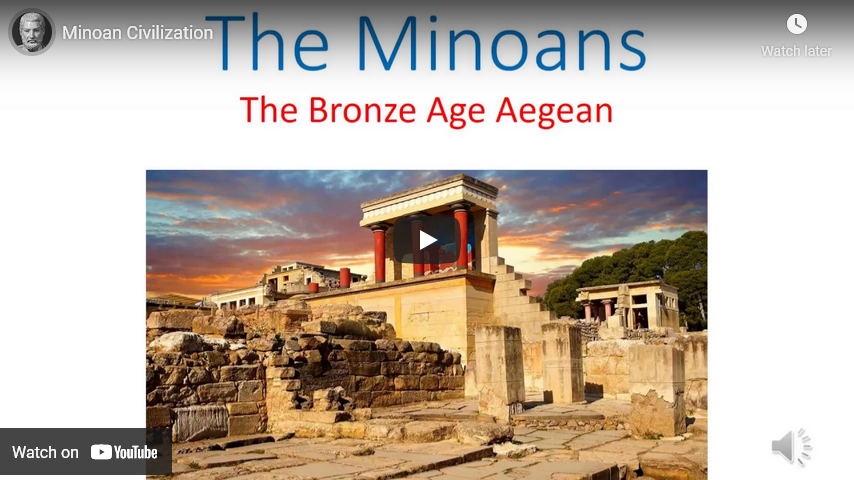
Published 25 Jan 2018In this video, I look at the Bronze Age civilization on Crete known as the Minoans.

Thersites the Historian
Published 25 Jan 2018In this video, I look at the Bronze Age civilization on Crete known as the Minoans.
Forgotten Weapons
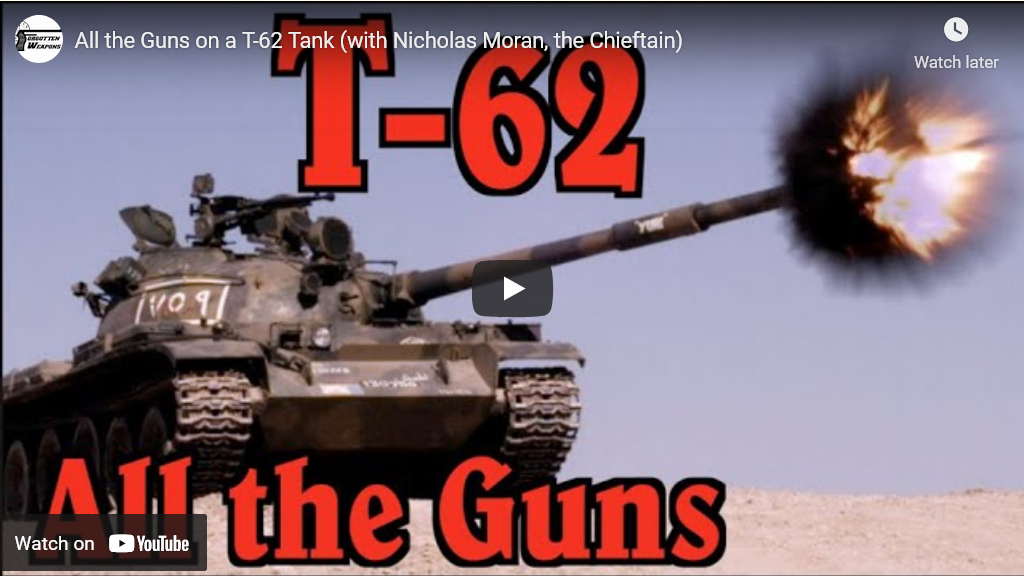
Published 5 Aug 2021Try out World of Tanks with a special bonus tank using this link!
Today Nicholas Moran (the Chieftain) and I are at Battlefield Vegas courtesy of Wargaming.net, to show you around a Soviet T-62 and all its various armaments. This particular T-62 was built in 1971 or 1972 and initially sold to Syria. It saw combat in the Valley of Tears in 1973, but survived as was eventually transferred to Lebanese ownership. From there is was captured by Israel and eventually imported into the United States via the UK. The T-62 was the last of the “simple” WW2-style Soviet tanks, and equipped with an extremely effective 115mm smoothbore main gun. In addition to that cannon, we will discuss and shoot the coaxial PKT machine gun and the loader’s antiaircraft DShKM heavy machine gun.
If you enjoy this video, check out World of Tanks – and maybe they will send Nicholas and I back again to do the same thing yet again on a third tank!
For videos on the detail of tanks like this one, check out The Chieftain:
https://www.youtube.com/user/WorldOfT…
https://www.youtube.com/channel/UCp4j…0:00:00 – Introduction
0:06:02 – Coaxial PKT
0:13:12 – Antiaircraft DShKM
0:20:25 – 115mm Main Gun
0:28:43 – Firing the main gunContact:
Forgotten Weapons
6281 N. Oracle 36270
Tucson, AZ 85740
World War Two
Published 12 Oct 2021In the history of European-style warfare, there has always been the ideal of “rules of warfare”. The horrors of the Eastern Front and the Pacific prove how hollow this ideal can be, but there is one theatre where some officers are trying to maintain it: North Africa.
(more…)
Overly Sarcastic Productions
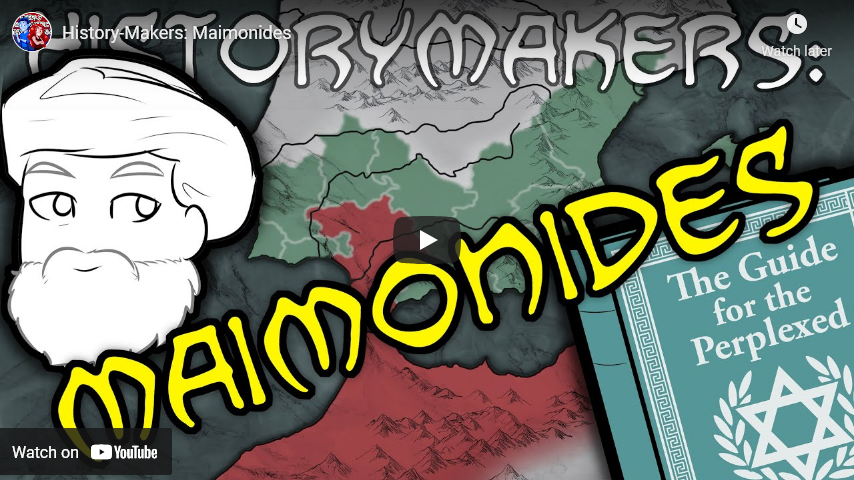
Published 17 Sep 2021“From Moses to Moses, there was none like Moses.” Jump into 1100s Cordoba & Cairo as we take a look at the life of one of the Medieval world’s most boundary-breaking History-Makers: Moses Maimonides!
SOURCES & Further Reading: Great Courses lectures “Jewish Scholar in Cairo: Moses Maimonides” from The History and Achievements of the Islamic Golden Age by Eamonn Gearon and “Maimonides and Jewish Law” from Great Minds of the Medieval World by Dorsey Armstrong. Britannica “Maimonides” https://www.britannica.com/biography/…, Stanford Encyclopedia of Philosophy “Maimonides” https://plato.stanford.edu/entries/ma…, The Guide For The Perplexed, Mishne Torah and Commentary on the Mishnah by Maimonides
Special thanks to Yellow/LudoHistory for his assistance in checking over my script. You can check out his livestreams playing historically-inspired videogames over at https://www.twitch.tv/ludohistory
Our content is intended for teenage audiences and up.PATREON: https://www.Patreon.com/OSP
PODCAST: https://overlysarcasticpodcast.transi…
DISCORD: https://discord.gg/osp
MERCH LINKS: http://rdbl.co/osp
OUR WEBSITE: https://www.OverlySarcasticProductions.com
Find us on Twitter https://www.Twitter.com/OSPYouTube
Find us on Reddit https://www.Reddit.com/r/OSP/
World War Two
Published 4 Sep 2021As the war turns three there is is no slacking in the fighting. Erwin Rommel launches another Axis attack in North Africa, but it is foiled in only days, though the Axis are advancing in the Caucasus as well as on Stalingrad, where the fight for the suburbs is now beginning. They’re also advancing in the South Pacific, as the Japanese fight their way along the Kokoda Trail.
(more…)
World War Two
Published 28 Aug 2021The Battle of the Eastern Solomons takes place this week — another carrier battle. As for the Germans, they’re advancing on Stalingrad, slowing down in the Caucasus, and Erwin Rommel is preparing to launch another assault in North Africa.
(more…)
… on Dec. 7, 1941, a U.S. Army Air Force lieutenant was spending his first-ever shift with a radar unit atop some Hawaiian high ground. Radar was brand new technology, and the U.S. was still figuring out how to best use it. The poor lieutenant watched on a scope as a big blob of something approached the naval base. He assumed it was a bunch of friendly planes coming in from the U.S. — what else would it be, right? Besides, even if he had been worried, there was no established protocol to sound an alarm. Forty-some-odd years before the release of Ghostbusters, the poor lieutenant was living the iconic tagline — when there’s a big mass of planes flying toward your base, who ya gonna call? And so the lieutenant and his men could only watch Japan’s massively successful attack on the U.S. fleet, an attack that caught the American defenders totally unprepared, with sailors asleep in their racks and senior officers golfing or breakfasting. There had been some intelligence warnings that Japan was up to something, but no one guessed that an attack on Hawaii was imminent. Not even the guys who quite literally saw it coming.
Let’s jump forward a few decades: in 1973, Israeli military intelligence was fully aware of a huge build-up of men and weapons on its borders with Syria and Egypt. The mobilizations were impossible to hide — tens of thousands of troops, tanks, artillery, the whole apparatus of modern warfare was lining up across Israel’s borders. But Israel’s top military intelligence officer concluded that the build-up was intended to apply political pressure ahead of negotiations, not actually to prepare for an assault. Israel was militarily superior, after all, and had handily defeated the combined Arab armies before, including just six years prior. The Arabs simply wouldn’t dare try again. Right?
Wrong. They dared, Israel was caught totally by surprise, and the Jewish state came shockingly close to defeat and likely destruction.
Ideally, these kinds of mistakes — mistakes of preparedness, mistakes of erroneous conclusion — are studied, learned from and then never repeated. In the real world, of course, we tend to make the same mistakes over and over.
Matt Gurney, “How the COVID crisis broke our leaders’ minds”, The Line, 2021-04-23.
World War Two
Published 7 Aug 2021The Axis Forces are on the move on the Eastern Front and in the Caucasus, but this week the Allies begin an offensive of their own: this week come Allied landings and attacks on Guadalcanal and nearby islands, the first American offensive against the Japanese.
(more…)
World War Two
Published 31 Jul 2021Operation Edelweiss opens with a blast, and as the Wehrmacht closes in on Stalingrad, Stalin issues that famous order. There aren’t just big actions in the East, the Japanese have landed in New Guinea, the Allies try one more offensive at El Alamein, and the Americans have locked in on Guadalcanal.
(more…)
World War Two
Published 17 Jul 2021The second phase of Fall Blau begins with second guessing by the Axis Powers and constant changes in directive. The Soviet Union’s response to the successes of the first phase of Fall Blau is equally chaotic. Over in North Africa there is the question of it maybe ending in stalemate.
(more…)
World War Two
Published 10 Jul 2021Adolf Hitler is not happy, and yet phase one of Fall Blau has accomplished all of its goals and done so ahead of the timetable. However, the Soviet Army in 1942 is not the same as that in 1941, and is not waiting around this time to be captured by the hundreds of thousands, and if things continue then the Axis might just be wasting a ton of gas to take a ton of empty space.
(more…)
World War Two
Published 3 Jul 2021It’s that time of the year again — the time when the Axis Powers drive deep into the Soviet Union. Fall Blau is the name of this year’s huge offensive, and it begins this week, making great gains from the very beginning, but the Axis Powers are also making big gains this week in North Africa, taking Mersa Matruh and pushing to within 100 km of Alexandria. Can nothing stop them?
(more…)
World War Two
Published 26 Jun 2021Fall Blau, the huge Axis summer offensive in the Soviet Union, is supposed to being this, but is postponed to next. The smaller Operation Fridericus II does begin though, and what does Josef Stalin make of that and the intelligence he’s received? Meanwhile in North Africa, after the fall of Tobruk, the British 8th Army gets a leadership change, but Erwin Rommel is still on the move eastward into Egypt. Where will the Allies try to hold him? Half the world away, the Allies begin to establish a base at Milne Bay, New Guinea. It’s a start, a small one, but a start.
(more…)
Overly Sarcastic Productions
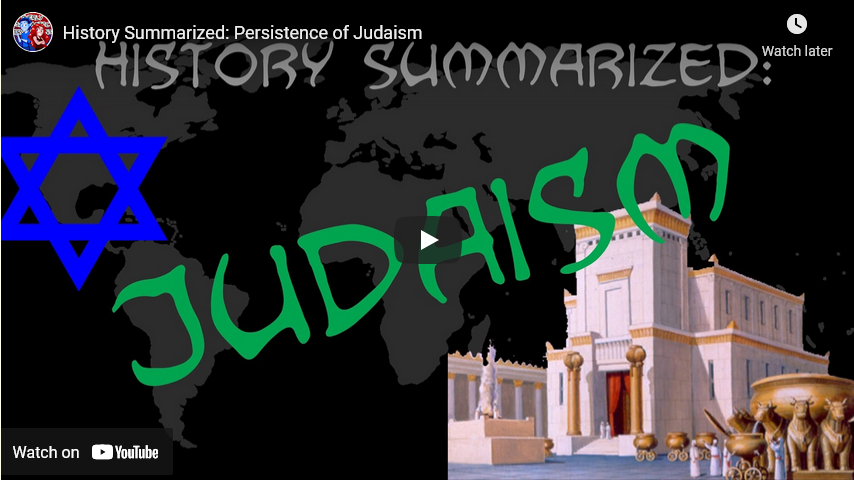
Published 7 Apr 2017Gooooood morning everybody! Today, Blue finishes the trilogy of Abrahamic religions with a video summarizing the history of the Hebrew people and the Jewish faith. There’s a lot of ground to cover, so fasten your seatbelts for a twenty-minute rundown of the facts, the theories, and the ever-so-popular misconceptions!
Look forward to next time, when Blue brings it all together to talk about Religious Wars and Religious Philosophy!
PATREON: www.patreon.com/user?u=4664797
MERCH LINKS:
Shirts – https://overlysarcasticproducts.threa…
All the other stuff – http://www.cafepress.com/OverlySarcas…Find us on Twitter @OSPYouTube!
During the Mouseion‘s heyday in the third and second centuries BC the funding for this labour and the upkeep of the institution generally would have been regular and reliable. The Mouseion was, after all, one of the jewels in the crown of the Ptolemaic kingdom and it sat in the Broucheion or Royal Quarter where the Ptolemies themselves lived. By the first century BC, however, there is some indication that the prestige of the institution had begun to decline. In its first two centuries the Mouseion‘s directors were famous scholars, renowned for their intellects throughout the Greek-speaking world. By the time of the later Ptolemies, however, we find administrators, court favourites and even a former commander of the palace guard taking up the role, which seems to have become, as Lionel Casson puts it, “a political plum” to be awarded to flunkies rather than scholars. This continued under the Romans in the first century AD, with Tiberius Claudius Balbilus being awarded the post by Claudius, though he at least was something of a scholar if not a leading intellect. It is likely that the later Ptolemies began to neglect the institution and Roman imperial patronage of it was probably even less reliable.
But war has always been one of the main destroyers of libraries down the ages and the Great Library’s slow decline was marked by several sacks of the Broucheion which eventually led to the end of the Mouseion. The first and probably the most significant came in 47 BC when Julius Caesar took the side of Cleopatra in her claim on the Ptolemy’s throne and besieged her younger brother, the boy king Ptolemy XIII, in Alexandria. Caesar’s own account mentions that he burned a fleet in the docks of the city, but makes no mention of this fire destroying anything else (Civil Wars, III.11). His account was continued by his lieutenant Aulus Hirtius in his Alexandrine War and he too makes no mention of any fire damaging the city, but he does go out of his way to say “Alexandria is well-nigh fire-proof, because its buildings contain no wooden joinery and are held together by an arched construction and are roofed with rough-cast or tiling” (Alexandrine War, I.1) which could be read as an attempt at a defence against accusations of damage through fire, given his role in the siege. The earliest account of Caesar’s siege damaging Alexandria comes from a lost work by Livy via an epitome by Florus (Florus, II.13) which describes Caesar burning the area around the docks to deprive enemy archers of a position on which to fire on his troops, and this is echoed by Lucan (The Civil War, X.24). It is Plutarch who first depicts this fire destroying the Great Library in an almost casual mention that perhaps assumes this as common knowledge:
In this war, to begin with, Caesar encountered the peril of being shut off from water, since the canals were dammed up by the enemy; in the second place, when the enemy tried to cut off his fleet, he was forced to repel the danger by using fire, and this spread from the dockyards and destroyed the Great Library, and thirdly, when a battle arose at Pharos, he sprang from the mole into a small boat and tried to go to the aid of his men in their struggle, but the Egyptians sailed up against him from every side, so that he threw himself into the sea and with great difficulty escaped by swimming. (Plutarch, Caesar, 49)
Aulus Gellius’ mention of the Great Library says that the collection numbered “nearly seven hundred thousand volumes” and then adds “but these were all burned during the sack of the city in our first war with Alexandria”, referring to Caesar’s siege (Gellius, Attic Nights, VII.17). Dio Cassius gives a slightly longer account:
After this many battles occurred between the two forces both by day and by night, and many places were set on fire, with the result that the docks and the storehouses of grain among other buildings were burned, and also the library, whose volumes, it is said, were of the greatest number and excellence. (Dio Cassius, Roman History, XLII.36)
There is some debate about how literally we can take the reports that the whole Great Library was destroyed, especially given that the docks area of Alexandria were some distance from the Mouseion‘s likely location. The fact that so many writers agree that Caesar’s fire destroyed the Great Library simply can’t be ignored, however, and at the very least the fire seems to have destroyed a substantial portion of the book collection, probably stored in warehouses on the docks. It is clear that the losses were huge, as Plutarch also tells the (probably apocryphal) story of Mark Antony confiscating the whole collection of the Great Library of Pergamon and giving them to Cleopatra to replace the books lost in the fire (Plutarch, Antony, 58). While this was not the end of the Mouseion and not the end of its whole collection, writers from around the end of the reign of Caesar’s dynasty onwards tend to refer to the Great Library in the past tense and any surviving collection was probably greatly reduced after 47 BC.
Scholarship continued in the Mouseion, however, and the Roman emperors seem to have continued its funding under their patronage when the Ptolemaic dynasty came to an end with the death of Cleopatra. Claudius built a new wing or annex to the Mouseion, which was to house his works of history and see the public reading of them twice a year. But it was the calamitous third century AD that saw a succession of military disasters in Alexandria and seems to have seen the final end of the Mouseion.
In 215 AD Caracalla punished Alexandria for mockery of him with a wholesale massacre of its young men, after which his troops plundered parts of the city. It is not known if the Mouseion was sacked in this action, but John Malas records that its funding was stopped by Caracalla at this time (Delia, p. 1463). The real end probably came in 272 AD when Aurelian stormed the Broucheion with Ammianus noting “[Alexandria’s] walls were destroyed and she lost the greater part of the district called Bruchion.” (Ammianus, History, XII.15). If that sack didn’t mean the death blow for the institution, Diocletian probably finished the job when he too sacked the city in 295 AD, and it was later devastated by a major earthquake in 365 AD. The only mention of the Mouseion after this is found in a late source, the tenth century Byzantine encyclopaedia called the Suda, which describes the fourth century philosopher Theon as “the man from the Mouseion“, though it is hard to tell exactly what this means. Given that the Mouseion was most likely long gone by Theon’s time, it could be that some other successor “Mouseion” had been established and Theon studied there or it could be that “the man from the Mouseion” is stylised honorific or even a personal nickname – meaning “a scholar like one from the old days”.
The Mouseion and its library were almost certainly a memory by the late third century, destroyed in a series of calamities after a long period of decline. But what is missing from all this evidence is any howling, pyromaniacal Christian mob. If the Great Library ceased to exist in the century before Chrisitanity came to power in the Empire, how did Christians get stuck with the charge of destroying it? The answer lies not in the evidence about the Great Library, but in the history of its daughter library and annex in the Serapeum.
Tim O’Neill, “The Great Myths 5: The Destruction Of The Great Library Of Alexandria”, History for Atheists, 2017-07-02.



Powered by WordPress