
HenryvKeiper
Published on 28 May 2009My favorite scene from one of my favorite TV shows of all time.
December 5, 2018
Yes, Minister – The Six Diplomatic Options
Comments Off on Yes, Minister – The Six Diplomatic Options
November 28, 2018
The Difficult Road To Peace 1919 I THE GREAT WAR Epilogue 2
The Great War
Published on 26 Nov 2018After 4 1/2 years of war and millions of dead and wounded any kind of peace would be difficult. The peace process in 1919 was even more difficult because it happened in turbulent times with a rapidly changing landscape and new ideas about a future world order that should prevent this level of bloodshed in the future.
Comments Off on The Difficult Road To Peace 1919 I THE GREAT WAR Epilogue 2
November 12, 2018
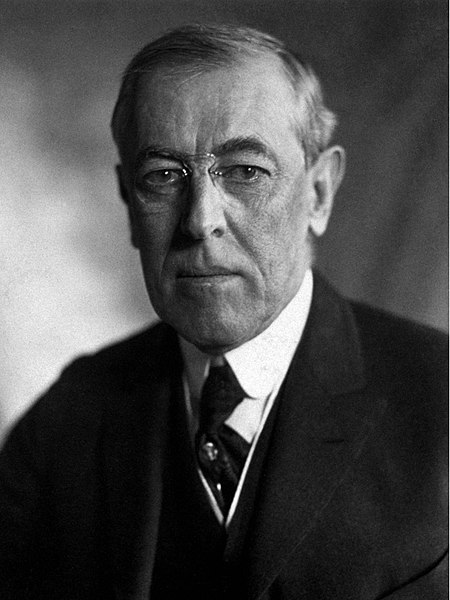
Woodrow Wilson
In City Journal, Lance Morrow looks back at the successes and failures of President Wilson:
It’s been a century since President Woodrow Wilson arrived in Europe, weeks after the Armistice ending World War I. A crowd of 2 million cheered him in Paris. The papers called him the “God of Peace,” the “Savior of Humanity,” a “Moses from America.” He bowed, he tipped his silk top hat — the newsreel images come flickering to us from an earlier world. He sat down with Georges Clemenceau and David Lloyd George and the others to hash out the fiasco of the Versailles Treaty. He returned home to the fatal wrangle over the League of Nations with Henry Cabot Lodge in the Senate. Then came the cross-country tour to sell the treaty to the American people, his collapse on the train near Wichita, and, back in Washington, the terrible stroke and the long twilight — a sequence that led, further down the road, to Warren G. Harding and, in the fullness of time, to Adolf Hitler and World War II.
Woodrow Wilson, 1919
Photo via Wikimedia Commons.The Woodrow Wilson story is an American classic — a set piece, like the rise and fall of Joseph McCarthy, or the fable of John F. Kennedy. Of Wilson, the historian Barbara Tuchman wrote: “Since Americans are not, by and large, a people associated with tragedy, it is strange and unexpected that the most tragic figure in modern history — judged by the greatness of expectations and the measure of the falling off — should have been an American.”
People speak of “settled science.” One might also speak of “settled myth.” (The Kennedys are one of those.) But Wilson’s myth remains vexed and unsettled. He persists, in American memory, as a sort of botched paragon — a man who remains almost irritatingly alive and imperfect and somehow touching. The respect that he deserves is complicated — and so is the contempt. The same has been said of American idealism itself.
As with America, there are two basic versions of Wilson: the sacred and the profane. Was his greatness real or fake? He ranks in polls in the top quarter of American presidents, but with a dissenting asterisk. Was he the superbly effective Progressive president (who introduced the Federal Reserve and the graduated income tax and much else) and the prophet of twentieth-century internationalism? (Wait: Are we to thank Wilson for Vietnam? Iraq? Afghanistan?) Or was he the last fling of nineteenth-century moralism and hypocrisy — a Southern-born racist or near-racist, and a brute on the subject of civil liberties? (He tossed Eugene V. Debs in jail merely for disagreeing with him on the war, leaving it to Warren G. Harding to pardon Debs.) Some said that his mind was a Sunday school; others, that it was the pool of Narcissus. Yet he managed to be a great man all the same. It’s too bad that he did not leave the presidency, one way or another, in 1919, after the damage from his stroke became evident. Amazingly, even in the summer of 1920, the broken man had delusions of running for a third term. He felt embittered and betrayed when the Democratic nomination went to Governor James Cox of Ohio. Woodrow Wilson’s ego died harder than Rasputin.
An indispensable aspect of Wilson’s genius—and a key, perhaps, to his failure — was his lambent but vaguely narcissistic prose style, sweet in its clarities but sometimes too supple and manipulative. Unlike most presidents, he wrote his own speeches. He governed a good deal by means of language, and he used words to impose his will or to conjure up an ideal world that might be mistaken, from a distance, for the Kingdom of God. He was also a theatrical man, an actor, an excellent mimic: a performer. Was he Prospero? Or was he, in the end, Christ crucified? People spoke routinely of his messiah complex. At one point during the Paris Peace Conference, he seemed to suggest that he was actually an improvement on the messiah. Lloyd George listened in amazement as Wilson observed that organized religion had yet to devise practical solutions to the problems of the world. Christ had articulated the ideal, Wilson said, but he had offered no instructions on how to attain it. “That is the reason why I am proposing a practical scheme to carry out his aims.” Self-righteousness is tiresome in the end. Many concluded that Wilson should be remembered, without appeals to either religion or literature, as the stiff-necked, hypochondriacal son of a Presbyterian minister, led astray by his own moral vanity — either that, or as the uxorious hero of ladies’ teas. He loved the companionship of doting women but not necessarily that of strong men.
H.L. Mencken wrote of Wilson, shortly after the President’s death, in a review of The Story of a Style by Dr. William Bayard Hale:
Two or three years ago, at the height of his illustriousness, it was spoken of in whispers, as if there were something almost supernatural about its merits. I read articles, in those days, comparing it to the style of the Biblical prophets, and arguing that it vastly exceeded the manner of any living literatus. Looking backward, it is not difficult to see how that doctrine arose. Its chief sponsors, first and last, were not men who actually knew anything about the writing of English, but simply editorial writers on party newspapers, i.e., men who related themselves to literary artists in much the same way that Dr. Billy Sunday relates himself to the late Paul of Tarsus. What intrigued such gentlemen in the compositions of Dr. Wilson was the plain fact that he was their superior in their own special field — that he accomplished with a great deal more skill than they did themselves the great task of reducing all the difficulties of the hour to a few sonorous and unintelligible phrases, often with theological overtones – that he knew better than they did how to arrest and enchant the boobery with words that were simply words, and nothing else. The vulgar like and respect that sort of balderdash. A discourse packed with valid ideas, accurately expressed, is quite incomprehensible to them. What they want is the sough of vague and comforting words – words cast into phrases made familiar to them by the whooping of their customary political and ecclesiastical rabble-rousers, and by the highfalutin style of the newspapers that they read. Woodrow knew how to conjure up such words. He knew how to make them glow, and weep. He wasted no time upon the heads of his dupes, but aimed directly at their ears, diaphragms and hearts.
But reading his speeches in cold blood offers a curious experience. It is difficult to believe that even idiots ever succumbed to such transparent contradictions, to such gaudy processions of mere counter-words, to so vast and obvious a nonsensicality. Hale produces sentence after sentence that has no apparent meaning at all — stuff quite as bad as the worst bosh of the Hon. Gamaliel Harding. When Wilson got upon his legs in those days he seems to have gone into a sort of trance, with all the peculiar illusions and delusions that belong to a frenzied pedagogue. He heard words giving three cheers; he saw them race across a blackboard like Socialists pursued by the Polizei; he felt them rush up and kiss him. The result was the grand series of moral, political, sociological and theological maxims which now lodges imperishably in the cultural heritage of the American people, along with Lincoln’s “government for the people, by the people,” etc., Perry’s “We have met the enemy, and they are ours,” and Vanderbilt’s “The public be damned.” The important thing is not that a popular orator should have uttered such grand and glittering phrases, but that they should have been gravely received, for many weary months, by a whole race of men, some of them intelligent. Here is a matter that deserves the sober inquiry of competent psychologists. The boobs took fire first, but after a while even college presidents — who certainly ought to be cynical men, if ladies of joy are cynical women — were sending up sparks, and for a long while anyone who laughed was in danger of the calaboose. Hale does not go into the question; he confines himself to the concrete procession of words. His book represents tedious and vexatious labor; it is, despite some obvious defects, very well managed; it opens the way for future works of the same sort. Imagine Harding on the Hale operating table!
Comments Off on Woodrow Wilson
November 11, 2018
Armistice – But Peace? I THE GREAT WAR Week 225
The Great War
Premiered 4 hours agoOn November 11 1918, the German delegation and the Allies reach an agreement for an armistice. At the 11th hour the guns go silent and the First World War is over, well at least the guns go silent but is it a peace already? Germany is struggling with revolution and civil war at home, the break up of the Austro-Hungarian Empire causes a lot of chaos. And in Romania, the men are taking up arms again.
Comments Off on Armistice – But Peace? I THE GREAT WAR Week 225
November 10, 2018
Emperor Karl’s last attempt for peace, 1917
Part of a post at Essays in Idleness from last month by David Warren:
As we approach the centenary of the Great Armistice, I see the plastic poppies circulating from the little boxes in the liquor stores. My thoughts turn to war qua war. Though sometimes necessary, it is not a good thing (“bad for children and animals” as the peaceniks say); and given the ambiance of our high-tech weaponry, little heroism is left to raise the tone. Contemporary battles are not confined to the soldiers, as once they could be. The devastation of cities and towns, the routine destruction of infrastructure, the civilian suffering that follows from that, must match or quite exceed ancient incidents of rapine.
While I’ve never thought war should be avoided at all costs, I recognize that the cost is very high. Opportunities for peace should not be overlooked, even while the carnage is in progress.
When, for instance, the newly-enthroned Emperor Karl of Austria-Hungary — “fanatic” Catholic Christian — discreetly proposed a separate peace to the allies in the spring of 1917, his agents were rebuffed, outed, and mocked. The Americans were coming to tilt our fortunes, the Germans were distracted overrunning the Russians, and while the Western Front was in catastrophic stasis, our nationalist politicians could now hope to utterly crush the foe. They would demand unconditional surrender.
The incident haunts my historical imagination. This was a serious opportunity to restore something close to the status quo ante, while resolving casus belli (very much plural) from Belgium and Alsace to Serbia and Constantinople on the principle of sweet reason. Drowned in the gunfire was this Blessed Karl’s expressly Christian plea. In an instant the decision was made, in the West, to persist till millions more were slain, and the conditions were assembled for international violence and totalitarianism through the next seventy years.
The gentlemen I call “the three stooges of the apocalypse” — Wilson, Lloyd George, Clemenceau — were all modern politicians, whose nationalist ideals were now buttressed by the vast democratic constituencies of countries at war, goaded on by the screaming headlines of a paper mass media. They wanted a New Europe, a New World Order, in which antiquated empires and all the sleepy old aristocratic polities would be smashed and replaced — with modern, ethically homogenous, democratic States. The consequences were unforeseeable to them, wrapped in their flags and the rhetoric of liberté, égalité, fraternité.
It was a war to end all wars! … Both the malice and the naivety were astounding.
Comments Off on Emperor Karl’s last attempt for peace, 1917
November 9, 2018
Revolution in Germany – Armistice in Austria I THE GREAT WAR Week 224
The Great War
Published on 8 Nov 2018Unrest within the German Empire is spreading, resentment against the war, the hunger and the elites is turning into revolutionary action and with a mutiny in Kiel the wheels begin to turn quickly. Austria signs an armistice, the Macedonian Front collapses, Romania might enter the war again and the new German political leaders send a delegation through the lines in France. Their goal: An Armistice.
Comments Off on Revolution in Germany – Armistice in Austria I THE GREAT WAR Week 224
November 4, 2018
Molotov’s Heel on Finland and Nobody to Fight in the West – WW2 – 010 3 November 1939
World War Two
Published on 3 Nov 2018Ten weeks into World War Two, and the Allied ground forces are bored in France. In North-Eastern Europe, Poland’s suffering has no end and Finland is in the crosshairs of the USSR.
WW2 day by day, every day is now live on our Instagram account @World_war_two_realtime https://www.instagram.com/world_war_t…
Between 2 Wars: https://www.youtube.com/playlist?list…
Join us on Patreon: https://www.patreon.com/TimeGhostHistory
Or join The TimeGhost Army directly at: https://timeghost.tvWritten and Hosted by: Indy Neidell
Produced and Directed by: Spartacus Olsson and Astrid Deinhard
Executive Producers: Bodo Rittenauer, Astrid Deinhard, Indy Neidell, Spartacus Olsson
Research by: Indy Neidell
Edited by: Wieke Kapteijns and Spartacus OlssonColoring by Spartacus Olsson and Sarvesh
Archive by Screenocean/Reuters https://www.screenocean.com
A TimeGhost chronological documentary produced by OnLion Entertainment GmbH
Comments Off on Molotov’s Heel on Finland and Nobody to Fight in the West – WW2 – 010 3 November 1939
October 19, 2018
The Battle of the Selle – Ludendorff Resigns I THE GREAT WAR Week 221
The Great War
Published on 18 Oct 2018As the Germans are retreating further and further during the Battle of the Selle, Erich Ludendorff – the German Quartermaster General, one half of Germany’s military dictatorship and mastermind behind the last big German offensive in spring 1918 – resigns under pressure by the Kaiser and the Reichstag. The German upper class realizes that their days might be numbered if the war continues in the current form and Austria-Hungary’s Emperor Karl has the same epiphany.
Comments Off on The Battle of the Selle – Ludendorff Resigns I THE GREAT WAR Week 221
October 15, 2018
Forgotten History: Glade of the Armistice
Forgotten Weapons
Published on 25 Sep 2018http://www.patreon.com/ForgottenWeapons
Here at a forested railroad crossing outside Compiègne in Picardy, France, two rail cars met in November of 1918 – one with members of the Allied/Entente high commend and ones with representatives of Imperial Germany. They met here to end 5 years of slaughter; the German delegation being presented terms for armistice by the Allies. Faced with no other viable option, they would accept these terms, and the fighting officially ended at the 11th hour of the 11th day or the 11th month of 1918. More than a year would go by before the Treaty of Versailles was fully ratified, but it was here that the decision to end the death was made.
The rail car in which the papers were signed was kept as a monument here, along with a rather pointed monument to the French dead, featuring a slain German Imperial eagle. A large stone message was also put up in the center of the clearing, reading (in translation):
“Here on the 11th of November 1918 succumbed the criminal pride of the German reich, vanquished by the free peoples which it tried to enslave.”
When France signed an armistice with Germany in 1940, Hitler would have those papers signed here as well, in that very same rail car. The car was then taken to Berlin as a trophy, and the monuments here destroyed. The car itself was burned accidentally in 1945, but the monuments were rebuilt by the French following the war, and a sister car is now on display here with many of the original artifacts of the Armistice (which were hidden from the Germans in 1940).
Thanks to Military History Tours for making this video possible!
If you enjoy Forgotten Weapons, check out its sister channel, InRangeTV! http://www.youtube.com/InRangeTVShow
Contact:
Forgotten Weapons
PO Box 87647
Tucson, AZ 85754
Comments Off on Forgotten History: Glade of the Armistice
October 5, 2018
Germany’s Reckoning – Bulgarian Armistice I THE GREAT WAR Week 219
The Great War
Published on 4 Oct 2018The 14 Points: https://en.wikipedia.org/wiki/Fourtee…
While Bulgaria signs the Armistice of Salonika and effectively exits the war as the first of the Central Powers, the Hindenburg Line is broken on the Western Front. It dawns among the German leadership, that an armistice is necessary and in a desperate attempt to secure a more favourable position at the negotiations table, the Kaiser agrees to a “revolution from the top” that gives more political say to the Reichstag.
Comments Off on Germany’s Reckoning – Bulgarian Armistice I THE GREAT WAR Week 219
October 3, 2018
USMCA (aka son-of-NAFTA) – what’s the damage after all?
The most common sentiment from Canadian comments appears to be “meh, it could have been much worse”. That doesn’t mean it’s particularly good, either:
All that cross-border yelling, a solid year of bluster and petulance, dire rhetoric about “stabs in the back” and “special places in hell,” fake deadlines and all-night negotiations, and we end up with pretty much the agreement we started with? All that was required to fix NAFTA, that destroyer of American jobs and pox on its prosperity, the deal Donald Trump memorably complained was “the worst agreement in history,” was to change its name — from North American Free Trade Agreement to US-Mexico-Canada Agreement? Seriously?
Not quite. The result is certainly a far heave from some of the more apocalyptic scenarios we had been entertaining ourselves with. But neither is it the largely unaltered “NAFTA 2.0” of much initial comment. There are substantive changes in there, most of them bad, and not all of them imposed by an overbearing U.S. on an unwilling Canada.
Still, it’s not quite the conflagration we’d been banking on, is it? Trump is the bully in middle school who threatens to take your lunch money, only to settle for a half a slice of your pizza. Or, in this case, 3.6 per cent of it.
That’s the share of the Canadian dairy market to which the U.S. will now have tariff-free access, a slight advance on the 3.25 per cent market share the U.S. had negotiated under the Trans Pacific Partnership — before Trump withdrew from it. (Oh, and “milk price classes 6 and 7” are eliminated, for fans of that dispute. It involves skim milk solids.) There are also some minor increases in tariff-free imports in the other supply-managed sectors: eggs, chicken, cheese and so on. Everything else will face the same triple-digit tariffs, as before.
That’s unfortunate. Supply management is a blight on the Canadian political and economic landscape we could well do without. The NAFTA re-negotiations were an ideal opportunity to bargain it away, as it should have been in the original NAFTA. That it remains more or less intact — even the dairy lobby could manage only a half-hearted jeremiad of imminent lacto-doom in response — is one of the chief disappointments in this agreement.
Still, what did you expect? There was never any chance of these negotiations resulting in a deepening and broadening of NAFTA — not with protectionists on both sides of the table. The only question was whether the status quo protectionists on this side — who wished to preserve all of NAFTA’s existing exemptions — could hold out against the expansionist protectionists on the other, who wished to cut NAFTA into little mercantilist pieces. As it turns out the answer is: surprisingly well.
A quick summary of the winners and losers in this agreement:
Is this a free trade agreement?
No. Unlike NAFTA, this latest agreement makes no pretense to be about free trade (or even freer trade). It’s a protectionist agreement imposed by the U.S. on the other two countries.
Who benefits from the agreement?
The primary beneficiaries of the agreement are labor unions, U.S. dairy farmers, U.S. drug manufacturers, and companies that provide automation for manufacturers (e.g., robot makers).
The agreement will require at least 30 percent of cars (rising to 40 percent by 2023) to be made by workers earning $16 an hour. This will force more cars to be produced in the U.S. and Canada since the typical manufacturing wage in Mexico is only about $5 per hour. The agreement also requires Mexico to make it easier for workers to form unions, which will make them less competitive against more productive unionized workers in the U.S. and Canada.
U.S. dairy farmers will also gain greater access to the Canadian market. Because of new restrictions on how much dairy Canada can export, there is the potential for U.S. dairy to gain a greater market share in foreign countries.
U.S. drug companies will also be able to sell pharmaceuticals in Canada for 10 years (rather than eight) before facing generic competition.
Because the agreement makes human labor in the three countries somewhat more costly, companies that create robots and other automation will likely be the long-term beneficiaries.
Who are the biggest losers in this agreement?
As with almost all protectionist trade agreements, consumers are the ones who will be hurt the most.
As the Washington Post notes, economists and auto experts think USMCA is going to cause car prices in the U.S. to “rise and the selection to go down, especially on small cars that used to be produced in Mexico but may not be able to be brought across the border duty-free anymore.”
Because the restrictions on Canadian steel and aluminum also remain in place, businesses that use those materials in manufacturing will pay inflated prices, and their products will be less competitive on the global market.
Comments Off on USMCA (aka son-of-NAFTA) – what’s the damage after all?
September 9, 2018
“This isn’t hardball so much as Calvinball: a game where one player constantly makes up new rules as he goes along”
Andrew Coyne provides a useful set of clues to help ordinary folks understand the NAFTA “negotiations”:
Talks on a renegotiated North American Free Trade Agreement, which at various times in the past days, weeks and months have been said to be on the verge of either a deal or collapse, are now reported to be “progressing slowly.” An agreement was not expected by the end of the day Friday. Some reports said it was not expected till the end of the month. Or maybe December.
In other words, business as usual. Had you read none of the several thousand reports on the negotiations since they began more than a year ago you would be scarcely less informed than the most avid trade watcher. Some points to bear in mind as the talks grind toward their next “deadline”:
No one knows anything. Any number of authoritative commentators have weighed in on the failure of the talks, if they are in fact failing, and who is to blame if they are. But the truth is that unless you were in the room with the negotiators you have no idea what is really going on — assuming even they do. This is not because there have been no leaks or official accounts of the proceedings, but because…
Everyone is lying to you. Many a rookie reporter has had the same experience covering a labour negotiation. The talks are said to be coming “down to the wire,” facing a dramatic “midnight deadline.” Sources close to one side or the other confide there will be “no more concessions,” that a “strike is now unavoidable.”
So the deadline comes and goes and nothing happens: they keep talking. Or else the side that had vowed not to give an inch more caves and cuts a deal. Which is to say that while all sides dutifully proclaim their aversion to “negotiating through the media,” everyone negotiates through the media, all the time. The NAFTA talks are no different.
The NAFTA talks are completely different. There has never been a trade negotiation like this, because there has never been a president, or leader of any major country, like Donald Trump. It isn’t just that he lies all the time, or changes his mind on those occasions when he is not lying.
Comments Off on “This isn’t hardball so much as Calvinball: a game where one player constantly makes up new rules as he goes along”
August 17, 2018
QotD: TINA
I believe, and I have alluded to this several times, that we must anchor all our policies in North America. We are, I have said, again more than once, bound by what some wag called TINA²: we are Trapped In North America and There Is No Alternative. (TINA X TINA = TINA²) That’s the crux of it … no matter what some romantics might wish we are and must remain for generations anchored in North America. We are not big enough and rich enough to be powerful enough to face the world on our own, treating the USA as just another great power ~ as, arguably, Australia does. Geography, economics, personal issues ~ we are kith and kin ~ and the power imbalance make us dependent upon America to a degree that some, including me, find unhealthy.
But, until we can grow our population to 100 million, until we can grow up and appreciate that we need substantial hard (military) power in order to promote and protect our vital interests around the globe, until we can become a global free trader, and until America’s decline is more marked then There Is No Alternative … we are Trapped In North America ~ trapped in Donald Trump’s America, for now, anyway.
Ted Campbell, “Anchor, cornerstone or stumbling block?”, Ted Campbell’s Point of View, 2018-07-17.
Comments Off on QotD: TINA
August 7, 2018
“[Trudeau’s] ideology is jeopardizing 20% of the Canadian economy”
Brandon Kirby on Prime Minister Justin Trudeau’s failing efforts to negotiate with the United States on trade:
Trade with Canada constitutes 2% of America’s GDP and trade with America constitutes a whopping 20% of Canada’s GDP. My home province of New Brunswick finds 50% of its private sector exporting to the U.S. – NAFTA is of vital importance to our economy.
The dwindling efforts of Trudeau’s cabinet to negotiate a deal with the Americans could become his government’s greatest failure. With tariffs already being imposed on steel and aluminum, NAFTA is potentially unraveling before our eyes and along with it, the Canadian economy.
Trudeau’s American counterpart isn’t known for his vocal support of trade and yet he handed Canada everything on a silver platter at the recent G7 summit. He offered to remove all tariffs and subsidies on imports and exports, provided Canada did the same. This is about as fair an offer as one could expect. Trudeau retaliated by insisting Canada had been insulted.
The trouble with Trudeau is precisely that. He was given a talking point. He developed rhetoric rather than substance. Akin to Marco Rubio’s disaster of a debate performance, who refused to go off script even when he was being called out for scripted answers, Trudeau had a talking point. It was a good one, Canadians and Americans died together in the mountains of Afghanistan to bring justice for Americans who died on September 11th. Trump alluded to our tariffs on their dairy farmers as a national security threat. But when Trump acquiesced, Trudeau kept to his talking points and refused to go off script, even when his talking points no longer made sense.
The initial renegotiation began with Trudeau’s government attempting to include a chapter on gender. The Americans weren’t enthusiastic about devoting a significant portion of their time at the negotiations to discussing an unenforceable chapter of the deal, but Trudeau pressed on.
The liberal rationale in the briefing notes was leaked, “Think back 20 years and remember the early discussions of labour and environment in the context of trade agreements.”
Environmental and labour standards were included in the negotiations of decades past because a country that has humane labour standards is at a trade disadvantage to countries that neglect their workers and their environment. Gender doesn’t have any bearing on trade. His ideology is jeopardizing 20% of the Canadian economy.
Comments Off on “[Trudeau’s] ideology is jeopardizing 20% of the Canadian economy”
July 29, 2018
Carving up the Middle East and Preempting Rommel I BETWEEN 2 WARS I 1920 Part 3 of 4
TimeGhost History
Published on 27 Jul 2018In 1920 the colonial powers of the British Empire and France reverse course on their commitment to grant independence to the peoples of the Middle East. In a game to grab the oil fields of Arabia, Syria and Mesopotamia, and to control the Suez Canal they tighten their grip on the region, with far ranging consequences that will shape the world well into the 21st century.
Join us on Patreon: https://www.patreon.com/TimeGhostHistory
Hosted by: Indy Neidell
Written and directed by: Spartacus Olsson
Research Contributed by: Jonas Yazo Srouji
Produced by: Astrid Deinhard
Executive Producers: Bodo Rittenauer, Astrid Deinhard, Indy Neidell, Spartacus OlssonA TimeGhost chronological documentary produced by OnLion Entertainment GmbH
Comments Off on Carving up the Middle East and Preempting Rommel I BETWEEN 2 WARS I 1920 Part 3 of 4


