
The central problem of relations with de Gaulle stemmed from President Roosevelt’s distrust. Roosevelt saw him as a potential dictator. This view had been encouraged by Admiral Leahy, formerly his ambassador to Marshal Petain in Vichy, as well as several influential Frenchmen in Washington, including Jean Monnet, later seen as the founding father of European unity.
Roosevelt had become so repelled by French politics that in February he suggested changing the plans for the post-war Allied occupation zones in Germany. He wanted the United States to take the northern half of the country, so that it could be resupplied through Hamburg rather than through France. “As I understand it,” Churchill wrote in reply, “your proposal arises from an aversion to undertaking police work in France and a fear that this might involve the stationing of US Forces in France over a long period.”
Roosevelt, and to a lesser extent Churchill, refused to recognize the problems of what de Gaulle himself described as “an insurrectional government”. De Gaulle was not merely trying to assure his own position. He needed to keep the rival factions together to save France from chaos after the liberation, perhaps even civil war. But the lofty and awkward de Gaulle, often to the despair of his own supporters, seemed almost to take a perverse pleasure in biting the American and British hands which fed him. De Gaulle had a totally Franco-centric view of everything. This included a supreme disdain for inconvenient facts, especially anything which might undermine the glory of France. Only de Gaulle could have written a history of the French army and manage to make no mention of the Battle of Waterloo.
Anthony Beevor, D-Day: The Battle for Normandy, 2009.
June 5, 2014
QotD: Churchill, Roosevelt and de Gaulle
June 6, 2013
D-Day 1942 or 1943
At Military History Now, there’s a look at a few of the allied plans for invading France before the actual June 6, 1944 operation:
IKE’S SLEDGEHAMMER
Almost as soon as America entered the war with Nazi Germany, generals Dwight Eisenhower and George Marshall were both lobbying for a strike across the English Channel into France. One plan foresaw a joint British and American assault on either of the French port cities of Cherbourg or Brest as early as the fall of 1942. The operation, codenamed Sledgehammer, would see a force of just six divisions attack, capture and hold either one of the two strategically-vital, deep-water harbours. The force, which likely would have totalled no more than 60,000 men, would have been expected to withstand the inevitable Nazi counterattacks until spring when more reinforcements could arrive. Despite the fact that the Germans would have been free to throw as many as 30 divisions at the invaders, the U.S. Joint Chiefs (as well as the Soviets) endorsed Sledgehammer wholeheartedly. The American commanders seemed to favour any plan that would bring U.S. forces into action in Europe quickly, while Stalin was thrilled at the prospect of an Allied offensive in Western Europe — anything to divert German forces away from the Russian front. Oddly enough, while the mission called for the heavy use of American air and sea power, at the time there was still only a handful of combat-ready U.S. Army units in England. As such, the ground portion of the invasion would be left entirely up to the British military. Cooler heads, namely Prime Minister Churchill, convinced Eisenhower to shelve Sledgehammer – Britain was already stretched thin in Egypt and America still had yet to fully mobilize for the war in Europe. An invasion of France would simply have to wait.OPERATION ROUNDUP
Later in 1942, the Allies roughed out a second plan to put troops ashore in Western Europe the following spring. This operation, dubbed Roundup, called for 18 British and 30 American divisions to hit a series of landing zones along a 200 km stretch of coastline between Boulogne-sur-Mer near Calais and the port of Le Harve. Overhead, more than 5,700 Allied aircraft were to sweep the skies of the Luftwaffe clearing the way for a series of airborne drops. D-Day was set for some time in April or May of 1943. The British, already strained by three years of total war against the Axis, were understandably reluctant to throw their army headlong into the teeth of Germany’s Channel fortifications. They pushed instead to attack Sicily and Italy – what Churchill called the “soft underbelly of Europe” — by way of North Africa. A sober appraisal of British and American fleet strength, air assets and manpower ultimately convinced the Allied high command that no invasion could be mounted until 1944 at the earliest. For one thing, American factories had yet to manufacture enough of the landing craft needed for such a massive undertaking. Washington and London turned their attention instead towards a late 1942 invasion of Tunisia – Operation Torch. The rest is, as they say, history.
As any Canadian military historian would probably have said to either of these proposals … I have two words: Operation Jubilee.
The Dieppe Raid, also known as the Battle of Dieppe, Operation Rutter and, later, Operation Jubilee, was a Second World War Allied attack on the German-occupied port of Dieppe. The raid took place on the northern coast of France on 19 August 1942. The assault began at 5:00 a.m. and by 10:50 a.m. the Allied commanders were forced to call a retreat. Over 6,000 infantrymen, predominantly Canadian, were supported by a Canadian Armoured regiment and a strong force of Royal Navy and smaller Royal Air Force landing contingents.
The objective of the raid was discussed by Winston Churchill in his war memoirs:
“I thought it most important that a large-scale operation should take place this summer, and military opinion seemed unanimous that until an operation on that scale was undertaken, no responsible general would take the responsibility of planning the main invasion…
In discussion with Admiral Mountbatten it became clear that time did not permit a new large-scale operation to be mounted during the summer (after Rutter had been cancelled), but that Dieppe could be remounted (with the new code-name “Jubilee”) within a month, provided extraordinary steps were taken to ensure secrecy. For this reason no records were kept but, after the Canadian authorities and the Chiefs of Staff had given their approval, I personally went through the plans with the C.I.G.S., Admiral Mountbatten, and the Naval Force Commander, Captain J. Hughes-Hallett.”
Objectives included seizing and holding a major port for a short period, both to prove it was possible and to gather intelligence from prisoners and captured materials, including naval intelligence in a hotel in town and a radar installation on the cliffs above it. Although the primary objective was not met and secondary successes were relatively few, some knowledge was gained while assessing the German responses. The Allies also wanted to destroy coastal defences, port structures and all strategic buildings. Due to the failure to secure Dieppe this objective was not met in any systematic sense. The raid had the added objective of providing a morale boost to the troops, Resistance, and general public, while assuring the Soviet Union of the commitment of the United Kingdom and the United States.
A total of 3,623 of the 6,086 men (almost 60%) who made it ashore were either killed, wounded, or captured. The Royal Air Force failed to lure the Luftwaffe into open battle, and lost 96 aircraft (at least 32 to flak or accidents), compared to 48 lost by the Luftwaffe.[2] The Royal Navy lost 33 landing craft and one destroyer. The events at Dieppe later influenced preparations for the North African (Operation Torch) and Normandy landings (Operation Overlord).
Operation Jubilee clearly showed that the plans for both Sledgehammer and Roundup would have been bloody failures.
November 9, 2012
Deception and counter-deception
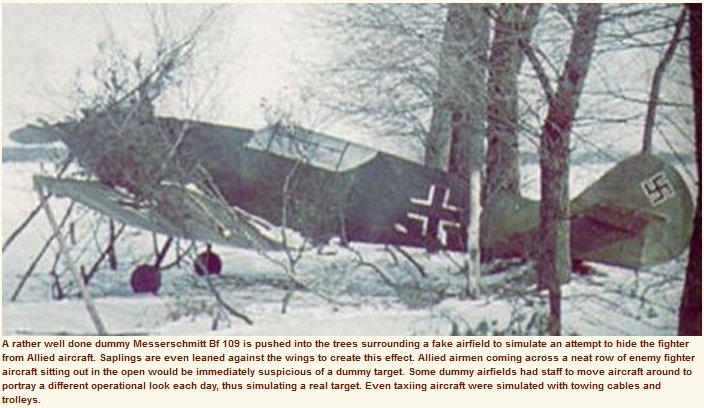
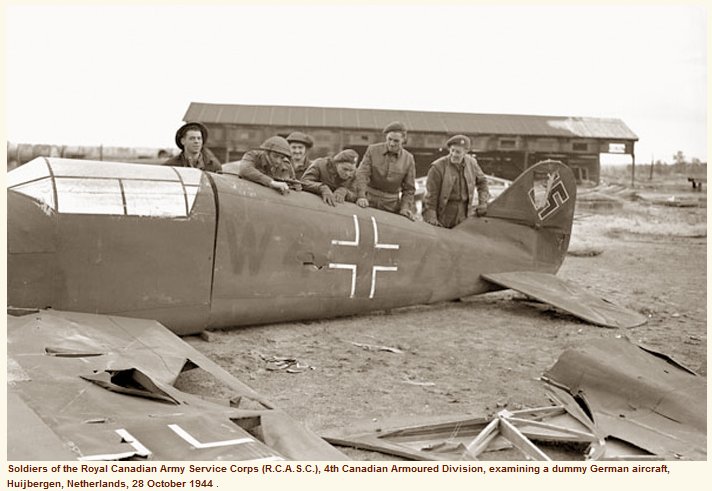
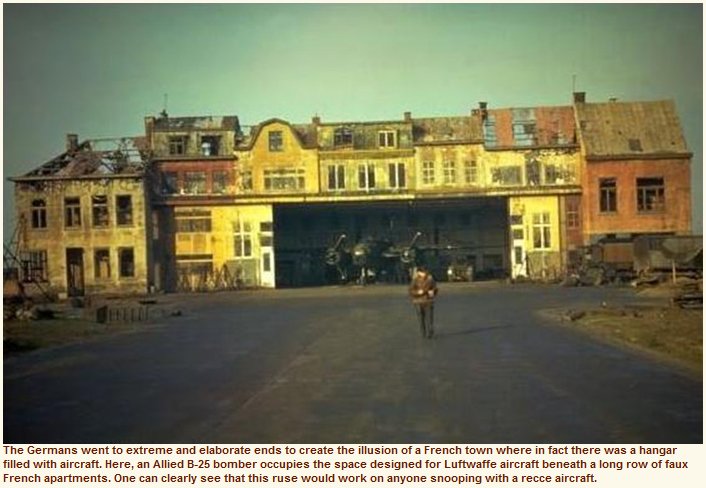
Deception in war reached a crescendo in the latter stages of World War 2, with the allies’ use of General George S. Patton’s imaginary First US Army Group (FUSAG) to pin German attention on the Pas de Calais for more than a month after the real D-Day landings in Normandy. In addition to direct propaganda and an extensive radio network generating fake messages to show the size of FUSAG, the allies also created entire dummy airfields and flotillas of fake landing craft to show up on German air recon photos. The fake planes, aircraft, and buildings were a key part of maintaining the fictitious threat of another, bigger invasion — which successfully kept a large German force away from the real landings.
Less well-known is that the Germans also indulged in this kind of deception:
In what could easily be the finest and boldest example of death-defying and cheeky nose-thumbing during the Second World War or any conflict for that matter, bomber and intruder crews of the Royal Air Force and USAAF are reputed to have bombed the Luftwaffe’s decoy airfields and dummy aircraft, not with high explosives or incendiaries, but with nothing more than dummy bombs made of wood, and painted with the smug remark “Wood for Wood”… all just to make a point.
Throughout all theatres of war, during the Second World War, from China to Holland to Kent, air forces, phsy-ops units and logistics people constructed dummy targets such as airfields, factories, truck parks, convoys and even ships, out of wood, canvas, burlap, or inflatable rubber. The decoy airfields were often populated with dummy aircraft and vehicles of such high quality, that even low flying recce aircraft with photographic equipment would have hard time telling the difference between the dummies and the real thing. The decoy airfields and dummy aircraft served several purposes simultaneously. They confused snooping enemy aircraft and hence planners as to the number of aircraft available to the opposing forces as well as to their displacement. They provided decoy targets for enemy bombers which, if attacked would prevent real aircraft from being destroyed. Often, these airfields were built near real airports in the path of attacking aircraft in the hopes that they would then drop their bombs and strafe the dummies, thereby saving the real aircraft.
H/T to Roger Henry for the original link.
September 20, 2012
Rewriting a crucial moment in WW2: 9th Canadian Infantry Brigade on D+1
If you’re interested in the Canadian part of the D-Day landings and the days that followed, you’ll probably want to visit the Canadian Military History site:
Marc Milner’s Chapter, “No Ambush, No Defeat: The Advance of the Vanguard of the 9th Canadian Infantry Brigade, 7 June 1944″ in Canada and the Second World War: Essays in Honour of Terry Copp rewrites the history of 9 Brigade on D-Day+1. The defeat of 9 Brigade has always been used a prime example of the flawed nature of Allied leadership and combat capability and proof of the superior fighting skill of German forces. Milner challenges this assessment, arguing “the vanguard of 9 Brigade fought an enemy at least three times its size to a standstill, and did so largely without the crucial component of Anglo-Canadian doctrine: artillery support … in the process 9 Brigade met and defeated a portion of the panzer forces that the 3rd Canadian Division had been tasked with destroying. So maybe 9 Brigade did all right on D+1 after all.”
The revised chapter to the book has been made available as a freely downloadable PDF.
June 6, 2012
Colour footage of the D-Day landings
Reposted from last year.
Update: Jonathan Kay on the forgotten casualties of the Slapton Sands exercise:
In the dead of night, just over 68 years ago, 30,000 Allied soldiers stationed in British ports filed onto amphibious landing craft, and put out to sea. The flotilla sailed toward its objective, and all went according to plan — until a German naval squadron patrolling the English Channel spotted the Allied force and opened fire. The defenseless landing craft began burning and sinking, sending more than 600 men to their deaths.
The surviving ships sailed on to their assigned landing zone, disgorging the soldiers onto the beach. There, the killing continued: More than 300 troops died in the sand, blasted to bits by incoming shells. All told, 946 men from among the original 30,000 died that day — a fatality rate of about 3%.
That figure was hardly unusual for major Second World War offensive operations. And yet, amazingly, the tragedy described in the paragraphs above wasn’t actually an offensive operation at all. It was Exercise Tiger, an American training mission that took place in April, 1944 — a full five weeks before D-Day.
The beach that the men landed on wasn’t in Nazi-occupied Europe, but Slapton Sands on the Devon coast. And the shells that rained down on the dunes were fired not from German artillery positions, but by guns on the British cruiser HMS Hawkins. As British historian Giles Milton notes, “the Supreme Allied Commander, General Eisenhower, had ordered that real ammunition be used, so that men would experience actual battlefield conditions. It was a disastrous decision.”
June 6, 2011
Colour footage of D-Day, 1944
H/T to Nick Gillespie for the link.


