Quotulatiousness

January 8, 2026

QotD: Canned food and the early days of the Raj

Consider the history of canned food. It has obvious military applications — Napoleon famously quipped that an army marches on its stomach, and as canning was largely invented in France, he made some effort to issue food to his troops (as opposed to local procurement and / or “living off the land”). He didn’t quite get there, but the resultant revolution in logistics was as important to the conduct of war, in its way, as just about anything else. If you don’t know how armies are provisioned, you’re likely to miss something when you talk about wars.

You might even miss something culturally. For instance, there’s an entire sub-subdiscipline called “Food and Foodways”, and it’s not as silly as it sounds. Canned food was an important part of British cultural life in the Raj, for instance. File it under “Women Ruin Everything” — once it got safe enough for ladies to have a reasonable chance of surviving East of Suez, the awesome freewheeling decadence of the “White Mughals” period was replaced by dour, dowdy Victorian bullshit. Every summer the “fishing fleet” pulled into Calcutta harbor, disembarking scads of ugly British girls with a Bible in one hand and a can of spotted dick in the other, determined to snag the highest-ranking ICS man they could and, in the process, turn India into another boring suburb of Edinburgh. Anglo-Indian cookbooks are full of recipes for horrid British glop straight out of cans, and if you routinely got really, really sick from eating spoiled stuff, well, hard cheese, old chap! Heaven forbid you eat the delicious, nutritious, climate-optimized cuisine that was literally right there …

If you want to argue that the Indian Army fought so many border wars just to get away from sour, hectoring memsahibs and their godawful tinned slop, I’m not going to stop you.

Anyway, the point is, IF you are conversant enough with the relevant technical stuff, it occurs to me that you can get a snapshot of embedded cultural assumptions by looking at a period’s characteristic or representative technology.

Severian, “Assumption Artifacts”, Founding Questions, 2024-04-30.

January 6, 2026

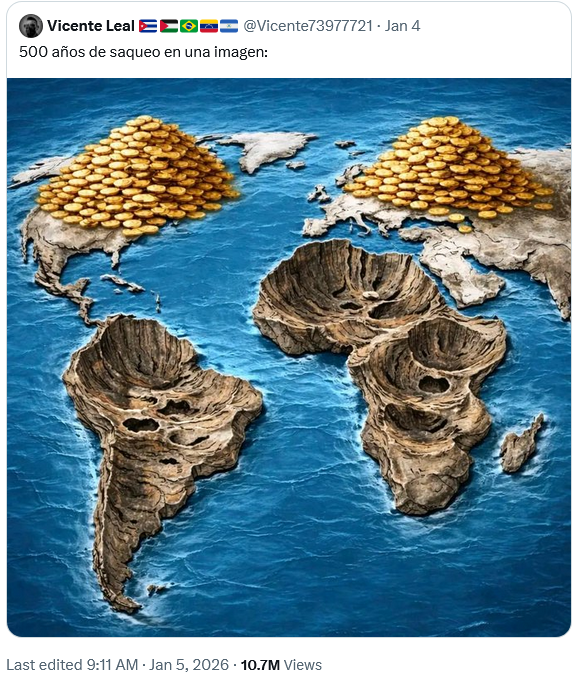
The “developing world” is not poor because the “rich countries” looted them

On the social media site formerly known as Twitter, Lauren Chen reacts to an emotive claim that the Third World is poor only because of the exploitation of their resources by the First World:

People often say that the developing world is poor because the Western world colonized them and stole their resources.

The truth, however, is that over the past century, the developing world has, for the most part, shown that they are completely incapable of harnessing their own resources. They are not poor because we stole from them. They are poor because they do not know how to run and administer their own countries, resources be damned.

Take Venezuela. The world’s largest oil reserves mean nothing if you have a corrupt communist as your leader. People will actually be starving and trying to eat zoo animals while you sit on trillions of dollars in resources!

Africa is another example. Europeans left behind farmland, trains, roads, and mines in Africa. What happened to it all?

It’s not that all of a sudden, the Africans started running things like anti-colonialist activists had envisioned at the time. No, no.

All the infrastructure fell into disrepair and/or was stripped down and looted. They were literally handed fully functioning, completed supply chains for resource extraction, and basically unlimited wealth, but they couldn’t manage the simple upkeep.

Now, the defense for Africa might be that “The Europeans didn’t teach the Africans how to manage any of this! It’s not the Africans’ fault they couldn’t run it independently! They were never trained!”

But my brother in Christ, the Europeans DID try to train locals for management! Obviously it would have been easier to have at least some locals in administration, rather than having to import an ENTIRE workforce, but efforts to find African talent were largely unsuccessful.

Don’t believe me? Just look at the different outcomes in Hong Kong and Singapore when compared to Africa. In East Asia, Europeans often did work with locals in administrative and management capacities. When colonialism ended, Hong Kong and Singapore were able to manage themselves. Not the case with Africa.

Now, none of this is to say that colonialism is good. People have the right to self-rule and self-determination. However, the idea that colonialism and resources extraction are responsible for the developing world’s ongoing poverty? That is quite simply a crock of shit.

January 5, 2026

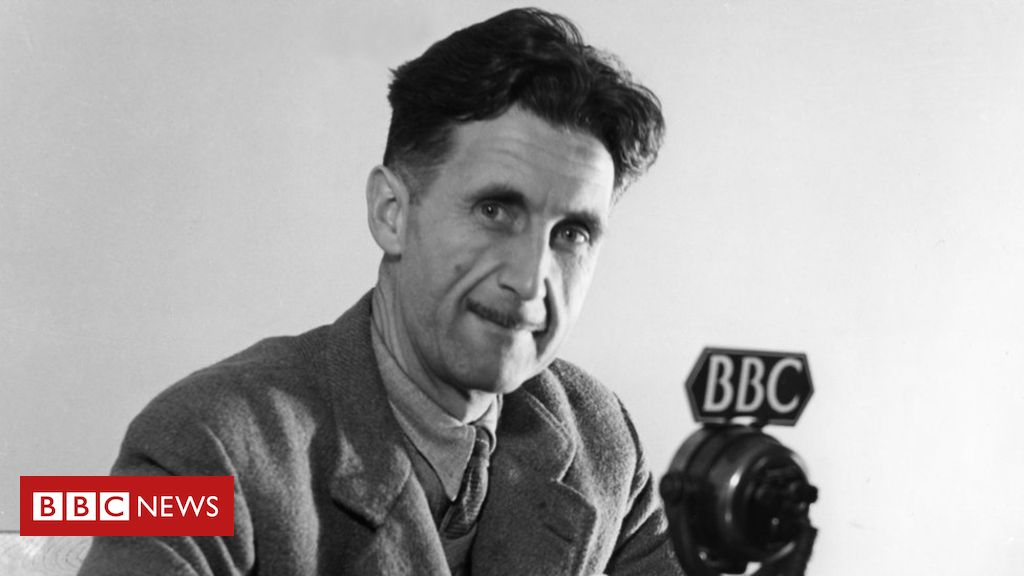
Friedman on Orwell

On his Substack, David Friedman considers some of the things that George Orwell was mistaken about in his non-fiction writings:

    It cannot be said too often – at any rate, it is not being said nearly often enough – that collectivism is not inherently democratic, but, on the contrary, gives to a tyrannical minority such powers as the Spanish Inquisitors never dreamed of. (George Orwell, The Observer, April 9, 1944)

George Orwell got some things right; unlike most political partisans, he saw the problems with the position he supported. He also got quite a lot of things wrong. The quote is from Orwell’s review of two books, The Road to Serfdom by Friedrich Hayek and The Mirror of the Past by K. Zilliacus, a left-wing writer and politician. The conclusion of the review is that Hayek is right about what is wrong with socialism, Zilliacus is right about what is wrong with capitalism, hence that “the combined effect of their books is a depressing one”.

But Zilliacus was wrong about capitalism, as was Orwell, who wrote:

    But he [Hayek] does not see, or will not admit, that a return to “free” competition means for the great mass of people a tyranny probably worse, because more irresponsible, than that of the State. The trouble with competitions is that somebody wins them. Professor Hayek denies that free capitalism necessarily leads to monopoly, but in practice that is where it has led, and since the vast majority of people would far rather have State regimentation than slumps and unemployment, the drift towards collectivism is bound to continue if popular opinion has any say in the matter. (“As I Please”, pp.117-119)1

The problem is that Orwell, like many of his contemporaries (and ours), did not understand economics and thought he did. Since he wrote we have had extensive experience with free competition, if not as free as Hayek would have wanted, and the result has not been the nightmare that Orwell expected. “The trouble with competitions is that somebody wins them” sounds right only if you don’t actually understand the logic of a competitive market. In most industries organizational diseconomies of scale, the effect of more layers between the head office and the factory floor, limit the size of the firm to something considerably below the size of the market for what the firm produces. In some fields, such as restaurants or barber shops, the result is an industry with thousands of firms, in some five or ten, in only the rare case of a natural monopoly can one large firm outcompete all of its smaller competitors.

The effect of free competition is not the only thing that Orwell got wrong. Consider his essay on Kipling.2 He gets some things right, realizes that Kipling is not a fascist, indeed less of one than most moderns, and recognizes his talent:

    During five literary generations every enlightened person has despised him, and at the end of that time nine-tenths of those enlightened persons are forgotten and Kipling is in some sense still there.

But he gets quite a lot wrong. In arguing that Kipling misunderstood the economics of imperialism, Orwell writes:

    He could not understand what was happening, because he had never had any grasp of the economic forces underlying imperial expansion. It is notable that Kipling does not seem to realize, any more than the average soldier or colonial administrator, that an empire is primarily a money-making concern.

In explaining his own view of the logic of empire, what he thought Kipling was missing, Orwell writes:

    We all live by robbing Asiatic coolies, and those of us who are “enlightened” all maintain that those coolies ought to be set free; but our standard of living, and hence our “enlightenment”, demands that the robbery shall continue.3

Britain let go of its empire, starting with India. British standards of living did not collapse; by the time all of the colonies were independent, the average real wage in the UK was 50% higher than when Orwell wrote. He could not know the future but he could observe that Switzerland, before the war, was richer than England, Denmark, with no significant colonies, almost as rich, Portugal, with an enormous African empire, much poorer. Whether Britain ran its empire at a net profit or a net loss is, I think, still an open question, but Orwell’s view of colonialism is strikingly inconsistent with the observed effects of decolonization.

Economics is not all that Orwell got wrong about Kipling; he badly underestimated the quality of Kipling’s work, due to having read very little of it. The clearest evidence is Orwell’s description of The Light that Failed as Kipling’s “solitary novel”. Kipling wrote three novels, of which that is by a good margin the worst. Orwell not only had not read Kim, Kipling’s one world class novel, he did not know it existed. In a recent post I listed eighteen works by Kipling that I liked. Orwell mentions only one of them.


  1. That free capitalism would ultimately fail was still Orwell’s view in 1947:
  2. In North America the masses are contented with capitalism, and one cannot tell what turn they will take when capitalism begins to collapse (“Toward European Unity“)

  3. Discussed in more detail in an earlier post.
  4. As late as 1947, Orwell wrote:
  5. The European peoples, and especially the British, have long owed their high standard of life to direct or indirect exploitation of the coloured peoples. (“Toward European Unity“)

January 2, 2026

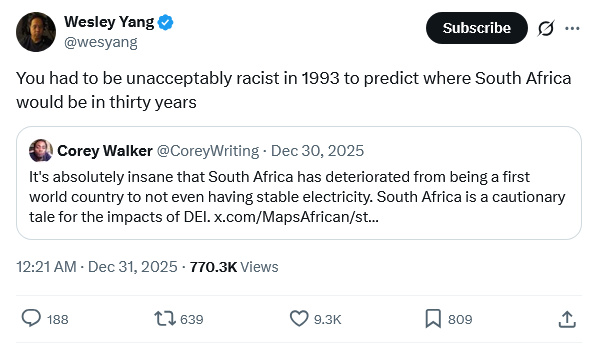
“You had to be unacceptably racist in 1993 to predict where South Africa would be in thirty years”

On the social media site formerly known as Twitter, Wesley Yang posted the comment in the headline. Will Tanner responded:

You did not, in fact. You just had to be paying attention

By 1993, South Africa was the only First World country left in Africa

America and the UN chased Belgium out of the Congo, and it collapsed into decades of civil war and famine

Mugabe destroyed Rhodesia after we aided the Soviets in helping him win. Angola and Mozambique became hells after Salazar died, the Carnation Revolution happened, and they were given up. Kenya and Sierre Leone all showed the hellish state of things that came with decolonization in the name of “democracy”

South Africa was the last man standing. It had a nuclear program. It had a space program. It had clean, reliable water and electricity. It had a thriving industrial sector. Crime was problematic, but not out of control

Now all of that was gone, for the same reason the Congo is a mess and Zimbabwe went from being the breadbasket of Africa to a famine-ridden mess: decolonization and equity

Anyone who paid attention could have predicted that. Maintaining First World life requires a First World mindset; that dies when handed over to race communists who are happy to backslide into the Stone Age if doing so means “equality” exists

And so South Africa went from First World to Third

And John Carter responded in turn:

When you stand back and look at this from ten thousand feet, a very dark pattern emerges.

In the aftermath of WWII, the newly established globalist institutions were used to give moral and financial support to decolonization movements, thereby chasing European countries out of what became the third world.

A governance structure that had successfully brought order, prosperity, and civilization to much of the planet was dismantled, leaving behind a chaotic mess of war and poverty.

Those same globalist organizations then embarked on a program of “foreign aid” that dramatically increased the size of that immiserated third world population (without actually improving conditions for them).

At the same time, their agents were busy at work within the governments of the former colonial powers, changing their immigration policies to allow immigration from more or less anywhere. Countries began adopting “multiculturalism” in the name of fighting “racism” … A newly developed postwar concept, which the media and education arms of the globalist project indoctrinated the youth to consider the worst of all possible sins.

Once the ideological and legal ground had been prepared in the former colonial powers, migration via legal and irregular pathways commenced, facilitated by — of course — the very same set of globalist NGOs that chased Europe out of the colonies.

Somehow, this new form of colonization is a good thing. Somehow, the European peoples enjoy none of the rights of “national self-determination” accorded to “indigenous” peoples which had been invoked to end colonialism.

As the populations of the third world were exploding thanks to the foreign aid being provided by globalist organizations, fertility in the first world fell off a cliff. The pill, abortion, feminism drawing women into universities and careers and therefore away from marriage and child-bearing, no-fault divorce destroying the family, and a gender war incited to new levels of bitter intensity every year which estranged the sexes, all served to reduce the white birth rate.

White fertility crashed just as the population bomb that had been set in the third world exploded, with the gates left open by carefully constructed legal frameworks that made immigration very easy and deportation very, very hard.

Update, 3 January: Welcome, Instapundit readers! Please do have a look around at some of my other posts you may find of interest. I send out a daily summary of posts here through my Substackhttps://substack.com/@nicholasrusson that you can subscribe to if you’d like to be informed of new posts in the future.

December 27, 2025

Campaign Furniture by Christopher Schwarz

Filed under: Books, Britain, History, India, Woodworking — Tags: , — Nicholas @ 10:30

I try not to clutter the blog with woodworking-related posts, as I know it’s a niche interest among my readership, but every now and again I find something I just have to share. Today, it’s a post from Lost Art Press on the book Campaign Furniture written by Christopher Schwarz:

My 2014 book Campaign Furniture is now a free pdf download for everyone. You can download it via this link (a compressed version for slower connections is available here). And customers will always be able to download it from the book’s page in our store.

I’m a fan of the book … I ended up buying two copies through Lee Valley Tools (I loaned my first copy out and it got lost in the shipwreck of a friend’s messy divorce). I like Chris’s writing style and I’ve long been a fan of Campaign furniture.

Why Do I Do This?

I get asked by fellow publishers why I offer my books for free download. “Surely you use it to gather emails to market to readers.” Nope. “Are these out-of-print books that you are using to get eyeballs on your website?” Nope. “So what’s the strategy?”

I think – as much as possible – that information should be free. I think the best hope for inspiring other woodworkers is to give them whatever they need to begin in the craft.

And, I fu&%ing hate this world we’ve created where people can’t own anything. Companies come into your house and your phone and change things or take away stuff you’ve bought. Many times they take back stuff you owned then rent it back to you.

That’s why we make books. Buy a book from us, and it’s yours. Its contents can’t be changed by some ideologue a thousand miles away. All of our digital products are free of DRM (digital rights management). That means they can’t be locked or disabled. And you can copy them onto whatever device you like.

OK, the holiday rant is over.

I hope you find something of interest in Campaign Furniture. We still use three of the pieces from the book every day in our home. Other pieces are with my kids. So my family’s love of this neglected furniture style continues.

December 17, 2025

“The ‘liberal international order’ – a technocratic oligarchy sustained by tightly interlocked institutions”

Last week, Len D. Pozeram wrote about how the real (but mostly unacknowledged) American empire is facing unprecedented challenges and may indeed be in serious decline:

“The Empire’s Mask is Slipping”, The Libertarian Alliance

For generations, Americans were sold a saccharine myth: that our nation’s vast global presence — its military bases on every continent, its endless wars, its economic interventions — was all done in the name of “freedom” and “human rights”. This was the sales pitch. Washington, we were told, was the benevolent policeman of a dangerous world, upholding a Pax Americana designed to uplift humanity.

But for those willing to look beyond the rhetoric, the truth was never hidden — only ignored. This narrative was never more than a sophisticated marketing campaign, engineered to pacify a domestic public and legitimize imperial conquest abroad. From the very beginning, the post-WWII global order was not about freedom, but about power — and who would control it after the collapse of the old European empires.

With the fall of the British Empire, America did not merely “step up” to defend the West — it seized control of the imperial machinery and rebranded it. The British financial aristocracy gave way to a new though related American elite, its nucleus formed around Wall Street banks, the military-industrial complex, Big Oil cartels, and, increasingly, a rising Zionist lobby with ambitions stretching far beyond Tel Aviv.

Under the guise of “containing communism” or “defending democracy”, this new managerial class waged a quiet war against genuine national independence movements across the globe. Countries seeking to control their own resources, chart their own destinies, or resist Western financial domination were systematically targeted for destabilization or outright annihilation.

Guatemala in 1954. Iran in 1953. Indonesia in 1965. The Congo. Chile. Nicaragua. Greece. Even Australia, whose 1975 constitutional crisis remains a textbook case of covert Anglo-American regime change. The public, of course, was kept in the dark. History books were rewritten. Journalists who strayed from the script were destroyed or silenced. CIA fingerprints are now visible in dozens of these cases — operations sanctioned not to spread freedom, but to preserve a system of elite extraction and control.

This system — often referred to in polite company as the “liberal international order” — is, in fact, a technocratic oligarchy. It is sustained by tightly interlocked institutions: the Federal Reserve, the IMF, the World Bank, NATO, and a sprawling Intelligence Community whose true loyalties lie not with the American public, but with transnational networks of finance, energy, and geopolitical strategy. To the extent that ideology plays a role, it is the convergence of evangelical apocalypticism and messianic Zionism — two religious currents that have dangerously informed U.S. foreign policy since the Reagan era.

Yet today, this system is beginning to eat itself. The ideology of endless war, and top-down control has run up against hard limits: financial, and political. The de-dollarization trend in the Global South, the rise of multipolar alliances like BRICS, and the exposure of elite criminality — from Epstein to the endless intelligence scandals — are all symptoms of imperial overstretch and rot.

We are watching the slow collapse of an empire built not on democratic values but on lies, coercion, and institutionalized greed.

From a slightly different viewpoint, Spaceman Spiff maintains that the narratives that have been used to direct and control political thought in the west are in the process of collapsing:

Image from Postcards from the Abyss

As reality intrudes the naivety behind many sacred cows is exposed. The emperor is naked and his supporters look equally naked. The narratives driving their fantasies are failing.

The big three issues common in the West illustrate why people are noticing.

Diversity and immigration

The promotion of diversity as a strength is a consequence of blank slate thinking, a belief disparate populations are substantially the same with most observable differences due to environment only.

This is at odds with what we observe, the significant range in ability and proficiency between distinct groups that becomes apparent when we interact. So artificial variety is sold as a positive in an attempt to downplay the homogeneity that gets better results.

The consequence of this is quotas, where arbitrary rules are enforced to ensure a diverse outcome.

This destroys competency even if we ignore the potential for conflict when foreigners are imported in large numbers.

The main effect of pushing this absurd policy seems to be the rise of ethnic awareness among those who must step aside to accommodate it. How could it not? When people are excluded because of their ethnicity it becomes important to them.

This is not what advocates of diversity intended but is already happening.

Climate

Climate and energy policy is based on anti-scientific magical thinking. With the current emphasis on carbon dioxide we are told a tiny portion of our atmosphere is responsible for most of the future changes that will cause widespread harm. There is no evidence for such claims.

The reality of climate is different from the narrative. It is resilient, as many things are. Our obsession is arrogance. A belief we matter more than we do.

Intellectuals are prone to get lost in their theories of how the world ought to work. Activists then latch on to their utopian ideas to gain some sense of meaning in their lives.

Society also has people lacking conscience who will profit from anything no matter how much damage it causes. Combining these two, dreamers with schemers, is often lethal. Seemingly opposing forces, left-wing activists and capitalist profiteers, can cooperate even if they embrace distinct beliefs.

As many memes remind us, if you have corporate sponsorship you are not the resistance. This is precisely what we see.

Narratives begin to collapse as we witness ruthless corporations promote feelgood nonsense about climate while fleecing taxpayers in the background. Many are noticing.

And the effects of suicidal climate goals are difficult to hide. Every closed factory or power station kills another element of credibility.

Socialism

Socialism is based on the idea an educated elite can make decisions for us all while simultaneously conditioning us to be better versions of ourselves. It ignores all of history and everything we have learned of human psychology to embrace a literal fantasy utopia that no one has even come close to realizing.

Nothing sums up the bankruptcy of our intellectuals more than their inability to reject this failed ideology.

But it also shows us the Anglo-Saxon instinct to restrict others’ control over us is the only way to counter it.

It teaches us of the wisdom of documents like Magna Carta or the Bill of Rights, designed to constrain the powerful regardless of their motives, ambitions or mental state. Rare moments of historical sanity that remind us what effective countermeasures can look like.

It would seem this lesson must be relearned every few generations. But we are learning it. Real life is reminding us why we must limit government and its agents no matter how inconvenient.

Bad ideas are inevitable. It is the ability of activists and the powerful to enact them many are now waking up to as narratives visibly fail.

December 13, 2025

QotD: Victorian mores, homosexuality, and the Empire

Filed under: Britain, History, India, Quotations — Tags: , , , , — Nicholas @ 01:00

The public school phenomenon, which probably isn’t a euphemism but we’ll use it as one. You know, the whole “beatings and buggery” thing, and I’m going to stop now, because of course you know what I mean. Lots of Old Boys from all tiers of the public school system really did go out to run the Empire because they wanted to escape Victorian women, who were indeed as bad as that in a lot of cases (again, think “Karen on steroids”). But how much of that “to escape women” thing was because the women were awful, and how much of it was because the Old Boys were not-very-repressed homos?

This is where modern identity politics really messes up historical analysis. We probably all know that the vast majority of Victorian homosexuals were married, because the vast majority of Victorians were married. This isn’t my professional field, but because I went to grad school I’m pretty well up on it – the ivory tower finds Victorian poofters endlessly fascinating, because they are huge homo cheerleaders (obviously), but also because of the costumes.

Women and gay men love playing dress up — have you noticed? — and Victorian dress up is the best, because it’s a) expensive, and b) time consuming, but also c) flattering to just about any body type. It was socially acceptable among the upper classes to be porky (and nobody dresses up like a chimney sweep or factory hand), so both men’s and women’s fashion in the Late Victorian era can accommodate modern bodies. (Unlike the early Victorian era, which continued Regency fashion. They’d love to dress up Regency style — there’s a reason “Regency romance” is the most popular genre of light porno books for cat ladies — but it takes a specific physical type to pull off, and they don’t have it). […]

Anyway, where was I? Oh yeah — lots of people in grad school really, really into Victorian queers, so if I seem extremely well informed on this topic, don’t read too much into it.

“Repressed homosexual” was redundant back then. Oscar Wilde, for instance, was sort of the ur-homo — he was so gay, just gazing too long at a picture of him at his dandiest could give you an uncomfortably strong urge to touch a penis. […] Oscar Wilde was also married, and had two children, because that’s how even the queerest of the queer rolled in Victorian London.

Given that, you’d expect one of two things to happen to public schoolboys once they got out into the bush. Either they’d totally let their freak flag fly — you know, given that everyone else in their social world was an equally repressed public schoolboy — or they’d bottle it up even further, because it was important to show nothing but the best image of Her Majesty’s servants to the wogs at all times.

As far as I know, the latter was almost universally the case. Before the opening of the Suez Canal (1869), you could have a nonstop bacchanalia over there … if you were straight. Those guys could, and did, rock the casbah with extreme prejudice. It started tapering off early in Victoria’s reign, but in the late 1700s you had British army officers converting to Islam (no, really) for the express purpose of getting even more tail, by marrying the Koranically sanctioned four wives (sometimes with all the age of consent queasiness that implies).

The repressed homos, on the other hand, got really into scholarship. It’s not generally known (because even then the vast majority of their works were of interest only to micro-specialists) but Anglo-Indians were insanely productive scholars, on every conceivable topic. You could fill a decent sized library with their five-, seven-, nine-volume works on Sanskrit philology, and the botany of the lower Himalayas, or the migratory habits of tigers, or pretty much anything. And if they weren’t the scholarly sort, the repressed homos simply threw themselves into their work, of which there was always an endless supply — take a look at a map of India, recall that there were at most 200,000 Britons in the whole place, and you’ll see what I mean.

So: Were they going out there to get away from Victorian women? Absolutely. Were they therefore going to turn the place into Studio 54? Absolutely not.

Severian, “Ruling Caste II”, Founding Questions, 2022-03-10.

December 7, 2025

“Anglofuturism” – slogan or beacon of hope?

At Without Diminishment, Robert King argues for Anglofuturism as the most hopeful path forward from the morass all of the Anglosphere seems to be bogged down in:

(From the Ministry of Space, created by Warren Ellis, 2004.)

Born in the digital backwaters of podcasts and Substacks, Anglofuturism has climbed into public view like a rocket nearing the King Charles III Space Station, gathering both attention and indignation as it ascends.

The New Statesman mutters about it being rooted in “nostalgia“, while the far-left activist group Hope Not Hate insists it is something deeply sinister. Yet their agitation merely confirms a familiar sequence. First, they ignore you, then they laugh at you, then they fight you, and then you win.

At its essence, Anglofuturism is a project of civilisational renewal.

It begins with the conviction that Britain’s decline is not destiny but a decision, and the consequence of decades of political miscalculations that consider the national story to be over, Britain’s very own “end of history”.

Just turn on the news and you will see evidence for this everywhere. Strategic islands like the Chagos Islands surrendered to the vassals of hostile powers. A once-thriving energy sector crippled by the ritual self-flagellation of net zero policies, despite abundant North Sea oil resources.

The capital city of London, once envied for its composure, now deafened by the shrill chants of imported grievances, “From the river to the sea”. Britain was once a country whose streets were said to be paved with gold, according to the legend of Dick Whittington.

Today, they are paved with boarded banks, betting slips, and vape shops. The country’s future is already playing out in London, a place where the nation of Britain has faded into the idea of “the Yookay”. Britain is told that because it once colonised, it must now invite colonisation, that because it once conquered, it must now submit.

The result is a people bending ever lower in the hope of forgiveness from a self-appointed virtuous minority at home, and from the ever-growing numbers of strangers who now claim the country as their own.

Anglofuturism is the vanguard against this ideology. It insists that love of one’s civilisation is a duty, not a sin. It binds identity to optimism, and pride to ambition. It seeks to remind Britons that its best days may yet lie ahead, but only if it learns once more to have confidence in itself.

[…]

The policy of splendid isolation simply will not work for the twenty-first century.

Enter CANZUK, the proposed alliance of Canada, Australia, New Zealand, and the United Kingdom. Four constitutional monarchies, four democracies, and four maritime powers linked by law, language, and lineage. Together they would represent over 140 million people and a combined GDP exceeding $6 trillion. It would be a realm on which, once again, the sun would never set.

Our shared day of remembrance on November 11 is a reminder that we partake in traditions born of shared sacrifice.

Such a bloc would not be a re-creation of empire, but a confederation of equals who share the responsibilities of defence and trade, coordinating space and science, and projecting stability from north to south and east to west.

It could stand apart from American turbulence, Chinese authoritarianism, and European stagnation, and be a new civilisational pole rooted in innovation and freedom under common law. It could even be a new contender to lead the free world.

Britain is still a nation successful at exporting ideas like capitalism, liberalism, and, regrettably, Blairism. Anglofuturism could be its most powerful export to the Anglosphere yet.

For those of us at the edge of that world, in Cape Town, Perth, or Vancouver, the message of Anglofuturism is that our story is not over. Our civilisation may be weak, even fading, but it can be revived. Doing this will demand the same courage that built it, in the spirit of the pioneers and soldiers, the engineers and thinkers who shaped continents and defended freedom when it was under siege.

Like this, but better.

November 24, 2025

Algeria: France’s War It Refused to Name – W2W 054

Filed under: Africa, France, History, Military — Tags: , , , , , , — Nicholas @ 04:00

TimeGhost History
Published 23 Nov 2025

This episode tracks how the doctrine “Algeria is France” — departments, settler power, and forced assimilation — breeds dispossession, mass violence, and a new Algerian nationalism: from conquest and the Sétif massacres to the FLN’s launch in 1954 and Philippeville in 1955. As Paris doubles its forces and passes Special Powers, Suez intertwines with the war, bombings in Algiers begin, and Lacoste hands police powers to General Massu — opening the Battle of Algiers and a system of torture.
(more…)

November 23, 2025

Battle for the Mediterranean, 1940

Real Time History
Published 4 Jul 2025

In the summer of 1940, the British Empire faces German attacks against the home islands a new Italian adversary in the Mediterranean Sea, the lifeline to its colonies around the globe. In a series of campaigns the British beat back the Italians and eliminate parts of the French fleet. But the service of its overseas subjects won’t come for free.
(more…)

November 22, 2025

“Whig history”

Filed under: Books, Britain, History — Tags: , , , , — Nicholas @ 05:00

If you’ve read any history books written before the Second World War (aside from explitly Marxist interpretations), you’ll probably recognize the worldview which, subtly or overtly, informed the stories being told (and those not mentioned). On her Substack, Mary Catelli discusses “the Whig interpretation of history”:

Among the many perils of viewpoint that lurk in your path when you read history, one of the nastiest is the Whig Interpretation of History, and its variants, and other teleological views.

The original interpretation, popular in British history writing of the 19th century, was that all of history had been aiming for the wonderfully wonderful wonder that was 19th century Britain. And if it was not quite so smooth as a train ride gliding over well-laid tracks, it was unnecessary to point out minor details.

The most disastrous effect, for the reader, is that the things of the past are described for their presumed effect on the progress toward that aim. They were not described for their actual effect on the era, or how they appeared to the people of that era (possibly more important for the fiction writer), which is what a reader using them for that era needs. Down to and including excluding vital details as unimportant.

(Obviously, “development of what they regard as progress” books are more or less resistant to this, though they can press some very odd things into the service of their thesis, and sandpaper off quite a bit of things they deem anomalies. It is when it colors works about something else — or nominally about something else — that the peril really arises.)

Plus of course any coloring the viewpoint gives them in regarding the people of the era as stepping stones toward the ideal future. In particular, the heroes and villains are assigned not for the moral character of their deeds but whether they sped history along the right path. Frequently enough, any openly and clearly stated motives by the historical figures will be breezed over for the “real” motives according to the historian’s agenda. Some quote the primary source and not even apparently noticing that it contradicts the agenda before writing as if the historical figures’ intentions matched the agenda.

H. G. Wells, in The Outline of History, gets all starry-eyed about any attempt, or success, at union between countries because he’s looking forward to the beneficent World State, regardless of how the union was imposed, and what its consequences were, and again looking with a jaundiced eye on any division regardless of how justified.

It would be easier if the issue were limited to the historians of that school, but, of course, anyone who regards history in light of a progress toward the wonderful present — or future — will have the same issues. World War I hit the original Whig interpretation quite hard, but the Marxist interpretation kept roaring along, and is not quite dead yet.

November 21, 2025

The EU (with NATO) as a substitute empire

Filed under: Europe, Government, History, Military, USA — Tags: , , , , — Nicholas @ 04:00

On his Substack, Lorenzo Warby discusses the European Union (and its essential military support, NATO) as an imperial subsitute in a post-imperial age:

Historian Timothy Snyder makes an argument in various lectures and on his Substack that what became the EU was a replacement for empire. I think he is right, but not in the way he suggests. Prof. Snyder holds that what became the EU is an economic replacement because he appears to believe that empire was economically beneficial to their metropole economies.

This seems clearly wrong. Every maritime imperial metropole got richer after it lost its empire. This is true whether they were part of what became the EU or not: the obvious example of the latter being Japan and its dramatic postwar economic success after being stripped of its empire and devastated by American bombing. For the economies of all the former maritime-empire states, access to the US market, and the US-led maritime order, was much more valuable, and way cheaper, than empire.

It is not clear that even Britain made a “profit” from its Empire, once you consider military and administrative costs. Portugal had the largest maritime empire — relative to the size of its metropole — for longest and is the poorest country in Western Europe. Compare that to rather wealthier land-locked Switzerland, which never had an empire.

Empires are what states do.1 It is foolish to presume that any particular state action is beneficial to those that a state rules. Having an empire increases the power of state, and the opportunities within the state apparat. That is more than enough to motivate territorial imperialism, whether by land or by sea.

Conspicuous absences

A conspicuous absence from Prof. Snyder’s analysis of what-became-the-EU is NATO. There are a lot of regional economic cooperation organisations around the word. None of them are remotely as integrated as the EU because none of them have the equivalent of NATO.

In order to pool sovereignty within the EU, states first have to have their territorial sovereignty guaranteed. This guarantee is precisely what NATO provides.

The post-Versailles European order of 1919-1939 was unstable because it interspersed between Germany and the Soviet Union a series of small states that the victors of 1914-1918 could not readily reach. NATO has two huge advantages that the nation-states of Eastern Europe did not have in the 1919-1939 period — NATO is a geographically contiguous alliance and it includes the United States. The purpose of NATO, in the famous words of its first Secretary-General, being:

    to keep the Soviet Union out, the Americans in, and the Germans down.

In other words, the purpose of NATO was to provide a comprehensive solution to the structural weakness of the 1919-1939 Versailles order. A solution that the countries of Eastern Europe availed themselves of as soon as they could.2

The other conspicuous absence from Prof. Snyder’s analysis of the EU as a substitute to empire is Oceania. His analysis is deeply “(North) Atlantic”. It looks much less impressive from a Pacific perspective.

Japan was a maritime empire which lost the Second World War. It did not join anything like the EU. Australia gave up its (small) maritime empire. It also did not join anything like the EU. Both are very much postwar economic success stories. Participating in the maritime order with good internal institutional structures was enough: no other substitute for empire was needed for economic success.


  1. The Conquistadors were a mixture of private adventurers and state agents, but their conquests were incorporated by the imperial Spanish state. The use of corporations as instruments of imperial expansion — most famously the Dutch and British East India Companies — was an unusual feature of European imperialism, but such companies were licensed by their state and their territorial holdings were eventually fully incorporated as state possessions.
  2. For all sorts of reasons, we should distinguish between the postwar order of 1945-1991 and the post Cold War order of after 1991. So much of contemporary madness only really got underway in the 1990s.

November 8, 2025

History Summarized: Greece… TWO (it’s in Italy)

Overly Sarcastic Productions
Published 4 Jul 2025

From the Olympians who brought you “Greece” and “The Other Side of Greece” comes the bold, innovative, and way shinier “GREECE TWO”.

SOURCES & Further Reading:
The Greeks: A Global History by Roderick Beaton
Ancient Greece: The Definitive Visual History produced by DK & Smithsonian
The Complete Greek Temples by Tony Spawforth
Ancient Cities Brought To Life by Jean-Claude Golvin
“From Sicily to Syria – The Growth of Trade and Colonization” from Ancient Greek Civilization by Jeremy McInerney
“Magna Graecia: Taras and Syracuse” and “Cyrene, Leptis Magna, and Ancient Libya” from Great Tours: Ancient Cities of the Mediterranean by Darius Arya
Sicily: An Island at the Crossroads of History by John Julius Norwich
“The Greeks: An Illustrated History” by Diane Harris Cline for National Geographic

October 19, 2025

QotD: The Indian Civil Service

Filed under: Books, Britain, Bureaucracy, Education, History, India, Quotations — Tags: , , , , — Nicholas @ 01:00

There’s actually a great book called The Ruling Caste. It’s a “collective biography”, for lack of a better term, of the Indian Civil Service (ICS), by Sir David Gilmour. You can of course find biographies of the individual Governors-General (Gilmour wrote one, also excellent, on Lord Curzon), but this is the only study I know of the lower levels — i.e. the guys who really ran the Raj. Gilmour is literally a gentleman amateur, so while he’s also an excellent historian (and The Ruling Caste conforms to all the canons of scholarship), he tells an engaging story, too.

I think about The Ruling Caste often when I think about the turds in the Apparat. Looked at from the outside, the ICS were apparatchiks, too. Indeed, even more so than actual apparatchiks, since “apparatchik” means something like “expert without portfolio” and while the ICS had two broad “tracks” (if I recall correctly), “civil” and “legal”, in practice most every ICS man was supposed to be able to do pretty much everything, including (again IIRC) assume military command of local forces if necessary.

Given that there were never more than 200K Britons in the Raj at any one time, how could it be otherwise?

And the ICS was as fully ideologized as the Soviet (or AINO) Apparat. The French gave us the lovely phrase mission civilisatrice, but that’s what the ICS was doing, too. Lord Macauley was the big mover behind the English Education Act of 1835, which explicitly designed to

    form a class who may be interpreters between us and the millions whom we govern – a class of persons Indian in blood and colour, but English in tastes, in opinions, in morals and in intellect. To that class we may leave it to refine the vernacular dialects of the country, to enrich those dialects with terms of science borrowed from the Western nomenclature, and to render them by degrees fit vehicles for conveying knowledge to the great mass of the population.

There were two huge differences between the ICS and the Apparat, though, that really come out reading Gilmour’s book. First, and actually least important, was the obvious fact that English education was superior. Macauley really gave “native” literature both barrels — nobody condescends like an Englishman — but he wasn’t wrong. In 1835 you could take the “scientific” literature of every other race on the planet combined and get … the Iron Age? Maybe? 200K Britons could dominate 750 million Indians because

    whatever happens, we have got
    the Maxim gun, and they have not.

Or “steam power” or “replaceable parts” or “calculus” or what have you. Season to taste.

The second — and far, far more important — difference between the ICS and the Apparat, though, was that the ICS was in general composed of decent people. In a very real sense, all imperialism is “cultural imperialism”. Rome became an empire by whomping all its enemies, but it stayed an empire by giving its enemies a great deal. Life was simply better — orders of magnitude better — inside the Empire than outside.

And the reason for this is simple, so simple that you need many years of long and hideously expensive training, by highly skilled and fanatically motivated indoctrinators, to miss it. Macauley, Caesar, Confucius, anyone who wrote anything on barbarian management at any point, anywhere in the world, well into the 20th century, said basically the same thing: Our material culture is the result of our cultural culture.

You can learn to operate our stuff. Obviously so — with only 200K Britons throughout the Subcontinent, the Raj was quite obviously run by Indians. And they did a bang-up job, too, such that India at independence had the real potential to become a first world country (note to folks getting ready to break away from a globe-spanning empire: Never elect a lunatic socialist yoga dude as your first prime minister. He’ll go full retard and set you back 50 years … and he’ll be shooting for 500). You might even learn how to maintain our stuff, maybe even build a few cheap knockoff copies of our stuff.

But it’ll never be more than that — shitty knockoff copies, gruesomely expensive, and available only to the elite — unless you embrace as much of the culture that created the stuff as you can stand. The English themselves are a great example: They were blue-assed savages when Caesar found them, but they got with the program, and look how well that worked out. Ditto the Gauls (“Our ancestors, the Gauls!”) and all the rest.

It’s the culture, stupids. The culture of the ICS was English culture — “play up, play up, and play the game!” sounds like baloney to jaded Postmodern ears, but listen:

    The sand of the desert is sodden red,—
    Red with the wreck of a square that broke; —
    The Gatling’s jammed and the Colonel dead,
    And the regiment blind with dust and smoke.
    The river of death has brimmed his banks,
    And England’s far, and Honour a name,
    But the voice of a schoolboy rallies the ranks:
    “Play up! play up! and play the game!”

As poetry it’s shit, but if that doesn’t make you want to get up out of your chair and take a swing at somebody, then you, sir, have no hair on your scrotum, and will never know a woman’s touch (trannies don’t count).

They really believed that, those Eton schoolboys out there East of Suez. Or, at least, they behaved as if they did, and everything else flowed from that behavior. Recall that it was a coin flip, going East of Suez — chances are you wouldn’t be coming back, or if you did, it would be as a malarial ruin. But they went anyway, though England’s far and Honour a name, because that’s just what they did. Even at their worst — and their worst was very bad; Gilmour pulls no punches — you can’t help but admire them a little, the arrogant bastards. Their convictions were sometimes awful, but they had the courage of them … and courage is magnificent.

Severian, “Ruling Caste II”, Founding Questions, 2022-03-10.

October 4, 2025

The “nation of shopkeepers” is now the nation of problematic “Centrist Dads”

Filed under: Books, Britain, Germany, History, Military, WW2 — Tags: , , — Nicholas @ 03:00

Dr. Robert Lyman on the common misunderstanding of the nature of war and even their own imperial history among British voters:

I’ve been involved with the practice and study of war for the past 44-years. I have five degrees in history and the study and practice of war, and I have written 19 books on the subject and have contributed to the writing of 10 more, with 3 more of my own in train. The net result of this, observing international events and Britain’s response to them over recent times, is to conclude that Britain – and Britons – have a problem about war. The problem is that at a very fundamental or essential level we simply don’t understand it. I see eyebrows rising everywhere at this assertion, protests arising in the usual places to suggest that if we don’t understand war, how on earth did we create an empire? Worrying swathes of academia and our impressionable young – I know, I’ve taught them – believe that Britain is and has been a nation of rapacious warlords that conquered a major part of the world by the use of violence and disrespect for others. We don’t have time to refute that silly nonsense here, apart from observing that the primary nature of the British Empire wasn’t one that was secured or maintained by violence.

But, to the subject at hand. A product of long decades readying, studying, teaching and writing about war has led me to the conclusion that as a nation, both politically and culturally, we are too squeamish about the practice of war to be any good at either preventing it, or preparing for it. Put simply, our problem is that we are just too nice. Centrist Dads spend their entire lives seeking compromise, and worrying when a middle way cannot be found. It is only when, deep into a war we hoped wouldn’t wash up against our shores, that we come to the shocking realisation that people are trying to destroy us and as a result we find ourselves forced into the process of trying to master the business of organizing violence on a massive scale, and unleashing it as effectively as we can against our enemies. We always seem to be playing catch up, because we haven’t prepared adequately in the first place for the inevitability of war in a fractious world.

[…] Kit Kowol’s superb (and recent) Blue Jerusalem describes in embarrassing detail the ignorance evinced by politicians and military thinkers in the 1930s who hoped to avoid the sharp end of war by buying only bombers, or ships, or of relying on persuading the enemy population to coerce their leaders into ending a war they had themselves started. Perhaps if we dropped leaflets on Herr Hitler he would see the error of his ways, and end all this silliness? Very few people in Britain on the eve of the Second World War could bring themselves to comprehend the extent of the fascist animus either for democracy in general, or the Jews in particular, both seen by the Nazis as preventing the creation of a Grosse Deutschland and allowing Germany to regain her status as primus inter pares in continental Europe. It was only as Belsen was liberated nearly six-years later that the penny seemed to drop in the befuddled British mind that these people were bad, really bad, after all. It is one of the accepted reasons for the Allied failure to destroy the railways feeding Auschwitz: decision-makers in London or New York never truly comprehended the scale of the slaughter then underway across Occupied Europe.

This is where are again. Evidence for the worryingly widespread intellectual softness that dominated political thinking through the 1930s, which I would describe as a Centrist Dad problem, is everywhere. At an event last year with General Lord Dannatt where he gave what I considered to be a pretty straight forward talk on the security threats facing the UK, and what we should do about them, I overheard a comfortable middle class couple at the end complaining that he was being “too pessimistic”. They couldn’t see any cause for alarm. I was almost too shocked to reply. These are the sort of people who cannot quite understand why Hamas and Israel don’t just kiss and make up. It must therefore be Israel’s fault that there is no two-state solution in the Middle East. I read this sort of commentary every day in the broad sheets. It is particularly well expressed by the weekly output of two well-known podcast blatherers, archetypical Centrist Dads, one a retired politician – you know the two I mean – who consistently demonstrate that they have a fragile grasp on the animus that is generated in the hearts of those who despise us, no real understanding of the security steps we need to take to prevent it, nor of the kind of war required to eliminate such threats.

The starting point of these blatherers is what the journalist Jake Wallis Simon and the security commentator Andrew Fox describe as the “Wykehamist proposition”, which is that we should treat all people, hostile or otherwise, on the basis of our own benign ideological predilections. Accordingly, if we want to prevent someone attempting to kill us, regardless of the enemy’s motives, all we need to do is to sit round a table together, assume we all want the same positive outcomes from our conversation, and proceed amicably to resolve our differences. The sad reality is that this is not how the world works, nor is it how humans behave. If they have been to taught from childhood to despise you and everything about you, to the extent that they want to kill you – as Hamas and its ilk see Jews – no amount of so-called Wykehamism is going to persuade them to do otherwise. I suggest that the opposite approach is required. We need to treat threats to ourselves and our friends seriously, both in political and in military terms, and prepare accordingly. As General Lord Dannatt and I suggest in our book, stern, decisive military active to prevent Herr Hitler from remilitarising the Rhineland may well have prevented the entire Second World War from breaking out at all. To understand how to deal with war and threats of war, we need a political class that understands the scale of the threat we face and is prepared to undertake decisive action to nip hostility in the bud when it might occur. If we can resolve our differences amicably then of course we must always do so. But where an enemy does not want to play this game we must be determined to use force – and if necessary extreme violence – to protect our interests, and our people. This might involve dropping leaflets over the Ruhr but it might also entail dropping incendiaries on Berlin. In other words, to defend ourselves as a country, we must have the capability and the willingness to exercise the full-throated management of violence. We must also accept that it is the legitimate function of other democracies – like Israel – to do the same.

« Newer PostsOlder Posts »

Powered by WordPress