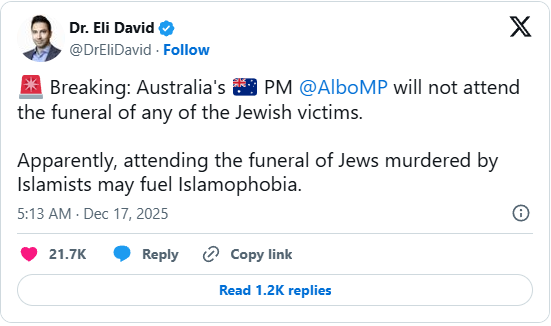
In the National Post, Brendan O’Neill criticizes Australian Prime Minister Anthony Albanese in particular, but he’s just the most recent exemplar of western politicians trying to blame society in general and “right wing extremists” in particular for the terrorist attacks by Islamic extremists:
Australian Prime Minister Anthony Albanese spoke a total of 5,022 words in the day after the slaughter of Jews at Bondi Beach. And not one of those words was “Islam”. Or “Muslim”. Or even “Islamic extremism”.
He did talk about the “far right” though. Twice. We need to tackle “the rise of right-wing extremist groups”, he said.
What an odd thing to focus on the day after a father-and-son Islamofascist outfit had mown down 15 innocents, all while proudly displaying the black flag of ISIS.
To fret about the far right hours after suspected Islamic militants had carried out the worst slaughter of Jews in Australian history is cognitive dissonance of epic proportions.
It would be like turning up to the bloody aftermath of a KKK massacre and flat-out refusing to say the words “Klansmen”, “racist” or “white supremacist”. Well, we wouldn’t want to offend the pointed-hood community.
Some Australians were dumbfounded by the PM’s bullish refusal to name the ideology that fuelled this act of antisemitic savagery.
After all, at the time he was holding forth on the various threats to the Aussie way of life, officialdom had found the killers’ ISIS flag and other paraphernalia suggesting they had taken the knee to the death cult of radical Islam.
“What happened at Bondi was an act of radical Islamic terrorism”, thundered Sean Bell of the populist party One Nation. If the PM “cannot be honest” about the “radical Islamic ideology”, he said, “then he has no place leading the country”.
It’s hard to disagree. The first duty of a leader following the barbarous slaying of citizens is to tell the truth. If Albanese can’t even bring himself to mouth the words “Islamic extremism”, how’s he going to fight it?
The PM’s yellow-bellied dodging of the i-word was shocking but not surprising. Other Western leaders have behaved similarly in the wake of Islamist outrages. They have furiously thumbed their thesauruses for spins on the word “extremist” — fanatic, militant, evil — all so that they can avoid committing that most gauche faux pas in polite society: talking about the problems in Islam.
This is the dire handiwork of the Islamophobia industry. For years now, Islam has been ruthlessly ringfenced from free, frank discussion.
Mock Muhammad and you’ll be damned as “phobic”. Crack a joke about the Koran and you can expect a mob of fundamentalists at your front door. Say Islam has an extremism problem and the self-elected guardians of correct-think will drag you off for re-education.
We’ve witnessed the rehabilitation of medieval strictures against “blasphemy”. The end result is that even as women and children writhe in agony from the wounds inflicted on them by Islamist militants, still our leaders won’t say that i-word. It clogs in their throats. They dread cancellation more than they cherish truth.
[…]
After every attack, the same platitudes are trotted out. “Nothing to do with Islam”. “Islam is a religion of peace”. We’re gagged from naming the threat we face, from correctly identifying the men who are killing our fellow citizens.
Believe them when they show you what they are, Oz edition:
In The Line, Ariella Kimmel thinks there are signs that at least some political figures are getting the right lessons out of the events of the last few years:
In the wake of the terrorist attack in Bondi Beach, it seems as if leaders are finally starting to realize the risk of allowing antisemitic extremism to run unchecked for years.
Calgary’s new mayor offered a powerful example of what this means in practice.
At Calgary City Hall’s Chanukah celebration, Mayor Jeromy Farkas delivered remarks that stood out not only for their eloquence, but for their accountability. He spoke plainly about antisemitism and acknowledged the very real fear that Jewish communities are living with. Most importantly, he made clear that civic leadership means showing up publicly, consistently, and without excuses.
In a room of just over a thousand, he declared “let me be absolutely crystal clear. There is no place for antisemitism in Calgary. Not on our streets, not in our schools or campuses, not at protests, not online, not hidden behind slogans, not excused as politics, because Jewish lives are not expendable. Jewish safety is not expendable.”
That moment was especially symbolic given Calgary’s recent past. Two years ago, then-Mayor Jyoti Gondek refused to attend a Chanukah event amid pressure and controversy. Farkas’ presence this week marked a break from that pattern. It signalled that someone, finally, was willing to take responsibility.
That is what leadership looks like.
The Bondi Beach attack should force a reckoning in Canada. If we want to avoid becoming the next headline, this country must do more than mourn; we must decide, clearly and concretely, that extremism has consequences and that antisemitism will not be indulged.
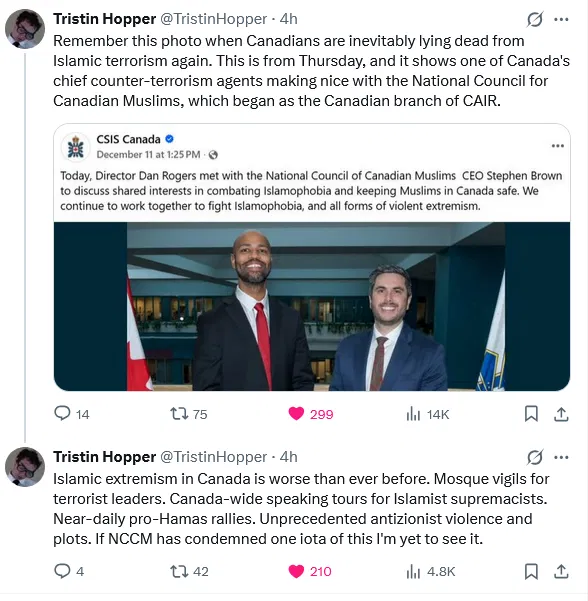
In Canada, politicians were quick to offer condolences. Statements flowed with the standard lines – “my thoughts are with the community”, “our government condemns all forms of hate”, “no one should be targeted for practicing their religion”. The words are familiar, and quite frankly hollow, because for the past two years, many of the same leaders issuing their thoughts and prayers have either ignored, excused, or actively engaged with movements that normalize hostility toward Jews.
Since October 7, Jewish Canadians have watched as public spaces became hostile territory. Synagogues require police protection, while Jewish schools are shot at and community centres are defaced. Rallies openly glorify terrorist groups, call for the destruction of Israel, and chant slogans that any reasonable person understands as genocidal, such as calls to “globalize the intifada”, “from the river to the sea Palestine will be free”, “there is only one solution, intifada revolution”, and “resistance is justified”.
What makes the current moment particularly dangerous is the gap between rhetoric and reality among leaders. Politicians speak of fighting hate while refusing to enforce existing laws against intimidation, mischief, and hate-motivated harassment. They speak of unity while legitimizing groups and movements that openly reject the safety of Jewish communities, even giving funding through government programs meant to combat antisemitism, to organizations that perpetrate it. They issue statements condemning violence abroad while tolerating the ideological conditions that make violence inevitable at home.