Quotulatiousness

September 2, 2024

There’s no limit to how progressive politicians want to control your life

In the National Post a couple of days ago, Carson Jerema provided many examples of how the Canadian federal government — despite failing and fumbling so many of its existing responsibilities — still wants to increase control over the daily lives of Canadians:

After a decade or so, progressives are on the defensive in Canada and elsewhere because regular people, as in those who are not activist weirdos, are tired of the agenda to control every aspect of our lives. Point this out to a progressive, and they will deny that anyone’s life is being interfered with and claim only some far-right monster would think otherwise. They can’t believe there are people out there who share a different view. They don’t understand how this could be.

But progressive governments are trying to control our lives in ways big and small, and in ways that range from subtle to a punch in the face.

In Canada, the federal government’s environmental policies are the most obvious example of this interference. The Liberals have banned plastic straws and plastic bags; even compostable bags are banned in grocery stores because they resemble plastic. Such bans are pointless irritants that make shopping more expensive, and life slightly less enjoyable as paper straws dissolve in one’s drink. People might dismiss these concerns as simply minor inconveniences, but this is how most people experience government policy, by being forced to replace their bag of plastic bags that they were already reusing, with more expensive, less useful options.

Next up, the Liberals are exploring options to bring in environmental regulations for clothing. The cost of clothes has actually gone down in recent years, so leave it to Ottawa to look for ways to bring the cost back up and to limit options.

There is also the plan to essentially force Canadians to purchase electric vehicles, that nobody would otherwise want, through government mandates to phase out the sale of gas-powered cars and trucks.

On a larger scale, the government is attempting to restrict the kind of work people do, specifically work in the oil and gas industry, through steep emissions targets, which will close off lucrative job opportunities in western oilfields. It will also limit the kinds of fuels people will be able to use to heat their homes.

There are also policies that the Canadian government hasn’t implemented, but which green activists have endorsed, such as the banning of gas stoves and the ludicrous suggestion from some academics that “climate lockdowns” be implemented to help cut emissions.

It is possible to be supportive of all these policies, despite their paternalistic and job-killing nature, but pretending that no one is trying to, or that no one wants to, interfere with our liberty is not a credible position to take.

August 13, 2024

Feelings … nothing more than (climate) feelings …

Filed under: Books, Environment, Europe, Politics — Tags: , , , — Nicholas @ 04:00

Have you been metaphorically beaten over the head about your climate sins? Your carbon buttprint? You know your very existence is a threat to Mother Gaia, right? Well, Katharina van Bronswijk is worried that you’ll stop listening to the neverending lectures about you and your evil externalities:

Climatism is a political programme bound to a broad social movement. Most of its momentum comes not from The Science or The Experts, but from diffuse cultural forces that we should probably try to understand, if only because they are driving our entire civilisation straight into the ground. Against all advice, I will therefore steer the plague chronicle into this ridiculous quagmire of leftoid green babble, with a look at our first lesson in Unlearnings, namely “Unlearn Repression”.

This superficial and disorganised essay is the work of an infuriating young woman named Katharina van Bronswijk. She’s a psychotherapist best known for her 2022 book, Climate in Our Heads. Fear, Anger, Hope: What the Ecological Crisis is Doing to Us. It belongs to that genre of inevitably unreadable monographs, in which the author herself appears on the cover, looking windswept, pioneering and undaunted:

“Climate feelings” are van Bronswijk’s niche in the extremely crowded enterprise of CO2-bothering. In “Unlearn Repression”, she argues that we should not suppress our negative feelings about climate change, but rather embrace them in constructive ways on behalf of the planet.

Now, van Bronswijk is the kind of deeply unoriginal person who just says the same things over and over. Everything she writes in “Unlearn Repression” flows directly from Climate in our Heads; she’s been digesting, reheating and reworking this same overboiled intellectual artichoke for almost two years now, through various media interviews and even in this English-language TEDx Talk. Throughout this woman’s work is the vague anxiety that the climatists have perhaps overdone it with doom and gloom, and that a lot of people have had enough of hearing about a climate apocalypse that never quite happens.

Van Bronswijk is naturally very dumb, but more than that she is painfully condescending, oblivious, verbose and just awash in litres of estrogen. I defy anyone to read her work and not come away from it a raging misogynist. This odious overpromoted schoolmarm belongs out of sight in a childcare centre teaching young children the alphabet. Perhaps she should also be in a choir, or part of a local environmental club dedicated to collecting litter in parks. That our society has denied van Bronswijk and so many others like her these proper outlets for their instincts and instead pushed them into public activism and intellectual production itself explains a great deal of what is wrong with the world.

“Unlearn Repression” opens with some autobiographical details, because of course everything van Bronswijk talks about is all about van Bronswijk. Like so many Germans of her generation, she was radicalised by school climate propaganda – specifically, by her teacher’s fateful screening of that classic propaganda film, An Inconvenient Truth:

    Back then … I was happy for the welcome distraction of watching a film instead of doing normal lessons. But afterwards I was shocked and asked my mum for answers to all the questions and challenges. She didn’t have any solutions for me, how could she? I was alarmed and started to think about the impending consequences of climate change and what could be done about it. I found approaches in newsletters from NGOs and by reading up on animal and environmental protection … That was when my dream bubble burst and I realised: the world is unfair and, unlike all the Disney stories of my childhood, there will be no single hero*ine who saves the world. And there is no magical or technical miracle solution either.

Al Gore’s film so terrified the young van Bronswijk, that for a while she retreated into conspiratorial theories about why climate change is not happening, which qualifies our crayon psychotherapist to pronounce upon the psychology of those who deny the climate. This deeply evil and irrational movement is driven primarily by “white men”, because they “still enjoy most of the privileges in our society, and therefore have the most to lose”.

July 10, 2024

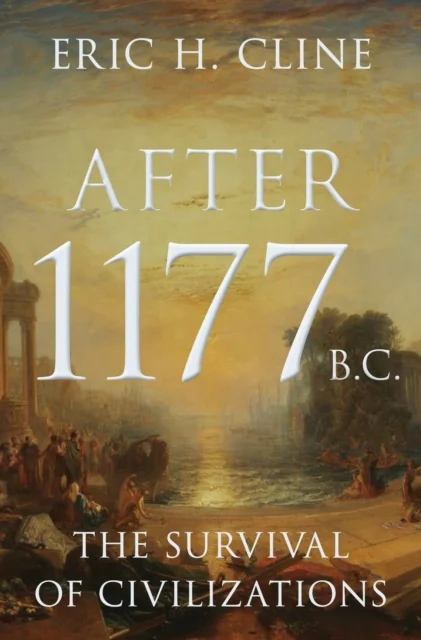
After 1177 B.C.

Filed under: Books, Europe, History, Middle East — Tags: , , , , — Nicholas @ 03:00

Jane Psmith reviews the follow-on book from Eric Kline’s bestseller about the Bronze Age Collapse, After 1177 B.C.: The Survival of Civilizations:

Sometime around 1150 BC, the dense network of politically, economically, and culturally interdependent states around the eastern Mediterranean collapsed. In 2014, GWU archaeologist Eric Cline wrote a book about it. And then, surprisingly, it became a bestseller.

Okay, maybe it’s not that much of a surprise: most people can recognize an obvious historical analogy when it hits them over the head, and the globalized1 state system of the Late Bronze Age has extremely clear parallels to the modern day. An interconnected and cosmopolitan world? Centralized state bureaucracy? High-level diplomacy between ruling elites? A technologically complex civilization enabled by extensive international trade along lengthy and elaborate supply chains? Well, gosh, that seems remarkably familiar. An audience that had just weathered a global financial crisis (and, later, a global pandemic) was perfectly poised to appreciate Cline’s exploration of the fragility of complex systems. No wonder it sold! (A copy entered the Psmith household in early 2020 for, uh, obvious reasons.)

Cline’s basic argument in the book was that the Collapse was due not to any single cause but to a “perfect storm” of calamities: drought and accompanying famine, earthquake, internal rebellion, external invasion. These were all problems that the civilizations of the Bronze Age Mediterranean had faced and survived in the past, but under their combined onslaught the most fragile parts of the system at last began buckle. When one society disintegrated, its sudden absence from the interconnected global economy became a new stressor on its surviving neighbors — until at last, domino-like, the whole thing came down.2 It would be decades, or in some places centuries, before the standard of living returned to anything like its previous level, and it would be nearly five hundred years before an international system as complex and sophisticated as the world of the Late Bronze Age emerged.

Now, a decade after his original book, Cline has a sequel exploring what happened after the Collapse. Which civilizations were able to rebound to something approaching their former glory, which barely managed to limp along into the Iron Age, and which vanished into the sands of time? And, more importantly, why?

This is a much more difficult story to tell. The original 1177 B.C. spent much of its page count on the zenith of Bronze Age civilization, the 15th through 13th centuries BC, to explain what it was that did the collapsing. It’s a sweeping tale, full of wonderful stories and fascinating digressions into the historicity of the Trojan War (yes) and the Exodus (not archeologically substantiated) as well as being a compelling portrait of a complicated set of societies. Cline’s narrative darts from Egypt to Assyria to the Aegean to the Hittites, treating each in turn as he moves forward through time towards what we all know is coming.

But chronological framing is impossible for the sequel. There is, definitionally — there can be — no grand narrative of regional divergence after the fall of a “world-system“. The fate of Mesopotamia is no longer linked to that of Greece; there are no more Cretan envoys in New Kingdom tomb reliefs, no more battles between the Hittite Great King and the wanax of a Mycenaean palatial center, no more Uzbek tin shipwrecked off the coast of Anatolia. Once the ties are cut, each story must stand alone, and accordingly Cline gives each region its own chapter.

Alas, this is a lot less fun to read.


    1. For sufficiently small values of “globe”. But larger than you might expect!

    2. The revised 2021 edition apparently gives a larger role to climate factors, especially the 3.2kya megadrought, but that’s not the one I read and anyway the other elements were still present.

July 8, 2024

All the conspiracists seem to find room for the Rockefellers in their theories

Filed under: Environment, Media, Politics, USA — Tags: , , , , , , — Nicholas @ 04:00

Elizabeth Nickson on a new book by Jacob Nordangård that illustrates just how important Rockefeller funding is to so many activists and the environmental pressure groups that deploy them:

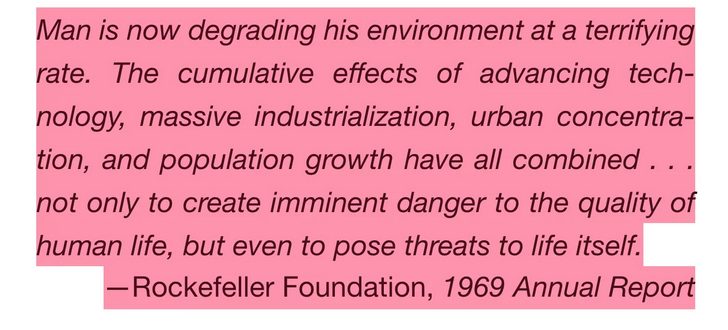
In the climate change arena, the Rockefellers call the shots. The whole thing was their idea, they took a silly but interesting theory and amped it up with hundreds and hundreds of million of dollars. They founded institutions and linked the survival of those institutions to promoting climate change and population reduction. They adopted one likely politician after another.

The Rockefellers have created 990 Climate Change activist organizations. They give them directions, financing, and launch them on the world. The Green Movement was started, financed, organized, and militarized by the Rockefellers. By the late 40’s the family was all in, on the same page. In the 50’s they began to stand up countless institutions, committees, university departments, university institutes, foundations, and policy shops gathered around this one idea, as below:

Let’s just pause here and recognize that the United States and Canada are 5% developed. If it were 50%, then maybe we would have reason to worry about the effects of trace gas that takes up .04% of the atmosphere, of which 3% is currently contributed to by humans. But were we to have that level of development, our science would have long ago solved the problem. Our sense of proportion, size and consequence has been twisted, propagandized via hundreds of billions of purposed dollars. And all of it is exaggerated science done by scientists compromised by Rockefeller money.

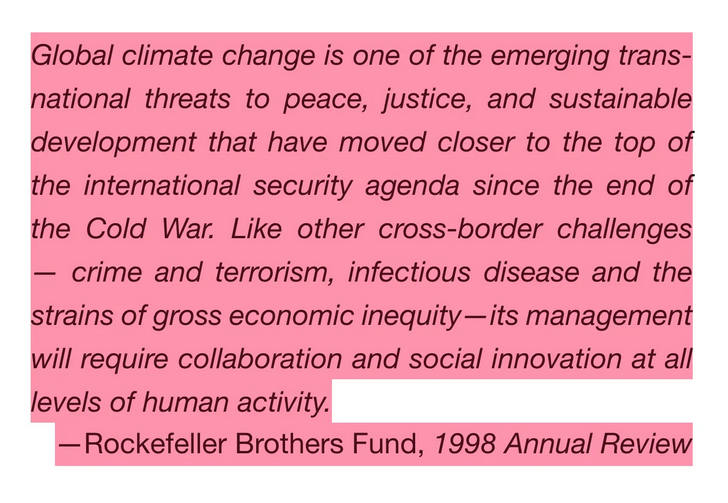
By 1998, the Rockefeller family had swept the table clean of any opposition to this one idea. Any scientist not on board with the agenda was imperiled. Any university department not working towards this one artificial goal, was in danger of being marginalized. Infiltration had begun into every media organization, every entertainment division of every major corporation. This, as stated below, would be a generational goal. For everyone. Or get off the bus.

What is evidentiary, what can be proved in a court of law, rather than opinion, however, is that the Fabians started the idea of this whole one-world, no nation state. It is clear too that after the First World War, the Fabians roped in the second generation of Rockefellers. It was a major catch. It meant they had America. And it was spiritual. It was meant to change mankind, to kill off Homo Sapiens and turn us to Homo Universalis.

The New Man would be not-Christian, quietist, and self-obsessed. The economy would trend towards zero-growth if not de-growth. There is a preponderance of data, many many publications that laid out their plans. They twisted education away from practical science, engineering and building things towards social movements, the humanities, the arts, and pleasure. And via Laurance Rockefeller’s money and organizational skill, they devised and invented the discipline of cybernetics from which the internet flows.

June 29, 2024

“So, as the pundits say, everywhere is warming faster than everywhere else”

Terry Etam on the totalitarian controls being imposed on citizens in Canada where under yet another censorship bill being pushed out to ensure that nobody says anything that contravenes some yet-to-be-determined “internationally recognized methodology”:

And then, as a final but impressive gasp of inept state control, witness Canada’s frantic flailing to control the situation by …

Send in the goons: Canada cracks down on any speech it doesn’t like, with sweeping rules measured against undefined regulations, and enters the historical pantheon of legendarily badly run states

We’ve all heard about bill C-59 by now, the government of Canada’s crackdown on any comments related to emissions reduction mitigation efforts that do not adhere to “internationally recognized methodology”. It’s a Soviet-style attempt to crack down on any talk about what companies are doing to reduce emissions, or anything they do that is an attempt to reduce “the environmental, social and ecological causes or effects of climate change”.

The apes in charge, and their sycophants, say hey, it’s not censorship at all, you can talk about emissions reduction all day long, so long as it meets some undefined international standard, and the onus of proof is on anyone making the statement to show that they are not violating some “internationally recognized methodology” that does not exist.

This whole fiasco is of course a one way street; the freedom to say anything that cements the climate emergency narrative remains gloriously unchecked. For example, energy commentator David Blackmon recently catalogued on LinkedIn the number of countries/regions that claim to be warming faster than the global average: Canada, Mexico, Latin America and Caribbean, Arctic, Asia, Africa, the US, Europe, Russia, Australia, China, and Finland all claim to be warming faster than the global average. The high priest of modern politicized science, Scientific American, says that oceans are also warming 40 percent faster than expected, and that oceans absorb up to 90 percent of the warming caused by human carbon emissions, and SA also notes that the South Pole is warming “three times faster than the global average”. So, as the pundits say, everywhere is warming faster than everywhere else.

Extrapolating from this, in keeping with necessary mathematical precedents such as how averages work, then the few remaining regions not mentioned must be plummeting in temperature, because that’s how averages work. And I mean plummeting, if it alone is offsetting the above-average gains in the rest of the world. Strange indeed how not a single headline can be found to that effect.

The speech police have no problem with such math crimes, because the asinine claims are put forth under the banner of “science”. It must be concluded then that math is not one of the “internationally recognized methodologies”.

No matter. The point is, as always, to silence discussions and ram through whatever ideological junk they can while still clinging to power like a bee holding onto an accelerating windshield.

Welcome to Canada, where if global embarrassment were an Olympic sport we’d be wearing perma-gold. Joke’s on us though; we elected these people. We should now clearly understand why Canada’s status as an investment haven is plummeting like a shot duck. (Do not point me towards legendary genius Warren Buffett who says he is comfortable investing in Canada; Buffett buys existing businesses, with moats, and the government of Canada is working to build those moats as fast as it can. Remember this investing rule for the foreseeable future: existing infrastructure is getting more valuable, because building anything gets harder by the day.)

It is probably unfair to single out Canada for such withering criticism when other western countries are on similar energy suicide missions. Australia, England, Germany … all under the spell of radicals that will accept nothing other than total nihilistic energy “victory”, a crown that seems to mean de-industrialization and subjugation of citizens in autos they don’t want, doing things they don’t want to, and not being permitted to say what they want to. (New Zealand was in that club as well, but has recently repealed a ban on oil & gas exploration when it dawned on them that fields decline, and do not produce at flat levels in perpetuity without investment. Yes, western governments really have enacted such legislation while simultaneously holding an astonishing ignorance about how energy really works.)

As far as Canada’s hydrocarbon sector goes, the most important thing to do at this stage is to keep our heads [down] and carry on providing the energy the world desperately needs. And that means every single person, right down to Guilbeault’s Greenpeace and the soup throwing fools of Just Stop Oil. If the feds are going to outlaw emissions talk, let them … the rotten foundations of their world can’t stand for much longer.

No one should stand taller than one that provides reliable and affordable energy for the globe’s citizens. Go back to work, and patiently wait until the inevitable happens, the day when governments are no longer able to pretend they can’t see reality. It’s going to be epic.

June 21, 2024

“Neoliberal ideology is antidemocratic at its very core. Its aim is to give free-reign over our societies to corporations, not citizens”

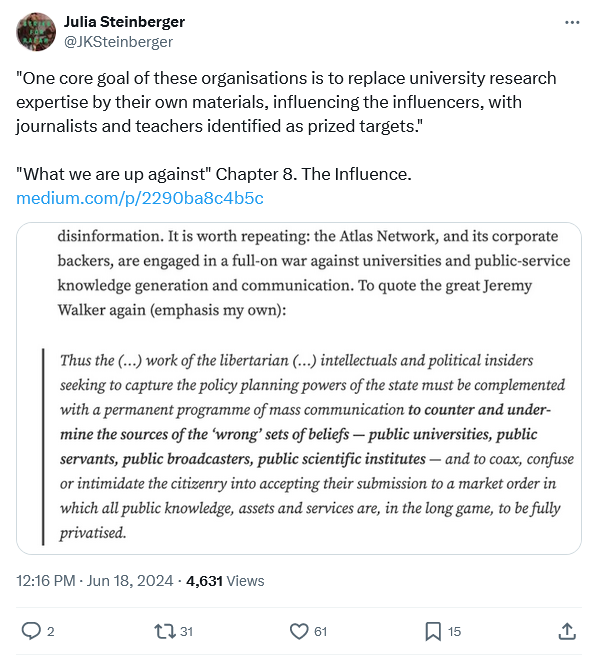
Tim Worstall responds to a recent Medium essay by Julia Steinberger which illustrates that “neoliberal” has joined “fascist” as a generic term to indicate strong disapproval of a person, organization, or idea:

The idea that an adult woman can believe these things is just amazeballs. But here we are. A tweet from Julia Steinberger leads to her Medium essay about what’s wrong with the world.

An upheaval in 10 chapters:

    1. The cause. We know the climate crisis is brought to us by highly unequal and undemocratic economic systems.

Err, no? Emissions are emissions. 100 people emitting one tonne each is exactly the same as 1 person emitting 100 tonnes. Sure, it’s true that a more unequal society will have more people emitting those 100 tonne personal amounts. But a more equal society will have more people able to emit another 1 tonne each. For, more equality is by definition the movement of some of those assets of the richer to those poorer — the economic assets which either allow or do the emitting. Sure, Jim Ratcliffe’s £50,000 private jet flight emits more than my £100 Easyjet one. But if we take the £50k off Jim and give it to 500 folk like me then all 500 of us might spend the marginal income on an Easyjet flight each — which would be more emissions than Jim’s spending of the money.

It simply is not true that economic inequality is the heart, the core or the cause of climate change. It’s idiocy to think it is too.

Of course, we know what’s happening here. Climate Change is Bad, M’Kay? Which it is, obviously. Economic inequality is Bad, M’Kay? Well, there the evidence is a great deal more mixed but whatever. But in the minds of the stupid all bad things have the same cause. So, if inequality is bad, climate change is bad, then they must be the same thing because they’re Bad, M’Kay?

    2. The rise. The recent history of these economic systems, in the Americas and Eurasia, is dominated by the ascendance of neoliberal ideology.

Oh, that is good. Given that I am a neoliberal — a fully paid up one, Senior Fellow at the Adam Smith Institute and all — that’s very good. Given HS2, looming wealth taxation, the increased bite of idiot regulation and all that I can’t say that I see neoliberalism as winning right now but that might depend upon your starting point. If you’re a socialist — or an idiot but I repeat myself — you might well regard the plenitude of bananas in the supermarket as neoliberal. After all, that is something that socialism never did achieve.

    3. The threat. Neoliberal ideology is antidemocratic at its very core. Its aim is to give free-reign over our societies to corporations, not citizens.

And, well, you know, bollocks. The very beating heart of neoliberalism is that corporations need to be controlled and they’re best controlled by the citizens. In the form of free markets rather than voting on which bureaucrats get the gold plated pension, true. But neoliberals are between indifferent and actually against capitalist power. The whole nub of the idea is that markets do the job of controlling capitalists better than bureaucrats, politicians or, obviously, capitalists.

There’s not really any way for her thesis to survive after getting so much of the basics wrong, is there?

But just one more tidbit:

    Hayek and his neoliberal colleagues now needed another, antidemocratic way, to organise society. They didn’t want democracy, but they wanted some kind of self-maintaining organisation — by which they meant hierarchy. Organisation was supposed to be supplied by the market, and hierarchy by competition within markets. (It’s worth noting that neoliberals in the 1950s did not, although they should have, predict that unfettered markets lead to concentrations in monopolies or cartels. They would arguably disapprove of the vast corporations running our current economies, even though their market-above-democracy policies predictably brought them into being.)

Well, that wasn’t actually the last tidbit. But the idea that Friedman, Mises, Menger, Hayek and the rest didn’t worry about monopolies? Jesu C is really bouncin’ on that pogo stick right now. And then the idea that democracy will be better bulwark against monopolies than markets? Can you actually do backflips on a pogo stick?

June 15, 2024

The Ford Foundation and the far left

Filed under: Media, Politics, USA — Tags: , , , , , — Nicholas @ 03:00

N.S. Lyons looks at the vast amount of money the “philanthropic” Ford Foundation donates to organizations pushing far left agendas:

It’s November 2023, and, following the October 7 attacks by Hamas terrorists that killed some 1,400 Israelis and at least 31 Americans, thousands of demonstrators march through New York City, calling for the destruction of the Jewish state. Chants of “from the river to the sea, Palestine will be free” echo through the streets, along with “there is only one solution: intifada revolution”. Among the crowd is the infamous Palestinian American activist Linda Sarsour, who warns through a megaphone that a cabal of wily Jews has conspired to place “their little posters” (of kidnapped Israeli civilians) across the city, seeking to entice people to rip them down. While many onlookers might look like “ordinary people”, she says, the Jews have “their little people all around the city”, surveilling others. Sarsour is there to deliver such rhetoric in part because she’s been paid to be there: her nonprofit, MPower Change, has received $300,000 in grant funding from the Ford Foundation “to build grassroots Muslim power”.

It’s May 2023, and protesters have stormed the Capitol building in Washington, D.C., to demand that lawmakers not accept spending cuts during negotiations to lift the debt ceiling. Many are so disruptive that the police arrest them and drag them out. These are activists of the Center for Popular Democracy, an extreme left-wing organization that has collected $35.2 million from the Ford Foundation since 2012. Four months later, they will be imitated by 150 youth activists from the “climate revolution” group the Sunrise Movement, 18 of whom will be arrested after occupying the Speaker of the House’s office. The Sunrise Movement also receives Ford Foundation money—$650,000 for “training and organizing”.

It’s April 2023, and, a world away, the China Development Research Foundation (CDRF), a think tank set up and directed by the Chinese state, is hosting a conference in Beijing to discuss how to “promote the formation of an internationally accepted ESG system with Chinese characteristics”, including through China’s globe-spanning influence and infrastructure plan, the Belt and Road Initiative. But this effort by America’s top geopolitical adversary isn’t too far afield for the Ford Foundation to fund; it has given CDRF $600,000 to help realize its ambitions.

These examples from just the last year — collected via a semi-random tour of the Ford Foundation’s vast Grants Database — represent a tiny fraction of the nearly $1 billion that the foundation gives away yearly, on average. Almost a century old and sitting on a mountainous $16.4 billion endowment in 2022, the foundation is a “philanthropic” giant — one of the five largest in the U.S. If it were a for-profit firm, its market capitalization would rank it among the Fortune 500. Instead, “guided by a vision of social justice”, as its mission statement puts it, the Ford Foundation’s enormous flood of untaxed money flows annually to an immense ecosystem of overwhelmingly left-wing — and often outright revolutionary — causes.

Yet the foundation’s activities remain largely below the public’s radar, the extent of its malign history mostly unknown. This should change. America today faces a multitude of escalating sociopolitical crises that are rapidly tearing apart the body politic: a rapacious strain of tribal identity politics; spreading legal, cultural, and moral chaos; lawlessness in the streets; and the entrenchment of an oligarchic managerial elite, increasingly willing to cast aside any remaining shred of democratic or national sovereignty in its pursuit of top-down global “progress”. Behind every one of these fractures, one finds the ongoing work of the Ford Foundation.

In 2020, following the death of George Floyd in Minneapolis, a “racial reckoning” swept the United States, kindling fiery riots across the nation, abrupt moves by municipalities to defund police departments, and the near-wholesale capitulation of public institutions — from universities to government agencies to major corporations — to a culturally revolutionary ideology of identitarian grievance and racial separatism. To some, this came as a shock. To the Ford Foundation, it marked the fulfillment of decades of effort.

The foundation has long seen itself as uniquely dedicated to progress and social justice, its stated mission from as early as the 1950s being the “general purpose of advancing human welfare” and to “eradicate the causes of suffering” worldwide. But after current president Darren Walker took the helm in 2013, it began more fully to embrace a public identity as a “social justice foundation” and reoriented its mission to “disrupt the drivers of inequality” in every sphere of life and across the globe.

June 8, 2024

Eco-terrorism – it’s all over Canada

Filed under: Cancon, Environment, Media, Politics — Tags: , , , , , , , — Nicholas @ 03:00

Elizabeth Nickson on the strong likelihood of any given wildfire in Canada being not just man-made but deliberately set for political reasons:

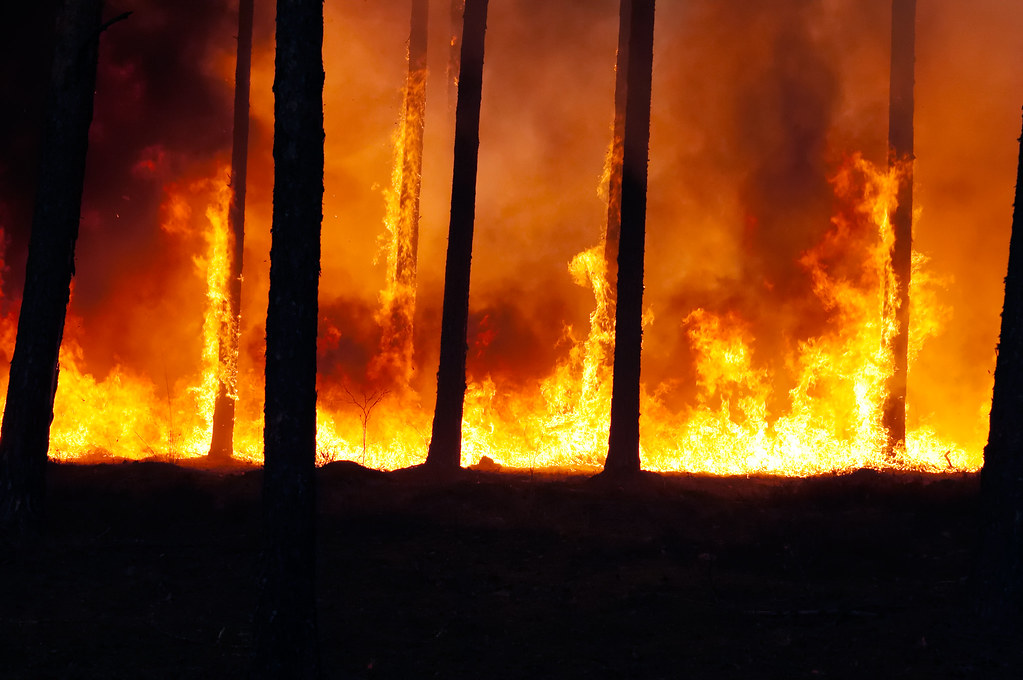
“Forest fire” by Ervins Strauhmanis is licensed under CC BY 2.0 .

A Google Earth satellite video is making the rounds on twitter. it shows the moment an arc of fires began in northern Quebec, the smoke rising. It looks like people calculated the prevailing winds so that the smoke would blow south. Then connected via sat phone, they lit them. It’s another psy-op from our gracious overlords. We aren’t afraid enough, despite every nasty limiting idiotic play they have visited upon us in the last four years. Monkey Pox failed, more plague warnings were greeted by a shrug. But this one, the world bursting into flame? Be very very afraid.

Justin Trudeau lost no time in announcing that the fires were from “climate change” and the carbon tax, which is impoverishing everyone not in government or on lush pensions, is just the beginning of the restrictions he must institute or we are all gonna die.

The stupidity and cruelty of this is almost unimaginable. But fires have worked over and over again to terrify people into quiescence. The rumours that they were deliberate were the stuff of fantasy until people started getting arrested. Alberta shows that almost 60 percent of fires in that province are human caused. And in Canada, as of today, we have arrested dozens. They will be released, their bails paid by a high-priced lawyer because most of them act as agents of the hyper-rich, paid through a cascade of environmental NGOs. The richest people among us are burning the forests in order to force compliance.

When I moved back to the country 20 years ago, the movement adopted me because I was writing for the Globe and Mail and Harper’s Magazine. I interviewed hundreds of local activists, the ones who, with the inspiration of RFK, Jr. had shut down the biggest industrial forest in the world in an action called “The War of the Woods“. They were mostly ordinary people, socialists and scientists of one stripe or another and deeply profoundly committed to saving the earth. The fact that they had eliminated the principal source of funding for health care and education — forestry — their own in fact, went right over their heads. It didn’t matter. “Climate Change” was an existential threat and those trees must stand to suck up “carbon”, or CO2, as it used to be known.

I met Denis Hayes too, the founder of Earth Day, head of the Bullitt Foundation in Seattle, founded by the heiresses to Weyerhaeuser. He excitedly told me how he created the storm of protest that led to Bill Clinton shutting down the western forests of the U.S., during the same period that Clinton was giving away American manufacturing to China. The result was devastation in forested communities from northern California to the Canadian border. Hayes, a tall, attractive Ivy Leaguer married to a woman whose father won a Nobel in chemistry, slithers through every institution. When I hung out with him, his target was Bill Gates’ climate initiatives and clearly, he has succeeded.

His “work” turned the forests into a tinderbox. Today, the 9th of June, 2023, a full thirty years too late, the Wall Street Journal editorial board finally acknowledges that sustainable forestry management may be the principal cause of the forests burning down. Holly Fretwell, a fellow at the Property and Environment Research Center, and professor at Montana State, gives, in this book, a thoroughgoing analysis of how wrong-headed and destructive “green” has been in the forests. Also this book by me, and a follow-up policy paper, also by me. These were not popular opinions, but they were, in fact, right. It is not “climate change” burning down the forests, it is government in the hands of brutal greens, in pursuit of an impossible goal.

May 20, 2024

At what point did “quiet genocide” become the preferred option for the climate cultists to “save the planet”?

The Daily Sceptic‘s Chris Morrison on the not-so-subtle change in the opinions of the extreme climatistas that getting rid of the majority of the human race is now the preferred way to address their concerns:

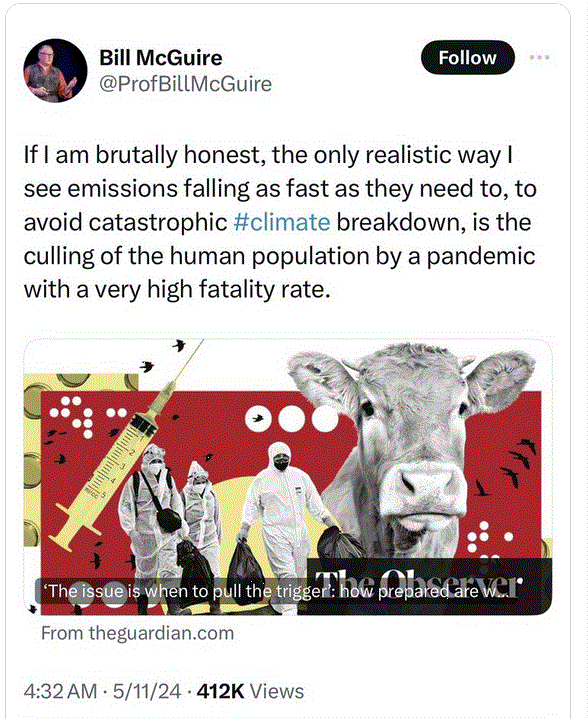
The grisly streak of neo-Malthusianism that runs through the green movement reared its ugly head earlier this week when former United Nations contributing author and retired UCL Professor Bill McGuire tweeted that the only “realistic way” to avoid catastrophic climate breakdown was to cull the human population with a high fatality pandemic. The tweet was subsequently withdrawn by McGuire, “not because I regret it”, but people took it the wrong way. McGuire is the alarmists’ alarmist, suggesting for instance that human-caused climate change could lead to more earthquakes and volcanic eruptions. The Daily Sceptic will not take his views the wrong way. They are an illuminating insight into environmental Malthusianism that does not get anything like the amount of publicity it deserves.

Every now and then Sir David Attenborough allows the genial TV presenter mask to slip to reveal a harder-edged Malthusian side. Speaking to BBC Breakfast in 2021, he suggested that the Earth would be better off without the human race, describing us as “intruders”. In 2009, Attenborough became the patron of the Optimum Population Trust and told the Guardian: “I’ve never seen a problem that wouldn’t be easier to solve with fewer people.” In 2013, he made the appalling remark that it was “barmy” for the United Nations to send bags of flour to famine-stricken Ethiopia. Too little land, too many people, was his considered judgement.

Any consideration of the refusal of food aid these days brings to mind the 19th century Malthusian Sir Charles Trevelyan, the British civil servant during the Irish famines who saw the starvation as retribution on the local population for their moral failings and tendency to have numerous children. He is said to have seen the great loss of life as a regrettable but unavoidable consequence of reform and regeneration.

Anti-human sentiment is riven through much green thinking. In 2019, Anglia Ruskin University Professor Patricia MacCormack wrote a book suggesting humans were already enslaved to the point of “zombiedom” because of capitalism, and “phasing out reproduction is the only way to repair the damage done to the world”. Green fanatics can be a joyless crowd – it is not enough to declare a climate crisis, now they want a “nookie” emergency. As the economist and philosopher Robert Boulding once remarked: “Is there any more single-minded, simple pleasure than viewing with alarm? At times it is even better than sex.”

May 17, 2024

“Once a mind is infected with Climate Change, bioweapons are just another kind of carbon credit”

Jo Nova presents evidence of a university professor — a vulcanologist — who perhaps has more sympathy for the volcanoes he studies than the human race:

Let’s just say, hypothetically, that someone wanted an excuse to reduce global population, or limit competing tribes and religions, there’s a scientific hat for that. Climate Change is the ultimate excuse for mass death — done in the nicest possible way and for the most honorable of reasons. But isn’t that what they all say: Jim Jones, the Branch Davidians, Heavens Gate — death makes the world a better place?

The cult that pretends it isn’t a cult sells itself as “science”. I mean, what the worst thing you can think of? Would that be one degree of warming, or the Black Death?

In Bill McQuire’s mind the catastrophe is not when billions of innocent people die.

One hundred years from now, what would our great grandchildren prefer: that the world was slightly cooler or they were never born at all? If you hate humans it’s a terrible dilemma …

Bill McGuire, vulcanologist, accidentally put his primal instincts in a tweet last weekend:

Thirty years of telling us that humans are bad has consequences. As Elon Musk said” They want a holocaust for humanity.” It turns out a televised diet of one-sided climate projection by mendicant B-Grade witchdoctors might be a dangerous thing for mental health. If only Bill McQuire had seen a skeptic on TV?

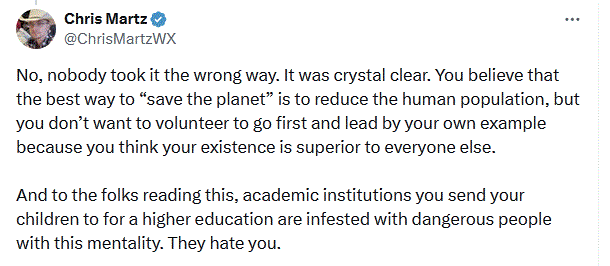
Predictably the McGuire tweet spread far, and got crushing replies so the Emeritus Professor deleted it, as all cowards do, yelling at us:

To which the winning reply was:

May 7, 2024

But Carbon Dioxide is scary, m’kay?

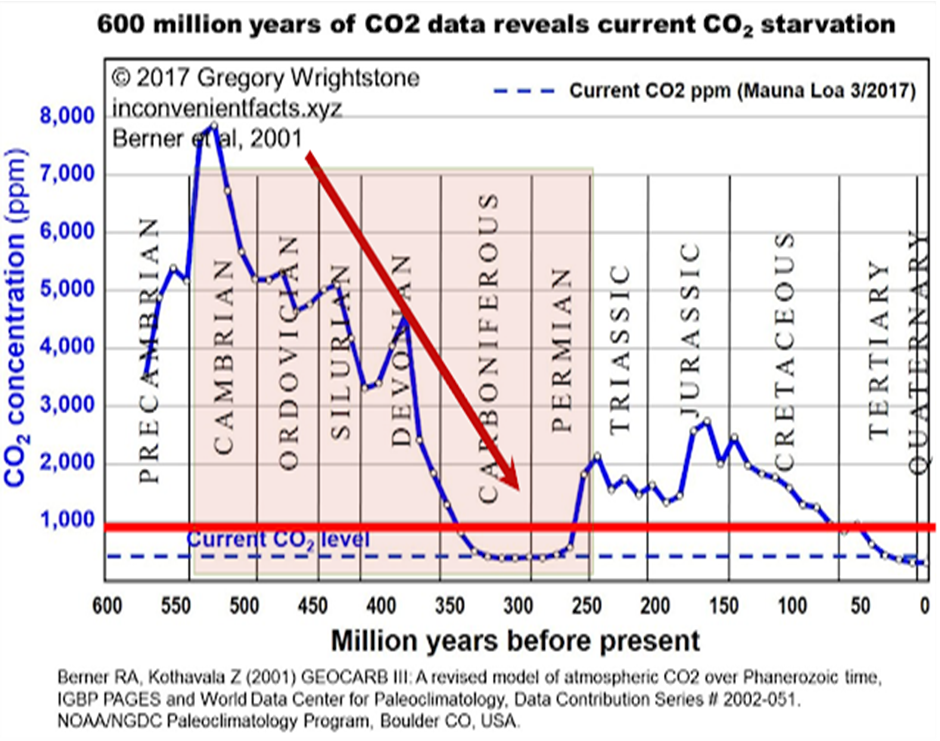
Last week, Chris Morrison shared some charts that show atmospheric carbon dioxide to be nowhere near high enough to be a concern … in fact, compared to ancient atmospheric conditions, CO2 may be at a potentially concerning low point:

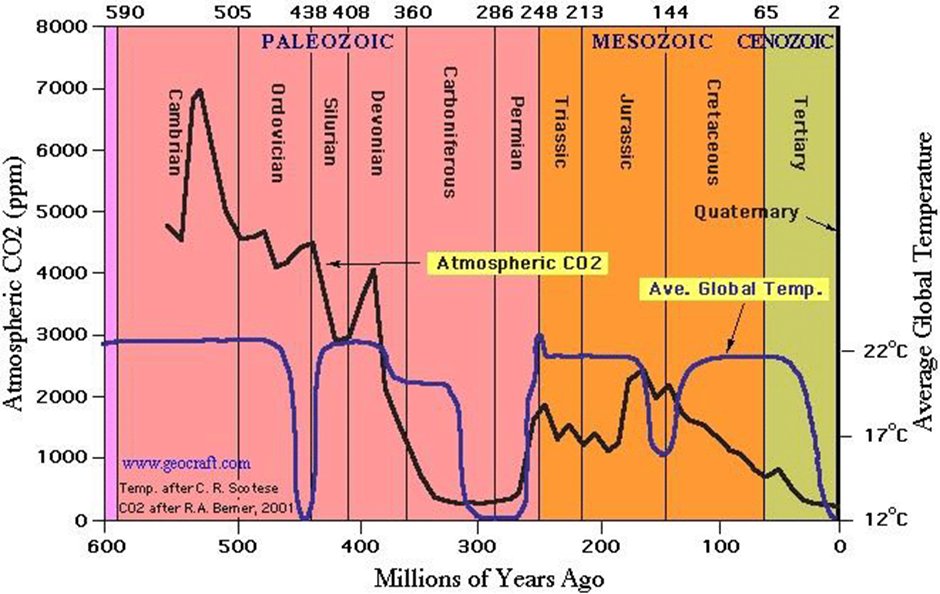
Last year, Chris Packham hosted a five-part series on the BBC called Earth, which compared a mass extinction event 252 million years ago to the small rise in atmospheric carbon dioxide seen in the last 150 years. He said he hoped the “terror factor” generated by his programme would “spur us to do something about the environment crisis”. But as we shall see, the only terror factor is having to sit through an hour-long film consisting of cherry-picked science data and unproven assertions in the hope of persuading us that the increase in global temperatures in the last 150 years or so is comparable to the rise in temperatures over a considerable swath of geological time. Great play was made of a 12°C rise in average global temperatures 252 million years ago as CO2 levels started to rise, although Packham fails to report that CO2 levels were already at least four times higher back then than in modern times. The “science” that Packham cloaks himself with on every occasion is hardly served by terrorising the viewer with what is little more than a highly personal political message.

Think of all that suffering and wastage, he says about the fourth great mass extinction. I don’t think we want a comparable extinction to the one that happened 252 million years ago on our conscience, he adds. Of course, Packham is not the first person to politicise the end-Permian extinction when most plant and animal life disappeared to be replaced eventually with what became known as the age of the dinosaurs. As we can see from the graph below, even though that extinction event coincided with an uptick in CO2 levels, the general trend over a 600-million-year period was downwards ending in the near denudation currently experienced today. But scientists note that the rise started some time before the extinction event, with most of the Permian characterised by very low levels of CO2.

It is obvious why the three other great extinctions are of little interest to modern day climate alarmists. The Ordovician extinction 445 million years ago occurred when CO2 levels were 12 times higher than today, the Devonian wipe-out happen 372 millions ago when CO2 levels were falling, while the later Triassic/Jurassic event 201 million years ago occurred at a time of stable CO2. Hard to see a pattern there suggesting rising CO2 levels equals a mass extinction event. The disappearance of the dinosaurs 66 million years ago is generally attributed to the impact of a giant meteorite, while the current sixth mass extinction exists only inside the head of the Swedish doom goblin, and need not detain us at this point.

Since Packham was essentially making a BBC political film promoting Net Zero, he inevitably started with the fixed view that all our current environmental problems are the fault of CO2. An intense period of volcanic eruptions that led to huge coal deposits catching fire increased CO2 levels and almost instantly sent temperatures soaring at the end of the Permian period. About 20 million years of rain subsequently followed, he observed, taking some of the CO2 out of the atmosphere and order it seems was restored. Certainly, CO2 resumed a small descent but levels remained almost as high, or for some periods higher, as those at the end of the Permian period for another 120 million years. Packham does not provide an explanation of what happened to the average global temperature at this time.

The graph above shows why he avoided the subject. Temperatures did rise at the end of the Permian period after a long decline, but only as far as previous highs recorded 200 million years earlier. They then stayed at those levels for most of the next 200 million years, throughout the age of the dinosaurs. Helped by the increased levels of CO2, this is considered one of the most verdant periods in Earth’s history.

April 29, 2024

“The Earth goes around the Sun, or so they would have you believe …”

Filed under: Economics, Environment, History — Tags: , , , , — Nicholas @ 03:00

Colby Cosh on a recent “grand theory” from Andrea Matranga, an Italian economist who outlined his thoughts in a paper accepted by the Quarterly Journal of Economics, summarized in the sub-hed “Hunter-gatherers were better off than Neolithic farmers, diet-wise — until Earth was hit by seasonal extremes caused by Jupiter’s gravity”:

Reconstruction of a neolithic farmstead at the Irish National Heritage Park in Ferrycarrig.
Photo by Jo Turner via Wikimedia Commons.

Matranga’s own explanation for the invention of agriculture is: “Believe it or not, it is down to extraterrestrial forces”. Yes, that’s an actual quote from a cheeky Twitter thread in which Matranga summarizes his hypothesis colourfully. The real idea is that the period of the Neolithic Revolutions coincided with a time when seasonal temperature and rainfall differences were maximized by coinciding features of Earth’s orbit — features attributable mostly to Jupiter’s gravitational tug on us.

The Earth goes around the Sun, or so they would have you believe, and Earth’s rotational axis is tilted relative to the Sun, which creates the seasons. But the Earth’s motion has other subtle wobbles and shimmies caused by Jupiter: the eccentricity of its elliptical orbit grows and shrinks, and the rotational axis “precesses”, or wobbles, meaning that the face of the Earth pointing toward the Sun at our closest approach to it changes over time.

The implication of this is that over a period of millennia, and particularly in what we think of as the “temperate” zones, the magnitude of climate seasonality will itself change in a somewhat chaotic way. For some periods much longer than a human lifetime, seasonal changes might be almost beneath notice; a few millennia later, they become a dominant feature of human experience. And one hemisphere of the planet — say, the northern one — might end up with a lingering developmental advantage because it was favoured at the right moment by the precession of Earth’s axis.

Matranga pulls together a lot of math, astronomy and geography to show that the local Neolithic Revolutions coincide with maximum local seasonality, and then he builds some economic models of primitive society to suggest what effect this might have had on social organization and population evolution. Alfred Marshall would have told him to burn this part of his paper, but perhaps the equations are necessary for appearances. The crucial point is that Matranga has found a strong possible explanation for the Neolithic paradox — why, and when, humans in many places adopted a form of social organization that seems to have left most of them worse off on average.

For it’s not just the average that matters. In a world that was more or less the same year-round, hunter-gatherers didn’t have to worry about food storage: they could migrate cyclically within a small range, following wild game, to keep up with modest seasonal effects. But if the seasons then got more intense, food storage would become more important to the long-term survival of the group: one winter could now finish everyone off.

April 27, 2024

Climate science or climate “science”?

Filed under: Economics, Environment, Media, Science — Tags: , — Nicholas @ 04:00

David Friedman is a very intelligent man and I wouldn’t want to face him in a debate, even on a topic I feel well-informed about. He’s not a scientist and hasn’t made a serious study of climate but he can read the reports and make up his own mind. He’s inclined to believe the data available indicates that the planet is warming but he isn’t convinced that this is enough to justify the kind of authoritarian controls that climate activists demand:

The argument for doing drastic things to prevent global warming has two parts. The first has to do with reasons to think that the earth is getting warmer and that the reason is human action, in particular the production of CO2. The second is the claim that changes we have good reason to expect if we do not take appropriate action to prevent them will have very bad consequences for us.

Much of the criticism I have seen of the argument has to do with the first half, with critics arguing that the evidence for global warming, at least the evidence that it is caused by humans and will continue if humans do not mend their ways, is weak. I do not not know enough to be certain that those criticisms are wrong; climate is a very complicated and not terribly well understood subject.1 But my best guess from watching the debate is that the first half of the argument is correct, that global climate is warming and human action is an important part of the cause. What I find unconvincing is the second half of the argument, the claim that climate change we have good reason to expect would have catastrophic consequences for humans.

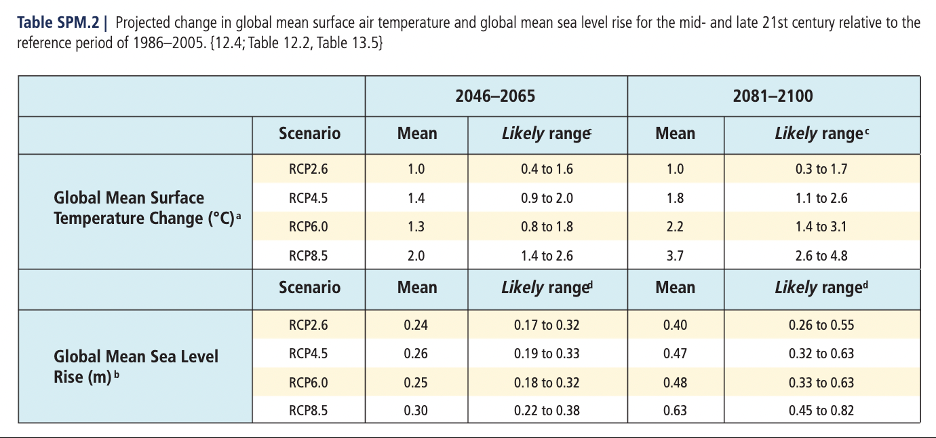
Obviously one can imagine climate change large enough and fast enough to be a very serious problem — a rapid end of the current interglacial, for example. If, as I believe is the case, climate is not very well understood, one cannot absolutely rule out such changes.2 But most of the argument is put in terms not of what might conceivably happen but of what we have good reason to expect to happen. I think the outer bound of that is provided by the IPCC models. They suggest a temperature increase of a few degrees centigrade over the next hundred years resulting in a sea level rise of less than a meter.3

Comparing a map of global temperature to a map of population density shows densely inhabited regions with average temperatures from about 10°C to about 30°C, with some of the most densely inhabited regions at the high end of the range. I could find no empty areas that are hotter than all populated areas, hence no areas that are depopulated only because of how hot they are. If people can currently live, work, grow crops over a temperature range of twenty degrees it is hard to imagine any reason why most of them couldn’t continue to do so about as easily if average temperature shifted up by two or three degrees, with a century to adjust to the change.

That raises the question with which I titled this post: Does climate change catastrophe pass the giggle test? Is the claim that climate change on that scale would have catastrophic consequences one that a reasonable person should take seriously?

[…]

A different version of the catastrophist argument is the claim that climate is unstable, that an increase of a few degrees could trigger a much larger increase. That might be plausible if current temperatures were so high that additional warming would raise them above any in the past. But although present temperatures may be higher than any in the past two thousand years, as discussed in an earlier post, the Earth is much more than two thousand years old.

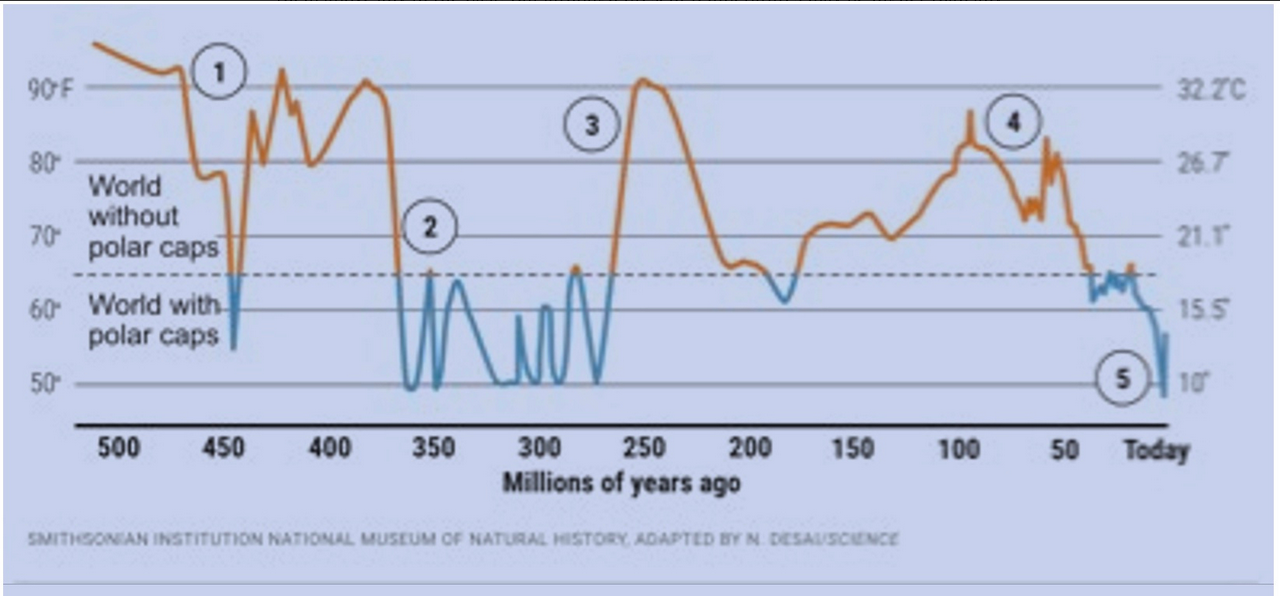
The graph below4 shows estimated global temperature over the past five hundred million years. While present temperature is high relative to the recent past it is cool relative to the more distant past, more than thirteen degrees below the high of the past hundred million years.

We are currently in an ice age, defined by geologists as a period when there is an ice cap on one or both poles. For most of the past five hundred million years there wasn’t.

The claim that we have good reason to expect climate change on a scale that will produce not merely problems for some but catastrophe for many is one that no reasonable person should take seriously.5


    1. As some evidence, as of 2018 the temperature projections produced by the IPCC’s elaborate analysis did a somewhat worse job of predicting actual temperature than a straight line fit from the date when warming restarted after the midcentury pause to the date of each of the first four IPCC reports.

    2. We cannot absolutely rule out catastrophic changes either caused by anthropogenic warming or prevented by anthropogenic warming. There is, in fact, some evidence, discussed in an earlier post, that the reason the next glaciation is not already starting is anthropogenic warming — not current warming due to the industrial revolution but warming that started some eight thousand years ago due to the invention of agriculture.

    3. From Future Climate Changes, Risks and Impacts. RCP8.5 was originally designed as an upper bound on how high future CO2 emissions might be and assumed a level of world population growth that, so far, is not occurring, so should probably not be included.

    4. The headline of the news story I found it in: “A 500-million-year survey of Earth’s climate reveals dire warning for humanity”.

    If life gives you peaches, make cyanide from the pits.

    5. The weaker claim that climate change will produce net costs for humans is, in my view, less obviously true than many believe. For reasons see my past posts on the subject.

“… when it comes to energy policy Germany is an undisputed champion of crazy”

eugyppius explains how Angela Merkel’s government reacted to the Japanese Fukushima disaster in a sane, measured, and sensible way … naw, I’m pulling your leg. They looked at all the options and then selected the dumbest possible reaction available to them:

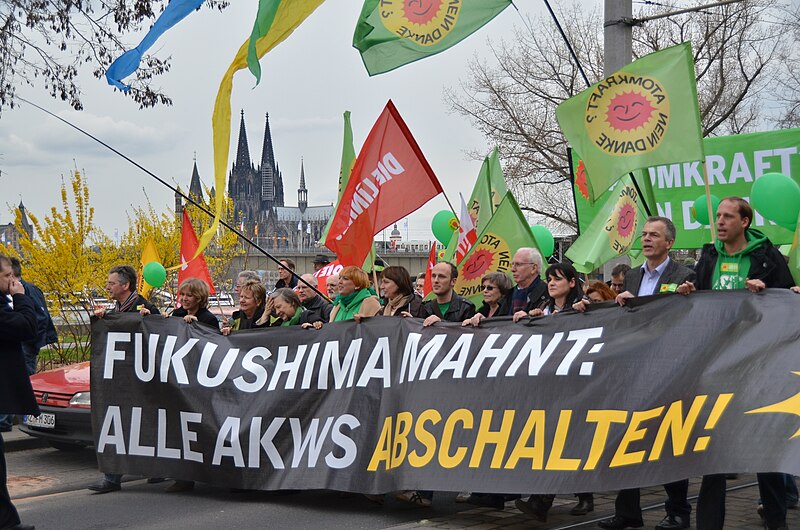
German anti-nuclear protest in Cologne, 26 March 2011.
Photo by Bündnis 90/Die Grünen Nordrhein-Westfalen via Wikimedia Commons.

All of our countries are crazy in various ways, but when it comes to energy policy Germany is an undisputed champion of crazy.

In 2011, a tsunami caused the Fukushima nuclear disaster. If you check a map, you’ll notice that Fukushima is in a country called Japan, which it turns out is a different country from Germany. The Fukushima disaster had zero to do with the Federal Republic, but then-Chancellor Angela Merkel felt the need to solve the problem of Fukushima by phasing out nuclear power in Germany, even though tsunamis and earthquakes are not a problem in Germany, because Germany is a country in Central Europe and not an island nation in Asia.

That is crazy enough, but it gets much crazier. Months before announcing the nuclear phase-out, Merkel’s government had passed energy transition legislation to secure Germany’s path towards a zero-emissions future. We resolved to ditch our most significant source of emissions-free power, in other words, just months after resolving an energy transition to emissions-free power. At this point you would be justified in wondering if Germany suffers from some kind of shamanistic cultural phobia of electricity in general, that is how crazy this is. These insane choices had the near-term consequence of increasing our dependence on Russian natural gas. Otherwise, they ensured that power generation in Germany would be vastly more expensive than necessary and also vastly more carbon intensive than necessary.

Now, crazy demands explanations, and observers have proposed various theories for the German climate nuclear crazy. Two of them deserve mention here:

1) The 1968 generation in Germany suffered from unusual radicalism, sharpened by moral anxiety over National Socialism, and resolved to outcompete all others in the project of self-abnegating virtue. Our culture developed a deranged anti-nuclear movement that in a fit of typical German thoroughness also came to embrace opposition to nuclear power. The Chernobyl disaster radicalised the pink-haired anti-nuclearists still further, and these cretins grew up to become news anchors, school teachers and book authors, effectively indoctrinating the next generation according to their parareligious delusions.

2) German politicians after the Cold War – especially Gerhard Schröder and Angela Merkel – harboured a subtle and not entirely unreasonable desire to strengthen ties with resource-rich Russia. They decided that the anti-nuclearists and the Green Party could be instrumentalised towards this end. The energy transition and the nuclear phase-out increased our dependence on Russian gas, and this was a feature more than it was a bug.

These are mutually supporting theories, but I don’t think either of them can fully account for the bizarre phenomenon before us. Germany energy crazy is a very deep problem and it will keep historians busy for many generations.

In 2022, Russia invaded Ukraine, and Germany under Merkel’s successor, Chancellor Olaf Scholz, decided along with the rest of the liberal West that Russia was bad, bad, bad and that evil Putin had to be punished with self-immolating sanctions, sanctions, sanctions. This new spasm of high-minded moralising further attenuated our energy situation, ushering in an entirely self-made energy crisis. The Greens, now in government, were determined to proceed with the last stages of the nuclear phase-out, even with our natural gas supplies in doubt. Only when they saw themselves staring into the abyss of political doom did they grudgingly agree to give our last nuclear plants a three-and-a-half month lease on life. We Germans and our energy policy had out-crazied everyone else, we had made ourselves the laughing stock of the entire world, that is how crazy we were.

April 16, 2024

For you, is no autobahn

Filed under: Environment, Germany, Government — Tags: , , , , — Nicholas @ 03:00

eugyppius on the German federal government’s latest brainstorm to achieve their mandated emissions targets:

“Old Autobahn” by en:User:DF08 is licensed under CC BY-SA 3.0 .

… despite the headlines, they are not going to take away our cars. Amazingly, not even the Greens want to do that. For once the story is not about German authoritarianism, or woke insanity or anything like that. Rather, it’s about how nobody can really bring himself to care about the climate anymore – not even our forward-thinking, progressively minded, environmentally responsible political establishment.

For the backstory, we must go all the way back to the pre-Covid era, when aggressive climate legislation was popular even with centre-right CDU voters, and before the electorate had a taste of what Green policies like the draconian home heating ordinances really feel like on the ground.

Back in those halcyon days, when the child saint Greta Thunberg was cutting class to save the earth, Angela Merkel’s government passed the Climate Protection Act. The law mandates a 65% reduction in CO2 emissions compared to 1990 levels by 2030, an 88% reduction by 2040, and an utterly unrealisable carbon neutrality by 2045. In the near term, the Climate Protection Act also establishes maximum annual emissions levels for various economic sectors. Should a given sector exceed its maximum, the responsible Ministry must submit an ominous “action programme” to bring things back on target.

The Climate Protection Act is archetypal climate nonsense. Politicians like to take credit for Doing Something about the climate, but because Doing Something amounts to massive economic restrictions and drastic interventions in daily life, they would prefer not to Do that Something themselves. Far better is to pass legislation committing future governments to Do Something and let them deal with the mess. Then you can reap the short-term rewards of being tough on carbon emissions, without bearing direct responsibility for all the chaos that actually being tough on carbon emissions would unleash. Alas, time marches forwards at a steady pace. I am sure that 2030 sounded like an unimaginably distant date when it was floated at the Paris Accords in 2015, but now it is a mere six years away. That is becoming a big, big problem for the climatists.

You could say that Merkel’s Climate Protection Act bequeathed the hapless Scholz government a small collection of ticking time bombs, which they’ve developed a considerable interest in defusing. One way to do this, is to revise the Climate Protection Act and remove its strict sector-based emissions limits before anybody is forced to field a climate-saving “action programme”. In the meantime, they’ve been studiously ignoring the requirements, which is why our Minister of Economic Destruction Robert Habeck could be found complaining back in June that no cabinet ministers were complying with Climate Protection Act emissions limits.

« Newer PostsOlder Posts »

Powered by WordPress