Quotulatiousness

September 27, 2013

Harper and climate change … spending

David Akin points out that all the major federal parties believe the same thing about climate change, except that the Tories are the ones who’ve been chucking around the money on climate change programs:

The simple fact of Canadian politics here is that, if you do not believe in climate change, there is no federal political party that shares your view. There almost was one in Alberta in its last provincial election but, boy, did that idea get shouted down.

But back to what [former environment minister Peter] Kent said to me in that interview:

“There is no question that since the Industrial Revolution there have been anthropogenic, man-made effects on our global climate. The argument continues in the scientific community how much is evolution and how much is man-made but there is certainly something we can do.”

So what is the something that the Harper government has been doing? Well, truth be told, the Harper Conservatives, like the Martin and Chretien Liberals before them, have not been doing very much. None of them, in fact, got the job done. Which might, come to think of it, be a good reason — if climate change is the only thing you’re voting on — to consider choosing the NDP or the Greens next time around. Not to say they’d actually get it done but it’s pretty clear the other two parties, while they talk a good game, just don’t have the political stomach for the job. Those New Democrats brought us universal health care. Maybe they can fix the environment, too.

Still, that doesn’t mean Conservatives aren’t prepared to spend hundreds of millions of dollars — billions even — on a problem they are accused of not admitting even exists. Take biofuels, for example. Early on, the Harper government got the idea that if corn- or plant-based ethanol displaced enough fossil fuels, we’d easily roll back greenhouse gas emissions. Apparently no one bothered to point out that there is serious doubt that corn-based ethanol is actually a lower-emission alternative to fossil fuels but why complicate things? Ethanol is a good, solid, job-creating green story!

In the long run, the subsidies and outright gifts of government money to green-ish sounding companies will likely be the only reminders of the great global warming panic of the last decade. Certainly little or no actual environmental improvements will be traced to the billions of dollars doled out to cronies under this government.
September 22, 2013

Statistical fail for political axe-grinding

Filed under: Environment, Media, Politics, USA — Tags: , , — Nicholas @ 11:29

Coyote Blog views with alarm a recent article in Rolling Stone which abuses statistics to make a point that apparently isn’t true:

What I want to delve into is the claim by the author that wildfires are increasing due to global warming, and only evil Republicans (who suck) could possibly deny this obvious trend […]

These are the 8 statements I can find to support an upward trend in fires. And you will note, I hope, that none of them include the most obvious data — what has the actual trend been in number of US wildfires and acres burned. Each of these is either a statement of opinion or a data point related to fire severity in a particular year, but none actually address the point at hand: are we getting more and larger fires?

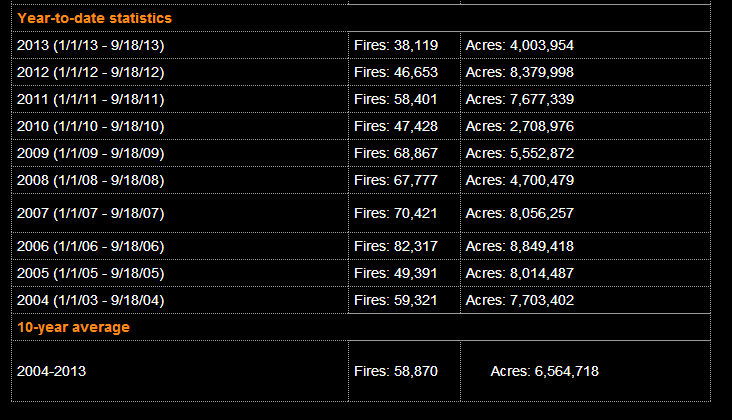
Maybe the data does not exist. But in fact it does, and I will say there is absolutely no way, no way, the author has not seen the data. The reason it is not in this article is because it does not fit the “reporters” point of view so it is left out. Here is where the US government tracks fires by year, at the National Interagency Fire Center. To save you clicking through, here is the data as of this moment:

Wildfire averages 2004-2013

Well what do you know? The number of fires and the acres burned in 2013 are not some sort of record high — in fact they actually are the, respectively, lowest and second lowest numbers of the last 10 years. In fact, both the number of fires and the total acres burned are running a third below average.

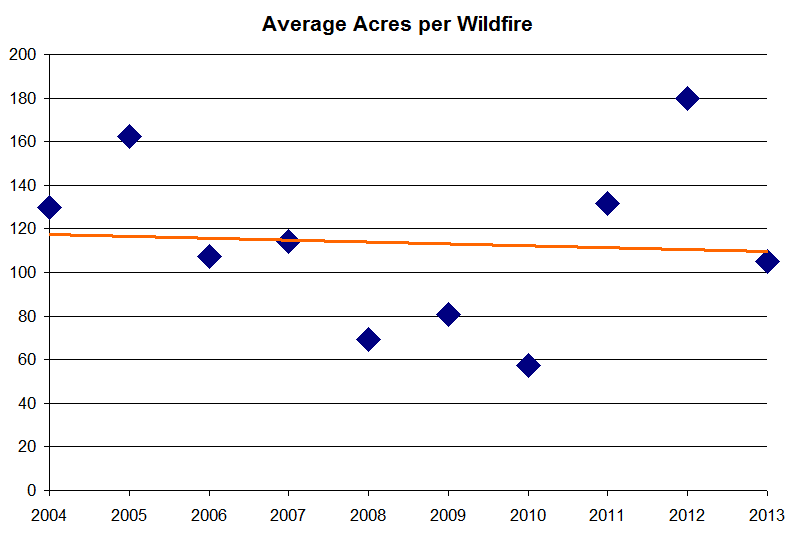
The one thing this does not address is the size of fires. The author implies that there are more fires burning more acres, which we see is clearly wrong, but perhaps the fires are getting larger? Well, 2012 was indeed an outlier year in that fires were larger than average, but 2013 has returned to the trend which has actually been flat to down, again exactly opposite of the author’s contention (data below is just math from chart above)

Wildfires average acres per fire 2004-2013

In the rest of the post, I will briefly walk through his 8 statements highlighted above and show why they exhibit many of the classic fallacies in trying to assert a trend where none exists. In the postscript, I will address one other inconsistency from the article as to the cause of these fires which is a pretty hilarious of how to turn any data to supporting your hypothesis, even if it is unrelated.

September 20, 2013

The IPCC’s new, more cautious tone

Filed under: Environment, Media, Science — Tags: , , , , — Nicholas @ 07:41

In The Spectator, a muted tone of “we told you so” about the upcoming IPCC report:

Next week, those who made dire predictions of ruinous climate change face their own inconvenient truth. The summary of the fifth assessment report by the Intergovernmental Panel on Climate Change (IPCC) will be published, showing that global temperatures are refusing to follow the path which was predicted for them by almost all climatic models. Since its first report in 1990, the IPCC has been predicting that global temperatures would be rising at an average of 0.2° Celsius per decade. Now, the IPCC acknowledges that there has been no statistically significant rise at all over the past 16 years.

It is difficult to over-emphasise the significance of this report. The IPCC is not simply a research body making reports and declarations which are merely absorbed into political debate. Its word has been taken as gospel, and its research has been used to justify all manner of schemes to make carbon-based energy more expensive while subsidising renewable energy.

The failure of its predictions undermines the certainties which have been placed upon the science of climate change. Previous IPCC reports — and much of the debate over how to react to them — have appeared to treat the Earth’s climate as if it were a domestic central heating system, with carbon emissions analogous to the dial on the thermostat: a small tweak here will result in a temperature rise of precisely 0.2°C and so on. What is clear from the new IPCC report is that the science is not nearly advanced enough to make useful predictions on the future rise of global temperatures. Perhaps it never will be.

Some climate scientists themselves, to give them credit, have admitted as much. Their papers now incorporate a degree of caution, as you would expect from genuine scientists. The problems arise when the non-scientists leap upon the climate change bandwagon and assume that anything marked ‘science’ must be the final word. As the chemist and novelist C.P. Snow once warned in his lecture about the ‘two cultures’, you end up in a situation where non-scientists use half-understood reports to silence debate — not realising that proper science welcomes refutation and is wary of the notion of absolute truths.

August 17, 2013

Fracking and the environment

Filed under: Environment, Media, Technology — Tags: , , , , — Nicholas @ 09:03

Matt Ridley debunks five common myths about environmental issues with fracking:

The movie Gasland showed a case of entirely natural gas contamination of water and the director knew it, but he still pretended it might have been caused by fracking. Ernest Moniz, the US Energy Secretary, said earlier this month: “I still have not seen any evidence of fracking per se contaminating groundwater.” Tens of thousands of wells drilled, two million fracking operations completed and not a single proven case of groundwater contamination. Not one. It may happen one day, of course, but there’s few industries that can claim a pollution record that good.

Next comes the claim that shale gas production results in more methane release to the atmosphere and hence could be as bad for climate change as coal. (Methane is a more powerful greenhouse gas than carbon dioxide, but stays in the atmosphere for a shorter time and its concentration is not currently rising fast.) This claim originated with a Cornell biology professor with an axe to grind. Study after study has refuted it. As a team from Massachusetts Institute of Technology put it: “It is incorrect to suggest that shale gas-related hydraulic fracturing has substantially altered the overall [greenhouse gas] intensity of natural gas production.”

Third comes the claim that fracking uses too much water. The Guardian carried a report this week implying that a town in Texas is running dry because of the water used for fracking. Yet in Texas 1% of water use is for fracking, in the United States as a whole 0.3% — less than is used by golf courses. If parts of Texas run out of water, blame farming, by far the biggest user.

Fourth, the ever-so-neutral BBC in a background briefing this week described fracking as releasing “hundreds of chemicals” into the rock. Out by an order of magnitude, Auntie. Fracking fluid is 99.51% water and sand. In the remaining 0.49% there are just 13 chemicals, all of which can be found in your kitchen, garage or bathroom: citric acid (lemon juice), hydrochloric acid (swimming pools), glutaraldehyde (disinfectant), guar (ice cream), dimethylformamide (plastics), isopropanol (deodorant), borate (hand soap); ammonium persulphate (hair dye); potassium chloride (intravenous drips), sodium carbonate (detergent), ethylene glycol (de-icer), ammonium bisulphite (cosmetics), petroleum distillate (cosmetics).

As for earthquakes, Durham University’s definitive survey of all induced earthquakes over many decades concluded that “almost all of the resultant seismic activity [from fracking] was on such a small scale that only geoscientists would be able to detect it” and that mining, geothermal activity or reservoir water storage causes more and bigger tremors.

(more…)

July 31, 2013

“What LEED designers deliver is what most LEED building owners want – namely, green publicity, not energy savings”

Filed under: Business, Environment, Media, USA — Tags: , , , — Nicholas @ 10:24

A bit of LEED debunking at The New Republic:

When the Bank of America Tower opened in 2010, the press praised it as one of the world’s “most environmentally responsible high-rise office building[s].” It wasn’t just the waterless urinals, daylight dimming controls, and rainwater harvesting. And it wasn’t only the Leadership in Energy and Environmental Design (LEED) Platinum certification — the first ever for a skyscraper — and the $947,583 in incentives from the New York State Energy Research and Development Authority. It also had as a tenant the environmental movement’s biggest celebrity. The Bank of America Tower had Al Gore.

The former vice president wanted an office for his company, Generation Investment Management, that “represents the kind of innovation the firm is trying to advance,” his real-estate agent said at the time. The Bank of America Tower, a billion-dollar, 55-story crystal skyscraper on the northwest corner of Manhattan’s Bryant Park, seemed to fit the bill. It would be “the most sustainable in the country,” according to its developer Douglas Durst. At the Tower’s ribbon-cutting ceremony, Gore powwowed with Mayor Michael Bloomberg and praised the building as a model for fighting climate change. “I applaud the leadership of the mayor and all of those who helped make this possible,” he said.

Gore’s applause, however, was premature. According to data released by New York City last fall, the Bank of America Tower produces more greenhouse gases and uses more energy per square foot than any comparably sized office building in Manhattan. It uses more than twice as much energy per square foot as the 80-year-old Empire State Building. It also performs worse than the Goldman Sachs headquarters, maybe the most similar building in New York — and one with a lower LEED rating. It’s not just an embarrassment; it symbolizes a flaw at the heart of the effort to combat climate change.

[…]

“What LEED designers deliver is what most LEED building owners want — namely, green publicity, not energy savings,” John Scofield, a professor of physics at Oberlin, testified before the House last year.

Governments, nevertheless, have been happy to rely on LEED rather than design better metrics. Which is why New York’s release of energy data last fall was significant. It provided more public-energy data for a U.S. city than has ever existed. It found the worst-performing buildings use three to five times more energy per square foot than the best ones. It also found that, if the most energy-intensive large buildings were brought up to the current seventy-fifth percentile, the city’s total greenhouse gases could be reduced by 9 percent.

June 27, 2013

How many “environmental” groups are actually harming the environment

Filed under: Economics, Environment, Media — Tags: , , , — Nicholas @ 00:01

Willis Eschenbach at Watts Up With That:

Now, given that poverty is the greatest threat to the global environment, the inescapable conclusion is that the only way the global environment stands a chance is if poor countries can develop economically.

And that is why the anti-development, pro-expensive energy stance of the large environmental NGOs is one of the great environmental tragedies of our times.

Here’s the chain of causality:

1. Climate alarmists, with the strong support of the major environmental NGOs like Greenpeace and WWF, declared war on CO2.

2. The method that they chose to fight CO2 was to discourage fossil fuel use by making energy more expensive, using a combination of taxation, legislation, international pressure, and expensive subsidies to achieve that end. Obama’s War on Coal, announced today, is just one of hundreds of examples of the wealthy NGOs and the rich governments working to increase the price of energy.

3. Since energy is development, expensive energy keeps poor countries in poverty. When the World Bank denies loans for coal fired plants in India, the poor suffer … but the environment suffers more. Until they can afford to use coal and gas, they’ll run the country on wood … I refer you back to Figure 1 for how well that works out.

4. Expensive energy slows a country’s economic development, and as President Obama pointed out, people worried about money don’t pay attention to the environment.

This ends up in a bizarre position—the actions of the major environmental NGOs are ensuring continued environmental destruction in the developing world.

June 22, 2013

The Economist on the cooling chances of major climate control legislation

Filed under: Environment, Government, Media, Science — Tags: , , — Nicholas @ 09:37

I was disappointed when The Economist switched sides to join the “consensus” on global warming and started arguing for massive government intervention in the economy to “save the planet”. Fifteen years after the last significant bout of warming, The Economist is starting to sound a bit more sensible (and skeptical):

…there’s no way around the fact that this reprieve for the planet is bad news for proponents of policies, such as carbon taxes and emissions treaties, meant to slow warming by moderating the release of greenhouse gases. The reality is that the already meagre prospects of these policies, in America at least, will be devastated if temperatures do fall outside the lower bound of the projections that environmentalists have used to create a panicked sense of emergency. Whether or not dramatic climate-policy interventions remain advisable, they will become harder, if not impossible, to sell to the public, which will feel, not unreasonably, that the scientific and media establishment has cried wolf.

Dramatic warming may exact a terrible price in terms of human welfare, especially in poorer countries. But cutting emissions enough to put a real dent in warming may also put a real dent in economic growth. This could also exact a terrible humanitarian price, especially in poorer countries. Given the so-far unfathomed complexity of global climate and the tenuousness of our grasp on the full set of relevant physical mechanisms, I have favoured waiting a decade or two in order to test and improve the empirical reliability of our climate models, while also allowing the economies of the less-developed parts of the world to grow unhindered, improving their position to adapt to whatever heavy weather may come their way. I have been told repeatedly that “we cannot afford to wait”. More distressingly, my brand of sceptical empiricism has been often met with a bludgeoning dogmatism about the authority of scientific consensus.

Of course, if the consensus climate models turn out to be falsified just a few years later, average temperature having remained at levels not even admitted to be have been physically possible, the authority of consensus will have been exposed as rather weak. The authority of expert consensus obviously strengthens as the quality of expertise improves, which is why it’s quite sensible, as matter of science-based policy-making, to wait for a callow science to improve before taking grand measures on the basis of it’s predictions.

As I wrote back in 2004, “I’ve never been all that convinced of the accuracy of the scientific evidence presented in favour of the Global Warming theory, especially as it seemed to play rather too clearly into the hands of the anti-growth, anti-capitalist, pro-world government folks. A world-wide ecological disaster, clearly caused by human action, would allow a lot of authoritarian changes which would radically reduce individual freedom and increase the degree of social control exercised by governments over the actions and movement of their citizenry.”

May 15, 2013

Canadians’ hypocrisy on climate change

Filed under: Cancon, Environment, Politics — Tags: , , , — Nicholas @ 00:01

Stephen Gordon fired off a tweetstorm yesterday:

April 19, 2013

Enviro-Apocalypse Now (or real soon, anyway)

Filed under: Books, Environment, Media — Tags: , , — Nicholas @ 09:17

At sp!ked, Tim Black reviews the latest environmental doom-mongering tome from Andrew Simms:

All of this ought to leave Simms & Co looking like the boys who cried climate catastrophe. Yet somehow, as Cancel the Apocalypse shows, they are continuing, unabashed, to preach environmental doom despite its palpable absence. In fact, the hyper-pessimism has even been ramped up a bit. ‘The horsemen are galloping and there are more than four of them’, Simms chirrups. ‘Climate change, financial meltdown, the global peak and decline of oil production, a mass extinction event of plant and animal species, overuse of fresh water supplies, soil loss, economic infrastructure increasingly vulnerable to external shocks — it’s the age of the complex super disaster.’ It seems devastating climate change is no longer enough for Simms; he wants to solicit a whole host of other unrelated, and highly debatable, phenomena for his narrative of woe. Cancelled? No way, Simms chortles: the apocalypse is back on.

So how is Simms able to maintain his unshakeable belief in our imminent destruction? What makes him and his tweedy, right-on puritan mates different to, say, William Miller, founder of the Second Adventists (later to become the Seventh Day Adventists), who, as Simms tells us, believed the day of reckoning would fall in 1843, 1845, 1846, 1849, 1851, 1874 and 1999?

The ostensible answer is that whereas previous doomsayers derived their predictions from ‘gobbledygook floating up from patterns of words and numbers dimly discerned in books about faith and belief’, Simms and his followers rely upon ‘verifiable scientific experiment’. Of course, The Science.

Which is funny, because Cancel the Apocalypse does not contain much in the way of ‘verifiable scientific experiment’. What it does feature, though, is a scientistic use of the authority of science to justify a whole range of dubious assertions. In Simms’ hands, science is no longer science. It is a metaphor, an authority-bolstering gloss, allowing him to talk, for example, of socio-historical phenomena such as the economy in terms of the laws of nature: ‘Just as physical laws constrain the maximum efficiency of a heat engine’, he writes, so ‘economic growth is constrained by the finite nature of our planet’s natural resources, the variable but ultimately bounded biocapacity of its oceans, fields, geology and atmosphere’; and later on, ‘the laws of physics mean it is not possible to create the order of such [economic] exchanges without a little something being lost [Simms is referring to the biosphere]’.

March 28, 2013

British energy prices graphically explained

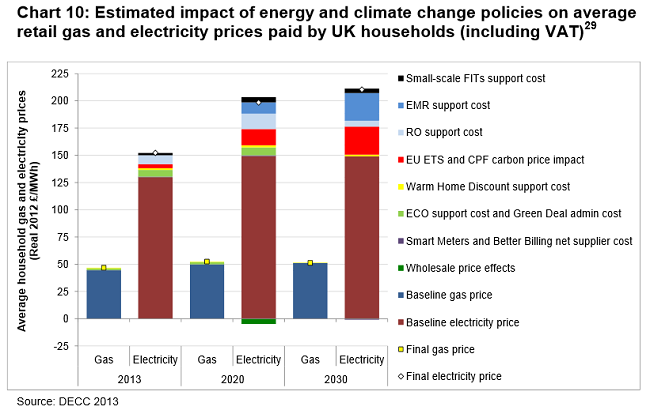
At The Register, Lewis Page debunks the propaganda from the government and shows the cost components of British energy prices from the government’s own published source:

The government’s Department of Energy and Climate Change, with the current minister as mouthpiece, has just pushed out a report claiming that its green policies are saving us money now and will save us even more in coming decades. Can it be true? We can save the planet — or anyway reduce carbon emissions — and it not only costs nothing, but puts money in our pockets?

In a word, no: of course not. If that was true there would be no need for government action, we’d be acting to reduce carbon emissions on our own. And indeed, once you skip the foolish tinned quotes and bogo-stats in the executive summary, the report itself makes it very clear that in fact green policies are already to blame for most of the sustained climb in electricity prices we’ve suffered over the past decade — and that it’s going to get a lot worse.

The blue and brown bars are what you would pay without green intervention. The rest is thanks to the greens.

The blue and brown bars are what you would pay without green intervention. The rest is thanks to the greens.

So there you are, plain as day. The various green interventions in the UK and EU energy markets which have come in since the turn of the century are already costing you a hefty sum — the government have already forced up the price you pay for electricity today by nearly 20 per cent over where it would have been if they’d left matters alone. If they carry on as planned, by the year 2030 they will have managed to drive it up by more than a third over where it would normally be.

March 23, 2013

Human Achievement Hour 2013

Oh, right. It’s once again time for the Gaia-worshippers to do an hour’s penance for the crime of being alive in an industrialized society. The Competitive Enterprise Institute proposes a different way of using that hour:

On Saturday, March 23 at 8:30pm (local time), some people, businesses and governments around the world will choose to sit in the dark for one hour as a symbolic gesture to take action against climate change. The organizers of Earth Hour say that they [no] longer expect energy use to actually drop during the hour, but instead see it as a way for people to show their commitment to reducing energy use and taking action beyond the hour.

It’s absolutely every person’s right to decide if they want to conserve energy for whatever reason; they are free to sit in the dark as long as they want. However, it should not be their right to impose their beliefs or opinions on others. And that is what is at the heart of the environmentalist movement. While many participants in Earth Hour sincerely want a cleaner environment — a desire most of us share — the environmentalist movement whether implicitly or explicitly seeks to clamp down on human progress by reducing energy consumption whether through regulation and taxation. They want to make fossil fuels, which they see as dirty, more expensive to encourage the use of renewable “greener” energies.

Despite any good intentions, the ultimate result of environmentalist policies is not a healthier, cleaner environment. Instead we will see a population that is sicker and poorer. The only way we achieve technology that is “greener” is by building on older “dirtier” technology. As we make it harder and more expensive for those in the business of creating new technologies, all we do is slow progress and make it that much longer to reach more environmentally friendly solutions.

January 24, 2013

Is the media’s love affair with “extreme weather” just an elaborate insurance scam?

Terence Corcoran in the Financial Post:

All it takes these days is a little normal January Canadian cold spell and all of a sudden the nation is plunged into a frenzy of chatter about “extreme weather.” The CBC led the way, aided and abetted by climate alarmists in the Canadian insurance industry, with help from an apparently leaked data point from an Environment Canada report that supposedly will show that Canadian winters are now 3.2C warmer than they used to be. Get it? It’s really cold, but that’s because of climate change, which is making Canada’s winters warmer.

If you find this confusing, well, get used to it. That may even be part of the objective, which, judging by the sudden extreme flood of media reports, seems to be keep Canada’s population agitated about global warming, a cause that has so far failed to ignite voters.

If the theory of climate change doesn’t grab people, maybe “extreme weather” will. The media certainly love it. All News Radio in Toronto now has an “Extreme Weather Centre” that rouses itself every time weather happens — snow storms, cold spells, heat waves, rain, temperature anomalies. Alarmist weather forecasting and reporting is a media staple, but the concept now appears to have reached a new level of hypedom.

[. . .]

The insurance angle was cleverly juxtaposed with a leaked bit of data from an Environment Canada report that will not be released until May. It supposedly will show that Canadian winter temperatures have risen 3.2C since Canada began keeping systematic records in 1948. As a standalone bit of data, not much can be made of it. Even less can be made of it for popular consumption if current temperatures are approaching record cold. How can we have record warm and record cold at the same time?

That’s where “extreme weather” comes in. It’s also where the Canadian insurance industry, through a front group called the Institute for Catastrophic Loss Reduction, is actively promoting extreme weather as a major vehicle for business and policy development. With offices in Toronto and the University of Western Ontario, the institute’s membership is almost exclusively insurance companies, its eight-member board is stacked with five insurance executives, and the executive director is Paul Kovacs, is former head of the Insurance Bureau of Canada.

December 12, 2012

Climatic witchcraft

No offense intended to practitioners of witchcraft intended:

Superstition about the weather in particular is hardly surprising, given the awesome power of nature. Witnessing storms, lightning and even the daily rising and setting of the sun surely induced fear and wonder in primitive cultures. The same fear and wonder are what warmists exploit today in linking weather extremes to global warming.

Scholars tell us that weather superstition often found expression in ritual human sacrifice. The Mayans, for instance, tossed victims into a limestone sinkhole to appease the rain god Chaac.

And it’s only a few centuries since superstition over the climate led to intensive witch hunts and widespread executions, usually by burning, for witchcraft.

University of Chicago economist Emily Oster demonstrated in 2004 that the most active era of witchcraft trials in Europe coincided with the Little Ice Age. Since then, other researchers have argued that chilly weather may have precipitated the Salem witch trials in the 1690s — one of the coldest periods of that epoch.

It was widely believed during the late Middle Ages that witches were capable of controlling the weather with their magic powers, and thus cause storms that could destroy harvests and hobble food production.

[. . .]

Our obsession with weather extremes has reached such heights that it has become a knee-jerk reaction for climate-change alarmists to ascribe any unusual weather event at all to global warming. So they tell us that heat waves, floods, harsh winters, dust storms — even wildfires — are all the result of man-made CO2. But a check of records from, say, the 1930s or the 1950s, when the CO2 level was much lower than now, reveals that such events are nothing new.

Climate-change skeptics might be regarded as modern-day witches because they think that global warming comes from natural forces. However, it’s superstitious alarmists, who believe that extreme weather originates in our CO2 emissions and who have a dread of impending disaster, who are really the witches.

December 5, 2012

The Doha climate change conference is “like an absurdist flash mob”

Filed under: Environment, Media, Middle East, Politics — Tags: , , , , — Nicholas @ 09:33

Rob Lyons explains why the current meeting in Doha isn’t getting the same media love that earlier conferences have been able to depend upon:

It’s like a fly banging its head against a window pane, desperately trying to get to the other side and uncomprehending as to why it never succeeds. Except this is a 17,000-strong swarm of flies taking part in its annual exercise in futility. Yes, there’s another UN climate conference going on, though you might well have missed it.

The eighteenth Conference of the Parties to the UN Framework Convention on Climate Change — there’s a good reason they call it COP18 — is taking place in Doha, the capital of Qatar. The small Arab state is, by some measures, the richest country in the world per head of population, a position built on the fact that it has the third-largest reserves of natural gas in the world. The conference has been running since 26 November and is due to end on Friday. But no one is predicting any kind of dramatic deal.

Which is a bit of a problem for those who run this peculiar show because another thing that ends soon is the Kyoto Protocol. Signed 15 years ago in Japan, the protocol aimed to reduce greenhouse gas emissions in 37 industrialised countries and the EU to a level five per cent below 1990 levels for the period from 2008 to 2012. There’s no sign of a replacement — which, to be meaningful, really needs to include big developing countries like China, India and Brazil — just endless talks about talks. At last year’s event — COP17 in Durban, South Africa — there was an agreement to negotiate a ‘protocol, legal instrument, or an agreed outcome with legal force applicable to all Parties’ by 2015, to take effect by 2020. As a Greenpeace representative bemoaned then: ‘Right now the global climate regime amounts to nothing more than a voluntary deal that’s put off for a decade.’

It’s all a far cry from the Copenhagen talks in 2009. US president Barack Obama agreed to attend, which meant that there was real anticipation of a major deal. Yet Obama came and Obama went, and nothing of substance was agreed. And so the process has trundled on in its own, other-worldly way. COP18 sees thousands of the kind of people who think we’re screwing up the planet by flying around the world, flying around the world in order achieve bugger all in a country, Qatar, made rich by the very fossil fuels the delegates want left in the ground. It’s like an absurdist flash mob.

November 19, 2012

Hurricane Sandy, storm surges, and superstition

In sp!ked, Dominic Standish looks at how some recent extreme weather incidents are being attributed to climate change/global warming without sufficient scientific evidence:

Hurricane Sandy brought havoc in the Caribbean, especially Haiti, and caused approximately 60 deaths. Then the storm hit the US east coast; New York experienced exceptional floods and at least 40 people lost their lives. Next, Venice in Italy witnessed high flooding on 11 November, when the city’s tide measurements reached their sixth-highest level for 140 years. No one died from these floods in Venice, but — like Haiti and New York — the economic impact was significant.

Global warming was widely blamed for the flooding, yet in all three cases flooding was principally caused by storm surges. In the Caribbean and America, there was an unfortunate convergence of weather systems creating storm surges. As Hurricane Sandy swirled north in the Atlantic and towards land, a wintry storm headed towards it from the West and cold air was blowing south from the Arctic. After the hurricane devastated parts of the Caribbean, it moved towards the north-east of the US, pushing water up the estuaries of New York into the city. Venice’s floods were unconnected to Hurricane Sandy, but were also caused by high winds creating storm surges pushing water through the three inlets between the sea and the Venetian lagoon towards the city. Subsidence over the past century has made Venice more susceptible to storm surges. Nevertheless, after 70 per cent of Venice was under water on 11 November, Italy’s environment minister, Corrado Clini, insisted that global climate change was to blame.

Although storm surges were the cause of the floods in all three locations, global warming was widely identified as the culprit. Of course, we cannot ignore climate change. The Intergovernmental Panel on Climate Change (IPCC) established in 2007 that there was a global temperature rise of 0.74 degrees Celsius between 1906 and 2005, which added to global sea levels rising by an average rate of 1.8 millimetres per year from 1961. We need to have an open debate about climate change and its relationship with bad weather events. Some argue that climate change has increased hurricanes and storm surges, while others suggest there is insufficient evidence to prove this link. Whether climate change impacts on the frequency and strength of hurricanes remains uncertain, yet global warming has definitely been deployed as a superstitious narrative to close down discussion.

Update: Of course, the storm damage will eventually repaired and the federal government will pay the lion’s share of the costs. This is one of the bigger causes of rising costs due to storm damage along the US coastline: properties that are more exposed to damage keep getting rebuilt. Here’s an example from Dauphin Island, Alabama:

The western end of this Gulf Coast island has proved to be one of the most hazardous places in the country for waterfront property. Since 1979, nearly a dozen hurricanes and large storms have rolled in and knocked down houses, chewed up sewers and water pipes and hurled sand onto the roads.

Yet time and again, checks from Washington have allowed the town to put itself back together.

Across the nation, tens of billions of tax dollars have been spent on subsidizing coastal reconstruction in the aftermath of storms, usually with little consideration of whether it actually makes sense to keep rebuilding in disaster-prone areas. If history is any guide, a large fraction of the federal money allotted to New York, New Jersey and other states recovering from Hurricane Sandy — an amount that could exceed $30 billion — will be used the same way.

Tax money will go toward putting things back as they were, essentially duplicating the vulnerability that existed before the hurricane.

« Newer PostsOlder Posts »

Powered by WordPress