
Apart from the different philosophical status they assigned to reason and virtue, the one issue where the contrast between the British and French Enlightenments was sharpest was in their attitudes to the lower orders. This is a distinction that has reverberated through politics ever since. The radical heirs of the Jacobin tradition have always insisted that it is they who speak for the wretched of the earth. In eighteenth-century France, they claimed to speak for the people and the general will. In the nineteenth century, they said they represented the working classes against their capitalist exploiters. In our own time, they have claimed to be on the side of blacks, women, gays, indigenes, refugees, and anyone else they define as the victims of discrimination and oppression. Himmelfarb’s study demonstrates what a façade these claims actually are.
The French philosophes thought the social classes were divided by the chasm not only of poverty but, more crucially, of superstition and ignorance. They despised the lower orders because they were in thrall to Christianity. The editor of the Encyclopédie, Denis Diderot, declared that the common people had no role in the Age of Reason: “The general mass of men are not so made that they can either promote or understand this forward march of the human spirit.” Indeed, “the common people are incredibly stupid,” he said, and were little more than animals: “too idiotic — bestial — too miserable, and too busy” to enlighten themselves. Voltaire agreed. The lower orders lacked the intellect required to reason and so must be left to wallow in superstition. They could be controlled and pacified only by the sanctions and strictures of religion which, Voltaire proclaimed, “must be destroyed among respectable people and left to the canaille large and small, for whom it was made.”
Keith Windschuttle, “Gertrude Himmelfarb and the Enlightenment”, New Criterion, 2020-02.
May 6, 2020
QotD: The French philosophes and the “lower orders”
March 26, 2020
QotD: “Gammon”
Who voted Labor? Recent immigrants. University students. Urban professionals. The wealthy and the near wealthy. People who make their living by slinging words and images, not wrenches or hammers. Other than recent immigrants, the Labor voting base is now predominantly elite.
This is the Great Inversion – in Great Britain, Marxist-derived Left politics has become the signature of the overclass even as the working class has abandoned it. Indeed, an increasingly important feature of Left politics in Britain is a visceral and loudly expressed loathing of the working class.
To today’s British leftist, the worst thing you can be is a “gammon”. The word literally means “ham”, but is metaphorically an older white male with a choleric complexion. A working-class white male, vulgar and uneducated – the term is never used to refer to men in upper socio-economic strata. And, of course, all gammons are presumed to be reactionary bigots; that’s the payload of the insult.
Catch any Labor talking head on video in the first days after the election and what you’d see is either tearful, disbelieving shock or a venomous rant about gammons and how racist, sexist, homophobic, and fascist they are. They haven’t recovered yet as I write, eleven days later.
Observe what has occurred: the working class are now reactionaries. New Labor is entirely composed of what an old Leninist would have called “the revolutionary vanguard” and their immigrant clients. Is it any wonder that some Laborites now speak openly of demographic replacement, of swamping the gammons with brown immigrants?
It would be entertaining to talk about the obvious parallels in American politics – British “gammons” map straight to American “deplorables”, of course, and I’m not even close to first in noticing how alike Donald Trump and Boris Johnson are – but I think it is more interesting to take a longer-term view and examine the causes of the Great Inversion in both countries.
Eric S. Raymond, “The Great Inversion”, Armed and Dangerous, 2019-12-23.
March 1, 2020
“When you’re driving a fancy car, you’re an avatar for everyone else’s bad boss, useless trust-fund roommate, or absent workaholic father”
At Car and Driver, Ezra Dyer confirms what most of us already suspected about the folks who drive expensive rides:

Excuse us if you’ve already devoured the latest volume of the Journal of Transport & Health, but the March issue contains the results of a novel experiment that tested a cherished automotive stereotype. The study is entitled “Estimated Car Cost as a Predictor of Driver Yielding Behavior for Pedestrians,” but you can think of it as, “Are BMW drivers really jerks or what?”
Okay, so it was more nuanced than that. The authors of the study sent four pedestrians — black female, black male, white female, white male — to crosswalks in the Las Vegas area to see how many drivers would yield. The overall results were pretty dismal, with a yield rate of only about 28 percent out of 461 cars. Cars yielded more often to female and white pedestrians than male and nonwhite pedestrians, although not enough either way to register as statistically significant. The only factor that consistently predicted yielding behavior was the value of the car. Notably, the study’s authors estimated the book value on all 461 cars, so the 2004 Mercedes S-class that’s worth $5000 didn’t get ascribed automatic snob appeal.
[…]
However, if you’re driving an actual exotic, something way far up the food chain, behavior changes again. Everyone yields to the Rolls or the Lambo because cars like that are so over the top, they make you interesting by association. Plus: most people don’t know anybody with a car like that; thus they can’t associate it with anyone awful. The ultra-expensive car, and the driver, are a curiosity. What’s that guy’s deal? He probably invented that fake grass that goes between the pieces of sushi. And good for him! But the guy in the 911? He can wait an extra two turns at the four-way intersection. Probably deserves it.
Our not-scientific conclusions: If you expect fellow road users to demonstrate courtesy, you should drive either a 1984 Renault Alliance or a Lamborghini Aventador SVJ roadster. But either way, and to everybody in between: Yield at the damn crosswalks.
July 10, 2019
Liberals: “vote for us, you ignorant, uneducated conservative plebians!”
Andrew Coyne sneaks in a literary quote from Chesterton on the eternal snobbery of the not-so-hidden class war in Canadian politics:
Democracy, in G. K. Chesterton’s careful definition, means government by the uneducated, “while aristocracy means government by the badly educated.”
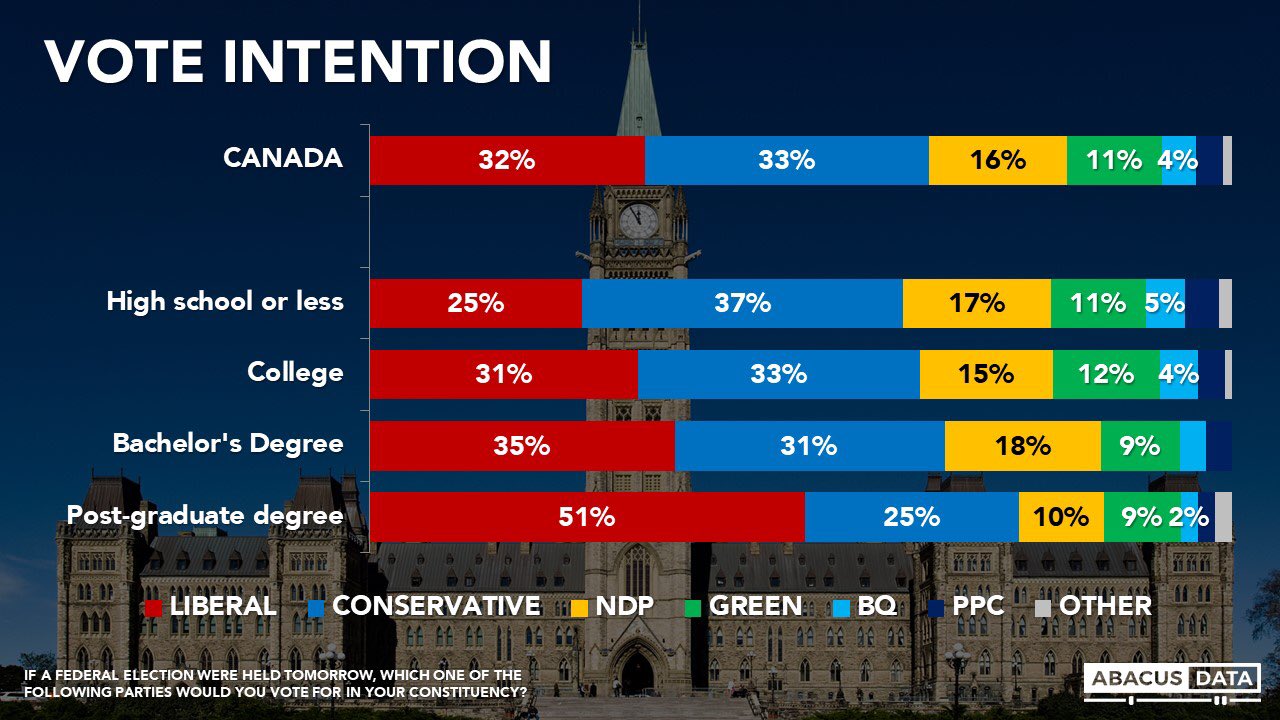
The enduring value of this distinction was suggested by the ruckus stirred up over the weekend by Amir Attaran, professor of law at University of Ottawa. Responding to a recent Abacus Data poll finding the Tories leading the Liberals by a wide margin among Canadians with a high school diploma or less, with the Liberals ahead among those with bachelor degrees or higher, the professor tweeted: “The party of the uneducated. Every poll says this.”
In the ensuing furor, Attaran tried to protest that he was just stating a fact, but the disdain in the tweet was clear enough to most. For their part, while some Tories quibbled with the data (just one poll, within the margin of error, misplaced correlation etc), most seemed less offended by the sentiment — every poll does show the less formal education a voter has, the more likely they are to support the Conservatives — than by the suggestion there was something shameful about it.
It was, in short, another skirmish in the continuing class war: class, now defined not by occupation or birth, as in Chesterton’s time, but by education. Conservatives, true to form, professed outrage at this arrogant display of Liberal elitism, while Liberal partisans protested that they were not snobs, it’s just that Conservatives are such ignorant boobs (I paraphrase).
The professor compounded matters by objecting, not only that he is not a Liberal, but that he is not an elite, since his parents were immigrants. And everyone did their best to be as exquisitely sensitive (“let us respect the inherent dignity of labour”) as they could while still being viciously hurtful (“not uneducated, just unintelligent”).
At the Post Millennial, Joshua Lieblein describes his initial reaction followed by sober second thoughts:
When I read the following condescending tweets from University of Ottawa professor Amir Attaran, my first thought was, “Well, somehow he wasn’t educated enough to predict this reaction. What did he expect?”
[…]
And then I realized that I wasn’t giving him enough credit. Professor Attaran knew exactly what to expect.
Professor Attaran wants you to read his unsolicited and deliberately insulting tweets. He wants you to talk about the tight links between the polling firm that provided him with his QUOTATION and the Liberal Party of Canada. He wants you to hurl all kinds of abuse at him.
Then, he and others will go through the pile of invective generated by this Sunday evening musing, pick out the most racist and inflammatory takes, and use them to justify the idea that facts are under assault, that minorities cannot speak out on issues of the day in Canada, that Conservatives don’t believe in freedom of speech, and that “right-wing mobs” exist and are being directed by CPC thought leaders.
It’s not like this is a new phenomenon, or something that’s new to Canada. Did you think all of Trudeau’s ridiculous behaviour was spontaneous? Sure, some of it is. The man is a certifiable moron. But we really should have guessed that we were being played for fools by the time he was doing shirtless photobombs of weddings.
July 3, 2019
Canada’s “elite”
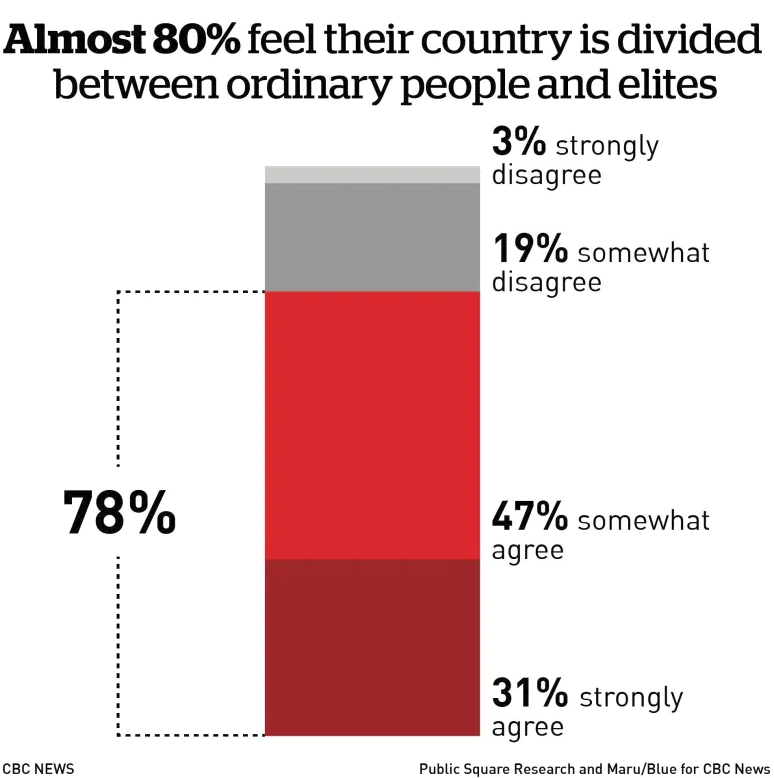
Jay Currie responded to a CBC article on a recent poll that found “nearly 80 per cent of Canadians either strongly or somewhat agree with the statement: ‘My country is divided between ordinary people and elites’.”
The CBC interviewee, Tony Laino, at Fordfest, said describing elites, “Those that think they’re better than me,” he said. “Because I don’t espouse their beliefs.”
Which misses the point. Elites really don’t think of guys like Tony Laino at all. Largely because, as Charles Murray points out in Coming Apart, the new upper class rarely, if ever, meets the Tony Lainos of the world. Murray was writing about white people in America but much the same social bi-furcation is taking place in Canada. Murray looks at education, wealth, marriage, access and what he refers to as the rise of the super-zips, areas where highly educated, well connected, well off people live with others of their class and kind. It is an accelerating phenomenon in the US and it is plainly visible in Canada. Murray quotes Robert Reich as calling this, “the segregation of the successful”.
Inside elite communities “the issues” look very different than they do in the more pedestrian parts of the country. A few pennies extra for gas or heating oil or natural gas to fight the universally acknowledged menace of “climate change” makes perfect sense if your income is in the hundreds of thousands of dollars a year. It is downright terrifying if you are making $50K. Only bigots and racists could be anti-imigration when you, yourself, live in virtually all white, old stock, Canadian enclaves and welcome refugees and migrants who you will never see.
The populist moment has not yet come to Canada and, if Andrew Scheer’s brand of Liberal lite wins in October, there will probably be another decade of elite consolidation before a proper populist movement gets off the ground. Whether it will be right populism a la Trump and Farange, or left populism with a firebrand NDP leader, is hard to say. However, as the Canadian elite grows more insular and disconnected from the ordinary life of Canada and Canadians, that populist moment draws closer.
April 20, 2019
QotD: They used to be called the Jet Set, but now they’re the Transnational Elite
… there is a certain level of pride that attaches to being ignorant of those one considers his inferiors. After all, it’s the natural duty of the simple shopkeeper to know the names of the Great Lords, but it is not the duty of the Great Lords to know the names of the shopkeepers. In fact, it’s the Great Lords’ class obligation to go out of their way not to know the names of the shopkeepers, because this Duty to Know flows in one direction — upwards — and hence ignorance of one’s lessers tends to solidify and reify the assumptions of certain castes being superior to others. It makes certain that everyone understands who’s important, and who’s not.
(I know, I sound like a communist — I can’t help it. I have to agree with Dennis the Peasant — “I mean, class is what it’s all about.” I guess I would say I’m agreeing with the communist critique of the rigid reification of class structures, but I happen to think the communists and their pink fellow travelers have largely captured the upper classes. I guess by my theory they’re so good at this because they’ve spent so long plotting vengeance for the exact same slights (which they largely imagined). In a similar way they’ve gotten quite good at blacklisting and guilt-by-association, eh?)
At any rate, it is your duty to know the values and customs of living of Piers Morgan, but due to his high station (ahem) he is proudly ignorant of yours. As is so often the case in our increasingly dysfunctional and nasty politics — in which certain parties refuse to even admit that their opponents are free citizens entitled to have beliefs at all — the Out-Classes are deemed all-but-officially Beneath Notice.
Michael Totten has written a crackerjack piece — or at least I think it is — about this principle in action among our foreign policy sages, the internationalist “elite.” He detects the exact same sort of phenomenon going on when the International “elite” visit foreign nations — because anyone who doesn’t share 90% of their cultural values (and the wealth that permits/encourages these values — the International Elite is not middle-class!) is beneath notice and not worth knowing about, they don’t bother asking anyone but the 3% of the population which largely shares their beliefs and cultural inputs about their intentions and their political agenda.
Which means, in Egypt, they only ask the jet-setting wealthy Westernized elite about the prognosis for Egyptian democracy. And in Lebanon, they only ask the educated, urbane population of Beirut about their desires for the country.
And they ignore all the “Dirty People,” the low people who aren’t worth networking with and probably wouldn’t be any fun to have a sexual affair with. Unfortunately — and this has huge consequences for American foreign policy — it turns out those Dirty Poor People greatly, greatly outnumber the small coteries of educated elites that cluster in every capital country.
And so our “elites” — and honestly, we need to start looking for a more accurate discriptor — come back with completely-wrong information about foreign countries.
Why, as Totten says (changing the words a bit), “All of these Egyptians are swell, educated, moderate, sexually-loose cosmopolitans! Why, democracy has a smashing chance of working out here!”
Yeah, not so much. Not so much.
Ace, “The Unburstable Bubble of Willful Ignorance of the International Self-Purported Elites”, Ace of Spades H.Q., 2013-01-09.
October 12, 2017
Britain’s Old Boy Network – from “the Establishment” to “the Embarrassment”
In the media rounds supporting his new book, The Square and the Tower: Networks, Hierarchies and the Struggle for Global Power, Niall Ferguson discusses the decline and fall of the oldest power network in Britain:
It used to be that the United Kingdom of Great Britain and Northern Ireland was the United Cronydom of Great Poshhouse and Northern Grousemoor. The only network that mattered was the Old Boy Network. The OBN was formed by men who were the old boys of a tiny elite of boarding schools known as “public schools” because they were closed to the public. Most boys at those schools were scions of the aristocracy or the landed gentry: future barons and baronets.
Even if thick to the point of educational sub-normality, these young gentlemen would attend either Oxford or Cambridge. They would then be given one of the following jobs:
1. Estate manager and courtier (eldest son).
2. Foreign Office or Treasury mandarin (brightest son).
3. Cabinet minister (most extrovert son).
4. Governor of [insert Caribbean island] (youngest son).
5. BBC director-general (Left-wing son).
This is of course a caricature. In reality, there were all kinds of sub-networks — clusters — within the elite network that ran Britain. Sometimes, a brilliant group of talented young men would come together to achieve great things. There was the “Kindergarten” formed by Alfred Milner, which tried (and failed) to transform South Africa into a second Canada or Australia. There were the Apostles — the Cambridge Conversazione, the most exclusive intellectual club of all time — to which the economist John Maynard Keynes belonged.
However, with increasing frequency after 1945, the OBN’s achievements were less than brilliant. Suez. Wilson. Heath. Double-digit inflation. The three-day week. From being the winners of glittering prizes, the OBN degenerated in the eyes of a previously deferential public into the upper-class twits of the year.
In the Sixties the journalists Henry Fairlie and Anthony Sampson popularised the disdainful name that the historian A.J.P. Taylor had given the British elite: “The Establishment”. By the Seventies the Establishment were more like The Embarrassment — objects of sitcom ridicule. By the Eighties they had been almost entirely driven from the corridors of power. Nothing better illustrated this than the Thatcher governments: not only was the prime minister a woman from provincial Lincolnshire (albeit one with an Oxford degree); there were enough ministers in her Cabinet with Jewish backgrounds to inspire off-colour jokes about “Old Estonians”.
July 11, 2017
The 905’ers – “the bridge-and-tunnel barbarians at the city’s gate”
Sniffy Torontonians have apparently adopted the NYC snobs’ favourite term for out-of-towners:
Not satisfied by the socioeconomic barriers to fine dining, downtown gourmands imagine any behaviour not matching their arbitrary standards of etiquette to be uncouth, going so far as to label outsiders to their tribe with a distinct pejorative: “the bridge-and-tunnel crowd.”
Originally a derisive description for commuters to Manhattan (the earliest known instance of its use is found in the December 13th, 1977 edition of the New York Times), the term has been adopted by the inhabitants of urban centres across North America to further alienate outsiders. In Toronto, it is used interchangeably with “905er,” a reference to the common area code for the suburbs surrounding the city.
To fully grasp the classism and snobbishness inherent in the term’s use, one is best advised to revisit an episode of the second season of The Sopranos, in which an annoying bar patron in Manhattan refers to the well-meaning, but simple-minded Christopher as a “bridge-and-tunnel boy.”
There is much sense, but little grace, to the formulation of such a descriptor. The self-absorbed downtown-dweller, you see, requires constant justification for their choice of domicile. The idea that one could escape the claustrophobic propinquity of the city and its higher cost of living while still enjoying its cultural amenities and nightlife on occasion is an affront – a threat that undermines not only the urbanite’s domestic decision-making, but to some extent, their very identity.
[…]
That an expectation of sustenance from ordering food at a restaurant would be scoffed at represents, at least on some level, a misappropriation of values. Oh, yes: It’s definitely the suburbanite who balks at the $35 plate of deconstructed spaghetti who is the fool. Believe it or not, you can live in a home with a dual car garage and still watch Chef’s Table on Netflix – and even understand why one might travel to Chicago to experience a meal at Alinea. However, if a chef is offering a Saturday night prix fixe, they’re probably not Grant Achatz.
Furthermore, it seems that if only one side of the urban versus suburban divide must be labelled ill-mannered, it should be the allotment who greets the other for an economic infusion in their service sector with disdainful mockery. The summer is littered with festivals and three- to five-course restaurant specials purposely constructed as an invitation for out-of-towners to come and open their wallets, and yet, the derisiveness projected toward them suggests a suffix should be attached to the Field of Dreams axiom: if you build it, they will come … for you to disparage them.
June 8, 2017
QotD: The Cloud People look out upon the land of the Dirt People
In the French Revolution, after the White Terror, the Constitution of 1795 established The Directory. This was the start of a new phase in which the lower classes were mostly ignored, as the new ruling class consolidated its power. That may be what we are seeing with our managerial class as they largely ignore the results of recent elections and enforce discipline in their own ranks. It’s not a perfect analogy, but it may be useful in analyzing what we are seeing.
There is another angle, one you can see in this Scott Alexander post a few weeks ago, that was popular with the cognoscenti. Star Slate Codex is popular with people who not only think they are smart, but see themselves as steely-eyed reason machines. It’s also popular with people who like to believe stuff like this:
Yes, CNN leans liberal, but it’s not as liberal as FOX is conservative, and it’s not as open about it – it has a pretense of neutrality that FOX doesn’t, and although we can disagree about how realistic that pretense is I think few people would disagree that the pretense is there. Nor is there a liberal version of FOX that lacks that pretense of neutrality.
That’s a very believable argument if you have no familiarity with cable news or you look out at the world from deep inside the Progressive fever swamps. It is the sort of thing people write when they want to seem like the people who write things like this. It’s the worldview of someone confusing a mirror with a telescope. To Alexander, Fox is way out on the fringe and they are brazen about it. CNN, on the other hand, is maybe a little biased, but they are good people, my people, so they mean well.
Of course, there is the omnipresent hive mindedness. The world for Scott Alexander, and most of his readers, is a world of black hats and white hats. There are those inside the walls, the people of light, and the people outside the walls, in the outer darkness. The people outside are an undifferentiated collection of eyes peering out of the darkness, which is why they routinely misuse works like “conservative” when describing the people outside the walls. Words like “conservative” and “right-wing” just mean the outsiders.
The Z Man, “Ruminations On The Way Down The Mountain”, The Z Blog, 2017-05-24.
June 7, 2017
QotD: Blame America
Canadians love to compare themselves to Americans, for all kinds of reasons — to congratulate themselves, to flagellate themselves, to comfort themselves when they’re somewhat embarrassed. The “meanwhile in Canada” genre of tweets is a bit of all three: in the midst of chaos in Washington, someone will oh-so-cleverly take note of a comparatively minor Canadian scandal. There is no charitable interpretation to be made of it: it’s either bragging, or it’s suggesting that we worry too much about Canada’s ostensibly piddling scandals — like, say, the prime minister’s chief of staff cutting a $90,000 cheque to a sitting Senator. That’s not Watergate, but it’s bonkers nonetheless.
The effect is both to confuse the conversation about any given issue and to absolve Canadians of any responsibility for it. The ultimate example was CBC Marketplace’s moronic attempt to sell racist t-shirts on Canadian streets and chalk up any interest to “the Trump effect.” But again, that was just an extreme manifestation of this unhealthy blame-America instinct — one we would do well to eradicate.
Chris Selley, “‘Canada’s Donald Trump’ was never on offer in the Conservative leadership race”, National Post, 2017-05-26.
May 13, 2017
QotD: Sneering at the “farmers” in fly-over country
If Star Wars was written by today’s establishment, Luke would have to be a girl who suffered oppression by the bigoted farm boys, then escaped to the Empire (which was, of course, politically correct and ruled by wise, learned Socialist oligarchs) to wield its military might against the hicks and unlearned morons of Planet Redneck.
Such disdain is everywhere, now. It’s not hard to find in the media, in entertainment, or social media. Some time ago, I remember watching a Youtube video where a man with a strong Southern accent went to great lengths to demonstrate his education and intelligence, discussing complex matters of science, history, and philosophy in an effort to disprove the notion that a Southern accent somehow implies stupidity. I remember wondering why this was even necessary. I’ve met many intelligent, educated individuals in the South, and I’ve encountered no more idiots here than in the other places I’ve been to. Why would this even have to be disproved?
Then it hit me. The new American myth, carefully constructed by the SJWs and their ilk, is that farmers are stupid. Mechanics are dumb. Plumbers only ply their trade because they are too stupid to take gender studies courses. And since they are all idiots, of course their children must be idiots too. Indeed, they are all far too stupid to be permitted a say in how their own lives are run. As Tom Nichols once explained to me: Americans are too stupid to read maps, so why bother informing them about terrorist incidents? Being something of a Centrist, Tom is more charitable than most of the Leftists, whose disdain is much more direct. To those folks, America (and by extension, Americans themselves) is nothing more than a backward nation full of bigots, greedy thieves, murderers, and utter morons in desperate need of extinction.
[…]
But now, a two and a half centuries later, we’re back to where we started. The anointed, ivory tower aristocrats telling us what’s good for us — when we all know it’s a steaming pile of horse manure constructed solely to fool enough good people to keep the nobles planted atop their wobbly thrones. Their underestimation of the regular folks in the world, the farm boys and plumbers, may be what saves us, in the end. After all, it’s worked for America before, time and time again. It’s why, despite all the agitprop to the contrary, today America still remains the most powerful nation on Earth.
Dystopic, “From Farm to Space: A Lost Cultural Myth”, The Declination, 2017-05-01.
May 3, 2017
“Poverty, to be scenic, should be rural”
Daniel Hannan on the contrast between rural and urban poverty, and the attitudes of Westerners:
When I was growing up in Lima in the 1970s, Western visitors were astonished by the shantytowns, the barriadas, as they were known, that ringed that grimy city. Why, they asked, did people leave the countryside to live in these squalid slums? Why swap the pure air of the Andes for traffic fumes and sewage?
It was a very First World question. No Peruvian ever asked why people were quitting villages that lacked electricity and clean water. The barriadas may have been ugly, but they were humming with enterprise. They offered work, access to schools and clinics, a power supply. They were, for most of their denizens, transitional, a staging post between mountain squalor and something better.
In time, I came to realize that Western nose-wrinkling at developed countries was more esthetic than sympathetic. As the Victorian novelist Anthony Trollope put it, “Poverty, to be scenic, should be rural.”
Western attitudes haven’t advanced much since then. My kids’ geography homework is full of stories about evil Western corporations exploiting poor women in Vietnam or wherever. Now, you and I would not want to work in a Vietnamese sweatshop. But we have not spent our lives bending our backs in rice paddies.
Employees of foreign-owned companies in Vietnam earn 210 percent of the average wage. The readiness of that country to open itself to trade and investment has brought huge benefits to the Vietnamese, including those on the lowest incomes. Over 19 years, the West struggled to defeat totalitarian socialism in Vietnam, and failed. Three decades of trade have achieved what 60,000 American lives and over a trillion dollars in today’s prices in military spending failed to achieve: the end of Communism.
Developing countries which open their markets eliminate poverty more quickly than those which don’t. Compare Vietnam to Myanmar, or Colombia to Venezuela, or Bangladesh to Pakistan. A study of developing states since 1980 showed that those which had joined the global trading system enjoyed annual growth at an average of 5 percent, as against 1.5 percent for those which hadn’t.
April 26, 2017
QotD: The modern vice is “ostentatious class disdain”
Yet Another Example… of our current practice of making important policy decisions based upon little except the learned habit of ostentatious class disdain.
You notice that at this late date, with a major policy campaign against the dreaded Semi. Automatic. Weapon., that most of these guys still haven’t bothered to discover what a semi-automatic is?
That’s a learned habit. They are signalling to other members of their class (or the class they aspire to) that they consider such knowledge base, the sort of thing known by the dirty callous-handed illiterates of the rabble and certainly not by the Lords of Intellect.
I mean, it’s like a recipe for ‘Possum Stew. To even know the thing would reduce you in status. Knowledge about guns is something the lower classes have; the criminal class, the agrarian workers (the peasantry), the lesser Servitor Classes of policemen and armed guards and military betas.
What could possibly explain such ignorance at this point, except a calculated, learned ignorance of the habits of one’s putative lessers?
Ace, “The Unburstable Bubble of Willful Ignorance of the International Self-Purported Elites”, Ace of Spades H.Q., 2013-01-09.
April 25, 2017
Cultural appropriation of “poverty culture” in the Tiny House Movement
Ann Althouse linked to this older article by July Westhale on “Poverty Appropriation”:
How many folks, I wonder, who have engaged in the Tiny House Movement have ever actually lived in a tiny, mobile place? Because what those who can afford homes call “living light,” poor folks call “gratitude for what we’ve got.”
And it’s not just the Tiny House Movement that incites my discontent. From dumpster diving to trailer-themed bars to haute cuisine in the form of poor-household staples, it’s become trendy for those with money to appropriate the poverty lifestyle — and it troubles me for one simple reason. Choice.
The Tiny House Movement began in the ’90s, but has only been rising in popularity since the recession. And to be fair, it’s rooted in a very real problem: more and more people being displaced as a result of soaring housing costs, especially in tech-boom areas like the Bay Area.
[…]
It’s likely, from where I sit, that this back-to-nature and boxed-up simplicity is not being marketed to people like me, who come from simplicity and heightened knowledge of poverty, but to people who have not wanted for creature comforts. For them to try on, glamorize, identify with.
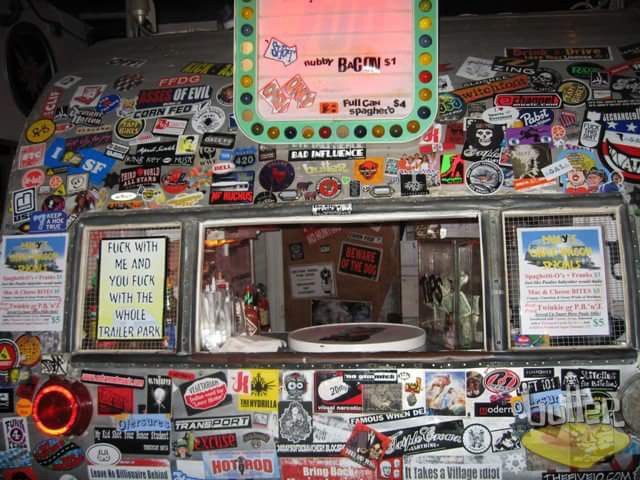
Such appropriation isn’t limited to the Tiny House trend, or even to the idea of simplicity. In major cities, people who come from high-income backgrounds flock to bars and restaurants that both appropriate, and mock, low-income communities. Perhaps the most egregious example is San Francisco’s Butter Bar, a trendy outpost that prides itself on being a true-blue, trailer park-themed bar, serving up the best in “trashy” cuisine and cocktails. With tater tots, microwaved food, and deep-fried Twinkies on the menu, the bar also serves cocktails that contain cheap ingredients, such as Welch’s grape soda. The bar has an actual trailer inside, and serves cans in paper bags, so that bar flies can have a paid-for experience of being what the owners of this bar think of when they think of trailer trash.
Butter Bar in San Francisco (Credit: Facebook)
It’s but one example of an entire hipster movement — can it be called a movement when it’s a subculture rooted not in political consciousness, but in capitalism? — that has brought with it an ethos of poor-culture appropriation and the “re-invention” of things that have largely been tools of survival for poor, disabled, working class, and/or communities of color for decades.
December 21, 2016
Mapping the new western caste system
An interesting re-map of India’s caste system to modern day western society:
I move professionally in circles where lib-left “virtue signaling” is taken for granted, especially inside the US. (Academia outside the US, while no less in the grip of a collective moral superiority complex, at least tolerates dissenters to some degree.)
As I was perusing Trump’s cabinet list in the Times of London the other day, I was struck not so much by the names — some ‘feck yeah!’, some ‘well, OK’, some ‘meh’ — as by what wasn’t there. The ‘Brahmandarins™’ had been left behind, as it were. Allow me to expand.
Traditional society in India has myriad little jatis (“births”, freely: castes), but they ultimately derive from four (plus one) major varnas (“colors”, freely: classes). While caste membership and profession are more fluid than generally assumed by Westerners, these five major groupings do exist to the present day, and are mostly endogamous. From top to bottom, the varnas are:
- Brahmins (scholars)
- Kshatryas (warriors, rulers, administrators)
- Vaishyas (merchants, artisans, and farmers)
- Shudras (laborers)
- Finally, the Dalit (downtrodden, outcasts — the term “pariah” is considered so offensive it has become “the p-word”) are traditionally considered beneath the varna system altogether, as are other “Scheduled Castes” (a legal term in present-day India, referring to eligibility for affirmative action).
The upper three varnas bear some resemblance to the three Estates of the French ancien régime: clergy, nobility, and the bourgeoisie (le tiers état, the Third Estate). American society used to be a byword for social mobility (“the American dream”) — but a stratification has set in, and it takes little imagination to identify strata of Dalit, Shudras, and Vaishyas in modern American society. The numerically small subculture of military families could be identified as America’s Kshatryas. So where are the Brahmins? (No, I’m not referring to the old money Boston elite.) And why am I using the portmanteau “Brahmandarins” for our New Class?
In India one was, of course, born into the Brahmin varna, and they actually delegated the messy business of governance to the varna below them. In China’s Middle Kingdom, on the other hand, not only was the scholarly Mandarin caste actually the backbone of governance, but in principle anyone who passed the civil service exams could become a Mandarin.
Originally, these exams were meant to foster a meritocracy. Predictably, over time, they evolved to select for conformity over ability, being more concerned with literary style and knowledge of the classics than with any relevant technical expertise.
Hmm, sounds familiar? Consider America’s “New Class”: academia, journalism, “helping” professions, nonprofits, community organizers, trustafarian artists,… Talent for something immediately verifiable (be it playing the piano, designing an airplane, or buying-and-selling,… ) or a track record of tangible achievements are much less important than credentials — degrees from the right places, praise from the right press organs,…


