
Feral Historian
Published 5 Sept 2025There’s a long-running argument over whether Heinlein’s book describes military service as the exclusive path to citizenship, or if “federal service” is a much broader basket of enfranchisement. While a close read of the book makes it unquestionably clear which is correct, it misses the greater point. Heinlein was writing about the role of civic virtue in the stability of a republic, his citizenship-through-service framing is the literary conceit for discussing that larger question.
For a more detailed examination of the nature of Federal Service, I recommend James Gifford’s essay on the subject: https://www.nitrosyncretic.com/rah/ft…
00:00 Intro
00:45 What is Federal Service?
02:18 An Exploration of Enfranchisement
03:13 Expanded Universe
05:38 But Why?
06:59 Starside R&D
09:07 “Unreasonable Facsimile”
10:54 Filtering Civic Virtue
(more…)
January 29, 2026
Starship Troopers: Service Isn’t The Point
November 22, 2025
Democrats may come to regret their “refuse illegal orders” messaging
Many current and former military folks ridiculed the Democrats for their sudden discovery of the right (and obligation) to refuse illegal orders … which has been part of western military doctrine since the end of World War Two. I poked some fun at them as well, but J.D. Tuccille points out that it’s a weird stance for the party that is always fully in favour of government agents’ maximizing their powers:

I favor government employees defying orders and sabotaging the instruments of the state as much as the next libertarian (well, maybe a little more). But I suspect the Democratic lawmakers urging members of the military and the intelligence community to “refuse illegal orders” haven’t entirely thought through their positions. While their advice is commendable so far as it goes, as officials of a political party known for its expansive view of the role of government their words are likely to come back and bite them on their collective asses. It’s hard to imagine them being so enthusiastic about a reboot of this message directed at the Bureau of Alcohol, Tobacco, Firearms, and Explosives (ATF), Environmental Protection Agency (EPA), and IRS agents under a Democratic administration.
Lawmakers Say: Refuse Illegal Orders
In a video message released this week, Democratic Sens. Elissa Slotkin of Michigan and Mark Kelly of Arizona, and Reps. Chris Deluzio of Pennsylvania, Maggie Goodlander of New Hampshire, Chrissy Houlahan of Pennsylvania, and Jason Crow of Colorado, introduce themselves with emphasis on their past roles in the military and intelligence agencies.
“We want to speak directly to members of the military and the intelligence community,” they say. “We know you are under enormous stress and pressure right now. Americans trust their military, but that trust is at risk. This administration is pitting our uniformed military and intelligence community professionals against American citizens. Like us, you all swore an oath to protect and defend this Constitution. And right now, the threats to our Constitution aren’t just coming from abroad, but from right here at home.”
That’s a nice lead-in. Then we get to the heart of the message: “Our laws are clear. You can refuse illegal orders. You can refuse illegal orders. You must refuse illegal orders. No one has to carry out orders that violate the law or our Constitution.”
Stirring stuff. And accurate. Referencing a Vietnam War-era atrocity, retired General Philip M. Breedlove, former Supreme Allied Commander in Europe, told NewsNation regarding the video, “Since My Lai, the way we have interpreted this is, as a combatant, as a military officer, you are not obligated, not obligated, to carry out an illegal or an immoral order. You simply refuse the order.”
[…]
Take Advice to Refuse Illegal Orders Seriously, and Apply It Universally
So, if we’re to take seriously — and I believe we are well-advised to do so — the six Democratic lawmakers’ advice that “no one has to carry out orders that violate the law or our Constitution,” there are interesting implications for our political culture. That’s because much of what the federal government does on a daily basis flouts constitutional protections and offends human decency.
So, how would Slotkin and Kelly, and Deluzio, Goodlander, Houlahan, and Crow, respond to campaign a few years from now under the next Democratic administration urging ATF and IRS agents, federal regulators, and general workers to refuse orders? How would they treat an attempt to recruit more whistleblowers like Manning and Edward Snowden?
Don’t get me wrong, I think the advice the lawmakers offer is praiseworthy. But I look forward to seeing it applied universally and becoming a permanent feature of our dealings with government. I suspect that likelihood hasn’t occurred to those six legislators, but thanks to them for showing the way.
In counterpoint to my original take on the issue, on the social media site formerly known as Twitter, Cynical Publius expresses his belief that the Democrats are actually encouraging disobedience to legal orders that they happen to dislike:
I’m not sure I’ve ever been angrier at Democrats than I am right now.
As a career Army officer, I take this latest nefarious chicanery from these filthy Congressional Democrat veterans quite personally,
It is loathsome and disgusting. You know, I know, they know and even their brainwashed acolytes know that what they are REALLY doing is encouraging active duty service members to refuse to follow lawful orders under the guise of pretending the orders are “unlawful”.
What these Democrat filth are doing is encouraging a form of military coup where service members get to decide not to do things they disagree with politically by pretending those otherwise lawful things are “unlawful”.
This is the greatest threat to US internal stability since the last time Democrats started a civil war. A military ruled by politics is no military at all. Instead, it is a group of armed thugs akin to the South American military juntas of the 1970s.
I cannot overstate what an extreme threat this situation is to our nation.
This is a precursor to civil war, initiated and deliberately created by traitorous elected officials hiding behind the honor of the uniform they once wore but now disgraced.
I have never been angrier.🤬
November 2, 2025
QotD: The “Blob”, aka the Deep State
The parasitic unholy alliance of Big Corporations, Big Government, Big Bankers and their entire fan club and cheer squad of supporters. Dangerously, this also includes the watchdogs: the Spy Agencies and large parts of the media. The Blob takes money from citizens, pays other parts of the Blob (eg USAID, The UN, The BIS, The World Bank etc), pretends to “help” some token victim group or environmental cause, or even to monitor or audit The Blob, but the outcome benefits The Blob more than the victims. They line their own pockets and increase their own privileges.
The Blob also includes a special category of “useful idiots” who naively assist them in looting Western Civilization. These people are paid in status or an illusory sense of purpose rather than money. They may not realize they are part of the self-serving Blob, and in the long run are not only harming the trees, birds and whales they say they want to save, but are harming their own health, wealth, national security, and worse, that of their children.
Jo Nova, “The Secret Ruling Class – Why the anonymous Blob needs to be invisible”, JoNova, 2025-07-18.
October 19, 2025
QotD: The Indian Civil Service
I think about The Ruling Caste often when I think about the turds in the Apparat. Looked at from the outside, the ICS were apparatchiks, too. Indeed, even more so than actual apparatchiks, since “apparatchik” means something like “expert without portfolio” and while the ICS had two broad “tracks” (if I recall correctly), “civil” and “legal”, in practice most every ICS man was supposed to be able to do pretty much everything, including (again IIRC) assume military command of local forces if necessary.
Given that there were never more than 200K Britons in the Raj at any one time, how could it be otherwise?
And the ICS was as fully ideologized as the Soviet (or AINO) Apparat. The French gave us the lovely phrase mission civilisatrice, but that’s what the ICS was doing, too. Lord Macauley was the big mover behind the English Education Act of 1835, which explicitly designed to
form a class who may be interpreters between us and the millions whom we govern – a class of persons Indian in blood and colour, but English in tastes, in opinions, in morals and in intellect. To that class we may leave it to refine the vernacular dialects of the country, to enrich those dialects with terms of science borrowed from the Western nomenclature, and to render them by degrees fit vehicles for conveying knowledge to the great mass of the population.
There were two huge differences between the ICS and the Apparat, though, that really come out reading Gilmour’s book. First, and actually least important, was the obvious fact that English education was superior. Macauley really gave “native” literature both barrels — nobody condescends like an Englishman — but he wasn’t wrong. In 1835 you could take the “scientific” literature of every other race on the planet combined and get … the Iron Age? Maybe? 200K Britons could dominate 750 million Indians because
whatever happens, we have got
the Maxim gun, and they have not.Or “steam power” or “replaceable parts” or “calculus” or what have you. Season to taste.
The second — and far, far more important — difference between the ICS and the Apparat, though, was that the ICS was in general composed of decent people. In a very real sense, all imperialism is “cultural imperialism”. Rome became an empire by whomping all its enemies, but it stayed an empire by giving its enemies a great deal. Life was simply better — orders of magnitude better — inside the Empire than outside.
And the reason for this is simple, so simple that you need many years of long and hideously expensive training, by highly skilled and fanatically motivated indoctrinators, to miss it. Macauley, Caesar, Confucius, anyone who wrote anything on barbarian management at any point, anywhere in the world, well into the 20th century, said basically the same thing: Our material culture is the result of our cultural culture.
You can learn to operate our stuff. Obviously so — with only 200K Britons throughout the Subcontinent, the Raj was quite obviously run by Indians. And they did a bang-up job, too, such that India at independence had the real potential to become a first world country (note to folks getting ready to break away from a globe-spanning empire: Never elect a lunatic socialist yoga dude as your first prime minister. He’ll go full retard and set you back 50 years … and he’ll be shooting for 500). You might even learn how to maintain our stuff, maybe even build a few cheap knockoff copies of our stuff.
But it’ll never be more than that — shitty knockoff copies, gruesomely expensive, and available only to the elite — unless you embrace as much of the culture that created the stuff as you can stand. The English themselves are a great example: They were blue-assed savages when Caesar found them, but they got with the program, and look how well that worked out. Ditto the Gauls (“Our ancestors, the Gauls!”) and all the rest.
It’s the culture, stupids. The culture of the ICS was English culture — “play up, play up, and play the game!” sounds like baloney to jaded Postmodern ears, but listen:
The sand of the desert is sodden red,—
Red with the wreck of a square that broke; —
The Gatling’s jammed and the Colonel dead,
And the regiment blind with dust and smoke.
The river of death has brimmed his banks,
And England’s far, and Honour a name,
But the voice of a schoolboy rallies the ranks:
“Play up! play up! and play the game!”As poetry it’s shit, but if that doesn’t make you want to get up out of your chair and take a swing at somebody, then you, sir, have no hair on your scrotum, and will never know a woman’s touch (trannies don’t count).
They really believed that, those Eton schoolboys out there East of Suez. Or, at least, they behaved as if they did, and everything else flowed from that behavior. Recall that it was a coin flip, going East of Suez — chances are you wouldn’t be coming back, or if you did, it would be as a malarial ruin. But they went anyway, though England’s far and Honour a name, because that’s just what they did. Even at their worst — and their worst was very bad; Gilmour pulls no punches — you can’t help but admire them a little, the arrogant bastards. Their convictions were sometimes awful, but they had the courage of them … and courage is magnificent.
Severian, “Ruling Caste II”, Founding Questions, 2022-03-10.
October 16, 2025
RIFfing the US federal workforce
In Reason, J.D. Tuccille considers the impact of the US government shutdown on the federal civil service:

“Lincoln Memorial During Government Shutdown 2013” by Flickr user reivax is licensed under CC BY-SA 2.0 

 .
.
As promised — or threatened, if you wandered over to Reason by accident — the Trump administration has started using the government sort-of-shutdown as an opportunity to engage in mass layoffs of federal employees. In the game of chicken between Republicans and Democrats over just how much the government should overspend and on what, the losers so far appear to be some of the almost 3 million Americans who thought federal employment would be a comfortable way to collect a paycheck.
Setting thousands of former government workers loose to seek jobs elsewhere — preferably not involving money forcibly extracted from taxpayers — is a step in the right direction.
Shutdowns Are (Mostly) Political Theater
As we all should know by now, government shutdowns are largely political theater. National parks and museums are closed to inconvenience the public into believing something big is happening even as taxes keep getting collected and government enforcers continue twisting arms to make sure people comply with laws and rules that never should have been imposed.
The Brookings Institution’s David Wessel pointed out last week, “the Justice Department said 90% of its employees would be exempted from the furlough” and “the Department of Homeland Security said in its 76-page contingency plan that roughly 95% of its nearly 272,000 employees would remain on the job if a shutdown occurred”. Agencies accomplish this by defining “essential” employees who remain on the job in the broadest way possible.
Paychecks may be delayed during the shutdown. But after it ends, “employees who were required to perform excepted work during the lapse will receive retroactive pay” and “employees who were furloughed as the result of the lapse will receive retroactive pay for those furlough periods” according to the Office of Personnel Management. Basically, all federal employees eventually get paid whether they continue to work or are sent home for the duration of the “shutdown”.
An Opportunity To Reduce the Federal Workforce
At least, that’s how it usually works. This time is a little different because the Trump administration came into office promising to downsize the federal government. The Department of Government Efficiency (DOGE) was supposed to accomplish that goal, but the shutdown offers another opportunity. Even before furloughs began, the Office of Management and Budget (OMB) sent out a memo noting:
With respect to those Federal programs whose funding would lapse and which are otherwise unfunded, such programs are no longer statutorily required to be carried out. Therefore, consistent with applicable law, including the requirements of 5 C.F.R. part 351, agencies are directed to use this opportunity to consider Reduction in Force (RIF) notices for all employees in programs, projects, or activities (PPAs) that satisfy all three of the following conditions: (1) discretionary funding lapses on October 1, 2025; (2) another source of funding, such as H.R. 1 (Public Law 119-21) is not currently available; and (3) the PPA is not consistent with the President’s priorities.
The White House is apparently taking this opportunity seriously. “Around 4,200 employees were laid off in total on Friday,” reports Eric Katz of Government Executive. The biggest cuts were at the Department of the Treasury (1,446 employees) and the Department of Health and Human Services (between 1,100 and 1,200 employees). The Department of Education, which President Trump proposes to totally eliminate, also experienced layoffs (466 or nearly 20 percent of its remaining workforce), as did the Environmental Protection Agency, Homeland Security, and Housing and Urban Development.
Everything this administration does seems to involve a bit of chaos, and the latest rounds of reductions in force are no different. While hundreds of employees of the Centers for Disease Control and Prevention (CDC) were included in the layoffs, some were fired by accident and immediately rehired.
Chris Bray notes that — stop me if you’ve heard this before — a district court judge has ruled that the President doesn’t have the power to do, well, pretty much anything to do with the federal workforce (what is it with the executive branch thinking they have powers that haven’t been explicitly approved by the judiciary?):
After a just absolutely bizarre hearing in a Northern California federal court, a judge has forbidden the Trump administration from laying off government employees. The hearing may have been held in the Court of the Red Queen: After Counsel to the Assistant Attorney General Elizabeth Hedges argued that she wasn’t going to get into the legal merits of the Trump administration’s layoffs because the court lacked jurisdiction and the plaintiffs hadn’t met the legal standards for filing a lawsuit, Judge Susan Illston warned that, actual quote, “This hatchet is falling on the heads of employees all across the nation and you’re not even prepared to address whether that’s legal?” Getting laid off is a hatchet attack, so we skip the arguments about ripeness and standing. It’s emotionally dire, a thing that feels very bad. Judges talk like this, now. OH GOD COUNSEL THIS IS LIKE A THING WITH A KNIFE THAT WOUNDS ME. Objection, your honor, inadequate trigger warning. […]
Illston declared the existence of a temporary restraining order from the bench, and I’ve been waiting for her written order to land on PACER. It’s here, and it’s … very … Well, okay: It has a lot of feelings. […]
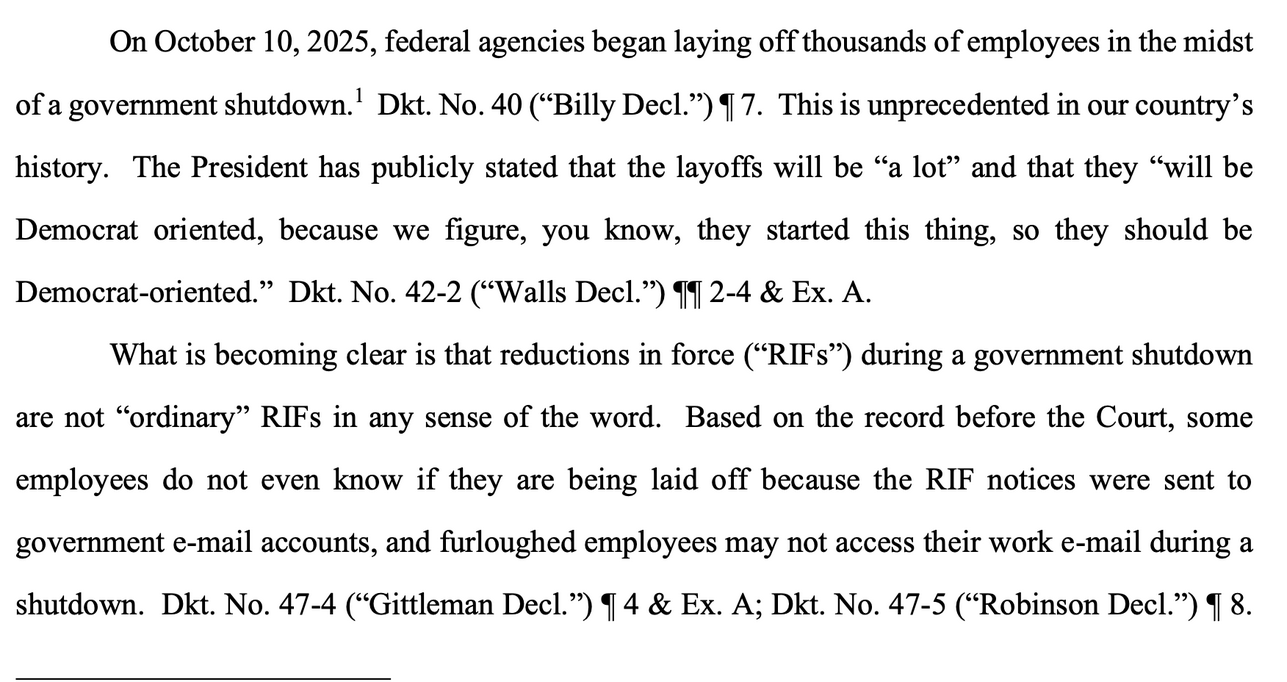
Opening paragraphs, first page:
Note that the first paragraph frames federal RIFs as historically unprecedented, while the second paragraph frames the current federal RIFS as not ordinary: different than the way RIFs are usually conducted. So this is unprecedented, but it has happened before, and the problem with the unprecedented thing is that it’s not being done the way the thing that has never been done before is usually done.
But anyway, a reduction in force of federal personnel during a shutdown is “unprecedented in our country’s history”. Of course, a reduction of force alone is not at all unprecedented, and the Clinton administration reduced the size of the federal bureaucracy by about 400,000 people. Illston doesn’t articulate a reason why reducing the bureaucracy during a shutdown is worse, or a reason why Clinton RIFs were good but Trump RIFs are a violent hatchet attack, but she clearly feels it. Of course, during a shutdown, the agencies being shrunk have no approved funding, so it would seem to make more sense to be careful about personnel costs, but this argument means that I just hurt people with a hatchet.
Above all, note that the argument out of the gate is a normative argument, not a legal argument. This is unprecedented! This is not ordinary! If a judge feels that something is a little off, she can order it stopped.
July 24, 2025
The vicious competition for Indian civil service jobs
Once upon a time in most of the Anglosphere, the advantage of civil service jobs was that they were nearly impossible to get fired from and had a relatively good pension at the end of a long career. Private sector jobs were far less permanent, but paid more, had better benefits, and more prestige. Over the last fifty years, little of that is still true — civil servants still have fantastic job security, but they’re also better paid, have better benefits, and for many there are opportunities to retire and get re-hired back into a similar position with even higher pay while collecting a generous pension. The private sector no longer pays better nor offers significantly better benefits, so lots of people look to get into the civil service who once would have shunned positions like that.
It’s apparently much worse in India:

In India, government jobs pay far more than equivalent jobs in the private sector — so much so that the entire labor market and educational system have become grossly distorted by rent-seeking to obtain these jobs. Teachers in the public sector, for example, are paid at least five times more than in the private sector. It’s not just the salary. When accounting for lifetime tenure, generous perks, and potentially remunerative possibilities for corruption, a government job’s total value can be up to 10 times that of an equivalent private sector job. (See also here.)
As a result, it’s not uncommon for thousands of people to apply for every government job — a ratio far higher than in the private sector. In one famous example, 2.3 million people submitted applications for 368 “office boy” positions in Uttar Pradesh.
The consequences of this intense competition for government jobs are severe. First, as Karthik Muralildharan argues, the Indian government can’t afford to pay for all the workers it needs. India has all the laws of, say, the United States, but about one-fifth the number of government workers per capita, leading to low state capacity.
But there is a second problem which may be even more serious. Competition to obtain government jobs wastes tremendous amounts of resources and distorts the labor and educational market.
If jobs were allocated randomly, applications would be like lottery tickets, with few social costs. Government jobs, however, are often allocated by exam performance. Thus, obtaining a government job requires an “investment” in exam preparation. Many young people spend years out of the workforce studying for exams that, for nearly all of them, will yield nothing. In Tamil Nadu alone, between one to two million people apply annually for government jobs, but far fewer than 1% are hired. Despite the long odds, the rewards are so large that applicants leave the workforce to compete. Kunal Mangal estimates that around 80% of the unemployed in Tamil Nadu are studying for government exams.
Classical rent-seeking logic predicts full dissipation: if a prize is worth a certain amount, rational individuals will collectively spend resources up to that amount attempting to win it. When the prize is a government job, the “spending” is not cash, but years of a young person’s productive life. Mangal calculates that the total opportunity cost (time out of the workforce) that job applicants “spend” in Tamil Nadu is worth more than the combined lifetime salaries of the available jobs (recall that jobs are worth more than salaries, so this is consistent with theory). Simply put, for every ₹100 the government spends on salaries, Indian society burns ₹168 in a collective effort of rent-seeking just to decide who gets them.
The winners are happy but the loss to Indian society — of unemployed young, educated workers who do nothing but study for government exams — is in the billions. Indeed, India spends about 3.86% of GDP on state salaries (27% of state revenues times 14.3% of GDP). If we take Mangal’s numbers from Tamil Nadu, a conservative (multiplier of 1 instead of 1.68) back-of-the-envelope estimate suggests that India could be wasting on the order of 1.4% of GDP annually on rent-seeking. (Multiply 3.86% of GDP by 15 (30 years at 5% discount) to get lifetime value, and take 0.025 as annual worker turnover.) Take this with a grain of salt, but regardless, the number is large.
July 20, 2025
“[T]he job of a manager [is] to get all C Northcote on bureaucracy”
Tim Worstall discusses the recent announcements about the US State Department significantly reducing their staff levels — a “Reduction In Force” or RIF — that is being lamented by the Washington bureaus of all the surviving mainstream media as a world tragedy:
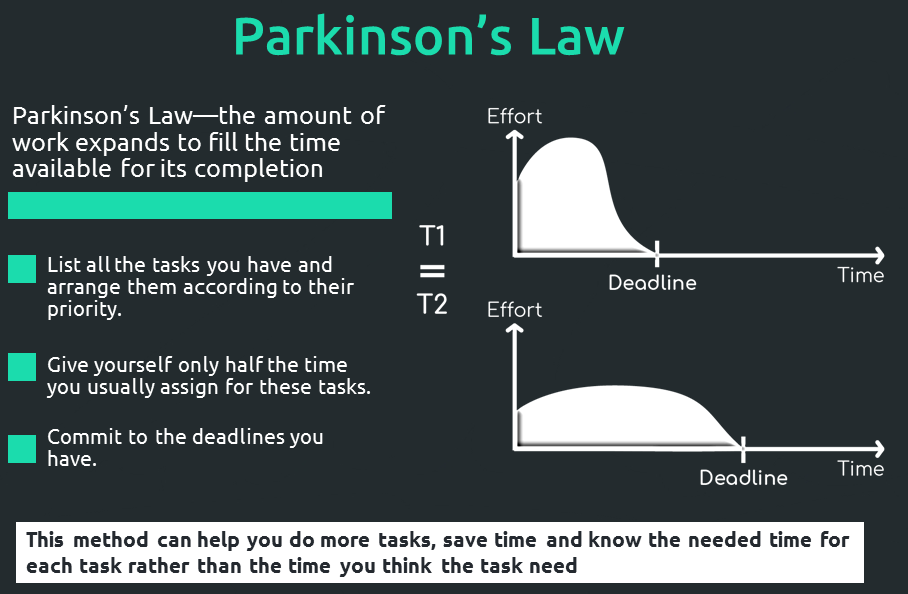
The Guru here, the epitome of the management science, is C Northcote Parkinson. Best remembered for Parkinson’s Law — work expands to fill the time available for its completion. But a deeper thinker than that aphorism.
The essential point being that the output of a bureaucracy is bureaucracy. There is nothing measurable that is being done, no financial value being put upon the work. Sure, sure, it might even be that what is being done is of value — we’ve not got a simple measure of it though.
Therefore a bureaucracy measures itself by the budget and staff count. The success of a bureaucracy — a bureau perhaps — is measured by increases in either or better both. Which really does mean that the output of having a bureaucracy is more bureaucracy.
In the private sector this occurs as well. That’s how the power skirts get to take over large corporations. Of course, at some point in that process the company runs out of money and goes bust — the land is cleared for the next attempt to actually add value.
With government that doesn’t happen. Which leads to one of my favourite little thoughts — every civilisation survives until it is parasitised, eaten from within, by its own bureaucracy. We’d probably prefer that this didn’t happen. Yes, anarchy is all very well in theory but no one does like it when the bins aren’t emptied and there’s no state left to keep the French at bay.
The result of this is that the state bureaucracy needs to be pruned. Always. The actual job of a minister is — should be at least — to muse on what shouldn’t be done any longer and who can we fire? As should be the waking thought of any CEO of course.
My preference — because I’m extremist, obviously — is that we just fire them all. Then hire back the 2% we actually do require in order to have a civilisation. Remember, the Empire ran India with 1,000 men. And, well, it’s not wholly obvious that it’s been run any better than that since then.
That’s therefore the job of a manager. To get all C Northcote on bureaucracy. Always and everywhere. If you prefer your phrasing a little more red blooded the answer to bureaucrats is the Carthaginian Solution. Not that anyone would buy them as slaves, not productive enough, but we can try, right?
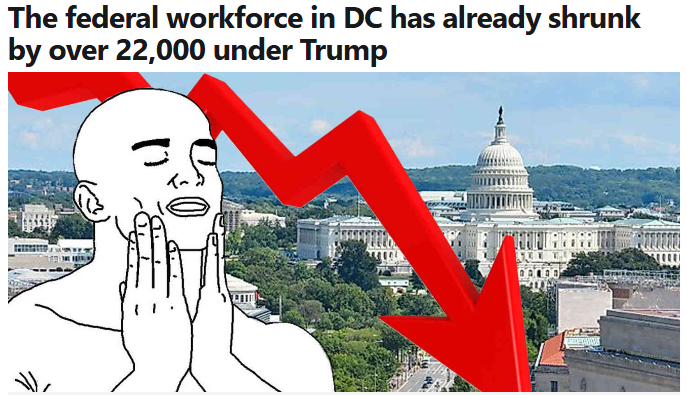
What do you call 22,000 fewer civil servants in Washington? A good start:
Update: Fixed missing URL.
July 16, 2025
Matt Gurney’s “Hollywood Thesis”
I almost skipped reading this one, as Matt and Jen usually keep their own columns behind the paywall, but this one is free to non-paying cheapskates like me:

… I actually think there is one way that Hollywood — and probably mass entertainment writ large — has kind of warped our society. It’s not that it has promoted degeneracy or loose morals or shameless enjoyment of vice. It’s more insidious. And probably more dangerous.
I think Hollywood has tricked us into thinking that, in an emergency, our governments will prove to be a lot more competent than they will be. And usually are.
This is something I’ve been thinking about for a while. I’ve mentioned it to my Line colleagues before, and I call it my Hollywood Thesis. As I see it, the broader public has fairly accurate expectations about the level of service they can expect from their government. Sometimes it’s good, sometimes it’s bad, but it’s mostly realistic. We basically know what we’re getting into when we, for example, drag the trash bin to the curb, or turn on a tap in the morning, or go to an emergency room because you need to get stitched up after a minor mishap.
But I’ve observed over the years an interesting exception. When the public is confronted with any kind of new or unexpected threat, people, for some reason, believe their government will have some secret ability or unexpected expertise in dealing with it. Maybe it’s a quirky scientist working in the bowels of some ministry or department. Maybe it’s an elite team of experts. Or some hidden base loaded with commandos and advanced weaponry.
Wrong. And I’ve been thinking about this. Why do we assume the same government that is, for instance, struggling to fill potholes in my city, or hire enough nurses in my province, or fix a federal payroll system, is going to be more competent when presented with something totally out of the blue? This flies in the face of all of our lived experiences with government. It’s a generous assumption of state capacity that is, to put it charitably, unearned.
So why? What explains this?
It’s Hollywood. It has to be.
Lots of smart, competent people have government jobs. One of the great joys of my career has been the opportunity to speak with many. There are shining lights of unusual competency in every department, and at every order of government, really — my colleague Jen Gerson recently told our podcast listeners about how one of these hidden gems helped her cut through a confusing and dysfunctional process so she could get a permit. And I will never get tired of saying good things about the men and women of the Canadian Armed Forces — true miracle workers we do not support enough.
But there aren’t hidden capabilities. There aren’t secret teams. The same people trying to prevent Canada Post from going on strike will be the same people handling the next pandemic — or who would be responsible for opening a dialogue if aliens decided to land their mothership in the middle of a Saskatchewan farm.
It’s within the range of possibilities that, presented with a unique challenge, government leaders could rise to meet it … as long as it’s a completely unexpected situation with no pre-existing rules or regulations or bureaucratic processes in place. I admit it’s not the way the smart money would bet, but it’s technically a possibility.
April 30, 2025
After the votes were counted
John Carter suggests that votes should be allocated to reflect the costs imposed on the voters by taxation, that is to ensure that those with the most “skin in the game” at least have their votes weighted more than those who pay little or no taxes but can still vote themselves more benefits:
Have you ever noticed how election results are regularly broken down geographically, as well by the demographic categories of age, sex, and – depending on the country – race, yet we almost never see the results separated into taxpayer vs taxeater status?
So anyhow.
For my American readers, in Canadian elections the Liberal Party is denoted by red, as the Devil and Karl Marx intended.
It is absolutely no surprise that Ottawa voted solidly for the Liberal Party of Canada, whose base consists of three primary groups: migrants, public sector workers, and baby boomers, all of whom are regime client groups, and all of whom are tightly packed into the nation’s capital.
Perhaps it’s that it’s tax season and I’m in a grumpy mood because I just got the bad news, but I can’t help but wonder about how electoral politics would change if only taxpayers were allowed to vote. It’s common for “taxpayers” to be used as a synonym for “the voting public”, but this is a bit of linguistic legerdemain which obscures a core dynamic rotting the heart out of every liberal democracy: most of the population are not, in fact, taxpayers. First there are those who don’t earn enough to pay taxes, such as university students; then there are those receiving direct welfare payments of one form or another; then there are public employees, who although they pay tax on paper, are clearly net recipients of government largess since their paychecks come from taxes in the first place.
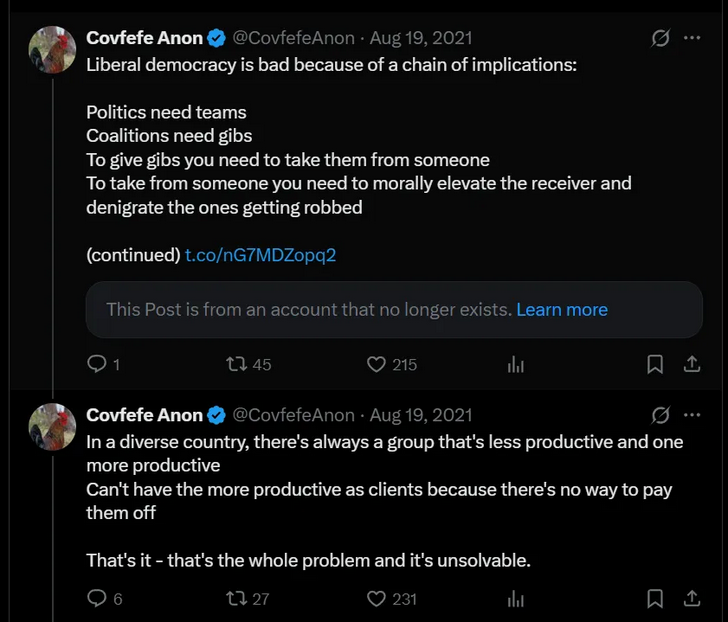
The most successful parties in country after country are the parties that mobilize client groups by promising to steal money from productive citizens and transfer that wealth to their non-productive clients. This dynamic is baked into the cake of any universal suffrage democracy, which is why Universal Suffrage is a Suicide Pact. Parties need client groups for electoral support; wealth can only be plundered from the productive; therefore the only available relationship is to cultivate non-productive clients.
The problem, of course, is that over time this destroys the economic productivity of the liberal democracy, because the productive groups will become less productive because what’s the point, or they’ll just look for the exits, while the client groups will swell, becoming simultaneously too expensive to maintain and to electorally heavy to dislodge.
I suspect you could fix all of this by simply tying votes to tax receipts, with only those who are net taxpayers being given the franchise in any given election. At a stroke this would disenfranchise the welfare underclass, government bureaucrats, and university students, all of whom should be prohibited from voting as a matter of principle. If you wanted to be really fancy, you could implement a tax-weighted vote: the more taxes you pay, the more your vote counts.
In addition to the salutary effects of reducing the electoral weight of female voters (since men tend to pay more in taxes), weighting votes by tax receipts would lead to a very interesting incentive structure. On the one hand, everyone hates paying taxes, and wants to minimize the taxes they pay; if only taxpayers were voting, this would place a strong downward pressure on taxes and, hence, on the size of government (thus forcing states to find other ways of funding themselves, via e.g. tariffs or service fees). On the other hand, people like to vote, so there would be a strong incentive not to evade taxes. On the gripping hand, since paying more tax means your vote counts for more, there would be a countervailing incentive to pay as much tax as you can afford. One might imagine a state functioning as a sort of de facto oligarchy, with the billionaires happily paying obscene levels of tax in order to gather as much political power to their class as possible, and enforcing their tyranny by voting to keep taxes on everyone else to the absolute bare minimum. This would be a truly dystopian brier patch to be thrown into.
Alas, we do not inhabit such a political experiment. Returning to the ostensible topic of yesterday’s Canadian election, however, it would probably not be an exaggeration to posit that if we did inhabit such a system, Canada’s Conservative Party would have rolled the Liberals in this and, in all likelihood, almost every other election.
That is not, however, what happened.
The high-level outcome is that, after running the country into the ground for the last decade, the Liberal Party has been elected for the fourth consecutive time, with a mandate to complete the project of crashing the plane of Dominion with no survivors. It brings me absolutely no pleasure to report that I predicted the Liberals would win before the election was even called. The Liberals are four seats short of forming a majority in parliament, meaning they cannot quite form a stable government on their own. This is not a problem for the Liberals, however. Despite the glorious collapse of the New Democratic Party – which plummeted from 25 seats in the last federal election to 7 in the current election, by far their lowest in 30 years – the NDP retains just enough seats for them to form a stable coalition government with the Liberals. In other words, the outcome of this election is that Canada will be in essentially the same situation it was in before the election, with the only meaningful difference being that the Liberals have a few more seats than they did before.


March 21, 2025
Apparently the US Constitution elevates the judiciary over the other branches of government
Chris Bray on recent innovative judicial activism to constrain the evil machinations of the Bad Orange Man:
It won’t be news to anyone that the federal judiciary has decided Donald Trump has no authority as President of the United States but to serve and protect the status quo, absolutely without deviation. Change is unconstitutional. Policy is unconstitutional. But even by that standard, today has been very special.
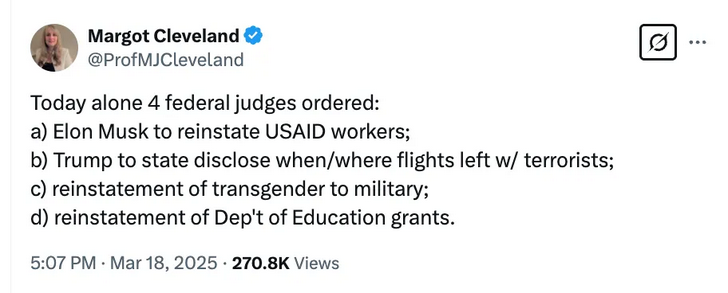
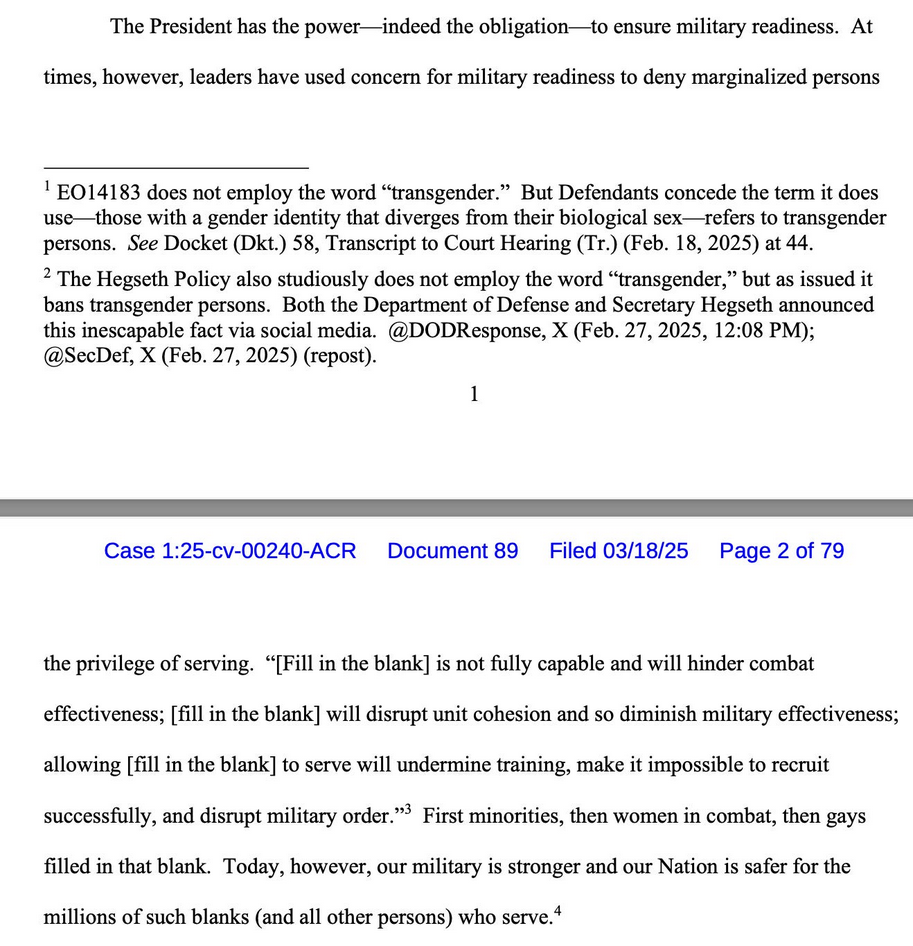
Without digging into all the details about everything, skim your way through a single judicial decision to begin to see what’s happening: the decision from District Court Judge Ana Reyes, ordering the Department of Defense to allow the continued service of transgender military personnel. You can click here to read it, or open the PDF file below.
This is not a judicial decision. I mean, it is a judicial decision, but it doesn’t represent judicial culture or a judicial outlook. At all. It’s a bitchy schoolgirl essay about being fair and not being mean, with healthy doses of platitudinous foot stompery. Screenshot, bottom of page one and top of page two:
“Today, however, our military is stronger and our Nation is safer for the millions of such blanks (and all other persons) who serve.” Because she says so, is why. The old bigoted American military was very weak. I don’t remember: Did the old dumb bigots ever even win any wars or anything?
[…]
Our military is much stronger now than it was when gay and transgender service wasn’t warmly encouraged, the end. (Stomps foot.) It’s a TikTok video formatted to look like a, you know, a judge thing. You can even agree with the judge and see that she hasn’t made an argument. “Today, however, our military is stronger.” Like when we beat the Taliban, or all the other wars we’ve won lately. This is the declarative reality in which a thing becomes true because you type it.
Now, watch this. Watch Judge Ana Reyes roll right over herself without noticing that she’s doing it. You don’t have to read past page two to see this.
On page one, she characterizes the reasoning — the premise the administration advanced to forbid military service by transgender personnel: “Service by transgender persons is ‘inconsistent’ with this mission because they lack the ‘requisite warrior ethos’ to achieve ‘military excellence’.” That’s it, those mean monsters! That’s their whole reason! They said trans people can’t serve because of, I don’t know, some stupid ethos thing. What does that even mean?

March 13, 2025
This explains a lot … IRS employees aren’t issued personal computers (in 2025!)
You sometimes read a small item and the information in it is so unexpected, it’s like being suddenly dumped into icy cold water, like this little item from Reason‘s “Morning Roundup” email:

Everything’s computer! But not at the IRS.
“The upheaval at the IRS is already having real impacts,” reports The Washington Post, referring to plans (already underway) to reduce the workforce by half. “Sources familiar with the agency report that its level of phone service is falling, in part because employees are spending their time waiting to use shared computers to respond to [the Department of Government Efficiency’s] requests for weekly emails detailing their work. (Not all IRS employees are issued their own computers.) And they report that taxpayer behavior is already adjusting to the reality of a diminished IRS workforce: IRS receipts — taxes paid already and taxes the agency is scheduled to receive from those who have already filed — are significantly lower than they were at this point last filing season.”
Wait, back up. They don’t have their own computers? And they’re sitting in a queue like schoolchildren in the library, waiting to use a single shared computer to respond to Musk’s five-things-you-did-last-week emails? How long does it take to write those emails? And why don’t they have computers?
Look, I’m worried by the slapdash approach Elon Musk’s Department of Government Efficiency has taken. But the continued federal employee freakout over being asked to justify their jobs by detailing what they’ve done at work makes no sense to me.
I know a girl from college who is a “Work-Life Specialist and Mindfulness Facilitator” at the U.S. Department of Transportation. She leads yoga sessions and “meditation made simple” workshops for federal employees, per her LinkedIn. This is a job I don’t want my taxpayer dollars funding. For Musk to apply scrutiny to this type of thing is a huge win for the American people.
There are lots of legitimate criticisms to make about whether cuts in staffing will actually lead to a better IRS. Taxpayer services will surely suffer if there are fewer people available to answer phone calls and emails; refunds might be delayed, which comes at a real cost to people. Worse tax collection means less revenue for the government, and it’s not like spending is under control — expect the fiscal hole we’re in to get worse if this continues. But “we just can’t figure out how to ration computer use in the year 2025 to craft a bullet-pointed email” is an absurd line that elicits no sympathy, and just leaves me confused about what the hell they’ve been doing all this time. Everything’s not, in fact, computer in the federal government.
February 26, 2025
The more DOGE uncovers, the more we see that western governments are really vast graft machines
Elizabeth Nickson discusses the ramifications of all the wasted money uncovered by DOGE in the first month of investigations and what it almost certainly confirms about the actual value taxpayers are getting for their money:

So essentially the entire town of Washington, D.C. has been stealing. The anomalies are those who are not stealing. $4.7 trillion, almost impossible to trace, represents two-thirds of the annual U.S. budget. And if it’s happening in the U.S., it is happening everywhere: France, Canada, the U.K., Germany, where budgetary processes are probably even more opaque than those of the U.S.
How does the Department of Defence have a $35 trillion black hole?
I used to think of people who worked for the government with a kind of veiled contempt or, in a more benign mood, compassion. I thought of them as pity jobs for those without initiative, as jobs paying off lefty campaigners, as a warehouse for the barely competent. In my own dealings with them, I found them punitive and extractive, papering me with demands to spend more and more money to hire more and more of their pet contractors, to get approval. In my working life, looking at the results of their involvement in America’s rural areas, I hated them for the hell they visited on people unable to fight back. They forced bad science on good people, and refused to see reason. They ruined forests, water courses, fisheries, and township after township turned to dustbowl status. The misery in rural sitting rooms in every state in the U.S. was palpable, long lasting; the green Blob ruined families for generations.
But I did not think of them as being embroiled in a theft so large as to be unparalleled in world history.
The level of the theft has now to be dawning on everyone not living off the public purse which is, what, 60%, 70% of us? The anger setting in is soul-deep, and very very powerful. People who live straightened lives, the poorly pensioned, those living off the laughable social security stipend, those waiting for health care, those whose children can’t even dream of an education, of college, of a six-figure salary which is now subsistence in the ruined cities. Those facing cancer treatment because of the vaccine, and don’t have excess funds. Their families, despairing, hurting, broke.
This isn’t going to go away. It affects everyone. Not addressed down to its deepest level, you are looking at a tax revolt, a national strike. A revolution. A real one, not a papered paid-for color revolution, which is what they have been doing to us.
Those living on social security should have five times the pension they do.
Can you count how many of those there are? Can you?
And meanwhile this:
Is this true? To this date, unknown; the digging continues. Look at this ghastly creature. She apparently has an account in the Cayman Islands. Look at her all compassionate and condescending. She started a war that killed 1.5 million people so far. And apparently got rich from it. A mass murderer celebrated at Upper East Side dinner parties.
Memes like this rocket around, and every one is now suspect. At this point who cares if it’s true, it’s truthy, it makes sense that she made out like a bandit, that Alexandra Ocasio-Cortez and Ilhan Omar have millions hidden somewhere. Ocasio can say “I only have $500,000!” all she wants, but we don’t believe her. If the Wall St Journal says it is false, we don’t believe them. Do you actually think they’d have the money sitting in their savings account? No, it would be buried off-shore. The media is not only complicit, it is the principal actor in this scam. It built the fantasy world we live in, where people read The Guardian, the Times and the Globe and Mail and think they’re informed.
No, they are being propagandized. And as a result, no one sane believes anything any legacy newspaper or television or media says anymore. They hid the theft. They did not report on it. No one trusts a thing they say.


Update: Fixed broken link.
February 25, 2025
Likely trajectories of the victims of DOGE
Bruce Ivar Godmundsson identifies the most probably career dislocations of civil servants winkled out of their expected life sinecures by the minions of Elon:

To put things another way, the status deprivation experienced by erstwhile feeders at the Federal trough will eventually lead to a great deal of radicalization. After all, if history is any guide, it is not the victims of sustained oppression who raise the banner of revolt, but those who lost advantages that they had earlier expected to enjoy for the rest of their days. (It was not, after all, agricultural laborers, let alone vagabonds, who enlisted in the machine-smashing armies of General Ludd, but practitioners of “decent trades” who had previously occupied lucrative bottlenecks in supply chains.)
As they LARP as extras in the street fighting scene of Les Misérables, the outcasts will find, standing beside them on the barricades, youngsters who, as recently as the autumn of 2024, had expected to parley their ability to paraphrase (or, at the very least, parrot) the Party Line into an internship with an agency, a poorly paid (but prestigious) place in an NGO, or, for those especially adept at symbolic manipulation, a job with a name-brand consulting firm.
Leaving aside the cinematic metaphors, some of the dispossessed will, no doubt, resort to rioting. More will ride the protest circuit, which will do for them what comic-book conventions do for fancy-dressed fans of manga and anime. Most, however, will do little more than haunt the margins of the middle class, muttering about their masters degrees in public policy as they wait for the next command to appear on the screens above their grills.
Repeated encounters with the fallen may drive the final nail into the coffin of the assumption, once central to the world view of so many Americans, that possession of a sheepskin entitled its holder to a desk job. No longer will parents dining at McDonalds whisper to their children “if you don’t go to college, you’ll end up like that”. Rather, they will point to the technician repairing a self-service kiosk and say “that’s the sort of thing that you want to do”.
February 24, 2025
Rule by bureaucrat, believe it or not, was once considered a better form of government
In the 19th century, the Americans switched from a system where one of the major outcomes of a presidential election was the wholesale replacement of government employees to one where the civil service was “professionalized” to the point that only the very top levels were subject to presidential replacement (Trump 2.0 may mark a significant change in this). Fans of the professional bureaucracy would sometimes gesture toward the venerable Chinese model, which had been run in this way for a very long time until the 20th century. Lorenzo Warby considers the actual performance of these kinds of systems:

Excerpt from the handscroll Viewing the Pass List. Imperial examination candidates gather around the wall where results had been posted. Traditionally attributed to Qiu Ying, but now suspected to be the work of a late-Ming painter with Qiu Ling’s name added.
National Palace Museum via Wikimedia Commons.
Over the course of the C19th, Western states adopted the Chinese notion of appointment by examination for their government bureaucracies. Such appointment-by-merit did have the effect — for about a century and a half — of creating effective and responsive bureaucracies. So much so, that Western democracies gave more and more tasks to such bureaucracies.
This replicates the early stage of the Chinese dynastic cycle — the actual one (see below), rather than the traditional version — where, early in a Dynasty, rule through the bureaucracy is quite effective, even efficient. In modern Western democracies, the legitimacy of democratic action — the demon-in-democracy problem, where the all-trumping legitimacy of the democratic principle tends to overwhelm other ways of doing things — aided the massive expansion in government action, and so in the ambit of government bureaucracy.
The trouble with adopting the Chinese model of appointment-by-merit bureaucracy — including selection-by-examinations — is that folk failed to take a good hard look at the patterns of Chinese government. This despite the fact that the keju, the imperial examination, was introduced under Emperor Wen of Sui (r.581-604) and was not abolished until 1905, so there was quite a lot of history to consider.
The patterns of Chinese government are much less encouraging, because the quite effective, quite efficient, stage of bureaucratic administration does not last. The problem with appointment-by-merit is that it selects for capacity, but not character. Confucianism tries to encourage good character, but it repeatedly turned out to be a weak reed compared to incentive structures. (Almost everything is a weak reed, compared to incentive structures.)
The actual dynastic cycle was:
- Population expands due to peace and prosperity in a unified China. This pushes against resources — mainly arable land — creating mass immiseration, an expanding underclass with no marriage prospects, peasant revolts and falling state revenues.
- The number of elite aspirants expand — a process aggravated by elite polygyny — but elite positions do not, leading to disgruntled would-be elites who provide organising capacity for peasant revolts (including through sects and cults).1
- Bureaucratic pathologies multiply, leading to a more corrupt, less responsive, less functional state apparatus, eroding state capacity and increasing pathocracy (rule by the morally disordered). Late-dynasty imperial bureaucracies could be astonishingly corrupt and dysfunctional.
In contemporary Western societies, mass migration interacting with restrictive land use, and other regulation (e.g. “net zero”), so that:
- housing supply is blocked from fully responding to demand for housing—thereby driving up rents and house prices; while also
- inhibiting infrastructure supply from responding to demand—increasing congestion and other (notably energy) costs
is creating immiseration pressures. Figures about the “macro” health of the US economy, for instance, are misleading as much of the growth is either not reaching people further down the income scale or is failing to compensate for rising rents.
Western commercial societies are sufficiently dynamic that elite over-supply is much less of a problem than in pre-industrial societies. There is, however, very much a problem of toxic parasitism — the entire (Diversity Equity Inclusion) DEI/EDI apparatus to start with. What we might call malign elite employment or bureaucratic parasitism.
1. NR: I’ve read that the Taiping Rebellion in China was led by a man who’d failed the Imperial Examination and raised the banner against the entire system as a form of revenge. By the time the rebellion was quashed, somewhere up to 30 million people were killed in the fighting or as an indirect result of the conflict. (Traditional note of caution about any statistics from pre-20th century China … well, any Chinese statistics at all, really.)
Update: Fixed broken link.
January 26, 2025
QotD: The map is not the territory, state bureaucrat style
… most bureaucrats aren’t evil, just ignorant … and as Scott shows, this ignorance isn’t really their fault. They don’t know what they don’t know, because they can’t know. Very few bureaucratic cock-ups are as blatant as Chandigarh, where all anyone has to do is look at pictures for five minutes to conclude “you couldn’t pay me enough to move there”. For instance, here’s the cover of Scott’s book:
That’s part of the state highway system in North Dakota or someplace, and though again my recall is fuzzy, the reason for this is something like: The planners back in Bismarck (or wherever) decreed that the roads should follow county lines … which, on a map, are perfectly flat. In reality, of course, the earth is a globe, which means that in order to comply with the law, the engineers had to put in those huge zigzags every couple of miles.
No evil schemes, just bureaucrats not mentally converting 2D to 3D, and if it happens to cost a shitload more and cause a whole bunch of other inconvenience to the taxpayers, well, these things happen … and besides, by the time the bureaucrat who wrote the regulation finds out about it — which, of course, he never will, but let’s suppose — he has long since moved on to a different part of the bureaucracy. He couldn’t fix it if he wanted to … which he doesn’t, because who wants to admit to that obvious (and costly!) a fuckup?
Add to this the fact that most bureaucrats have been bureaucrats all their lives — indeed, the whole “educational” system we have in place is designed explicitly to produce spreadsheet boys and powerpoint girls, kids who do nothing else, because they know nothing else. Oh, I’m sure the spreadsheet boys and powerpoint girls know, as a factual matter, that the earth is round — we haven’t yet declared it rayciss to know it. But they only “know” it as choice B on the standardized test. It means nothing to them in practical terms, so it would never occur to them that the map they’re looking at is an oversimplification — a necessary one, no doubt, but not real. As the Zen masters used to say, the finger pointing at the moon is not, itself, the moon.
Severian, “The Finger is Not the Moon”, Rotten Chestnuts, 2021-09-14.



