
Brasilia is interesting only insofar as it was an entire High Modernist planned city. In most places, the Modernists rarely got their hands on entire cities at once. They did build a number of suburbs, neighborhoods, and apartment buildings. There was, however, a disconnect. Most people did not want to buy a High Modernist house or live in a High Modernist neighborhood. Most governments did want to fund High Modernist houses and neighborhoods, because the academics influencing them said it was the modern scientific rational thing to do. So in the end, one of High Modernists’ main contributions to the United States was the projects – ie government-funded public housing for poor people who didn’t get to choose where to live.
I never really “got” Jane Jacobs. I originally interpreted her as arguing that it was great for cities to be noisy and busy and full of crowds, and that we should build neighborhoods that are confusing and hard to get through to force people to interact with each other and prevent them from being able to have privacy, and no one should be allowed to live anywhere quiet or nice. As somebody who (thanks to the public school system, etc) has had my share of being forced to interact with people, and of being placed in situations where it is deliberately difficult to have any privacy or time to myself, I figured Jane Jacobs was just a jerk.
But Scott has kind of made me come around. He rehabilitates her as someone who was responding to the very real excesses of High Modernism. She was the first person who really said “Hey, maybe people like being in cute little neighborhoods”. Her complaint wasn’t really against privacy or order per se as it was against extreme High Modernist perversions of those concepts that people empirically hated. And her background makes this all too understandable – she started out as a journalist covering poor African-Americans who lived in the projects and had some of the same complaints as Brazilians.
Her critique of Le Corbusierism was mostly what you would expect, but Scott extracts some points useful for their contrast with the Modernist points earlier:
First, existing structures are evolved organisms built by people trying to satisfy their social goals. They contain far more wisdom about people’s needs and desires than anybody could formally enumerate. Any attempt at urban planning should try to build on this encoded knowledge, not detract from it.
Second, man does not live by bread alone. People don’t want the right amount of Standardized Food Product, they want social interaction, culture, art, coziness, and a host of other things nobody will ever be able to calculate. Existing structures have already been optimized for these things, and unlesss you’re really sure you understand all of them, you should be reluctant to disturb them.
Third, solutions are local. Americans want different things than Africans or Indians. One proof of this is that New York looks different from Lagos and from Delhi. Even if you are the world’s best American city planner, you should be very concerned that you have no idea what people in Africa need, and you should be very reluctant to design an African city without extensive consultation of people who understand the local environment.
Fourth, even a very smart and well-intentioned person who is on board with points 1-3 will never be able to produce a set of rules. Most of people’s knowledge is implicit, and most rule codes are quickly replaced by informal systems of things that work which are much more effective (the classic example of this is work-to-rule strikes).
Fifth, although well-educated technocrats may understand principles which give them some advantages in their domain, they are hopeless without the on-the-ground experience of the people they are trying to serve, whose years of living in their environment and dealing with it every day have given them a deep practical knowledge which is difficult to codify.
How did Jacobs herself choose where to live? As per her Wikipedia page:
[Jacobs] took an immediate liking to Manhattan’s Greenwich Village, which did not conform to the city’s grid structure.
Scott Alexander, “Book Review: Seeing Like a State”, Slate Star Codex, 2017-03-16.
February 4, 2019
QotD: Brasilia and reconciling with Jane Jacobs
February 2, 2019
QotD: Le Corbusier
So the early modern period is defined by an uneasy truce between states who want to be able to count and standardize everything, and citizens who don’t want to let them. Enter High Modernism. Scott defines it as
A strong, one might even say muscle-bound, version of the self-confidence about scientific and technical progress, the expansion of production, the growing satisfaction of human needs, the mastery of nature (including human nature), and above all, the rational design of social order commensurate with the scientific understanding of natural laws
…which is just a bit academic-ese for me. An extensional definition might work better: standardization, Henry Ford, the factory as metaphor for the best way to run everything, conquest of nature, New Soviet Man, people with college degrees knowing better than you, wiping away the foolish irrational traditions of the past, Brave New World, everyone living in dormitories and eating exactly 2000 calories of Standardized Food Product (TM) per day, anything that is For Your Own Good, gleaming modernist skyscrapers, The X Of The Future, complaints that the unenlightened masses are resisting The X Of The Future, demands that if the unenlightened masses reject The X Of The Future they must be re-educated For Their Own Good, and (of course) evenly-spaced rectangular grids.
(maybe the best definition would be “everything G. K. Chesterton didn’t like.”)
It sort of sounds like a Young Adult Dystopia, but Scott shocked me with his research into just how strong this ideology was around the turn of the last century. Some of the greatest early 20th-century thinkers were High Modernist to the point of self-parody, the point where a Young Adult Dystopian fiction writer would start worrying they were laying it on a little too thick.
The worst of the worst was Le Corbusier, the French artist/intellectual/architect. The Soviets asked him to come up with a plan to redesign Moscow. He came up one: kick out everyone, bulldoze the entire city, and redesign it from scratch upon rational principles. For example, instead of using other people’s irrational systems of measurement, they would use a new measurement system invented by Le Corbusier himself, called Modulor, which combined the average height of a Frenchman with the Golden Ratio.
The Soviets decided to pass: the plan was too extreme and destructive of existing institutions even for Stalin. Undeterred, Le Corbusier changed the word “Moscow” on the diagram to “Paris”, then presented it to the French government (who also passed). Some aspects of his design eventually ended up as Chandigarh, India.
Scott Alexander, “Book Review: Seeing Like a State”, Slate Star Codex, 2017-03-16.
January 31, 2019
QotD: Top-down solutions
The closest analogy I can think of right now – maybe because it’s on my mind – is this story about check-cashing shops. Professors of social science think these shops are evil because they charge the poor higher rates, so they should be regulated away so that poor people don’t foolishly shoot themselves in the foot by going to them. But on closer inspection, they offer a better deal for the poor than banks do, for complicated reasons that aren’t visible just by comparing the raw numbers. Poor people’s understanding of this seems a lot like the metis that helps them understand local agriculture. And progressives’ desire to shift control to the big banks seems a lot like the High Modernists’ desire to shift everything to a few big farms. Maybe this is a point in favor of something like libertarianism? Maybe especially a “libertarianism of the poor” focusing on things like occupational licensing, not shutting down various services to the poor because they don’t meet rich-people standards, not shutting down various services to the poor because we think they’re “price-gouging”, et cetera?
Maybe instead of concluding that Scott is too focused on peasant villages, we should conclude that he’s focused on confrontations between a well-educated authoritarian overclass and a totally separate poor underclass. Most modern political issues don’t exactly map on to that – even things like taxes where the rich and the poor are on separate sides don’t have a bimodal distribution. But in cases there are literally about rich people trying to dictate to the poorest of the poor how they should live their lives, maybe this becomes more useful.
Actually, one of the best things the book did to me was make me take cliches about “rich people need to defer to the poor on poverty-related policy ideas” more seriously. This has become so overused that I roll my eyes at it. “Quantitative easing could improve GDP growth…but instead of asking macroeconomists, let’s ask this 19-year old single mother in the Bronx!” But Scott provides a lot of situations where that was exactly the sort of person they should have asked. He also points out that Tanzanian natives using their traditional farming practices were more productive than European colonists using scientific farming. I’ve had to listen to so many people talk about how “we must respect native people’s different ways of knowing” and “native agriculturalists have a profound respect for the earth that goes beyond logocentric Western ideals” and nobody had ever bothered to tell me before that they actually produced more crops per acre, at least some of the time. That would have put all of the other stuff in a pretty different light.
Finally, I understand Scott is an anarchist. He didn’t really try to defend anarchism in this book. But I was struck by his description of peasant villages as this unit of government which were happily doing their own thing very effectively for millennia, with the central government’s relevance being entirely negative – mostly demanding taxes or starting wars. They kind of reminded me of some pictures of hunter-gatherer tribes, in terms of being self-sufficient, informal, and just never encountering the sorts of economic and political problems that we take for granted. They make communism (the type with actual communes, not the type where you have huge military parades and kill everyone) look more attractive. I think Scott was trying to imply that this is the sort of thing we could have if not for governments demanding legibility and a world of universal formal rule codes accessible from the center? Since he never actually made the argument, it’s hard for me to critique it. And I wish there had been more about cultural evolution as separate from the more individual idea of metis.
Overall, though, I did like this book. I’m not really sure what I got from its thesis, but maybe that was appropriate. Seeing Like A State was arranged kind of like the premodern forests and villages it describes; not especially well-organized, not really directed toward any clear predetermined goal, but full of interesting things and lovely to spend some time in.
Scott Alexander, “Book Review: Seeing Like a State”, Slate Star Codex, 2017-03-16.
January 16, 2019
Tropico, the game for budding central planners
At FEE, Ong Jia Yi Justin looks at the video game Tropico and what it can show about real world economics:

In Tropico 5, you are El Presidente — the leader of a Caribbean island that is a semi-democratic banana republic. Your primary objective is to preserve your rule by micromanaging your country’s economy to appease your citizens, the Tropicans. If they are dissatisfied with your rule, they can vote you out in the next elections or stage a coup d’état, costing you the game.
First released in 2001, the city-building and management game has sold millions of copies worldwide, and the sixth installment is scheduled for release later in 2019. The game was even banned in Thailand due to concerns it would stir social unrest. In a hilarious response, the game developers included a mission in its DLC (downloadable content) to steal away tourists from Thailand.
Tropico 5 presents an engaging platform for players to craft their socialist paradise and examine the mechanics of socialist economies. Apart from sandy beaches and skyscrapers, Tropico 5’s appeal arises from loading players with a swarm of decisions to make, each with certain trade-offs that must be accounted for. Since most of us formulate our ideals from an armchair perspective, Tropico 5 delivers a much-needed dose of reality and numerous lessons on economics for its players to reflect upon.
Pineapples, Cotton, or Death
The first focus when you start up the Tropico 5 game is managing your agricultural sector. Players must choose between constructing two types of farms. Farms producing food crops for local consumption, such as bananas and pineapples, boost your approval rating but don’t add income to your budget. Conversely, farms growing economic crops such as tobacco and cotton bring a healthy income stream but don’t feed your people.
Some players prefer to amass large sums of wealth in the early game through cotton exports and then focus on food production later, hopefully before too many people starve to death. Other players risk bankruptcy in their attempt to bring their popularity to a safe level by spamming pineapple plantations before transitioning to economic crops later. Either way, you’re stuck between a rock and a hard place.
December 6, 2018
QotD: The best “industrial policy” is not to have one at all
Which brings us to nub of the matter: how do we increase trade and productivity, given that productivity is the thing they claim the whole schemozzle is about. There is one simple and single policy which will do both. One policy which will increase British productivity simply by allowing more trade.
This policy is so simple that even the Treasury (yes, that’s our Treasury, the one in London) was able to get right, even when being run by George Osborne. As they set out in their analysis of Brexit repercussions:
“The benefits of trade in terms of increasing productivity are well understood… greater openness to trade creates a larger market which the most productive firms expand to serve. Openness also increases competition between firms, enhancing the incentives for domestic firms to innovate or adopt new technology… It increases returns on investment, and encourages UK firms to make greater use of new technologies, either by improving the quality of inputs, or through the more effective adoption of technological innovations. Greater openness to trade also increases consumer choice and reduces prices. Lower trade costs give consumers access to cheaper imported goods and competition reduces the price of domestically-produced goods.”
In plain English, it is the competition from imports which forces British firms to buck up their act and become more productive. So here is how we improve British productivity: we move to unilateral free trade. No barriers to imports, no tariffs, just the same regulation as domestically produced items.
British industry, facing the stiffest competition from the best in the world, would be forced to meet global standards of productivity. So the best industrial policy would be to stop trying to have an industrial policy about what we can and can’t buy from beyond Britain’s borders – and the rest should take care of itself.
Tim Worstall, “The best industrial strategy for Britain is not to have one”, CapX, 2017-01-23.
November 5, 2018
QotD: Technological advance and the Knowledge Problem
Technology’s heightening of society’s complexity outstrips its heightening of the social planner’s informational capabilities. Hayek, like [Adam] Smith, drew a lesson for policy: Except in the most clear-cut cases of systemic harm, like air pollution, the supposition that government officials can figure out how to improve the results of decentralized (i.e., voluntary) decision making becomes more and more outlandish. In his Nobel lecture, Hayek called that supposition the pretense of knowledge. As intellectuals who ponder the complex workings of the social world, we really know little aside from one hardy fact: If those who participate in an activity do so voluntarily, each is probably bettering his or her own condition. The more complex the system is, the more skeptical we ought to be about claims to knowledge that go beyond and against that hardy fact.
Fred Foldvary and Daniel Klein, The Half-Life of Policy Rationales, 2003.
August 30, 2018
“This is simply drivel. And it’s the standard Green Party phantasm written out again”
Tim Worstall is not impressed with a new study out of Finland which recommends that the United Nations become much more involved in organizing and directing the lives of everyone on the planet … for our own good, of course:

We’ve another of those pieces of environmental drivel on offer to us. Here it’s the considered opinions of some Finnish knownothings on what is necessary to achieve the UN’s Sustainable Development Goals. The basis of which is that we should all prepare to be rather poorer. No, not because the Earth is running out of stuff to make us richer but because our Finnish knownothings are recommending that the UN take charge of things and forcibly make us poorer.
This is perhaps not the correct manner of running the global economy.
[…]
That’s all entirely drivel, of course. Capitalism doesn’t depend upon cheap fossil fuels nor even cheap energy. It’s just an economic system in which we have private property. Including the value added belonging to the people who own the property which adds the value. That’s really all it is too. Profit belongs to the people providing the capital – this is definitional by the way. For that’s what we define profit as, that part of the returns from an activity which go to those who provide the capital.
There is absolutely nothing at all which requires that energy, or any natural resource, be of any particular price nor level of price. All we are saying when we recommend capitalism is that the system seems to work better when those who make a profit get to keep it. Our economic definition of profit being when value of output is greater than the costs of inputs. Who gets those profits is definitional about capitalism. Any and every economic system is trying to produce profits. Because any and every economic system is trying to add value to inputs, trying to create value.
[…]
There’s a remarkable lack of reasoning as to why international trade needs to be limited or regulated. If we’re facing more expensive energy then we should be doing more of it, not less. But then perhaps those doing bio- and physics don’t know that Adam Smith pointed out we’d do better getting the wine from Bourdeaux rather than growing the grapes in Scotland. Or even that David Ricardo launched an entire subset of economics with his observation that trade uses fewer resources than non-trade. I mean, it is possible that they’re just ignorant of the most basic points here, isn’t it?
They’ve also not grasped that good life and economic growth part at all. No one actually producing economic growth – defined, as always, as an increase in the value being produced – does so in order to produce economic growth. They do it in pursuit of their definition of the good life. Economic growth is simply the aggregate of all those people trying to make their own lives better, their pursuit of that good life. The inverse is also true. If we leave people alone to pursue their own versions of the good life then economic growth is what we get. Our bio-p types seem unaware of the laissez faire argument. That we all get richer faster if left alone to our own visions of life?
Now, if this was just a few blokes in the Far North muttering to themselves among the trees of future toilet roll this wouldn’t matter. But this is serious advice to the United Nations? It’s about to become art of how world governance works? Dear God Above, what have any of us one to deserve this?
Try this for example:
A key problem with carbon pricing has been that states, federations, or unions have not implemented it on a sufficiently high level, fearing industrial leakage to less environmentally-regulated countries. For this reason, many economists and politicians hope for global carbon pricing. But if we return to the four examples above, energy, transport, food, and housing, we can see that it would be highly unlikely that even global carbon pricing would guide economic activity in the right direction – at least with sufficient speed and breadth. As a policy tool, carbon pricing lacks the crucial element of coordinating a diverse set of economic actors toward a common goal. Individual actors would have an incentive to decrease carbon emissions, but they would still compete through their own business logics; there would be nothing to ensure that any one business logic would support the transition to sustainability on a systemic level.
Everyone on the planet economises on their carbon emissions because emissions are now more expensive. This does not work to coordinate everyones’ actions about carbon emissions? These people never have considered the role of the price system in coordinating human activities, have they? Not heard a single beanie about Hayek, the Pretence of Knowledge and all that?
August 18, 2018
QotD: Adam Smith and Charles Darwin
… today few people appreciate just how similar the arguments made by Smith and Darwin are. Generally, Adam Smith is championed by the political right, Charles Darwin more often by the left. In, say, Texas, where Smith’s emergent, decentralised economics is all the rage, Darwin is frequently reviled for his contradiction of dirigiste creation. In the average British university, by contrast, you will find fervent believers in the emergent, decentralised properties of genomes and ecosystems who yet demand dirigiste policy to bring order to the economy and society. But if life needs no intelligent designer, then why should the market need a central planner? Where Darwin defenestrated God, Smith just as surely defenestrated Leviathan. Society, he said, is a spontaneously ordered phenomenon. And Smith faces the same baffled incredulity — How can society work for the good of all without direction? — that Darwin faces.
Matt Ridley, The Evolution of Everything, 2015.
August 4, 2018
QotD: Supply and demand
… that terribly simplistic stuff about supply and demand in those econ 101 classes is actually true. Prices are not some arbitrary numbers thrown at something by the capitalist neoliberals in order to do down the proletariat. They’re vital and essential information about who wants what and who is willing to produce what. Where the supply and demand curves meet is where the market will clear and the market price will be the market clearing price. The meaning of this is that when you decide to arbitrarily throw a price at something you’re going to up set that balance. And if you tell producers that the price will be lower than the market one then they will produce less. And as demand curves slope downwards so will consumers desire more at that lower price. Thus price fixing below the market price produces a shortage, a dearth.
This is not some optional feature, it’s an essential fact about our universe. It is the explanation for those food shortages that Venezuela has been having. More than that it’s the only explanation we need or desire. Fix prices below the market price and you will have shortages. Stop fixing prices and you will stop having shortages.
So, well done to Venezuela for giving in to reality there. And this is something that we need to take on board too. Rent controls which fix the price of housing below the market price will lead to a shortage of housing. And the opposite applies too – fix the price of labour above that market price with a minimum wage and you’ll have an excess supply of labour. Or, as we usually call that, an excess of unemployment.
The price of something simply is the price of something and don’t ever forget it.
Tim Worstall, “Congratulations To Bolivarian Socialism – Finally A Sensible Economic Policy In Venezuela”, Forbes, 2016-10-15.
August 2, 2018
QotD: Economic complexity
“Progressives” mistake as “science” their habit of lumping countless idiosyncratic individuals and things, each always in an ever-changing set of deeply nuanced circumstances, into catch-all categories (such as “consumers,” “labor,” “government,” “the environment,” “the health-care sector,” “the money supply,” “the unemployment rate,” “the capital stock,” and “imports”) and then theorizing about how these big blobs of people and things interact with each other, and how these interactions can be “improved” by an apolitical, loving, intelligent, ever-diligent scientific guiding hand. That professors and their graduate students can assemble data on each of these big blobs of people and things, can write intricate equations describing mathematically how the professors and their graduate students imagine these blobs interacting with each other, and use the gathered data and sophisticated software to “test” the equation-ladened “models” seems oh-so-objective and truly scientific.
Yet most such exercises are b.s. Far too many of these exercises, when done by economists, are done in utter disregard of the meaningful, if impossible to observe from afar, differences that separate from each other each of the individuals and things that comprise each constructed blob. Far too many of these exercise are done by people whose impressive, deep, and vast knowledge of econometric techniques does not begin to compensate for their innocence of price theory, of history, and of formal and informal institutions.
Correctly taught and understood, economics reveals that reality is vastly more complex than the economically untutored mind realizes. Yet this message of complexity is unwelcome by those who want to rule and command. The reason is that to understand the reality of reality’s complexities is to understand that ruling and commanding – the actions of the “man of system” – can only worsen most individuals’ lives. Ruling and commanding of the sort that “men – and women – of system” itch to do can only disrupt for the worse, and not improve for the better, the spontaneous forces of society.
Don Boudreaux, “Quotation of the Day…”, Café Hayek, 2016-09-20.
July 3, 2018
QotD: The fatal conceit
… each of these questions, like the larger point made here, applies not only to proposals for complete, economy-wide central planning of the sort that was fashionable during the mid-20th century. These questions apply to any proposal for government direction of economic affairs, however ‘partial’ it might be (or seem to be).
We can all agree, for example, that economic equality is fine thing – but do we count only monetary income as relevant for assessing equality, or do we count monetary income plus monetary wealth? What about the value of voluntarily chosen leisure: does it count? if not, why not? if so, how is it weighed against monetary income or wealth? And even if we all agree upon just what sources of utility do and don’t count as relevant for assessing economic equality, and agree also on the weights of the various sources of utility for making this assessment, how is the goal of economic equality itself to be traded off against competing goals – such as economic growth, or environmental sustainability (however that might be defined!)?
The previous paragraph gives only one small example of a huge problem that confronts those who believe that entrusting the state with the power to engineer economic outcomes is really just a matter of science, of empirically discovering the allegedly objective costs and benefits of various economic arrangements and then choosing that particular arrangement that best satisfies society’s object preferences.
The very notion that there is an objective ‘best’ arrangement of economic affairs that can be discovered independently of actual market processes and then imposed by the state to improve everyone’s, or most everyone’s, well-being is, truly, a fatal conceit.
Don Boudreaux, “Quotation of the Day…”, Café Hayek, 2016-09-03.
June 18, 2018
How Georgian wine survived the Soviet Union and its central planners
Last week, Atlas Obscura posted a fascinating story by Nickolaus Hines on how Georgian winemakers somehow managed to keep their craft alive during the Soviet period of mass production and mandated conformity:

Georgian Kvevri or Qvevri wine fermentation vessels. They are typically buried in the ground and grapes are fermented, then the resulting wine is scooped or suctioned out and the qvevri will be cleaned and sterilized for the next year’s vintage.
Photo by Levan Totosashvili, via Wikimedia Commons.
Qvevri are cultural metaphors, writes Keto Ninidze, Kiknavelidze’s great-granddaughter and a Georgian winemaker, in an email. Much like how someone might give birth to a child, she says, qvevri give birth to wine. And after many years of giving life, the qvevri were used as a burial place. “So in Georgian cultural perception, [qvevri are] regarded as the cycle of life and death,” she says.
Georgia has the oldest wine culture in the world, and little changed from the earliest qvevri to Ninidze’s qvevri. Everything — down to the shape of the clay pots, the method of burying the qvevri, and letting crushed grapes ferment naturally inside — is passed down from generation to generation. When the Soviet Union took control of the country in 1921, this ancient winemaking tradition was pushed underground, where it almost disappeared. During these years, Georgian winemakers lost their land or had to give over all of their grapes every harvest. If they wanted to make their own wine, they’d have to forage grapes from wild vines on hillsides, in forests, and sometimes on the sides of village streets.
Before the Soviet Union imposed their rule on Georgia, though, more than 500 different grape varieties flourished in the country’s moderate climate, tempered by its proximity to the Black Sea. Thanks to the environment, wine grapes grow without much intervention. Back then, most grapes were picked by hand and crushed by foot. The juice, skins and stems and all, were then put into qvevri.
[…]
For around six months, natural yeasts ferment the juice inside the pots. The solid parts of the grapes filter the liquid, which funnels naturally towards the bottom. Once fermentation is over, the wine is suctioned or scooped out and bottled. Or, more likely, it’s stored in smaller pots. Then the cleaning process begins. The tools of the trade have upgraded, Ninidze says, and winemakers now wash qvevri with high pressure water, ash, and citric acid, then disinfect the vessels with sulphur smoke. What hasn’t changed is the immovability. Qvevri is “something you can’t take from one place to another,” Ninidze says, adding that once a winemaker chooses a spot for their qvevri, they’re rooted there until they pass it on or buy new qvevri.
This process didn’t budge for years. Then, the Soviet Union invaded and annexed Georgia in 1921. The slow, natural qvevri cycle — an extension of the Georgian lifestyle — didn’t fit Joseph Stalin’s five-year economic plans. These plans set economic goals and called for industrializing industries, including wine. Rural winemaking would need to be mechanized, and the wild-looking vines would need to be tamed. In the region of Kakheti, officials uprooted more than 500 native varieties. Steel tanks replaced the storied underground clay pots, too.
The government then redistributed and repurposed the annexed land previously used for wine, and built sterile buildings on top of them. “You see these Soviet buildings everywhere that are sturdy cement and nothing beautiful about them, but very practical,” Railsback says. “And then the Georgian [buildings] are more beautiful, and the architecture is really unique with hand-carved woodworking on the front of houses. There’s the Georgian look, and there’s the Soviet [look] that tried to demolish the culture and vibe — you feel that literally everywhere.”
During that time, families were given a single acre of land compared to the full vineyards they once tended to alongside their homes. Vines were ripped out and replaced with tidy rows of hardy, high-yielding varieties such as Saperavi and Rkatskeli. While they were plentiful and certainly sweet, they were bland and lacked the character of traditional Georgian vines. “There was one or two state factories that [processed] the whole yield of the country,” Ninidze says. “The production policy was of course industrial (especially after Stalin’s period), based on the five-year plans and neither the factories nor the farmers cared [about] the quality of the grape.”
June 8, 2018
The spiritual and aesthetic brutality of Brutalist architecture
In City Journal, Catesby Leigh looks at (and shudders at) some of the best-known examples of Brutalist architecture in the UK:
World War II left Britain in urgent need of rebuilding. The Blitz destroyed 200,000 homes and left another quarter-million uninhabitable. In the severely overcrowded urban slums, often blighted by industrial pollution, families lived without indoor plumbing, and they shared outdoor privies with neighbors. Others found shelter in temporary prefabricated homes produced by the aviation industry. In 1946, the government legislated the creation of new towns that, along with extensions of existing ones, would eventually be home to more than 2 million Britons. Aside from the new towns, a multitude of urban renewal and greenfield-development schemes emerged during the economically vigorous 1950s and 1960s. Housing “estates” erected by city and other local councils, mainly for lower-income residents, sprang up at a vertiginous rate, along with new office buildings, civic centers, shopping centers, parking garages, schools, hospitals, factories, and university buildings. Some 1.5 million prewar homes were demolished in the three decades following the war. Old urban centers were transformed: “Post-war Birmingham rebuilt itself in austere raw concrete, like Kuwait and Hanover and Manila,” Christopher Beanland enthuses in Concrete Concept: Brutalist Buildings Around the World. But by the late 1960s, it was obvious that most Englishmen weren’t keen on the idea of Birmingham looking like Kuwait and Hanover and Manila.
[…]
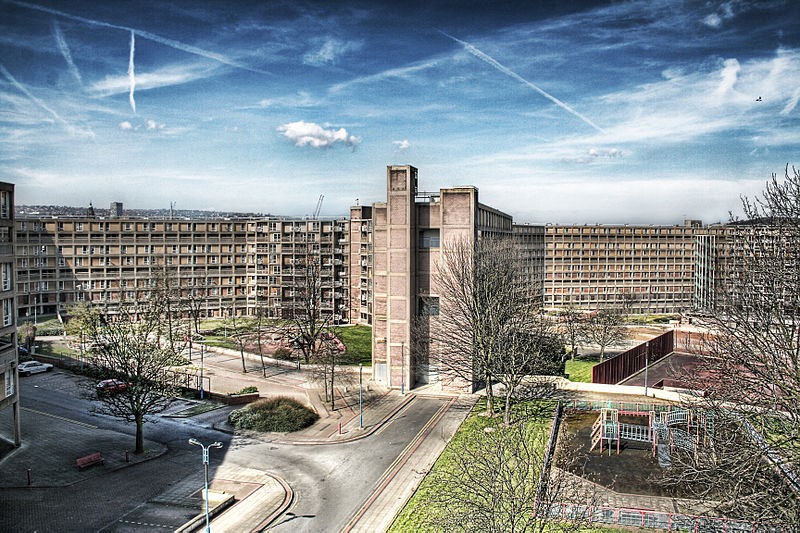
Park Hill, half-abandoned council housing estate, Sheffield, England
Photo via Wikimedia CommonsMany of the buildings that Harwood’s book covers make you wonder whether it is really about architecture at all. Consider Park Hill (1961), a huge council-housing estate containing nearly 1,000 duplexes and single-level flats that partially replaced a demolished slum overlooking downtown Sheffield — a crime-ridden precinct that, for all its problems, had housed a resilient community. Laid out as four long, interconnected slabs inflected so as to form an utterly antiurban, vermiculated footprint, Park Hill owed an enormous debt to the Unité d’habitation. At every third story, it featured elevated open-air “streets” or “decks” — the Corbusian fetish of the day — that ran indoors and out, connecting the slabs. As at the Unité, the imagery was nakedly industrial, with the apartments stashed in a “bottle-rack” grid of concrete that soon assumed a depressingly drab tincture and also proved prone to spalling. A ruthless rationalism likewise asserted itself in the level height maintained throughout the complex, which ranged from four to 13 stories, despite the irregular, sloping site. Park Hill was less a work of architecture than a huge, strange contraption inflicted on the urban skyline. Visual amenity, such as it was, came in the form of soft-hued brick within the concrete grid.
A typical deck in the Park Hill Flats, Sheffield.
Photo via Wikimedia Commons.As with many postwar housing projects, Park Hill offered practical amenities that residents had never before enjoyed: indoor plumbing, hot water, mechanical heating, even a sophisticated garbage-disposal system. Harwood mentions that, Britain’s many council-housing catastrophes notwithstanding, Park Hill “stood firm.” This is not true. By 1979, less than 20 years after its completion, Park Hill was an urban basket case — riddled with graffiti, terrorized by hooligans, afflicted with irruptions of black mold and the terrible stench resulting from waste-disposal blockages. Deserted decks and stairways provided criminals with multiple escape routes.
[…]
Local journalist Peter Tuffrey’s Sheffield Flats, Park Hill and Hyde Park: Hope, Eyesore, Heritage — whose title might seem to play ironically off Harwood’s but for the fact that the book appeared two years earlier — allows us to study a map and old photographs of the slum that Park Hill and Hyde Park supplanted. What we see are blocks, courts, and alleys teeming with row houses and low-rise tenements — streetscapes displaying a human scale, much solid construction, and considerable dereliction, all to be swept away by the desolation of the Corbusian superblocks.
Harwood doesn’t trouble herself with the Hulme Crescents (1972), another assemblage of concrete slabs on the vermiculated, “streets-in-the-sky” plan that rose from the blank slate of a demolished Manchester working-class district where 90,000 people once lived — “the human engine-room of the Industrial Revolution,” as Lynsey Hanley calls it in her largely autobiographical and often engrossing Estates: An Intimate History. The Crescents, designed to house more than 13,000, were conceived in emulation of Bath, the gorgeous Georgian city. Things didn’t work out that way.
“Almost immediately, the estate’s infrastructure began to suffer from the same problems that beset Park Hill and Broadwater Farm [a troubled north London estate]: leaky roof membranes, infestations of vermin and insects, uncontrollable damp, deserted walkways, and an endemic feeling of isolation,” Hanley notes. “The flats were so expensive to warm that many tenants never turned the central heating on, and communal areas were so difficult to maintain that the [city] council could not cope. When a small child died after falling off the top-floor ‘access deck’ of one of the Crescents in 1974, families decamped to the outskirts, belatedly following the rest of old Hulme.” The Crescents’ descent into chaos did make it possible for an anarchic punk scene to flourish in an upper-level hangout known as The Kitchen. The party ended with the estate’s demolition during the 1990s.
[…]
Still, the folly of concentrating lower-income populations in tall buildings eludes her, just as it eluded the Tory government that, in 1956, introduced hugely generous subsidies for the construction of high-rises, relative to row houses and semidetached houses. Not only are tall buildings much more expensive to build and maintain than houses; they were not even essential to achieving the residential densities that postwar planners sought. Tall buildings are highly artificial and complex structures housing temperamental machines, like elevators, that require a heightened degree of maintenance, often by highly paid technicians rather than handymen with toolboxes and stepladders, as Hanley observes. Tall buildings also require an elevated degree of social discipline, as well as security features like intercom systems, closed-circuit TV, and doormen or concierges. The tower blocks and high-rise slabs at the Barbican Estate, the carefully developed, elaborately landscaped, intensely picturesque Brutalist “bankers’ commune” in the City of London, have been very successful. The appropriate synecdoche for the Barbican’s low-end counterparts, however, might well be a broken-down elevator littered with trash, defaced by graffiti, and reeking of urine.

June 3, 2018
QotD: Price controls just make things more expensive in real terms
One of the perennial, and pernicious, political ideas is that if things are “too expensive” then we can fix that by just passing a law to make them less expensive. We see this just about everywhere and its sadly not limited to the more idiot sector of the left. Although of course it thrives there. Venezuela is a complete and total mess because Hugo Chavez and Nicolas Maduro thought they would make life cheaper by limiting prices by law. Payday lending doesn’t exist in certain states because people like Elizabeth Warren insist that interest rates should not go “too high”. Those usury laws mean that interest rates are infinite – as the lending simply isn’t available at all. And yes, people over on the right have made the same sort of mistake – Nixon tried to fix gas prices after all.
Price fixing just always leads to things getting more expensive. As David Friedman explains:
The result – that price control results in a cost to the consumer, pecuniary plus nonpecuniary, higher than the uncontrolled price – does not depend on the details of the [supply and demand] diagram. Consumers cannot consume more gas than producers produce, so the nonpecuniary cost must be large enough to drive quantity demanded down to quantity supplied. Quantity supplied is lower than without price control, so cost to the consumer must be higher.
Tim Worstall, “Memo For Would Be Price Fixers – Price Controls Always Make Things More Expensive”, Forbes.com, 2016-08-16.
May 5, 2018
What’s Wrong With Wakanda?
Foundation for Economic Education
Published on 3 May 2018Wakanda could never exist in the real world.
Wakanda is frustrating because it perpetuates the myth that an abundance of a really valuable natural resource is all you need to create a prosperous and extremely advanced society. This is simply not true. Matt Ridley, author of The Rational Optimist, wrote about how isolationism actually leads to a regress in technology.


