Quotulatiousness

November 2, 2012

California tax collectors discover exciting new technique: double billing

Filed under: Bureaucracy, Government, USA — Tags: , , — Nicholas @ 08:04

Let’s say you’re an honest, upstanding citizen who pays your taxes on time and in full. Let us also say you happen to live in California. What would you do when you got a bill from a different agency of the state government, saying you still owed an amount of money that you paid in your state taxes (and have the documentation to prove it)? David Friedman ponders whether this new approach to state fund-raising is fraud or mere incompetence:

I recently received a bill from the California Board of Equalization (BOE) demanding that I pay them about three hundred dollars in use tax. That puzzled me, since I had already paid the use tax with my California state income tax return—my reporting it on that return is the only reason the BOE knew that I owed it. Just to be sure, I went online and checked my account with the Franchise Tax Board, the body that collects California income tax—it showed me owing nothing.

So I called the number for the BOE. The woman I spoke with told me that they had not received the money from the FTB and that if I did not want them to bill me for it I should call the FTB and have them take care of the matter. I called the number she gave me, got an FTB phone tree with no option of talking to a human being and no reference to use tax.

[. . .]

It is possible, of course, that I am misinterpreting incompetence as dishonesty—that at some stage in the process someone made a mistake, which will now be corrected. One reason I doubt that is that what the letter I received said was:

    “According to information provided to us by the Franchise Tax Board (FTB), you reported a use tax liability on your state income tax return. However, FTB advised the funds were not available to be transferred to the State Board of Equalization (BOE), which is ultimately responsible for the collection of use tax.”

    “If the use tax was remitted with your FTB return, the use tax was either redirected to a FTB liability or refunded by FTB. Accordingly, the BOE is sending this letter to inform you that the use tax remains due (see enclosed billing notice)”

They do not say that I did not pay the money to the FTB, merely that the FTB did not pay it to them. And the final bit, which I missed in the initial draft of this post and have just added, makes it clear that if I paid the money but the FTB didn’t pass it on, they want me to pay it again.

September 21, 2012

California’s “wall of debt” actually a very high cliff of debt

Filed under: Economics, Government, USA — Tags: , , — Nicholas @ 09:21

Mary Williams Walsh on the so-much-worse than estimated debt of California:

Gov. Jerry Brown of California announced when he came into office last year that he had found an alarming $28 billion “wall of debt” looming over the state, which had to be dismantled.

Since then, he has slowed the issuance of municipal bonds, called for spending cuts and tried to persuade the state’s famously antitax voters to approve a tax increase this fall.

On Thursday, an independent group of fiscal experts said Mr. Brown’s efforts were all well and good, but in fact, the “wall of debt” was several times as big as the governor thought.

[. . .]

The task force estimated that the burden of debt totaled at least $167 billion and as much as $335 billion. Its members warned that the off-the-books debts tended to grow over time, so that even if Mr. Brown should succeed in pushing through his tax increase, gaining an additional $50 billion over the next seven years, the wall of debt would still be there, casting its shadow over the state.

July 2, 2012

Alex Tabarrok on the slow rail and infrastructure bottleneck

Writing at Marginal Revolution, Alex Tabarrok wonders “Why haven’t the $500 bills been picked up?”:

High speed rail, especially California’s project, looks to me to be monorail economics, a costly boondoggle whose appeal lies not in rational calculation […] but in the desire of some politicians (and voters) to feel visionary and sexy. In theory, CA HSR might work but the inevitable reviews, delays, lawsuits and special interest payoffs make the prospects of a beneficial project look dim, demosclerosis kills.

Slow speed rail, however, i.e. freight transport, isn’t sexy but Warren Buffett is investing in rail and maybe we should as well. In particular, there are basic infrastructure projects with potentially high payoffs. Congestion in Chicago, for example, is so bad that freight passing through Chicago often slows down to less than the pace of an electric wheel chair. Improvements are sometimes as simple as replacing 19th century technology with 20th century (not even 21st century!) technology. Even today, for example:

    …engineers at some points have to get out of their cabins, walk the length of the train back to the switch — a mile or more — operate the switch, and then trudge back to their place at the head of the train before setting out again.

In a useful article Phillip Longman points out that there are choke points on the Eastern Seaboard which severely reduce the potential for rail:

    …railroads can capture only 2 percent of the container traffic traveling up and down the eastern seaboard because of obscure choke points, such as the Howard Street Tunnel in downtown Baltimore. The tunnel is too small to allow double-stack container trains through, and so antiquated it’s been listed on the National Register of Historic Places since 1973. When it shut down in 2001 due to a fire, trains had to divert as far as Cincinnati to get around it. Owner CSX has big plans for capturing more truck traffic from I-95, and for creating room for more passenger trains as well, but can’t do any of this until it finds the financing to fix or bypass this tunnel and make other infrastructure improvements down the line.

June 27, 2012

California primed to make bad decision for “good” reasons

Filed under: Environment, Food, Government, Health, Science, USA — Tags: , , , , — Nicholas @ 00:05

California’s already bad economic situation could be made even worse by mandating that genetically modified foods be labelled to call attention to themselves:

The American Medical Association resolved this week that “there is no scientific justification for special labeling of bioengineered foods.”

The association has long-held that nothing about the process of recombinant DNA makes genetically engineered (GE) crop plants inherently more dangerous to the environment or to human health than the traditional crop plants that have been deliberately but slowly bred for human purposes for millennia. It is a view shared by the National Academy of Sciences, the World Health Organization, the Food and Agriculture Organization of the U.N., the European Commission, and countless other national science academies and non-governmental organizations.

And yet Californians will consider on their November ballots a law that mandates cigarette-like labeling of food derived from GE plants. Proponents claim to promote opportunities for consumers to make informed choices about the foods they eat. But to build support for the measure, they have played on consumer fears about a promising technology that is nevertheless prone to “Frankenfoods” demagoguery. If successful, they may well imperil the ability of Californians, and consumers around the world, to choose a technology that scientists contend could end hunger and malnutrition, lift hundreds of millions from poverty, and reduce the environmental impact of feeding an evermore populous world.

June 13, 2012

QotD: “California is becoming Detroit”

Filed under: Economics, Government, Politics, Quotations, USA — Tags: , , — Nicholas @ 09:14

The liberal model — borrowing huge sums, rigging interest and the currency to enable state profligacy, turning large swaths of the population into less productive unionized government workers or dependents on the dole who vote in thanks to political hacks — simply does not work. How could beautiful blue-state California lose almost a million refugees to arid Texas? I like Texas, but Dallas had far less of nature to work with than did San Francisco. (It takes a lot of human failure for thousands to give up verdant California to move to Utah or the Nevada desert.) What we are witnessing is nothing short of surreal: in the manner that Tijuana was a different universe from San Diego, so too the entire state of California is becoming a different world from its neighbors. Whether one examines its near dead-last schools, its oppressive income and sales taxes, its decaying roads and infrastructure, its absurd prison system, its dysfunctional state offices (try the DMV), or its priestly public employee caste, California is becoming Detroit.

Victor Davis Hanson, “The Liberal Super Nova”, PJ Media, 2012-06-11

June 5, 2012

QotD: The settling of the west (revised edition)

Filed under: History, Humour, Quotations, USA — Tags: , — Nicholas @ 00:03

America was built on the principle that a man could make choices about his own life. This has been a complete failure. You remember when pioneers set out by themselves into the untamed frontier? And you remember what happened to them? That’s right: They all died. Lacking a government to tell them how much soda to drink or salt to eat, they became too obese to run away from bears and mountain lions. It’s a sad chapter in our history, but luckily when people headed out west the next time, they brought lots and lots of government with them and founded California. And thanks to its huge amount of laws telling people what to do, that area has flourished (well, I haven’t read any news about California in a decade or so, but I assume it’s still doing pretty well).

Frank J. Fleming, “The Tyranny of Having Too Many Choices”, PJ Media, 2012-06-04

May 22, 2012

Lucasfilm fires Parthian shot in “retreat”

Filed under: Media, Politics, USA — Tags: , , , , — Nicholas @ 10:14

In the New York Times, Norimitsu Onishi reports on recent developments (if you’ll pardon the expression) in Marin County, California:

In 1978, a year after “Star Wars” was released, George Lucas began building his movie production company far from Hollywood, in the quiet hills and valley of Marin County here just north of San Francisco. Starting with Skywalker Ranch, the various pieces of Lucasfilm came together over the decades behind the large trees on his 6,100-acre property, invisible from the single two-lane road that snakes through the area.

And even as his fame grew, Mr. Lucas earned his neighbors’ respect through his discretion. Marin, one of America’s richest counties, liked it that way.

But after spending years and millions of dollars, Mr. Lucas abruptly canceled plans recently for the third, and most likely last, major expansion, citing community opposition. An emotional statement posted online said Lucasfilm would build instead in a place “that sees us as a creative asset, not as an evil empire.”

If the announcement took Marin by surprise, it was nothing compared with what came next. Mr. Lucas said he would sell the land to a developer to bring “low income housing” here.

“It’s inciting class warfare,” said Carolyn Lenert, head of the North San Rafael Coalition of Residents.

It’s lovely to see NIMBY-ism spiked on its own hypocritical underpinnings. Just the threat of allowing “the other” into their lovely 1% outpost will be enough to rattle cages and upset the (self-nominated) “great and the good”:

Whatever Mr. Lucas’s intentions, his announcement has unsettled a county whose famously liberal politics often sits uncomfortably with the issue of low-cost housing and where battles have been fought over such construction before. His proposal has pitted neighbor against neighbor, who, after failed peacemaking efforts over local artisanal cheese and wine, traded accusations in the local newspaper.

The staunchest opponents of Lucasfilm’s expansion are now being accused of driving away the filmmaker and opening the door to a low-income housing development. That has created an atmosphere that one opponent, who asked not to be identified, saying she feared for her safety, described as “sheer terror” and likened to “Syria.”

Update: Jesse Walker comments at Hit and Run:

Lucas hasn’t always been a force for good in land-rights fights: His same statement that complains about the barriers to building on his property also complains that he wasn’t able to put up similar barriers himself when a developer built a neighborhood nearby. But that’s forgiven now. You have to appreciate a move that will simultaneously achieve four worthy goals: making housing more affordable for the poor, showing up the hypocrisies of the local limousine liberals, taking revenge (whether or not Lucas wants to call it that) on the people who restricted his property rights, and setting off a reaction that promises to be far more entertaining than any of the director’s recent movies.

April 20, 2012

Building High Speed Rail won’t do much to cut carbon dioxide emissions

Filed under: Economics, Environment, Technology — Tags: , , , — Nicholas @ 08:11

Brad Plumer at the Washington Post on the latest straw that high speed rail enthusiasts have been grabbing to justify their expensive toys:

… Brown’s administration has proposed using money raised by California’s new climate law. Under the state’s cap-and-trade system for carbon emissions, power plants and factories will have to buy permits to pollute. Brown has suggested diverting this money into high-speed rail. But there are two problems here. For one, this might be illegal, as the state’s Legislative Analyst’s Office concluded on Tuesday. But second — and more broadly — high-speed rail turns out not to be the most effective use of money that’s meant to combat global warming.

Paul Druce at Reason & Rail offered up a few numbers on this topic last year. The California High Speed Rail Authority claims that by 2030, if the train ran entirely on renewable energy, then it would reduce the state’s carbon emissions by about 5.4 million metric tons a year. If you ignore all the energy used to build the system, that means the rail network would reduce California’s emissions at a cost of $12,506 per metric ton of carbon dioxide.

That’s a pricey way to cut carbon. To put this in perspective, research has suggested that you could plant 100 million acres of trees and reforest the United States for a cost of about $21 to $91 per ton of carbon dioxide. Alternatively, a study by Dan Kammen of UC Berkeley found that it would cost somewhere between $59 and $87 per ton of carbon dioxide to phase out coal power in the Western United States and replace it with solar, wind and geothermal. If reducing greenhouse gases is your goal, then there are much more cost-effective ways to do it than building a bullet train.

April 16, 2012

“This sort of investment pays for itself ten-fold over a very short period of time”

Filed under: Economics, Government, Technology, USA — Tags: , , , , , — Nicholas @ 10:16

You see? This is what’s wrong with private enterprise, especially in California. Those wimps aren’t willing to invest in something that will “pay for itself” ten times over in a “very short period of time”. That’s why all the greatest economic advances have come from over-aged students, business council speechifiers, bureaucrats, and career apparatchiks!

If you believe calling your opponents names is a sign that you have lost the argument, then this new high-speed rail commercial from the California Alliance for Jobs — in which unexpectedly macho proponents of the $41 billion, $110 billion, $98.5 billion, $68.4 billion high-speed rail project deride skeptics as “wimps” — is pretty much the end of the line […]

What reveals the intellectual bankruptcy of the high-speed rail project is not the insults but that what is supposed to be a rousing propaganda piece comes off like an orientation video for new hires at a failing company.

The video’s cast includes hacks respected citizens from Operating Engineers Local 3, including Alliance for Jobs Executive Director Jim Earp, along with leaders from what’s usually referred to as the “business community” whose skill sets cluster around serving on business councils rather than doing any actual business. There’s also a career apparatchik and the founder of the “I Will Ride” Student Coalition, who is apparently a UC Merced senior but looks at least a decade too old.

[. . .]

Again, why not just claim the Fresno-Bakersfield line will end up carrying 38 million people, the entire population of California, every day? It would be no less accurate than the current claims, which have been made with no data on ticket costs, no comparative studies of existing bullet-train ridership, or anything else that can reasonably pass for due diligence.

Oh, and nobody actually knows where the bullet train will go to or from. (Past, present and possibly future candidates include Corcoran, Borden, Fresno, Anaheim, Los Angeles, San Francisco, and some guy named Dave’s rec room.) You wouldn’t build a patio with the amount of planning that’s gone into the high-speed rail project.

To put the headline into a bit of perspective, note that only one high speed rail line in the world is profitable. This is an old hobby horse of mine and I’ve posted about High Speed Railways a few times before.

Update: And to answer the question about why parts of Europe, Japan, and China have high speed rail systems and neither Canada nor the United States do, here’s a brief overview I wrote last year:

The best place to build a high speed rail system for the US would be the Boston-New York-Washington corridor (aka “Bosnywash”, for the assumed urban agglomeration that would occur as the cities reach toward one another). It has the necessary population density to potentially turn an HSR system into a practical, possibly even profitable, part of the transportation solution. The problem is that without an enormous eminent domain land-grab to cheat every land-owner of the fair value of their property, it just can’t be done. Buying enough contiguous sections of land to connect these cities would be so expensive that scrapping and replacing the entire navy every year would be a bargain in comparison.

The American railway system is built around freight: passenger traffic is a tiny sliver of the whole picture. Ordinary passenger trains cause traffic and scheduling difficulties because they travel at higher speeds, but require more frequent stops than freight trains, and their schedules have to be adjusted to passenger needs (passenger traffic peaks early to mid-morning and early to mid-evening). The frequency of passenger trains can “crowd out” the freight traffic the railway actually earns money on.

Most railway companies prefer to avoid having the complications of carrying passengers at all — that’s why Amtrak (and VIA Rail in Canada) was set up in the first place, to take the burden of money-losing passenger services off the shoulders of deeply indebted railways. Even after the new entity lopped off huge numbers of passenger trains from its schedule, it couldn’t turn a profit on the scaled-down services it was offering.

Ordinary passenger trains can, at a stretch, share rail with freight traffic, but high speed trains cannot. At higher speeds, the actual construction of the track has to change to deal with the physical problem of safely guiding the fast passenger trains along the rail. Signalling must also change to suit the far-higher speeds — and the matching far-longer safe braking distances. High speed rail lines cannot be interrupted with grade crossings, for the safety of passengers and bystanders, so additional bridges and tunnels must be built to avoid bringing road vehicles and pedestrians too close to the trains.

In other words, a high speed railway line is far from being just a faster version of what we already have: it would have to be built separately, to much higher standards of construction.

Getting back to the California HSR line; it goes from A to B on this map:
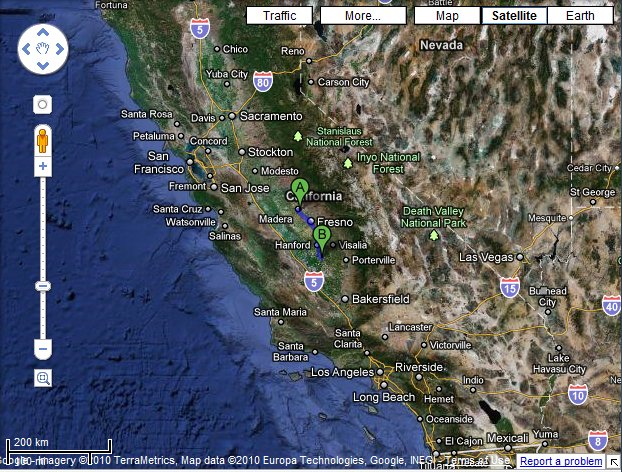
Okay, you think, at least Fresno will get some snazzy slick rail service . . . except this section will be built but not operated until further connecting sections are built . . . at a later date. Maybe. It will be the track, including elevated sections through Fresno, and the physical right-of-way, but no electrical system to power the trains; but that’s fine, because the budget doesn’t include any actual trains.


February 25, 2012

Reason.tv: Banning drugs, banning same-sex marriage, and banning fun

Filed under: Government, Liberty, USA — Tags: , , , — Nicholas @ 00:04

December 14, 2011

Reason.TV: Weed wars

Filed under: Government, Health, Law, Liberty, USA — Tags: , , , , — Nicholas @ 17:05

November 30, 2011

Reason.tv: California vs. The Feds on medical marijuana

Filed under: Government, Health, Liberty, USA — Tags: , , , — Nicholas @ 09:32

November 9, 2011

Federalism does not mean “do what the Feds say”

Filed under: Government, Law, USA — Tags: , , — Nicholas @ 12:41

The US government is actively undermining California law when it comes to medical marijuana:

When you get a new car, you start noticing the same model all over the highway. It’s the same way when you figure out what California’s marijuana dispensaries look like — green crosses and signage about “medicine” and “420” start popping up all over the City of Angels: On your commute to work, in your neighborhood, around the corner from your favorite restaurant. To put it bluntly, it’s not hard to find weed in California.

But that all might be about to change. The state’s four U.S. Attorneys are gamely trying to alter the broadly popular status quo with arrests and threats of prosecution and property seizure for landlords who rent to dispensaries, a campaign announced in a rare joint press conference in October. Medical marijuana advocates call it an “intense crackdown” and have launched a lawsuit claiming the federal attorneys’ tactics violate California’s tenth amendment rights (Rick Perry, call your office).

State and local officials, meanwhile, are divided in their reactions to the influx of dispensaries in California, but many say that overly eager federal intervention is undermining the state-regulated medical marijuana system that they have taken pains to set up. In other words, as long as the federal crackdown contained itself to targeting egregious offenders of state law, it was hard for anyone to object; many applauded. But by raising the prospect of a federal assault on city mayors and town councils, Obama’s Department of Justice could be making more enemies than friends in California.

November 4, 2011

The Kangaroo Family Court

Filed under: Law, USA — Tags: , , , , — Nicholas @ 11:15

The headline says it all: “Sexual Assault Victim Must Pay Her Attacker Spousal Support”

A San Diego judge ordered Crystal Harris to pay $1,000 a month in spousal support to her ex-husband — just as soon as he finishes up his six year prison sentence for sexually assaulting her. As 10News reports, “The entire assault was caught on tape and what it captured was enough to convict Shawn Harris of a felony — forced oral copulation.”

So why is a victim being forced to pay her attacker? According to Judge Gregory Pollock, it’s because Crystal Harris brought home six figures worth of bacon while Shawn Harris was unemployed.

    “I can’t look at a 12-year marriage where one side is making $400 a month, the other side is making over $11,000 and say no spousal support,” Pollock said in court. “That would be an abuse of discretion.”

It sounds like a miscarriage of justice, but the law is written so that it only excludes attempted murderers from the right to receive spousal support. Another case of a bad law forcing a bad judgement (or a judge unwilling to exercise his discretion in a case that cries out for it).

October 23, 2011

California Democrats in sudden financial crisis

Filed under: Law, Politics, USA — Tags: , , — Nicholas @ 11:18

No, I’m not talking about the plight of the state itself, but the plight of hundreds of individual Democratic candidates whose political campaign funds may have been drained by the state campaign treasurer:

Stunning accusations that a top California Democratic campaign treasurer looted the war chests of her big-name clients have left candidates across the state scrambling to raise more money as election season looms.

Kinde Durkee, who controlled the funds of roughly 400 candidates and groups, ranging from Senator Dianne Feinstein to local Democratic youth clubs, was arrested in September and charged with fraud.

While the extent of the losses isn’t yet clear, the coffers of dozens of Democratic politicians have been frozen, prompting the crippled campaigns to ask the California Fair Political Practices Commission to permit further donations from contributors who have already given the maximum.

Feinstein, seeking re-election in 2012, has been forced to start from “square one” to raise campaign money, said Bill Carrick, political strategist and consultant to the Senator.

But a commission official said it wasn’t that simple.

“It’s quite clear that we can’t just say ‘the contribution limit is set aside’,” California Fair Political Practices Commission chair Ann Ravel said, adding that the commission’s legal team was researching what options were permissible by law.

« Newer PostsOlder Posts »

Powered by WordPress


