
December 14, 2011
November 30, 2011
Reason.tv: California vs. The Feds on medical marijuana
November 9, 2011
Federalism does not mean “do what the Feds say”
The US government is actively undermining California law when it comes to medical marijuana:
When you get a new car, you start noticing the same model all over the highway. It’s the same way when you figure out what California’s marijuana dispensaries look like — green crosses and signage about “medicine” and “420” start popping up all over the City of Angels: On your commute to work, in your neighborhood, around the corner from your favorite restaurant. To put it bluntly, it’s not hard to find weed in California.
But that all might be about to change. The state’s four U.S. Attorneys are gamely trying to alter the broadly popular status quo with arrests and threats of prosecution and property seizure for landlords who rent to dispensaries, a campaign announced in a rare joint press conference in October. Medical marijuana advocates call it an “intense crackdown” and have launched a lawsuit claiming the federal attorneys’ tactics violate California’s tenth amendment rights (Rick Perry, call your office).
State and local officials, meanwhile, are divided in their reactions to the influx of dispensaries in California, but many say that overly eager federal intervention is undermining the state-regulated medical marijuana system that they have taken pains to set up. In other words, as long as the federal crackdown contained itself to targeting egregious offenders of state law, it was hard for anyone to object; many applauded. But by raising the prospect of a federal assault on city mayors and town councils, Obama’s Department of Justice could be making more enemies than friends in California.
November 4, 2011
The Kangaroo Family Court
The headline says it all: “Sexual Assault Victim Must Pay Her Attacker Spousal Support”
A San Diego judge ordered Crystal Harris to pay $1,000 a month in spousal support to her ex-husband — just as soon as he finishes up his six year prison sentence for sexually assaulting her. As 10News reports, “The entire assault was caught on tape and what it captured was enough to convict Shawn Harris of a felony — forced oral copulation.”
So why is a victim being forced to pay her attacker? According to Judge Gregory Pollock, it’s because Crystal Harris brought home six figures worth of bacon while Shawn Harris was unemployed.
“I can’t look at a 12-year marriage where one side is making $400 a month, the other side is making over $11,000 and say no spousal support,” Pollock said in court. “That would be an abuse of discretion.”
It sounds like a miscarriage of justice, but the law is written so that it only excludes attempted murderers from the right to receive spousal support. Another case of a bad law forcing a bad judgement (or a judge unwilling to exercise his discretion in a case that cries out for it).
October 23, 2011
California Democrats in sudden financial crisis
No, I’m not talking about the plight of the state itself, but the plight of hundreds of individual Democratic candidates whose political campaign funds may have been drained by the state campaign treasurer:
Stunning accusations that a top California Democratic campaign treasurer looted the war chests of her big-name clients have left candidates across the state scrambling to raise more money as election season looms.
Kinde Durkee, who controlled the funds of roughly 400 candidates and groups, ranging from Senator Dianne Feinstein to local Democratic youth clubs, was arrested in September and charged with fraud.
While the extent of the losses isn’t yet clear, the coffers of dozens of Democratic politicians have been frozen, prompting the crippled campaigns to ask the California Fair Political Practices Commission to permit further donations from contributors who have already given the maximum.
Feinstein, seeking re-election in 2012, has been forced to start from “square one” to raise campaign money, said Bill Carrick, political strategist and consultant to the Senator.
But a commission official said it wasn’t that simple.
“It’s quite clear that we can’t just say ‘the contribution limit is set aside’,” California Fair Political Practices Commission chair Ann Ravel said, adding that the commission’s legal team was researching what options were permissible by law.
September 4, 2011
California is apparently not in deep enough trouble
Otherwise, there’s no explanation for yet another extension of the state’s regulatory reach into the lives of everyday citizens. The most recent example is a bill that (at least on first look) appears to mandate workers’ compensation coverage, detailed pay slips (with all deductions clearly indicated), and paid vacation time for babysitters. Coyote Blog would like to see even more of this kind of thing:
I know this is exactly the kind of thing you would expect me to oppose, but I have decided this is exactly the kind of thing California needs. I am tired of average citizens passing crazy requirements on business without any concept of the costs and injustices they are proposing, and then scratch their head later wonder why job creation is stagnant.
I want to propose that California do MORE in this same vein. Here are some suggestions:
- Every household will have to register for a license to conduct any type of commerce, a license to occupy their house, and a license to hire any employees. Homeowner will as a minimum have to register to withhold income taxes, pay social security taxes, pay unemployment insurance, pay disability insurance, and pay workers comp insurance.
- Households should have to file a 1099 for every payment they make to contractors
- All requirements of Obamacare must be followed for any household labor, including payment of penalties for even part-time labor for which the homeowner does not provide medical insurance
- No alcohol may be purchased by any individual without first applying for and receiving a state liquor license
- No cigarettes may be purchased by any individual without first applying for and receiving a state cigarette license
- No over the counter drugs may be purchased by any individual without first applying for and receiving a state over the counter drug license
And the list goes on. But they’re not just being randomly generated: they’re all things that ordinary businesses in California already have to do.
June 2, 2011
Man succeeds in suicide attempt over an hour, as police and fire rescue watch
A hard-to-believe story from Alameda, California:
Fire crews and police could only watch after a man waded into San Francisco Bay, stood up to his neck and waited. They wanted to do something, but a policy tied to earlier budget cuts strictly forbade them from trying to save the 50-year-old, officials said.
A witness finally pulled the apparently suicidal man’s lifeless body from the 54-degree water.
The San Jose Mercury News reported that the man, later identified as Raymond Zack, spent nearly an hour in the water before he drowned.
Perhaps they assumed that the suicidal man would get too cold and come back to shore, but it’s hard to understand how they could stand around for an hour and not do anything.
May 20, 2011
Only one high speed rail line in the world is profitable
Babbage looks at the economics of the various high speed railway lines both in service and planned:
Of all the high-speed train services around the world, only one really makes economic sense — the 550km (350-mile) Shinkansen route that connects the 30m people in greater Tokyo to the 20m residents of the Kansai cluster of cities comprising Osaka, Kobe, Kyoto and Nara. At peak times, up to 16 bullet trains an hour travel each way along the densely populated coastal plain that is home to over half of Japan’s 128m people.
Having worked for many years in Tokyo, with family in Osaka, your correspondent has made the two-and-a-half hour journey on the Tokaido bullet-train many times. It is clean, fast and highly civilised, though far from cheap. It beats flying, which is unbearably cramped by comparison, just as pricey, and dumps you an hour from downtown at either end.
The sole reason why Shinkansen plying the Tokaido route make money is the sheer density — and affluence — of the customers they serve. All the other Shinkansen routes in Japan lose cart-loads of cash, as high-speed trains do elsewhere in the world. Only indirect subsidies, creative accounting, political patronage and national chest-thumping keep them rolling.
California’s planned 800-mile high speed rail route cannot possibly earn a profit, for many reasons (not least of which is that the first segment of the network won’t even run high speed trains until the entire system is built). It’s going to cost an eye-watering amount of money even to build that first section:
Between them, the federal government, municipals along the proposed route and an assortment of private investors are being asked to chip in $30 billion. A further $10 billion is to be raised by a bond issue that Californian voters approved in 2008. Anything left unfunded will have to be met by taxpayers. They could be dunned for a lot. A study carried out in 2008 by the Reason Foundation and the Howard Jarvis Taxpayers Association put the final cost of the complete 800-mile network at $81 billion.That is probably not far off the mark. Last week, the state’s Legislative Analyst’s Office came out with a damning indictment of the project’s unrealistic cost estimates and poor management. The bill this legislative watchdog put on the first phase of the high-speed rail project alone is $67 billion — and higher still if the project runs into trouble gaining route approval in urban areas.
If the latter number is correct, then the first phase of the system is clocking in at nearly $1 billion per mile. And this is the “cheap” section running through mostly thinly populated farming areas. If, somehow, the more expensive sections of the planned network don’t cost much more, the total construction bill will top $800 billion. The original plan had the entire system costing $43 billion.
Cost overruns are an expected part of major government construction projects, but that’s insane.
March 18, 2011
West coast earthquake zones
According to an article in The Economist, the well-known San Andreas fault in California is not the most likely to cause an earthquake of the magnitude of last week’s quake in Japan. The most likely source is the Cascadia subduction zone:
The most likely megaquake on the West Coast would be much further north — in fact, 50 miles off the coast between Cape Mendocino in northern California and Vancouver Island in southern British Columbia. This 680-mile strip of seabed is home to the Cascadia subduction zone, where oceanic crust known as the Juan de Fuca plate is forced under the ancient North American plate that forms the continent. For much of its length, the two sides of this huge subduction zone are locked together, accumulating stresses that are capable of triggering megaquakes in excess of magnitude 9.0 when they eventually slip. As such, Cascadia is more than a match for anything off the coast of Japan.
What makes Cascadia such a monster is not just its length, but also the shallowness of the angle with which the encroaching tectonic plate dives under the continental mass. The descending plate has to travel 40 miles down the incline before it softens enough from the Earth’s internal heat to slide without accumulating further frictional stresses. Could the fault unzip from end to end and trigger a megaquake — along with the mother of all tsunamis? You bet. By one account, it has done so at least seven times over the past 3,500 years. Another study suggests there have been around 20 such events over the past 10,000 years. Whatever, the “return time” would seem to be within 200 to 600 years.
And the last time Cascadia let go? Just 311 years ago.
Cascadia subduction zone image from wikimedia.org.
December 6, 2010
What happens when a “hoarder” is also an explosives buff
Julie Watson reports on the “largest amount of homemade explosives ever found in one location in the U.S.”
Now authorities face the risky task of getting rid of the explosives. The property is so dangerous and volatile that that they have no choice but to burn the home to the ground this week in a highly controlled operation involving dozens of firefighters, scientists and hazardous material and pollution experts.
[. . .]
Bomb experts pulled out about nine pounds of explosive material and detonated it, but they soon realized it was too dangerous to continue given the quantity of hazardous substances. A bomb-disposing robot was ruled out because of the obstacle of all the junk Jakubec hoarded.
[. . .]
“This is a truly unknown situation,” said Neal Langerman, the top scientist at the safety consulting firm, Advanced Chemical Safety in San Diego. “They’ve got a very good inventory of what’s in there. Do I anticipate something going wrong? No. But even in a controlled burn, things occasionally go wrong.”
He said the burning of the house would provide “an amazing textbook study” for bomb technicians in the future.
San Diego County authorities plan to burn the home Wednesday but need near perfect weather, with no rain, no fog, and only light winds blowing toward the east, away from the city. They have warned residents in the danger zone that they will be given less than 24 hours notice to evacuate their homes for a day, and that nearby Interstate 15, connecting the area to San Diego, will be closed.
Update, 8 December: Controlled burn has been delayed until better weather conditions prevail.
December 5, 2010
More on California’s High Speed Boondoggle
Tim Cavanaugh has more information on the high speed (high cost) train to nowhere:
California’s high speed rail project could be shaping up as the awesomest catastrogeddon of 2011.
The California High Speed Rail Authority is committed to breaking ground on a leg of the train that will serve passengers between the unincorporated town of Borden and the half-incarcerated town of Corcoran.
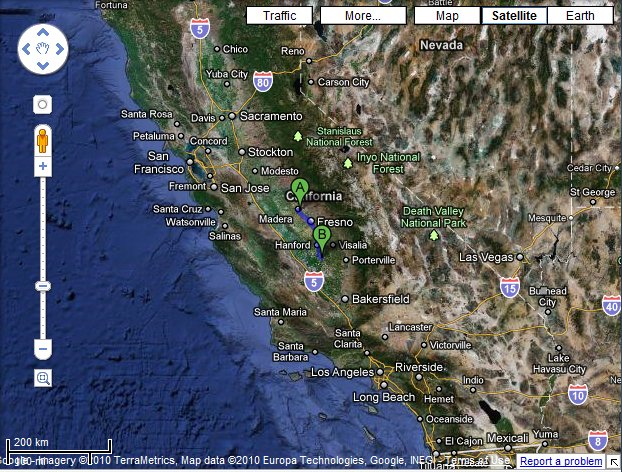
Even saying it will “serve” passengers between the two arbitrary spots on the map is an overstatement: there will be no actual service along this route until after connecting segments are completed and some engines and coaches are purchased.
Background: The CHSRA needs to break ground by September 2012 or lose $2.25 billion in federal funds. The U.S. Department of Transportation has for reasons of its own favored the sparsely populated Central Valley for this first leg of the thinly imagined high speed rail project. Although Golden State Democrats would prefer to start off by connecting San Francisco to Los Angeles or L.A. to Anaheim, they have generally accepted the humiliation rather than lose the funding and miss another start for the nearly 15-year-old project. The recent dedication of a high-speed terminal in San Francisco by outgoing Democratic House Speaker Rep. Nancy Pelosi was for show purposes only.
Geography buffs are invited to try and make any sense out of the CHSRA’s proposed alignment. Not only does the authority plan to incur all the financial and public relations costs of driving a 150-mph train down the heavily populated and extremely wealthy San Francisco-to-San Jose corridor; but it then plans to sacrifice the only goal that could possibly make that trouble worthwhile: a direct San Fran-L.A. run.
December 4, 2010
California gambles on risky High Speed Rail ploy
The board of the California High Speed Rail Authority voted to build the first segment of the planned HSR trackage from nowhere to nowhere, and will carry no passengers:
Citing a need for jobs and fast approaching federal deadlines for funding, the California High Speed Rail Authority board Thursday unanimously approved construction of the first leg of the state’s proposed bullet train — a 65-mile section in the Central Valley that would not carry passengers until more of the system is built.
Costing at least $4.15 billion, the segment would run from the tiny town of Borden to Corcoran, an area hit so hard by the recession and agriculture declines that it has been dubbed the New Appalachia. Stations would be built in Fresno and Hanford.
Included in the plan are tracks, station platforms, bridges and viaducts, which would elevate the line through urban areas. The initial section, however, would not be equipped with maintenance facilities, locomotives, passenger cars or an electrical system necessary to power high-speed trains.
The board clearly believes that the state and the federal government will be forced to build the connecting segments in order to “save” the $4+ billion in sunk costs for this initial project (costs almost always balloon on major projects like this . . . final figure may well be double the headline number). In other words, they’re deliberately planning to blackmail the money out of future governments.
November 3, 2010
Monty: The flushing sound you just heard is California’s future
Monty pronounces the final doom of California:
That sound you just heard was the State of California irretrievably flushing itself down the toilet.
[. . .]
California’s most dire problems right now are related to public-employee obligations (pensions and healthcare). The power of public-employee unions in California have held the State and local governments in thrall for years, and with the election of Jerry Brown as Governor, the people of California have opted to spray kerosene on a blaze that was already threatening to overwhelm them.
[. . .]
Well, the die has been cast, California. You have placed your fate into the hands of a political party and a governmental machine that cares for nothing except what it can squeeze out of you to keep the party-train rolling. There will come a time in the not-too-distant future when you will have cause to bitterly regret what happened last night, and to wonder when the disaster truly became unavoidable. Well, now you know: it happened last night when you elected Jerry Brown as your governor. You chose to kowtow to the labor unions; you chose to believe comforting lies rather than the horrible truth.
You will reap the whirlwind.
Update: A couple of Twitter updates from Iowahawk sum things up nicely.
10:28: Boxer, Brown, no on Prop 19: congrats, California. You have officially gone Full Retard.
11:05: And as if California wasn’t already full of idiots, lunatics, and drug abusers, I’m flying there this afternoon.
November 1, 2010
It’s not liberal bias: it’s statist bias
Radley Balko uses the media positions on California’s Proposition 19 as a proxy to determine the actual bias:
For the last few months, my colleague Matt Welch has been tracking the positions of California’s newspapers on Proposition 19, the ballot measure that would legalize marijuana for recreational use. At last count, 26 of the state’s 30 largest dailies (plus USA Today) had run editorials on the issue, and all 26 (plus USA Today) were opposed. This puts the state’s papers at odds with nearly all of California’s left-leaning interest groups, including the Green Party, the American Civil Liberties Union, the Service Employees International Union, and the National Association for the Advancement of Colored People; progressive publications such The Nation, Salon, and The Huffington Post; and a host of prominent liberal bloggers. According to a CNN/Time poll released last week, it also pits the state’s newspapers against 76 percent of California voters who identify themselves as “liberal.”
On this issue, the state’s dailies are also to the right of conservative publications such as The Economist and National Review, prominent Republicans such as former New Mexico Gov. Gary Johnson, a growing portion of the Tea Party movement, and even Fox News personality Glenn Beck. (Beck has said he favors marijuana legalization, although he has been typically schizophrenic on Prop. 19.) So who are the newspapers’ allies? Nearly all of California’s major elected officials are against the measure, and the No on Prop. 19 campaign has been funded mainly by contributions from various law enforcement organizations, including the California Police Chiefs Association, the prison guard union, and the California Narcotics Officers Association.
It’s telling that the loudest voices opposing pot legalization are coming from the mainstream media, politicians, and law enforcement. The three have a lot in common. Indeed, the Prop. 19 split illustrates how conservative critics of the mainstream media have it all wrong. The media — or at least the editorial boards at the country’s major newspapers — don’t suffer from liberal bias; they suffer from statism. While conservatives emphasize order and property, liberals emphasize equality, and libertarians emphasize individual rights, newspaper editorial boards are biased toward power and authority, automatically turning to politicians for solutions to every perceived problem.
August 13, 2010
QotD: Same-sex marriage in California
Me, I’m no bleeding-heart small-D democrat. But to the opponents of gay marriage, and perhaps even to unpersuaded moderates, this might seem like sharp dealing. It is one thing for the judiciary to block the will of the majority: hey, welcome to the U.S.A., tenderfoot. This, however, is a case where the judiciary may not only end up obstructing the volonté générale, but elbowing it good and hard in the vitals. Somehow, in California, a majority vote against same-sex marriage will have led directly to the near-permanent entrenchment of same-sex marriage.
Colby Cosh, “Same-sex marriage in California: the trap closes?”, Maclean’s, 2010-08-13


