
Back in my teaching days, many years ago, one of the things I liked to ask the class to consider was this: Imagine a government agency with only two tasks: (1) building statues of Benedict Arnold and (2) providing life-saving medications to children. If this agency’s budget were cut, what would it do?
The answer, of course, is that it would cut back on the medications for children. Why? Because that would be what was most likely to get the budget cuts restored. If they cut back on building statues of Benedict Arnold, people might ask why they were building statues of Benedict Arnold in the first place.
The example was deliberately extreme as an illustration. But, in the real world, the same general pattern can be seen in local, state and national government responses to budget cuts.
At the local level, the first response to budget cuts is often to cut the police department and the fire department. There may be all sorts of wasteful boondoggles that could have been cut instead, but that would not produce the public alarm that reducing police protection and fire protection can produce. And public alarm is what can get budget cuts restored.
Thomas Sowell, “Will Obama turn the United States into the world’s largest banana republic?”, Washington Examiner, 2013-03-04
March 7, 2013
QotD: When bureaucrats have to cut back
March 2, 2013
March 1, 2013
February 27, 2013
Parliamentary Budget Officer conducting “constitutional vandalism”
Senator Anne Cools is displeased by the PBO’s ongoing legal and media campaign against the Federal government:
An independent senator says the parliamentary budget watchdog, Kevin Page, overstepped his mandate by taking the government to court in a battle for spending figures, and the Senate should force Page to withdraw the legal proceedings.
In a speech to the Senate Tuesday, Sen. Anne Cools argued that Page’s regular comments to reporters and more recent comments to his international counterparts about his battles with the government over spending figures were “provocative and inflammatory public statements” that are “intolerable and unacceptable.”
Page’s actions, Cools argued, were tantamount to contempt of Parliament, were a breach of parliamentary privilege and were affecting the Senate’s credibility to carry out its functions.
“Contemptuous and un-parliamentary,” she said of Page’s actions and comments, “they are constitutional vandalism.”
“They are inappropriate conduct from a Library officer under the direction of the Speakers of the Senate and the House of Commons. This Senate cannot accept this and should take some ‘shock-no-more’ actions.”
Sequestration and the defence budget
At the Cato At Liberty blog, Christopher Preble graphically refutes the notion that sequestration will automatically weaken the US military:
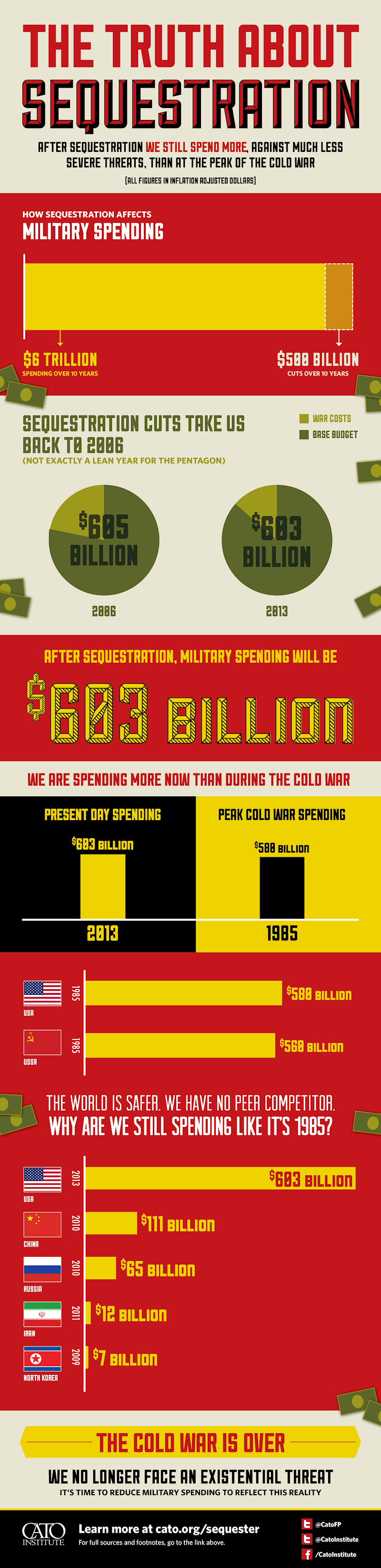
Click to see full-size infographic at Cato At Liberty.
Military spending will remain at roughly 2006 levels — $603 billion, higher than peak U.S. spending during the Cold War. Meanwhile, we live in a safer world. The Soviet Union has been dead for more than two decades; no other nation, or combination of nations, has emerged since that can pose a comparable threat. We should have a defense budget that reflects this reality.
To be clear, sequestration was no one’s first choice. But the alternative — ever-increasing military spending detached from a legitimate debate over strategy — is worse. We should have had such a debate, one over the roles and missions of the U.S. military, long before this day of reckoning. And politicians could have pursued serious proposals to prudently reduce military spending. Instead, they chose the easy way out, avoiding difficult decisions that would have allowed for smarter cuts.
Update: Nick Gillespie explains why you shouldn’t worry too much about the sequester:
Update, the second: Putting the actual numbers in perspective:
I don’t have an informed opinion on the sequester, but this is a memorable graph: twitter.com/charlesmurray/…
— Charles Murray (@charlesmurray) February 27, 2013
February 26, 2013
Budget cutting gets real in Ottawa
David Akin tweeted some news about upcoming budget cuts for various Canadian government agencies:
Ottawa cutting budget for Aboriginal Affairs in FY14 by $480 million or -5.7% compared to FY13 “Estimates to Date”. #bdgt13
— David Akin (@davidakin) February 26, 2013
RCMP Public Complaints Commission loses 32% of its funding or $2.6 million in FY14 vs FY13 “Estimates To Date” #cdnpoli #bdgt13
— David Akin (@davidakin) February 26, 2013
Canadian International Development Agency cuts = $471 million in FY14 or 13% of its budget. #cdnpoli #bdgt13
— David Akin (@davidakin) February 26, 2013
Think #CPC hates culture? @jamesmoore_org ‘s Heritage dept one of just 5 major govt depts or agencies to get funding boost of 5% or more.
— David Akin (@davidakin) February 26, 2013
Biggest cuts pct: VIA Rail (-61%) AECL (-44) Public Safety & Emergency Preparedness (-29.2) Transport (-27.7) Infrastructure Canada (-26.1)
— David Akin (@davidakin) February 26, 2013
Major depts biggest % boosts: Cdn Space Agency (+35), Natural Resources (+11.2) HRSDC (+6) Citizenship (+5.8) and Heritage (+5.3)#bdgt13
— David Akin (@davidakin) February 26, 2013
#CPC cuts law-and-order: Correctional Services Canada loses $428 m or -14.2%,CBSA loses $357M (-17.5%), RCMP trimmed $58M (-2.1%) #bdgt13
— David Akin (@davidakin) February 26, 2013
February 23, 2013
Provincial budgets range from less-than-accurate to verging on financial fraud
Andrew Coyne, after a short diatribe about our first-past-the-post electoral system (he’s agin’ it), gets down to brass tacks about provincial finances:
As bad as the federal government is, the provinces are worse. And as horrendous as the provinces are generally, the record in some provinces borders on the fraudulent. Saskatchewan and Alberta, for instance, have overspent their budgets in the past decade by an average — an average — of nearly 5%. And since each year’s overshoot becomes the baseline for next year’s budget, the cumulative impact is to produce spending, in the fiscal year just ended, vastly larger than was ever specifically authorized in advance: in Saskatchewan’s case, nearly 40% larger.
That’s as best the [C. D. Howe Institute] can make out. Provincial accounting is notoriously haphazard and inconsistent. Not only does each province use its own rules and procedures, making it impossible to compare the public accounts from one province to another with any confidence, but in several provinces — Newfoundland and Quebec are the worst offenders — the public accounts are not even stated on the same basis as the budget.
And while the public accounts must ultimately prevail, efforts to reconcile the two sets of figures, and to explain the discrepancies, remain spotty. In some provinces — Quebec, Saskatchewan, British Columbia — auditors have refused, repeatedly, to sign off on the books without attaching reservations.
So not only can voters have little confidence that governments will spend what they said they would, they can have little ability even to reckon how much they overspent, or to compare their own province’s performance with the others’. All in all, a thoroughly disgraceful performance. (Honourable exceptions: Ontario and Nova Scotia, though voters in both provinces have other reasons to doubt their governments’ fiscal candour.)
February 21, 2013
February 8, 2013
Telegraph runs “Shock, horror!” story about UK government’s wine budget
I’m a minarchist: I’m in favour of much smaller, less intrusive government. Even saying that, I can’t find it in my heart to get upset about this “shocking” revelation:
Ministers fail to balance books at £3million wine cellar
Ministers and guests have got through 5,000 bottles of alcohol worth more than £55,000 in the last year, report into the Government’s wine cellar has revealed.[. . .]
The latest annual report into the Government’s wine cellar has revealed that ministers, officials and their guests got through nearly 5,000 bottles of alcohol worth more than £55,000 in the last year.
In total, the cellar holds 38,000 bottles costing £857,000 when bought, but are now valued on the open market at £2,953,000.
Some of the taxpayer-funded bottles are sold in shops for more than £1,000 each.
Guests at Government events drank 23 bottles of the 1982 Chateau Margaux Bordeaux, which sells for up to £1,100 a bottle.
Five thousand bottles? That’s all? David Cameron’s cabinet consists of 22 senior ministers. I assume there are junior ministers or parliamentary assistants for most of those ministers, so let’s call it 50 men and women who are entertaining on government business and would be drawing from the official wine cellar. Even if each of them only entertains one other person at each event, that’s roughly two bottles of wine per minister per week.
The Queen drinks more than that by herself!
And the eye-popping number of £857,000? That works out to less than £23 per bottle. And we’re told that some of the bottles could sell on the open market for £1,100 a bottle. But based on the figures, there can’t be very many of those ultra-expensive bottles, can there?
I fail to see a scandal here…
February 7, 2013
Almost a clean sweep of top Canadian military leadership
As Andrew Coyne noted in a tweet, “In some countries, this would be big news”. Lee Berthiaume in the Ottawa Citizen on the upheaval at the top of Canada’s defence establishment:
Spring cleaning has come early at the Department of National Defence as the Conservative government announced Wednesday it was sweeping out a number of the military’s top officers — including the head of the Canadian Army and the Royal Canadian Navy — in a major shuffle.
The moves represent a dramatic change at the top as National Defence faces a major shift in focus from the days of the Afghanistan war and increasing budgets, to a state of deep budget cuts and limited deployments.
[. . .]
In addition to [vice-chief of defence staff, Vice-Admiral Bruce] Donaldson, those leaving include Royal Canadian Navy commander Vice-Admiral Paul Maddison and Canadian Army commander Lt.-Gen. Peter Devlin.
Maddison’s deputy, Rear-Admiral Mark Norman, will take over as commander of the navy; Lt.-Gen. Marquis Hainse, who was serving as deputy commander to the NATO headquarters in Naples, Italy, is the new head of the army.
Lt.-Gen. Walter Semianiw, who oversaw all Canadian military missions inside Canada and North America, including the Caribbean, is also on the way out, the apparent casualty of a Defence Department restructuring that started last year.
February 5, 2013
Ontario facing fiscal crisis that is worse than California’s
In the Financial Post, Jason Clemens and Niels Veldhuis look at the under-reported fiscal problems Ontario has to deal with … and soon:
‘I do not want Ontario to become like California,” Ontario Finance Minister Dwight Duncan once proclaimed. And it’s not hard to understand why — California is a fiscal nightmare. It has the lowest bond rating in the United States and its own treasurer, Bill Lockyer, referred to the state budget as “a fiscal train wreck.”
Yet, despite all that is said about California’s finances in the media and financial markets, Ontario is in much worse shape.
Back in 2002-03, the fiscal year before the governing Liberals took office, Ontario’s net debt (assets minus liabilities) stood at $132.6-billion. In the ensuing decade, the province’s debt ballooned by almost 78% to $235.6-billion (2011-12). Most worrying, however, is that if Ontario continues on its current path (status quo in terms of spending and revenues), its debt will balloon to over $550-billion (66% of GDP) by the end of the decade (2019-20).
[. . .]
On a per-person basis, Ontario’s bonded debt (the concept of net debt is not used in U.S. public accounting) currently stands at nearly $18,000, over four-and-a-half times that of California at $3,800. As a share of the economy, Ontario’s debt (38.6%) is more than five times that of the Golden State (7.7% of GDP). This is a stunning difference in the burden of debt, particularly given the attention and concern focused on California compared with Ontario.
While the two jurisdictions face similar average interest rates for their debt, the large difference in the stock of the debt means equally large differences in interest costs. Specifically, Ontario spends almost double what California does on interest costs in dollar terms and a little over three times what California spends as a share of the revenues collected, 8.9% compared to 2.8% of revenues. This is money that could have been spent on health care, education, public safety.
February 2, 2013
“The welfare state we have is excellent in most ways. We only have this little problem. We can’t afford it.”
Based on this report in The Economist, we really should strive to be more like Sweden, and not for the reasons most Canadians would expect:
Sweden has reduced public spending as a proportion of GDP from 67% in 1993 to 49% today. It could soon have a smaller state than Britain. It has also cut the top marginal tax rate by 27 percentage points since 1983, to 57%, and scrapped a mare’s nest of taxes on property, gifts, wealth and inheritance. This year it is cutting the corporate-tax rate from 26.3% to 22%.
Sweden has also donned the golden straitjacket of fiscal orthodoxy with its pledge to produce a fiscal surplus over the economic cycle. Its public debt fell from 70% of GDP in 1993 to 37% in 2010, and its budget moved from an 11% deficit to a surplus of 0.3% over the same period. This allowed a country with a small, open economy to recover quickly from the financial storm of 2007-08. Sweden has also put its pension system on a sound foundation, replacing a defined-benefit system with a defined-contribution one and making automatic adjustments for longer life expectancy.
Most daringly, it has introduced a universal system of school vouchers and invited private schools to compete with public ones. Private companies also vie with each other to provide state-funded health services and care for the elderly. Anders Aslund, a Swedish economist who lives in America, hopes that Sweden is pioneering “a new conservative model”; Brian Palmer, an American anthropologist who lives in Sweden, worries that it is turning into “the United States of Swedeamerica”.
[. . .]
This is not to say that the Nordics are shredding their old model. They continue to pride themselves on the generosity of their welfare states. About 30% of their labour force works in the public sector, twice the average in the Organisation for Economic Development and Co-operation, a rich-country think-tank. They continue to believe in combining open economies with public investment in human capital. But the new Nordic model begins with the individual rather than the state. It begins with fiscal responsibility rather than pump-priming: all four Nordic countries have AAA ratings and debt loads significantly below the euro-zone average. It begins with choice and competition rather than paternalism and planning. The economic-freedom index of the Fraser Institute, a Canadian think-tank, shows Sweden and Finland catching up with the United States (see chart). The leftward lurch has been reversed: rather than extending the state into the market, the Nordics are extending the market into the state.
Why are the Nordic countries doing this? The obvious answer is that they have reached the limits of big government. “The welfare state we have is excellent in most ways,” says Gunnar Viby Mogensen, a Danish historian. “We only have this little problem. We can’t afford it.” The economic storms that shook all the Nordic countries in the early 1990s provided a foretaste of what would happen if they failed to get their affairs in order.
January 31, 2013
January 30, 2013
Sequestration cuts must be more likely to happen because the sob stories are getting traction
Tad Dehaven thinks the upsurge in horror stories about what sequestration will do to the US economy means it’s more likely that those cuts will actually take place:
The odds that $85 billion in “unthinkable, draconian” sequestration spending cuts will go into effect in March as scheduled are looking better. The odds must be getting better because, as if on cue, the horror stories have commenced.
A perfect example is an article in the Washington Post that details the angst and suffering being experienced by federal bureaucrats and other taxpayer dependents over the mere possibility that the “drastic” cuts will occur. You see, the uncertainty surrounding the issue has forced government employees to draw up contingency plans. Contingency plans? Oh, the humanity!
[. . .]
I certainly believe that Washington’s bouncing from one manufactured fiscal crisis to the next is detrimental to the economy, but my sympathy lies with the private sector – not the federal bureaucracy. It’s the private sector that has been suffering under the constant uncertainty surrounding federal tax and regulatory policy. And let’s not forget that there is no public sector without the private sector – the former existing entirely at the latter’s expense.
Yet, what follows in the Post article is boo-hoo after boo-hoo without the slightest regard to those who are paying for it or whether the whiner’s agency could use some belt-tightening


