Quotulatiousness

January 10, 2021

QotD: Sexual equality and the risk of demographic collapse

Filed under: Health, Quotations, USA — Tags: , , , , — Nicholas @ 01:00

I like living in a society where women are, generally speaking, as free to choose their own path in life as I am. I like strong women, women who are confident and look me in the eye and see themselves as my equals. But I wonder, sometimes, if sexual equality isn’t doomed by biology. The relevant facts are (a) men and women have different optimal reproductive strategies because of the asymmetry in energy investment – being pregnant and giving birth is a lot more costly and risky than ejaculating, and (b) a woman’s fertile period is a relatively short portion of her lifetime. Following the logic out, it may be that the consequence of sexual equality is demographic collapse — nasty cultures which treat women like brood mares are the future simply because the nice cultures that don’t do that stop breeding at replacement rates.

Eric S. Raymond, “Fearing what might be true”, Armed and Dangerous, 2009-10-23.

November 8, 2020

“… participants in men’s sport, on average, out-perform participants in women’s sports, current science is unable to isolate why this is the case”

Filed under: Health, Politics, Sports — Tags: , , , , , — Nicholas @ 03:00

Barbara Kay is not in favour of clearly misogynistic sports policies:

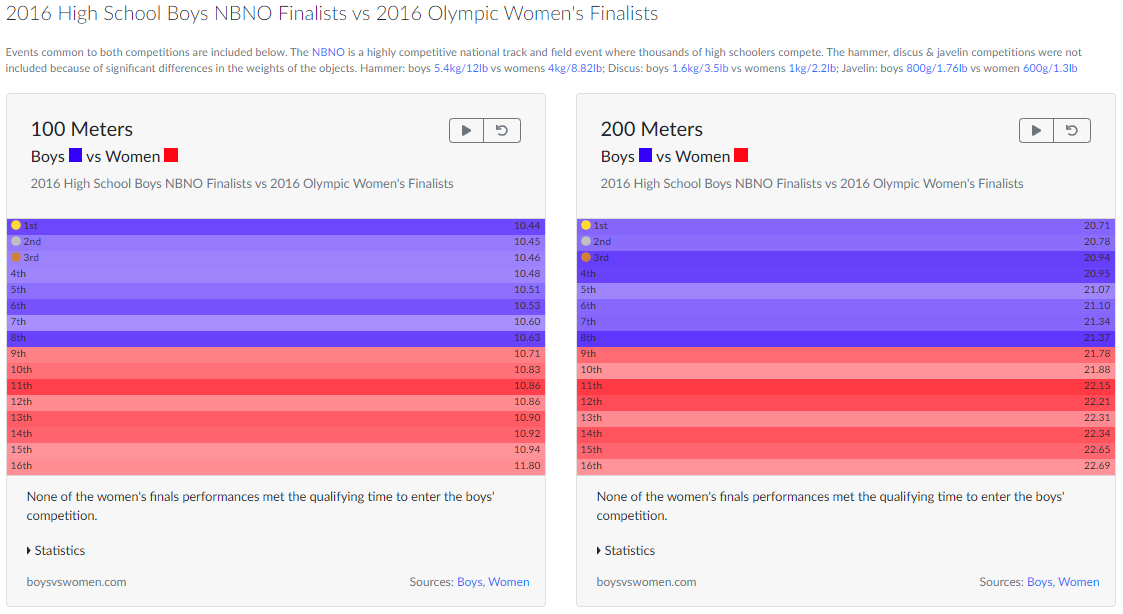
2016 high school boys compared to 2016 Olympic Women’s Finalists.
Source: http://boysvswomen.com/#/

No hormone treatment is required, says the EWG, because being male or female is not dependent on biology but on one’s feelings: “(It) is recognized that transfemales are not males who become females. Rather these are people who have always been psychologically female.” Furthermore, these individuals must be allowed to participate in “the gender with which they feel most comfortable and safe, which may not be the same in each sport or consistent in subsequent seasons.” Your eyes do not deceive you. First they justified trans women competing with women because they had “always” felt they were female. Then they say the “always” female trans athlete might “be” male for certain sports or at different times.

It gets worse.

They say that although “participants in men’s sport, on average, out-perform participants in women’s sports, current science is unable to isolate why this is the case.” This is nonsense on two counts. First, there is no “on average” about it. Virtually all high-performance male athletes out-perform all high-performance female athletes. And second, even in 2014, abundant scientific data “to isolate why this is the case” was readily, even effortlessly (#Google!) available.

Data or no data, a statement in the document itself makes clear that the ideological fix was in from the get-go: “The Expert Working Group held strongly to the principle that the inclusion of all athletes, based on the fundamental human right of gender self-determination overrides any consideration of potential competitive advantage.”

Needless to say, but it must be said anyway: Male athletes have nothing whatsoever to fear in competing with trans male athletes. This is a problem for female athletes only, which seems not to trouble the CCES at all. I’m not a feminist, but I know a misogynistic sport policy when I see it. Quis custodiet ipsos custodes?

September 3, 2020

QotD: Racism

Filed under: History, Politics, Quotations, USA — Tags: , , , — Nicholas @ 01:00

Racism is stupid. Humans come in different shades for obvious biological reasons to do with the intensity of sunlight where their ancestors grew up. Apart from calculating intake of Vitamin D when living in cold climates, it shouldn’t matter. Yet people keep on making it matter — for all kinds of reasons; few if any of them good.

America’s race relations problems arise from its shameful history with slavery. Black Americans clearly feel a sense of solidarity based on that history. I can understand the magnificent language of the Declaration of Independence or the majestic ideas behind the US Constitution are tainted for black American students knowing, as they learn about them, that they didn’t apply to their ancestors. It must be hard for them to take the same pride in the foundation of their great nation as white classmates. I get that “Plymouth Rock landed on us” idea.

Many White Americans do feel a corresponding sense of shame but it’s daft to feel guilty for stuff people who share some random attribute with you did. Short people are not to blame for Napoleon and nor (fun though it is to tease them about him) are French people. No doubt we all do feel pride and shame about our ancestors’ achievements and sins, but it’s nuts to base law or policy on those irrational feelings or to allow them to taint relationships today.

Even if we were to go down the mad road of punishing people for the sins of the fathers, we’d have to find out what those “fathers” actually did, person by person. To do it skin tone by skin tone would itself be racist. It would involve, for example, some British people being heroes because their ancestors sailed with the Royal Navy squadron detailed to suppress the Slave Trade while others are villains because theirs crewed slave ships. There would be no way of knowing if you were hero or villain until you played that historical lottery.

As I told a Jewish American friend who teased me one Fourth of July about losing the American Revolutionary War, “That was a dispute between two sets of my ancestors — yours were in Germany at the time. Stay out of our family quarrels.” That’s a good joke but it would be dumb to base a social science on it. Yet America’s “grievance studies” types have done something remarkably similar in creating the wicked notion of “white privilege”.

Tom Paine, “Checking my privilege”, The Last Ditch, 2020-06-02.

June 28, 2020

“Viking” was the word for “Incel” in the early Middle Ages

Filed under: Books, China, Europe, Health, History, India, Military — Tags: , , , , , , — Nicholas @ 05:00

At least, that’s one interpretation offered by Mary Harrington at UnHerd:

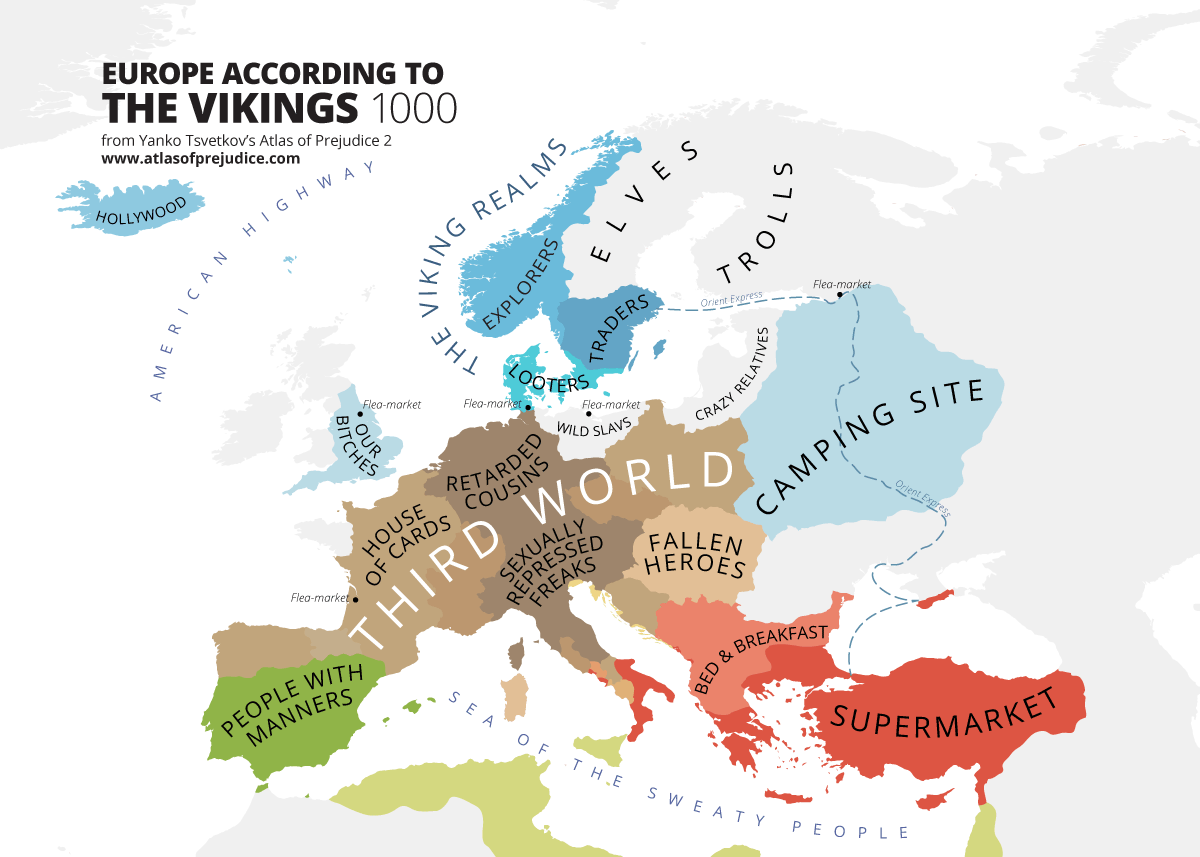
Europe According to the Vikings (1000) from Atlas of Prejudice 2 by Yanko Tsvetkov.

Last week, World War 3 nearly started in Ladakh. A dry, high-altitude region of Indian Kashmir on the Himalayan border with China, it’s been the site of escalating tensions and military buildup for some time. On June 15, the first physical confrontation between the Indian and Chinese militaries for 45 years erupted, killing at least 20 Indian and 45 Chinese soldiers.

There are all sorts of geopolitical reasons cited for the escalating tension between the world’s two most populous countries, but there is one more central and timeless problem that is going to drive both countries towards violence and instability — women. Or a lack of them.

In his History of the Normans, written circa 1015, Dudo of St Quentin argued that the reason the Vikings went raiding was because they couldn’t find wives, an idea echoed by the Tudor antiquarian William Camden in his 1610 book Britannia. “Wikings”, Camden suggested, were what you got when there weren’t enough women to go round, resulting in an excess of young men hanging around full of machismo but without any prospect of finding a nice girl and settling down. (Viking literally means raider.)

So, whenever these spare males “multiply’d themselves to a burdensom community”, Camden reports that an area would draw lots. Those of the young troublemakers chosen in the lottery would be sent off on a ship to make a nuisance of themselves overseas. Which they did.

In evolutionary biology, the “operational sex ratio” is a term used to count the proportion of males and females in a given species that are seeking a reproductive mate. As soon as the ratio tilts away from 50:50, the sex that’s over-represented will have to compete to secure a mate from among the less-plentiful potential partners of the opposite sex.

Though they wouldn’t have used that phrase, both Dudo of St Quentin and William Camden were both describing this phenomenon in human males. Where potential wives are scarce and the “burdensom community” of spare men multiplies, the result is more violence and crime. One 2019 study showed that where polygyny — that is, multiple wives — is a social norm for higher-status men, attacks on neighbouring ethnic groups skyrocket. With a few men monopolising eligible women, the rest are forced to seek status and resources by attacking other tribes.

India and China both have an extremely “burdensom community” of spare males. The normal ratio of newborn boys to girls is around 105:100. But as Mara Hvistendahl documents in Unnatural Selection, thanks to prenatal ultrasound and sex-selective abortion the ratio in China is around 118:100, and 108:100 in India. In some regions of India, the ratio rises as high as 150 males to 100 females. Though sex-selective technology is now banned in India, it’s still widespread, and the country now has some 37 million more men than women. Studies estimate that China has around 30 million excess men.

May 1, 2020

The Scottish Sentencing Council recommends that no under-25s be sent to prison

Filed under: Britain, Law — Tags: , , , , , — Nicholas @ 05:00

Theodore Dalrymple isn’t impressed with this proposal:

A judges’s wig and advocate’s wig on temporary display in Parliament Hall, Edinburgh, 26 October 2013.
Photo by Kim Traynor via Wikimedia Commons.

Just as one begins to imagine that the liberal pseudo-conscience can go no further in foolishness, it comes up with new schemes to make the world a little worse. Its inventiveness, in fact, is infinite, and no victory over it by common sense is ever more than temporary. The price of sanity, at least in the modern world, is eternal vigilance.

This is not to say, of course, that no liberal reform in the past was ever justified or did no good, or that none will ever do any good in the future. It is simply that, as a matter of contingent sociological fact, many liberals seem to have lost their minds.

The Scottish Sentencing Council, an advisory body with no legislative powers but whose recommendations judges disregard at their peril, put forward a proposal earlier this year that those under the age of 25 should not be sent to prison because research shows that their brains have not yet fully matured. It is difficult to know where to begin in arguing with this fatuity.

Let us then start with the notion that no man under 25 is sufficiently mature to know that it is wrong to strangle old ladies in their beds and the further proposition that, until that age, they are unable to control their impulse to do so.

[…]

The idea that a man’s brain is so immature before age 25 that he does not know that all manner of crimes are wrong would suggest a revision of our electoral laws, for if a man can neither distinguish right from wrong nor control his impulses, should he have the vote? Should he, in fact, be considered of legal age? Should he be allowed even to choose his own career? I doubt that the Sentencing Council would preen itself on the corollaries of its proposal.

There is, of course, an element of truth in what the Sentencing Council says. Our characters are not fully formed by the age of 25 — mine certainly wasn’t. It is true also that there is a biological component to crime, inasmuch as the vast majority of criminals in all societies in which crime is a category of behaviour are young and male. The rate at which even recidivist criminals commit crimes declines with age and most often reaches zero. Time is the great therapist.

But punishment is not therapy. It is a very good thing, of course, if punishment (such as imprisonment) reforms the criminal, and I think that it is a moral obligation of the state, if it is to lock up people, to try to give them something purposeful and worthwhile to do. But that is not the primary purpose of punishment. If it could be shown that rewarding criminals with large fortunes would change their behaviour — as almost certainly it would in most cases — we should not advocate such a course, even if it were a better way of reforming them in the sense of reducing their recidivism rate.

April 20, 2020

Prehistory Summarized: Early Life

Filed under: Humour, Science — Tags: , , , — Nicholas @ 02:00

Overly Sarcastic Productions
Published 1 Dec 2015

Blue’s back with more sweet, sweet prehistory! Today, Bruce explores the wonders of life.

April 11, 2020

Pandemics Economically Worse than War – The First Pandemic – Pandemic History 01

Filed under: Europe, Health, History, Science — Tags: , , , , — Nicholas @ 04:00

TimeGhost History
Published 10 Apr 2020

There is much we can learn from past pandemics, like how Emperor Justinian ruined the Eastern Roman Empire’s economy and made the first plague pandemic even worse.

Join us on Patreon: https://www.patreon.com/TimeGhostHistory

Hosted by: Indy Neidell and Spartacus Olsson
Written by: Spartacus Olsson
Directed by: Astrid Deinhard
Executive Producers: Bodo Rittenauer, Astrid Deinhard, Indy Neidell, Spartacus Olsson
Creative Producer: Joram Appel
Post-Production Director: Wieke Kapteijns

Research by: Spartacus Olsson
Edited by: Spartacus Olsson

Archive by Reuters/Screenocean http://screenocean.com
A TimeGhost chronological documentary produced by OnLion Entertainment GmbH.

From the comments:

TimeGhost History
3 minutes ago
As announced, here is the first instalment of our impromptu series on the history of pandemics. Now, as you will see in the video this is not just a reaction to the current COVID-19 pandemic, but very much back to the roots for us. Indy studied the pandemics extensively back in university times, and to study history in general requires a somewhat morbid fascination with human disaster in general. So we have spent many, many years looking intently at the worst disasters that have befallen humanity — and there is nothing worse than disease, especially on a pandemic scale. Hopefully this is the time when we can share a bit of that amassed knowledge to add a little timely understanding of the greater effects of pandemics, beyond the immediate tragic medical ones, like how they have impacted society, the economy, and human life in general throughout history. While we cannot give you fixed schedule for this series (we have the regular programming to take care of) we will try to come out with the next one very soon.

A note on a statement I make in the video: when I say COVID-19 might be the first time we successfully fight back a pandemic, I am saying that fully aware of the eradication of small pox and the near eradication of polio, the flu vaccine successes and so on — but that is avoidance of recurring pandemics of a specific kind and we have made more progress there than actually handling pandemics of a new disease when they break out for the first time. On that note, take care, stay safe, and may you be healthy despite these trying times.

Spartacus

April 7, 2020

QotD: The universal plight of women in pre-modern times

Filed under: Health, History, Quotations — Tags: , , , — Nicholas @ 01:00

Because giving birth was such a high-risk enterprise, and because so many of the products of that enterprise died before payback of the [pun intended, I think] labor involved in bringing them to the world, it was THE most important work of society. Those members able to do it had to be kept in such a situation that it allowed them to maximize that one thing they could do.

As for “the property of their husbands, etc, etc, blah blah blah” work was so brutal and hard, and providing for a family so difficult, that yes, a man wanted to make sure the children he supported were his own.

Also, because of very early (many women married before even 18) death in childbirth, etc, most women skewed younger than men as a population, which would encourage a certain degree of paternalism. On top of that, hate to tell you, but women while hormonal are often not fully rational. We can sort of compensate for it, but one of the pregnancy hormones is SUPPOSED to make you fat, dumb and happy.

I don’t know if most women need a minder while pregnant, but from both personal experience and watching friends go through it, I imagine many women do.

It is therefore only natural that in a society where most women are pregnant most of the time, men would view it was their duty to look after the puir confused things.

When feminists assume that back in a time with no contraceptive, high child mortality and an horrendous death toll of pregnancy, women should have been recognized as the equals of men, and that men were being evil villains for not doing that, they are demonstrating an astonishingly blind and ideological view of history.

In fact, even back in the middle ages and before SOME women were considered the intellectual equals of men. (And sometimes the military equals.) There are very few of them, again, not because The Man was keeping them down, but because the women attracted to intellectual or military pursuits are (like men) a minority and on top of that they tended to be either unmarried, childless, or the percentage of women not much affected by pregnancy. I.e. a minority of minorities.

Women started making advances in what was considered, traditionally, male realms, like science or scholarship, (the others … well … there is a problem with upper body strength. Sure. Some women. Again a minority of a minority) or being able to vote when two twin advances occurred: the first was the curbing of infant mortality. When it became obvious (after a generation or so) that most of your babies would survive, it was possible for women to spend only a tiny minority of their lives pregnant.

The second was contraception that was cheap, easily available, and safe. Yeah, okay, I have certain issues with the pill, because the medical issues of using it long term are only now showing up in the population at large. That’s fine.

It remains that even the early “horse-dose” pill was safer than anything else anyone else had ever come up with for women to avoid getting pregnant all the time.

Sarah Hoyt, “Wrong Battle, Insane Tactics”, According to Hoyt, 2018-01-15.

December 9, 2019

Why do Mosquitoes Prefer some people to others? | James May’s Q&A | Head Squeeze

Filed under: Environment, Health — Tags: , — Nicholas @ 02:00

BBC Earth Lab
Published 26 Apr 2013

James May imparts some very interesting facts on mosquitoes. So why do they prefer some people to others?
Subscribe: http://bit.ly/SubscribeToEarthLab

Welcome to BBC Earth Lab! Here we answer all your curious questions about science in the world around you (and further afield too).

October 1, 2019

Charles Darwin – The Voyage of the Beagle – Extra History

Filed under: Americas, Britain, History, Pacific, Science — Tags: , — Nicholas @ 04:00

Extra Credits
Published 29 Sep 2019

The 1830s were an exciting time for science. All throughout Europe, there was a great movement to explore, map, and classify the world. And it was this expanding world that young Charles Darwin graduated into … albeit with the wrong degree. Because although he would one day be known as “the Father of Modern Biology,” Darwin’s father was set on his son following in his footsteps — as a doctor.

August 12, 2019

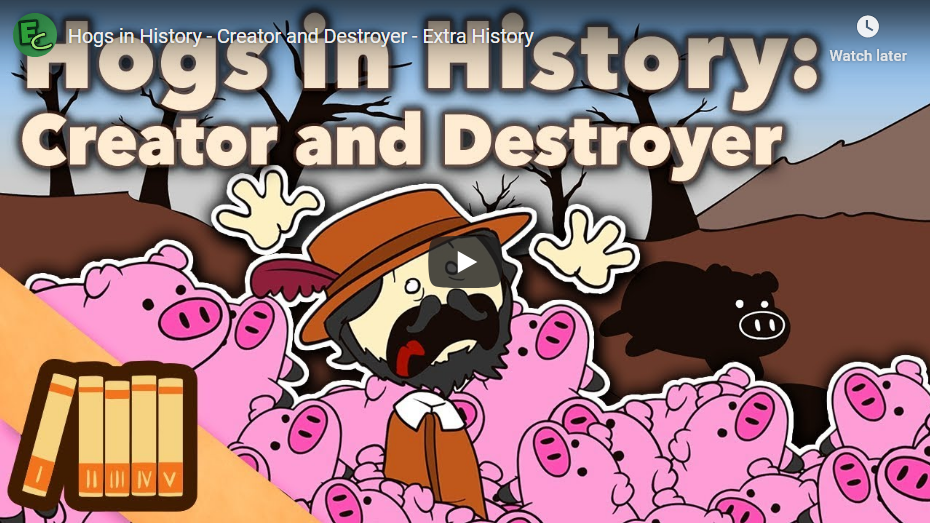
Hogs in History – Creator and Destroyer – Extra History

Filed under: Americas, Environment, Europe, Food, History — Tags: , , , — Nicholas @ 06:00

Extra Credits
Published on 10 Aug 2019

Download the World of Tanks game for free https://tanks.ly/2yj0usN and use the invite code EXTRATANKS1 to claim your $15 starter pack.

In 1494, among the colonization forces from Spain, eight pigs arrived in Cuba. With multiple uses in culinary and craft trades, as well as their general top-tier hardiness, pigs would naturally propagate themselves throughout the Caribbean, and then to Central, South, and North America — but they were also incredibly destructive.

Visit TierZoo to learn about how OP pigs are: https://www.youtube.com/watch?v=6xbQ2…

Join us on Patreon! http://bit.ly/EHPatreon

July 20, 2019

QotD: Spices

Filed under: Food, Health, Quotations, Science — Tags: , , , , — Nicholas @ 01:00

Why do we use spices in our foods? In thinking about this question keep in mind that (1) other animals don’t spice their foods, (2) most spices contribute little or no nutrition to our diets, and (3) the active ingredients in many spices are actually aversive chemicals, which evolved to keep insects, fungi, bacteria, mammals and other unwanted critters away from the plants that produce them.

Several lines of evidence indicate that spicing may represent a class of cultural adaptations to the problem of food-borne pathogens. Many spices are antimicrobials that can kill pathogens in foods. Globally, common spices are onions, pepper, garlic, cilantro, chili peppers (capsicum) and bay leaves. Here’s the idea: the use of many spices represents a cultural adaptation to the problem of pathogens in food, especially in meat. This challenge would have been most important before refrigerators came on the scene. To examine this, two biologists, Jennifer Billing and Paul Sherman, collected 4578 recipes from traditional cookbooks from populations around the world. They found three distinct patterns.

1. Spices are, in fact, antimicrobial. The most common spices in the world are also the most effective against bacteria. Some spices are also fungicides. Combinations of spices have synergistic effects, which may explain why ingredients like “chili power” (a mix of red pepper, onion, paprika, garlic, cumin and oregano) are so important. And, ingredients like lemon and lime, which are not on their own potent anti-microbials, appear to catalyze the bacteria killing effects of other spices.

2. People in hotter climates use more spices, and more of the most effective bacteria killers. In India and Indonesia, for example, most recipes used many anti-microbial spices, including onions, garlic, capsicum and coriander. Meanwhile, in Norway, recipes use some black pepper and occasionally a bit of parsley or lemon, but that’s about it.

3. Recipes appear to use spices in ways that increase their effectiveness. Some spices, like onions and garlic, whose killing power is resistant to heating, are deployed in the cooking process. Other spices like cilantro, whose antimicrobial properties might be damaged by heating, are added fresh in recipes.

Thus, many recipes and preferences appear to be cultural adaptations adapted to local environments that operate in subtle and nuanced ways not understood by those of us who love spicy foods. Billing and Sherman speculate that these evolved culturally, as healthier, more fertile and more successful families were preferentially imitated by less successful ones. This is quite plausible given what we know about our species’ evolved psychology for cultural learning, including specifically cultural learning about foods and plants.

Among spices, chili peppers are an ideal case. Chili peppers were the primary spice of New World cuisines, prior to the arrival of Europeans, and are now routinely consumed by about a quarter of all adults, globally. Chili peppers have evolved chemical defenses, based on capsaicin, that make them aversive to mammals and rodents but desirable to birds. In mammals, capsicum directly activates a pain channel (TrpV1), which creates a burning sensation in response to various specific stimuli, including acid, high temperatures and allyl isothiocyanate (which is found in mustard or wasabi). These chemical weapons aid chili pepper plants in their survival and reproduction, as birds provide a better dispersal system for the plants’ seeds than other options (like mammals). Consequently, chilies are innately aversive to non-human primates, babies and many human adults. Capsaicin is so innately aversive that nursing mothers are advised to avoid chili peppers, lest their infants reject their breast (milk), and some societies even put capsicum on mom’s breasts to initiate weaning. Yet, adults who live in hot climates regularly incorporate chilies into their recipes. And, those who grow up among people who enjoy eating chili peppers not only eat chilies but love eating them. How do we come to like the experience of burning and sweating — the activation of pain channel TrpV1?

Research by psychologist Paul Rozin shows that people come to enjoy the experience of eating chili peppers mostly by re-interpreting the pain signals caused by capsicum as pleasure or excitement. Based on work in the highlands of Mexico, children acquire this gradually without being pressured or compelled. They want to learn to like chili peppers, to be like those they admire. This fits with what we’ve already seen: children readily acquire food preferences from older peers. In Chapter 14, we further examine how cultural learning can alter our bodies’ physiological response to pain, and specifically to electric shocks. The bottom line is that culture can overpower our innate mammalian aversions, when necessary and without us knowing it.

Joseph Henrich, The Secret of Our Success: How Culture Is Driving Human Evolution, Domesticating Our Species, and Making Us Smarter, 2015.


June 21, 2019

QotD: Caloric intake and weight gain

Filed under: Food, Health, Quotations, Science — Tags: , , — Nicholas @ 01:00

The average person needs about 800,000 calories per year. And it takes about 3,500 extra calories to gain a pound of weight. So if somebody stays about the same weight for a year, it means they fulfilled their 800,000 calorie requirement to within a tolerance of 3,500 calories, ie they were able to match their food intake to their caloric needs with 99.5% accuracy.

By this measure, even people who gain five or ten pounds a year are doing remarkably well, falling short of perfection by only a few percent. It’s not quite true that someone who gains five pounds is ((5*3,500)/800,000) = 98% accurate, because each pound you gain increases caloric requirements in a negative feedback loop, but it’s somewhere along those lines.

Take a second to think about that. Can you, armed with your FitBit and nutritional labeling information, accurately calculate how many calories you burn in a given day, and decide what amount of food you need to eat to compensate for it, within 10%? I think even the most obsessive personal trainer would consider that a tall order. But even the worst overeaters are subconsciously managing that all the time. However many double bacon cheeseburgers they appear to be eating in a single sitting, over the long term their body is going to do some kind of magic to get them to within a few percent of the calorie intake they need.

It’s not surprising that people overeat, it’s surprising that people don’t overeat much more. Consider someone who just has bad impulse control and so eats whatever they see – wouldn’t we expect them to deviate from ideal calorie input by more than a few percent, given that this person probably has no idea what their ideal input even is and maybe has never heard of calories?

Scott Alexander, “Book Review: The Hungry Brain”, Slate Star Codex, 2017-04-27.

May 31, 2019

QotD: How we gain weight

Filed under: Books, Food, Health, Quotations, Science — Tags: , , — Nicholas @ 01:00

I first learned about [Stephan] Guyenet’s work from his various debates with Gary Taubes and his supporters, where he usually represents the “establishment” side. He is very careful to emphasize that the establishment doesn’t look anything like Taubes’ caricature of it. The establishment doesn’t believe that obesity is just about weak-willed people voluntarily choosing to eat too much, or that obese people would get thin if they just tried diet and exercise, or that all calories are the same. He writes

    The [calories in, calories out or CICO] model is the idea that our body weight is determined by voluntary decisions about how much we eat and move, and in order to control our body weight, all we need is a little advice about how many calories to eat and burn, and a little willpower. The primary defining feature of this model is that it assumes that food intake and body fatness are not regulated. This model seems to exist mostly to make lean people feel smug, since it attributes their leanness entirely to wise voluntary decisions and a strong character. I think at this point, few people in the research world believe the CICO model.

    [Debate opponent Dr. David] Ludwig and I both agree that it provides a poor fit for the evidence. As an alternative, Ludwig proposes the insulin model, which states that the primary cause of obesity is excessive insulin action on fat cells, which in turn is caused principally by rapidly-digesting carbohydrate. According to this model, too much insulin reduces blood levels of glucose and fatty acids (the two primary circulating metabolic fuels), simultaneously leading to hunger, fatigue, and fat gain. Overeating is caused by a kind of “internal starvation”. There are other versions of the insulin model, but this is the one advocated by Ludwig (and Taubes), so it will be my focus.

    But there’s a third model, not mentioned by Ludwig or Taubes, which is the one that predominates in my field. It acknowledges the fact that body weight is regulated, but the regulation happens in the brain, in response to signals from the body that indicate its energy status. Chief among these signals is the hormone leptin, but many others play a role (insulin, ghrelin, glucagon, CCK, GLP-1, glucose, amino acids, etc.)

The Hungry Brain is part of Guyenet’s attempt to explain this third model, and it basically succeeds. But like many “third way” style proposals, it leaves a lot of ambiguity. With CICO, at least you know where you stand – confident that everything is based on willpower and that you can ignore biology completely. And again, with Taubes, you know where you stand – confident that willpower is useless and that low-carb diets will solve everything. The Hungry Brain is a little more complicated, a little harder to get a read on, and at times pretty wishy-washy.

But listening to people’s confidently-asserted simple and elegant ideas was how we got into this mess, so whatever, let’s keep reading.

Scott Alexander, “Book Review: The Hungry Brain“, Slate Star Codex, 2017-04-27.

May 6, 2019

Tree of Life Explorer

Filed under: History, Science — Tags: , — Nicholas @ 05:00

A tweet from Simon Kuestenmacher (@simongerman600) included this graphic, which is a static version of the full Tree of Life Explorer (which is well worth a visit):

« Newer PostsOlder Posts »

Powered by WordPress