
I first learned about [Stephan] Guyenet’s work from his various debates with Gary Taubes and his supporters, where he usually represents the “establishment” side. He is very careful to emphasize that the establishment doesn’t look anything like Taubes’ caricature of it. The establishment doesn’t believe that obesity is just about weak-willed people voluntarily choosing to eat too much, or that obese people would get thin if they just tried diet and exercise, or that all calories are the same. He writes
The [calories in, calories out or CICO] model is the idea that our body weight is determined by voluntary decisions about how much we eat and move, and in order to control our body weight, all we need is a little advice about how many calories to eat and burn, and a little willpower. The primary defining feature of this model is that it assumes that food intake and body fatness are not regulated. This model seems to exist mostly to make lean people feel smug, since it attributes their leanness entirely to wise voluntary decisions and a strong character. I think at this point, few people in the research world believe the CICO model.
[Debate opponent Dr. David] Ludwig and I both agree that it provides a poor fit for the evidence. As an alternative, Ludwig proposes the insulin model, which states that the primary cause of obesity is excessive insulin action on fat cells, which in turn is caused principally by rapidly-digesting carbohydrate. According to this model, too much insulin reduces blood levels of glucose and fatty acids (the two primary circulating metabolic fuels), simultaneously leading to hunger, fatigue, and fat gain. Overeating is caused by a kind of “internal starvation”. There are other versions of the insulin model, but this is the one advocated by Ludwig (and Taubes), so it will be my focus.
But there’s a third model, not mentioned by Ludwig or Taubes, which is the one that predominates in my field. It acknowledges the fact that body weight is regulated, but the regulation happens in the brain, in response to signals from the body that indicate its energy status. Chief among these signals is the hormone leptin, but many others play a role (insulin, ghrelin, glucagon, CCK, GLP-1, glucose, amino acids, etc.)
The Hungry Brain is part of Guyenet’s attempt to explain this third model, and it basically succeeds. But like many “third way” style proposals, it leaves a lot of ambiguity. With CICO, at least you know where you stand – confident that everything is based on willpower and that you can ignore biology completely. And again, with Taubes, you know where you stand – confident that willpower is useless and that low-carb diets will solve everything. The Hungry Brain is a little more complicated, a little harder to get a read on, and at times pretty wishy-washy.
But listening to people’s confidently-asserted simple and elegant ideas was how we got into this mess, so whatever, let’s keep reading.
Scott Alexander, “Book Review: The Hungry Brain“, Slate Star Codex, 2017-04-27.
May 31, 2019
QotD: How we gain weight
May 6, 2019
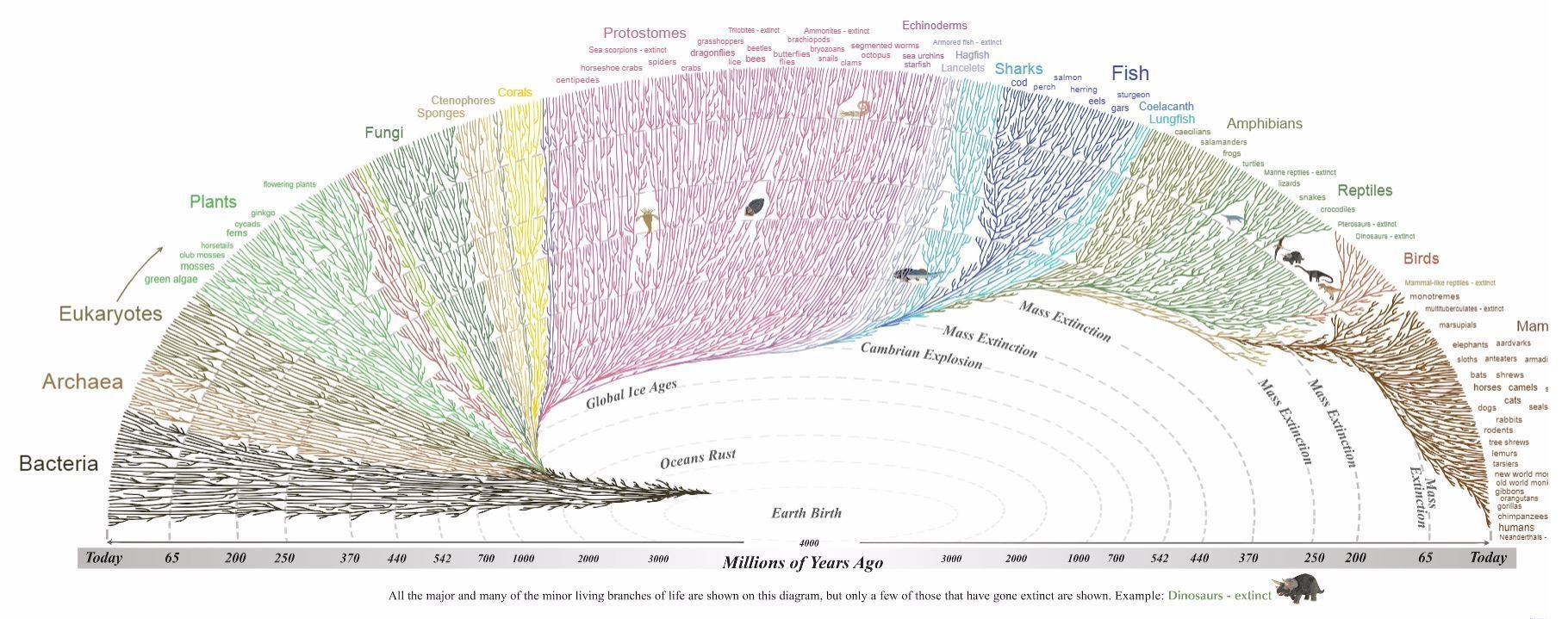
Tree of Life Explorer
A tweet from Simon Kuestenmacher (@simongerman600) included this graphic, which is a static version of the full Tree of Life Explorer (which is well worth a visit):
“Casual sex” isn’t actually all that casual to most women
Suzanne Venker makes the case that the innate physiological and psychological differences between men and women accounting for most women’s much lower comfort level with “no-strings-attached” sexual encounters:
The differences between women and men are vast, and in no domain is this more true than sex. Our bodies alone prove this in spades! If one body carries life and the other doesn’t, this clearly makes the sexes unequal. Newsflash: The birth control pill doesn’t change a woman’s inherent nature — it merely gives the illusion she’s just like a man.
She’s not. A woman’s need to bond with a man, to feel safe and loved and committed to, is crucial for her to feel secure enough to let down her guard sexually. That’s why she feels uneasy about one-night stands. Her body won’t cooperate.
It’s also why men, not women, are the ones who gain the most from casual sex. (To be clear: I’m not arguing that it’s “OK” or even good for men to sleep around; I’m simply pointing out why, from a physical standpoint, they aren’t angst-ridden when they do.)
Women just aren’t designed for one-night stands. What do we think all those films and television programs are about where the man and the woman have sex and he doesn’t call her the next day, so she thinks he’s a jerk? If women were “just like men,” this would never be a theme in the first place.
When it comes to uncommitted sex, women are playing a game they can’t win. Feeling “used,” or like a “booty call,” is the most common experience of women who engage in casual sex, or “hookups,” whether they’re teenagers or grown women. That just isn’t the case for most men.
Every American over the age of 40 knows this to be true, and adults in schools and at home are failing our youth by not passing this wisdom along — particularly when young people are bombarded with the lie that casual sex is empowering.
May 2, 2019
“Wuv, twue wuv”
Debra Soh talks about the neurobiology of “wuv”:

We all remember the first time we fell in love. No matter how strong or independent or free you thought you were, all at once, you became powerless in the face of feelings that, to others, seemed obsessive and irrational.
When you’re in that state, everything reminds you of the one you love. They become the center of your world. Friends say your face lights up when you talk about them. You can’t sleep, you can’t eat. The thought of being without them feels like losing a part of yourself.
There are biological reasons that explain why the experience of being in love feels so overwhelming. These emotions serve an evolutionary purpose. Specifically, they allow two people to bond in a way that increases the likelihood they’ll procreate and maintain an environment in which the resulting offspring survive.
Neurobiologists know that love usually occurs in three phases: lust, attraction and attachment. In the first phase, lust, sex hormones create physiological arousal; in the second phase, attraction, dopamine creates intense feelings associated with the object of one’s desire (often tipping into something that resembles real addiction); and in the third phase, attachment, occurring in established couples, oxytocin and vasopressin (the “cuddle hormones”) facilitate the long-term bonding required to raise children over a time span of years or decades.
Romantic love is an intangible state of mind. But we are coming to understand it more clearly through techniques such as functional magnetic resonance imaging. FMRI, as it’s known, measures brain activity by examining changes in blood flow and oxygenation. These studies typically have involved researchers showing study participants pictures of their lovers, and then contrasting the observed brain activity with the activity observed when the study subjects are shown pictures of friends of the same sex and a similar age.
One of the first fMRI studies in the field found a distinct network of brain regions associated with being, as described by the researchers, “truly, deeply, and madly in love.” These regions included the insula and anterior cingulate cortex, which are associated, respectively, with feelings of desire and happiness. Other regions included those linked to sexual arousal, such as the hypothalamus and amygdala.
March 11, 2019
Misery was
exurb1a
Published on 10 Mar 2019Goodbye to closed-source human history. Maybe.
The Fifth Science Paperback ► https://tinyurl.com/y5zj33s5 (you may need to change your region accordingly: .co.uk, etc)Sample story from the book (The Lantern) ► https://youtu.be/um6cGuJ4mNE
The Fifth Science Treasure Hunt:
Minimal clues will be provided in the videos below. If you happen to live in one of these countries, then all the very best of luck finding the books. They’re not hidden elaborately, just out of sight of passers-by. If you need to do any heavy lifting, trespassing, or scale walls, you’re definitely in the wrong place. Hint: strange fonts and geography.
England ► https://youtu.be/HQDeKPNUF4U
Germany ► https://youtu.be/qfKd134AETo
Bulgaria ► https://youtu.be/XLLaa7G97B8
I also make horrendous music ► https://soundcloud.com/exurbia-1
Help me to do this full-time, if you’re deranged enough ► https://www.patreon.com/exurb1r?ty=h
The rest of my books ► https://tinyurl.com/ycnl5bo3Incidentally:
So, one of the many issues I didn’t get around to yelling at you about was the line between ‘genetic disorder’ and an individual’s unique features. I’ve mentioned before I’m more or less blind in one eye and this is almost definitely a result of a mutation in my family line. And you know, given the option, I’m not sure if I’d have it removed. Or, I’d need to give it a very, very long think.
There are plenty of lovely and bizarre anomalies specific to individuals, and it’s not for me to say – or even speculate really – where the line should be drawn when it comes to one day potentially making alterations to our descendants. I’m not a public educator, philosopher, scientist, or policy maker. Just an idiot with a USB microphone. I’m not the person to talk about this stuff. So I hope you’ll forgive my glossing over of it.
March 6, 2019
The “grandmother hypothesis”
Jonathan Lambert on the theory for why, almost alone among species, human females live on well past their reproductive years:
Killer whales, Japanese aphids and Homo sapiens — they’re among the few organisms whose females live on long past the age of reproduction.
Since the name of the evolutionary game is survival and reproduction, the phenomenon begs explanation — why live longer than you can reproduce? In the 1960s, researchers came up with the “grandmother hypothesis” to explain the human side of things. The hypothesis is that the help of grandmothers enables mothers to have more children. So women who had the genetic makeup for longer living would ultimately have more grandchildren carrying their longevity genes. (Sorry, grandfathers, you’re not included in this picture.)
Two studies published Thursday in Current Biology take another look at this hypothesis and add new insights into the role grandmothers play.
The first hard evidence for the grandmother hypothesis was gathered by Kristen Hawkes, an anthropologist at the University of Utah who was studying the Hadza people, a group of hunter-gatherers in northern Tanzania. Hawkes was struck by “how productive these old ladies were” at foraging for food, and she later documented how their help allowed mothers to have more children.
If our long post-reproductive lives evolved because of grandmothers, we should be able to find fingerprints of the benefits of grandmothering in many cultures. But the circumstances of modern life differ drastically from those we faced at the beginning of our evolutionary story.
The studies in Current Biology turned to the detailed records of two preindustrial populations, one in what is now Quebec and the other in Finland. The researchers mined these rich databases to quantify the reproductive boost that grandmothers provide and to help us better understand the limits of their help.
H/T to Claire Lehmann for the link.
November 20, 2018
QotD: Why do we drink?
Alcoholic beverages, like agriculture, were invented independently many different times, likely on every continent save Antarctica. Over the millennia nearly every plant with some sugar or starch has been pressed into service for fermentation: agave and apples, birch tree sap and bananas, cocoa and cassavas, corn and cacti, molle berries, rice, sweet potatoes, peach palms, pineapples, pumpkins, persimmons, and wild grapes. As if to prove that the desire for alcohol knows no bounds, the nomads of Central Asia make up for the lack of fruit and grain on their steppes by fermenting horse milk. The result, koumiss, is a tangy drink with the alcohol content of a weak beer.
Alcohol may afford psychic pleasures and spiritual insight, but that’s not enough to explain its universality in the ancient world. People drank the stuff for the same reason primates ate fermented fruit: because it was good for them. Yeasts produce ethanol as a form of chemical warfare — it’s toxic to other microbes that compete with them for sugar inside a fruit. That antimicrobial effect benefits the drinker. It explains why beer, wine, and other fermented beverages were, at least until the rise of modern sanitation, often healthier to drink than water.
What’s more, in fermenting sugar, yeasts make more than ethanol. They produce all kinds of nutrients, including such B vitamins as folic acid, niacin, thiamine, and riboflavin. Those nutrients would have been more present in ancient brews than in our modern filtered and pasteurized varieties. In the ancient Near East at least, beer was a sort of enriched liquid bread, providing calories, hydration, and essential vitamins.
[…]
Indirectly, we may have the nutritional benefits of beer to thank for the invention of writing, and some of the world’s earliest cities — for the dawn of history, in other words. Adelheid Otto, an archaeologist at Ludwig-Maximilians University in Munich who co-directs excavations at Tall Bazi, thinks the nutrients that fermenting added to early grain made Mesopotamian civilization viable, providing basic vitamins missing from what was otherwise a depressingly bad diet. “They had bread and barley porridge, plus maybe some meat at feasts. Nutrition was very bad,” she says. “But as soon as you have beer, you have everything you need to develop really well. I’m convinced this is why the first high culture arose in the Near East.”
Andrew Curry, “Our 9,000-Year Love Affair With Booze”, National Geographic, 2017-02.
October 24, 2018
How long can you go without sleep? | James May’s Q&A (Ep 14) | Head Squeeze
BBC Earth Lab
Published on 5 Apr 2013James May talks us through how long you can go for without any sleep.
October 20, 2018
QotD: Women and violence
Activists for feminism are continually characterizing the world of women as one of terror, abuse, and uncertainty. For Leitch to take them at their word, applying a tough-on-criminals spin, is an authentic Trump touch. I do not wholly approve of the tactic, but, as much as I think some feminists are attention-hungry zanies, I recognize the kernel of truth in their image of the universe. I’ve never had a close female friend who could not tell of bizarre, creepy, threatening things happening to them — sights and encounters that, to a male with an ordinary upbringing, seem to have wriggled from the corner of a Hieronymus Bosch painting.
[…]
The actual status of women is that they belong to the physically weaker sex. Biology has given male primates greater upper-body strength, stronger grip, and testosterone. Men commit the overwhelming majority of consequential violence everywhere in the world throughout all history. (Men’s rights advocates sometimes argue that women commit just as many violent acts as men, which misses the point by such a wide margin that it is the intellectual equivalent of throwing like a girl.)
Colby Cosh, “I’m with Leitch — give women pepper spray (but keep it from the men)”, National Post, 2016-12-05.
October 8, 2018
The tyranny of testosterone, or why we shouldn’t lie to our kids
Sarah Hoyt, in the latest Libertarian Enterprise tries to talk to young women about the biological reality and how to avoid being fooled by Hollywood fantasy:
Myself and accomplice, neither of us fainting maidens, first went to the cabinet store, and found that cabinets we could barely move with much effort between the two of us were hefted around effortlessly by teenage employee who probably weighed all of 90 lbs and therefore less than either of us, and had arms like boiled spaghetti, but who had the blessings of testosterone making him much stronger than either of us.
I first ran into this with younger son, who at fourteen looked like a twig which I could have broken over my knee (he’d just grown two feet over the previous year, going from a foot shorter than I to a foot taller. This was also the year in which I was unreasonable and would turn around when he came in the room and say “shower, now” even though he’d already showered twice that day. I.e. to quote our old neighbor “that poor boy is being beaten with a stick made of testosterone. Mothers of boys will get it. At least mothers of boys who went through growth spurt from hell.) We went to the store to get cement to repair a crack in a garden path. The bags were 100 lbs. I tried to lift it and (partly because it was at foot-level and was an awkward floppy bulk) just couldn’t budge it.
Younger son gave the theatrical teenage sigh, reached past me, grabbed the bag and threw it into our shopping cart, leaving me open-mouthed in surprise.
So every time 90 lb girl beats a 300 lb trained fighter on TV remember that. And for the love of heaven explain to your daughters that it’s play fantasy. The daughter of old friends of ours has fallen for this hook line and sinker and was telling older son she could beat him. Older son actually has muscles (he was the one who helped me renovate two Victorians from the ground up and build two balconies. He also does all the sawing by hand.) He’s six one but projects taller. He also happens to be built like a brick ****house, as the men on my side of the family are. (As a little girl I keep insisting my cousins were wardrobes. If you think of the old fashioned wardrobe, seven feet tall and six feet wide, that’s the impression they projected.) That poor girl is five five and skinny for her height. She couldn’t even push older son back if he decided to stand still. She MIGHT be able to fend him off long enough to run away, if she fought like a cornered cat and gouged eyes and bit (I’ve done something like that in similar circumstances, but there’s a reason I’m never without a weapon.) but that’s about it.
Watching her brag to my least excitable, very patient son who just sighed and didn’t even bother contradicting her, I thought how lucky she was in her choice of male to annoy. But if she keeps it up, sooner or later her luck will run out.
We shouldn’t lie to the young, and all our fiction and most of our movies lie about what women can and can’t do, all in the name of “there is no difference between men and women.” (“Except men are defective women” is implied.)
September 5, 2018
Mind Your Business Ep. 1: Breaking the Mold
Foundation for Economic Education
Published on 4 Sep 2018Join host Andrew Heaton as we profile the stories of interesting entrepreneurs from around the country for FEE’s newest series, Mind Your Business.
In this episode, we’ll meet Jeremy Umansky. He’s a chef with a true passion for unusual food and his unique brand of cuisine is making a big splash in the culinary world.
May 9, 2018
What Makes Spicy Foods Spicy | Earth Lab
BBC Earth Lab
Published on 24 Aug 2017Greg Foot explains why some food is spicy!
April 16, 2018
Mass extinction or mass genesis? “The net result is that many more species are arriving than are dying out”
We often hear laments for the addition of another species to the endangered list, but that’s not the whole story as evolutionary biologist Chris Thomas explains:
Animals and plants are seemingly disappearing faster than at any time since the dinosaurs died out, 66m years ago. The death knell tolls for life on Earth. Rhinos will soon be gone unless we defend them, Mexico’s final few Vaquita porpoises are drowning in fishing nets, and in America, Franklin trees survive only in parks and gardens.
Yet the survivors are taking advantage of new opportunities created by humans. Many are spreading into new parts of the world, adapting to new conditions, and even evolving into new species. In some respects, diversity is actually increasing in the human epoch, the Anthropocene. It is these biological gains that I contemplate in a new book, Inheritors of the Earth: How Nature is Thriving in an Age of Extinction, in which I argue that it is no longer credible for us to take a loss-only view of the world’s biodiversity.
The beneficiaries surround us all. Glancing out of my study window, I see poppies and camomile plants sprouting in the margins of the adjacent barley field. These plants are southern European “weeds” taking advantage of a new human-created habitat. When I visit London, I see pigeons nesting on human-built cliffs (their ancestors nested on sea cliffs) and I listen out for the cries of skyscraper-dwelling peregrine falcons which hunt them.
Climate change has brought tree bumblebees from continental Europe to my Yorkshire garden in recent years. They are joined by an influx of world travellers, moved by humans as ornamental garden plants, pets, crops, and livestock, or simply by accident, before they escaped into the wild. Neither the hares nor the rabbits in my field are “native” to Britain.
February 25, 2018
Masculinity and homicidal violence (aka “Not all men…”)
In Quillette, William Buckner looks at the violence inherent in the (biological) system. “Help, help, we’re being repressed!”
Understanding patterns of lethal violence among humans requires understanding some important sex differences between males and females. Globally, men are 95 percent of homicide offenders and 79 percent of victims. Sex differences in lethal violence tend to be remarkably consistent, on every continent, across every type of society, from hunter-gatherers to large-scale nation states. In their 2013 study on lethal violence among hunter-gatherers, Douglas Fry and Patrik Söderberg’s data showed that males committed about 96 percent of homicides and were victims 84 percent of the time. In her study on violence in non-state societies, criminologist Amy Nivette shows that, across a number of small-scale pastoralist and agriculturalist societies, males make up 91-98 percent of killers. To illustrate the consistency of this relationship even further: we see the same pattern among chimpanzees, where males make up 92 percent of killers and 73 percent of victims.
To be sure, there is some cross-cultural variation. While I can find no well-studied population where women are known to commit more lethal violence than men, there are some societies where women make up an equal number, or even the majority, of homicide victims. These societies generally seem to have low rates of homicide overall, as the United Nations Office on Drugs and Crime mentions in their 2013 study on global homicide:
Available data suggest that in countries with very low (and decreasing) homicide rates (less than 1 per 100,000 population), female victims constitute an increasing share of total victims and, in some of those countries, the share of male and female victims appears to be reaching parity.
Hong Kong, with a low homicide rate overall, has a comparatively smaller sex difference in homicide offending, and women make up a majority of homicide victims at 52 percent. Yet even in Hong Kong, males commit 78 percent of reported homicides. The world over, the majority of homicide offenders and victims tend to be reproductive-age males, between their late teens and early 40s.
To understand why this pattern is so consistent across a wide variety of culturally and geographically diverse societies, we need to start by looking at sex differences in reproductive biology.
[…]
Predictably, among humans, males engage in more direct, violent competition for mates than females do, and females provide more caregiving than males do. However, humans are unique in that some male participation in caregiving is ubiquitous across cultures. Human infants are particularly helpless during early development, requiring extensive provisioning and caregiving. Human males face the same tradeoff between securing mating opportunities and providing parental care that males of other species face, and the extent to which males utilize either of these strategies can vary significantly due to social and ecological factors.
Noting these sex differences in reproductive biology and parental investment is important because they help explain why males tend to engage in more violence than females. Aggressively engaging in violent conflict is more likely to reduce a female’s fitness, as it may bring unnecessary danger to her offspring, or cause an injury that may prevent her from reproducing in the future. For a male, however, violent conflict can potentially increase his reproductive success through increases in status, or by aggressively monopolizing access to key resources. Among the Yanomami of the Amazon, and the Nyangatom of East Africa, for example, males who participate in more violence and warfare have increased reproductive success. Even in the contemporary United States, there is evidence that more violent males have more sexual partners.
January 8, 2018
Forests in the olden days
Lindybeige
Published on 20 Apr 2016Forests and woodland in the ancient and medieval worlds didn’t look the way they show in the movies.
Support me on Patreon: https://www.patreon.com/LindybeigeMore archaeology videos here: https://www.youtube.com/playlist?list…
I visited a local wildlife sanctuary based in a wood. In order to attract birds, they left the woods unmanaged, so that the undergrowth and rotting falling trees afforded good habitat for insects and ground-nesting birds. I talk about a few things, including climax vegetation, the burning of woods by hunter-gatherers, the medieval practices of coppicing and pollarding, and the way a modern managed woodland (the sort that you almost always see in the movies) looks neither like a heavily-managed medieval wood nor a wilderness unmanaged wood.
Lindybeige: a channel of archaeology, ancient and medieval warfare, rants, swing dance, travelogues, evolution, and whatever else occurs to me to make.


